Sport Psychology Lab Report: Pressure, Performance, and Routines
VerifiedAdded on 2023/01/19
|8
|2694
|78
Report
AI Summary
This laboratory report, submitted to Desklib, examines the effects of pressure and pre-performance routines on athletic performance, drawing from a sport psychology experiment. The study involved undergraduate participants, categorized as skilled and unskilled basketball players, who attempted free throws under varying conditions. The report analyzes data collected using the Anxiety Rating Scale (ARS) to measure state anxiety, and tests two main hypotheses: that pressure negatively affects performance and that pre-performance routines enhance performance. The results section presents statistical analyses, including paired t-tests, to evaluate these hypotheses. The discussion section compares the findings with existing literature, exploring the complexities of pressure's impact and the efficacy of pre-performance routines. Limitations of the study, such as the sample size, are acknowledged, and suggestions for future research are provided. The report aims to contribute to the understanding of psychological factors in sports performance.

Running head: Performance and Pre-Performance Routines
1
Name
Course
Institution
Date
1
Name
Course
Institution
Date

Paraphrase This Document
Need a fresh take? Get an instant paraphrase of this document with our AI Paraphraser
Performance and Pre-Performance Routines 2
Examining the Effects of Pressure on Performance and Testing the Efficacy of Pre-Performance
Routines
Abstract
The paper attempts to examine the effects of pressure on performances and testing the efficacy of pre-
performance routines. Different journals have attempted to discuss this particular research topic.
Excellent performances are determined by different factors which include pressure and the quality of
health among others. This paper will later review the different journals that discuss the same topics in
depth. After synthesizing the existing academic journals, we will formulate the hypotheses of the
research paper considering the existing academic journals and the research topics. After formulating the
hypothesis, we will carry out analysis. Descriptive statistics and inferential statistics will be conducted
under the result section. Graphs and tables will also be produced and the results of the descriptive
explained. The inferential statistics will be used to test the hypotheses. Finally, the findings of the
results and the literature review will be discussed under the discussion section. The limitation of the
research and the threats of the authenticity of the study will also be discussed in this section. The
implication of future research will also be discussed in this section.
Examining the Effects of Pressure on Performance and Testing the Efficacy of Pre-Performance
Routines
Abstract
The paper attempts to examine the effects of pressure on performances and testing the efficacy of pre-
performance routines. Different journals have attempted to discuss this particular research topic.
Excellent performances are determined by different factors which include pressure and the quality of
health among others. This paper will later review the different journals that discuss the same topics in
depth. After synthesizing the existing academic journals, we will formulate the hypotheses of the
research paper considering the existing academic journals and the research topics. After formulating the
hypothesis, we will carry out analysis. Descriptive statistics and inferential statistics will be conducted
under the result section. Graphs and tables will also be produced and the results of the descriptive
explained. The inferential statistics will be used to test the hypotheses. Finally, the findings of the
results and the literature review will be discussed under the discussion section. The limitation of the
research and the threats of the authenticity of the study will also be discussed in this section. The
implication of future research will also be discussed in this section.
Performance and Pre-Performance Routines 3
Literature review
1. The effect of pressure on the performances
To ensure the quality and effectiveness of a person’s performance, many factors are considered. It is not
all about the physical fitness of an individual, but we need to consider it in a bigger picture. Research
shows that the worry and anxiety may probably reduce the working memory’s capacity. This prediction
is correlated to the distraction theory or the cognitive interference theory. These theories state that
anxiety results in the diversion of attention of the activity being done. Sometimes pressure can
stimulate efforts while doing a task and it always compensates for the reduced performance quality.
Performance effectiveness is always minimal compared to processing efficiency. The influence of
pressure on sports performance has focused on sensorimotor abilities. The skills that are involving are
golf putting which has been used to predict distraction and self-focused explanations. The distraction
and the self-focus were used to try to explain the performance declines. It is crucial to note that the
negative impact of pressure on sports performance is minimal than it would be apprehended (Hil et al.
2010). Much attention has been imputed to the influence of pressure on task performance across a
wide domain e.g., sports performances. From the behavioral evidence, it has been indicated that high-
pressure results decrease task performances more so task that involves reasoning. Attentional Control
Theory has remained one of the related theories that are used to explain the relationship between
anxiety and the level of performances. It is more considered in the extension of the PET, Processing
Efficacy Theory. This theory proposes that being anxious reduces the performances of demanding tasks.
Eysenck and Derakshan (2011) proposed that sometimes worry can lead to a positive performance
resulting in an additional effort and this improves the effectiveness of the task. Even though PET
received advocating support from many behavioral types of research using a variety of cognitive task, it
has many limitations in explaining the effect of anxiety on cognitive performances, and therefore ACT
was developed to improve the theory. It strengthens PET by emphasizing on the performances
effectiveness and the processing efficiency (Eysenck and Derakshan 2011). It predicts that pressure
influences task performances through its detrimental effect on the control of attention. As a result,
anxious individual bespeaks attentional bias regarding dangerous stimuli. Research conducted by Wong
et al. (2013) showed that both high and low anxious individuals showed decreased processing efficacy.
Further, the participants involved showed decreased performances with increased task difficulties. Also,
the participants level of accuracy decreased with increased task difficulties.
1. Effect of Pre-performance routine on performances
Pre-performance refers to the activities that are carried out before the actual performances. These
activities may involve training/ practice etc. While there exists much research that explores the nature
of pre-performance routines in sports, there is also very duties that abridgment the procedure of
developing and enacting these routines. In several sports such as football and cricket, preparation
before the main the match has been highlighted as very crucial to the outcome of the performances. It is
known that the key concentration is filling your mind with what to expect and do the needful to ensure
a successful action. Many publications have cited the effect of pre-performances and behavioral
routines towards the effectiveness of the performances (Cotterill, 2010). Even though many researchers
have researched on this topic, little work has regarded the difficulties that may probably be faced, the
process that could be used for the implementation of the essential routines in sports. The nature of pre-
Literature review
1. The effect of pressure on the performances
To ensure the quality and effectiveness of a person’s performance, many factors are considered. It is not
all about the physical fitness of an individual, but we need to consider it in a bigger picture. Research
shows that the worry and anxiety may probably reduce the working memory’s capacity. This prediction
is correlated to the distraction theory or the cognitive interference theory. These theories state that
anxiety results in the diversion of attention of the activity being done. Sometimes pressure can
stimulate efforts while doing a task and it always compensates for the reduced performance quality.
Performance effectiveness is always minimal compared to processing efficiency. The influence of
pressure on sports performance has focused on sensorimotor abilities. The skills that are involving are
golf putting which has been used to predict distraction and self-focused explanations. The distraction
and the self-focus were used to try to explain the performance declines. It is crucial to note that the
negative impact of pressure on sports performance is minimal than it would be apprehended (Hil et al.
2010). Much attention has been imputed to the influence of pressure on task performance across a
wide domain e.g., sports performances. From the behavioral evidence, it has been indicated that high-
pressure results decrease task performances more so task that involves reasoning. Attentional Control
Theory has remained one of the related theories that are used to explain the relationship between
anxiety and the level of performances. It is more considered in the extension of the PET, Processing
Efficacy Theory. This theory proposes that being anxious reduces the performances of demanding tasks.
Eysenck and Derakshan (2011) proposed that sometimes worry can lead to a positive performance
resulting in an additional effort and this improves the effectiveness of the task. Even though PET
received advocating support from many behavioral types of research using a variety of cognitive task, it
has many limitations in explaining the effect of anxiety on cognitive performances, and therefore ACT
was developed to improve the theory. It strengthens PET by emphasizing on the performances
effectiveness and the processing efficiency (Eysenck and Derakshan 2011). It predicts that pressure
influences task performances through its detrimental effect on the control of attention. As a result,
anxious individual bespeaks attentional bias regarding dangerous stimuli. Research conducted by Wong
et al. (2013) showed that both high and low anxious individuals showed decreased processing efficacy.
Further, the participants involved showed decreased performances with increased task difficulties. Also,
the participants level of accuracy decreased with increased task difficulties.
1. Effect of Pre-performance routine on performances
Pre-performance refers to the activities that are carried out before the actual performances. These
activities may involve training/ practice etc. While there exists much research that explores the nature
of pre-performance routines in sports, there is also very duties that abridgment the procedure of
developing and enacting these routines. In several sports such as football and cricket, preparation
before the main the match has been highlighted as very crucial to the outcome of the performances. It is
known that the key concentration is filling your mind with what to expect and do the needful to ensure
a successful action. Many publications have cited the effect of pre-performances and behavioral
routines towards the effectiveness of the performances (Cotterill, 2010). Even though many researchers
have researched on this topic, little work has regarded the difficulties that may probably be faced, the
process that could be used for the implementation of the essential routines in sports. The nature of pre-
⊘ This is a preview!⊘
Do you want full access?
Subscribe today to unlock all pages.

Trusted by 1+ million students worldwide
Performance and Pre-Performance Routines 4
performances should be categorized into two: a sequence of task-related thoughts and also the action
carried by the athlete before his or her actual performances. Many athletes who have used pre-
performance routines have experienced beneficial performances. Activities which has shown positive
results are encouraging the athlete to use his or her thoughts and helping the athlete not to focus on the
negatives influences. The research conducted by Cotterill (2011) which aimed at finding out the effect of
pre-performances among the cricket players showed that the participants felt that the routines
developed were very crucial for the implementation of the cricketing abilities. The formulas and the
ways developed by the consultants were successfully beneficial for the cricket players to achieve their
ultimate goals by developing routines that disciplined their behavior and the component of the mind.
Howeverseveral difficulties have been faced during the processing of achieving the effectiveness of the
performance using pre-performing activities.
Pre-performance is also evident is music. A study has been conducted to determine whether investing in
practicing instrumentals improved performance quality. The study also wanted to determine whether
rigorous practice, rehearsals are necessary for better performance (Ackerman et al. 2012). From music
education, students are encouraged to outcome of the performance may be less important than their
physical and mental health over a lifetime of performance. The study conducted by (Osborne, Greene, &
Immel, 2014) showed that the students who maximize their performance potential get the best overall
performance. Group practice has been reported to be more impactful than individual practice. The
process of pre-performance has more impact when the individuals are doing it in a group than doing it
alone (Ackermann, Driscoll & Kenny, 2012). This happens because there is always psych when doing
something as a team rather than individually. This has resulted in a positive impact on the actual
performances (Cooke et al. 2013).
The first of the literature review suggests that pressure lowers the performance of the participants. The
journals used have strongly supported this opinion in depth. Similarly, the second part of the literature
review suggests that Pre-performances increases the performances of individuals. Using these two
information we are going to formulate two hypotheses. The hypotheses formulated are also related to
the topic of the study. The first hypothesis will cover the first part i.e. concerning the effects of the
pressure to the performances of the individuals. The second hypothesis will cover the second part of the
literature review, i.e. the effect of the Pre-performances on the pressure.
Hypothesis 1: Pressure will affect performance negatively
Hypothesis 2: Pre-performance routine will facilitate better performance
Results
In this section, we need to test the two hypotheses formulated from the literature review, and
therefore, we will be able to conduct some inferential statistics. Under inferential statistics, we need to
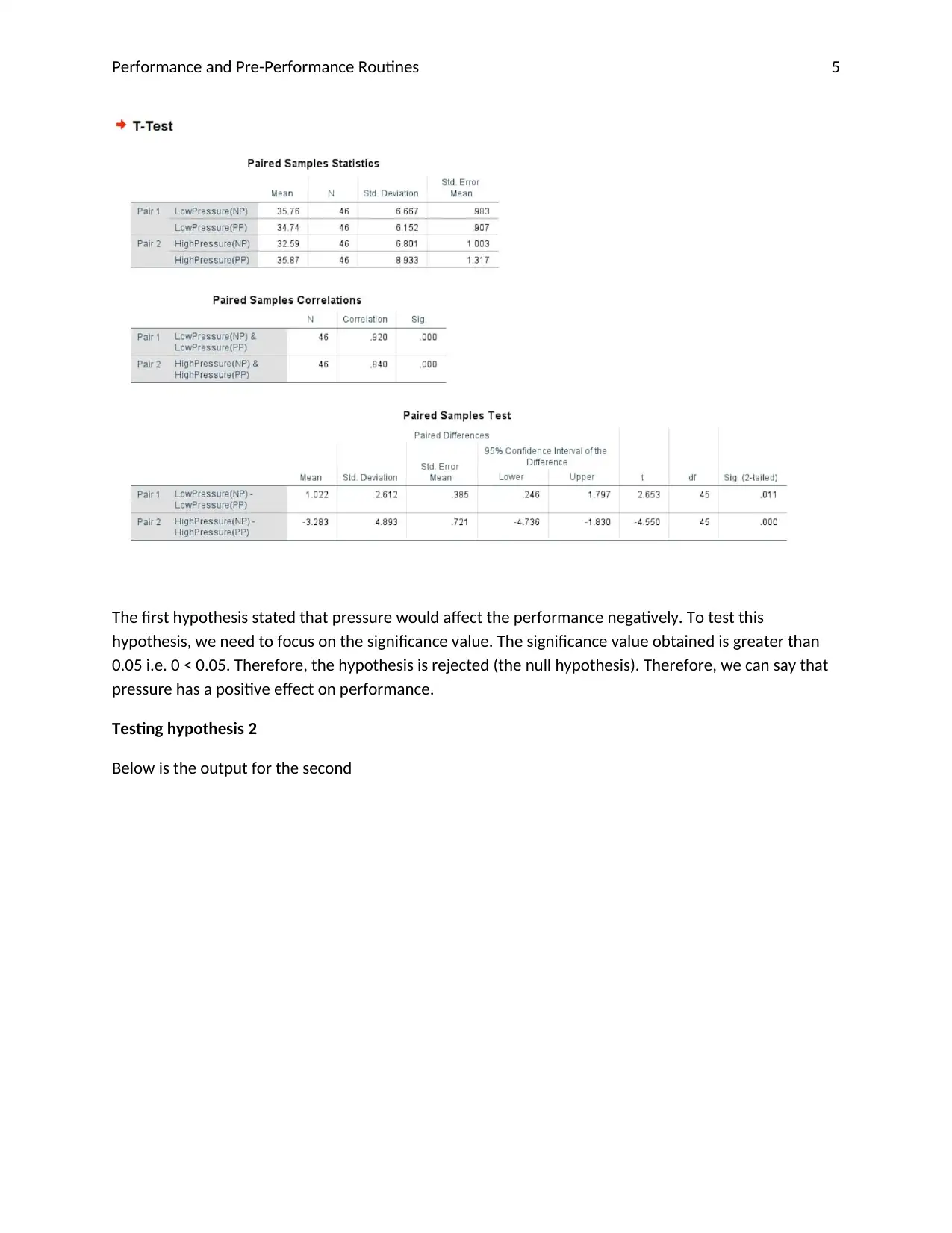
conduct a paired t-test that will be used to test the two hypotheses.
i) I am testing hypothesis 1.
Below is the results obtained from the first paired T-test
performances should be categorized into two: a sequence of task-related thoughts and also the action
carried by the athlete before his or her actual performances. Many athletes who have used pre-
performance routines have experienced beneficial performances. Activities which has shown positive
results are encouraging the athlete to use his or her thoughts and helping the athlete not to focus on the
negatives influences. The research conducted by Cotterill (2011) which aimed at finding out the effect of
pre-performances among the cricket players showed that the participants felt that the routines
developed were very crucial for the implementation of the cricketing abilities. The formulas and the
ways developed by the consultants were successfully beneficial for the cricket players to achieve their
ultimate goals by developing routines that disciplined their behavior and the component of the mind.
Howeverseveral difficulties have been faced during the processing of achieving the effectiveness of the
performance using pre-performing activities.
Pre-performance is also evident is music. A study has been conducted to determine whether investing in
practicing instrumentals improved performance quality. The study also wanted to determine whether
rigorous practice, rehearsals are necessary for better performance (Ackerman et al. 2012). From music
education, students are encouraged to outcome of the performance may be less important than their
physical and mental health over a lifetime of performance. The study conducted by (Osborne, Greene, &
Immel, 2014) showed that the students who maximize their performance potential get the best overall
performance. Group practice has been reported to be more impactful than individual practice. The
process of pre-performance has more impact when the individuals are doing it in a group than doing it
alone (Ackermann, Driscoll & Kenny, 2012). This happens because there is always psych when doing
something as a team rather than individually. This has resulted in a positive impact on the actual
performances (Cooke et al. 2013).
The first of the literature review suggests that pressure lowers the performance of the participants. The
journals used have strongly supported this opinion in depth. Similarly, the second part of the literature
review suggests that Pre-performances increases the performances of individuals. Using these two
information we are going to formulate two hypotheses. The hypotheses formulated are also related to
the topic of the study. The first hypothesis will cover the first part i.e. concerning the effects of the
pressure to the performances of the individuals. The second hypothesis will cover the second part of the
literature review, i.e. the effect of the Pre-performances on the pressure.
Hypothesis 1: Pressure will affect performance negatively
Hypothesis 2: Pre-performance routine will facilitate better performance
Results
In this section, we need to test the two hypotheses formulated from the literature review, and
therefore, we will be able to conduct some inferential statistics. Under inferential statistics, we need to
conduct a paired t-test that will be used to test the two hypotheses.
i) I am testing hypothesis 1.
Below is the results obtained from the first paired T-test
Paraphrase This Document
Need a fresh take? Get an instant paraphrase of this document with our AI Paraphraser
Performance and Pre-Performance Routines 5
The first hypothesis stated that pressure would affect the performance negatively. To test this
hypothesis, we need to focus on the significance value. The significance value obtained is greater than
0.05 i.e. 0 < 0.05. Therefore, the hypothesis is rejected (the null hypothesis). Therefore, we can say that
pressure has a positive effect on performance.
Testing hypothesis 2
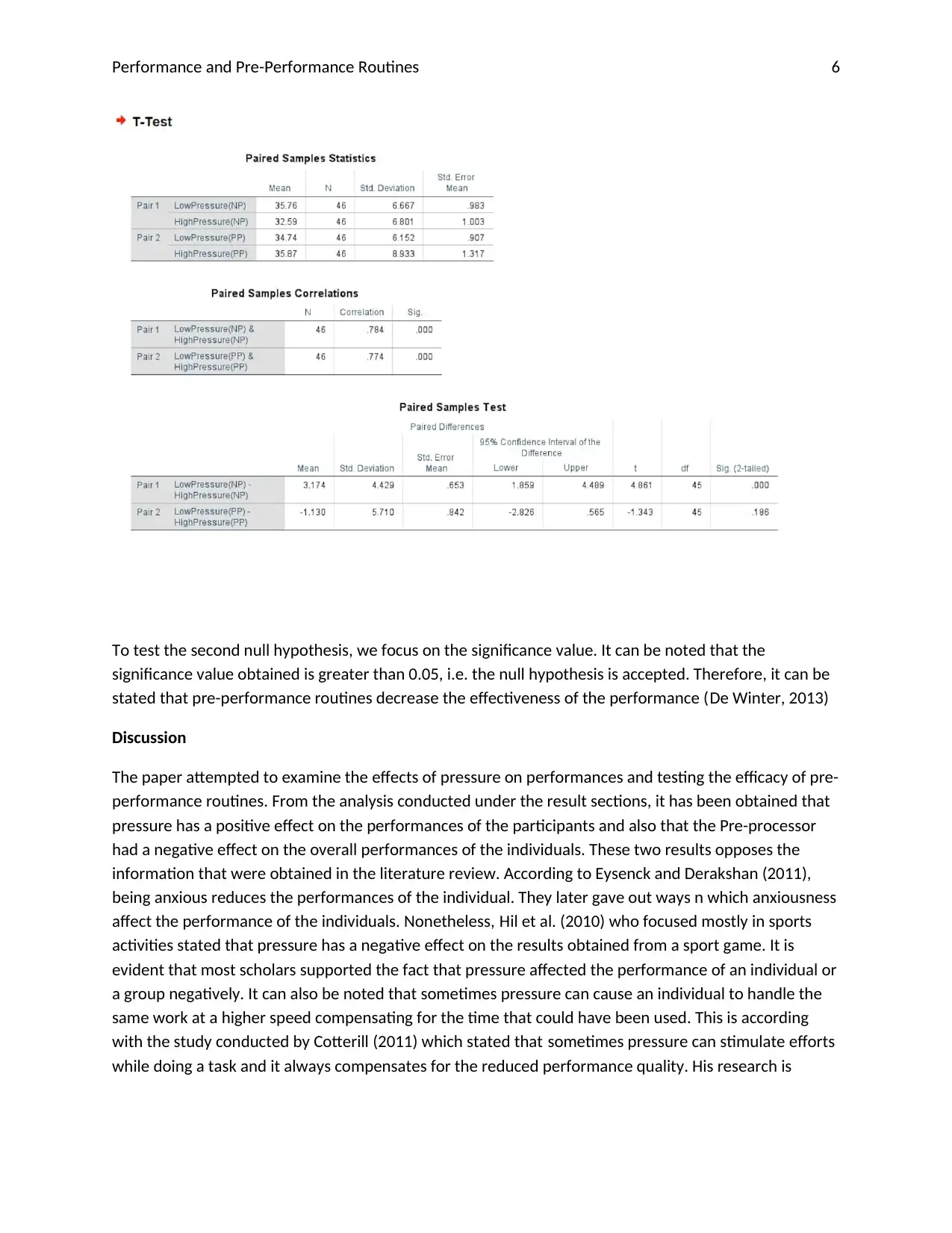
Below is the output for the second
The first hypothesis stated that pressure would affect the performance negatively. To test this
hypothesis, we need to focus on the significance value. The significance value obtained is greater than
0.05 i.e. 0 < 0.05. Therefore, the hypothesis is rejected (the null hypothesis). Therefore, we can say that
pressure has a positive effect on performance.
Testing hypothesis 2
Below is the output for the second
Performance and Pre-Performance Routines 6
To test the second null hypothesis, we focus on the significance value. It can be noted that the
significance value obtained is greater than 0.05, i.e. the null hypothesis is accepted. Therefore, it can be
stated that pre-performance routines decrease the effectiveness of the performance (De Winter, 2013)
Discussion
The paper attempted to examine the effects of pressure on performances and testing the efficacy of pre-
performance routines. From the analysis conducted under the result sections, it has been obtained that
pressure has a positive effect on the performances of the participants and also that the Pre-processor
had a negative effect on the overall performances of the individuals. These two results opposes the
information that were obtained in the literature review. According to Eysenck and Derakshan (2011),
being anxious reduces the performances of the individual. They later gave out ways n which anxiousness
affect the performance of the individuals. Nonetheless, Hil et al. (2010) who focused mostly in sports
activities stated that pressure has a negative effect on the results obtained from a sport game. It is
evident that most scholars supported the fact that pressure affected the performance of an individual or
a group negatively. It can also be noted that sometimes pressure can cause an individual to handle the
same work at a higher speed compensating for the time that could have been used. This is according
with the study conducted by Cotterill (2011) which stated that sometimes pressure can stimulate efforts
while doing a task and it always compensates for the reduced performance quality. His research is
To test the second null hypothesis, we focus on the significance value. It can be noted that the
significance value obtained is greater than 0.05, i.e. the null hypothesis is accepted. Therefore, it can be
stated that pre-performance routines decrease the effectiveness of the performance (De Winter, 2013)
Discussion
The paper attempted to examine the effects of pressure on performances and testing the efficacy of pre-
performance routines. From the analysis conducted under the result sections, it has been obtained that
pressure has a positive effect on the performances of the participants and also that the Pre-processor
had a negative effect on the overall performances of the individuals. These two results opposes the
information that were obtained in the literature review. According to Eysenck and Derakshan (2011),
being anxious reduces the performances of the individual. They later gave out ways n which anxiousness
affect the performance of the individuals. Nonetheless, Hil et al. (2010) who focused mostly in sports
activities stated that pressure has a negative effect on the results obtained from a sport game. It is
evident that most scholars supported the fact that pressure affected the performance of an individual or
a group negatively. It can also be noted that sometimes pressure can cause an individual to handle the
same work at a higher speed compensating for the time that could have been used. This is according
with the study conducted by Cotterill (2011) which stated that sometimes pressure can stimulate efforts
while doing a task and it always compensates for the reduced performance quality. His research is
⊘ This is a preview!⊘
Do you want full access?
Subscribe today to unlock all pages.
Trusted by 1+ million students worldwide
Performance and Pre-Performance Routines 7
correlated with the results that have been obtained from the t-test. Therefore, we cannot always ignore
the positive side of the effect of pressure.
A lot of research has stated that Pre-performance will always lead to better performance. To understand
more about this, many scholars have carried several study on sports, e.g. cricket, golf, volleyball, etc.
The results obtained always seem to be similar. Most of the scholars have concluded that Pre-
performance increases the effectiveness of sports (Ackerman et al. 2012). A study conducted by
Ackerman et al. (2012) claimed that rigorous practice led to better performances. Osborne, Greene, &
Immel (2014) who focused the same study to music claimed that the students who maximized their
potential while practicing the instrumentals showed a better performance compared to their fellow
friends. All these results oppose our friends who stated that Pre-performance reduced the effectiveness
of the performances. Sometimes human judgment can be biased especially during auditions where
several participants compete for a certain price. The judges and the audience always determine the fate
of the participants. In most cases, the candidate who wins the challenge is not always the best overall.
So, this can be one of the challenges that scholars and researchers face since they are not able to
determine the effectiveness of the Pre-performance.
This study might not be accurate because the sample size chosen was small. Only 22 participants were
involved in this research. To obtain better and more accurate results, it is always advisable to use a
larger group. For example, one can use 100 participants for the research. After collecting the data, the
analyst is free to select 30-50 random participants from the whole dataset. This will provide more
accurate results. Since the research didn’t give us the accurate results that were intended, future
research on the same can also be considered. To make the research more accurate, a large number of
participants need to be considered.
The aim of this paper has been met successfully. Initially, we aimed at viewing several literature that
supports the research topic, i.e. examining the effects of pressure on performances and testing the
efficacy of pre-performance routines. Different journals have been reviewed, and most of the
information have been gathered from the journals, then the hypotheses were formulated. The
formulated hypothesis were tested in the result section. Later, the findings were discussed in the
discussion section. The limitation of the research has been discussed and the future implication of the
research.
correlated with the results that have been obtained from the t-test. Therefore, we cannot always ignore
the positive side of the effect of pressure.
A lot of research has stated that Pre-performance will always lead to better performance. To understand
more about this, many scholars have carried several study on sports, e.g. cricket, golf, volleyball, etc.
The results obtained always seem to be similar. Most of the scholars have concluded that Pre-
performance increases the effectiveness of sports (Ackerman et al. 2012). A study conducted by
Ackerman et al. (2012) claimed that rigorous practice led to better performances. Osborne, Greene, &
Immel (2014) who focused the same study to music claimed that the students who maximized their
potential while practicing the instrumentals showed a better performance compared to their fellow
friends. All these results oppose our friends who stated that Pre-performance reduced the effectiveness
of the performances. Sometimes human judgment can be biased especially during auditions where
several participants compete for a certain price. The judges and the audience always determine the fate
of the participants. In most cases, the candidate who wins the challenge is not always the best overall.
So, this can be one of the challenges that scholars and researchers face since they are not able to
determine the effectiveness of the Pre-performance.
This study might not be accurate because the sample size chosen was small. Only 22 participants were
involved in this research. To obtain better and more accurate results, it is always advisable to use a
larger group. For example, one can use 100 participants for the research. After collecting the data, the
analyst is free to select 30-50 random participants from the whole dataset. This will provide more
accurate results. Since the research didn’t give us the accurate results that were intended, future
research on the same can also be considered. To make the research more accurate, a large number of
participants need to be considered.
The aim of this paper has been met successfully. Initially, we aimed at viewing several literature that
supports the research topic, i.e. examining the effects of pressure on performances and testing the
efficacy of pre-performance routines. Different journals have been reviewed, and most of the
information have been gathered from the journals, then the hypotheses were formulated. The
formulated hypothesis were tested in the result section. Later, the findings were discussed in the
discussion section. The limitation of the research has been discussed and the future implication of the
research.
Paraphrase This Document
Need a fresh take? Get an instant paraphrase of this document with our AI Paraphraser
Performance and Pre-Performance Routines 8
REFERENCES
Ackermann, B, Driscoll, T, & Kenny, DT. (2012). Musculoskeletal pain and injury in professional orchestral
musicians in Australia. Medical Problems of Performing Artists, 27(4), 181–187
Cooke, A., Kavussanu, M., McIntyre, D., & Ring, C. (2013). The effects of individual and team
competitions on performance, emotions, and effort. Journal of Sport and Exercise Psychology,
35(2), 132-143.
Cotterill, S. (2010). Pre-performance routines in sport: Current understanding and future directions.
International review of sport and exercise psychology, 3(2), 132-153.
Cotterill, S. T. (2011). Experiences of developing pre-performance routines with elite cricket players.
Journal of Sport Psychology in Action, 2(2), 81-91
De Winter, J. C. (2013). Using the Student's t-test with extremely small sample sizes. Practical
Assessment, Research & Evaluation, 18(10).
Eysenck, M. W., & Derakshan, N. (2011). New perspectives in attentional control theory. Personality and
Individual Differences, 50(7), 955-960.
Hill, D. M., Hanton, S., Matthews, N., & Fleming, S. (2010). Choking in sport: A review. International
Review of Sport and Exercise Psychology, 3(1), 24-39.
Osborne, M. S., Greene, D. J., & Immel, D. T. (2014). Managing performance anxiety and improving
mental skills in conservatoire students through performance psychology training: a pilot study.
Psychology of Well-Being, 4(1), 18.
Singer, R. N. (2002). Preperformance state, routines, and automaticity: what does it take to
realize expertise in self-paced events?. Journal of Sport and Exercise Psychology, 24(4),
359-375.
Wong, I., Mahar, D. P., Titchener, K., & Freeman, J. E. (2013). The impact of anxiety on processing
efficiency: implications for the attentional control theory. The Open Behavioral Science Journal,
7(6), 7-15.
REFERENCES
Ackermann, B, Driscoll, T, & Kenny, DT. (2012). Musculoskeletal pain and injury in professional orchestral
musicians in Australia. Medical Problems of Performing Artists, 27(4), 181–187
Cooke, A., Kavussanu, M., McIntyre, D., & Ring, C. (2013). The effects of individual and team
competitions on performance, emotions, and effort. Journal of Sport and Exercise Psychology,
35(2), 132-143.
Cotterill, S. (2010). Pre-performance routines in sport: Current understanding and future directions.
International review of sport and exercise psychology, 3(2), 132-153.
Cotterill, S. T. (2011). Experiences of developing pre-performance routines with elite cricket players.
Journal of Sport Psychology in Action, 2(2), 81-91
De Winter, J. C. (2013). Using the Student's t-test with extremely small sample sizes. Practical
Assessment, Research & Evaluation, 18(10).
Eysenck, M. W., & Derakshan, N. (2011). New perspectives in attentional control theory. Personality and
Individual Differences, 50(7), 955-960.
Hill, D. M., Hanton, S., Matthews, N., & Fleming, S. (2010). Choking in sport: A review. International
Review of Sport and Exercise Psychology, 3(1), 24-39.
Osborne, M. S., Greene, D. J., & Immel, D. T. (2014). Managing performance anxiety and improving
mental skills in conservatoire students through performance psychology training: a pilot study.
Psychology of Well-Being, 4(1), 18.
Singer, R. N. (2002). Preperformance state, routines, and automaticity: what does it take to
realize expertise in self-paced events?. Journal of Sport and Exercise Psychology, 24(4),
359-375.
Wong, I., Mahar, D. P., Titchener, K., & Freeman, J. E. (2013). The impact of anxiety on processing
efficiency: implications for the attentional control theory. The Open Behavioral Science Journal,
7(6), 7-15.

1 out of 8


Your All-in-One AI-Powered Toolkit for Academic Success.
+13062052269
info@desklib.com
Available 24*7 on WhatsApp / Email
![[object Object]](/_next/static/media/star-bottom.7253800d.svg)
Unlock your academic potential
Copyright © 2020–2026 A2Z Services. All Rights Reserved. Developed and managed by ZUCOL.