Improving Dementia Care: Environment Design Strategies
VerifiedAdded on 2023/05/30
|14
|3446
|279
Report
AI Summary
This report explores the crucial role of environment in the well-being of individuals with dementia, emphasizing the need for dementia-friendly designs to mitigate confusion and other challenges. It advocates for a person-centered care approach, considering the various health conditions and sensory problems often associated with dementia. The report proposes a participatory design model involving patients, families, and carers in the decision-making process. Key design elements include creating domestic-sized and characterized spaces, implementing effective floor plans, and tailoring specific spaces like bedrooms, bathrooms, and activity areas to enhance independence and minimize potential hazards. The design recommendations focus on promoting familiarity, visibility, and safety, ultimately aiming to improve the quality of life for people living with dementia.
Running head: DEMENTIA ENVIRONMENT 1
Dementia Environment
Name
Institution
Dementia Environment
Name
Institution

Paraphrase This Document
Need a fresh take? Get an instant paraphrase of this document with our AI Paraphraser
DEMENTIA ENVIRONMENT 2
Dementia Environment
Ideally, the environment in which people tend to live and work no doubt plays a major
role in defining a person’s physical as well as psychological well-being. In this light, there is an
increasing evidence that environment can have a detrimental effect, particularly on people with
dementia and cognitive problems thus leading to additional problems as well as Confusion. The
need to improve the settings in which people with dementia live has become a debated subject in
the contemporary society. Coming up with an improvised a dwelling that is considered dementia
friendly requires an individual to have a better understanding of the symptoms as well as the
challenges that are often presented by dementia and an overall appreciation of the lived
experiences at home, individuals with dementia, and their entire families at home (Aarsland,
Creese, & Chaudhuri, 2017). While there are varied difficulties that are experienced by people
living with dementia, they often tend to retain some abilities that need to be supported in their
daily lives. In essence people with dementia are likely to develop other complications especially
because of their progressive ages such as diabetes, cardiovascular diseases, and Parkinson’s. All
this illness has to be accounted for during their special care in the health care system.
Dementia Environment
Ideally, the environment in which people tend to live and work no doubt plays a major
role in defining a person’s physical as well as psychological well-being. In this light, there is an
increasing evidence that environment can have a detrimental effect, particularly on people with
dementia and cognitive problems thus leading to additional problems as well as Confusion. The
need to improve the settings in which people with dementia live has become a debated subject in
the contemporary society. Coming up with an improvised a dwelling that is considered dementia
friendly requires an individual to have a better understanding of the symptoms as well as the
challenges that are often presented by dementia and an overall appreciation of the lived
experiences at home, individuals with dementia, and their entire families at home (Aarsland,
Creese, & Chaudhuri, 2017). While there are varied difficulties that are experienced by people
living with dementia, they often tend to retain some abilities that need to be supported in their
daily lives. In essence people with dementia are likely to develop other complications especially
because of their progressive ages such as diabetes, cardiovascular diseases, and Parkinson’s. All
this illness has to be accounted for during their special care in the health care system.
DEMENTIA ENVIRONMENT 3
The health conditions as well as difficulties that are likely to significantly have a
damaging effect on people with dementia can be improved or rather aggravated by building a
psycho-social environment or rather person-centered care settings. Apparently, this is because
there are other mental illnesses that can lead to other health problems such as vision, stroke,
hearing complications, as well as associated paralysis, problems with drinking and eating habit,
difficulty walking, injuries, and falls (Abe, Shimokado, & Fushimi, 2018). The interaction with
dementia particularly of the other diseases and sensory problems can sometimes result to further
complication especially in case the patient living with dementia can no longer communicate or
even if he or she is unable to comprehend the overall value of using specific devices such as the
glasses and hearing aid. It is, therefore, a bit challenged to especially design a build environment
to adhere to the complex and varying needs of an individual person with dementia, carers, and
their families (Eastham & Cox, 2017). For one to build a personal-centered environment it is
important to take into consideration of the health conditions as well as the overall sensory
problems individuals with dementia are likely to have. Notably, this is done while weighing up
the likely benefits and drawbacks of coming up with various design features for those people
who might have multiple complications (Moorman et al., 2017). In this light, it is always
recommended to build a universal design environment that is focused on a personal-centered
care which is not only beneficial to all patient but to individual persons with unique
complications. This paper proposes to design a personal friendly design that is likely to address
individual problems of persons living with dementia. The following is a design model for a
personal-centered care system for people suffering from dementia.
The health conditions as well as difficulties that are likely to significantly have a
damaging effect on people with dementia can be improved or rather aggravated by building a
psycho-social environment or rather person-centered care settings. Apparently, this is because
there are other mental illnesses that can lead to other health problems such as vision, stroke,
hearing complications, as well as associated paralysis, problems with drinking and eating habit,
difficulty walking, injuries, and falls (Abe, Shimokado, & Fushimi, 2018). The interaction with
dementia particularly of the other diseases and sensory problems can sometimes result to further
complication especially in case the patient living with dementia can no longer communicate or
even if he or she is unable to comprehend the overall value of using specific devices such as the
glasses and hearing aid. It is, therefore, a bit challenged to especially design a build environment
to adhere to the complex and varying needs of an individual person with dementia, carers, and
their families (Eastham & Cox, 2017). For one to build a personal-centered environment it is
important to take into consideration of the health conditions as well as the overall sensory
problems individuals with dementia are likely to have. Notably, this is done while weighing up
the likely benefits and drawbacks of coming up with various design features for those people
who might have multiple complications (Moorman et al., 2017). In this light, it is always
recommended to build a universal design environment that is focused on a personal-centered
care which is not only beneficial to all patient but to individual persons with unique
complications. This paper proposes to design a personal friendly design that is likely to address
individual problems of persons living with dementia. The following is a design model for a
personal-centered care system for people suffering from dementia.
⊘ This is a preview!⊘
Do you want full access?
Subscribe today to unlock all pages.

Trusted by 1+ million students worldwide
DEMENTIA ENVIRONMENT 4
Design
Encouraging a Participatory Design Model
When coming up with a new design that is going to affect the patients, their families, and
carers, it is important to make sure that all these people are involved in decisions making. In
essence, this is important as it helps to gather views of patients with dementia and how they
would like it made for their contingency (Grey, Pierce, Cahill, & Dyer, 2015). A good design
program should place a major emphasis on early as well as ongoing consultation with not only
the staff but also with the patients suffering from dementia, their family members, the wider
community as well as the carers. Involving the carers in coming up with a design allows them to
use their knowledge as well as experience to the full. Project teams should, therefore, make sure
that patients with dementia contribute to the overall individual schemes. For instance, using
colored pictures, mats in the process of informing color choice and through lively hands-on art
gatherings. Additionally, patients can as well be involved in selecting artworks something that
many patients tend to enjoy especially that of the local landmarks.
Domestic Size and Character
In essence, people with dementia are often challenged by large, spaces that are
unstructured, containing a large or rather unpredictable number of people who share the same
room. In this light, creating a patient-centered facility would be important if these factors are put
into consideration. When designing an environment, it is important to make sure that one designs
a setting that accommodates about 8 to 12 clients a number that one can be in a position of
maintaining a domestic character instead of overcrowded place (Browne, Edwards, Rhodes,
Brimicombe, & Payne, 2017). Coming up with an imaginative approach can help in designing
small groupings of individuals within a rather larger building as an alternative to a known
Design
Encouraging a Participatory Design Model
When coming up with a new design that is going to affect the patients, their families, and
carers, it is important to make sure that all these people are involved in decisions making. In
essence, this is important as it helps to gather views of patients with dementia and how they
would like it made for their contingency (Grey, Pierce, Cahill, & Dyer, 2015). A good design
program should place a major emphasis on early as well as ongoing consultation with not only
the staff but also with the patients suffering from dementia, their family members, the wider
community as well as the carers. Involving the carers in coming up with a design allows them to
use their knowledge as well as experience to the full. Project teams should, therefore, make sure
that patients with dementia contribute to the overall individual schemes. For instance, using
colored pictures, mats in the process of informing color choice and through lively hands-on art
gatherings. Additionally, patients can as well be involved in selecting artworks something that
many patients tend to enjoy especially that of the local landmarks.
Domestic Size and Character
In essence, people with dementia are often challenged by large, spaces that are
unstructured, containing a large or rather unpredictable number of people who share the same
room. In this light, creating a patient-centered facility would be important if these factors are put
into consideration. When designing an environment, it is important to make sure that one designs
a setting that accommodates about 8 to 12 clients a number that one can be in a position of
maintaining a domestic character instead of overcrowded place (Browne, Edwards, Rhodes,
Brimicombe, & Payne, 2017). Coming up with an imaginative approach can help in designing
small groupings of individuals within a rather larger building as an alternative to a known
Paraphrase This Document
Need a fresh take? Get an instant paraphrase of this document with our AI Paraphraser
DEMENTIA ENVIRONMENT 5
multiple small or even separate units. Another trait that one has to consider in this ‘domestic
character” design is to furnish each particular room as well as decorating them with an aim of
identifying its function and purpose in a similar way to the settings of an average home.
Additionally, one has to set up an environment that prompts a particular activity as well as
behavior that often links with all the area while minimizing confusion that is likely to come up
especially from large, all in a single activity area (Spears, 2018). Notably, one should select
designs that make the rooms and the entire spaces to be visible with minimum effort, therefore,
helping with the overall orientation and an ease in finding the way.
Floor Plan
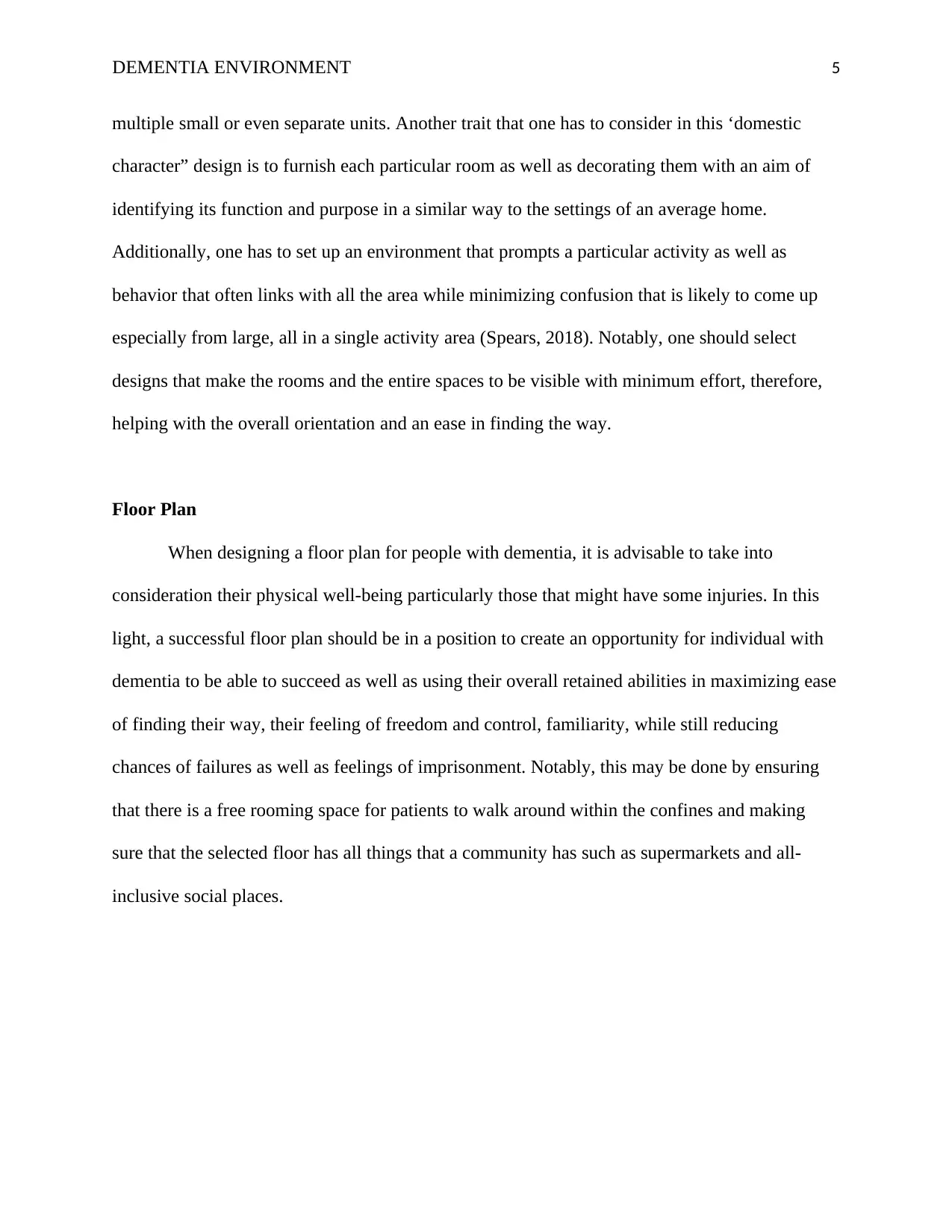
When designing a floor plan for people with dementia, it is advisable to take into
consideration their physical well-being particularly those that might have some injuries. In this
light, a successful floor plan should be in a position to create an opportunity for individual with
dementia to be able to succeed as well as using their overall retained abilities in maximizing ease
of finding their way, their feeling of freedom and control, familiarity, while still reducing
chances of failures as well as feelings of imprisonment. Notably, this may be done by ensuring
that there is a free rooming space for patients to walk around within the confines and making
sure that the selected floor has all things that a community has such as supermarkets and all-
inclusive social places.
multiple small or even separate units. Another trait that one has to consider in this ‘domestic
character” design is to furnish each particular room as well as decorating them with an aim of
identifying its function and purpose in a similar way to the settings of an average home.
Additionally, one has to set up an environment that prompts a particular activity as well as
behavior that often links with all the area while minimizing confusion that is likely to come up
especially from large, all in a single activity area (Spears, 2018). Notably, one should select
designs that make the rooms and the entire spaces to be visible with minimum effort, therefore,
helping with the overall orientation and an ease in finding the way.
Floor Plan
When designing a floor plan for people with dementia, it is advisable to take into
consideration their physical well-being particularly those that might have some injuries. In this
light, a successful floor plan should be in a position to create an opportunity for individual with
dementia to be able to succeed as well as using their overall retained abilities in maximizing ease
of finding their way, their feeling of freedom and control, familiarity, while still reducing
chances of failures as well as feelings of imprisonment. Notably, this may be done by ensuring
that there is a free rooming space for patients to walk around within the confines and making
sure that the selected floor has all things that a community has such as supermarkets and all-
inclusive social places.
DEMENTIA ENVIRONMENT 6
Source:https://www.google.com/search?
q=floor+plan+of+people+with+dementia&client=opera&hs=Cta&source=lnms&tbm=isc
h&sa=X&ved=0ahUKEwjdya_B8OPeAhVSM-
wKHbEuDiUQ_AUIDigB&biw=1366&bih=627#imgrc=H7HQzwD8ESbfpM:
Specific Spaces
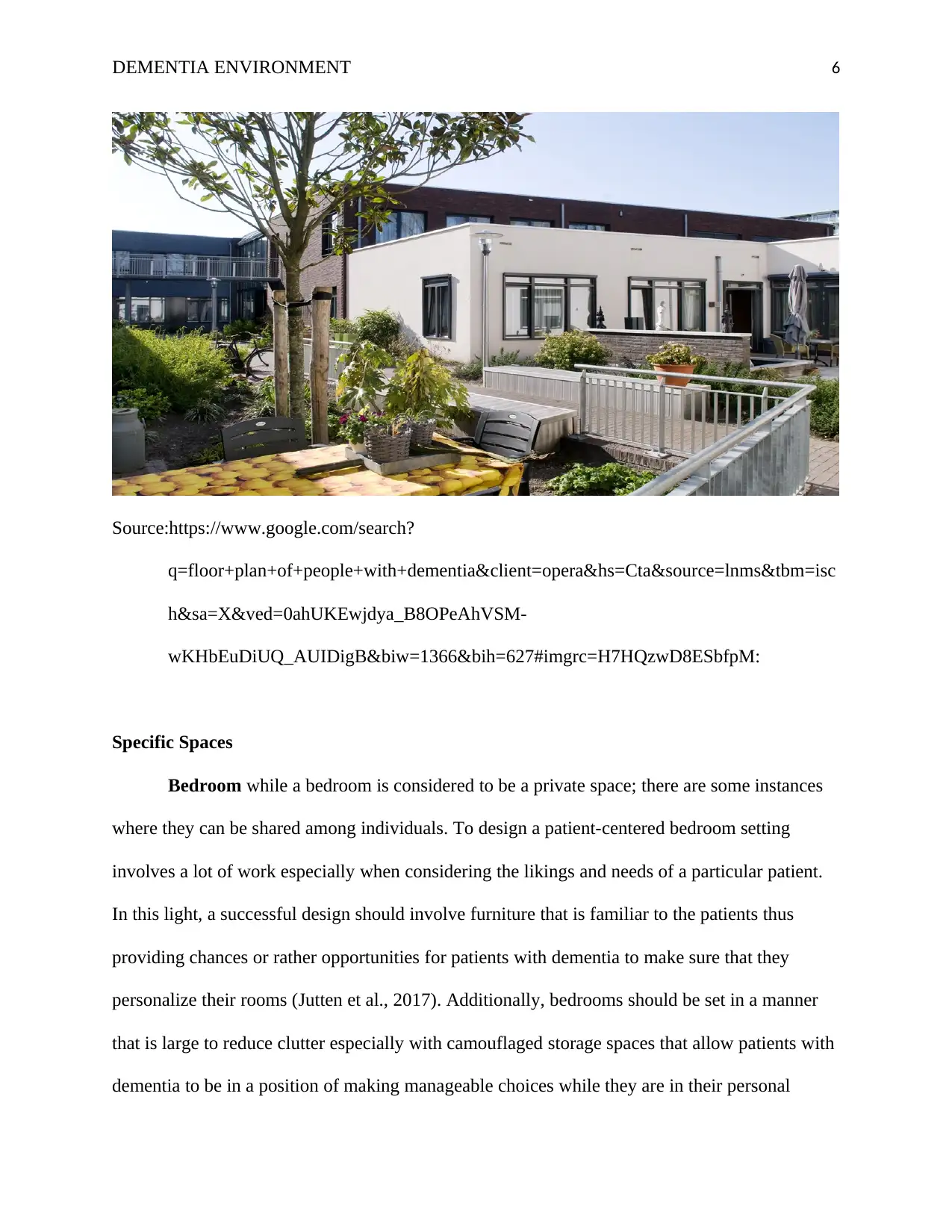
Bedroom while a bedroom is considered to be a private space; there are some instances
where they can be shared among individuals. To design a patient-centered bedroom setting
involves a lot of work especially when considering the likings and needs of a particular patient.
In this light, a successful design should involve furniture that is familiar to the patients thus
providing chances or rather opportunities for patients with dementia to make sure that they
personalize their rooms (Jutten et al., 2017). Additionally, bedrooms should be set in a manner
that is large to reduce clutter especially with camouflaged storage spaces that allow patients with
dementia to be in a position of making manageable choices while they are in their personal
Source:https://www.google.com/search?
q=floor+plan+of+people+with+dementia&client=opera&hs=Cta&source=lnms&tbm=isc
h&sa=X&ved=0ahUKEwjdya_B8OPeAhVSM-
wKHbEuDiUQ_AUIDigB&biw=1366&bih=627#imgrc=H7HQzwD8ESbfpM:
Specific Spaces
Bedroom while a bedroom is considered to be a private space; there are some instances
where they can be shared among individuals. To design a patient-centered bedroom setting
involves a lot of work especially when considering the likings and needs of a particular patient.
In this light, a successful design should involve furniture that is familiar to the patients thus
providing chances or rather opportunities for patients with dementia to make sure that they
personalize their rooms (Jutten et al., 2017). Additionally, bedrooms should be set in a manner
that is large to reduce clutter especially with camouflaged storage spaces that allow patients with
dementia to be in a position of making manageable choices while they are in their personal
⊘ This is a preview!⊘
Do you want full access?
Subscribe today to unlock all pages.
Trusted by 1+ million students worldwide
DEMENTIA ENVIRONMENT 7
rooms or area (Pinkert et al., 2018). The designers should as well make sure that they use a
cleaned but warm floor coverings that are not slippery and ensuring that patients are provided
rooms that are recognizable individually particularly from the outside and thus providing an
orientation to the general environment when leaving.
Source:https://www.google.com/search?
q=bedrooms+of+people+with+dementia&client=opera&hs=Kra&source=lnms&tbm=isc
h&sa=X&ved=0ahUKEwiew-6J8OPeAhXD-
aQKHZF6Ch8Q_AUIDigB&biw=1366&bih=627#imgrc=6xtrlulnHN90NM
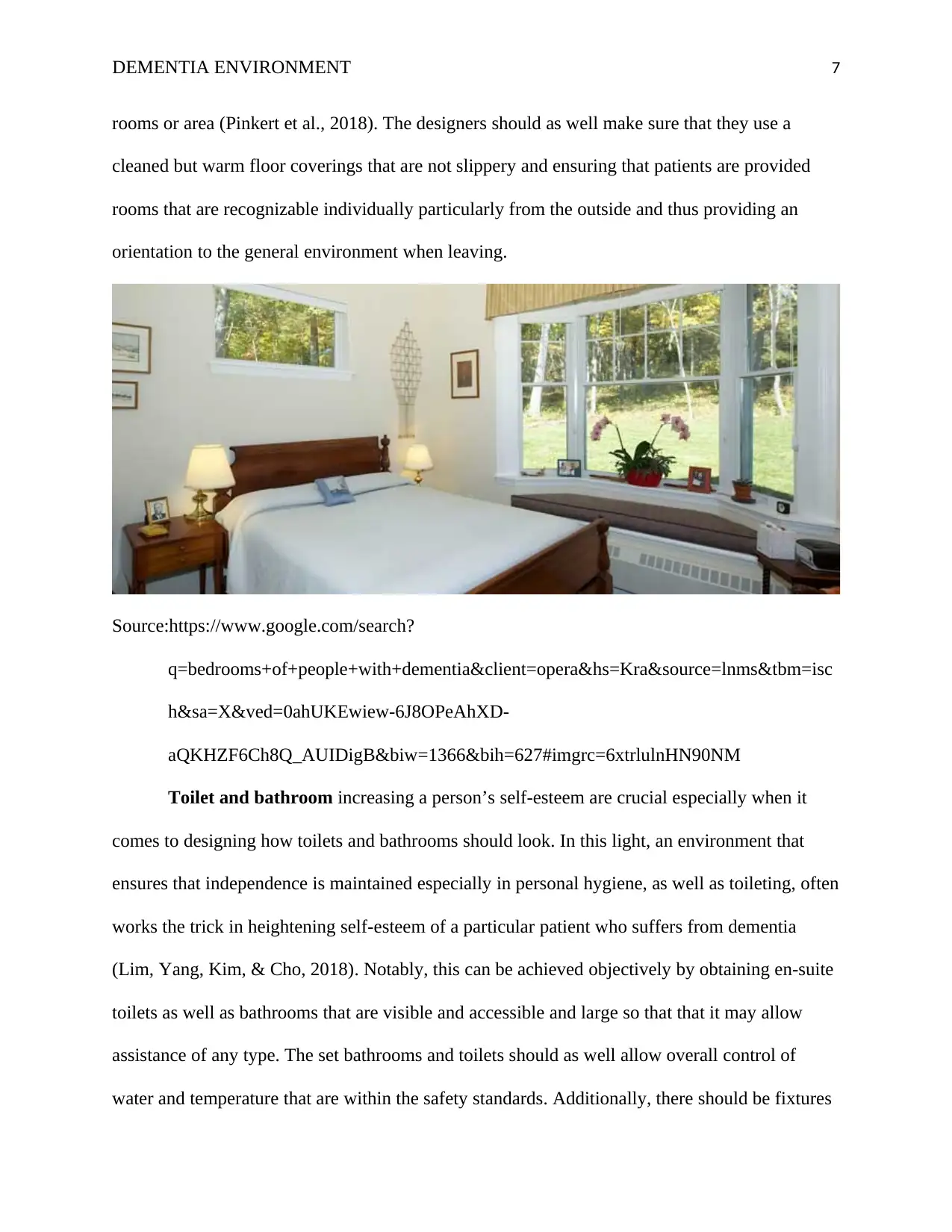
Toilet and bathroom increasing a person’s self-esteem are crucial especially when it
comes to designing how toilets and bathrooms should look. In this light, an environment that
ensures that independence is maintained especially in personal hygiene, as well as toileting, often
works the trick in heightening self-esteem of a particular patient who suffers from dementia
(Lim, Yang, Kim, & Cho, 2018). Notably, this can be achieved objectively by obtaining en-suite
toilets as well as bathrooms that are visible and accessible and large so that that it may allow
assistance of any type. The set bathrooms and toilets should as well allow overall control of
water and temperature that are within the safety standards. Additionally, there should be fixtures
rooms or area (Pinkert et al., 2018). The designers should as well make sure that they use a
cleaned but warm floor coverings that are not slippery and ensuring that patients are provided
rooms that are recognizable individually particularly from the outside and thus providing an
orientation to the general environment when leaving.
Source:https://www.google.com/search?
q=bedrooms+of+people+with+dementia&client=opera&hs=Kra&source=lnms&tbm=isc
h&sa=X&ved=0ahUKEwiew-6J8OPeAhXD-
aQKHZF6Ch8Q_AUIDigB&biw=1366&bih=627#imgrc=6xtrlulnHN90NM
Toilet and bathroom increasing a person’s self-esteem are crucial especially when it
comes to designing how toilets and bathrooms should look. In this light, an environment that
ensures that independence is maintained especially in personal hygiene, as well as toileting, often
works the trick in heightening self-esteem of a particular patient who suffers from dementia
(Lim, Yang, Kim, & Cho, 2018). Notably, this can be achieved objectively by obtaining en-suite
toilets as well as bathrooms that are visible and accessible and large so that that it may allow
assistance of any type. The set bathrooms and toilets should as well allow overall control of
water and temperature that are within the safety standards. Additionally, there should be fixtures
Paraphrase This Document
Need a fresh take? Get an instant paraphrase of this document with our AI Paraphraser
DEMENTIA ENVIRONMENT 8
that are almost familiar especially in a location as well as styles such as taps in the domestic
designs that are made with a normal operating position for both hot and cold (Turner, Eccles,
Elvish, Simpson, & Keady, 2017). In this light, sinks should be designed without plugs to
minimize accidents that are often caused by taps which are left on. The design of these
bathrooms should use contrast in color to help in the recognition of various equipment including
basins as well as benches. Moreover, a successful design should include a rather unobtrusive
supporting hardware such as grab rails. Notably, this can be made easy by setting up position
doorways as well as toilets that make sure there are an easy access and a proper visibility and
recognition, especially at night.
Sources:https://www.google.com/search?
q=bathroom+of+people+with+dementia&client=opera&hs=Woa&source=lnms&tbm=isc
h&sa=X&ved=0ahUKEwingey27-
PeAhXPDOwKHcgxAvQQ_AUIDigB&biw=1366&bih=627#imgrc=_ohrHl4u2goQsM:
Activity Areas
The overall objective of when designing specific areas such as kitchen, dining areas,
outdoor spaces, as well as social areas is to make sure that their best use is facilitated especially
that are almost familiar especially in a location as well as styles such as taps in the domestic
designs that are made with a normal operating position for both hot and cold (Turner, Eccles,
Elvish, Simpson, & Keady, 2017). In this light, sinks should be designed without plugs to
minimize accidents that are often caused by taps which are left on. The design of these
bathrooms should use contrast in color to help in the recognition of various equipment including
basins as well as benches. Moreover, a successful design should include a rather unobtrusive
supporting hardware such as grab rails. Notably, this can be made easy by setting up position
doorways as well as toilets that make sure there are an easy access and a proper visibility and
recognition, especially at night.
Sources:https://www.google.com/search?
q=bathroom+of+people+with+dementia&client=opera&hs=Woa&source=lnms&tbm=isc
h&sa=X&ved=0ahUKEwingey27-
PeAhXPDOwKHcgxAvQQ_AUIDigB&biw=1366&bih=627#imgrc=_ohrHl4u2goQsM:
Activity Areas
The overall objective of when designing specific areas such as kitchen, dining areas,
outdoor spaces, as well as social areas is to make sure that their best use is facilitated especially
DEMENTIA ENVIRONMENT 9
by people who have lost some part of their abilities in planning and making judgments while still
minimizing various chances of mistakes that might put these set of people in danger.
Kitchen in this particular dream facility, there is the overall consideration of a kitchen
with an aim of engaging people with dementia in daily activities such as cooking. The kitchen
design should be set in a manner that it balances the need for involvement as well as the safety of
patients with dementia. In this light, the kitchen should involve cures that are visible such as
open shelves with an aim of promoting recognition as well as the use of safe objects (Zadeh et
al., 2018). The used equipment should as well be designed in a familiar manner.
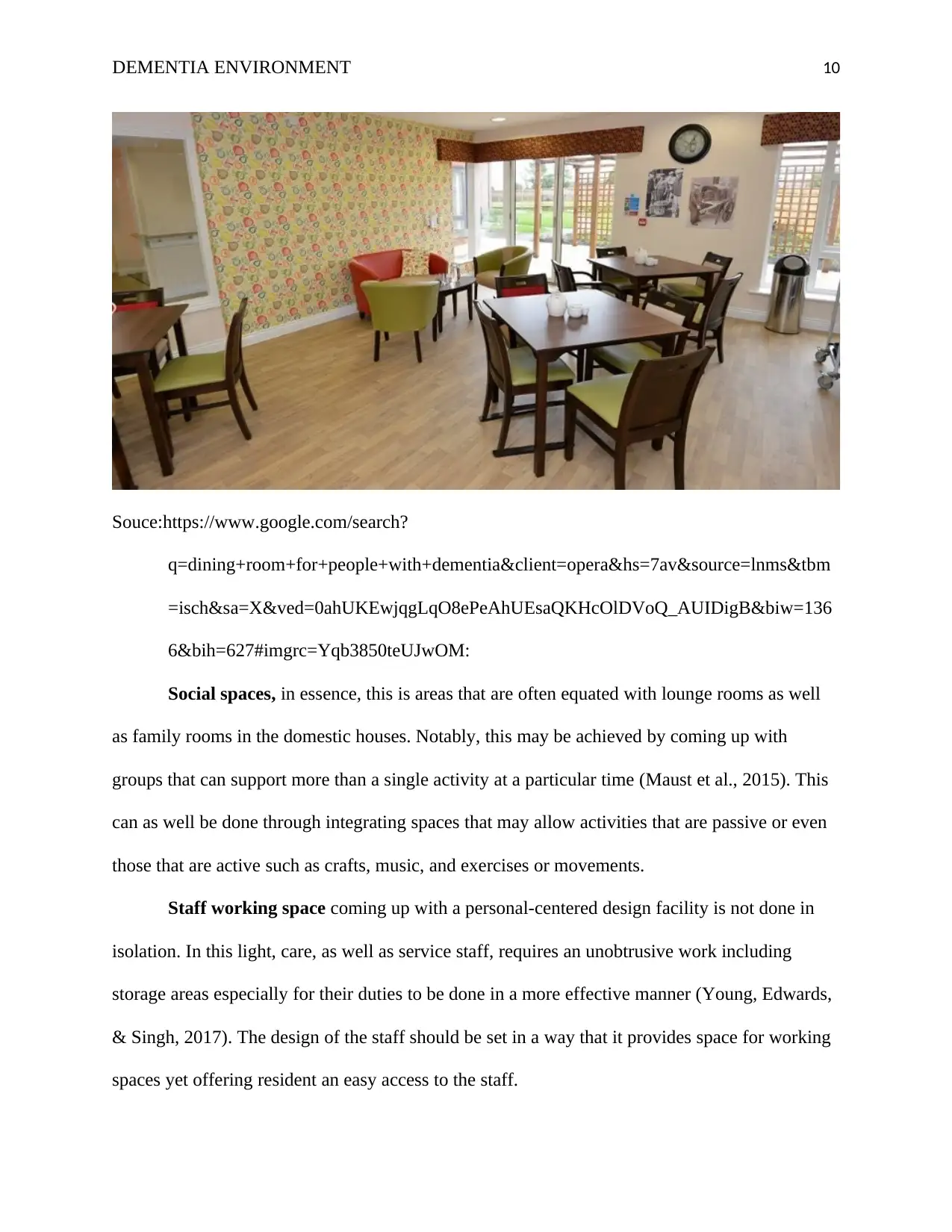
Dining rooms in most cases large dining areas are considered to be noisy as well as
complicated especially for those people who are suffering from dementia and therefore they do
not in any way promote a calm atmosphere that is recommended during meal times. A personal-
centered care system should be set in a manner that is small and recognizable thus enabling
personal abilities during meal times and an improve nutrition levels (König, Francis, Joshi,
Robillard, & Hoey, 2017). To achieve this outcome in a personal level involves setting up dining
chairs that often gives flexibility as well as support to patients. The dining rooms should as well
be provided effective lighting that makes sure there are maximum chances for the recognition of
specific equipment as well as food with an aim of enhancing the functional aspect of the room
(Maust, Langa, Blow, & Kales, 2017). Additionally, the design should take into consideration
square tables with an aim of identifying the space of each individual readily unlike a roundtable.
by people who have lost some part of their abilities in planning and making judgments while still
minimizing various chances of mistakes that might put these set of people in danger.
Kitchen in this particular dream facility, there is the overall consideration of a kitchen
with an aim of engaging people with dementia in daily activities such as cooking. The kitchen
design should be set in a manner that it balances the need for involvement as well as the safety of
patients with dementia. In this light, the kitchen should involve cures that are visible such as
open shelves with an aim of promoting recognition as well as the use of safe objects (Zadeh et
al., 2018). The used equipment should as well be designed in a familiar manner.
Dining rooms in most cases large dining areas are considered to be noisy as well as
complicated especially for those people who are suffering from dementia and therefore they do
not in any way promote a calm atmosphere that is recommended during meal times. A personal-
centered care system should be set in a manner that is small and recognizable thus enabling
personal abilities during meal times and an improve nutrition levels (König, Francis, Joshi,
Robillard, & Hoey, 2017). To achieve this outcome in a personal level involves setting up dining
chairs that often gives flexibility as well as support to patients. The dining rooms should as well
be provided effective lighting that makes sure there are maximum chances for the recognition of
specific equipment as well as food with an aim of enhancing the functional aspect of the room
(Maust, Langa, Blow, & Kales, 2017). Additionally, the design should take into consideration
square tables with an aim of identifying the space of each individual readily unlike a roundtable.
⊘ This is a preview!⊘
Do you want full access?
Subscribe today to unlock all pages.
Trusted by 1+ million students worldwide
DEMENTIA ENVIRONMENT 10
Souce:https://www.google.com/search?
q=dining+room+for+people+with+dementia&client=opera&hs=7av&source=lnms&tbm
=isch&sa=X&ved=0ahUKEwjqgLqO8ePeAhUEsaQKHcOlDVoQ_AUIDigB&biw=136
6&bih=627#imgrc=Yqb3850teUJwOM:
Social spaces, in essence, this is areas that are often equated with lounge rooms as well
as family rooms in the domestic houses. Notably, this may be achieved by coming up with
groups that can support more than a single activity at a particular time (Maust et al., 2015). This
can as well be done through integrating spaces that may allow activities that are passive or even
those that are active such as crafts, music, and exercises or movements.
Staff working space coming up with a personal-centered design facility is not done in
isolation. In this light, care, as well as service staff, requires an unobtrusive work including
storage areas especially for their duties to be done in a more effective manner (Young, Edwards,
& Singh, 2017). The design of the staff should be set in a way that it provides space for working
spaces yet offering resident an easy access to the staff.
Souce:https://www.google.com/search?
q=dining+room+for+people+with+dementia&client=opera&hs=7av&source=lnms&tbm
=isch&sa=X&ved=0ahUKEwjqgLqO8ePeAhUEsaQKHcOlDVoQ_AUIDigB&biw=136
6&bih=627#imgrc=Yqb3850teUJwOM:
Social spaces, in essence, this is areas that are often equated with lounge rooms as well
as family rooms in the domestic houses. Notably, this may be achieved by coming up with
groups that can support more than a single activity at a particular time (Maust et al., 2015). This
can as well be done through integrating spaces that may allow activities that are passive or even
those that are active such as crafts, music, and exercises or movements.
Staff working space coming up with a personal-centered design facility is not done in
isolation. In this light, care, as well as service staff, requires an unobtrusive work including
storage areas especially for their duties to be done in a more effective manner (Young, Edwards,
& Singh, 2017). The design of the staff should be set in a way that it provides space for working
spaces yet offering resident an easy access to the staff.
Paraphrase This Document
Need a fresh take? Get an instant paraphrase of this document with our AI Paraphraser
DEMENTIA ENVIRONMENT 11
The Built Environment and Quality of Life for People with Dementia
The built environment created above will be in a passion of contributing to the overall
quality of life especially for people who are suffering from dementia particularly when it
provides:
A balanced as well as controlled stimulation program;
Contains unique features that help the patients with orientation;
Be in a position to maximize the overall success, confidence as well as self-esteem;
Promote patient’s involvement in everyday activities;
Support patient’s relationships particular with their families, friends and the entire
community; and
Make sure that there is an unobtrusive security in the care system.
Conclusion
This paper has successfully drawn an opinion on the design structures that would enable
to provide a personal-centered care in the health care system especially for those people suffering
from dementia. Such an environment will ensure that there is a compensation of the cognitive
changes of dementia and thus maximizes the awareness in promoting feelings as well as actual
safety and security. The design will also provide opportunities for significant social contact while
supporting functional ability through the use of a meaningful activity to make dementia patients
active.
The Built Environment and Quality of Life for People with Dementia
The built environment created above will be in a passion of contributing to the overall
quality of life especially for people who are suffering from dementia particularly when it
provides:
A balanced as well as controlled stimulation program;
Contains unique features that help the patients with orientation;
Be in a position to maximize the overall success, confidence as well as self-esteem;
Promote patient’s involvement in everyday activities;
Support patient’s relationships particular with their families, friends and the entire
community; and
Make sure that there is an unobtrusive security in the care system.
Conclusion
This paper has successfully drawn an opinion on the design structures that would enable
to provide a personal-centered care in the health care system especially for those people suffering
from dementia. Such an environment will ensure that there is a compensation of the cognitive
changes of dementia and thus maximizes the awareness in promoting feelings as well as actual
safety and security. The design will also provide opportunities for significant social contact while
supporting functional ability through the use of a meaningful activity to make dementia patients
active.
DEMENTIA ENVIRONMENT 12
References
Aarsland, D., Creese, B., & Chaudhuri, K. R. (2017). A new tool to identify patients with
Parkinson's disease at increased risk of dementia. The Lancet Neurology, 16(8), 576-578.
Abe, Y., Shimokado, K., & Fushimi, K. (2018). Donepezil is associated with decreased in‐
hospital mortality as a result of pneumonia among older patients with dementia: A
retrospective cohort study. Geriatrics & gerontology international, 18(2), 269-275.
Browne, J., Edwards, D. A., Rhodes, K. M., Brimicombe, D. J., & Payne, R. A. (2017).
Association of comorbidity and health service use among patients with dementia in the
UK: a population-based study. BMJ Open, 7(3), e012546.
Eastham, A. J., & Cox, D. (2017). Dementia-friendly wards: A review of the literature and pilot
study of patient interaction and daily activity engagement. International Journal of
Health Governance, 22(1), 25-36.
Grey, T., Pierce, M., Cahill, S., & Dyer, M. (2015). Universal design guidelines: dementia
friendly dwellings for people with dementia, their families and carers. National Disability
Authority of Ireland.
Jutten, R. J., Harrison, J., de Jong, F. J., Aleman, A., Ritchie, C. W., Scheltens, P., & Sikkes, S.
A. (2017). A composite measure of cognitive and functional progression in Alzheimer's
disease: Design of the Capturing Changes in Cognition study. Alzheimer's & Dementia:
Translational Research & Clinical Interventions, 3(1), 130-138.
König, A., Francis, L. E., Joshi, J., Robillard, J. M., & Hoey, J. (2017). A qualitative study of
effective identities in dementia patients for the design of cognitive assistive
References
Aarsland, D., Creese, B., & Chaudhuri, K. R. (2017). A new tool to identify patients with
Parkinson's disease at increased risk of dementia. The Lancet Neurology, 16(8), 576-578.
Abe, Y., Shimokado, K., & Fushimi, K. (2018). Donepezil is associated with decreased in‐
hospital mortality as a result of pneumonia among older patients with dementia: A
retrospective cohort study. Geriatrics & gerontology international, 18(2), 269-275.
Browne, J., Edwards, D. A., Rhodes, K. M., Brimicombe, D. J., & Payne, R. A. (2017).
Association of comorbidity and health service use among patients with dementia in the
UK: a population-based study. BMJ Open, 7(3), e012546.
Eastham, A. J., & Cox, D. (2017). Dementia-friendly wards: A review of the literature and pilot
study of patient interaction and daily activity engagement. International Journal of
Health Governance, 22(1), 25-36.
Grey, T., Pierce, M., Cahill, S., & Dyer, M. (2015). Universal design guidelines: dementia
friendly dwellings for people with dementia, their families and carers. National Disability
Authority of Ireland.
Jutten, R. J., Harrison, J., de Jong, F. J., Aleman, A., Ritchie, C. W., Scheltens, P., & Sikkes, S.
A. (2017). A composite measure of cognitive and functional progression in Alzheimer's
disease: Design of the Capturing Changes in Cognition study. Alzheimer's & Dementia:
Translational Research & Clinical Interventions, 3(1), 130-138.
König, A., Francis, L. E., Joshi, J., Robillard, J. M., & Hoey, J. (2017). A qualitative study of
effective identities in dementia patients for the design of cognitive assistive
⊘ This is a preview!⊘
Do you want full access?
Subscribe today to unlock all pages.
Trusted by 1+ million students worldwide

1 out of 14


Related Documents


Your All-in-One AI-Powered Toolkit for Academic Success.
+13062052269
info@desklib.com
Available 24*7 on WhatsApp / Email
![[object Object]](/_next/static/media/star-bottom.7253800d.svg)
Unlock your academic potential
Copyright © 2020–2026 A2Z Services. All Rights Reserved. Developed and managed by ZUCOL.