Person Centred Approaches and Service User Involvement Report
VerifiedAdded on 2020/12/09
|19
|5239
|468
Report
AI Summary
This report provides a comprehensive overview of Person Centred Approach (PCA) and Service User Involvement (SUI) in the context of Health and Social Care. It begins with the historical background and conceptual frameworks of both approaches, detailing their evolution and key principles. The report explores relevant policies from organizations such as NHS England and CQC, examining their impact on healthcare delivery and patient care. It also discusses challenges and barriers to implementing PCA and SUI, such as funding deficiencies and cultural resistance. Furthermore, the report delves into theories related to SUI, approaches for empowerment and advocacy, and the impact of these approaches on the quality of care. The conclusion summarizes the key findings and emphasizes the importance of integrating PCA and SUI to improve patient outcomes and enhance the overall healthcare experience.
PERSON CENTRED APPROACHES AND
SERVICE USER INVOLVEMENT IN HEALTH
AND SOCIAL CARE
SERVICE USER INVOLVEMENT IN HEALTH
AND SOCIAL CARE

Paraphrase This Document
Need a fresh take? Get an instant paraphrase of this document with our AI Paraphraser
TABLE OF CONTENTS
INTRODUCTION...........................................................................................................................1
MAIN BODY...................................................................................................................................1
Overview of Person Centred Approach (PCA) ..........................................................................1
Overview of Service User Involvement (SUI)............................................................................3
Development of policies ............................................................................................................5
Extension of the overview of PCA / SUI with respect to policies..............................................7
Person Centred Approach ..........................................................................................................8
Service User Involvement...........................................................................................................9
Theories related to SUI.............................................................................................................10
Impact on PCA/SUI ................................................................................................................12
Approaches for empowerment and advocacy...........................................................................13
Impact of approaches on the quality of care being provided by service providers and
professionals..............................................................................................................................14
CONCLUSION..............................................................................................................................15
REFERENCES..............................................................................................................................16
INTRODUCTION...........................................................................................................................1
MAIN BODY...................................................................................................................................1
Overview of Person Centred Approach (PCA) ..........................................................................1
Overview of Service User Involvement (SUI)............................................................................3
Development of policies ............................................................................................................5
Extension of the overview of PCA / SUI with respect to policies..............................................7
Person Centred Approach ..........................................................................................................8
Service User Involvement...........................................................................................................9
Theories related to SUI.............................................................................................................10
Impact on PCA/SUI ................................................................................................................12
Approaches for empowerment and advocacy...........................................................................13
Impact of approaches on the quality of care being provided by service providers and
professionals..............................................................................................................................14
CONCLUSION..............................................................................................................................15
REFERENCES..............................................................................................................................16
INTRODUCTION
Health and Social Care is the combined composition of health services that infers on the
infrastructural provisions in both private and public sectors. It can be defined as the
amalgamation of range of vocational levels that reflect on the information in context to the heath
and social care. Moreover, this sector consists of diversified components from several disciplines
and includes biology, ethics, nutrition, law and sociology. With advent of technological
advancements, there has been pool of inventions and discoveries to make the lives of people
better and convenient by protecting them with enhanced diagnosis and treatment plans.
These evolutionary approaches brought attention to provide a platform to the users and
their families in improving their participation and knowledge regarding the entire medical
procedure. This assignment will be based on new approaches namely Person Centred Approach
and Service User Involvement and their background and the conceptual frameworks. It will
describe about the policies, barriers and theories to bring substantial changes in the outlook the
organisations and regulatory bodies function and conduct tasks to meet the people expectations
in proper and systematic manner. This will aid in establishing an integrated framework to
involve the patients and their families in an equal order.
MAIN BODY
Overview of Person Centred Approach (PCA)
Historical background: It is known as the Rogerian Psychotherapy/Person-centred counselling
which was developed in the early 1940's by the famous psychologist Carl Rogers. He
emphasized on the “self-actualization” approach in treating the patients who were suffering from
any disability and based it on specific six conditions. These parameters were helpful in moulding
the changes of individual's personality. Its major extension took place in the 1980's when
professionals seek the acceptance through positive regard in combination with empathic
understanding and genuineness (Castro and et.al., 2016). Gradually, its been implemented in
various areas of health and social care services such as elderly care, schools, criminal justice
system, mental health and more.
Person Centred Approach is one of the humanistic approaches which reflects on the
direct interaction between the patient's conscious minds and their way of interpreting the entire
care plan. Here, they are refereed as the equal partners along with the healthcare professionals
Health and Social Care is the combined composition of health services that infers on the
infrastructural provisions in both private and public sectors. It can be defined as the
amalgamation of range of vocational levels that reflect on the information in context to the heath
and social care. Moreover, this sector consists of diversified components from several disciplines
and includes biology, ethics, nutrition, law and sociology. With advent of technological
advancements, there has been pool of inventions and discoveries to make the lives of people
better and convenient by protecting them with enhanced diagnosis and treatment plans.
These evolutionary approaches brought attention to provide a platform to the users and
their families in improving their participation and knowledge regarding the entire medical
procedure. This assignment will be based on new approaches namely Person Centred Approach
and Service User Involvement and their background and the conceptual frameworks. It will
describe about the policies, barriers and theories to bring substantial changes in the outlook the
organisations and regulatory bodies function and conduct tasks to meet the people expectations
in proper and systematic manner. This will aid in establishing an integrated framework to
involve the patients and their families in an equal order.
MAIN BODY
Overview of Person Centred Approach (PCA)
Historical background: It is known as the Rogerian Psychotherapy/Person-centred counselling
which was developed in the early 1940's by the famous psychologist Carl Rogers. He
emphasized on the “self-actualization” approach in treating the patients who were suffering from
any disability and based it on specific six conditions. These parameters were helpful in moulding
the changes of individual's personality. Its major extension took place in the 1980's when
professionals seek the acceptance through positive regard in combination with empathic
understanding and genuineness (Castro and et.al., 2016). Gradually, its been implemented in
various areas of health and social care services such as elderly care, schools, criminal justice
system, mental health and more.
Person Centred Approach is one of the humanistic approaches which reflects on the
direct interaction between the patient's conscious minds and their way of interpreting the entire
care plan. Here, they are refereed as the equal partners along with the healthcare professionals
⊘ This is a preview!⊘
Do you want full access?
Subscribe today to unlock all pages.

Trusted by 1+ million students worldwide
who support in outlining the treatment, monitoring and taking decisions. PCA has brought
radical changes in how patients are treated and has provided an upper hand to take the steering
wheel and equally contribute to their recovering phase (McCormack and McCance, 2016). This
concept redefined the traditional methodologies of healthcare and social services. It focused on
fulfilling the personal expectations and needs of the individuals in effective manner.
In this regard, it is understandable to use this top bridge the communication gaps between
the professional help or the service user and the client/patient. The highlighted pointers are that
individuals problems get fixed through usage of humanly emotions like empathy, positivity etc.
by the service users/professionals and examinations are conducted to process and help them in
becoming a better version (Shippee and et.al., 2015). On the other hand, this is based on high
optimism which sometimes is impossible to execute in practical life. It acts as obstacle to control
this counselling process for those individuals who were suffering from deep mental issues, due to
its unstructured order. This approach is not fruitful for all types of situations along with it mainly
works on assumptions that might vary as per the individual's specifications leading to uncertain
conditions.
radical changes in how patients are treated and has provided an upper hand to take the steering
wheel and equally contribute to their recovering phase (McCormack and McCance, 2016). This
concept redefined the traditional methodologies of healthcare and social services. It focused on
fulfilling the personal expectations and needs of the individuals in effective manner.
In this regard, it is understandable to use this top bridge the communication gaps between
the professional help or the service user and the client/patient. The highlighted pointers are that
individuals problems get fixed through usage of humanly emotions like empathy, positivity etc.
by the service users/professionals and examinations are conducted to process and help them in
becoming a better version (Shippee and et.al., 2015). On the other hand, this is based on high
optimism which sometimes is impossible to execute in practical life. It acts as obstacle to control
this counselling process for those individuals who were suffering from deep mental issues, due to
its unstructured order. This approach is not fruitful for all types of situations along with it mainly
works on assumptions that might vary as per the individual's specifications leading to uncertain
conditions.
Paraphrase This Document
Need a fresh take? Get an instant paraphrase of this document with our AI Paraphraser
Overview of Service User Involvement (SUI)
Historical background: It has come into existence in the 1960's. In the year 1969, Arnstein
published about the 'Ladder of citizen participation in USA. With the United Kingdom's
government interventions in the beginning and through public contribution, they assisted in
laying the SUI foundational framework. Henceforth, its existence laid important social welfare
movements and supported a wide range of population. The best approaches to be considered is
called as the “Ladder of Participation”.
Service User Involvement is an integral part in the health and social care sector. It is
defined as the procedure in which those people are involved who are practising, using or have
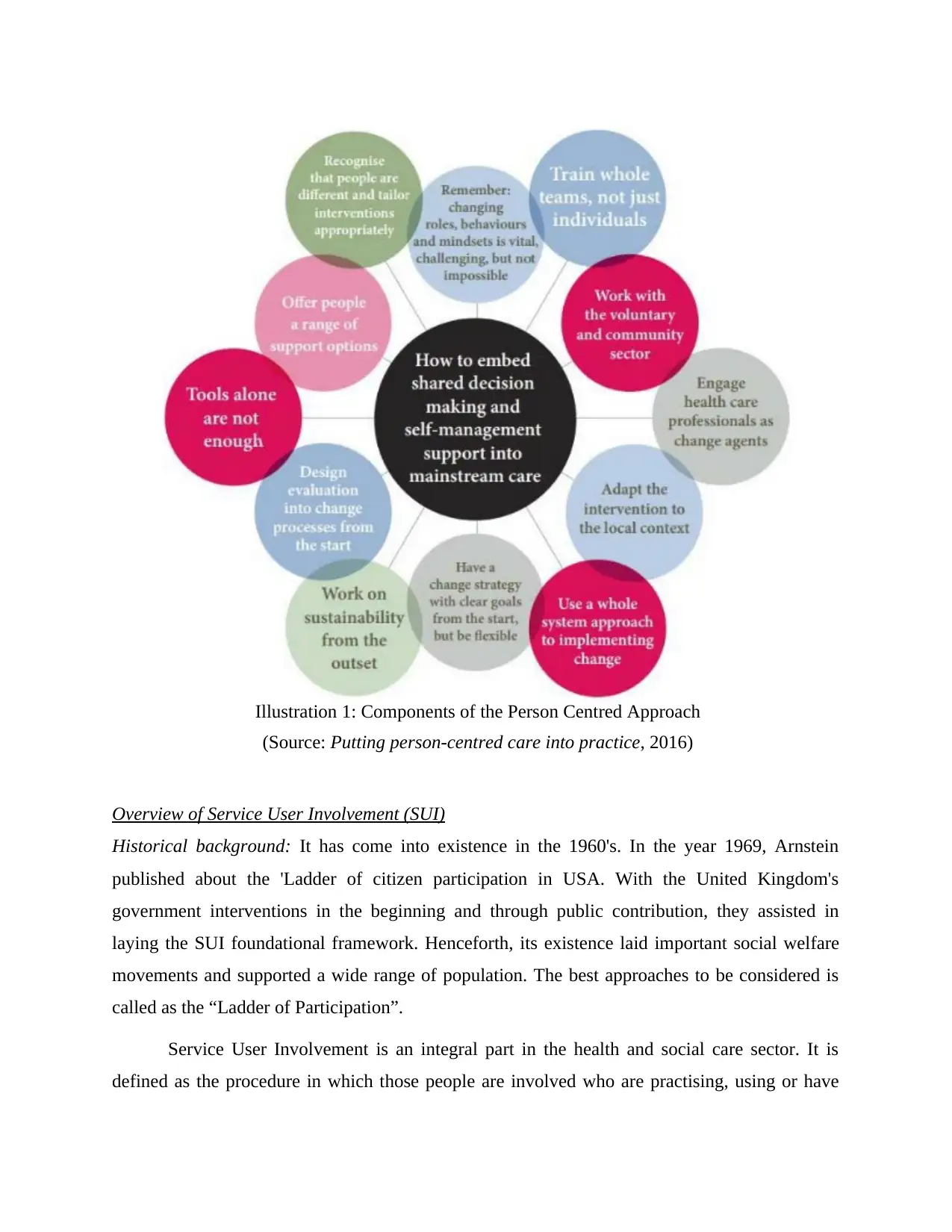
Illustration 1: Components of the Person Centred Approach
(Source: Putting person-centred care into practice, 2016)
Historical background: It has come into existence in the 1960's. In the year 1969, Arnstein
published about the 'Ladder of citizen participation in USA. With the United Kingdom's
government interventions in the beginning and through public contribution, they assisted in
laying the SUI foundational framework. Henceforth, its existence laid important social welfare
movements and supported a wide range of population. The best approaches to be considered is
called as the “Ladder of Participation”.
Service User Involvement is an integral part in the health and social care sector. It is
defined as the procedure in which those people are involved who are practising, using or have
Illustration 1: Components of the Person Centred Approach
(Source: Putting person-centred care into practice, 2016)
already used any service. This led them to be participative in the entire outline of planning,
developing and delivery of that service. This makes the service users empower by encouraging
their viewpoints in the planning (McCormack, 2017). For instance, it is considered useful in
laying the concerned principles of SUI with resect to the operational activities of the institutions,
organisations of the heath and social care services. This contains tasks such as establishing care
plans or PCA's, conducting examinations/tests etc. or planning the referrals.
Furthermore, it shed light on the step by step making decisions in relation to the people
involved, techniques or methods to be used in order to manage the criteria and objectives while
providing services. There are several tools that engage these service users and includes joining
the focus groups, using panels or platforms to vocal their voices/concerns/queries, organizing
surveys. Along this, usage of social media techniques and making short films have also been
encouraged to involve them in more prominent order. Whereas, on the other side, the major
drawback is the absence of representative while performing techniques for SUI. This leads to an
ambiguity in terms of sharing opinions, judgements, discussions regarding any health issue
related policies or service development (Hardyman, Daunt and Kitchener,2015). Along this, the
value and worth of such users' involvement is contradicting and affects the outcomes when
different perspectives get clashed without any proper authority. Additionally, it also brought
attention towards the validity and reliability attached with it to represent in with authentication.
developing and delivery of that service. This makes the service users empower by encouraging
their viewpoints in the planning (McCormack, 2017). For instance, it is considered useful in
laying the concerned principles of SUI with resect to the operational activities of the institutions,
organisations of the heath and social care services. This contains tasks such as establishing care
plans or PCA's, conducting examinations/tests etc. or planning the referrals.
Furthermore, it shed light on the step by step making decisions in relation to the people
involved, techniques or methods to be used in order to manage the criteria and objectives while
providing services. There are several tools that engage these service users and includes joining
the focus groups, using panels or platforms to vocal their voices/concerns/queries, organizing
surveys. Along this, usage of social media techniques and making short films have also been
encouraged to involve them in more prominent order. Whereas, on the other side, the major
drawback is the absence of representative while performing techniques for SUI. This leads to an
ambiguity in terms of sharing opinions, judgements, discussions regarding any health issue
related policies or service development (Hardyman, Daunt and Kitchener,2015). Along this, the
value and worth of such users' involvement is contradicting and affects the outcomes when
different perspectives get clashed without any proper authority. Additionally, it also brought
attention towards the validity and reliability attached with it to represent in with authentication.
⊘ This is a preview!⊘
Do you want full access?
Subscribe today to unlock all pages.
Trusted by 1+ million students worldwide
Development of policies
Policy framework is the basis for executing the operations' and tasks in a structured and
aligned manner. There is a good deal of health care organisations and regulatory institutions such
as NHS England, Public Health England, CQC, NICE and more to
promote the concept Person Centred Approach/Service User Involvement. Hereby, such policies
are imperative to communicate about the objectives, outcomes with the staff, personnel,
employees' in more profound manner to gain insights while making decisions.
National Health Services- Their mandate mainly comprises five key-areas to understand the
changes made to incorporate the above mentioned approaches effectually.
This institution helps the public by improving the transparency and brining equality for
accessing the health services.
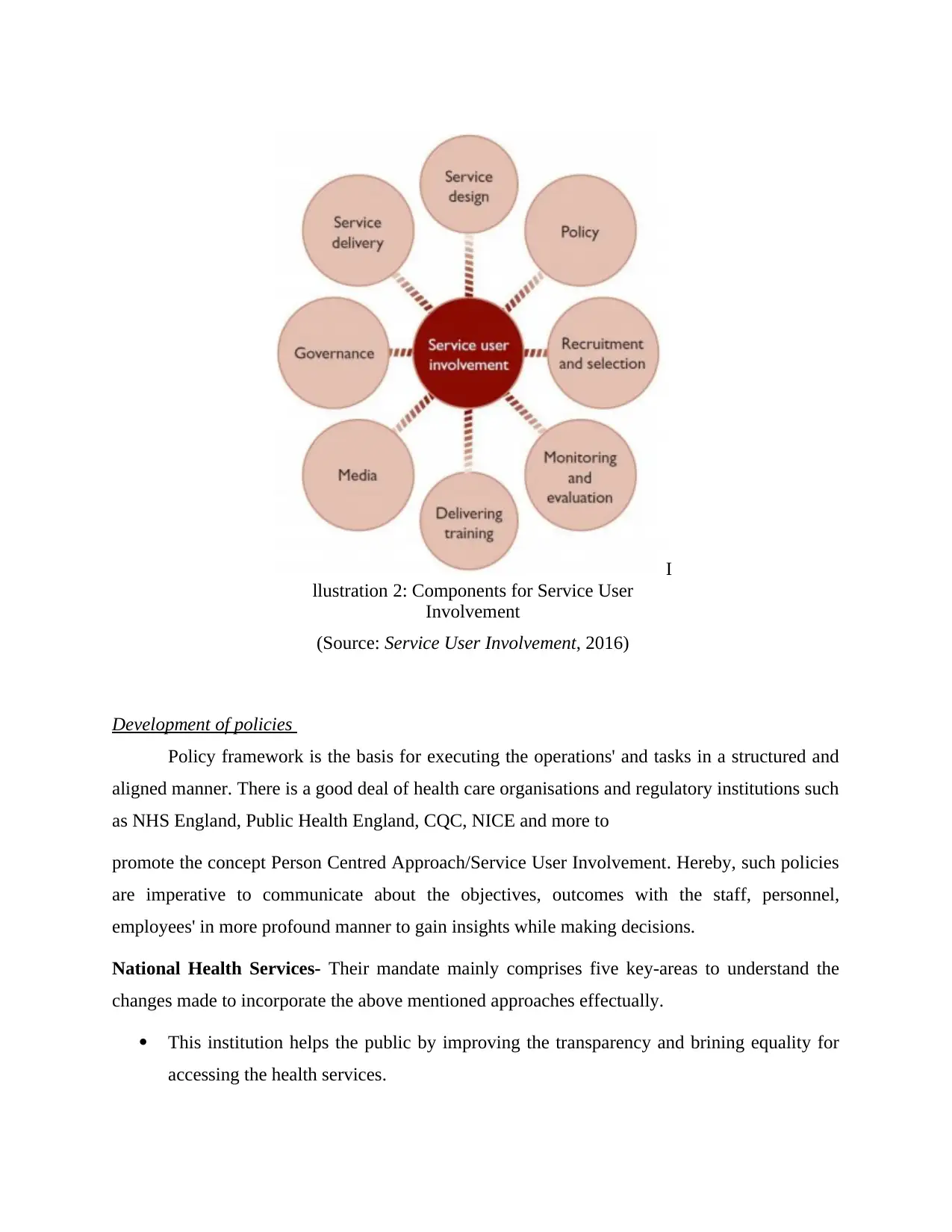
I
llustration 2: Components for Service User
Involvement
(Source: Service User Involvement, 2016)
Policy framework is the basis for executing the operations' and tasks in a structured and
aligned manner. There is a good deal of health care organisations and regulatory institutions such
as NHS England, Public Health England, CQC, NICE and more to
promote the concept Person Centred Approach/Service User Involvement. Hereby, such policies
are imperative to communicate about the objectives, outcomes with the staff, personnel,
employees' in more profound manner to gain insights while making decisions.
National Health Services- Their mandate mainly comprises five key-areas to understand the
changes made to incorporate the above mentioned approaches effectually.
This institution helps the public by improving the transparency and brining equality for
accessing the health services.
I
llustration 2: Components for Service User
Involvement
(Source: Service User Involvement, 2016)
Paraphrase This Document
Need a fresh take? Get an instant paraphrase of this document with our AI Paraphraser
This enhances the individual's life quality by integrating the diagnosis and care with use
of technological advancements.
This focuses on prevention of deaths from prematurity of any diseases.
Their agenda is to measure, support and improve the standards of care and providing
support, better access in terms of the services.
By providing proper treatment and suitable care to individuals through a safe and
protected environment with minimal danger or harmful effects.
In this context, NHS has the following policies to maintain and manage the governance in
the most orderly manner. They highlighted the importance of strict adherence to these policies
for better standards.
Health and Safety Policy: It is one of the important policies that addresses the commitment of the
professionals for bringing transparency and reliability in adopting the methods and techniques
for effective health and safety.
Information Sharing and Confidentiality Policy: This is significant to govern the entire
framework in more secured manner. In this regard, the patients and their medical history is
protected along with having the freedom of information only when it is concerned with the well-
being and safeguarding them.
Sustainable Development Policy: It has been founded to create equal opportunities in order to
meet the people needs for encouraging the personal well-being in association with social
cohesion. This is to bring an equilibrium between varied needs to fulfil the gaps led by socio-
economic and environmental factors.
Equality Delivery System: This is developed to subject the particular Section 149 of the Equality
Act 2010 along with lines of the Equality and Human Rights Commission (EHRC). The ulterior
motive is to promote the equality objectives by enhanced accountability, transparency and
understanding to address the information and feedback.
of technological advancements.
This focuses on prevention of deaths from prematurity of any diseases.
Their agenda is to measure, support and improve the standards of care and providing
support, better access in terms of the services.
By providing proper treatment and suitable care to individuals through a safe and
protected environment with minimal danger or harmful effects.
In this context, NHS has the following policies to maintain and manage the governance in
the most orderly manner. They highlighted the importance of strict adherence to these policies
for better standards.
Health and Safety Policy: It is one of the important policies that addresses the commitment of the
professionals for bringing transparency and reliability in adopting the methods and techniques
for effective health and safety.
Information Sharing and Confidentiality Policy: This is significant to govern the entire
framework in more secured manner. In this regard, the patients and their medical history is
protected along with having the freedom of information only when it is concerned with the well-
being and safeguarding them.
Sustainable Development Policy: It has been founded to create equal opportunities in order to
meet the people needs for encouraging the personal well-being in association with social
cohesion. This is to bring an equilibrium between varied needs to fulfil the gaps led by socio-
economic and environmental factors.
Equality Delivery System: This is developed to subject the particular Section 149 of the Equality
Act 2010 along with lines of the Equality and Human Rights Commission (EHRC). The ulterior
motive is to promote the equality objectives by enhanced accountability, transparency and
understanding to address the information and feedback.
Department and Care Quality Commission (CQC)- It is one of the non-departmental public
bodies which comes under the Health and Social Care Act 2008. Their objective is to impart an
assurance for health and adult social care services for greater quality and safety as well. Along
this, they present an organisational view in a definite manner and are as follows:
Their focus is on complete customization and editing of the tasks and activities assigned.
They minimise the risks by using consistent and standardized practices.
Application of a Plan-Do-Check-Act quality Assurance Cycle is promoted to form a
coherent and clear framework for better performance management.
They promote the responsible behaviour by controlling the spread of any illness or
mental health issue or disability by giving timely and sufficient care planning.
There is need of maintaining and managing an accessible system to recognise, receive
and review the complaints and other relatable queries from stakeholders.
Furthermore, their major agenda is to understand the inherit risks and its related
complicated issues and make informed decisions to improvise the care and other treatment
options. This makes sure that there is a legal framework underpinning the consensual planning,
implementing and evaluating the treatments, procedures by the professional setup. Henceforth,
their approach is to bring a uniformity between people and the professional set-up.
Extension of the overview of PCA / SUI with respect to policies
These regulations and policies laid the foundation of proper guidance with suitable
framework that consists of an autonomy and validity. They describe that such institutions act as
key regulators in auditing and bringing authoritative instructions to develop positive outcomes.
Such policies not only support in liberation of the involved professionals but also analyse the
people manifestation towards the various procedures and methods (Brooker and Latham, 2015).
They help in the extension of the fiscal accountability to reap benefits so that further, facilities,
equipments and helping staff can be made responsible and motivated to give the best possible
outcomes. Alongside, the collaborations between NHSE,CCGs and other organisations assisted
in minimising the complexities and make the entire system in a centralised manner without
defining any structural changes. Moreover, these promote the principles of PCA/SUI through
favouring them from a professional outlook.
bodies which comes under the Health and Social Care Act 2008. Their objective is to impart an
assurance for health and adult social care services for greater quality and safety as well. Along
this, they present an organisational view in a definite manner and are as follows:
Their focus is on complete customization and editing of the tasks and activities assigned.
They minimise the risks by using consistent and standardized practices.
Application of a Plan-Do-Check-Act quality Assurance Cycle is promoted to form a
coherent and clear framework for better performance management.
They promote the responsible behaviour by controlling the spread of any illness or
mental health issue or disability by giving timely and sufficient care planning.
There is need of maintaining and managing an accessible system to recognise, receive
and review the complaints and other relatable queries from stakeholders.
Furthermore, their major agenda is to understand the inherit risks and its related
complicated issues and make informed decisions to improvise the care and other treatment
options. This makes sure that there is a legal framework underpinning the consensual planning,
implementing and evaluating the treatments, procedures by the professional setup. Henceforth,
their approach is to bring a uniformity between people and the professional set-up.
Extension of the overview of PCA / SUI with respect to policies
These regulations and policies laid the foundation of proper guidance with suitable
framework that consists of an autonomy and validity. They describe that such institutions act as
key regulators in auditing and bringing authoritative instructions to develop positive outcomes.
Such policies not only support in liberation of the involved professionals but also analyse the
people manifestation towards the various procedures and methods (Brooker and Latham, 2015).
They help in the extension of the fiscal accountability to reap benefits so that further, facilities,
equipments and helping staff can be made responsible and motivated to give the best possible
outcomes. Alongside, the collaborations between NHSE,CCGs and other organisations assisted
in minimising the complexities and make the entire system in a centralised manner without
defining any structural changes. Moreover, these promote the principles of PCA/SUI through
favouring them from a professional outlook.
⊘ This is a preview!⊘
Do you want full access?
Subscribe today to unlock all pages.
Trusted by 1+ million students worldwide
Person Centred Approach
Challenges: There are many barriers such as lack of skilled and well-supported taskforce,
stringent administrative supervision, over-dependency on families to take care, keeping the
service users to have minimal control over the access to mainstream policies, regulations etc. It
has also seen some queries regarding the payment systems that might act as an obstacle when
using PCA in real time (Elwyn and et.al., 2014). Moreover, it emphasis on a set of wide range of
tools and techniques with an uncertain duration for treating the patients as the partners for overall
treatment. However, this hinders their development and disempowers them by operating at
increased bureaucratisation in terms of operational activities conducted by the professionals,
nurses and more. Along with this, there is still a dominance of the paternalistic culture in this
approach which leads to ambiguous assumptions and affects the relationships between the
nurses, practitioners, counsellors and the patients/service users.
Impact: Due to the above mentioned causes, there are detrimental effects on the development
and delivery of healthcare services. This can be bifurcated into a constant and prolonged
deficiency of funding for proper social care and the consistent discomfort to accept this approach
in terms of societal norms or cultural differences. The professional set-up including the
counsellors, doctors, nurses, practitioners etc. lack the support from families or regulatory bodies
as capacity building is still behind the required benchmark. It means they need resources, capital,
etc. to find suitable techniques, guidance and advocacy to fulfil the service users' expectations
and needs (Kitson and et.al., 2013). Henceforth, the impact is undermining the holistic approach
of person centred approach which promote the inclusive nature and equality for sustenance.
Strategies: In order to overcome the challenges, support and value must be given to the staff so
that they can in turn give out the best efforts to improve the patients' experience of care.
Nevertheless, proper retentions must be encouraged by giving training and induction programs in
simplified and systematic manner to enhance the relationships between the practitioners and the
patients. There must be unified priority to be given for bringing positive changes in
communication and listening skills to ensure a developmental inclusion to mitigate the risks and
assumptions made in context to the PCA. Along this, importance must be given in identifying the
associated regulations and policies, especially in relation to the ethical and cultural differences of
the patents and their families.
Challenges: There are many barriers such as lack of skilled and well-supported taskforce,
stringent administrative supervision, over-dependency on families to take care, keeping the
service users to have minimal control over the access to mainstream policies, regulations etc. It
has also seen some queries regarding the payment systems that might act as an obstacle when
using PCA in real time (Elwyn and et.al., 2014). Moreover, it emphasis on a set of wide range of
tools and techniques with an uncertain duration for treating the patients as the partners for overall
treatment. However, this hinders their development and disempowers them by operating at
increased bureaucratisation in terms of operational activities conducted by the professionals,
nurses and more. Along with this, there is still a dominance of the paternalistic culture in this
approach which leads to ambiguous assumptions and affects the relationships between the
nurses, practitioners, counsellors and the patients/service users.
Impact: Due to the above mentioned causes, there are detrimental effects on the development
and delivery of healthcare services. This can be bifurcated into a constant and prolonged
deficiency of funding for proper social care and the consistent discomfort to accept this approach
in terms of societal norms or cultural differences. The professional set-up including the
counsellors, doctors, nurses, practitioners etc. lack the support from families or regulatory bodies
as capacity building is still behind the required benchmark. It means they need resources, capital,
etc. to find suitable techniques, guidance and advocacy to fulfil the service users' expectations
and needs (Kitson and et.al., 2013). Henceforth, the impact is undermining the holistic approach
of person centred approach which promote the inclusive nature and equality for sustenance.
Strategies: In order to overcome the challenges, support and value must be given to the staff so
that they can in turn give out the best efforts to improve the patients' experience of care.
Nevertheless, proper retentions must be encouraged by giving training and induction programs in
simplified and systematic manner to enhance the relationships between the practitioners and the
patients. There must be unified priority to be given for bringing positive changes in
communication and listening skills to ensure a developmental inclusion to mitigate the risks and
assumptions made in context to the PCA. Along this, importance must be given in identifying the
associated regulations and policies, especially in relation to the ethical and cultural differences of
the patents and their families.
Paraphrase This Document
Need a fresh take? Get an instant paraphrase of this document with our AI Paraphraser
Service User Involvement
Challenges: The major barrier here is the presentation of the information and data. People still
believe the experts, specialists and the clinical opinions which have been testimonial by
reliability and validity. Along with this, the dependency parameter is completely discouraged in
this approach; however, the mechanisms related to service user involvement is still in connection
with the traditional outlooks that foster the joint working between the practitioners and the
service users. Such proximity leads to an open scrutiny which might hamper the
conceptualization and customization that are required in adopting such approach. It leads to
inflexible control in completing the tasks (Nelson and et.al., 2015). Moreover, there is direct or
indirect influence of the staff on the service users' mindset. For e.g. when any particular religious
belief follower comes into this cyclic loop, the environment might get disturbed due to the
pressure of the external forces or when the practitioner has poor ethical norms and moral values
then it might lead to adverse effects on the treatment.
Impact: SUI has put additional burden on the working practises of the heath and social care
services. These barriers have hampered the development, progress and delivery in the most
critical aspects. Hereby, the lack of awareness leads to ineffective interventions and expectations
between the service user and the practitioners, nurses and other professionals. There is a sudden
rise of tailored approaches that creates gaps in terms of communication, details about the
contacts of family and visitors and giving regular feedbacks. Such practices slowed down the
progress of participation and involvement of the staff and professionals that affected the overall
impact in the delivery of services. Additionally, the entire designing part becomes tedious and
lack conviction to attain the support and care the service users desire for.
Strategies: There is a great need to put a strategic planning in generating appropriate reduction
methods to minimise the challenges. It will directly reap benefits and assist in improving the
patients' experience of care. An audit can be implemented to understand the gaps and help in
studying the assessment related to tools, methods and techniques. Along with, periodical
feedback is imperative to know about the shortcomings and barriers that have posed adverse
effects on the SUI approach (Freeth, 2017). With this, establishment of service user groups
would pave the path to maintain the communication channels between them and the professional
help which consists of the administration, nurses etc. so that there will be no scope of
misjudgements or errors.
Challenges: The major barrier here is the presentation of the information and data. People still
believe the experts, specialists and the clinical opinions which have been testimonial by
reliability and validity. Along with this, the dependency parameter is completely discouraged in
this approach; however, the mechanisms related to service user involvement is still in connection
with the traditional outlooks that foster the joint working between the practitioners and the
service users. Such proximity leads to an open scrutiny which might hamper the
conceptualization and customization that are required in adopting such approach. It leads to
inflexible control in completing the tasks (Nelson and et.al., 2015). Moreover, there is direct or
indirect influence of the staff on the service users' mindset. For e.g. when any particular religious
belief follower comes into this cyclic loop, the environment might get disturbed due to the
pressure of the external forces or when the practitioner has poor ethical norms and moral values
then it might lead to adverse effects on the treatment.
Impact: SUI has put additional burden on the working practises of the heath and social care
services. These barriers have hampered the development, progress and delivery in the most
critical aspects. Hereby, the lack of awareness leads to ineffective interventions and expectations
between the service user and the practitioners, nurses and other professionals. There is a sudden
rise of tailored approaches that creates gaps in terms of communication, details about the
contacts of family and visitors and giving regular feedbacks. Such practices slowed down the
progress of participation and involvement of the staff and professionals that affected the overall
impact in the delivery of services. Additionally, the entire designing part becomes tedious and
lack conviction to attain the support and care the service users desire for.
Strategies: There is a great need to put a strategic planning in generating appropriate reduction
methods to minimise the challenges. It will directly reap benefits and assist in improving the
patients' experience of care. An audit can be implemented to understand the gaps and help in
studying the assessment related to tools, methods and techniques. Along with, periodical
feedback is imperative to know about the shortcomings and barriers that have posed adverse
effects on the SUI approach (Freeth, 2017). With this, establishment of service user groups
would pave the path to maintain the communication channels between them and the professional
help which consists of the administration, nurses etc. so that there will be no scope of
misjudgements or errors.
Theories related to SUI
There are several theories that laid the foundation for better adoption of reforms and
establishment of secular system in the health and social care sector, devoid of any challenges and
social stigmas. Thus, it helps in proficient utilisation of the work areas by using such approaches
to manage the resources and staff properly.
Utilization Management:
It is one of the management theories to safeguard the patients' confidentiality and
complete assessment of their treatment plan in cost effective manner. There are many
components that reflects on the collection, supervision and evaluation of the specified timelines
given to understand the needs, requirements and necessities of services users and their families.
The major implications this theory is that patients receive the treatments and related services at
the right time with right approachability.
This theory's principles help in the determination of the accuracy, viability and proper
appropriateness in context to the health and social care services. It lays the foundation of
eradication of unnecessary services and aid in analysing the unsuitability of few pre-determined
methods and the patterns that have been followed by the professional help (Jurgutis and et.al.,
2012). This theory has redefined the education programs in more authentic and practical manner
to sustain with generation of profits and enhanced productivity.
Furthermore, this has led the management of care and support in forwarding direction by
bridging the costs, value and standardizing processes. This theory acted as the relationship
builders for the growth of the organization with re-assigning and re-aligning the practitioners,
administration, staff, additional personnel, patients, shareholders and others.
There are several theories that laid the foundation for better adoption of reforms and
establishment of secular system in the health and social care sector, devoid of any challenges and
social stigmas. Thus, it helps in proficient utilisation of the work areas by using such approaches
to manage the resources and staff properly.
Utilization Management:
It is one of the management theories to safeguard the patients' confidentiality and
complete assessment of their treatment plan in cost effective manner. There are many
components that reflects on the collection, supervision and evaluation of the specified timelines
given to understand the needs, requirements and necessities of services users and their families.
The major implications this theory is that patients receive the treatments and related services at
the right time with right approachability.
This theory's principles help in the determination of the accuracy, viability and proper
appropriateness in context to the health and social care services. It lays the foundation of
eradication of unnecessary services and aid in analysing the unsuitability of few pre-determined
methods and the patterns that have been followed by the professional help (Jurgutis and et.al.,
2012). This theory has redefined the education programs in more authentic and practical manner
to sustain with generation of profits and enhanced productivity.
Furthermore, this has led the management of care and support in forwarding direction by
bridging the costs, value and standardizing processes. This theory acted as the relationship
builders for the growth of the organization with re-assigning and re-aligning the practitioners,
administration, staff, additional personnel, patients, shareholders and others.
⊘ This is a preview!⊘
Do you want full access?
Subscribe today to unlock all pages.
Trusted by 1+ million students worldwide

1 out of 19


Related Documents


Your All-in-One AI-Powered Toolkit for Academic Success.
+13062052269
info@desklib.com
Available 24*7 on WhatsApp / Email
![[object Object]](/_next/static/media/star-bottom.7253800d.svg)
Unlock your academic potential
Copyright © 2020–2026 A2Z Services. All Rights Reserved. Developed and managed by ZUCOL.