University Name - HRM7001: Personal and Business Transformation Report
VerifiedAdded on 2022/09/07
|23
|6808
|17
Report
AI Summary
This report examines the business transformation strategies of the '2 Sisters Food Group,' a UK-based food manufacturing company. It analyzes the organizational structure, organizational behavior theories, and various leadership approaches implemented. The report explores the impact of technological, marketing, social, legal, and personnel changes on the organization. Furthermore, it highlights HR strategies for managing these changes, including a personal development plan to enhance employability. The report also covers the company's potential, training and development plans, and methods for measuring results, culminating in a critical awareness of learning and interaction methods. The report provides a comprehensive overview of the company's transformation journey and the strategies employed to adapt to a dynamic business environment.
Running Head: PERSONAL AND BUSINESS TRANSFORMATION
Personal and Business Transformation
Name of the student:
Name of the University:
Author note:
Personal and Business Transformation
Name of the student:
Name of the University:
Author note:

Paraphrase This Document
Need a fresh take? Get an instant paraphrase of this document with our AI Paraphraser
1PERSONAL AND BUSINESS TRANSFORMATION
Abstract:
The report will focus on the business transformation and the strategies adopted by the ‘2
sisters Food Group’. The food manufacturing private company operates from Birmingham in
United Kingdom. The report will study the organizational structure, its relation to the various
changes. The report will highlight the various HR strategies that will be applied to make the
company adopt to the changes in a more flexible manner.
Abstract:
The report will focus on the business transformation and the strategies adopted by the ‘2
sisters Food Group’. The food manufacturing private company operates from Birmingham in
United Kingdom. The report will study the organizational structure, its relation to the various
changes. The report will highlight the various HR strategies that will be applied to make the
company adopt to the changes in a more flexible manner.
2PERSONAL AND BUSINESS TRANSFORMATION
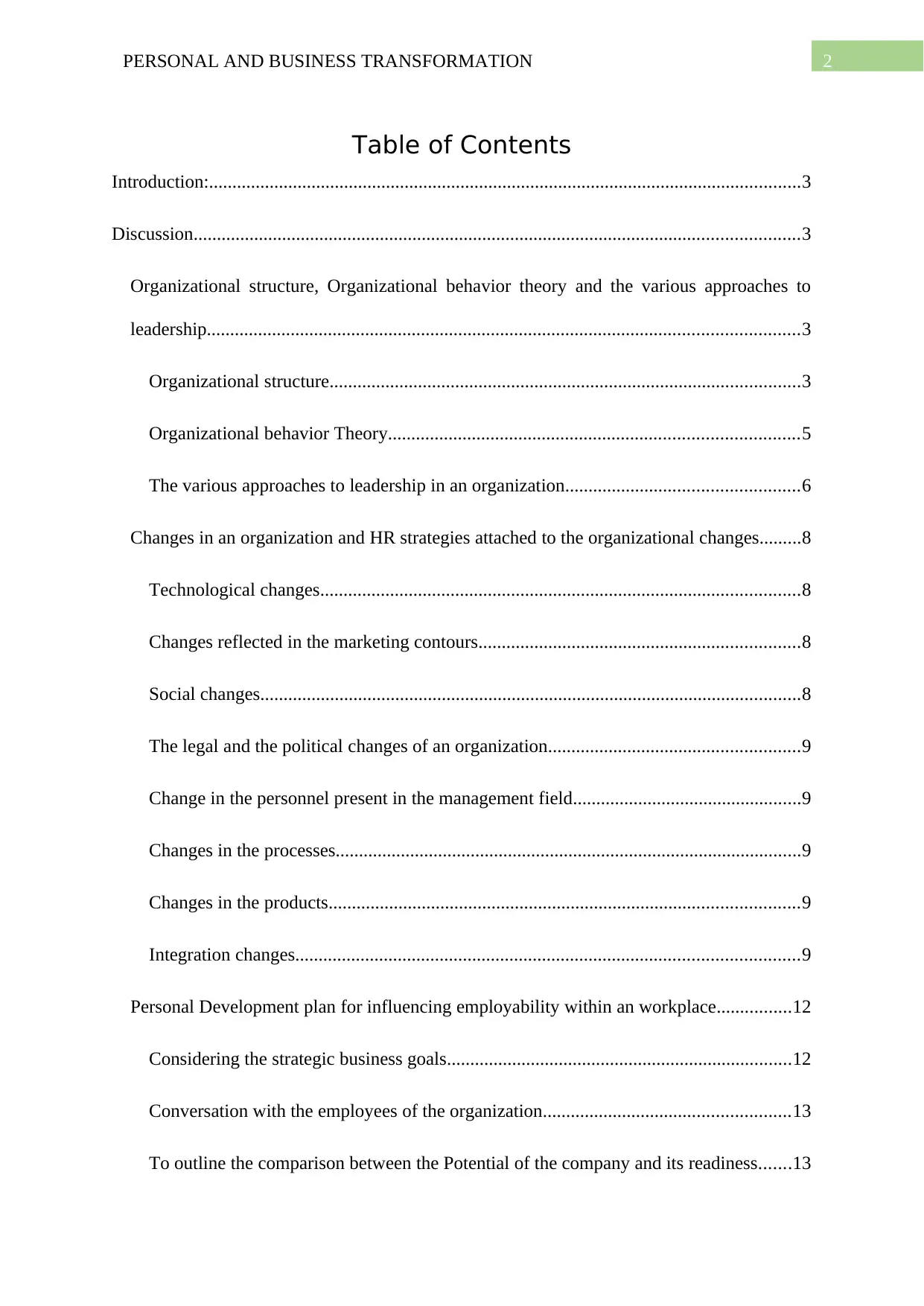
Table of Contents
Introduction:...............................................................................................................................3
Discussion..................................................................................................................................3
Organizational structure, Organizational behavior theory and the various approaches to
leadership...............................................................................................................................3
Organizational structure.....................................................................................................3
Organizational behavior Theory........................................................................................5
The various approaches to leadership in an organization..................................................6
Changes in an organization and HR strategies attached to the organizational changes.........8
Technological changes.......................................................................................................8
Changes reflected in the marketing contours.....................................................................8
Social changes....................................................................................................................8
The legal and the political changes of an organization......................................................9
Change in the personnel present in the management field.................................................9
Changes in the processes....................................................................................................9
Changes in the products.....................................................................................................9
Integration changes............................................................................................................9
Personal Development plan for influencing employability within an workplace................12
Considering the strategic business goals..........................................................................12
Conversation with the employees of the organization.....................................................13
To outline the comparison between the Potential of the company and its readiness.......13
Table of Contents
Introduction:...............................................................................................................................3
Discussion..................................................................................................................................3
Organizational structure, Organizational behavior theory and the various approaches to
leadership...............................................................................................................................3
Organizational structure.....................................................................................................3
Organizational behavior Theory........................................................................................5
The various approaches to leadership in an organization..................................................6
Changes in an organization and HR strategies attached to the organizational changes.........8
Technological changes.......................................................................................................8
Changes reflected in the marketing contours.....................................................................8
Social changes....................................................................................................................8
The legal and the political changes of an organization......................................................9
Change in the personnel present in the management field.................................................9
Changes in the processes....................................................................................................9
Changes in the products.....................................................................................................9
Integration changes............................................................................................................9
Personal Development plan for influencing employability within an workplace................12
Considering the strategic business goals..........................................................................12
Conversation with the employees of the organization.....................................................13
To outline the comparison between the Potential of the company and its readiness.......13
⊘ This is a preview!⊘
Do you want full access?
Subscribe today to unlock all pages.

Trusted by 1+ million students worldwide
3PERSONAL AND BUSINESS TRANSFORMATION
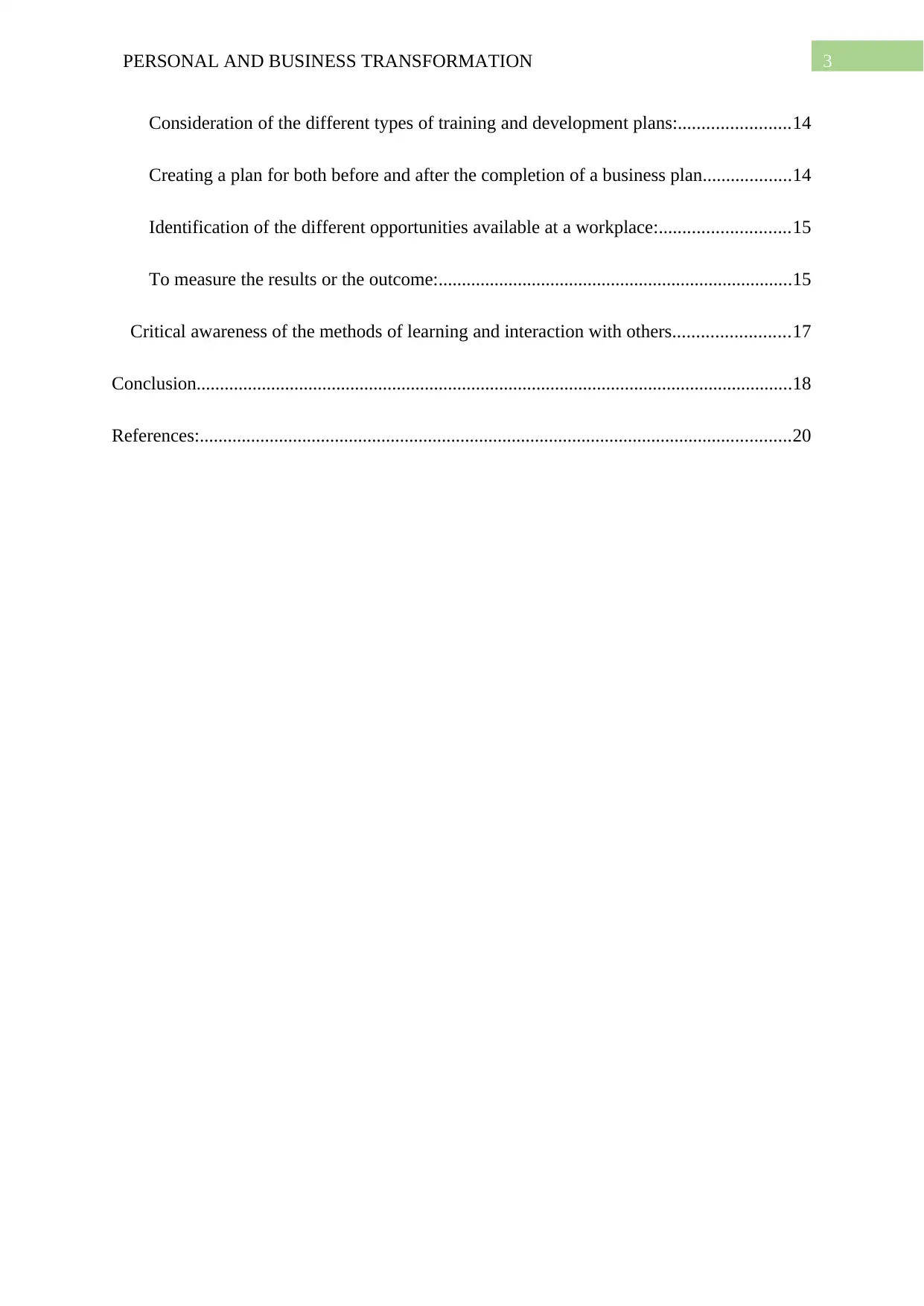
Consideration of the different types of training and development plans:........................14
Creating a plan for both before and after the completion of a business plan...................14
Identification of the different opportunities available at a workplace:............................15
To measure the results or the outcome:............................................................................15
Critical awareness of the methods of learning and interaction with others.........................17
Conclusion................................................................................................................................18
References:...............................................................................................................................20
Consideration of the different types of training and development plans:........................14
Creating a plan for both before and after the completion of a business plan...................14
Identification of the different opportunities available at a workplace:............................15
To measure the results or the outcome:............................................................................15
Critical awareness of the methods of learning and interaction with others.........................17
Conclusion................................................................................................................................18
References:...............................................................................................................................20
Paraphrase This Document
Need a fresh take? Get an instant paraphrase of this document with our AI Paraphraser
4PERSONAL AND BUSINESS TRANSFORMATION
Introduction:
The two sisters Food Group is a private food-manufacturing unit that works from
Birmingham, United Kingdom. The Indian origin entrepreneur Ranjit Singh Boparan
established the company in in 1993. The company initially started as a retail of frozen poultry
in it cutting operation edge. Since them, the company has recorded a high growth rate
through the acquisition and the expansion programs that covers around 36 manufacturing
sites of UK, out of the 36, 6 manufacturing sites are present in Netherlands, one is present in
Ireland and Poland each.It primarily worked as a private label manufacturer for the food
service markets in general and for the retailer specifically. The acquisition of the Northern
Foods Industry in the year 2011 gave the ownership right to the brand that includes the Fox’s
Biscuits, Goodfella pizza brands and the Mathew Walker Christmas Puddings and at present,
it works as the largest food company by turnover in the U.K (Shafritz and 2015).
Discussion
Organizational structure, Organizational behavior theory and the various approaches
to leadership
Organizational structure
An organizational structure can be defined as that mechanism that is used to define the
hierarchy that exists in an organization. An organizational structure outlines the process in
which certain activities are carried out in order to achieve the specific goals of an
organization. These activities include various rules, regulations and the responsibilities. The
organizational structure also help to determine how the information will circulate between the
different levels of a company. For instance in case of a centralized structure, the flow of
decisions and information take place in a top to bottom manner. Whereas in a decentralized
Introduction:
The two sisters Food Group is a private food-manufacturing unit that works from
Birmingham, United Kingdom. The Indian origin entrepreneur Ranjit Singh Boparan
established the company in in 1993. The company initially started as a retail of frozen poultry
in it cutting operation edge. Since them, the company has recorded a high growth rate
through the acquisition and the expansion programs that covers around 36 manufacturing
sites of UK, out of the 36, 6 manufacturing sites are present in Netherlands, one is present in
Ireland and Poland each.It primarily worked as a private label manufacturer for the food
service markets in general and for the retailer specifically. The acquisition of the Northern
Foods Industry in the year 2011 gave the ownership right to the brand that includes the Fox’s
Biscuits, Goodfella pizza brands and the Mathew Walker Christmas Puddings and at present,
it works as the largest food company by turnover in the U.K (Shafritz and 2015).
Discussion
Organizational structure, Organizational behavior theory and the various approaches
to leadership
Organizational structure
An organizational structure can be defined as that mechanism that is used to define the
hierarchy that exists in an organization. An organizational structure outlines the process in
which certain activities are carried out in order to achieve the specific goals of an
organization. These activities include various rules, regulations and the responsibilities. The
organizational structure also help to determine how the information will circulate between the
different levels of a company. For instance in case of a centralized structure, the flow of
decisions and information take place in a top to bottom manner. Whereas in a decentralized
5PERSONAL AND BUSINESS TRANSFORMATION
structure, the decision making power is distributed among the different levels of the
organization. The organizational structure helps a company to work in an efficient manner
and how to remain focused in its decision making process. Businesses of various shapes and
sizes take the help of organizational structures largely. The organizational structure highlights
a certain hierarchical procedure that is present in an organization. A good structure of an
organization clearly states the employees’ job requirements and it will be applied in the
overall organizational structure and provides a layout of the allocation of the work among the
employees so that the company can efficiently meet the overall objectives. This process will
provide a visual representation to the company and it is shaping phenomenon towards the
direction of the achievement of the different objectives. The organizational structure can be
illustrated in the form of charts or a pyramid like diagram where the most powerful members
of the organization are placed at the top and the least powerful members placed at the bottom.
In the absence of a proper structure, the employees may face a lot of difficulty in performing
well and creates a communication gap between the owners and their employees. This leads to
a certain level of uncertainty about the person who will be held responsible tasks in an
organization. Organizational structure can be of various categories like centralized and
decentralized structures or bureaucratic or business oriented organizational structure. A
centralized organizational structure has the presence of a central leadership and has a defined
channel of command. On the other hand, a decentralized structure allows the companies to
remain fast and adaptable with each employee receiving a high level of personal agency.
Similarly, a bureaucratic organizational structure categorizes the entire company, which is
influenced by the specialization of the workforce. The small and medium sized business
companies implements a sound functional structure. A proper bureaucratic structure involves
the division of any firm into various departments that deals with marketing and sales and
other such operation. A business oriented organizational structure involves the larger
structure, the decision making power is distributed among the different levels of the
organization. The organizational structure helps a company to work in an efficient manner
and how to remain focused in its decision making process. Businesses of various shapes and
sizes take the help of organizational structures largely. The organizational structure highlights
a certain hierarchical procedure that is present in an organization. A good structure of an
organization clearly states the employees’ job requirements and it will be applied in the
overall organizational structure and provides a layout of the allocation of the work among the
employees so that the company can efficiently meet the overall objectives. This process will
provide a visual representation to the company and it is shaping phenomenon towards the
direction of the achievement of the different objectives. The organizational structure can be
illustrated in the form of charts or a pyramid like diagram where the most powerful members
of the organization are placed at the top and the least powerful members placed at the bottom.
In the absence of a proper structure, the employees may face a lot of difficulty in performing
well and creates a communication gap between the owners and their employees. This leads to
a certain level of uncertainty about the person who will be held responsible tasks in an
organization. Organizational structure can be of various categories like centralized and
decentralized structures or bureaucratic or business oriented organizational structure. A
centralized organizational structure has the presence of a central leadership and has a defined
channel of command. On the other hand, a decentralized structure allows the companies to
remain fast and adaptable with each employee receiving a high level of personal agency.
Similarly, a bureaucratic organizational structure categorizes the entire company, which is
influenced by the specialization of the workforce. The small and medium sized business
companies implements a sound functional structure. A proper bureaucratic structure involves
the division of any firm into various departments that deals with marketing and sales and
other such operation. A business oriented organizational structure involves the larger
⊘ This is a preview!⊘
Do you want full access?
Subscribe today to unlock all pages.
Trusted by 1+ million students worldwide
6PERSONAL AND BUSINESS TRANSFORMATION
companies that consists of various multidivisional structure, or a company that has various
methodological structures in its leadership team based on certain products or the lines of
business. A recent organizational structure is referred to as the ‘autarchy’ and is mainly used
by the various startup business. As the name indicates, it is used to flatten the hierarchical
chain and the chain of command to ensure a certain degree of autonomy for the employees of
a company (Winnubst 2017).
Organizational behavior Theory
The organizational behavioral theory studies the pattern of human behavior within an
organizational setting. This signifies that the organizational behavior can ask questions about
the causes of the different sorts of human behavior working in the different environments.
Classical management theorists like Frederick W. Taylor developed the concept of
organizational behavior. Considering the importance and the huge impact, that Human
behavior has on any workplace the social scientist Kurt Lewin was critical in the
establishment of the National Training Laboratories (NTL), which is entrusted, with the
pioneering of T- groups which are basically a learning laboratory that helps people to
understand the implications and consequences associated with the individual behavior and
also the behavior of the others. Within each group, there exists a separate place for the
learning methods about the different communication skills, the interpersonal relations and the
individual personality traits and the domain of the different group dynamics, which refers to
the different behavior traits that takes place within a group. These groups also offer a
different space for each individuals to process the group interactions and the reactions of the
members. In 1960s based on the work of Lewin and Maslow, McGregor believed that in
order to create a more satisfying working environment for the individuals separately in order
to create a stable along with an effective organization. The Theory X assumes that people are
mostly lazy, passive and are irresponsible which becomes a limiting factor from helping the
companies that consists of various multidivisional structure, or a company that has various
methodological structures in its leadership team based on certain products or the lines of
business. A recent organizational structure is referred to as the ‘autarchy’ and is mainly used
by the various startup business. As the name indicates, it is used to flatten the hierarchical
chain and the chain of command to ensure a certain degree of autonomy for the employees of
a company (Winnubst 2017).
Organizational behavior Theory
The organizational behavioral theory studies the pattern of human behavior within an
organizational setting. This signifies that the organizational behavior can ask questions about
the causes of the different sorts of human behavior working in the different environments.
Classical management theorists like Frederick W. Taylor developed the concept of
organizational behavior. Considering the importance and the huge impact, that Human
behavior has on any workplace the social scientist Kurt Lewin was critical in the
establishment of the National Training Laboratories (NTL), which is entrusted, with the
pioneering of T- groups which are basically a learning laboratory that helps people to
understand the implications and consequences associated with the individual behavior and
also the behavior of the others. Within each group, there exists a separate place for the
learning methods about the different communication skills, the interpersonal relations and the
individual personality traits and the domain of the different group dynamics, which refers to
the different behavior traits that takes place within a group. These groups also offer a
different space for each individuals to process the group interactions and the reactions of the
members. In 1960s based on the work of Lewin and Maslow, McGregor believed that in
order to create a more satisfying working environment for the individuals separately in order
to create a stable along with an effective organization. The Theory X assumes that people are
mostly lazy, passive and are irresponsible which becomes a limiting factor from helping the
Paraphrase This Document
Need a fresh take? Get an instant paraphrase of this document with our AI Paraphraser
7PERSONAL AND BUSINESS TRANSFORMATION
workers to deliver their best in the organizational context. Theory Y on the other hand
assumes that the people are quite capable to achieve and take responsibility, which will
eventually them to excel in their individual job domains. At its core, the work of McGregor
has aimed to create a better cooperation strategy among the management and the team of
workers to create satisfying environments. The modern organizational theory is based on the
systematic approach that forms a key element in the array of behavioral science. There are
four main area of focus area in the theory of the organizational theory that includes the
individual behavior analysis, the organizational structure and the different processes
associated with the organization. Motivation is another significant factor of the theory of
organizational behavior. Motivation is at times related to that particular level where the
members of the organization who become involved in the different actions and missions.
When considering the motivation factor , there should be a clear line of distinction between
the intrinsic and the extrinsic factors of motivation which too becomes critical at times.
Extrinsic motivation includes the factors like the salary structure, the work environment and
the different types of promotions and terminations. On the other hand the intrinsic motivation
factor is based on the level of reward given in the respect of one‘s own needs (Buchanan and
Huczynski 2019).
The various approaches to leadership in an organization
The significance of leadership emerged in an organization from the growing needs
and expectations of the workers in the organization, the influence that the leaders can bring
on the workers and how their attitudes and the behavioral pattern of the leaders can affect
their followers or the workers in the organization. In the later periods, the leadership emerged
considering the needs and the wants of the modern workers. Therefore, present leadership
requires the proper understanding of the increasing needs and expectation of the people and
the workers should be consulted on a regular basis and should involve their ideas in the
workers to deliver their best in the organizational context. Theory Y on the other hand
assumes that the people are quite capable to achieve and take responsibility, which will
eventually them to excel in their individual job domains. At its core, the work of McGregor
has aimed to create a better cooperation strategy among the management and the team of
workers to create satisfying environments. The modern organizational theory is based on the
systematic approach that forms a key element in the array of behavioral science. There are
four main area of focus area in the theory of the organizational theory that includes the
individual behavior analysis, the organizational structure and the different processes
associated with the organization. Motivation is another significant factor of the theory of
organizational behavior. Motivation is at times related to that particular level where the
members of the organization who become involved in the different actions and missions.
When considering the motivation factor , there should be a clear line of distinction between
the intrinsic and the extrinsic factors of motivation which too becomes critical at times.
Extrinsic motivation includes the factors like the salary structure, the work environment and
the different types of promotions and terminations. On the other hand the intrinsic motivation
factor is based on the level of reward given in the respect of one‘s own needs (Buchanan and
Huczynski 2019).
The various approaches to leadership in an organization
The significance of leadership emerged in an organization from the growing needs
and expectations of the workers in the organization, the influence that the leaders can bring
on the workers and how their attitudes and the behavioral pattern of the leaders can affect
their followers or the workers in the organization. In the later periods, the leadership emerged
considering the needs and the wants of the modern workers. Therefore, present leadership
requires the proper understanding of the increasing needs and expectation of the people and
the workers should be consulted on a regular basis and should involve their ideas in the
8PERSONAL AND BUSINESS TRANSFORMATION
decision making process of the firm. The main approaches to the leadership required in any
organization
The Qualities or Traits approach: This approach believes in the context that leaders cannot be
born they are made in the process and leadership is all about the unique trait in personality or
the qualities inherited by the leader.
The Group or the Functional Approach: This concept believes in the fact that that leadership
can also be developed in the process of learning. This approach puts more emphasis on the
different level of accountabilities, functions and the individual responsibilities of the leaders
and the features of that particular group.
Behavioral approach of leadership: This approach deals with the behavior of the different
people in the different positions of leadership and how the behavior of the leaders influence
the overall group performance.
Apart from the different approaches, there are different styles of leadership like autocratic
leadership that is authoritarian in nature, democratic leadership and the laissez-faire pattern of
leadership. Leadership can also be of solo leader type and team leader. On the degree of
authority of the manager of an organization there are different types of leaders. The
situational approach of leadership determines the styles of leadership that can be applied as
the most effective technique as no single leadership style is appropriate for all situations.
There are also transactional and transformational leadership types, where the transactional
leadership type appears to be beneficial for the workers, which help them to achieve their
organizational goals which is influenced by their organizational position in the organizational
structure. The transformational leadership creates a larger vision for transformation of the
performance of an organization and finds conformity to the high ethics and values of the
organizational structure. The workers will get motivated when their wants and demands are
decision making process of the firm. The main approaches to the leadership required in any
organization
The Qualities or Traits approach: This approach believes in the context that leaders cannot be
born they are made in the process and leadership is all about the unique trait in personality or
the qualities inherited by the leader.
The Group or the Functional Approach: This concept believes in the fact that that leadership
can also be developed in the process of learning. This approach puts more emphasis on the
different level of accountabilities, functions and the individual responsibilities of the leaders
and the features of that particular group.
Behavioral approach of leadership: This approach deals with the behavior of the different
people in the different positions of leadership and how the behavior of the leaders influence
the overall group performance.
Apart from the different approaches, there are different styles of leadership like autocratic
leadership that is authoritarian in nature, democratic leadership and the laissez-faire pattern of
leadership. Leadership can also be of solo leader type and team leader. On the degree of
authority of the manager of an organization there are different types of leaders. The
situational approach of leadership determines the styles of leadership that can be applied as
the most effective technique as no single leadership style is appropriate for all situations.
There are also transactional and transformational leadership types, where the transactional
leadership type appears to be beneficial for the workers, which help them to achieve their
organizational goals which is influenced by their organizational position in the organizational
structure. The transformational leadership creates a larger vision for transformation of the
performance of an organization and finds conformity to the high ethics and values of the
organizational structure. The workers will get motivated when their wants and demands are
⊘ This is a preview!⊘
Do you want full access?
Subscribe today to unlock all pages.
Trusted by 1+ million students worldwide
9PERSONAL AND BUSINESS TRANSFORMATION
met and the needs get satisfied. The transformational version of leadership on the other hand
depends on the extension that is attached to the company rather than the substitutes attached
to it. The inspirational or the charismatic leadership approach is based on the individual
qualities or the charisma attached with an individual leader. The leaders are assumed to have
a strong vision and has specific targets or goal or mission attached with the vision.
Leadership is also attached with authority or power that a leader possess (Cullen-Lester and
Yammarino 2016).
Changes in an organization and HR strategies attached to the organizational changes
Change is a very crucial aspect of any organization. In the changing global scenario,
the modern world is facing constant and dynamic forces of change in the context of the
business environment. The organizations that formulate the strategic plans to cope up with
the ongoing global changes taking place around them. The organizations, which are unable to
adapt itself to the changes, fail to make progress in the end. The changes faced by a company
is broadly divided into two types External and internal changes. The external changes that
affect the functioning of the organization are
Technological changes: The technological changes that take place in an
organizational environment and influences the other organizations to adopt to the latest
technologies. When the other technologies adopt to the new organizations, the new
equilibrium process affects the work structure
Changes reflected in the marketing contours: An organization goes
through the various phases of competition in the market domain. Two forces affect the
position of the organization in a market domain are the organizations that supply the same
type of products and any changes that are suitable in the organization. The changes in the
different market contours helps the organizations to align themselves with the latest
met and the needs get satisfied. The transformational version of leadership on the other hand
depends on the extension that is attached to the company rather than the substitutes attached
to it. The inspirational or the charismatic leadership approach is based on the individual
qualities or the charisma attached with an individual leader. The leaders are assumed to have
a strong vision and has specific targets or goal or mission attached with the vision.
Leadership is also attached with authority or power that a leader possess (Cullen-Lester and
Yammarino 2016).
Changes in an organization and HR strategies attached to the organizational changes
Change is a very crucial aspect of any organization. In the changing global scenario,
the modern world is facing constant and dynamic forces of change in the context of the
business environment. The organizations that formulate the strategic plans to cope up with
the ongoing global changes taking place around them. The organizations, which are unable to
adapt itself to the changes, fail to make progress in the end. The changes faced by a company
is broadly divided into two types External and internal changes. The external changes that
affect the functioning of the organization are
Technological changes: The technological changes that take place in an
organizational environment and influences the other organizations to adopt to the latest
technologies. When the other technologies adopt to the new organizations, the new
equilibrium process affects the work structure
Changes reflected in the marketing contours: An organization goes
through the various phases of competition in the market domain. Two forces affect the
position of the organization in a market domain are the organizations that supply the same
type of products and any changes that are suitable in the organization. The changes in the
different market contours helps the organizations to align themselves with the latest
Paraphrase This Document
Need a fresh take? Get an instant paraphrase of this document with our AI Paraphraser
10PERSONAL AND BUSINESS TRANSFORMATION
situations. It enables the company to enhance their competitive ability to face the competitive
threats present in the market.
Social changes: The changes in the thought process of people, their aspirations,
needs and in their attitude of working reflects the various social changes in the context of a
market structure. The difference in the attitude of different workers takes place due to
changes in the different factors like the education level, the degree of urbanization, the sense
of autonomy and the impact of the international factors to the new information sources.
The legal and the political changes of an organization: The outline of the
different activities of an organization and the methodology used to follow it are highlights the
different legal changes that affects an organization in accomplishing its various targets or
objectives.
Apart from the external factors, various internal factors affect the functioning of an
organization:
Change in the personnel present in the management field: Managerial
changes are also significant in the organizational environment similarly as the environmental
changes occurring around the organizational context of an organization. The managerial
changes mainly occur due to the change in the position of manager sand appointment of new
managers in an organization.
Changes in the processes: The delivery of a product is associated with
different types of processes. The processes constantly change owing to the different factors
and the other changes in the manufacturing process. These changes are collectively known as
the changes associated with the processes. The different market structures goes through the
vicissitudes in the procedural changes on a regular basis.
situations. It enables the company to enhance their competitive ability to face the competitive
threats present in the market.
Social changes: The changes in the thought process of people, their aspirations,
needs and in their attitude of working reflects the various social changes in the context of a
market structure. The difference in the attitude of different workers takes place due to
changes in the different factors like the education level, the degree of urbanization, the sense
of autonomy and the impact of the international factors to the new information sources.
The legal and the political changes of an organization: The outline of the
different activities of an organization and the methodology used to follow it are highlights the
different legal changes that affects an organization in accomplishing its various targets or
objectives.
Apart from the external factors, various internal factors affect the functioning of an
organization:
Change in the personnel present in the management field: Managerial
changes are also significant in the organizational environment similarly as the environmental
changes occurring around the organizational context of an organization. The managerial
changes mainly occur due to the change in the position of manager sand appointment of new
managers in an organization.
Changes in the processes: The delivery of a product is associated with
different types of processes. The processes constantly change owing to the different factors
and the other changes in the manufacturing process. These changes are collectively known as
the changes associated with the processes. The different market structures goes through the
vicissitudes in the procedural changes on a regular basis.
11PERSONAL AND BUSINESS TRANSFORMATION
Changes in the products: This refers to the different changes that are
implemented in the product designs to increase the demand among the customers for that
product (Al-Haddad and Kotnour 2015).
Integration changes: This refers to the different changes in the synchronization
of the IT sectors and the in the domain of the different business cultures and the changes in
the objectives accordingly and the changes that are attached in the alignment of the different
technological tools and in the strategies of the different companies and their related goals.
Integration refers to the different capacities of absorption the It as a function of that
particular organization. In the generalized overview, it is the changes in integration factors
that facilitates all the other changes or we can say that all changes to some extent requires
integration as its driving force. Unlike the other change, the factor of integration is highly
complex in nature. The force of integration has a wide influence in the entire company, which
is evident by the fact that if it is carried out successfully, the whole company will become
more valuable in terms of the totality of its sum and the other various parts (Paauwe and
Boon 2018).
The HR strategies need a complete revamp and structural changes to align itself with
the different approaches of the engagement shown by the different employees. The HR
strategies are changes based on the periodic report of the review of the different employees as
released by that company. The annual performance of the different employees like the
reviews of their performance, the setting of the different goals and the different array of
surveys that are conducted by that organization. First, the HR department can update and
increase the feedback mechanism from their employees to conduct changes in their
behavioral structure and enhance the skills of their employees accordingly. Second, the HR
strategies should be such that it will be able to ensure the regular conversations that will of
significance, which will be conducted by the different technological tools to ensure the
Changes in the products: This refers to the different changes that are
implemented in the product designs to increase the demand among the customers for that
product (Al-Haddad and Kotnour 2015).
Integration changes: This refers to the different changes in the synchronization
of the IT sectors and the in the domain of the different business cultures and the changes in
the objectives accordingly and the changes that are attached in the alignment of the different
technological tools and in the strategies of the different companies and their related goals.
Integration refers to the different capacities of absorption the It as a function of that
particular organization. In the generalized overview, it is the changes in integration factors
that facilitates all the other changes or we can say that all changes to some extent requires
integration as its driving force. Unlike the other change, the factor of integration is highly
complex in nature. The force of integration has a wide influence in the entire company, which
is evident by the fact that if it is carried out successfully, the whole company will become
more valuable in terms of the totality of its sum and the other various parts (Paauwe and
Boon 2018).
The HR strategies need a complete revamp and structural changes to align itself with
the different approaches of the engagement shown by the different employees. The HR
strategies are changes based on the periodic report of the review of the different employees as
released by that company. The annual performance of the different employees like the
reviews of their performance, the setting of the different goals and the different array of
surveys that are conducted by that organization. First, the HR department can update and
increase the feedback mechanism from their employees to conduct changes in their
behavioral structure and enhance the skills of their employees accordingly. Second, the HR
strategies should be such that it will be able to ensure the regular conversations that will of
significance, which will be conducted by the different technological tools to ensure the
⊘ This is a preview!⊘
Do you want full access?
Subscribe today to unlock all pages.
Trusted by 1+ million students worldwide

1 out of 23


Related Documents


Your All-in-One AI-Powered Toolkit for Academic Success.
+13062052269
info@desklib.com
Available 24*7 on WhatsApp / Email
![[object Object]](/_next/static/media/star-bottom.7253800d.svg)
Unlock your academic potential
Copyright © 2020–2026 A2Z Services. All Rights Reserved. Developed and managed by ZUCOL.