CARE: Personal Story of Caring in Nursing - Patient Experiences

Verified

Added on  2023/04/11

|8
|1585
|307
Essay
AI Summary
This essay presents a student's personal story of caring in a healthcare setting, focusing on the challenges and rewards of nursing practice. The student reflects on their experiences caring for patients, particularly those with dementia, and the emotional impact of the role. The essay discusses key concepts such as cultural competence, effective communication, and building therapeutic nurse-patient relationships. It highlights the importance of patient-centered care, ethical considerations, and the legal obligations of nurses. The student draws upon personal experiences, course materials, and scholarly research to explore the complexities of providing compassionate and effective care. The essay emphasizes the significance of understanding patient needs, respecting cultural differences, and fostering a supportive environment to improve patient outcomes and promote professional growth. The student's reflection underscores the vital role of caring in nursing and its impact on patient well-being and the overall healthcare experience.
Document Page
Running head: CARE
Student name
Student No.
Unit
Title: Care for Patients
tabler-icon-diamond-filled.svg

Paraphrase This Document

Need a fresh take? Get an instant paraphrase of this document with our AI Paraphraser
Document Page
CARE
Personal story of caring
Struggling with bad emotions was what I could see with my friends who cared for
patients with dementia. These struggling and bad feelings remained a riddle to me until I was
among the team caring for these patients. I then discovered that these multiplicity of feelings
during patients care were attributed to the progressive nature of the disease and its
psychological effects on the patient. Frustration and exhaustion are the worst feeling during
caring for patients because, yes it is my duty but I cannot help it as the patients were
“annoying.” Patients with dementia have these insufficient complex needs. The inability to
handle the patients appropriately brought to us the feeling of disappointment and shame.
Some of my colleagues were registered nurses and the shame and disappointments could be
seen clearly on their faces. Being registered nurses, it was their duty to provide quality care to
every patient. I shared in these feelings with them because I knew sometime in future I would
be a registered nurse and I would be bound by law and nurses code of ethics.
Some authors like Monthaisong (2018) think that caring for people with dementia was
all about experience. I would have agreed with these authors until I met these patients unless
people have the ability to stand being abused in their work environment. If there was a way to
deal with the abuse by these patients, both verbal and physical abuse, then caring for them
would be easier. The abuse by the patients evoked feelings of stress, anger, fear, frustration,
being insulted and powerlessness. Most nurses complained of feeling threatened and
vulnerable. This is because of the unpredictable nature of patients suffering from dementia.
Concept of caring
According to Newbanks, Shirlene, Linda and Beverly (2018), many theorists and
scholars have tried to explain “caring” though it has turned nebulous and difficult to capture
the meaning. They have not yet come in to a consensus about its definition and its origin too.
Document Page
CARE
Nevada State College (2018) defines caring as the act of showing kindness or concern for
others. According to Watson (2011), nursing is considered have a powerful impact on the
patient. It creates a strong relationship between the nurse and the patient, which is very
essential in contributing to the patient’s safety, experience and healing. The spirit in nursing
is a way to express the essence and also what organizational culture is. Caring in nursing is a
culture based on professional practice operating under innovative environment to improve the
lives of the patients and the society at large. Stroehlein (2016) thinks that caring is the first
word that clicks in to someone’s mind whenever they hear of nursing. She describes caring as
the practice of looking after and showing concern and kindness to the people who cannot care
for themselves. Caring is related with attributes such as honesty, being resilient and
connecting with the patient in order to better their health state. The nurse must show honesty,
responsibility, patience, attentive listening, sensitivity, touch, even calling the patient by
name and providing the patient with any information they need so as to make informed
decisions about themselves (Rhodes, Morris and Lazenby, 2013).
Nursing, over the years, has been dynamic together with continuous evolution due to
changes in societal expectations and norms, new medical discoveries and more sophisticated
technical systems shaping the whole nursing practice. Currently, cultural competence in
nursing is a trend that influenced nursing. For nurses operating in high stress and high acuity
environments need to provide a cultural competent care. This would help them establish a
rapport with their patients (Murphy, 2011). Cultural competence is also important in also
important in implementing, assessing and developing nursing interventions drawn to help the
patients with their needs. Culturally competent health care calls for nurses to respect decision
made by the patient or their families that reflects their culture and maybe in contrast with the
mainstream health care norms. Some cultures term direct eye contact as disrespectful and
nurses are to ensure this is adhered to. For nurses to honour and show respect to individual
Document Page
CARE
cultures, beliefs and choices, there is need for awareness, show acceptance and ask whenever
need arises. Being aware of not only one’s beliefs and culture but also the patient’s is an
important aspect of competent cultural care (Sitzman and Watson, 2013). Caregivers should
be aware of their cultural identifications so as to be in control with personal biases which
could influence therapeutic relationship. Self-awareness also involves examining the patient’s
culture and assumptions and perceptions as pertains their cultures (Tucker et al. 2011).
According to NMBA (2018), nurses are under a legal and ethical obligation to preserve the
patient’s privacy and confidentiality. Unless a patient’s information is needed by the law or
needed for emergency care, nurses must hold any patient’s information confidential. Sharing
a patient’s information over the social media is considered by NMBA as unethical and
unprofessional and this is punishable by the law. In cases a need arises to share the
information, health professionals must obtain informed consent from the patient. To ensure
privacy and confidentiality, any information and communications between the nurses and
their clients should be left at the very room all that took place.
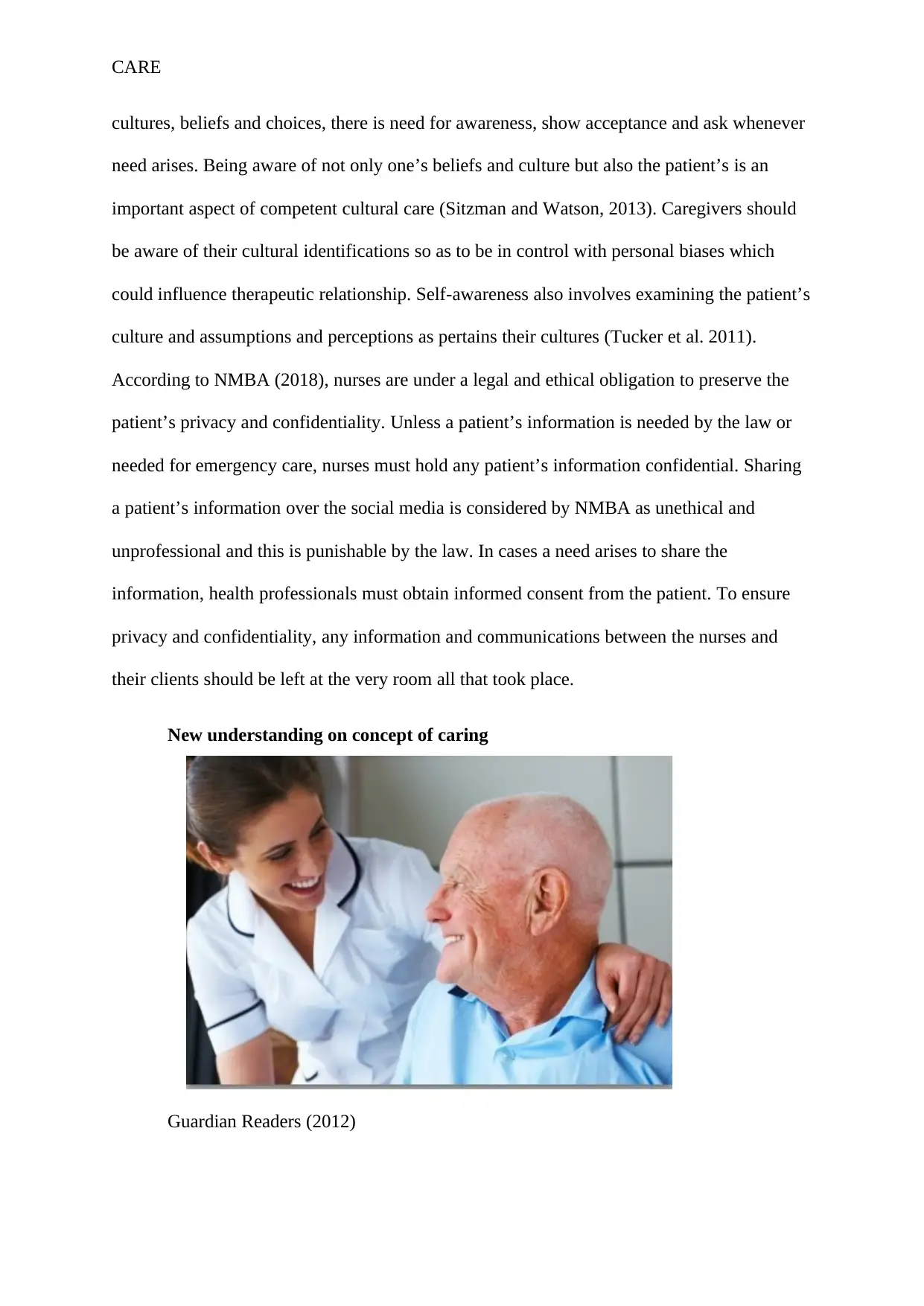
New understanding on concept of caring
Guardian Readers (2012)
tabler-icon-diamond-filled.svg

Paraphrase This Document

Need a fresh take? Get an instant paraphrase of this document with our AI Paraphraser
Document Page
CARE
On seeing this picture, it dawns on me how important holistic care is important to the
patient. Though my first experience with caring for patients derailed my feeling towards
patients’ care, compassion, satisfaction and the patient’s feelings as shown in his face makes
me to do it again. It is so awakening and makes me feeling that nursing is about caring and
making people’s lives better. It is said that nursing is a calling, and yes it is. Just like many
other profession, nursing is faced by its challenges like what I faced in caring for patients
with dementia. This does not mean that when faced with these challenges, no matter how
cruel they could be, we should give up. As a nurses we are called to care for these patients
and should do it with passion. In cases of uncooperative patients, incorporating their families
in the caring procedures would help attain better results. My previous experience together
with my class work has helped me appreciate the importance of creating a caring
environment as a nurse with my patients. Creating a caring environment ensures continuity of
health care. I am also able to appreciate other people’s cultures as it is core in building a
therapeutic nurse-patient relationship. I am aware of my culture, able to accept others and
even ask about the patient’s culture when I know nothing about them.
Patient centred care is important though most nurses claim to be difficult because they
think they are being overworked and underappreciated. Lack of effective communication
between the nurse and the patient leads to inappropriate, ineffective and fatal error. Therefore
effective communication is a core aspect in therapeutic care (Appelgren, Bahtsevani, Persson
and Borglin, 2018). Effective communication needs the nurse to understand the patient’s
expressive experiences, which requires skills and sincere intention the concerns of the patient.
This changed my perspective about caring and especially for the old; I now take it with
commitment. I learned that understanding the patient not just enough to deliver quality care,
but conveying a message acceptable and understandable to the patient (Kourkouta and
Papathanasiou (2014). Other than learning about communication skills in school, I have taken
Document Page
CARE
my time to build on these skills. This would help me handle any patient requiring my care.
This would also help me accurately and consistently do my work as a nurse and attain patient
satisfaction as well as protect the nursing profession.
Document Page
CARE
References
Appelgren, M., Bahtsevani, C., Persson, K. and Borglin, G. (2018). Nurses’ experiences of
caring for patients with intellectual developmental disorders: A systematic review
using a meta-ethnographic approach. BMC Nursing, Vol. 17, No. 51. Doi:
https://doi.org/10.1186/s12912-018-0316-9
Kourkouta, L., & Papathanasiou, I. V. (2014). Communication in nursing practice. Materia
socio-medica, 26(1), 65-7. Doi: 10.5455/msm.2014.26.65-67
Monthaisong, D. (2018). Nurses’ experiences providing care for people with dementia: An
integrative literature review. Journal of Nursing & Care, Vol. 7, No. 2, pp. 453-460.
Doi: 10.4172/2167-1168.1000453
Murphy, K. (2013). The importance of cultural competence. Nursing Made Incredibly Easy,
Vol. 9, No. 2, pp. 5. Doi: 10.1097/01.NME.0000394039.35217.12
Doi: http://dx.doi.org/10.15226/2471-6529/2/1/00113
Newbanks, R. Shirleen, R. Linda, S and Beverly, S. (2018). What is caring in Nursing?
Sorting out humanistic and Christian perspectives. Journal of Christian Nursing, Vol.
35, No. 3, pp. 160-167. Doi: 10.1097/CNJ.0000000000000441
Nursing and Midwifery Board of Australia. (2018). Professional Standards. Retrieved from:
https://www.nursingmidwiferyboard.gov.au/codes-guidelines-statements/
professional-standards.aspx
Rhodes, M., Morris, A. and Lazenby, R. (2013). Nursing at its best: Competent and Caring.
The Online Journal of issues in Nursing, Vol. 16, No. 2. Doi:
10.3912/OJIN.Vol16No02PPT01
tabler-icon-diamond-filled.svg

Paraphrase This Document

Need a fresh take? Get an instant paraphrase of this document with our AI Paraphraser
Document Page
CARE
Sitzman, K. and Watson, J. (2014). Caring science, mindful practice: Implementing Watson’s
Human Caring Theory. New York: Springer Publishing Company
Tucker, C. M., Marsiske, M., Rice, K. G., Nielson, J. J., & Herman, K. (2011). Patient-
centered culturally sensitive health care: model testing and refinement. Health
psychology: official journal of the Division of Health Psychology, American
Psychological Association, 30(3), 342-50.. doi: 10.1037/a0022967
The Guardian Readers. (2012). Elderly care: Your experiences. Retrieved from:
https://www.theguardian.com/society/2012/feb/29/eldery-care-your-experiences
Watson, J. (2012). Human caring science: A theory of nursing. Colorado: Jones & Bartlett
Learning.
Stroehlein, M. (2016). Caring Concept. SOJ Nursing and Health Care, Vol. 2, No. 1, pp. 1-3.
chevron_up_icon
1 out of 8
circle_padding
hide_on_mobile
zoom_out_icon
[object Object]