Personal Development Plan, SWOT Analysis, and Nursing Philosophy

Verified

Added on  2023/04/22

|6
|1460
|377
Report
AI Summary
This report presents a personal development plan focusing on a nursing career. It begins with a self-assessment and SWOT analysis to identify strengths, weaknesses, opportunities, and threats, particularly adaptability and communication skills. The report identifies threats such as peer conflict and opportunities in the evolving nursing profession. The plan emphasizes the importance of evidence-based research, continued education, and maintaining a positive attitude to improve communication skills. It then outlines a personal philosophy of nursing, highlighting values beyond medicine. Finally, it details strategies for developing resilience, including self-care, maintaining an optimistic outlook, and continuous learning to support professional career development.
Document Page
Running head: PERSONAL DEVELOPMENT
PERSONAL DEVELOPMENT
Name of the Student
Name of the university
Author’s note
tabler-icon-diamond-filled.svg

Paraphrase This Document

Need a fresh take? Get an instant paraphrase of this document with our AI Paraphraser
Document Page
1PERSONAL DEVELOPMENT
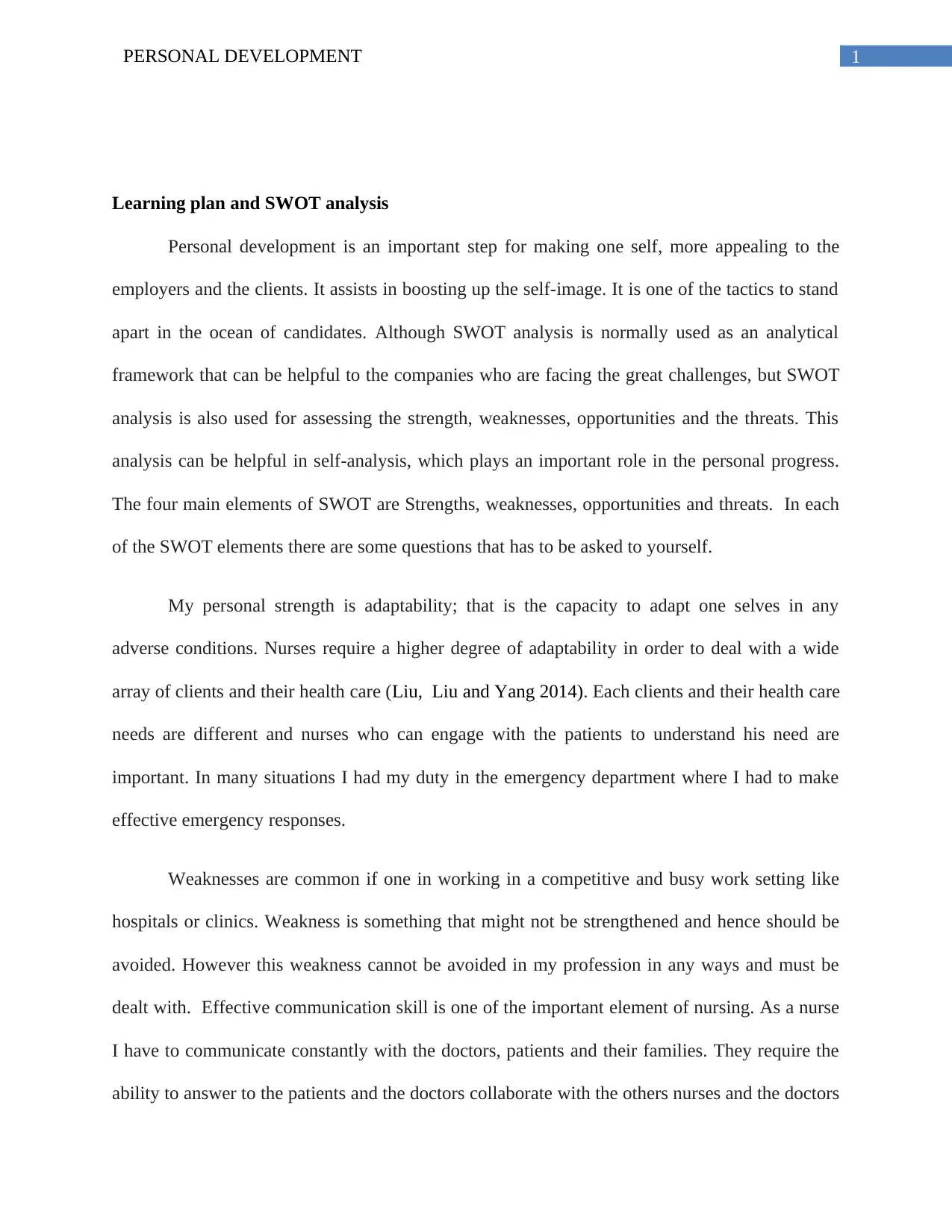
Learning plan and SWOT analysis
Personal development is an important step for making one self, more appealing to the
employers and the clients. It assists in boosting up the self-image. It is one of the tactics to stand
apart in the ocean of candidates. Although SWOT analysis is normally used as an analytical
framework that can be helpful to the companies who are facing the great challenges, but SWOT
analysis is also used for assessing the strength, weaknesses, opportunities and the threats. This
analysis can be helpful in self-analysis, which plays an important role in the personal progress.
The four main elements of SWOT are Strengths, weaknesses, opportunities and threats. In each
of the SWOT elements there are some questions that has to be asked to yourself.
My personal strength is adaptability; that is the capacity to adapt one selves in any
adverse conditions. Nurses require a higher degree of adaptability in order to deal with a wide
array of clients and their health care (Liu, Liu and Yang 2014). Each clients and their health care
needs are different and nurses who can engage with the patients to understand his need are
important. In many situations I had my duty in the emergency department where I had to make
effective emergency responses.
Weaknesses are common if one in working in a competitive and busy work setting like
hospitals or clinics. Weakness is something that might not be strengthened and hence should be
avoided. However this weakness cannot be avoided in my profession in any ways and must be
dealt with. Effective communication skill is one of the important element of nursing. As a nurse
I have to communicate constantly with the doctors, patients and their families. They require the
ability to answer to the patients and the doctors collaborate with the others nurses and the doctors
Document Page
2PERSONAL DEVELOPMENT
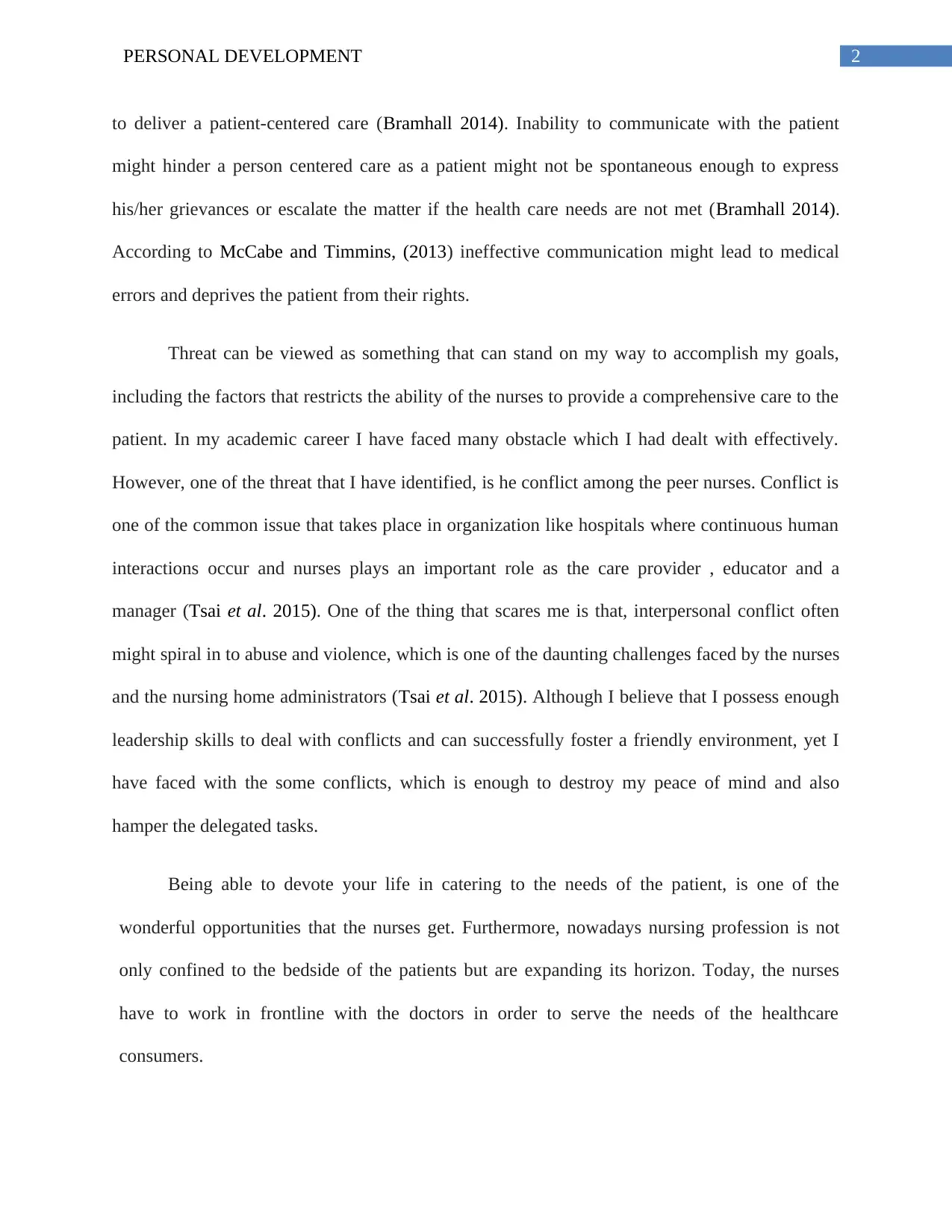
to deliver a patient-centered care (Bramhall 2014). Inability to communicate with the patient
might hinder a person centered care as a patient might not be spontaneous enough to express
his/her grievances or escalate the matter if the health care needs are not met (Bramhall 2014).
According to McCabe and Timmins, (2013) ineffective communication might lead to medical
errors and deprives the patient from their rights.
Threat can be viewed as something that can stand on my way to accomplish my goals,
including the factors that restricts the ability of the nurses to provide a comprehensive care to the
patient. In my academic career I have faced many obstacle which I had dealt with effectively.
However, one of the threat that I have identified, is he conflict among the peer nurses. Conflict is
one of the common issue that takes place in organization like hospitals where continuous human
interactions occur and nurses plays an important role as the care provider , educator and a
manager (Tsai et al. 2015). One of the thing that scares me is that, interpersonal conflict often
might spiral in to abuse and violence, which is one of the daunting challenges faced by the nurses
and the nursing home administrators (Tsai et al. 2015). Although I believe that I possess enough
leadership skills to deal with conflicts and can successfully foster a friendly environment, yet I
have faced with the some conflicts, which is enough to destroy my peace of mind and also
hamper the delegated tasks.
Being able to devote your life in catering to the needs of the patient, is one of the
wonderful opportunities that the nurses get. Furthermore, nowadays nursing profession is not
only confined to the bedside of the patients but are expanding its horizon. Today, the nurses
have to work in frontline with the doctors in order to serve the needs of the healthcare
consumers.
Document Page
3PERSONAL DEVELOPMENT
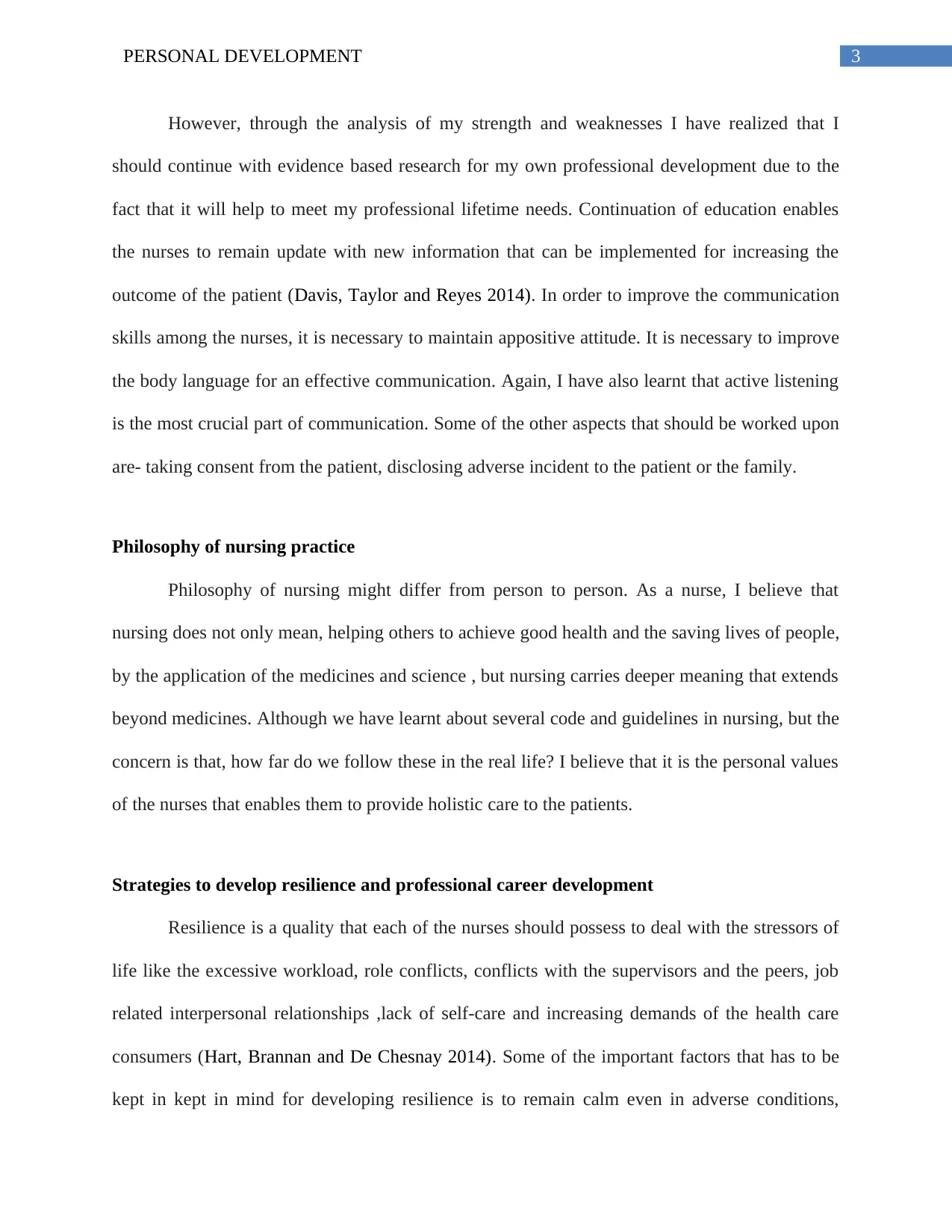
However, through the analysis of my strength and weaknesses I have realized that I
should continue with evidence based research for my own professional development due to the
fact that it will help to meet my professional lifetime needs. Continuation of education enables
the nurses to remain update with new information that can be implemented for increasing the
outcome of the patient (Davis, Taylor and Reyes 2014). In order to improve the communication
skills among the nurses, it is necessary to maintain appositive attitude. It is necessary to improve
the body language for an effective communication. Again, I have also learnt that active listening
is the most crucial part of communication. Some of the other aspects that should be worked upon
are- taking consent from the patient, disclosing adverse incident to the patient or the family.
Philosophy of nursing practice
Philosophy of nursing might differ from person to person. As a nurse, I believe that
nursing does not only mean, helping others to achieve good health and the saving lives of people,
by the application of the medicines and science , but nursing carries deeper meaning that extends
beyond medicines. Although we have learnt about several code and guidelines in nursing, but the
concern is that, how far do we follow these in the real life? I believe that it is the personal values
of the nurses that enables them to provide holistic care to the patients.
Strategies to develop resilience and professional career development
Resilience is a quality that each of the nurses should possess to deal with the stressors of
life like the excessive workload, role conflicts, conflicts with the supervisors and the peers, job
related interpersonal relationships ,lack of self-care and increasing demands of the health care
consumers (Hart, Brannan and De Chesnay 2014). Some of the important factors that has to be
kept in kept in mind for developing resilience is to remain calm even in adverse conditions,
tabler-icon-diamond-filled.svg

Paraphrase This Document

Need a fresh take? Get an instant paraphrase of this document with our AI Paraphraser
Document Page
4PERSONAL DEVELOPMENT
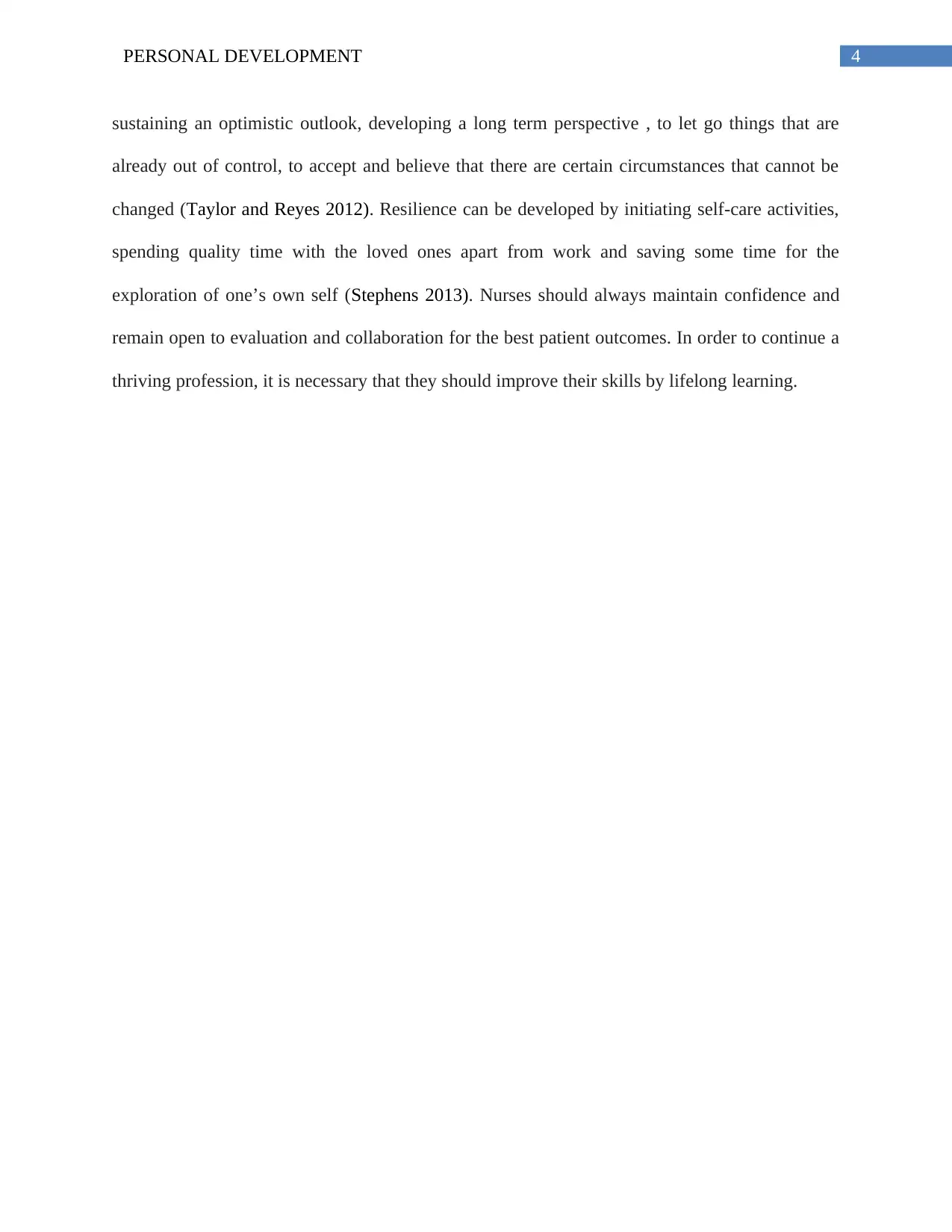
sustaining an optimistic outlook, developing a long term perspective , to let go things that are
already out of control, to accept and believe that there are certain circumstances that cannot be
changed (Taylor and Reyes 2012). Resilience can be developed by initiating self-care activities,
spending quality time with the loved ones apart from work and saving some time for the
exploration of one’s own self (Stephens 2013). Nurses should always maintain confidence and
remain open to evaluation and collaboration for the best patient outcomes. In order to continue a
thriving profession, it is necessary that they should improve their skills by lifelong learning.
Document Page
5PERSONAL DEVELOPMENT
References
Bramhall, E., 2014. Effective communication skills in nursing practice. Nursing Standard
(2014+), 29(14), p.53.
Davis, L., Taylor, H. and Reyes, H., 2014. Lifelong learning in nursing: a Delphi study. Nurse
Education Today, 34(3), pp.441-445.
Hart, P.L., Brannan, J.D. and De Chesnay, M., 2014. Resilience in nurses: an integrative review.
Journal of nursing management, 22(6), pp.720-734.
Liu, J.Y., Liu, Y.H. and Yang, J.P., 2014. Impact of learning adaptability and time management
disposition on study engagement among chinese baccalaureate nursing students. Journal of
Professional Nursing, 30(6), pp.502-510.
McCabe, C. and Timmins, F., 2013. Communication skills for nursing practice. Macmillan
International Higher Education.
Stephens, T.M., 2013, April. Nursing student resilience: a concept clarification. In Nursing
forum (Vol. 48, No. 2, pp. 125-133).
Taylor, H. and Reyes, H., 2012. Self-efficacy and resilience in baccalaureate nursing students.
International Journal of Nursing Education Scholarship, 9(1), pp.1-13.
Tsai, H.H., Tsai, Y.F., Weng, L.C. and Chou, H.F., 2013. More than communication skills:
experiences of communication conflict in nursing home nurses. Medical education, 47(10),
pp.990-1000.
chevron_up_icon
1 out of 6
circle_padding
hide_on_mobile
zoom_out_icon
[object Object]