Personal Practice Model: Acute Care Nursing Approach and Guidelines
VerifiedAdded on 2021/06/18
|16
|4327
|27
Report
AI Summary
This report delves into the significance of the personal practice model in nursing, particularly within acute care settings. It examines the importance of individual expertise in enhancing decision-making and management of critical situations, emphasizing mindfulness and experience-based learning. The report includes a reflection on a nursing professional's day, highlighting the challenges and emotional demands of the profession, alongside the application of the Nursing and Midwifery Board of Australia (NMBA) standards. It also discusses the five ways of knowing in nursing practice (empirics, ethics, personal, esthetics, and emancipatory knowing), and explores emerging themes such as person-centered care and informed decision-making. The conceptual framework and relationships between different concepts are outlined, along with a comparison of the personal practice model with other relevant areas of nursing care. Finally, the report addresses the challenges and opportunities in implementing the personal practice model, concluding with recommendations for improvement and future research.
Running head: PERSONAL PRACTICE MODEL
Personal Practice Model
Name of the student
University name
Author’s note
Personal Practice Model
Name of the student
University name
Author’s note

Paraphrase This Document
Need a fresh take? Get an instant paraphrase of this document with our AI Paraphraser
1
PERSONAL PRACTICE MODEL
Table of Contents
Introduction................................................................................................................................2
Reflection upon a day in a nursing professional’s life...............................................................3
Knowledge derived from the five ways of knowing in nursing practice...................................4
Emerging themes and patterns form practice descriptions........................................................7
Conceptual framework of the emerging themes and patterns....................................................8
Relationships between different concepts..................................................................................8
Comparison of personal practice model with other relevant areas of nursing care...................9
Figure: UC Davis professional practice model........................................................................11
Challenges and opportunities in implementing personal practice model.................................11
Conclusion................................................................................................................................12
References................................................................................................................................13
PERSONAL PRACTICE MODEL
Table of Contents
Introduction................................................................................................................................2
Reflection upon a day in a nursing professional’s life...............................................................3
Knowledge derived from the five ways of knowing in nursing practice...................................4
Emerging themes and patterns form practice descriptions........................................................7
Conceptual framework of the emerging themes and patterns....................................................8
Relationships between different concepts..................................................................................8
Comparison of personal practice model with other relevant areas of nursing care...................9
Figure: UC Davis professional practice model........................................................................11
Challenges and opportunities in implementing personal practice model.................................11
Conclusion................................................................................................................................12
References................................................................................................................................13
2
PERSONAL PRACTICE MODEL
Introduction
The current study focuses on the importance of personal knowledge in nursing
professionals. The nursing care professionals working in an acute care setup need to be
developing a certain amount of expertise with regards to effective decision making and
management of emergency and trauma care situations. The individual expertise can help in
enhancing the overall productivity of an emergency and trauma care ward (Nagle et al.,
2017). Some of these are based upon mindfulness where the nursing profession needs to be
aware of the space, time and surroundings. The emergency decision making is solely based
on exposure to similar critical and trauma care incidents (Ellis, 2016).
Therefore, based on individual expertise and exposure to acute care setups the
professional practice models are developed. The professional practice model differs from
individual to individual are subject to variation and improvement. The professional practice
models are established through a number of standardised forms which helps in improving the
quality of care. The professional practice approaches and guidelines are further based on the
Nursing and midwifery board of Australia (NMBA).
In the current study and actual clinical setup has been taken into consideration for the
development of the professional practise model. Here, the nurse was placed in a renal or
urology ward for a night shift, there were six patients in the ward at all. However, one patient
suddenly developed d a chronic pain in her abdomen. Using the pain assessment, she
recorded a score of 8/10. On further inspection, it was found that the patient had undergone a
kidney transplant and was blessing from the abdominal area. Therefore, a practising nurse
attending to a series of patients within an acute care ward a number of effective steps could
be taken over here. For example, measuring the level of consciousness in the patient could be
helpful. Therefore, based on the responses the patient could be put under an advanced life
PERSONAL PRACTICE MODEL
Introduction
The current study focuses on the importance of personal knowledge in nursing
professionals. The nursing care professionals working in an acute care setup need to be
developing a certain amount of expertise with regards to effective decision making and
management of emergency and trauma care situations. The individual expertise can help in
enhancing the overall productivity of an emergency and trauma care ward (Nagle et al.,
2017). Some of these are based upon mindfulness where the nursing profession needs to be
aware of the space, time and surroundings. The emergency decision making is solely based
on exposure to similar critical and trauma care incidents (Ellis, 2016).
Therefore, based on individual expertise and exposure to acute care setups the
professional practice models are developed. The professional practice model differs from
individual to individual are subject to variation and improvement. The professional practice
models are established through a number of standardised forms which helps in improving the
quality of care. The professional practice approaches and guidelines are further based on the
Nursing and midwifery board of Australia (NMBA).
In the current study and actual clinical setup has been taken into consideration for the
development of the professional practise model. Here, the nurse was placed in a renal or
urology ward for a night shift, there were six patients in the ward at all. However, one patient
suddenly developed d a chronic pain in her abdomen. Using the pain assessment, she
recorded a score of 8/10. On further inspection, it was found that the patient had undergone a
kidney transplant and was blessing from the abdominal area. Therefore, a practising nurse
attending to a series of patients within an acute care ward a number of effective steps could
be taken over here. For example, measuring the level of consciousness in the patient could be
helpful. Therefore, based on the responses the patient could be put under an advanced life
⊘ This is a preview!⊘
Do you want full access?
Subscribe today to unlock all pages.

Trusted by 1+ million students worldwide
3
PERSONAL PRACTICE MODEL
support. In the current assignment, a reflection through the actual nursing scenario had been
taken into consideration. A number of themes and patterns have been developed over here
which has been related to professional nursing practice. The various challenges and
opportunities faced in implementing the nursing professional practice model have been
further discussed over here.
Reflection upon a day in a nursing professional’s life
Working as a nursing professional in an acute care ward I come across a number of
varied situations. Some of these situations are emotionally tiring and put heavy demand on
the nursing profession. These are situations where sufficient expertise of the nursing
professionals is called required. The actions depicted by the nursing professionals are further
guided based on the professional NMBA standards (Ingham-Broomfield, 2015). The
standards as mentioned in the NMBA ensure safe and effective nursing care practices are
delivered. Some of the most crucial challenges, which are faced over here, are with respect
to taking effective judgment or decision making. As mentioned by Cusack et al. (2016), the
actions undertaken within an acute clinical care setup are often guided by instincts. This is
because in the absence of sufficient guidance from the healthcare professionals it often
becomes challenging to deal with the pressurising situation or take an apt and just situation.
In dealing with the regular nursing care activities one needs to ensure that the NMBA
standards and guidelines are effectively followed (Nursing and Midwifery Board of Australia,
2014). However as argued by Manojlovich and Ketefian (2016), it places the importance
upon sufficient adequate training a support to be provided to the nursing professionals. As
suggested by Townsend and Morgan (2017), the heavy and pressurising clinical situation
often results in the development of phenomena known as compassion fatigue in nurses. In an
acute clinical care setting the nurses often have to put longer work hours which results in
PERSONAL PRACTICE MODEL
support. In the current assignment, a reflection through the actual nursing scenario had been
taken into consideration. A number of themes and patterns have been developed over here
which has been related to professional nursing practice. The various challenges and
opportunities faced in implementing the nursing professional practice model have been
further discussed over here.
Reflection upon a day in a nursing professional’s life
Working as a nursing professional in an acute care ward I come across a number of
varied situations. Some of these situations are emotionally tiring and put heavy demand on
the nursing profession. These are situations where sufficient expertise of the nursing
professionals is called required. The actions depicted by the nursing professionals are further
guided based on the professional NMBA standards (Ingham-Broomfield, 2015). The
standards as mentioned in the NMBA ensure safe and effective nursing care practices are
delivered. Some of the most crucial challenges, which are faced over here, are with respect
to taking effective judgment or decision making. As mentioned by Cusack et al. (2016), the
actions undertaken within an acute clinical care setup are often guided by instincts. This is
because in the absence of sufficient guidance from the healthcare professionals it often
becomes challenging to deal with the pressurising situation or take an apt and just situation.
In dealing with the regular nursing care activities one needs to ensure that the NMBA
standards and guidelines are effectively followed (Nursing and Midwifery Board of Australia,
2014). However as argued by Manojlovich and Ketefian (2016), it places the importance
upon sufficient adequate training a support to be provided to the nursing professionals. As
suggested by Townsend and Morgan (2017), the heavy and pressurising clinical situation
often results in the development of phenomena known as compassion fatigue in nurses. In an
acute clinical care setting the nurses often have to put longer work hours which results in
Paraphrase This Document
Need a fresh take? Get an instant paraphrase of this document with our AI Paraphraser
4
PERSONAL PRACTICE MODEL
physical and emotional burn out within them. From my personal experiences, I have felt that
the longer shift durations followed by insufficient communication during handover often
affects the quality and the standards of the support and care services provided.
Therefore, focussing on my last clinical setup I have realized that I need to hone my
personal level of knowledge further. For example, acting on time and putting the patient on
advanced life support could help in saving the life of the patient. However, it was an
instinctive reaction undertaken by me where I followed up the excessive bleeding in the
patient to put the patient on a life support machine after checking the level of consciousness
in the patient. It was a much approve move based on the current situation. However, I had no
idea regarding the underlying pathophysiology in the patient and had to wait for the
intervention of the after-hours educator for enlightening me regarding my present set of
action. Based on this experience, I felt that I need to hone my personal level of knowledge
which will help me to be more confident and affirmative regarding my actions in the future.
Though, my past experience with a transplant patient helped me in taking effective measures.
I felt a certain pressure and obligation towards the patient and her family. Additionally, in my
mind, I contemplated all possible and worrisome options for the patient. I often felt
emotional burnout or a gust of crying and felt it difficult to control myself. Hence, I felt that I
need to develop a certain amount of emotional and mental resilience which will help me in
coming up with the situation better.
Knowledge derived from the five ways of knowing in nursing practice
In order to develop the professional practice and improve the quality of nursing care
one needs to focus on more than one patterns of knowing which are could be described as –
empirics, esthetics, personal, aesthetic and emancipatory knowing etc. The empirics are the
science of education which refers to the amount and the kind of knowledge gathered using
PERSONAL PRACTICE MODEL
physical and emotional burn out within them. From my personal experiences, I have felt that
the longer shift durations followed by insufficient communication during handover often
affects the quality and the standards of the support and care services provided.
Therefore, focussing on my last clinical setup I have realized that I need to hone my
personal level of knowledge further. For example, acting on time and putting the patient on
advanced life support could help in saving the life of the patient. However, it was an
instinctive reaction undertaken by me where I followed up the excessive bleeding in the
patient to put the patient on a life support machine after checking the level of consciousness
in the patient. It was a much approve move based on the current situation. However, I had no
idea regarding the underlying pathophysiology in the patient and had to wait for the
intervention of the after-hours educator for enlightening me regarding my present set of
action. Based on this experience, I felt that I need to hone my personal level of knowledge
which will help me to be more confident and affirmative regarding my actions in the future.
Though, my past experience with a transplant patient helped me in taking effective measures.
I felt a certain pressure and obligation towards the patient and her family. Additionally, in my
mind, I contemplated all possible and worrisome options for the patient. I often felt
emotional burnout or a gust of crying and felt it difficult to control myself. Hence, I felt that I
need to develop a certain amount of emotional and mental resilience which will help me in
coming up with the situation better.
Knowledge derived from the five ways of knowing in nursing practice
In order to develop the professional practice and improve the quality of nursing care
one needs to focus on more than one patterns of knowing which are could be described as –
empirics, esthetics, personal, aesthetic and emancipatory knowing etc. The empirics are the
science of education which refers to the amount and the kind of knowledge gathered using
5
PERSONAL PRACTICE MODEL
the physical senses such as hearing, touching and hearing etc. It is based on traditional
problem solving, which are further guided and supported by theoretical constructs (White,
Dudley-Brown & Terhaar, 2016). These are based upon gaining sufficient scientific
knowledge. In this respect, sufficient emphasis needs to be provided upon the gathering of
knowledge during the theoretical sessions. The theoretical sessions are very important in the
development of effective problem-solving skills in the nursing professionals. In this respect,
special emphasis needs to be given to the implementation and inculcation of the nursing
professional standards.
The ethics refer to the moral knowledge acquired by the nursing professionals. Some
of the ethical standards of care help in improving the quality of nursing care. It requires
empirical and experiential knowledge of social norms and values. It focuses on knowing
one's responsibility better, which helps in differentiating the right from the wrong. As
mentioned by Déry, D'Amour, Blais and Clarke (2015), the ethics are guided by different
philosophical aspects affecting duty and social justice. The sense of ethics often helps in
removing the various dilemmas faced in an acute clinical setup with respect to effective
decision making (Erickson, 2017). For example, the decision to shift the patient to an ICU is
guided by the feeling that putting the patient under critical care can bring in specific health
improvements within the patient. However, the move may be questioned significantly by the
extended family of the patient. Therefore, it is the moral duty of a nursing professional to
inform the family members of the patient regarding any particular move taken.
The personal knowing is one of the most pivotal components of nursing literature and
depends upon the marketing skills developed by individuals. It varies from individual to
individual based upon the knowledge and values inherited by then along with the in-house
training sessions that one had been exposed to. As mentioned by Keyko, Cummings, Yonge
and Wong (2016), the person knowing refers to the therapeutic use of self. It refers to the
PERSONAL PRACTICE MODEL
the physical senses such as hearing, touching and hearing etc. It is based on traditional
problem solving, which are further guided and supported by theoretical constructs (White,
Dudley-Brown & Terhaar, 2016). These are based upon gaining sufficient scientific
knowledge. In this respect, sufficient emphasis needs to be provided upon the gathering of
knowledge during the theoretical sessions. The theoretical sessions are very important in the
development of effective problem-solving skills in the nursing professionals. In this respect,
special emphasis needs to be given to the implementation and inculcation of the nursing
professional standards.
The ethics refer to the moral knowledge acquired by the nursing professionals. Some
of the ethical standards of care help in improving the quality of nursing care. It requires
empirical and experiential knowledge of social norms and values. It focuses on knowing
one's responsibility better, which helps in differentiating the right from the wrong. As
mentioned by Déry, D'Amour, Blais and Clarke (2015), the ethics are guided by different
philosophical aspects affecting duty and social justice. The sense of ethics often helps in
removing the various dilemmas faced in an acute clinical setup with respect to effective
decision making (Erickson, 2017). For example, the decision to shift the patient to an ICU is
guided by the feeling that putting the patient under critical care can bring in specific health
improvements within the patient. However, the move may be questioned significantly by the
extended family of the patient. Therefore, it is the moral duty of a nursing professional to
inform the family members of the patient regarding any particular move taken.
The personal knowing is one of the most pivotal components of nursing literature and
depends upon the marketing skills developed by individuals. It varies from individual to
individual based upon the knowledge and values inherited by then along with the in-house
training sessions that one had been exposed to. As mentioned by Keyko, Cummings, Yonge
and Wong (2016), the person knowing refers to the therapeutic use of self. It refers to the
⊘ This is a preview!⊘
Do you want full access?
Subscribe today to unlock all pages.
Trusted by 1+ million students worldwide
6
PERSONAL PRACTICE MODEL
interactions, relationships and transactions between patients and clients. The personal
knowing refers to knowing encountering and actualization of own self. The objectives of
personal knowing focuses on developing an effective bond between two persons (Gullick &
West, 2016). It emphasises an open environment which helps in the full potential
development of a nursing professional. It helps in addressing the personal weaknesses which
helps one emerge out as a mentally strong person. This is because the pressure within an
acute nursing care setup can often result in a professional burnout. It focuses much upon the
therapeutic communication approaches for analysing the mental and emotional levels of the
patient.
The estheric pattern of knowing highlights the level of empathy depicted by an
individual for connecting with others. As mentioned by Douglas et al. (2014), the nursing
profession needs to put sufficient emphasis upon the feelings and the beliefs of the patients
which helps in them in designing of an effective care plan and services.
The emancipatory learning better comprehends the environment, the modulators and
their journeys which can help one in learning or adopt sufficient skills which are a pre-
requisite within a professional care environment (Ellis, 2016).
Therefore, as a nursing professional, I need to develop my knowledge further into
individual domains which would help me practice more efficiently within an acute clinical
care setup. In my opinion, one of the most pivotal components over here is the presence of an
efficient course modulator which can facilitate the process of authentic knowledge absorption
within the nursing professionals which can help improve the quality of support and care
services. Additionally participating in more in-house practical session can help me develop
my clinical skills better along with effective decision-making skills. Some of these have been
seen to develop my personal knowing skills better.
PERSONAL PRACTICE MODEL
interactions, relationships and transactions between patients and clients. The personal
knowing refers to knowing encountering and actualization of own self. The objectives of
personal knowing focuses on developing an effective bond between two persons (Gullick &
West, 2016). It emphasises an open environment which helps in the full potential
development of a nursing professional. It helps in addressing the personal weaknesses which
helps one emerge out as a mentally strong person. This is because the pressure within an
acute nursing care setup can often result in a professional burnout. It focuses much upon the
therapeutic communication approaches for analysing the mental and emotional levels of the
patient.
The estheric pattern of knowing highlights the level of empathy depicted by an
individual for connecting with others. As mentioned by Douglas et al. (2014), the nursing
profession needs to put sufficient emphasis upon the feelings and the beliefs of the patients
which helps in them in designing of an effective care plan and services.
The emancipatory learning better comprehends the environment, the modulators and
their journeys which can help one in learning or adopt sufficient skills which are a pre-
requisite within a professional care environment (Ellis, 2016).
Therefore, as a nursing professional, I need to develop my knowledge further into
individual domains which would help me practice more efficiently within an acute clinical
care setup. In my opinion, one of the most pivotal components over here is the presence of an
efficient course modulator which can facilitate the process of authentic knowledge absorption
within the nursing professionals which can help improve the quality of support and care
services. Additionally participating in more in-house practical session can help me develop
my clinical skills better along with effective decision-making skills. Some of these have been
seen to develop my personal knowing skills better.
Paraphrase This Document
Need a fresh take? Get an instant paraphrase of this document with our AI Paraphraser
7
PERSONAL PRACTICE MODEL
Emerging themes and patterns form practice descriptions
A number of common themes and patterns could be focussed upon here based upon
the practice descriptions. Some of the themes are person-centred care and informed decision
making. These two themes have been developed further through personal practice model.
Additionally, acting in accordance with the professional nursing guidelines can help in
improving the quality of care. The person-centred care places more importance upon apathy
and values, which helps in relating with the patient on a personal level. As mentioned by
Taylor (2017), the patient centred approach takes into consideration the culture and values of
the patient. In this respect, an acute healthcare setup admits huge number of patients from
multicultural and multilingual setup. The different cultural beliefs often lead to disputes
within an acute care setup. Hence, the undertaking of a patient centred approach helps in
removing the biases within a clinical setup.
Additionally, informed decision making can help in making the patients aware of the
nursing care plans and the reasons for implementing a particular care approach. In one of my
past clinical setups, I had to undergo sufficient pressure put by the family members of the
patients where they insisted that I share with them the confidential details of the patient. As
mentioned by Farquhar (2018), the decisions making needs to be done with proper approval
and information to the family members of the patient.
Additionally, the current decade has seen the emergence of evidence-based nursing
practices. These are developed around common standards or guidelines and helps in
improving the quality of care. The evidence-based nursing practices are further customised in
order to meet the requirements of the patient (Birks, Davis, Smithson & Cant, 2016).
PERSONAL PRACTICE MODEL
Emerging themes and patterns form practice descriptions
A number of common themes and patterns could be focussed upon here based upon
the practice descriptions. Some of the themes are person-centred care and informed decision
making. These two themes have been developed further through personal practice model.
Additionally, acting in accordance with the professional nursing guidelines can help in
improving the quality of care. The person-centred care places more importance upon apathy
and values, which helps in relating with the patient on a personal level. As mentioned by
Taylor (2017), the patient centred approach takes into consideration the culture and values of
the patient. In this respect, an acute healthcare setup admits huge number of patients from
multicultural and multilingual setup. The different cultural beliefs often lead to disputes
within an acute care setup. Hence, the undertaking of a patient centred approach helps in
removing the biases within a clinical setup.
Additionally, informed decision making can help in making the patients aware of the
nursing care plans and the reasons for implementing a particular care approach. In one of my
past clinical setups, I had to undergo sufficient pressure put by the family members of the
patients where they insisted that I share with them the confidential details of the patient. As
mentioned by Farquhar (2018), the decisions making needs to be done with proper approval
and information to the family members of the patient.
Additionally, the current decade has seen the emergence of evidence-based nursing
practices. These are developed around common standards or guidelines and helps in
improving the quality of care. The evidence-based nursing practices are further customised in
order to meet the requirements of the patient (Birks, Davis, Smithson & Cant, 2016).
8
PERSONAL PRACTICE MODEL
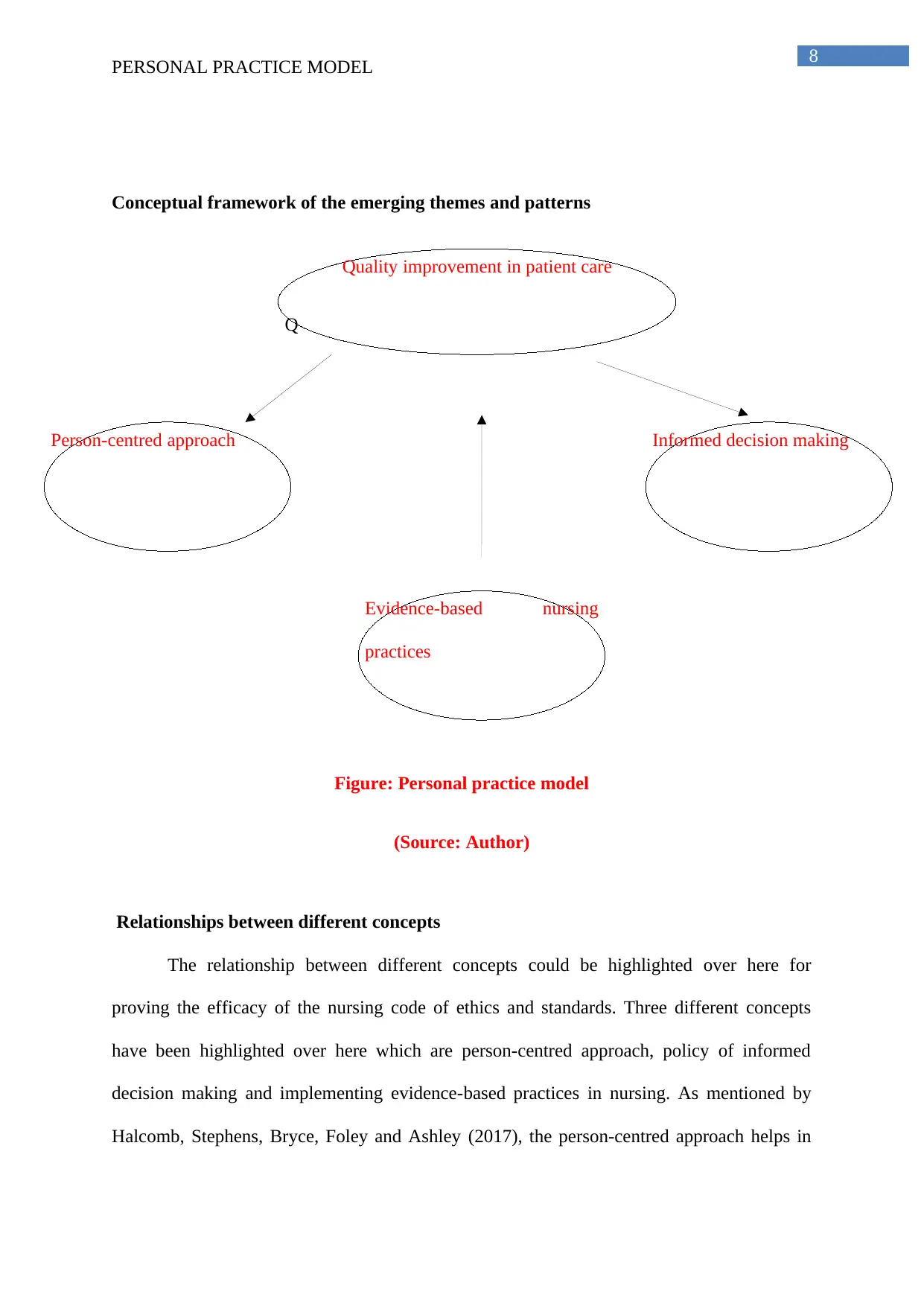
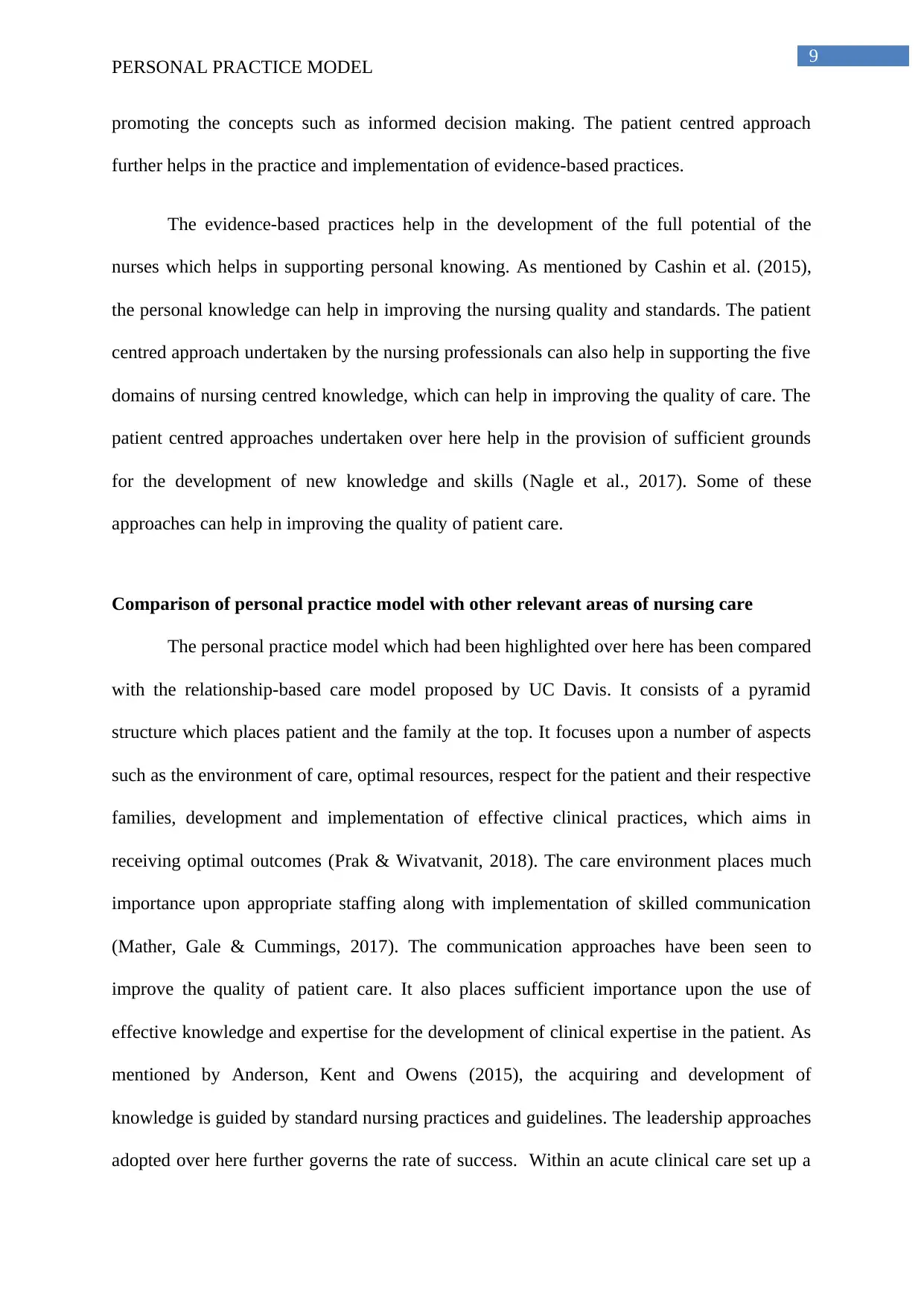
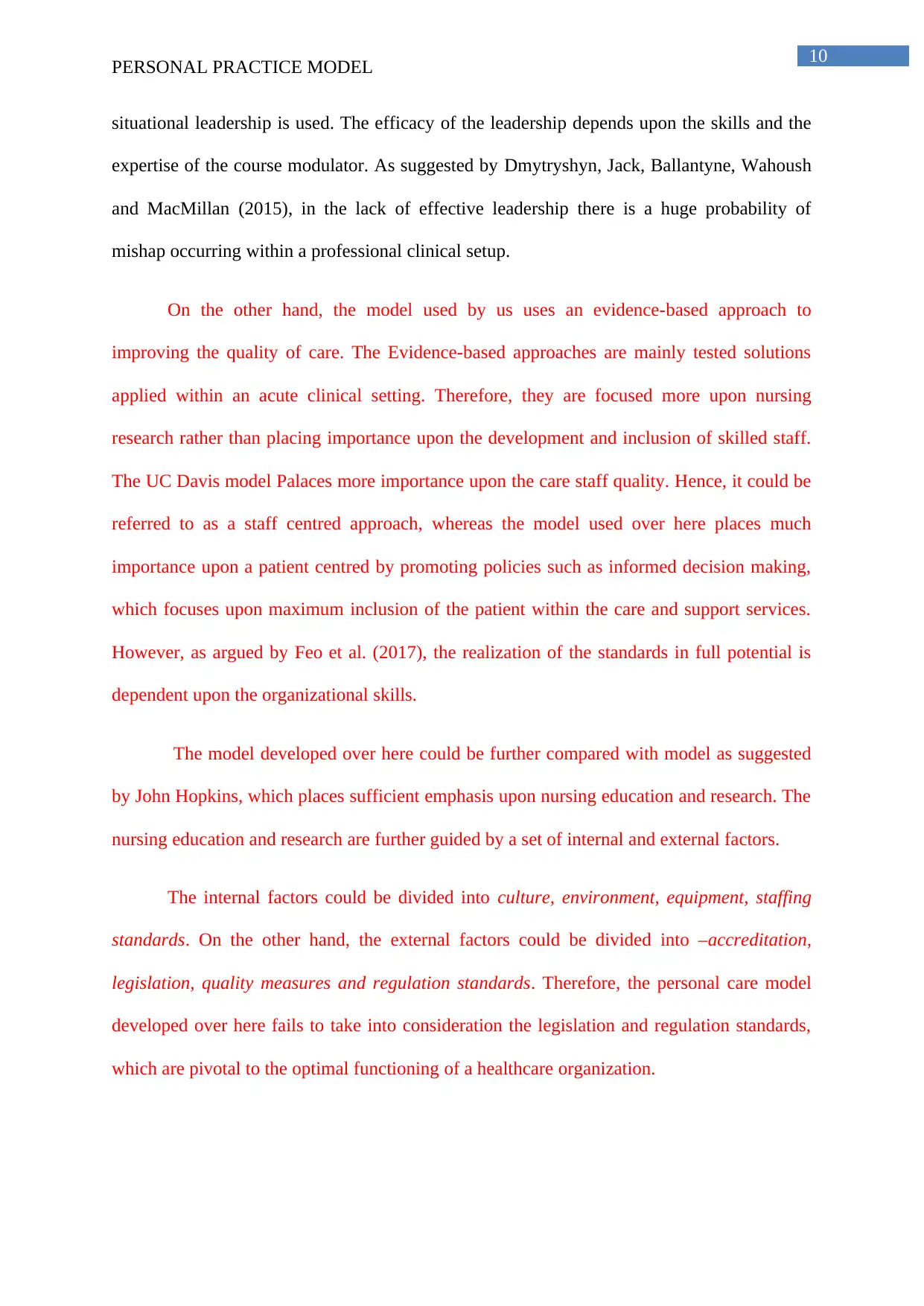
Conceptual framework of the emerging themes and patterns
Figure: Personal practice model
(Source: Author)
Relationships between different concepts
The relationship between different concepts could be highlighted over here for
proving the efficacy of the nursing code of ethics and standards. Three different concepts
have been highlighted over here which are person-centred approach, policy of informed
decision making and implementing evidence-based practices in nursing. As mentioned by
Halcomb, Stephens, Bryce, Foley and Ashley (2017), the person-centred approach helps in
Quality improvement in patient care
Q
Person-centred approach Informed decision making
Evidence-based nursing
practices
PERSONAL PRACTICE MODEL
Conceptual framework of the emerging themes and patterns
Figure: Personal practice model
(Source: Author)
Relationships between different concepts
The relationship between different concepts could be highlighted over here for
proving the efficacy of the nursing code of ethics and standards. Three different concepts
have been highlighted over here which are person-centred approach, policy of informed
decision making and implementing evidence-based practices in nursing. As mentioned by
Halcomb, Stephens, Bryce, Foley and Ashley (2017), the person-centred approach helps in
Quality improvement in patient care
Q
Person-centred approach Informed decision making
Evidence-based nursing
practices
⊘ This is a preview!⊘
Do you want full access?
Subscribe today to unlock all pages.
Trusted by 1+ million students worldwide
9
PERSONAL PRACTICE MODEL
promoting the concepts such as informed decision making. The patient centred approach
further helps in the practice and implementation of evidence-based practices.
The evidence-based practices help in the development of the full potential of the
nurses which helps in supporting personal knowing. As mentioned by Cashin et al. (2015),
the personal knowledge can help in improving the nursing quality and standards. The patient
centred approach undertaken by the nursing professionals can also help in supporting the five
domains of nursing centred knowledge, which can help in improving the quality of care. The
patient centred approaches undertaken over here help in the provision of sufficient grounds
for the development of new knowledge and skills (Nagle et al., 2017). Some of these
approaches can help in improving the quality of patient care.
Comparison of personal practice model with other relevant areas of nursing care
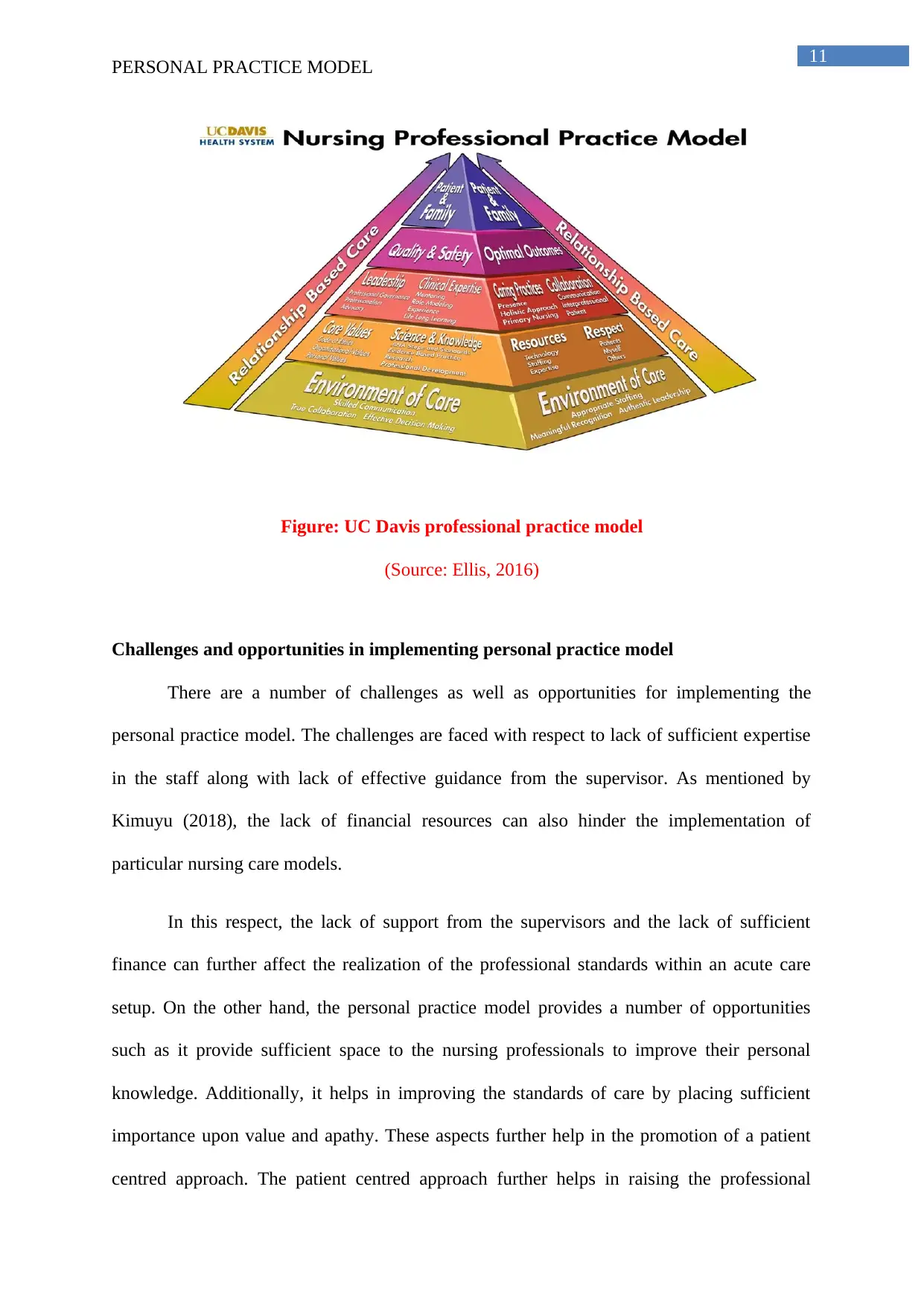
The personal practice model which had been highlighted over here has been compared
with the relationship-based care model proposed by UC Davis. It consists of a pyramid
structure which places patient and the family at the top. It focuses upon a number of aspects
such as the environment of care, optimal resources, respect for the patient and their respective
families, development and implementation of effective clinical practices, which aims in
receiving optimal outcomes (Prak & Wivatvanit, 2018). The care environment places much
importance upon appropriate staffing along with implementation of skilled communication
(Mather, Gale & Cummings, 2017). The communication approaches have been seen to
improve the quality of patient care. It also places sufficient importance upon the use of
effective knowledge and expertise for the development of clinical expertise in the patient. As
mentioned by Anderson, Kent and Owens (2015), the acquiring and development of
knowledge is guided by standard nursing practices and guidelines. The leadership approaches
adopted over here further governs the rate of success. Within an acute clinical care set up a
PERSONAL PRACTICE MODEL
promoting the concepts such as informed decision making. The patient centred approach
further helps in the practice and implementation of evidence-based practices.
The evidence-based practices help in the development of the full potential of the
nurses which helps in supporting personal knowing. As mentioned by Cashin et al. (2015),
the personal knowledge can help in improving the nursing quality and standards. The patient
centred approach undertaken by the nursing professionals can also help in supporting the five
domains of nursing centred knowledge, which can help in improving the quality of care. The
patient centred approaches undertaken over here help in the provision of sufficient grounds
for the development of new knowledge and skills (Nagle et al., 2017). Some of these
approaches can help in improving the quality of patient care.
Comparison of personal practice model with other relevant areas of nursing care
The personal practice model which had been highlighted over here has been compared
with the relationship-based care model proposed by UC Davis. It consists of a pyramid
structure which places patient and the family at the top. It focuses upon a number of aspects
such as the environment of care, optimal resources, respect for the patient and their respective
families, development and implementation of effective clinical practices, which aims in
receiving optimal outcomes (Prak & Wivatvanit, 2018). The care environment places much
importance upon appropriate staffing along with implementation of skilled communication
(Mather, Gale & Cummings, 2017). The communication approaches have been seen to
improve the quality of patient care. It also places sufficient importance upon the use of
effective knowledge and expertise for the development of clinical expertise in the patient. As
mentioned by Anderson, Kent and Owens (2015), the acquiring and development of
knowledge is guided by standard nursing practices and guidelines. The leadership approaches
adopted over here further governs the rate of success. Within an acute clinical care set up a
Paraphrase This Document
Need a fresh take? Get an instant paraphrase of this document with our AI Paraphraser
10
PERSONAL PRACTICE MODEL
situational leadership is used. The efficacy of the leadership depends upon the skills and the
expertise of the course modulator. As suggested by Dmytryshyn, Jack, Ballantyne, Wahoush
and MacMillan (2015), in the lack of effective leadership there is a huge probability of
mishap occurring within a professional clinical setup.
On the other hand, the model used by us uses an evidence-based approach to
improving the quality of care. The Evidence-based approaches are mainly tested solutions
applied within an acute clinical setting. Therefore, they are focused more upon nursing
research rather than placing importance upon the development and inclusion of skilled staff.
The UC Davis model Palaces more importance upon the care staff quality. Hence, it could be
referred to as a staff centred approach, whereas the model used over here places much
importance upon a patient centred by promoting policies such as informed decision making,
which focuses upon maximum inclusion of the patient within the care and support services.
However, as argued by Feo et al. (2017), the realization of the standards in full potential is
dependent upon the organizational skills.
The model developed over here could be further compared with model as suggested
by John Hopkins, which places sufficient emphasis upon nursing education and research. The
nursing education and research are further guided by a set of internal and external factors.
The internal factors could be divided into culture, environment, equipment, staffing
standards. On the other hand, the external factors could be divided into –accreditation,
legislation, quality measures and regulation standards. Therefore, the personal care model
developed over here fails to take into consideration the legislation and regulation standards,
which are pivotal to the optimal functioning of a healthcare organization.
PERSONAL PRACTICE MODEL
situational leadership is used. The efficacy of the leadership depends upon the skills and the
expertise of the course modulator. As suggested by Dmytryshyn, Jack, Ballantyne, Wahoush
and MacMillan (2015), in the lack of effective leadership there is a huge probability of
mishap occurring within a professional clinical setup.
On the other hand, the model used by us uses an evidence-based approach to
improving the quality of care. The Evidence-based approaches are mainly tested solutions
applied within an acute clinical setting. Therefore, they are focused more upon nursing
research rather than placing importance upon the development and inclusion of skilled staff.
The UC Davis model Palaces more importance upon the care staff quality. Hence, it could be
referred to as a staff centred approach, whereas the model used over here places much
importance upon a patient centred by promoting policies such as informed decision making,
which focuses upon maximum inclusion of the patient within the care and support services.
However, as argued by Feo et al. (2017), the realization of the standards in full potential is
dependent upon the organizational skills.
The model developed over here could be further compared with model as suggested
by John Hopkins, which places sufficient emphasis upon nursing education and research. The
nursing education and research are further guided by a set of internal and external factors.
The internal factors could be divided into culture, environment, equipment, staffing
standards. On the other hand, the external factors could be divided into –accreditation,
legislation, quality measures and regulation standards. Therefore, the personal care model
developed over here fails to take into consideration the legislation and regulation standards,
which are pivotal to the optimal functioning of a healthcare organization.
11
PERSONAL PRACTICE MODEL
Figure: UC Davis professional practice model
(Source: Ellis, 2016)
Challenges and opportunities in implementing personal practice model
There are a number of challenges as well as opportunities for implementing the
personal practice model. The challenges are faced with respect to lack of sufficient expertise
in the staff along with lack of effective guidance from the supervisor. As mentioned by
Kimuyu (2018), the lack of financial resources can also hinder the implementation of
particular nursing care models.
In this respect, the lack of support from the supervisors and the lack of sufficient
finance can further affect the realization of the professional standards within an acute care
setup. On the other hand, the personal practice model provides a number of opportunities
such as it provide sufficient space to the nursing professionals to improve their personal
knowledge. Additionally, it helps in improving the standards of care by placing sufficient
importance upon value and apathy. These aspects further help in the promotion of a patient
centred approach. The patient centred approach further helps in raising the professional
PERSONAL PRACTICE MODEL
Figure: UC Davis professional practice model
(Source: Ellis, 2016)
Challenges and opportunities in implementing personal practice model
There are a number of challenges as well as opportunities for implementing the
personal practice model. The challenges are faced with respect to lack of sufficient expertise
in the staff along with lack of effective guidance from the supervisor. As mentioned by
Kimuyu (2018), the lack of financial resources can also hinder the implementation of
particular nursing care models.
In this respect, the lack of support from the supervisors and the lack of sufficient
finance can further affect the realization of the professional standards within an acute care
setup. On the other hand, the personal practice model provides a number of opportunities
such as it provide sufficient space to the nursing professionals to improve their personal
knowledge. Additionally, it helps in improving the standards of care by placing sufficient
importance upon value and apathy. These aspects further help in the promotion of a patient
centred approach. The patient centred approach further helps in raising the professional
⊘ This is a preview!⊘
Do you want full access?
Subscribe today to unlock all pages.
Trusted by 1+ million students worldwide

1 out of 16


Related Documents


Your All-in-One AI-Powered Toolkit for Academic Success.
+13062052269
info@desklib.com
Available 24*7 on WhatsApp / Email
![[object Object]](/_next/static/media/star-bottom.7253800d.svg)
Unlock your academic potential
Copyright © 2020–2026 A2Z Services. All Rights Reserved. Developed and managed by ZUCOL.