Personal and Professional Development Report: Skills and Competencies
VerifiedAdded on 2019/12/03
|23
|6717
|200
Report
AI Summary
This report delves into the crucial aspects of personal and professional development, emphasizing self-managed learning, skills and competency assessment, and the creation of actionable development plans. It explores various approaches to self-managed learning, including leadership styles (transformational, transactional, and situational) and learning style theories (Kolb's and Honey & Mumford). The report highlights the importance of lifelong learning, examining methods like apprenticeship, continuous professional development, and recognition of prior learning. Furthermore, it outlines the benefits of self-managed learning for both individuals and organizations, focusing on improved skills, effective decision-making, and enhanced teamwork. The report includes tables for skill analysis, development needs, and a personal development plan, culminating in an evaluation of the development activities and plan adjustments based on feedback.
Personal and Professional
Development
Development

Paraphrase This Document
Need a fresh take? Get an instant paraphrase of this document with our AI Paraphraser
TABLE OF CONTENTS
INTRODUCTION...........................................................................................................................1
TASK 1............................................................................................................................................1
1.1 Approaches to self-managed learning..............................................................................1
1.2 Ways in which lifelong learning can be encouraged in personal and professional context
................................................................................................................................................4
Following are the ways of life long process:..........................................................................5
1.3 Benefits of self-managed learning to the individual and organization.............................5
TASK 2............................................................................................................................................6
2.1 Own current skills and competencies against professional standards and organizational
objectives................................................................................................................................6
2.2 Own development needs and activities required to meet them......................................11
2.3 Development opportunities to meet current and future defined needs...........................12
2.4 Personal and professional development plan based on identified needs........................12
TASK 3..........................................................................................................................................14
3.1 Processes and activities required to implement the development plan..........................14
3.2 Undertake and document development activities as planned.........................................15
3.3 Reflect critically on own learning against original aims and objectives set in the
development plan..................................................................................................................16
3.4 The development plan based on feedback and Evaluation.............................................17
CONCLUSION..............................................................................................................................18
REFERENCES..............................................................................................................................20
INTRODUCTION...........................................................................................................................1
TASK 1............................................................................................................................................1
1.1 Approaches to self-managed learning..............................................................................1
1.2 Ways in which lifelong learning can be encouraged in personal and professional context
................................................................................................................................................4
Following are the ways of life long process:..........................................................................5
1.3 Benefits of self-managed learning to the individual and organization.............................5
TASK 2............................................................................................................................................6
2.1 Own current skills and competencies against professional standards and organizational
objectives................................................................................................................................6
2.2 Own development needs and activities required to meet them......................................11
2.3 Development opportunities to meet current and future defined needs...........................12
2.4 Personal and professional development plan based on identified needs........................12
TASK 3..........................................................................................................................................14
3.1 Processes and activities required to implement the development plan..........................14
3.2 Undertake and document development activities as planned.........................................15
3.3 Reflect critically on own learning against original aims and objectives set in the
development plan..................................................................................................................16
3.4 The development plan based on feedback and Evaluation.............................................17
CONCLUSION..............................................................................................................................18
REFERENCES..............................................................................................................................20
INDEX OF TABLES
Table 1: Areas to be developed.......................................................................................................8
Table 2: Professional Skills.............................................................................................................9
Table 3: Table for measuring Personal and Professional Development........................................10
Table 4: Updated Personal and Professional Plan.........................................................................15
Table 1: Areas to be developed.......................................................................................................8
Table 2: Professional Skills.............................................................................................................9
Table 3: Table for measuring Personal and Professional Development........................................10
Table 4: Updated Personal and Professional Plan.........................................................................15
⊘ This is a preview!⊘
Do you want full access?
Subscribe today to unlock all pages.

Trusted by 1+ million students worldwide
INTRODUCTION
Personal and professional development is important for improving the skills and
knowledge which an individual possess. It helps out in setting up the strategies, goals and
objectives for improving knowledge and skills for better performance. In personal development,
one should focus on the skills which have to be improved. It is all about improving the potential
and talents which one possesses. Professional development is to understand the job and to
improve the work performance (Alcock, Daily and Griggs, 2008). The present report covers the
importance of self-management learning and contains personal and professional development
plans based on needs identified by individuals. Moreover, it also focuses the effectiveness of
time management strategies. The objective of personal and professional development is to
improve Communication skills, listening skill, leadership skills, presentation skills, self-
management, professional knowledge and time Management.
TASK 1
1.1 Approaches to self-managed learning
Personal and professional development is essential in improving the skills and knowledge
which an individual possess. This task aims to examine self-managed learning and associated
approaches that can enhance lifelong learning. For individuals, personal skills play a vital role
for attaining success in student or in the professional life. Self-managed learning is very helpful
in evaluating own strengths and weaknesses (Back and et. al., 2003). Learning is a never ending
process in which it helps in attaining personal and organizational goals. People use Self-directed
learning as it develops great awareness of responsibility. It enables the individual to view their
problems, enjoy learning and desire change. There are different self-management style and
learning style theories, which are as follows:
Leadership styles
Transformational leadership: This is leadership style which focuses on the role of
organization, group performance and supervisors. In this style the leaders encourage their
employees by providing them rewards and punishments depending upon their
performance of their work.
Transformational leadership: This is a leadership style which inspires change positively
on employees who follow. These type of leaders are enthusiastic, passionate and
energetic. Moreover, they help every employees working under them. Few components
1
Personal and professional development is important for improving the skills and
knowledge which an individual possess. It helps out in setting up the strategies, goals and
objectives for improving knowledge and skills for better performance. In personal development,
one should focus on the skills which have to be improved. It is all about improving the potential
and talents which one possesses. Professional development is to understand the job and to
improve the work performance (Alcock, Daily and Griggs, 2008). The present report covers the
importance of self-management learning and contains personal and professional development
plans based on needs identified by individuals. Moreover, it also focuses the effectiveness of
time management strategies. The objective of personal and professional development is to
improve Communication skills, listening skill, leadership skills, presentation skills, self-
management, professional knowledge and time Management.
TASK 1
1.1 Approaches to self-managed learning
Personal and professional development is essential in improving the skills and knowledge
which an individual possess. This task aims to examine self-managed learning and associated
approaches that can enhance lifelong learning. For individuals, personal skills play a vital role
for attaining success in student or in the professional life. Self-managed learning is very helpful
in evaluating own strengths and weaknesses (Back and et. al., 2003). Learning is a never ending
process in which it helps in attaining personal and organizational goals. People use Self-directed
learning as it develops great awareness of responsibility. It enables the individual to view their
problems, enjoy learning and desire change. There are different self-management style and
learning style theories, which are as follows:
Leadership styles
Transformational leadership: This is leadership style which focuses on the role of
organization, group performance and supervisors. In this style the leaders encourage their
employees by providing them rewards and punishments depending upon their
performance of their work.
Transformational leadership: This is a leadership style which inspires change positively
on employees who follow. These type of leaders are enthusiastic, passionate and
energetic. Moreover, they help every employees working under them. Few components
1
Paraphrase This Document
Need a fresh take? Get an instant paraphrase of this document with our AI Paraphraser
of Transformational leadership are intellectual stimulation, inspirational motivation,
individualized consideration, etc.
Situational leadership: The managers or leader adopt this style to influence the
development level. This style can be changed continuously to meet the organizational
need.
David Kolb's learning styles
According to Kolb's people learn in different ways. There are two ways through which an
individual can learn experience by concrete experience and abstract conceptualization.
According to abstract conceptualization one learns through analyzing and what is happening.
Concrete experience one learn through having a specific experience. Further, Kolb's explains that
these experiences can be dealed in two ways they are through actively experimenting and
reflective observation. Actively experimenting happens which individuals directly involve
themselves in experience. Reflective observation happens when individuals merely reflect on
observations. In addition to this Kolb's created a Learning style inventory in which individuals
fill a questionnaire according to the learning situation. After completing the questionnaire, the
individual can tally this response in determining the performance level for each phase. Learning
cycle help the individual in writing down his scores attained creating a kite shape. There are four
quadrants in the kite with different portions. Below given are performance by each quadrant:
Diverging style: These people are sensitive and have the ability to look situations in
different perspective. They tent to collect information and apply their imagination power
to solver their problems. These people prefer to work in groups, have an open mind and
encourage feedback.
Assimilating style: It is a logical approach. Concepts and knowledge are given
importance. Rather than practical knowledge they require clear explanation. Individuals
with this style prefer exploring, reading, etc.
Converging style: In this the individuals have the capability of problem solving and
adopts their knowledge and learning in solving issues. They are also capable in effective
decision making. They like to apply new ideas in solving problems.
Accommodating style: This type of individuals believe in intuitions rather that logical
thinking. They apply others analyzes in solving problems (Bouwman and Duin, 2003).
They love to face challenges but depend on other's information to carry out their analysis.
2
individualized consideration, etc.
Situational leadership: The managers or leader adopt this style to influence the
development level. This style can be changed continuously to meet the organizational
need.
David Kolb's learning styles
According to Kolb's people learn in different ways. There are two ways through which an
individual can learn experience by concrete experience and abstract conceptualization.
According to abstract conceptualization one learns through analyzing and what is happening.
Concrete experience one learn through having a specific experience. Further, Kolb's explains that
these experiences can be dealed in two ways they are through actively experimenting and
reflective observation. Actively experimenting happens which individuals directly involve
themselves in experience. Reflective observation happens when individuals merely reflect on
observations. In addition to this Kolb's created a Learning style inventory in which individuals
fill a questionnaire according to the learning situation. After completing the questionnaire, the
individual can tally this response in determining the performance level for each phase. Learning
cycle help the individual in writing down his scores attained creating a kite shape. There are four
quadrants in the kite with different portions. Below given are performance by each quadrant:
Diverging style: These people are sensitive and have the ability to look situations in
different perspective. They tent to collect information and apply their imagination power
to solver their problems. These people prefer to work in groups, have an open mind and
encourage feedback.
Assimilating style: It is a logical approach. Concepts and knowledge are given
importance. Rather than practical knowledge they require clear explanation. Individuals
with this style prefer exploring, reading, etc.
Converging style: In this the individuals have the capability of problem solving and
adopts their knowledge and learning in solving issues. They are also capable in effective
decision making. They like to apply new ideas in solving problems.
Accommodating style: This type of individuals believe in intuitions rather that logical
thinking. They apply others analyzes in solving problems (Bouwman and Duin, 2003).
They love to face challenges but depend on other's information to carry out their analysis.
2
Honey and Mumford learning styles
Based on the work of Kolb's, Peter Honey and Alan Mumford developed learning style. They
established four learning performances:
Activist: These are those who learn by doing. They have an open mind in learning thing
or new approaches.
Theorist: In this, people love to know the background learning. They prefer facts and
concepts in learning. They draw new information through analyzing the situations.
Pragmatists: These people apply the learning in real world. They apply their learning
practically. People love to try out new theories, ideas, techniques, etc.
Reflectors: Individual learn through their previous experience. Collection of data for
effective decision making.
In addition to this, following are the few things which can be done for self management learning:
Internet: This source is very much useful in gaining knowledge as have a vast data
regarding any topic. Google Scholar is very helpful searching with academic journals and
articals. It allows accessing information by different authors related to subject like risk
and business management etc. It also has latest's innovations, information regarding
entrepreneurs, new business, etc. With this knowledge, individuals can attain success in
their work place and can gain knowledge of any topic which would further guide in
thinking critically and making appropriate decisions
Social media: This is a modern source in which helps in gaining information. Different
social media like Twitter, Facebook, and My Space etc. are very helpful as it assists
people in chatting with others which increases their knowledge in certain areas. Through
these social media there would be many who would share information like any attack,
issues related to health, society, country, nation, etc.
Seminars and conferences: These are very important as which the help of these seminars
and conferences knowledge increases and in addition to this, other skills like confidence,
body movements, etc. can also be learned. These are very effective tools which enable in
presenting the information to others. It helps in developing confidence to speak in front
of public and to improve their presentation skills.
3
Based on the work of Kolb's, Peter Honey and Alan Mumford developed learning style. They
established four learning performances:
Activist: These are those who learn by doing. They have an open mind in learning thing
or new approaches.
Theorist: In this, people love to know the background learning. They prefer facts and
concepts in learning. They draw new information through analyzing the situations.
Pragmatists: These people apply the learning in real world. They apply their learning
practically. People love to try out new theories, ideas, techniques, etc.
Reflectors: Individual learn through their previous experience. Collection of data for
effective decision making.
In addition to this, following are the few things which can be done for self management learning:
Internet: This source is very much useful in gaining knowledge as have a vast data
regarding any topic. Google Scholar is very helpful searching with academic journals and
articals. It allows accessing information by different authors related to subject like risk
and business management etc. It also has latest's innovations, information regarding
entrepreneurs, new business, etc. With this knowledge, individuals can attain success in
their work place and can gain knowledge of any topic which would further guide in
thinking critically and making appropriate decisions
Social media: This is a modern source in which helps in gaining information. Different
social media like Twitter, Facebook, and My Space etc. are very helpful as it assists
people in chatting with others which increases their knowledge in certain areas. Through
these social media there would be many who would share information like any attack,
issues related to health, society, country, nation, etc.
Seminars and conferences: These are very important as which the help of these seminars
and conferences knowledge increases and in addition to this, other skills like confidence,
body movements, etc. can also be learned. These are very effective tools which enable in
presenting the information to others. It helps in developing confidence to speak in front
of public and to improve their presentation skills.
3
⊘ This is a preview!⊘
Do you want full access?
Subscribe today to unlock all pages.
Trusted by 1+ million students worldwide
1.2 Ways in which lifelong learning can be encouraged in personal and professional context
This task aims the importance of lifelong learning to an individual and organization.
Learning is a lifelong search for gaining knowledge and information. It is a never ending process
that helps in improving personal growth, developing skills and assist in improving
understanding. Following are the ways for encouraging lifelong learning in professional and
personal development: Apprenticeship: It is a type of learning in which the individuals are trained in a normal
working situation. In other words it is a time when student devotes his time in an
operational class room and is trained by veteran instructor. All the things which are
explained are shown practically. It is similar as on-the-job training, where the individuals
are trained in normal work place. Here the employee who has a vast experience will
provide the individual with practically. This is very effective as the individual get
practical knowledge. The things which the individuals learned during their classes are
been shown practically. It is very helpful in lifelong learning as whatever a person learns
practically remains with him for a long time. Continuous professional development: It is a means of through which individuals
maintain their skills and knowledge related with their professionalism. There are many
ways through which individuals learn to maintain their skills and knowledge. Most of the
individuals learn through experience and by viewing their life. The actions done, the
situations which occur, etc. are very helpful in knowing oneself. The decision taken
which may be right or wrong helps in learning. This is all about personal understanding,
reviewing opinion and judging. This type of learning is very helpful in developing new
skills and in improving the existing potentials (Draganidis and Mentzas, 2006). This
could be achieved through effectively managing roles and responsibilities. Individuals
also use internet for maintaining their knowledge and skills. Learning is successful only
when individuals search for their own gain. Learning something without understanding
the meaning is very difficult. Individual should question himself regarding things which
would help him to improve the skills and should find answers by using different search
engines. Recognition of prior learning: It is process used career development practitioners,
training institutes, regulatory bodies, etc. for evaluating the knowledge and skills which
4
This task aims the importance of lifelong learning to an individual and organization.
Learning is a lifelong search for gaining knowledge and information. It is a never ending process
that helps in improving personal growth, developing skills and assist in improving
understanding. Following are the ways for encouraging lifelong learning in professional and
personal development: Apprenticeship: It is a type of learning in which the individuals are trained in a normal
working situation. In other words it is a time when student devotes his time in an
operational class room and is trained by veteran instructor. All the things which are
explained are shown practically. It is similar as on-the-job training, where the individuals
are trained in normal work place. Here the employee who has a vast experience will
provide the individual with practically. This is very effective as the individual get
practical knowledge. The things which the individuals learned during their classes are
been shown practically. It is very helpful in lifelong learning as whatever a person learns
practically remains with him for a long time. Continuous professional development: It is a means of through which individuals
maintain their skills and knowledge related with their professionalism. There are many
ways through which individuals learn to maintain their skills and knowledge. Most of the
individuals learn through experience and by viewing their life. The actions done, the
situations which occur, etc. are very helpful in knowing oneself. The decision taken
which may be right or wrong helps in learning. This is all about personal understanding,
reviewing opinion and judging. This type of learning is very helpful in developing new
skills and in improving the existing potentials (Draganidis and Mentzas, 2006). This
could be achieved through effectively managing roles and responsibilities. Individuals
also use internet for maintaining their knowledge and skills. Learning is successful only
when individuals search for their own gain. Learning something without understanding
the meaning is very difficult. Individual should question himself regarding things which
would help him to improve the skills and should find answers by using different search
engines. Recognition of prior learning: It is process used career development practitioners,
training institutes, regulatory bodies, etc. for evaluating the knowledge and skills which
4
Paraphrase This Document
Need a fresh take? Get an instant paraphrase of this document with our AI Paraphraser
are gained outside the class room. Individuals learn through personal assessment and
observing others.
Linking higher education with industry: This type of learning is possible when
individual relate the things learned in a class room with the outside world. This helps in
understanding the concept more clearly.
Following are the ways of life long process:
Autodidacticism: It is an act of self-directed learning regarding a particular subject which
individual had no understanding.
Continuous professional development(CPE): Another types self-directed learning in
which individual maintain their skills and knowledge.
Recognition to prior learning (RPL): This is a process to identify the skills and
knowledge against a qualification.
Credit accumulation and transfer schemes (CATS): This establishes a movement between
institutions and courses.
1.3 Benefits of self-managed learning to the individual and organization
This task aims to asses how self-managed learning benefits the individual and
organization. Self-managed learning helps in developing competency level of individuals as this
kind of learning supports in gaining deep knowledge of each and every aspect which will be
helpful in improving their knowledge and skills. Self-managed learning also proves to be
supportive in organizational aspect as firms give training to their employees but many times,
they do not get the desired results even after making huge expenditures for these programmes
(Fink, 2013). This happens as a result of lack in self-managed learning. Following are the
benefits of Self-managed learning to individual and organization:
Organization: Firms provide training to employees but there are times when they do not
get the desired results and this is because of lack in self-managed learning. Proper self-
management will help in improving skills for working as a team which will contribute in the
growth of organization. Along with that, it also improves presentation skills through continuous
assessment of one's drawback and with corrective measures. It helps in effective decision making
which will help in reducing company’s expenses and losses. This is very useful for the firm and
would help to assist in attaining goals. Moreover, employees become capable in solving
5
observing others.
Linking higher education with industry: This type of learning is possible when
individual relate the things learned in a class room with the outside world. This helps in
understanding the concept more clearly.
Following are the ways of life long process:
Autodidacticism: It is an act of self-directed learning regarding a particular subject which
individual had no understanding.
Continuous professional development(CPE): Another types self-directed learning in
which individual maintain their skills and knowledge.
Recognition to prior learning (RPL): This is a process to identify the skills and
knowledge against a qualification.
Credit accumulation and transfer schemes (CATS): This establishes a movement between
institutions and courses.
1.3 Benefits of self-managed learning to the individual and organization
This task aims to asses how self-managed learning benefits the individual and
organization. Self-managed learning helps in developing competency level of individuals as this
kind of learning supports in gaining deep knowledge of each and every aspect which will be
helpful in improving their knowledge and skills. Self-managed learning also proves to be
supportive in organizational aspect as firms give training to their employees but many times,
they do not get the desired results even after making huge expenditures for these programmes
(Fink, 2013). This happens as a result of lack in self-managed learning. Following are the
benefits of Self-managed learning to individual and organization:
Organization: Firms provide training to employees but there are times when they do not
get the desired results and this is because of lack in self-managed learning. Proper self-
management will help in improving skills for working as a team which will contribute in the
growth of organization. Along with that, it also improves presentation skills through continuous
assessment of one's drawback and with corrective measures. It helps in effective decision making
which will help in reducing company’s expenses and losses. This is very useful for the firm and
would help to assist in attaining goals. Moreover, employees become capable in solving
5
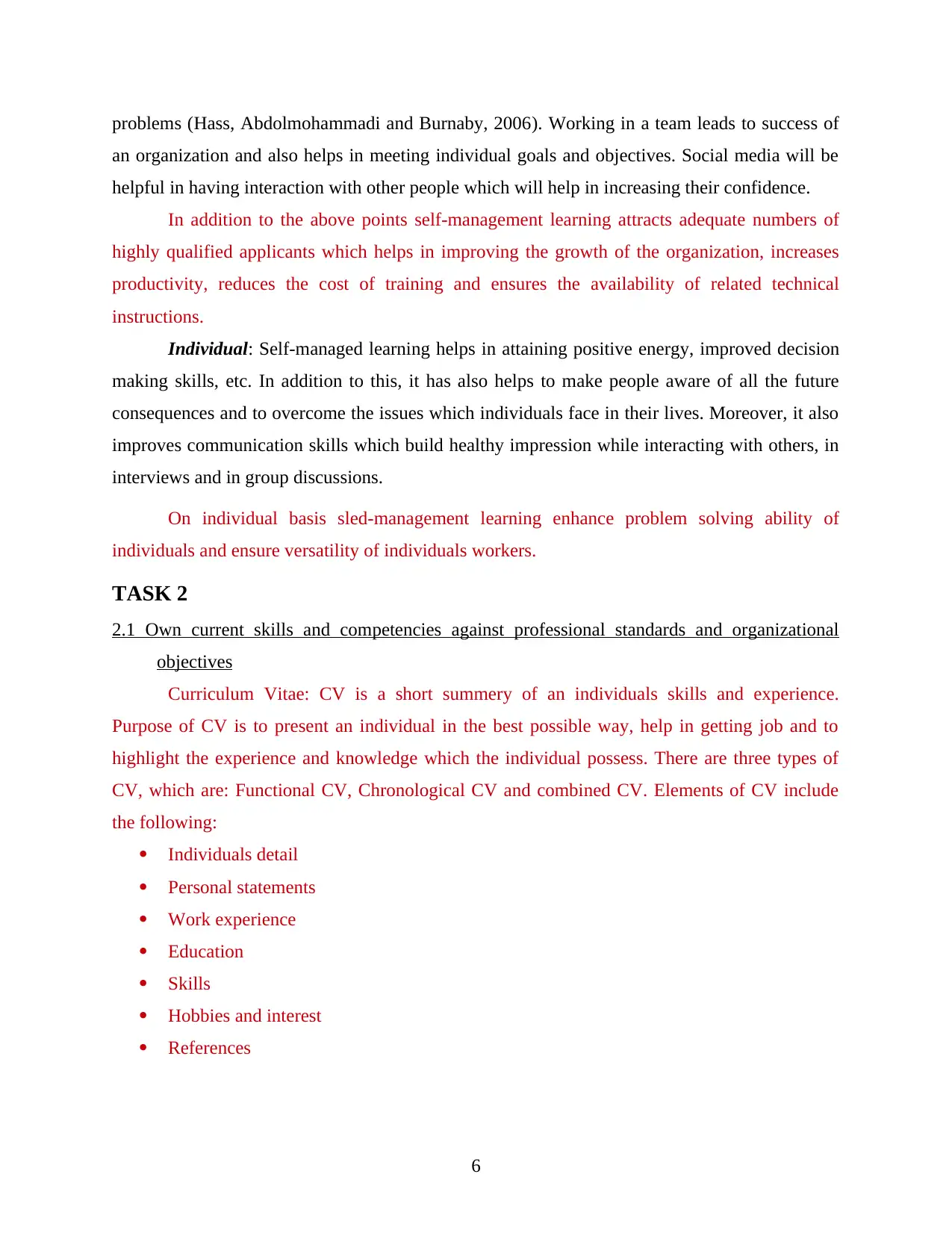
problems (Hass, Abdolmohammadi and Burnaby, 2006). Working in a team leads to success of
an organization and also helps in meeting individual goals and objectives. Social media will be
helpful in having interaction with other people which will help in increasing their confidence.
In addition to the above points self-management learning attracts adequate numbers of
highly qualified applicants which helps in improving the growth of the organization, increases
productivity, reduces the cost of training and ensures the availability of related technical
instructions.
Individual: Self-managed learning helps in attaining positive energy, improved decision
making skills, etc. In addition to this, it has also helps to make people aware of all the future
consequences and to overcome the issues which individuals face in their lives. Moreover, it also
improves communication skills which build healthy impression while interacting with others, in
interviews and in group discussions.
On individual basis sled-management learning enhance problem solving ability of
individuals and ensure versatility of individuals workers.
TASK 2
2.1 Own current skills and competencies against professional standards and organizational
objectives
Curriculum Vitae: CV is a short summery of an individuals skills and experience.
Purpose of CV is to present an individual in the best possible way, help in getting job and to
highlight the experience and knowledge which the individual possess. There are three types of
CV, which are: Functional CV, Chronological CV and combined CV. Elements of CV include
the following:
Individuals detail
Personal statements
Work experience
Education
Skills
Hobbies and interest
References
6
an organization and also helps in meeting individual goals and objectives. Social media will be
helpful in having interaction with other people which will help in increasing their confidence.
In addition to the above points self-management learning attracts adequate numbers of
highly qualified applicants which helps in improving the growth of the organization, increases
productivity, reduces the cost of training and ensures the availability of related technical
instructions.
Individual: Self-managed learning helps in attaining positive energy, improved decision
making skills, etc. In addition to this, it has also helps to make people aware of all the future
consequences and to overcome the issues which individuals face in their lives. Moreover, it also
improves communication skills which build healthy impression while interacting with others, in
interviews and in group discussions.
On individual basis sled-management learning enhance problem solving ability of
individuals and ensure versatility of individuals workers.
TASK 2
2.1 Own current skills and competencies against professional standards and organizational
objectives
Curriculum Vitae: CV is a short summery of an individuals skills and experience.
Purpose of CV is to present an individual in the best possible way, help in getting job and to
highlight the experience and knowledge which the individual possess. There are three types of
CV, which are: Functional CV, Chronological CV and combined CV. Elements of CV include
the following:
Individuals detail
Personal statements
Work experience
Education
Skills
Hobbies and interest
References
6
⊘ This is a preview!⊘
Do you want full access?
Subscribe today to unlock all pages.
Trusted by 1+ million students worldwide
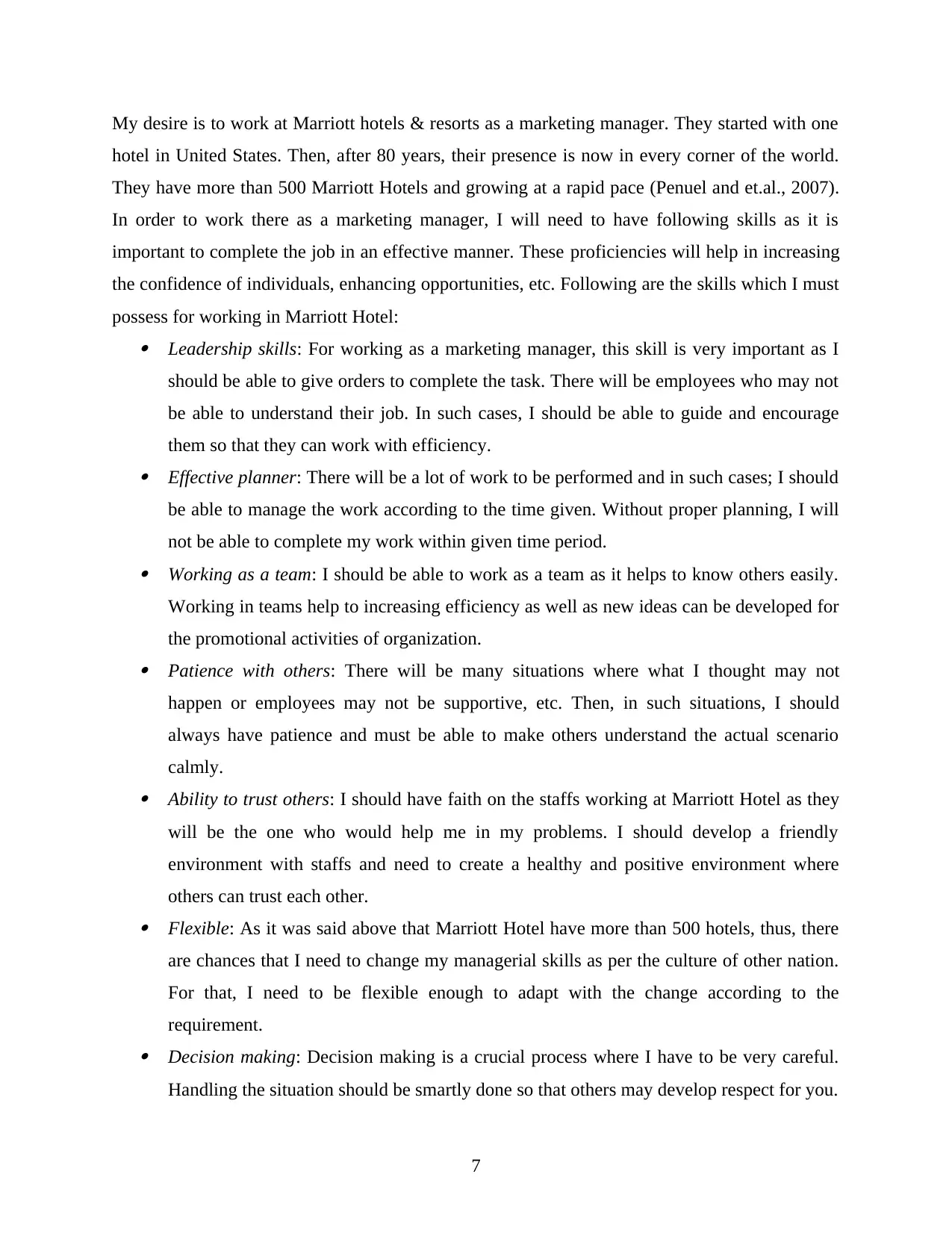
My desire is to work at Marriott hotels & resorts as a marketing manager. They started with one
hotel in United States. Then, after 80 years, their presence is now in every corner of the world.
They have more than 500 Marriott Hotels and growing at a rapid pace (Penuel and et.al., 2007).
In order to work there as a marketing manager, I will need to have following skills as it is
important to complete the job in an effective manner. These proficiencies will help in increasing
the confidence of individuals, enhancing opportunities, etc. Following are the skills which I must
possess for working in Marriott Hotel: Leadership skills: For working as a marketing manager, this skill is very important as I
should be able to give orders to complete the task. There will be employees who may not
be able to understand their job. In such cases, I should be able to guide and encourage
them so that they can work with efficiency. Effective planner: There will be a lot of work to be performed and in such cases; I should
be able to manage the work according to the time given. Without proper planning, I will
not be able to complete my work within given time period. Working as a team: I should be able to work as a team as it helps to know others easily.
Working in teams help to increasing efficiency as well as new ideas can be developed for
the promotional activities of organization. Patience with others: There will be many situations where what I thought may not
happen or employees may not be supportive, etc. Then, in such situations, I should
always have patience and must be able to make others understand the actual scenario
calmly. Ability to trust others: I should have faith on the staffs working at Marriott Hotel as they
will be the one who would help me in my problems. I should develop a friendly
environment with staffs and need to create a healthy and positive environment where
others can trust each other. Flexible: As it was said above that Marriott Hotel have more than 500 hotels, thus, there
are chances that I need to change my managerial skills as per the culture of other nation.
For that, I need to be flexible enough to adapt with the change according to the
requirement. Decision making: Decision making is a crucial process where I have to be very careful.
Handling the situation should be smartly done so that others may develop respect for you.
7
hotel in United States. Then, after 80 years, their presence is now in every corner of the world.
They have more than 500 Marriott Hotels and growing at a rapid pace (Penuel and et.al., 2007).
In order to work there as a marketing manager, I will need to have following skills as it is
important to complete the job in an effective manner. These proficiencies will help in increasing
the confidence of individuals, enhancing opportunities, etc. Following are the skills which I must
possess for working in Marriott Hotel: Leadership skills: For working as a marketing manager, this skill is very important as I
should be able to give orders to complete the task. There will be employees who may not
be able to understand their job. In such cases, I should be able to guide and encourage
them so that they can work with efficiency. Effective planner: There will be a lot of work to be performed and in such cases; I should
be able to manage the work according to the time given. Without proper planning, I will
not be able to complete my work within given time period. Working as a team: I should be able to work as a team as it helps to know others easily.
Working in teams help to increasing efficiency as well as new ideas can be developed for
the promotional activities of organization. Patience with others: There will be many situations where what I thought may not
happen or employees may not be supportive, etc. Then, in such situations, I should
always have patience and must be able to make others understand the actual scenario
calmly. Ability to trust others: I should have faith on the staffs working at Marriott Hotel as they
will be the one who would help me in my problems. I should develop a friendly
environment with staffs and need to create a healthy and positive environment where
others can trust each other. Flexible: As it was said above that Marriott Hotel have more than 500 hotels, thus, there
are chances that I need to change my managerial skills as per the culture of other nation.
For that, I need to be flexible enough to adapt with the change according to the
requirement. Decision making: Decision making is a crucial process where I have to be very careful.
Handling the situation should be smartly done so that others may develop respect for you.
7
Paraphrase This Document
Need a fresh take? Get an instant paraphrase of this document with our AI Paraphraser
Effective listener: In solving any issues or in attending any conferences, I should be an
effective listener so that I will be able to understand easily and can respond according to
the situation.
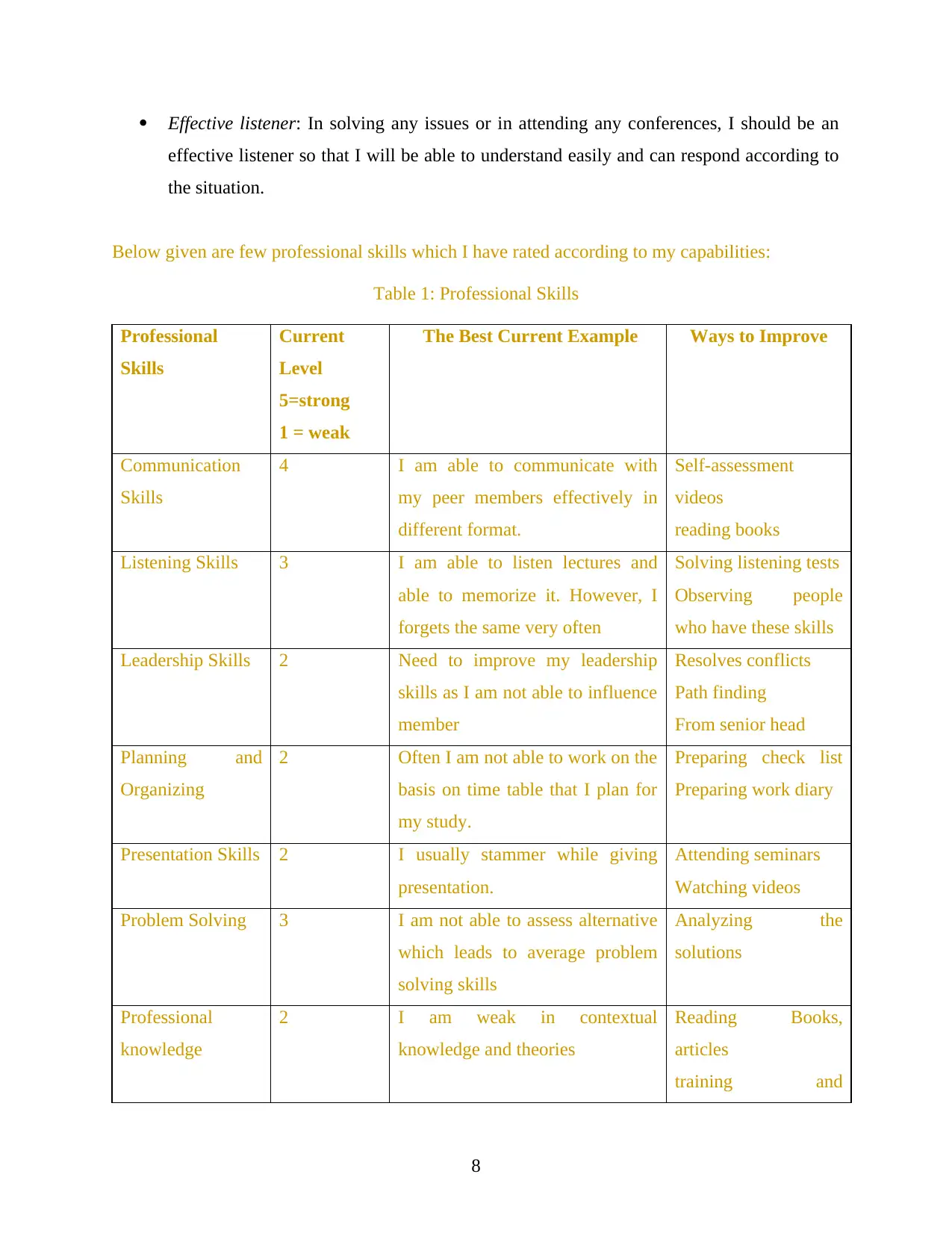
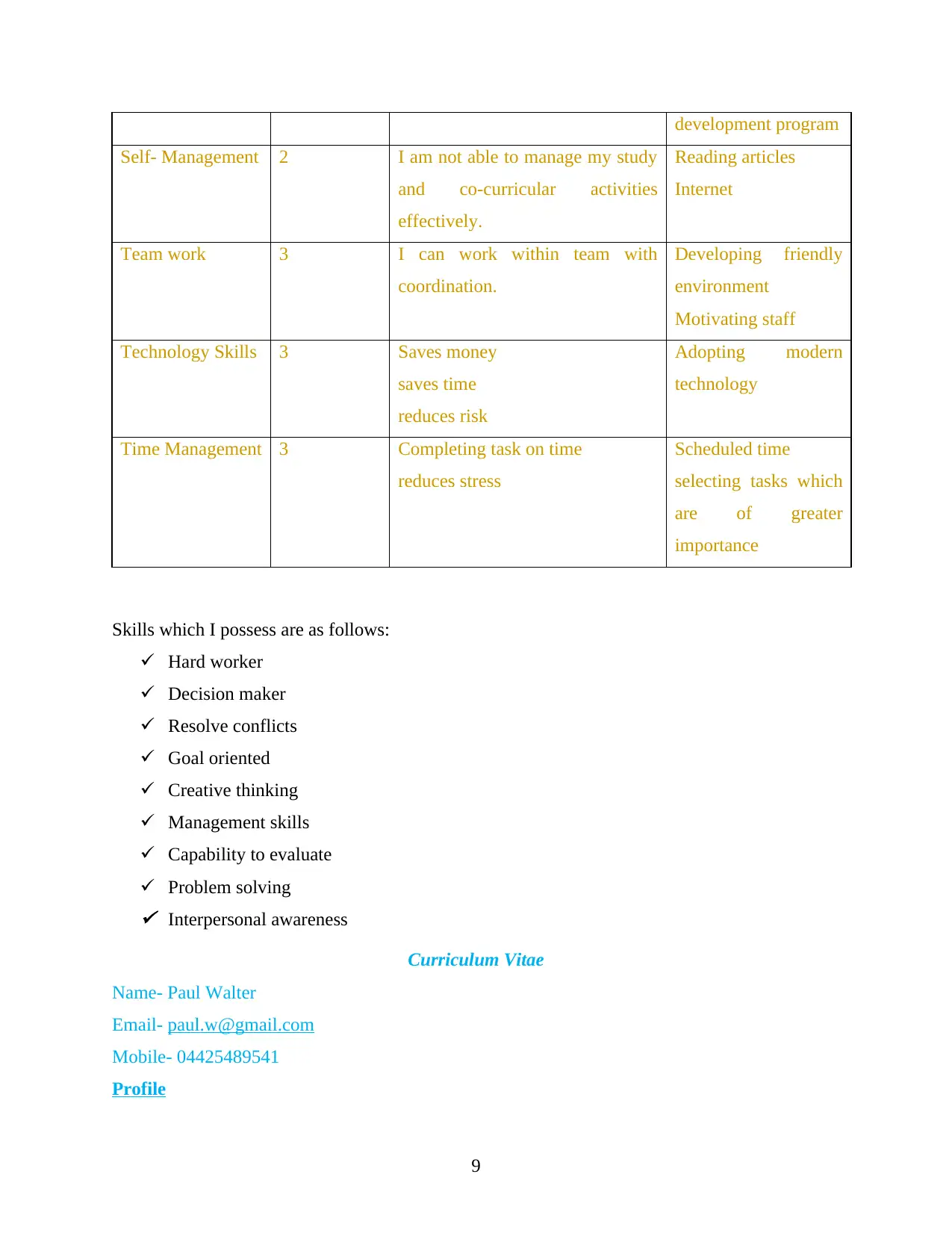
Below given are few professional skills which I have rated according to my capabilities:
Table 1: Professional Skills
Professional
Skills
Current
Level
5=strong
1 = weak
The Best Current Example Ways to Improve
Communication
Skills
4 I am able to communicate with
my peer members effectively in
different format.
Self-assessment
videos
reading books
Listening Skills 3 I am able to listen lectures and
able to memorize it. However, I
forgets the same very often
Solving listening tests
Observing people
who have these skills
Leadership Skills 2 Need to improve my leadership
skills as I am not able to influence
member
Resolves conflicts
Path finding
From senior head
Planning and
Organizing
2 Often I am not able to work on the
basis on time table that I plan for
my study.
Preparing check list
Preparing work diary
Presentation Skills 2 I usually stammer while giving
presentation.
Attending seminars
Watching videos
Problem Solving 3 I am not able to assess alternative
which leads to average problem
solving skills
Analyzing the
solutions
Professional
knowledge
2 I am weak in contextual
knowledge and theories
Reading Books,
articles
training and
8
effective listener so that I will be able to understand easily and can respond according to
the situation.
Below given are few professional skills which I have rated according to my capabilities:
Table 1: Professional Skills
Professional
Skills
Current
Level
5=strong
1 = weak
The Best Current Example Ways to Improve
Communication
Skills
4 I am able to communicate with
my peer members effectively in
different format.
Self-assessment
videos
reading books
Listening Skills 3 I am able to listen lectures and
able to memorize it. However, I
forgets the same very often
Solving listening tests
Observing people
who have these skills
Leadership Skills 2 Need to improve my leadership
skills as I am not able to influence
member
Resolves conflicts
Path finding
From senior head
Planning and
Organizing
2 Often I am not able to work on the
basis on time table that I plan for
my study.
Preparing check list
Preparing work diary
Presentation Skills 2 I usually stammer while giving
presentation.
Attending seminars
Watching videos
Problem Solving 3 I am not able to assess alternative
which leads to average problem
solving skills
Analyzing the
solutions
Professional
knowledge
2 I am weak in contextual
knowledge and theories
Reading Books,
articles
training and
8
development program
Self- Management 2 I am not able to manage my study
and co-curricular activities
effectively.
Reading articles
Internet
Team work 3 I can work within team with
coordination.
Developing friendly
environment
Motivating staff
Technology Skills 3 Saves money
saves time
reduces risk
Adopting modern
technology
Time Management 3 Completing task on time
reduces stress
Scheduled time
selecting tasks which
are of greater
importance
Skills which I possess are as follows:
Hard worker
Decision maker
Resolve conflicts
Goal oriented
Creative thinking
Management skills
Capability to evaluate
Problem solving Interpersonal awareness
Curriculum Vitae
Name- Paul Walter
Email- paul.w@gmail.com
Mobile- 04425489541
Profile
9
Self- Management 2 I am not able to manage my study
and co-curricular activities
effectively.
Reading articles
Internet
Team work 3 I can work within team with
coordination.
Developing friendly
environment
Motivating staff
Technology Skills 3 Saves money
saves time
reduces risk
Adopting modern
technology
Time Management 3 Completing task on time
reduces stress
Scheduled time
selecting tasks which
are of greater
importance
Skills which I possess are as follows:
Hard worker
Decision maker
Resolve conflicts
Goal oriented
Creative thinking
Management skills
Capability to evaluate
Problem solving Interpersonal awareness
Curriculum Vitae
Name- Paul Walter
Email- paul.w@gmail.com
Mobile- 04425489541
Profile
9
⊘ This is a preview!⊘
Do you want full access?
Subscribe today to unlock all pages.
Trusted by 1+ million students worldwide

1 out of 23


Related Documents


Your All-in-One AI-Powered Toolkit for Academic Success.
+13062052269
info@desklib.com
Available 24*7 on WhatsApp / Email
![[object Object]](/_next/static/media/star-bottom.7253800d.svg)
Unlock your academic potential
Copyright © 2020–2026 A2Z Services. All Rights Reserved. Developed and managed by ZUCOL.