Personal and Professional Development: Skills, Strategies, and Plan
VerifiedAdded on 2020/04/01
|19
|4645
|39
Report
AI Summary
This report delves into the realm of personal and professional development, exploring various facets crucial for individual and organizational success. It begins by examining self-managed learning approaches, evaluating their sustainability, and proposing methods to encourage lifelong learning in personal and professional contexts. The report then assesses the benefits of self-managed learning for both individuals and organizations, followed by an identification of work-based problems, specifically focusing on communication issues, and proposing solutions. It further discusses learning styles applicable to resolving these issues and evaluates different time management strategies. The report proceeds to evaluate the author's current skills and competencies against professional standards and organizational objectives, creating a CV reflecting these competencies. It identifies personal and professional development needs, outlines activities to meet them, and identifies development opportunities for current and future requirements. A detailed personal and professional development plan is devised, including short-term and long-term objectives, with documentation of planned activities. Finally, the report reflects on learning against the original aims and objectives, updating the PDP based on evaluation and feedback, and referencing relevant sources.
Running head: PERSONAL AND PROFESSIONAL DEVELOPMENT
Personal and Professional Development
Name of the Student
Name of the University
Author Note
Personal and Professional Development
Name of the Student
Name of the University
Author Note

Paraphrase This Document
Need a fresh take? Get an instant paraphrase of this document with our AI Paraphraser
1PERSONAL AND PROFESSIONAL DEVELOPMENT
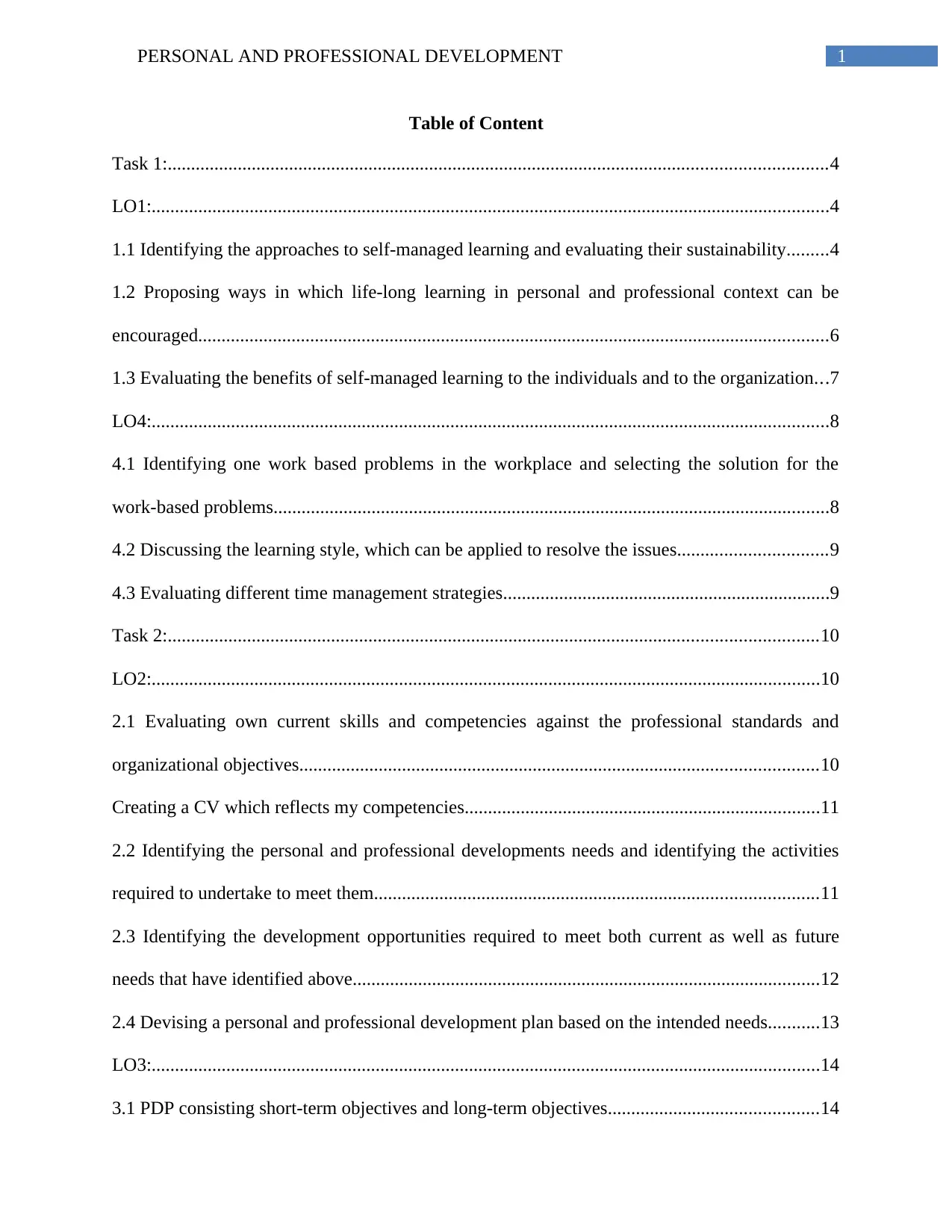
Table of Content
Task 1:.............................................................................................................................................4
LO1:.................................................................................................................................................4
1.1 Identifying the approaches to self-managed learning and evaluating their sustainability.........4
1.2 Proposing ways in which life-long learning in personal and professional context can be
encouraged.......................................................................................................................................6
1.3 Evaluating the benefits of self-managed learning to the individuals and to the organization...7
LO4:.................................................................................................................................................8
4.1 Identifying one work based problems in the workplace and selecting the solution for the
work-based problems.......................................................................................................................8
4.2 Discussing the learning style, which can be applied to resolve the issues................................9
4.3 Evaluating different time management strategies......................................................................9
Task 2:...........................................................................................................................................10
LO2:...............................................................................................................................................10
2.1 Evaluating own current skills and competencies against the professional standards and
organizational objectives...............................................................................................................10
Creating a CV which reflects my competencies............................................................................11
2.2 Identifying the personal and professional developments needs and identifying the activities
required to undertake to meet them...............................................................................................11
2.3 Identifying the development opportunities required to meet both current as well as future
needs that have identified above....................................................................................................12
2.4 Devising a personal and professional development plan based on the intended needs...........13
LO3:...............................................................................................................................................14
3.1 PDP consisting short-term objectives and long-term objectives.............................................14
Table of Content
Task 1:.............................................................................................................................................4
LO1:.................................................................................................................................................4
1.1 Identifying the approaches to self-managed learning and evaluating their sustainability.........4
1.2 Proposing ways in which life-long learning in personal and professional context can be
encouraged.......................................................................................................................................6
1.3 Evaluating the benefits of self-managed learning to the individuals and to the organization...7
LO4:.................................................................................................................................................8
4.1 Identifying one work based problems in the workplace and selecting the solution for the
work-based problems.......................................................................................................................8
4.2 Discussing the learning style, which can be applied to resolve the issues................................9
4.3 Evaluating different time management strategies......................................................................9
Task 2:...........................................................................................................................................10
LO2:...............................................................................................................................................10
2.1 Evaluating own current skills and competencies against the professional standards and
organizational objectives...............................................................................................................10
Creating a CV which reflects my competencies............................................................................11
2.2 Identifying the personal and professional developments needs and identifying the activities
required to undertake to meet them...............................................................................................11
2.3 Identifying the development opportunities required to meet both current as well as future
needs that have identified above....................................................................................................12
2.4 Devising a personal and professional development plan based on the intended needs...........13
LO3:...............................................................................................................................................14
3.1 PDP consisting short-term objectives and long-term objectives.............................................14
2PERSONAL AND PROFESSIONAL DEVELOPMENT
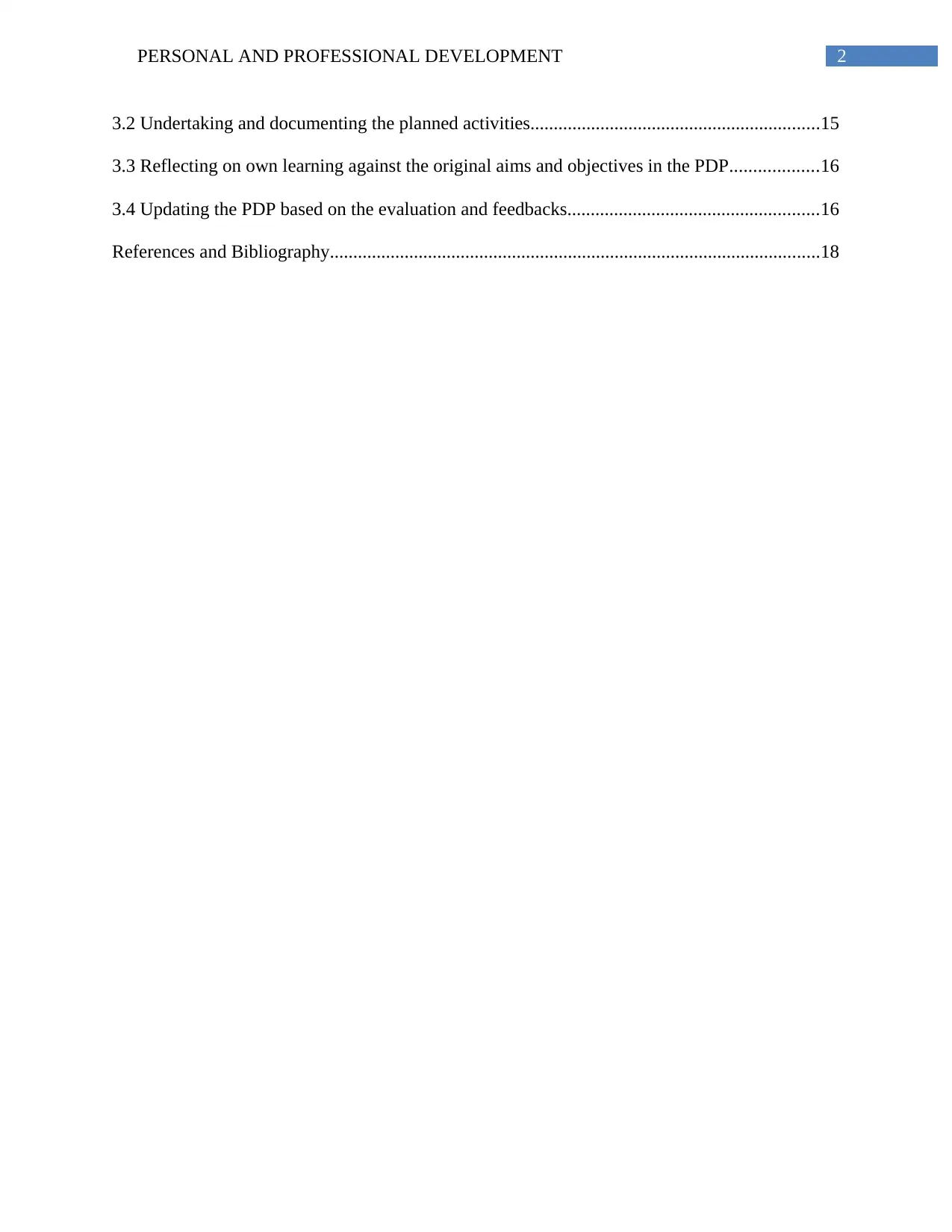
3.2 Undertaking and documenting the planned activities..............................................................15
3.3 Reflecting on own learning against the original aims and objectives in the PDP...................16
3.4 Updating the PDP based on the evaluation and feedbacks......................................................16
References and Bibliography.........................................................................................................18
3.2 Undertaking and documenting the planned activities..............................................................15
3.3 Reflecting on own learning against the original aims and objectives in the PDP...................16
3.4 Updating the PDP based on the evaluation and feedbacks......................................................16
References and Bibliography.........................................................................................................18
⊘ This is a preview!⊘
Do you want full access?
Subscribe today to unlock all pages.

Trusted by 1+ million students worldwide
3PERSONAL AND PROFESSIONAL DEVELOPMENT
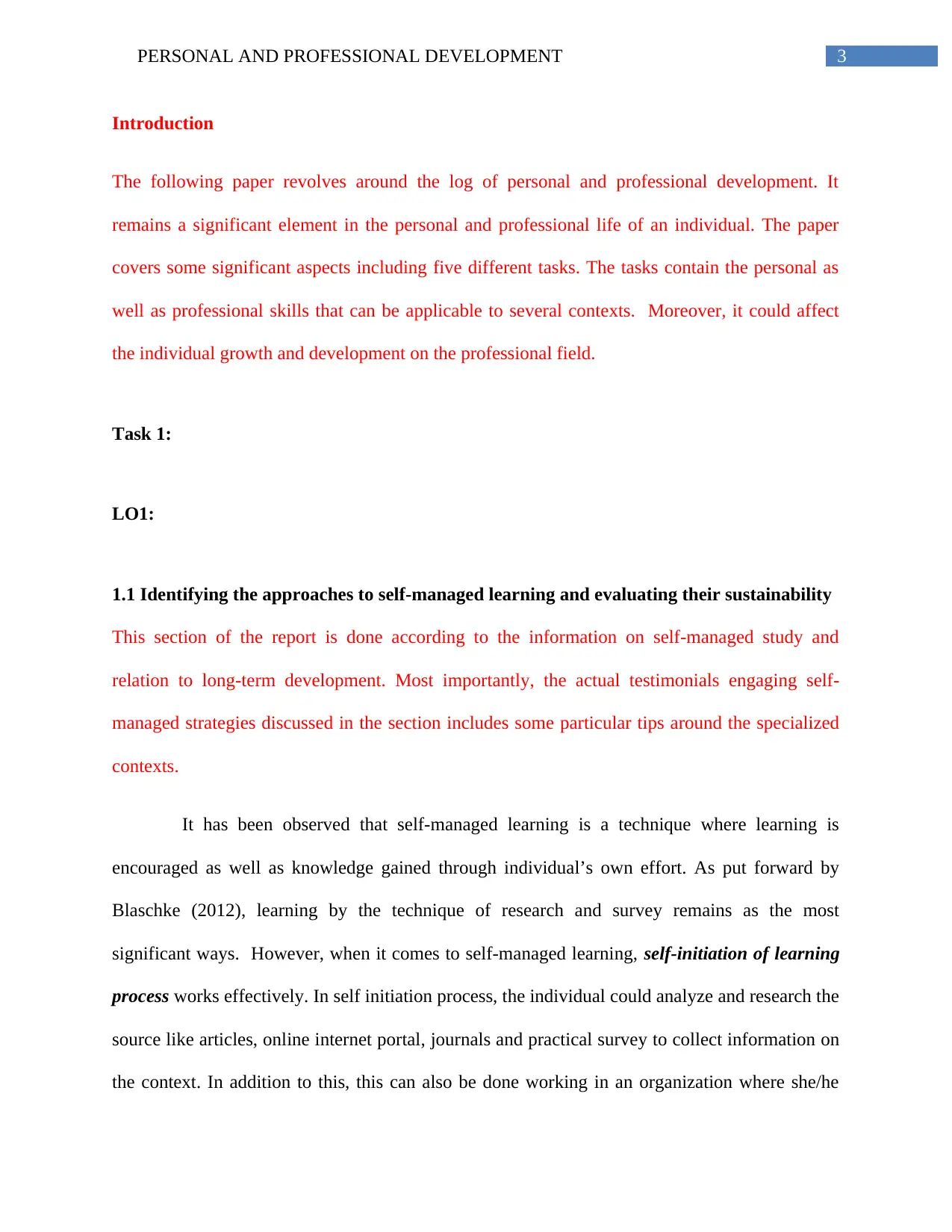
Introduction
The following paper revolves around the log of personal and professional development. It
remains a significant element in the personal and professional life of an individual. The paper
covers some significant aspects including five different tasks. The tasks contain the personal as
well as professional skills that can be applicable to several contexts. Moreover, it could affect
the individual growth and development on the professional field.
Task 1:
LO1:
1.1 Identifying the approaches to self-managed learning and evaluating their sustainability
This section of the report is done according to the information on self-managed study and
relation to long-term development. Most importantly, the actual testimonials engaging self-
managed strategies discussed in the section includes some particular tips around the specialized
contexts.
It has been observed that self-managed learning is a technique where learning is
encouraged as well as knowledge gained through individual’s own effort. As put forward by
Blaschke (2012), learning by the technique of research and survey remains as the most
significant ways. However, when it comes to self-managed learning, self-initiation of learning
process works effectively. In self initiation process, the individual could analyze and research the
source like articles, online internet portal, journals and practical survey to collect information on
the context. In addition to this, this can also be done working in an organization where she/he
Introduction
The following paper revolves around the log of personal and professional development. It
remains a significant element in the personal and professional life of an individual. The paper
covers some significant aspects including five different tasks. The tasks contain the personal as
well as professional skills that can be applicable to several contexts. Moreover, it could affect
the individual growth and development on the professional field.
Task 1:
LO1:
1.1 Identifying the approaches to self-managed learning and evaluating their sustainability
This section of the report is done according to the information on self-managed study and
relation to long-term development. Most importantly, the actual testimonials engaging self-
managed strategies discussed in the section includes some particular tips around the specialized
contexts.
It has been observed that self-managed learning is a technique where learning is
encouraged as well as knowledge gained through individual’s own effort. As put forward by
Blaschke (2012), learning by the technique of research and survey remains as the most
significant ways. However, when it comes to self-managed learning, self-initiation of learning
process works effectively. In self initiation process, the individual could analyze and research the
source like articles, online internet portal, journals and practical survey to collect information on
the context. In addition to this, this can also be done working in an organization where she/he
Paraphrase This Document
Need a fresh take? Get an instant paraphrase of this document with our AI Paraphraser
4PERSONAL AND PROFESSIONAL DEVELOPMENT
might change the job role and learn things. Moreover, in the external environment, the individual
could attend the seminars, conference and event to observe and learn things. The individuals
could also learn by setting clear goals and objectives. Based on the objectives, the individual
could develop a particular aims and then requirements to meet goals can be sorted. For example,
if an individual wants to be an aircraft pilot by profession, after collecting a degree from high
school, that person needs to study aircraft engineering. Hence, the aim is to become a pilot and
the requirements are studies in aircraft engineering. These self-managed learning process are
sustainable because they can be achieved with the knowledge of real-world context. The
individuals could apply these learning processes in their own life and gain benefits. Each
method is linked to the real-world context.
Identifying learning style and examining how these can be used to help individual the
benefits of each
Learning styles usually relate to the way in which different individuals learn. As the
scholar have focused on different elements of this, a large range of interpretation and definitions
Some particular learning styles are personal preference, pragmatist, theorist and reflector. In
personal preference, the individuals tend to rely on their own way of learning. For example, an
individual could prefer visual learning while others might prefer verbal learning. However,
according to Kolb’s learning theory, the learning becomes effective, when the style of learning is
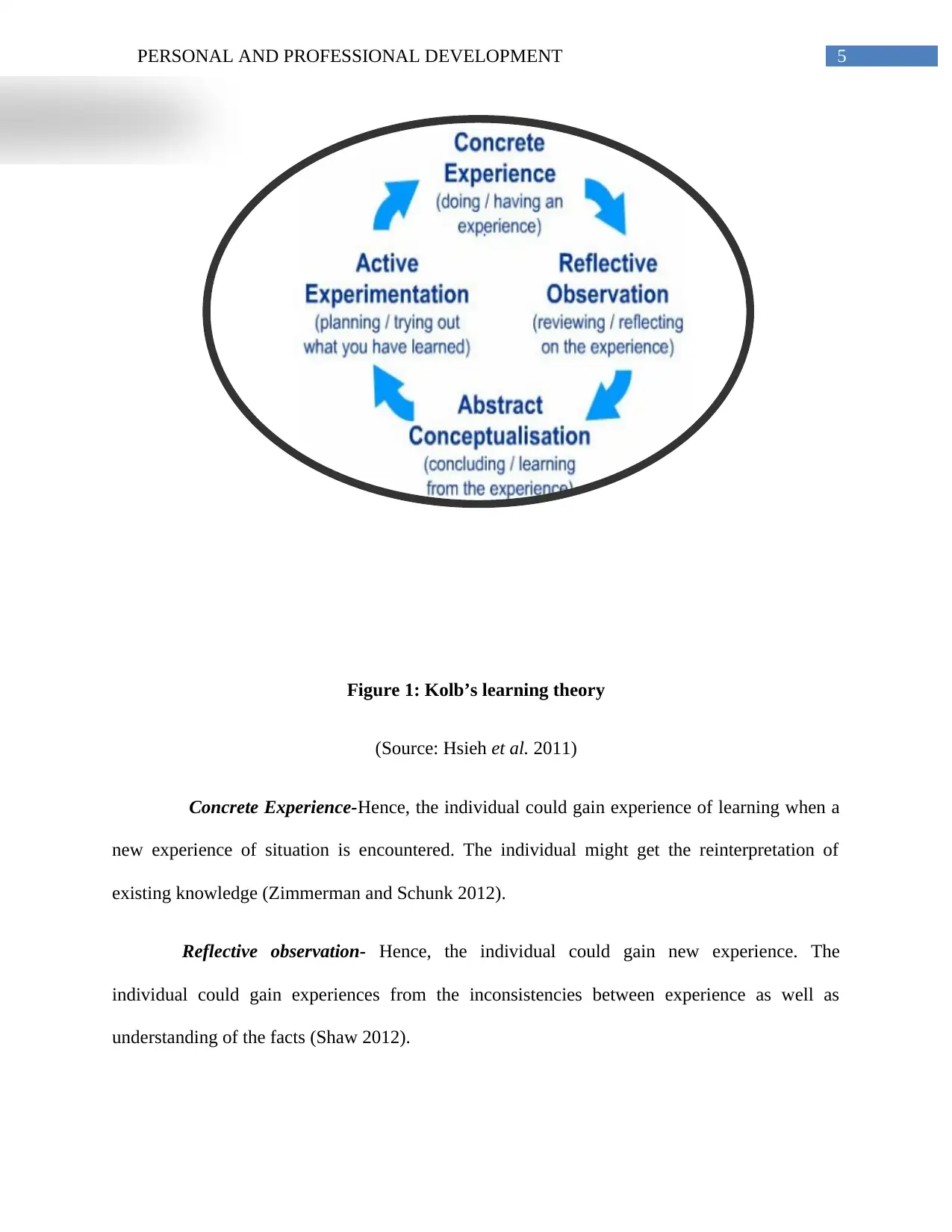
linked to learner’s internal cognitive process. Kolb’s experimental learning style theory, which is
presented by the four stages learning cycle, can be applied to one’s own learning process.
might change the job role and learn things. Moreover, in the external environment, the individual
could attend the seminars, conference and event to observe and learn things. The individuals
could also learn by setting clear goals and objectives. Based on the objectives, the individual
could develop a particular aims and then requirements to meet goals can be sorted. For example,
if an individual wants to be an aircraft pilot by profession, after collecting a degree from high
school, that person needs to study aircraft engineering. Hence, the aim is to become a pilot and
the requirements are studies in aircraft engineering. These self-managed learning process are
sustainable because they can be achieved with the knowledge of real-world context. The
individuals could apply these learning processes in their own life and gain benefits. Each
method is linked to the real-world context.
Identifying learning style and examining how these can be used to help individual the
benefits of each
Learning styles usually relate to the way in which different individuals learn. As the
scholar have focused on different elements of this, a large range of interpretation and definitions
Some particular learning styles are personal preference, pragmatist, theorist and reflector. In
personal preference, the individuals tend to rely on their own way of learning. For example, an
individual could prefer visual learning while others might prefer verbal learning. However,
according to Kolb’s learning theory, the learning becomes effective, when the style of learning is
linked to learner’s internal cognitive process. Kolb’s experimental learning style theory, which is
presented by the four stages learning cycle, can be applied to one’s own learning process.
5PERSONAL AND PROFESSIONAL DEVELOPMENT
Figure 1: Kolb’s learning theory
(Source: Hsieh et al. 2011)
Concrete Experience-Hence, the individual could gain experience of learning when a
new experience of situation is encountered. The individual might get the reinterpretation of
existing knowledge (Zimmerman and Schunk 2012).
Reflective observation- Hence, the individual could gain new experience. The
individual could gain experiences from the inconsistencies between experience as well as
understanding of the facts (Shaw 2012).
Figure 1: Kolb’s learning theory
(Source: Hsieh et al. 2011)
Concrete Experience-Hence, the individual could gain experience of learning when a
new experience of situation is encountered. The individual might get the reinterpretation of
existing knowledge (Zimmerman and Schunk 2012).
Reflective observation- Hence, the individual could gain new experience. The
individual could gain experiences from the inconsistencies between experience as well as
understanding of the facts (Shaw 2012).
⊘ This is a preview!⊘
Do you want full access?
Subscribe today to unlock all pages.
Trusted by 1+ million students worldwide
6PERSONAL AND PROFESSIONAL DEVELOPMENT
Abstract Conceptualization-This aspect gives an increase to new ideas; this mean the
individuals could experience from the existing abstract concept.
Active Experimentation- Here, the learner could apply this experimentation to the
real world context to observe the outcome that comes out of it.
1.2 Proposing ways in which life-long learning in personal and professional context can be
encouraged
These section discuses the ways that are commonly learnt in which the individuals learn through
appropriate research with the addition of different researches of a society that people require.
As put forward by Wong and Nunan (2011), people often think that they are not
achieving enough in their personal as well as professional life; however, they do not consider the
reasons for this underachieving. The life-long learning in the professional and personal context
can be achieved if the individuals follow the methods like self-direct learning, continuing
professional development, recognition for Prior learning, further education and others
(Chiang et al. 2013). The individuals could also learn and measure the progress of their learning
activities. For example, if an individual attend seminars on weekly or monthly basis, he/she
could compare his learning experience between the time since the individual started doing it and
the previous phase of learning. However, personal development in terms of learning can be
achieved through hard work and commitment. Self-direct learning method can be applied if the
individuals become concerned about the commitment and hard work required to put.
Commitment remains as the significant factor, which determines the desire to do something. In
addition to this, being in a professional field for long period, the individuals could enhance their
Abstract Conceptualization-This aspect gives an increase to new ideas; this mean the
individuals could experience from the existing abstract concept.
Active Experimentation- Here, the learner could apply this experimentation to the
real world context to observe the outcome that comes out of it.
1.2 Proposing ways in which life-long learning in personal and professional context can be
encouraged
These section discuses the ways that are commonly learnt in which the individuals learn through
appropriate research with the addition of different researches of a society that people require.
As put forward by Wong and Nunan (2011), people often think that they are not
achieving enough in their personal as well as professional life; however, they do not consider the
reasons for this underachieving. The life-long learning in the professional and personal context
can be achieved if the individuals follow the methods like self-direct learning, continuing
professional development, recognition for Prior learning, further education and others
(Chiang et al. 2013). The individuals could also learn and measure the progress of their learning
activities. For example, if an individual attend seminars on weekly or monthly basis, he/she
could compare his learning experience between the time since the individual started doing it and
the previous phase of learning. However, personal development in terms of learning can be
achieved through hard work and commitment. Self-direct learning method can be applied if the
individuals become concerned about the commitment and hard work required to put.
Commitment remains as the significant factor, which determines the desire to do something. In
addition to this, being in a professional field for long period, the individuals could enhance their
Paraphrase This Document
Need a fresh take? Get an instant paraphrase of this document with our AI Paraphraser
7PERSONAL AND PROFESSIONAL DEVELOPMENT
professional career, where opportunities for learning are optimal. Throughout the professional
career, the individuals learn things belonging to different fields.
1.3 Evaluating the benefits of self-managed learning to the individuals and to the
organization
The self-managed learning provides the individuals large freedom in deciding their
choice and they perform on the basis of their goals. In addition, the self-managed learning helps
in the self-assessment as well as the analysis of the individuals. It helps people in learning the
areas in which they need to develop as well as expand their horizons. The individuals could
focus on improving the ability range with the personal learning (Gureckis and Markant 2012).
On the basis of individual strength and weakness analysis, the individual could enhance the
margin of their ability in their personal learning. For example, based on the goals or time period,
the ability of observing things should improve. When it comes to organizational benefits, the
organization gains the advantages when the individuals work in a team. The productivity of the
team increases and the individuals work in a team, the process helps the individuals in
encouraging and motivating to work in teams and help each other in deriving knowledge and
skills. Therefore, hence, the benefits are mutual.
LO4:
4.1 Identifying one work based problems in the workplace and selecting the solution for the
work-based problems
There are many worked based issues that could be visible in a workplace but I would
insist on the communication issue in the workplace. If I wish to work in the organization IBM,
professional career, where opportunities for learning are optimal. Throughout the professional
career, the individuals learn things belonging to different fields.
1.3 Evaluating the benefits of self-managed learning to the individuals and to the
organization
The self-managed learning provides the individuals large freedom in deciding their
choice and they perform on the basis of their goals. In addition, the self-managed learning helps
in the self-assessment as well as the analysis of the individuals. It helps people in learning the
areas in which they need to develop as well as expand their horizons. The individuals could
focus on improving the ability range with the personal learning (Gureckis and Markant 2012).
On the basis of individual strength and weakness analysis, the individual could enhance the
margin of their ability in their personal learning. For example, based on the goals or time period,
the ability of observing things should improve. When it comes to organizational benefits, the
organization gains the advantages when the individuals work in a team. The productivity of the
team increases and the individuals work in a team, the process helps the individuals in
encouraging and motivating to work in teams and help each other in deriving knowledge and
skills. Therefore, hence, the benefits are mutual.
LO4:
4.1 Identifying one work based problems in the workplace and selecting the solution for the
work-based problems
There are many worked based issues that could be visible in a workplace but I would
insist on the communication issue in the workplace. If I wish to work in the organization IBM,
8PERSONAL AND PROFESSIONAL DEVELOPMENT
which is a knowledge outsourcing organization, I should have appropriate communication skill
to manage the team. It is certain that not all members in the team may be efficient in
communication but communication should be prioritized. Moreover, in an autocratic
management style, the communication often becomes a significant issue. For example, the
employees at the lower or middle level usually do not get the opportunity to interact with the
senior management and due to this communication gap, the work progress gets delayed and the
decision making is slowed down.
One significant solution that can be applied is proper training and development
program. In order to resolve the work-based issue related to communication can be resolved by
providing the employees with appropriate training. In every week, the organizational members
could attend the communication program and during the work process, they could apply the
gained knowledge to the workplace. This could help the members to interact with the seniors in
the workplace. Once the communication is developed between the senior management and the
general employees, the possible workplace issues can be resolved.
4.2 Discussing the learning style, which can be applied to resolve the issues
In order to resolve the above-mentioned issue related to communication in the
workplace, certain learning styles and strategies can be applied to resolve those issues. To
overcome the issue, the individuals should rely on the direct learning style and this means after
gaining the knowledge from the training related to communication, the individuals would work
on a team. Being in a team, all members should follow the culture of knowledge sharing,
information exchanging and other possible interactive methods. This will certainly increase the
level of communication. For example, if one member in the team faces certain issue related to
which is a knowledge outsourcing organization, I should have appropriate communication skill
to manage the team. It is certain that not all members in the team may be efficient in
communication but communication should be prioritized. Moreover, in an autocratic
management style, the communication often becomes a significant issue. For example, the
employees at the lower or middle level usually do not get the opportunity to interact with the
senior management and due to this communication gap, the work progress gets delayed and the
decision making is slowed down.
One significant solution that can be applied is proper training and development
program. In order to resolve the work-based issue related to communication can be resolved by
providing the employees with appropriate training. In every week, the organizational members
could attend the communication program and during the work process, they could apply the
gained knowledge to the workplace. This could help the members to interact with the seniors in
the workplace. Once the communication is developed between the senior management and the
general employees, the possible workplace issues can be resolved.
4.2 Discussing the learning style, which can be applied to resolve the issues
In order to resolve the above-mentioned issue related to communication in the
workplace, certain learning styles and strategies can be applied to resolve those issues. To
overcome the issue, the individuals should rely on the direct learning style and this means after
gaining the knowledge from the training related to communication, the individuals would work
on a team. Being in a team, all members should follow the culture of knowledge sharing,
information exchanging and other possible interactive methods. This will certainly increase the
level of communication. For example, if one member in the team faces certain issue related to
⊘ This is a preview!⊘
Do you want full access?
Subscribe today to unlock all pages.
Trusted by 1+ million students worldwide
9PERSONAL AND PROFESSIONAL DEVELOPMENT
the work, other member should come up and help in resolving the issue and once the individual
learn the process, she/he could help others. Under a strategic level, it can be mentioned that the
individuals should relate their own personal learning style such as the verbal learning style, to the
style they are asked to follow in the training session. Nonetheless, Fink (2013) mentioned that
learning becomes effective, when the interaction with others is there among the individuals.
Thus, it is necessary that individuals maintain the required level of communication among
themselves. This means during the sharing of knowledge and information, the individuals should
respect other opinions and listen to others.
4.3 Evaluating different time management strategies
Time management is one of the significant aspects that each individual should
consider. Time management can be done by prioritizing workloads, setting work objectives,
making and keeping appointments and reliable estimates of task time. The individuals could
prioritize their work, which means based on the priority and importance of work the type of work
should be arranged. For example, if an individual is supposed to prepare and submit the audit
report of the month and the he/she also has to attend the daily meeting. Hence, the individual
first needs to finish the auditing and he/she could attend the daily meeting. However, this can be
done more effectively, if the individuals set their own work objectives (Chang 2016). Before
implementing or carrying out the task, the individuals could set few objectives related to that
work. Based on the objectives, they could sort out the requirements. For example, if I am
required to submit the weekly production report on the last day of the week to the senior
manager, my objective is to finish the work a day before the submission. Thus, I do not have to
take the burden of work on the last day. In addition to this, an appropriate work schedule helps to
divide the work into several small parts and those can easily be adjusted into the time schedule.
the work, other member should come up and help in resolving the issue and once the individual
learn the process, she/he could help others. Under a strategic level, it can be mentioned that the
individuals should relate their own personal learning style such as the verbal learning style, to the
style they are asked to follow in the training session. Nonetheless, Fink (2013) mentioned that
learning becomes effective, when the interaction with others is there among the individuals.
Thus, it is necessary that individuals maintain the required level of communication among
themselves. This means during the sharing of knowledge and information, the individuals should
respect other opinions and listen to others.
4.3 Evaluating different time management strategies
Time management is one of the significant aspects that each individual should
consider. Time management can be done by prioritizing workloads, setting work objectives,
making and keeping appointments and reliable estimates of task time. The individuals could
prioritize their work, which means based on the priority and importance of work the type of work
should be arranged. For example, if an individual is supposed to prepare and submit the audit
report of the month and the he/she also has to attend the daily meeting. Hence, the individual
first needs to finish the auditing and he/she could attend the daily meeting. However, this can be
done more effectively, if the individuals set their own work objectives (Chang 2016). Before
implementing or carrying out the task, the individuals could set few objectives related to that
work. Based on the objectives, they could sort out the requirements. For example, if I am
required to submit the weekly production report on the last day of the week to the senior
manager, my objective is to finish the work a day before the submission. Thus, I do not have to
take the burden of work on the last day. In addition to this, an appropriate work schedule helps to
divide the work into several small parts and those can easily be adjusted into the time schedule.
Paraphrase This Document
Need a fresh take? Get an instant paraphrase of this document with our AI Paraphraser
10PERSONAL AND PROFESSIONAL DEVELOPMENT
Task 2:
LO2:
2.1 Evaluating own current skills and competencies against the professional standards and
organizational objectives
While focusing my own current skills and competencies, I observe that my
communication skills are not efficient enough to manage a large set of work. However, I have
observed that organizations often prioritize the individuals who have tremendous problem
solving, decision-making skills and communication skills. I must say that compared to
organizational standard, my communication skills are not up to the mark. In the recent time, I
have joined a fast food restaurant called Red Rooster, where I found that there are some
situations where the managers involvement is necessary but due to my poor communication skill,
I could not approach my senior manager for the help. For example, during the festival season, the
restaurant often becomes crowded and managing each customer with equal attention becomes
difficult. In such context, I needed help from the seniors in terms of dealing with the customers
but my poor communication skills discourage me from taking such initiative. I have also
observed that I need to develop my problem solving skills to manage the stressful situation in the
workplace. On the other side, I also need to focus on personal and interpersonal skills to reach
the standard of organizational demands.
As put forward by DeKay (2012), interpersonal skills are the skills people use daily
when communicate as well as interact with each other individually or in a group. More
specifically, I can mention that my interpersonal skills are sufficient to deal with the new flow of
Task 2:
LO2:
2.1 Evaluating own current skills and competencies against the professional standards and
organizational objectives
While focusing my own current skills and competencies, I observe that my
communication skills are not efficient enough to manage a large set of work. However, I have
observed that organizations often prioritize the individuals who have tremendous problem
solving, decision-making skills and communication skills. I must say that compared to
organizational standard, my communication skills are not up to the mark. In the recent time, I
have joined a fast food restaurant called Red Rooster, where I found that there are some
situations where the managers involvement is necessary but due to my poor communication skill,
I could not approach my senior manager for the help. For example, during the festival season, the
restaurant often becomes crowded and managing each customer with equal attention becomes
difficult. In such context, I needed help from the seniors in terms of dealing with the customers
but my poor communication skills discourage me from taking such initiative. I have also
observed that I need to develop my problem solving skills to manage the stressful situation in the
workplace. On the other side, I also need to focus on personal and interpersonal skills to reach
the standard of organizational demands.
As put forward by DeKay (2012), interpersonal skills are the skills people use daily
when communicate as well as interact with each other individually or in a group. More
specifically, I can mention that my interpersonal skills are sufficient to deal with the new flow of
11PERSONAL AND PROFESSIONAL DEVELOPMENT
communication but I need to work questioning and body language. I realize that to be able to
work well in a good team or group, I need to develop my interpersonal skills, so that, I will be
able to communicate effectively with others, family, friends and colleagues and others. Apart
from all these personal and inter personal skills, I also need to focus on the leadership skills.
Leadership skills are necessary to run a team or operation. I realize that without proper
leadership skills, I might not be able to manage other people in the team.
Creating a CV which reflects my competencies
(Referred to Word file attached)
2.2 Identifying the personal and professional developments needs and identifying the
activities required to undertake to meet them
I must mention that my current performances are not effective or up to the mark to deal
with a senior team in my organization Red Rooster. Recently, I have observed I need to develop
communication skills, problem solving skills, leadership skills and decision-making skills. I
understand that such poor skills in communication and decision-making could be the significant
threats for my career. Among the interpersonal skills, I need to develop the approaches of
questioning and maintaining a formal body language. In coming future, I may have to work on a
new project with the senior members of the firm but before I fulfill the above-mentioned future
needs.
Identifying the activities required to meet those needs
Firstly, I need to enhance my communication skills, which can be done by increasing the
level of interaction with people. I can implement this activity by attending the training sessions
communication but I need to work questioning and body language. I realize that to be able to
work well in a good team or group, I need to develop my interpersonal skills, so that, I will be
able to communicate effectively with others, family, friends and colleagues and others. Apart
from all these personal and inter personal skills, I also need to focus on the leadership skills.
Leadership skills are necessary to run a team or operation. I realize that without proper
leadership skills, I might not be able to manage other people in the team.
Creating a CV which reflects my competencies
(Referred to Word file attached)
2.2 Identifying the personal and professional developments needs and identifying the
activities required to undertake to meet them
I must mention that my current performances are not effective or up to the mark to deal
with a senior team in my organization Red Rooster. Recently, I have observed I need to develop
communication skills, problem solving skills, leadership skills and decision-making skills. I
understand that such poor skills in communication and decision-making could be the significant
threats for my career. Among the interpersonal skills, I need to develop the approaches of
questioning and maintaining a formal body language. In coming future, I may have to work on a
new project with the senior members of the firm but before I fulfill the above-mentioned future
needs.
Identifying the activities required to meet those needs
Firstly, I need to enhance my communication skills, which can be done by increasing the
level of interaction with people. I can implement this activity by attending the training sessions
⊘ This is a preview!⊘
Do you want full access?
Subscribe today to unlock all pages.
Trusted by 1+ million students worldwide

1 out of 19


Related Documents


Your All-in-One AI-Powered Toolkit for Academic Success.
+13062052269
info@desklib.com
Available 24*7 on WhatsApp / Email
![[object Object]](/_next/static/media/star-bottom.7253800d.svg)
Unlock your academic potential
Copyright © 2020–2026 A2Z Services. All Rights Reserved. Developed and managed by ZUCOL.