Skills Gap Analysis: Managing Personal & Professional Development
VerifiedAdded on 2024/06/05
|9
|1861
|490
Report
AI Summary
This report provides a detailed analysis of personal and professional development, comparing sources of information on professional development trends and their validity. It identifies trends and developments that influence the need for professional development, evaluates the benefits of personal and professional development, and explains the basis on which types of development actions are selected. The report also identifies current and future likely skills, knowledge, and experience needs using skills gap analysis and explains how to set specific, measurable, achievable, realistic, and time-bound (SMART) objectives for effective personal and professional growth. The document is available on Desklib, a platform providing AI-based study tools and student resources.
Manage Personal and Professional Development
1
1
Paraphrase This Document
Need a fresh take? Get an instant paraphrase of this document with our AI Paraphraser

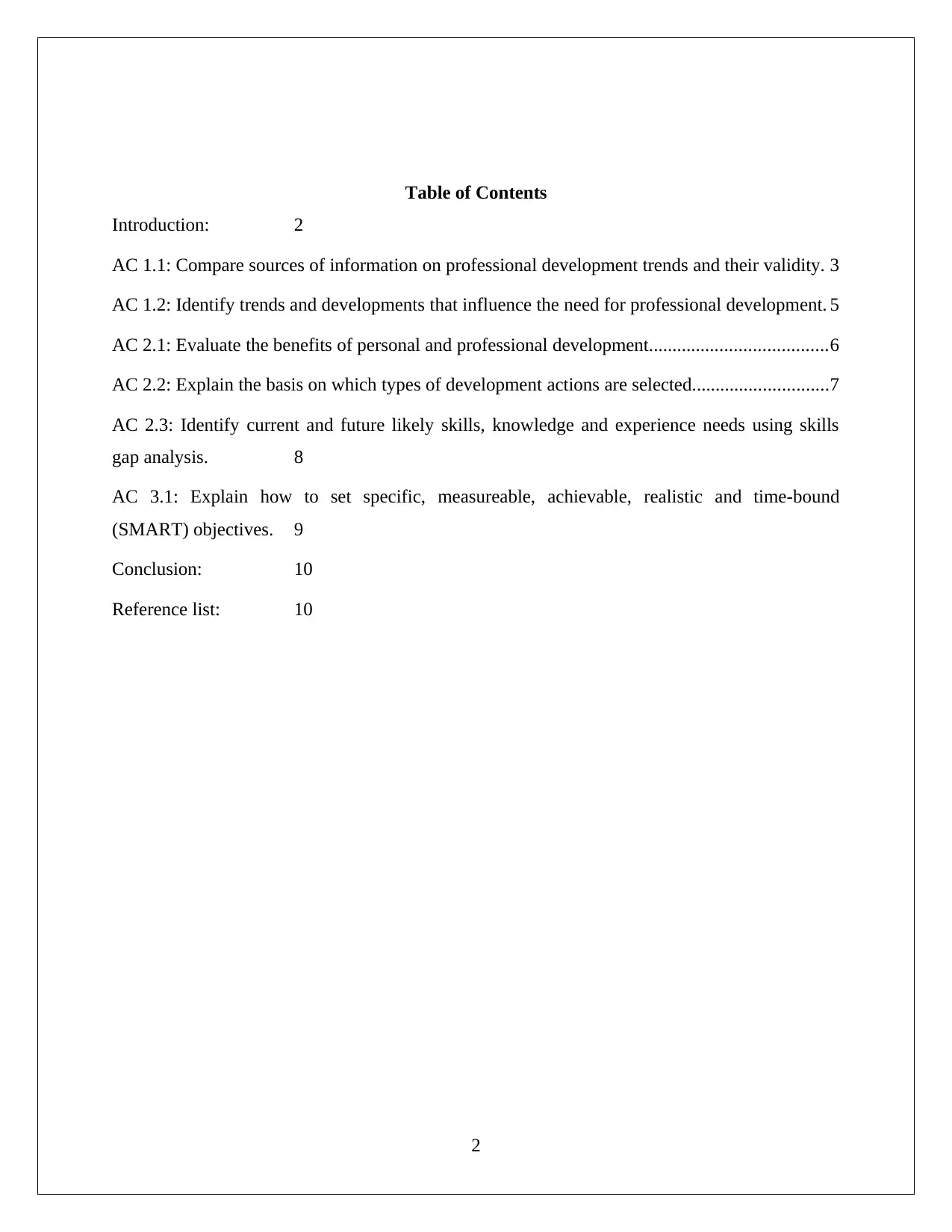
Table of Contents
Introduction: 2
AC 1.1: Compare sources of information on professional development trends and their validity. 3
AC 1.2: Identify trends and developments that influence the need for professional development. 5
AC 2.1: Evaluate the benefits of personal and professional development......................................6
AC 2.2: Explain the basis on which types of development actions are selected.............................7
AC 2.3: Identify current and future likely skills, knowledge and experience needs using skills
gap analysis. 8
AC 3.1: Explain how to set specific, measureable, achievable, realistic and time-bound
(SMART) objectives. 9
Conclusion: 10
Reference list: 10
2
Introduction: 2
AC 1.1: Compare sources of information on professional development trends and their validity. 3
AC 1.2: Identify trends and developments that influence the need for professional development. 5
AC 2.1: Evaluate the benefits of personal and professional development......................................6
AC 2.2: Explain the basis on which types of development actions are selected.............................7
AC 2.3: Identify current and future likely skills, knowledge and experience needs using skills
gap analysis. 8
AC 3.1: Explain how to set specific, measureable, achievable, realistic and time-bound
(SMART) objectives. 9
Conclusion: 10
Reference list: 10
2

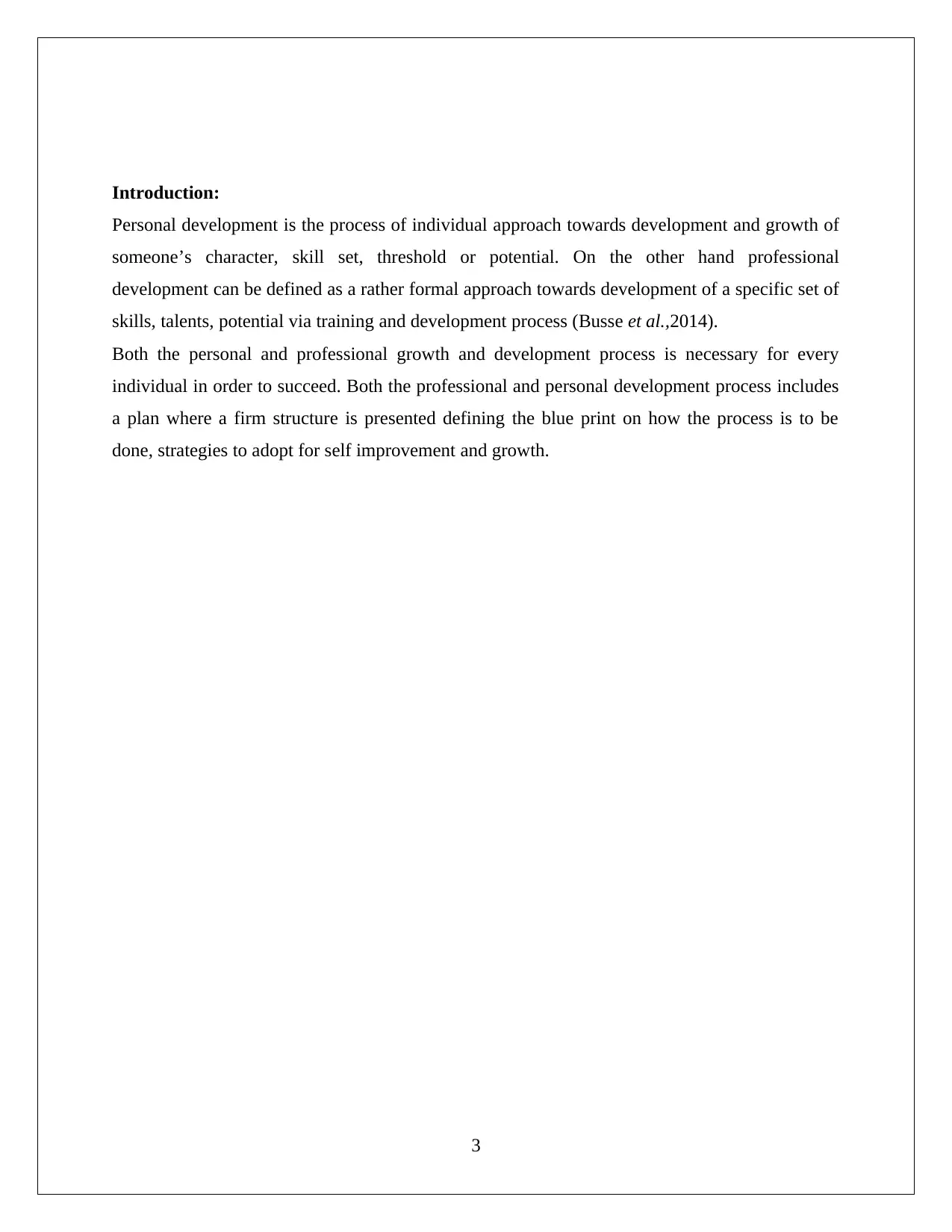
Introduction:
Personal development is the process of individual approach towards development and growth of
someone’s character, skill set, threshold or potential. On the other hand professional
development can be defined as a rather formal approach towards development of a specific set of
skills, talents, potential via training and development process (Busse et al.,2014).
Both the personal and professional growth and development process is necessary for every
individual in order to succeed. Both the professional and personal development process includes
a plan where a firm structure is presented defining the blue print on how the process is to be
done, strategies to adopt for self improvement and growth.
3
Personal development is the process of individual approach towards development and growth of
someone’s character, skill set, threshold or potential. On the other hand professional
development can be defined as a rather formal approach towards development of a specific set of
skills, talents, potential via training and development process (Busse et al.,2014).
Both the personal and professional growth and development process is necessary for every
individual in order to succeed. Both the professional and personal development process includes
a plan where a firm structure is presented defining the blue print on how the process is to be
done, strategies to adopt for self improvement and growth.
3
⊘ This is a preview!⊘
Do you want full access?
Subscribe today to unlock all pages.

Trusted by 1+ million students worldwide

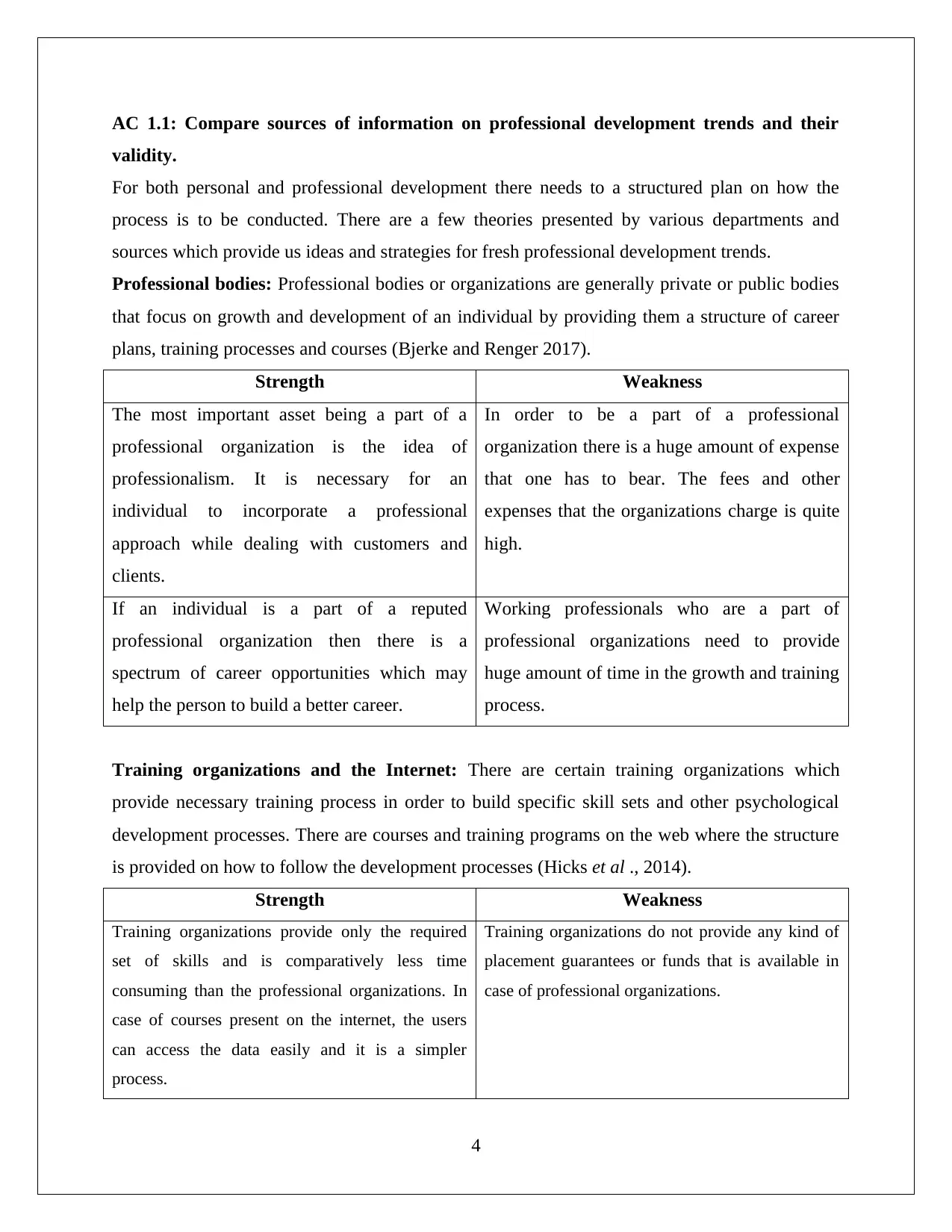
AC 1.1: Compare sources of information on professional development trends and their
validity.
For both personal and professional development there needs to a structured plan on how the
process is to be conducted. There are a few theories presented by various departments and
sources which provide us ideas and strategies for fresh professional development trends.
Professional bodies: Professional bodies or organizations are generally private or public bodies
that focus on growth and development of an individual by providing them a structure of career
plans, training processes and courses (Bjerke and Renger 2017).
Strength Weakness
The most important asset being a part of a
professional organization is the idea of
professionalism. It is necessary for an
individual to incorporate a professional
approach while dealing with customers and
clients.
In order to be a part of a professional
organization there is a huge amount of expense
that one has to bear. The fees and other
expenses that the organizations charge is quite
high.
If an individual is a part of a reputed
professional organization then there is a
spectrum of career opportunities which may
help the person to build a better career.
Working professionals who are a part of
professional organizations need to provide
huge amount of time in the growth and training
process.
Training organizations and the Internet: There are certain training organizations which
provide necessary training process in order to build specific skill sets and other psychological
development processes. There are courses and training programs on the web where the structure
is provided on how to follow the development processes (Hicks et al ., 2014).
Strength Weakness
Training organizations provide only the required
set of skills and is comparatively less time
consuming than the professional organizations. In
case of courses present on the internet, the users
can access the data easily and it is a simpler
process.
Training organizations do not provide any kind of
placement guarantees or funds that is available in
case of professional organizations.
4
validity.
For both personal and professional development there needs to a structured plan on how the
process is to be conducted. There are a few theories presented by various departments and
sources which provide us ideas and strategies for fresh professional development trends.
Professional bodies: Professional bodies or organizations are generally private or public bodies
that focus on growth and development of an individual by providing them a structure of career
plans, training processes and courses (Bjerke and Renger 2017).
Strength Weakness
The most important asset being a part of a
professional organization is the idea of
professionalism. It is necessary for an
individual to incorporate a professional
approach while dealing with customers and
clients.
In order to be a part of a professional
organization there is a huge amount of expense
that one has to bear. The fees and other
expenses that the organizations charge is quite
high.
If an individual is a part of a reputed
professional organization then there is a
spectrum of career opportunities which may
help the person to build a better career.
Working professionals who are a part of
professional organizations need to provide
huge amount of time in the growth and training
process.
Training organizations and the Internet: There are certain training organizations which
provide necessary training process in order to build specific skill sets and other psychological
development processes. There are courses and training programs on the web where the structure
is provided on how to follow the development processes (Hicks et al ., 2014).
Strength Weakness
Training organizations provide only the required
set of skills and is comparatively less time
consuming than the professional organizations. In
case of courses present on the internet, the users
can access the data easily and it is a simpler
process.
Training organizations do not provide any kind of
placement guarantees or funds that is available in
case of professional organizations.
4
Paraphrase This Document
Need a fresh take? Get an instant paraphrase of this document with our AI Paraphraser

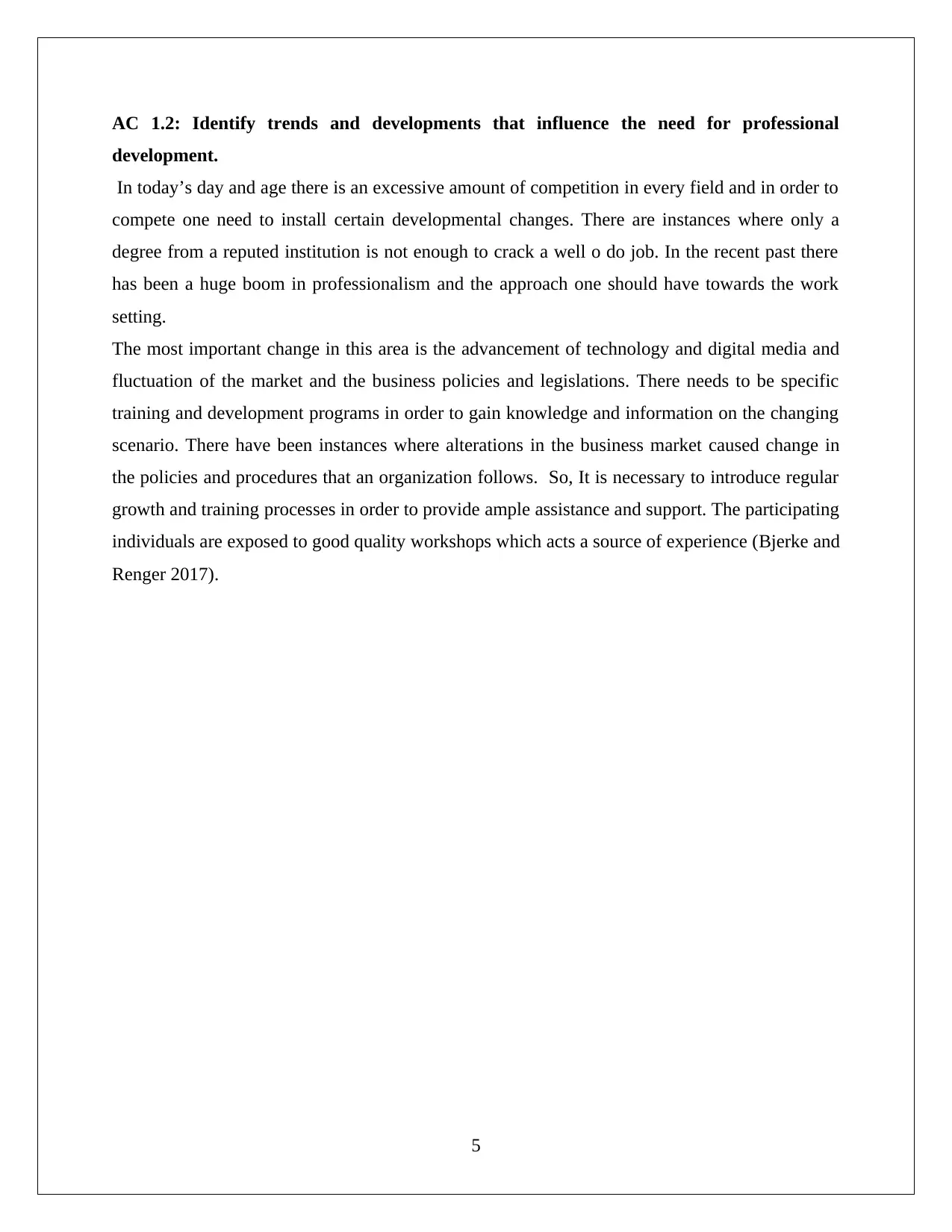
AC 1.2: Identify trends and developments that influence the need for professional
development.
In today’s day and age there is an excessive amount of competition in every field and in order to
compete one need to install certain developmental changes. There are instances where only a
degree from a reputed institution is not enough to crack a well o do job. In the recent past there
has been a huge boom in professionalism and the approach one should have towards the work
setting.
The most important change in this area is the advancement of technology and digital media and
fluctuation of the market and the business policies and legislations. There needs to be specific
training and development programs in order to gain knowledge and information on the changing
scenario. There have been instances where alterations in the business market caused change in
the policies and procedures that an organization follows. So, It is necessary to introduce regular
growth and training processes in order to provide ample assistance and support. The participating
individuals are exposed to good quality workshops which acts a source of experience (Bjerke and
Renger 2017).
5
development.
In today’s day and age there is an excessive amount of competition in every field and in order to
compete one need to install certain developmental changes. There are instances where only a
degree from a reputed institution is not enough to crack a well o do job. In the recent past there
has been a huge boom in professionalism and the approach one should have towards the work
setting.
The most important change in this area is the advancement of technology and digital media and
fluctuation of the market and the business policies and legislations. There needs to be specific
training and development programs in order to gain knowledge and information on the changing
scenario. There have been instances where alterations in the business market caused change in
the policies and procedures that an organization follows. So, It is necessary to introduce regular
growth and training processes in order to provide ample assistance and support. The participating
individuals are exposed to good quality workshops which acts a source of experience (Bjerke and
Renger 2017).
5

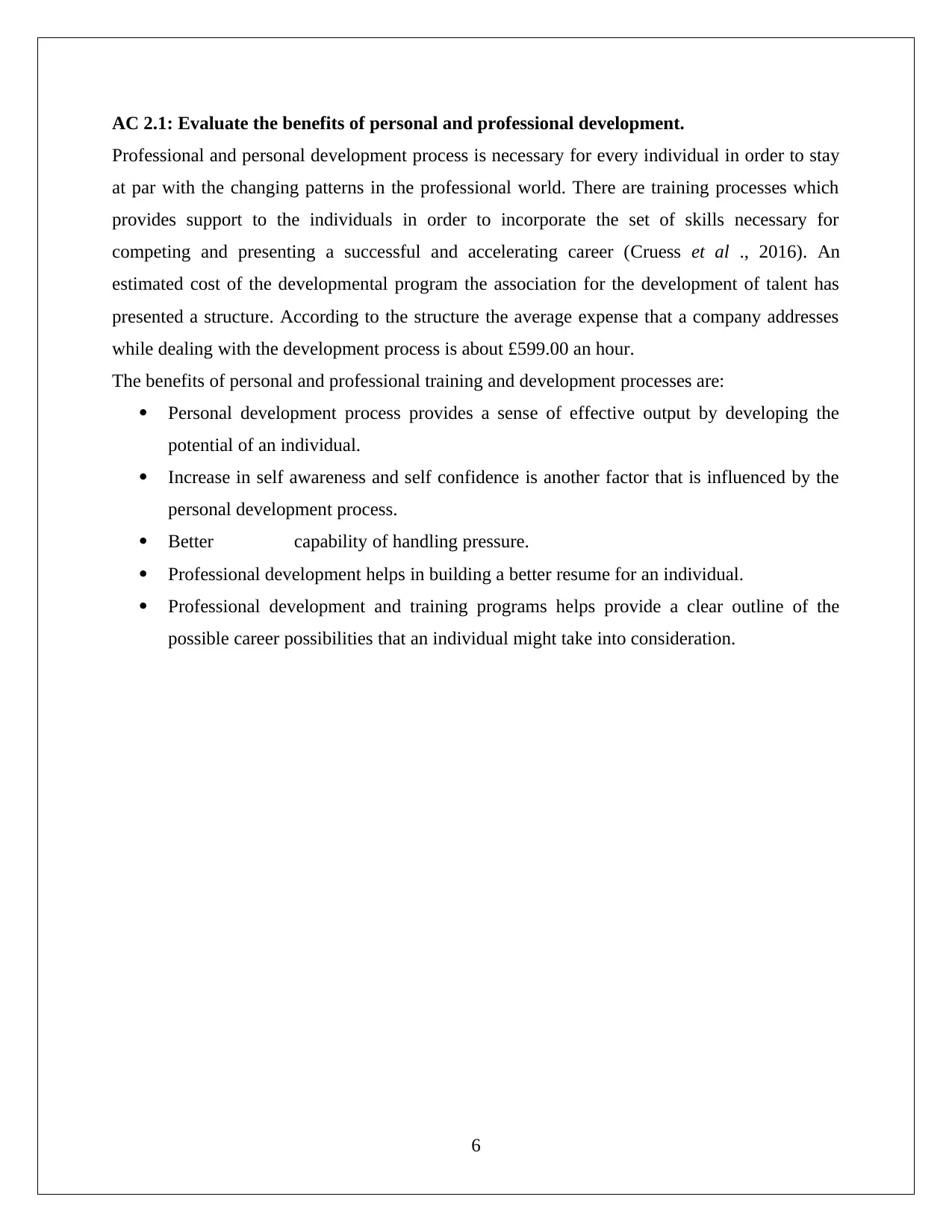
AC 2.1: Evaluate the benefits of personal and professional development.
Professional and personal development process is necessary for every individual in order to stay
at par with the changing patterns in the professional world. There are training processes which
provides support to the individuals in order to incorporate the set of skills necessary for
competing and presenting a successful and accelerating career (Cruess et al ., 2016). An
estimated cost of the developmental program the association for the development of talent has
presented a structure. According to the structure the average expense that a company addresses
while dealing with the development process is about £599.00 an hour.
The benefits of personal and professional training and development processes are:
Personal development process provides a sense of effective output by developing the
potential of an individual.
Increase in self awareness and self confidence is another factor that is influenced by the
personal development process.
Better capability of handling pressure.
Professional development helps in building a better resume for an individual.
Professional development and training programs helps provide a clear outline of the
possible career possibilities that an individual might take into consideration.
6
Professional and personal development process is necessary for every individual in order to stay
at par with the changing patterns in the professional world. There are training processes which
provides support to the individuals in order to incorporate the set of skills necessary for
competing and presenting a successful and accelerating career (Cruess et al ., 2016). An
estimated cost of the developmental program the association for the development of talent has
presented a structure. According to the structure the average expense that a company addresses
while dealing with the development process is about £599.00 an hour.
The benefits of personal and professional training and development processes are:
Personal development process provides a sense of effective output by developing the
potential of an individual.
Increase in self awareness and self confidence is another factor that is influenced by the
personal development process.
Better capability of handling pressure.
Professional development helps in building a better resume for an individual.
Professional development and training programs helps provide a clear outline of the
possible career possibilities that an individual might take into consideration.
6
⊘ This is a preview!⊘
Do you want full access?
Subscribe today to unlock all pages.

Trusted by 1+ million students worldwide

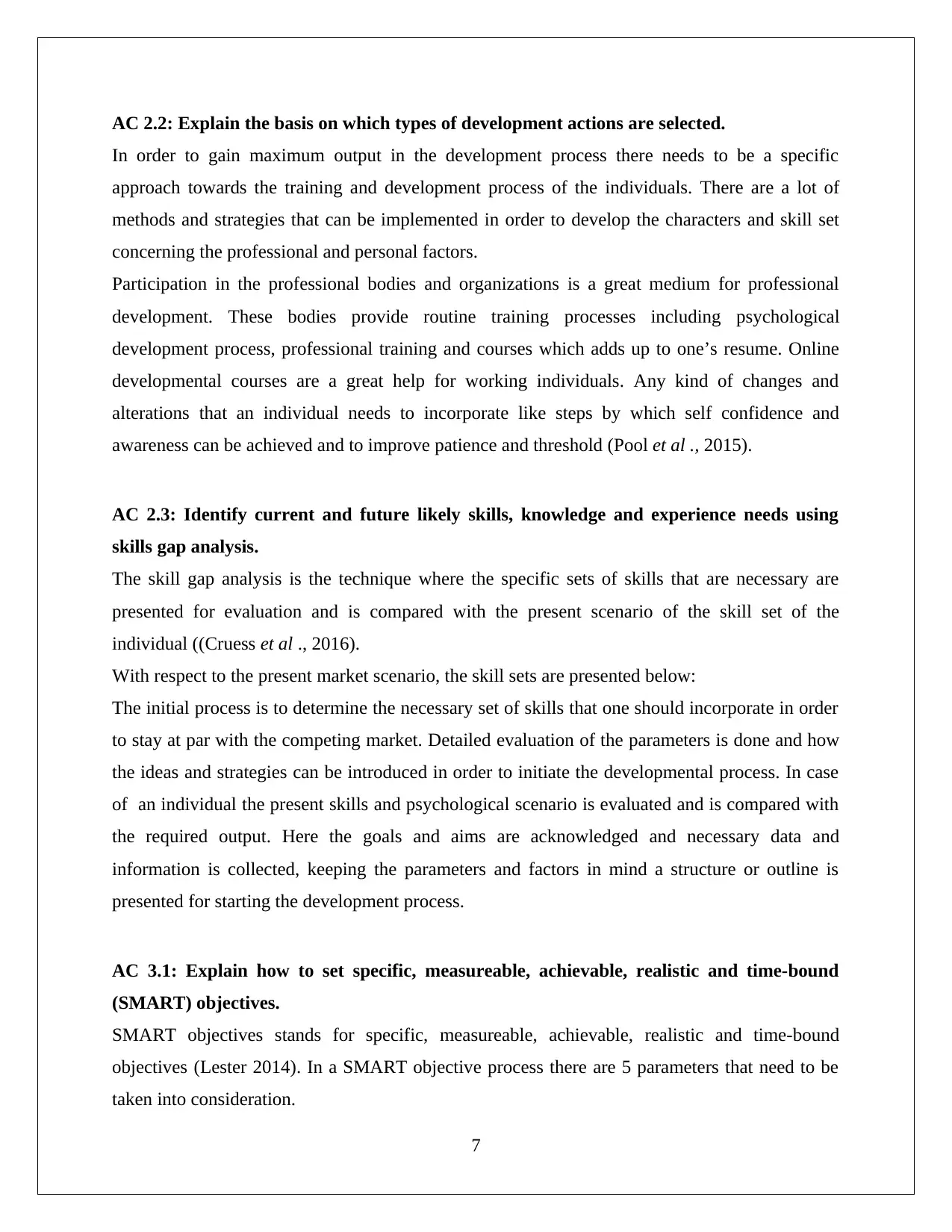
AC 2.2: Explain the basis on which types of development actions are selected.
In order to gain maximum output in the development process there needs to be a specific
approach towards the training and development process of the individuals. There are a lot of
methods and strategies that can be implemented in order to develop the characters and skill set
concerning the professional and personal factors.
Participation in the professional bodies and organizations is a great medium for professional
development. These bodies provide routine training processes including psychological
development process, professional training and courses which adds up to one’s resume. Online
developmental courses are a great help for working individuals. Any kind of changes and
alterations that an individual needs to incorporate like steps by which self confidence and
awareness can be achieved and to improve patience and threshold (Pool et al ., 2015).
AC 2.3: Identify current and future likely skills, knowledge and experience needs using
skills gap analysis.
The skill gap analysis is the technique where the specific sets of skills that are necessary are
presented for evaluation and is compared with the present scenario of the skill set of the
individual ((Cruess et al ., 2016).
With respect to the present market scenario, the skill sets are presented below:
The initial process is to determine the necessary set of skills that one should incorporate in order
to stay at par with the competing market. Detailed evaluation of the parameters is done and how
the ideas and strategies can be introduced in order to initiate the developmental process. In case
of an individual the present skills and psychological scenario is evaluated and is compared with
the required output. Here the goals and aims are acknowledged and necessary data and
information is collected, keeping the parameters and factors in mind a structure or outline is
presented for starting the development process.
AC 3.1: Explain how to set specific, measureable, achievable, realistic and time-bound
(SMART) objectives.
SMART objectives stands for specific, measureable, achievable, realistic and time-bound
objectives (Lester 2014). In a SMART objective process there are 5 parameters that need to be
taken into consideration.
7
In order to gain maximum output in the development process there needs to be a specific
approach towards the training and development process of the individuals. There are a lot of
methods and strategies that can be implemented in order to develop the characters and skill set
concerning the professional and personal factors.
Participation in the professional bodies and organizations is a great medium for professional
development. These bodies provide routine training processes including psychological
development process, professional training and courses which adds up to one’s resume. Online
developmental courses are a great help for working individuals. Any kind of changes and
alterations that an individual needs to incorporate like steps by which self confidence and
awareness can be achieved and to improve patience and threshold (Pool et al ., 2015).
AC 2.3: Identify current and future likely skills, knowledge and experience needs using
skills gap analysis.
The skill gap analysis is the technique where the specific sets of skills that are necessary are
presented for evaluation and is compared with the present scenario of the skill set of the
individual ((Cruess et al ., 2016).
With respect to the present market scenario, the skill sets are presented below:
The initial process is to determine the necessary set of skills that one should incorporate in order
to stay at par with the competing market. Detailed evaluation of the parameters is done and how
the ideas and strategies can be introduced in order to initiate the developmental process. In case
of an individual the present skills and psychological scenario is evaluated and is compared with
the required output. Here the goals and aims are acknowledged and necessary data and
information is collected, keeping the parameters and factors in mind a structure or outline is
presented for starting the development process.
AC 3.1: Explain how to set specific, measureable, achievable, realistic and time-bound
(SMART) objectives.
SMART objectives stands for specific, measureable, achievable, realistic and time-bound
objectives (Lester 2014). In a SMART objective process there are 5 parameters that need to be
taken into consideration.
7
Paraphrase This Document
Need a fresh take? Get an instant paraphrase of this document with our AI Paraphraser

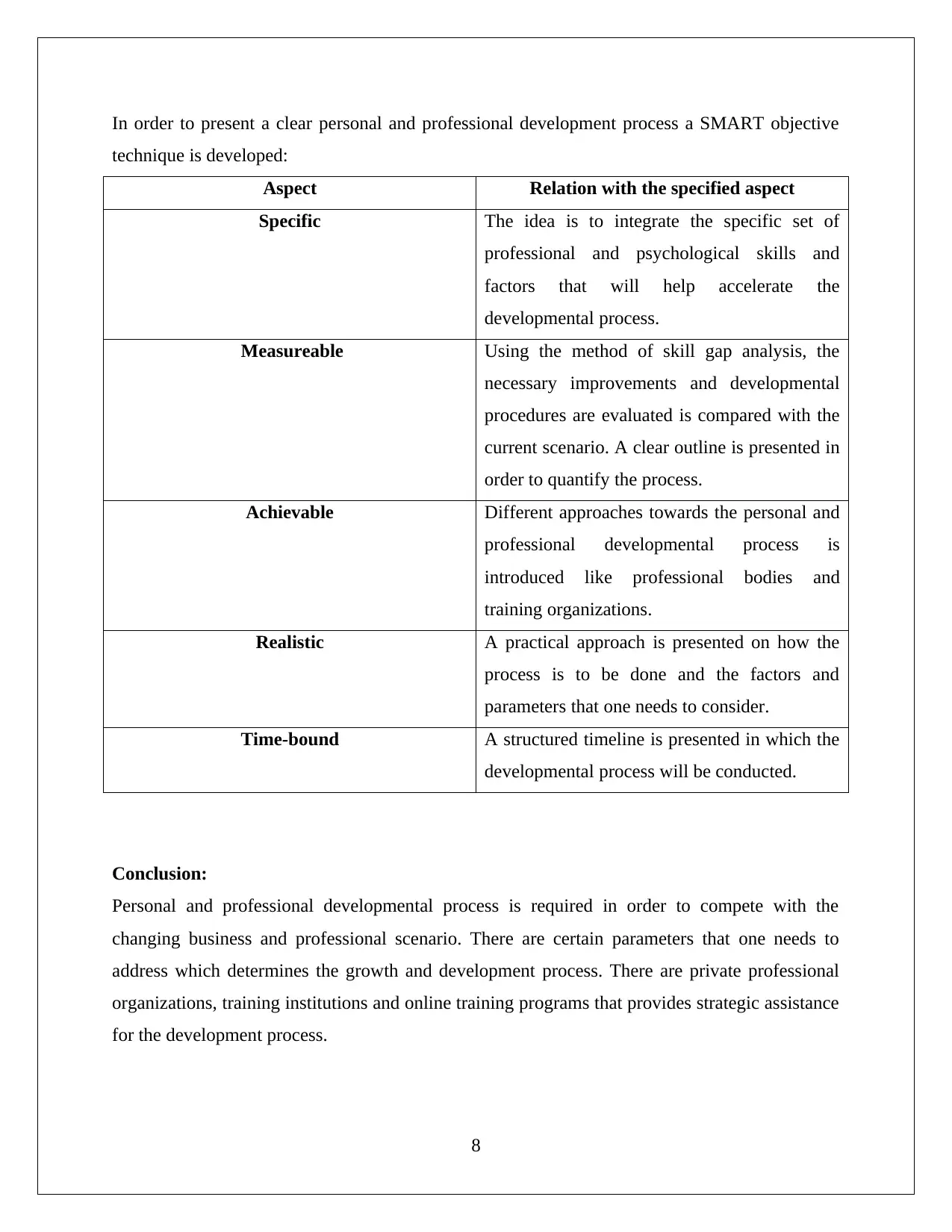
In order to present a clear personal and professional development process a SMART objective
technique is developed:
Aspect Relation with the specified aspect
Specific The idea is to integrate the specific set of
professional and psychological skills and
factors that will help accelerate the
developmental process.
Measureable Using the method of skill gap analysis, the
necessary improvements and developmental
procedures are evaluated is compared with the
current scenario. A clear outline is presented in
order to quantify the process.
Achievable Different approaches towards the personal and
professional developmental process is
introduced like professional bodies and
training organizations.
Realistic A practical approach is presented on how the
process is to be done and the factors and
parameters that one needs to consider.
Time-bound A structured timeline is presented in which the
developmental process will be conducted.
Conclusion:
Personal and professional developmental process is required in order to compete with the
changing business and professional scenario. There are certain parameters that one needs to
address which determines the growth and development process. There are private professional
organizations, training institutions and online training programs that provides strategic assistance
for the development process.
8
technique is developed:
Aspect Relation with the specified aspect
Specific The idea is to integrate the specific set of
professional and psychological skills and
factors that will help accelerate the
developmental process.
Measureable Using the method of skill gap analysis, the
necessary improvements and developmental
procedures are evaluated is compared with the
current scenario. A clear outline is presented in
order to quantify the process.
Achievable Different approaches towards the personal and
professional developmental process is
introduced like professional bodies and
training organizations.
Realistic A practical approach is presented on how the
process is to be done and the factors and
parameters that one needs to consider.
Time-bound A structured timeline is presented in which the
developmental process will be conducted.
Conclusion:
Personal and professional developmental process is required in order to compete with the
changing business and professional scenario. There are certain parameters that one needs to
address which determines the growth and development process. There are private professional
organizations, training institutions and online training programs that provides strategic assistance
for the development process.
8

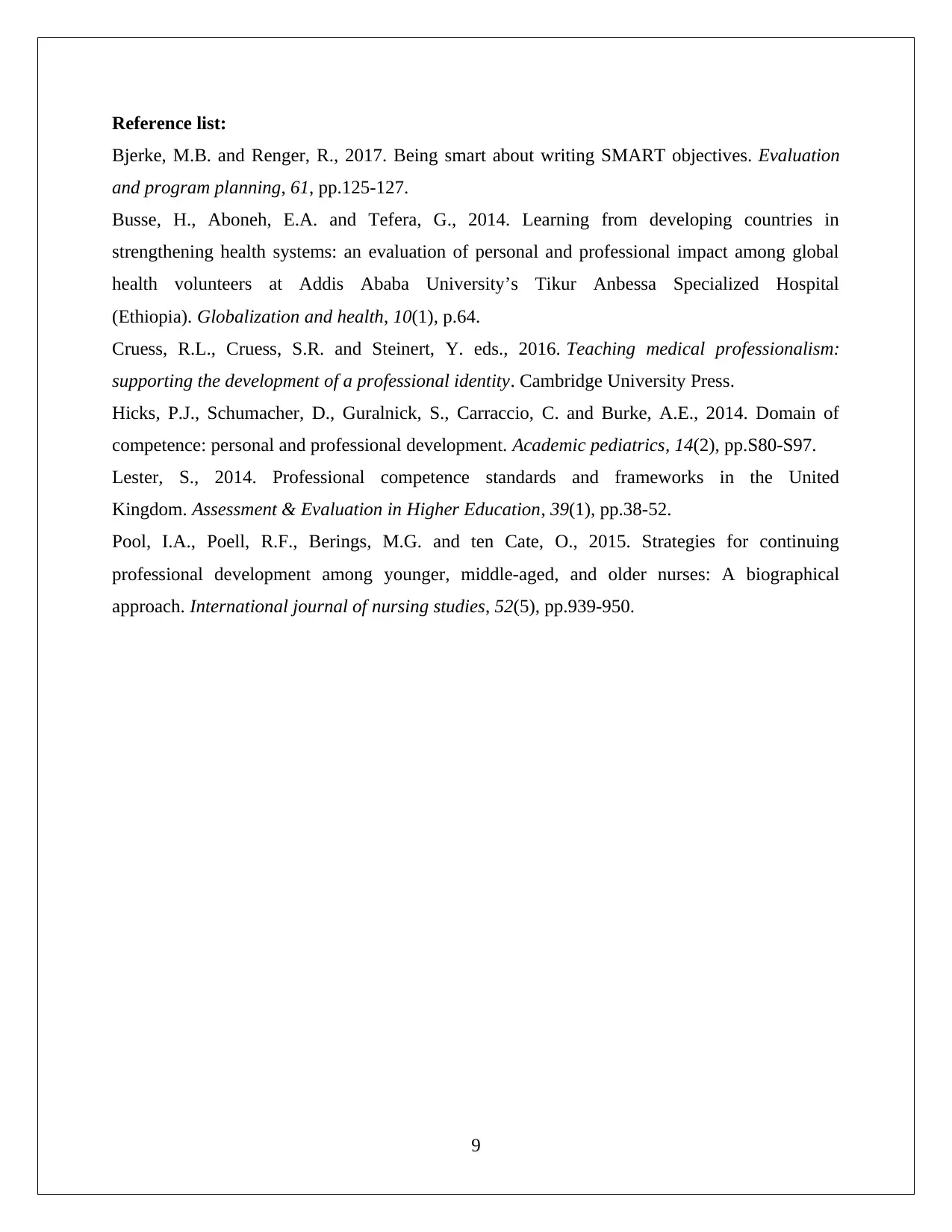
Reference list:
Bjerke, M.B. and Renger, R., 2017. Being smart about writing SMART objectives. Evaluation
and program planning, 61, pp.125-127.
Busse, H., Aboneh, E.A. and Tefera, G., 2014. Learning from developing countries in
strengthening health systems: an evaluation of personal and professional impact among global
health volunteers at Addis Ababa University’s Tikur Anbessa Specialized Hospital
(Ethiopia). Globalization and health, 10(1), p.64.
Cruess, R.L., Cruess, S.R. and Steinert, Y. eds., 2016. Teaching medical professionalism:
supporting the development of a professional identity. Cambridge University Press.
Hicks, P.J., Schumacher, D., Guralnick, S., Carraccio, C. and Burke, A.E., 2014. Domain of
competence: personal and professional development. Academic pediatrics, 14(2), pp.S80-S97.
Lester, S., 2014. Professional competence standards and frameworks in the United
Kingdom. Assessment & Evaluation in Higher Education, 39(1), pp.38-52.
Pool, I.A., Poell, R.F., Berings, M.G. and ten Cate, O., 2015. Strategies for continuing
professional development among younger, middle-aged, and older nurses: A biographical
approach. International journal of nursing studies, 52(5), pp.939-950.
9
Bjerke, M.B. and Renger, R., 2017. Being smart about writing SMART objectives. Evaluation
and program planning, 61, pp.125-127.
Busse, H., Aboneh, E.A. and Tefera, G., 2014. Learning from developing countries in
strengthening health systems: an evaluation of personal and professional impact among global
health volunteers at Addis Ababa University’s Tikur Anbessa Specialized Hospital
(Ethiopia). Globalization and health, 10(1), p.64.
Cruess, R.L., Cruess, S.R. and Steinert, Y. eds., 2016. Teaching medical professionalism:
supporting the development of a professional identity. Cambridge University Press.
Hicks, P.J., Schumacher, D., Guralnick, S., Carraccio, C. and Burke, A.E., 2014. Domain of
competence: personal and professional development. Academic pediatrics, 14(2), pp.S80-S97.
Lester, S., 2014. Professional competence standards and frameworks in the United
Kingdom. Assessment & Evaluation in Higher Education, 39(1), pp.38-52.
Pool, I.A., Poell, R.F., Berings, M.G. and ten Cate, O., 2015. Strategies for continuing
professional development among younger, middle-aged, and older nurses: A biographical
approach. International journal of nursing studies, 52(5), pp.939-950.
9
⊘ This is a preview!⊘
Do you want full access?
Subscribe today to unlock all pages.

Trusted by 1+ million students worldwide
1 out of 9
Related Documents
Your All-in-One AI-Powered Toolkit for Academic Success.
+13062052269
info@desklib.com
Available 24*7 on WhatsApp / Email
Unlock your academic potential
Copyright © 2020–2026 A2Z Services. All Rights Reserved. Developed and managed by ZUCOL.