Procrastination and Big Five Personality Traits: PSY303 Report
VerifiedAdded on 2022/10/31
|14
|3080
|390
Report
AI Summary
This lab report examines the relationship between procrastination and three of the Big Five personality traits: conscientiousness, extraversion, and openness. Utilizing a dataset from past psychology students, the study employs Pearson correlation and OLS regression to analyze the data. The findings reveal a significant negative relationship between conscientiousness and extraversion with procrastination, while openness shows no significant correlation. The report includes an introduction outlining the objectives and hypotheses, a literature review discussing personality models and related research, and a methods section detailing the participants, materials, and procedure. The results section presents descriptive statistics, correlation coefficients, and regression analysis, followed by a discussion that interprets the findings in relation to the hypotheses and existing literature. The study concludes that individuals with high conscientiousness and extroverted personalities are less prone to procrastination.
Running head: PROCRASTINATION AND THREE OF BIG FIVE PERSONALITY 1
The Relationship Between Procrastination and Three of Big Five Personality
(Conscientiousness, Extraversion, Openness)
Name
Institution
The Relationship Between Procrastination and Three of Big Five Personality
(Conscientiousness, Extraversion, Openness)
Name
Institution

Paraphrase This Document
Need a fresh take? Get an instant paraphrase of this document with our AI Paraphraser
PROCRASTINATION AND THREE OF BIG FIVE PERSONALITY 2
Abstract
The purpose of this study is to explore the relationship between procrastination and three of
the “Big five” personality traits (conscientiousness, extraversion, openness). The hypothesis
of the study is that there does not exists a significant relationship between conscientiousness
(N) or extraversion (E) or openness (O) personalities and procrastination. The method used in
the analysis are Pearson correlation and OLS regression. The results obtained confirmed that
there exists a significant negative relationship between conscientiousness (N) or extraversion
(E) and procrastination but no significant relationship between procrastination and openness
(O). Therefore, the conclusion from the study was that people who are extroverts and having
high level of conscientiousness are less likely to postpones activities (procrastination).
Keywords: Procrastination, conscientiousness, extraversion, openness and personalities.
Abstract
The purpose of this study is to explore the relationship between procrastination and three of
the “Big five” personality traits (conscientiousness, extraversion, openness). The hypothesis
of the study is that there does not exists a significant relationship between conscientiousness
(N) or extraversion (E) or openness (O) personalities and procrastination. The method used in
the analysis are Pearson correlation and OLS regression. The results obtained confirmed that
there exists a significant negative relationship between conscientiousness (N) or extraversion
(E) and procrastination but no significant relationship between procrastination and openness
(O). Therefore, the conclusion from the study was that people who are extroverts and having
high level of conscientiousness are less likely to postpones activities (procrastination).
Keywords: Procrastination, conscientiousness, extraversion, openness and personalities.
PROCRASTINATION AND THREE OF BIG FIVE PERSONALITY 3
The Relationship Between Procrastination and Three of Big Five Personality
(Conscientiousness, Extraversion, Openness)
Introduction
The aim of this study was to investigate existences of relationship between the
procrastination level and three of the big five personality factors (conscientiousness,
extraversion, and openness to experience) in the 3rd year psychology students. In order to
achieve the main aim three objectives and three hypotheses were framed in relation to the
four variables. The three objectives are directly related to procrastination and the big five
personality domains in the whole group of 3rd year psychology students, males against
females. Further, the three-hypothesis formulated were related the study of link between the
procrastination and threes of the big five personality factors. The following objectives and
hypothesis were settled on for this study;
Objectives of the Study
(i) To find out whether there exists a significant link between conscientiousness (C)
personality and procrastination.
(ii) To examine the relationship between extraversion (E) and procrastination.
(iii) To establish if there exist any relationship between openness (O) personality and
procrastination.
Hypothesis of the Study
(i) There does not exists a significant relationship between conscientiousness (N)
personality and procrastination.
(ii) There does not exists a significant relationship between extraversion (E) personality
and procrastination.
(iii) There will be no significant link between openness (O) personality and
procrastination.
The Relationship Between Procrastination and Three of Big Five Personality
(Conscientiousness, Extraversion, Openness)
Introduction
The aim of this study was to investigate existences of relationship between the
procrastination level and three of the big five personality factors (conscientiousness,
extraversion, and openness to experience) in the 3rd year psychology students. In order to
achieve the main aim three objectives and three hypotheses were framed in relation to the
four variables. The three objectives are directly related to procrastination and the big five
personality domains in the whole group of 3rd year psychology students, males against
females. Further, the three-hypothesis formulated were related the study of link between the
procrastination and threes of the big five personality factors. The following objectives and
hypothesis were settled on for this study;
Objectives of the Study
(i) To find out whether there exists a significant link between conscientiousness (C)
personality and procrastination.
(ii) To examine the relationship between extraversion (E) and procrastination.
(iii) To establish if there exist any relationship between openness (O) personality and
procrastination.
Hypothesis of the Study
(i) There does not exists a significant relationship between conscientiousness (N)
personality and procrastination.
(ii) There does not exists a significant relationship between extraversion (E) personality
and procrastination.
(iii) There will be no significant link between openness (O) personality and
procrastination.
⊘ This is a preview!⊘
Do you want full access?
Subscribe today to unlock all pages.

Trusted by 1+ million students worldwide
PROCRASTINATION AND THREE OF BIG FIVE PERSONALITY 4
The Big-Five Model
In the field of psychology, the ‘Big Five’ model forms the backbone of research and
study of personality. The theory has been in used from the late 20th Century to date. The five
factors are mostly used to measure or develop an in-depth description of personalised
variations in personalities (Borghuis et al., 2017). The five factors are neuroticism,
agreeableness, extraversion, conscientiousness, and openness to experience. In practise the
five factors are presented in the acronym ‘OCEAN’ (van der Linden et al., 2017). The
measures are on a continuous scale in which three groups of individuals can be defined.
Those with high score are extroverts, low score are introverts. A part from the two extremes a
person might be between the two extremes. These people are referred to as moderates.
The early research on personality inclined on the trait theory. The theory states that a
person’s behaviour and temperament can be described based on individual traits such as
melancholy or friendliness and self-confidence (Saucier & Srivastava, 2015). However, the
theory takes a vocabulary approach to personality by assuming that character can be
explained based on descriptive phrases or single adjectives. Moreover, the lexical approach
requires that if a significant number of people regularly exhibit a particular form of behaviour
but there does not exist a psychological term in any language to explain it, then a term is
formulated for the trait and discussed with others.
Personality Traits
Personality is a term derived from the Latin word, persona (Kristanto & Abraham,
2016). Originally the term was used to refer to theatrical mask. According to Sirois, Yang and
van Eerde (2019) the exploration of personality was first introduced by Hippocrates' defined
by four humours which were transformed to four temperaments. Therefore, personality refers
to the dynamic association within an individual that determines their characteristics thought
and behaviour. Moreover, Garcia-Naveira and Ruiz-Barquin (2013) refereed to personality as
The Big-Five Model
In the field of psychology, the ‘Big Five’ model forms the backbone of research and
study of personality. The theory has been in used from the late 20th Century to date. The five
factors are mostly used to measure or develop an in-depth description of personalised
variations in personalities (Borghuis et al., 2017). The five factors are neuroticism,
agreeableness, extraversion, conscientiousness, and openness to experience. In practise the
five factors are presented in the acronym ‘OCEAN’ (van der Linden et al., 2017). The
measures are on a continuous scale in which three groups of individuals can be defined.
Those with high score are extroverts, low score are introverts. A part from the two extremes a
person might be between the two extremes. These people are referred to as moderates.
The early research on personality inclined on the trait theory. The theory states that a
person’s behaviour and temperament can be described based on individual traits such as
melancholy or friendliness and self-confidence (Saucier & Srivastava, 2015). However, the
theory takes a vocabulary approach to personality by assuming that character can be
explained based on descriptive phrases or single adjectives. Moreover, the lexical approach
requires that if a significant number of people regularly exhibit a particular form of behaviour
but there does not exist a psychological term in any language to explain it, then a term is
formulated for the trait and discussed with others.
Personality Traits
Personality is a term derived from the Latin word, persona (Kristanto & Abraham,
2016). Originally the term was used to refer to theatrical mask. According to Sirois, Yang and
van Eerde (2019) the exploration of personality was first introduced by Hippocrates' defined
by four humours which were transformed to four temperaments. Therefore, personality refers
to the dynamic association within an individual that determines their characteristics thought
and behaviour. Moreover, Garcia-Naveira and Ruiz-Barquin (2013) refereed to personality as
Paraphrase This Document
Need a fresh take? Get an instant paraphrase of this document with our AI Paraphraser
PROCRASTINATION AND THREE OF BIG FIVE PERSONALITY 5
a characteristic or a mixture of traits that distinguishes people. However, The American
Psychological Association defined personality as distinct variances in behaviour patterns of
feeling, thinking, and behaving (Mikulincer, Shaver, Cooper & Larsen, 2015). The
definitions allow the study of personality to focus on two broad areas. The areas are (i)
understanding personalised differences in specific personality traits such as irritability or
sociability. Next, (ii) making sense on how the various sections of a person operates as a
whole (Mikulincer et al., 2015).
The big five taxonomy has been used extensively in researching on the personality
traits in relation to procrastination (van Eerde, 2003). The results obtained by Steel (2007)
demonstrated a negligible positive correlation between openness to experience and
procrastination (Pearson Coefficient = 0.03). Next a weak negative correlation between
agreeableness or extraversion and procrastination (Pearson Coefficient = −0.12). However, a
small positive correlation between procrastination and neuroticism (Pearson Coefficient =
0.24). Finally, a strong correlation was established between procrastination and
conscientiousness (Pearson Coefficient = −0.62) (Steel, 2007). Further, according to Hettema
et al. (2006) neuroticism entails the propensity to experience feelings of depression and
anxiety accompanied by a more wearisomeness or self-conscious thus explaining the strong
correlation with procrastination.
On the other hand, Ozer and Benet-Martinez (2006) defined conscientiousness as
being careful, thorough, and tenacious. These qualities have the tendency of limiting
procrastination. However, Steel (2007), proposed that additional personality traits might have
the ability to predict procrastination. The proposed traits include high degree of
impulsiveness with correlation coefficient of 0.41 and a lack of self-control with coefficient
of −0.58. The correlations reveal moderate and strong relationship between procrastination
a characteristic or a mixture of traits that distinguishes people. However, The American
Psychological Association defined personality as distinct variances in behaviour patterns of
feeling, thinking, and behaving (Mikulincer, Shaver, Cooper & Larsen, 2015). The
definitions allow the study of personality to focus on two broad areas. The areas are (i)
understanding personalised differences in specific personality traits such as irritability or
sociability. Next, (ii) making sense on how the various sections of a person operates as a
whole (Mikulincer et al., 2015).
The big five taxonomy has been used extensively in researching on the personality
traits in relation to procrastination (van Eerde, 2003). The results obtained by Steel (2007)
demonstrated a negligible positive correlation between openness to experience and
procrastination (Pearson Coefficient = 0.03). Next a weak negative correlation between
agreeableness or extraversion and procrastination (Pearson Coefficient = −0.12). However, a
small positive correlation between procrastination and neuroticism (Pearson Coefficient =
0.24). Finally, a strong correlation was established between procrastination and
conscientiousness (Pearson Coefficient = −0.62) (Steel, 2007). Further, according to Hettema
et al. (2006) neuroticism entails the propensity to experience feelings of depression and
anxiety accompanied by a more wearisomeness or self-conscious thus explaining the strong
correlation with procrastination.
On the other hand, Ozer and Benet-Martinez (2006) defined conscientiousness as
being careful, thorough, and tenacious. These qualities have the tendency of limiting
procrastination. However, Steel (2007), proposed that additional personality traits might have
the ability to predict procrastination. The proposed traits include high degree of
impulsiveness with correlation coefficient of 0.41 and a lack of self-control with coefficient
of −0.58. The correlations reveal moderate and strong relationship between procrastination
PROCRASTINATION AND THREE OF BIG FIVE PERSONALITY 6
and the two additional personality traits (Moffitt et al., 2011). Further, Steel (2007) found
weak negative relationship between intelligence or aptitude and procrastination.
Method
Participants and Design
The data has been collected from past 3rd year psychology students (2012-2014). The
data is anonymous and was collected as part of their coursework. A total of 134 students were
contacted anonymously to respond to the personality questionnaire and fill procrastination
scale and social functioning. The procedures used in the collection of the data was survey in
which the entire 3rd year psychology students (2012-2014) were given identical
questionnaires to fill.
Materials and Procedure
The data was collected from the 3rd ear psychology students (2012-2014) after seeking
permission from the college authorities. However, for this study the secondary data was
obtain from the course blackboard with the permission of the course instructor. The other
details on how the data was collected and pre-processed was not the concern of this study
since the ready to use data was provided by the lecturer. In this stud the data was subjected to
statistical analysis which include descriptive statistics, Pearson Correlation, and regression
analysis. The next step involved interpretation of the statistical results with the aim of
identifying significant relationships between the response variable (procrastination) and the
three personality traits (conscientiousness, extraversion and openness). The analysis was
performed in IBM SPSS version 25.
Results
Descriptive Statistic
The table 1 shows the descriptive statistics for the gender. The decision to include descriptive
statistics for genders is to check for the representativeness of the data.
and the two additional personality traits (Moffitt et al., 2011). Further, Steel (2007) found
weak negative relationship between intelligence or aptitude and procrastination.
Method
Participants and Design
The data has been collected from past 3rd year psychology students (2012-2014). The
data is anonymous and was collected as part of their coursework. A total of 134 students were
contacted anonymously to respond to the personality questionnaire and fill procrastination
scale and social functioning. The procedures used in the collection of the data was survey in
which the entire 3rd year psychology students (2012-2014) were given identical
questionnaires to fill.
Materials and Procedure
The data was collected from the 3rd ear psychology students (2012-2014) after seeking
permission from the college authorities. However, for this study the secondary data was
obtain from the course blackboard with the permission of the course instructor. The other
details on how the data was collected and pre-processed was not the concern of this study
since the ready to use data was provided by the lecturer. In this stud the data was subjected to
statistical analysis which include descriptive statistics, Pearson Correlation, and regression
analysis. The next step involved interpretation of the statistical results with the aim of
identifying significant relationships between the response variable (procrastination) and the
three personality traits (conscientiousness, extraversion and openness). The analysis was
performed in IBM SPSS version 25.
Results
Descriptive Statistic
The table 1 shows the descriptive statistics for the gender. The decision to include descriptive
statistics for genders is to check for the representativeness of the data.
⊘ This is a preview!⊘
Do you want full access?
Subscribe today to unlock all pages.
Trusted by 1+ million students worldwide
PROCRASTINATION AND THREE OF BIG FIVE PERSONALITY 7
The data is not representative since males form only 15.7% of the total sample while
females form 81.3%. Therefore, the results obtained from this study might only be valid for
this sample and not any other sample. The missing values will be neglected from the
regression analysis. The table 2 shows descriptive statistics for the three variables.
The N represent the number of observations that are valid and the variation indicate
that there are missing observations from the data. Therefore, inferential analysis will use 129
observations instead of 134 (the original sample size). The average procrastination level is
36.52 (moderate) with standard deviation of 7.3 and range of 37. Next, the average
conscientiousness personality level is 6.86 (high) with standard deviation of 1.14 and range
of 5.38. Further, the average extraversion personality level is 5.48 (high) with standard
deviation of 1.37 and range of 7.38. Finally, the average openness personality level is 6.80
(high) with standard deviation of 1.138 and range of 5.50.
The data is not representative since males form only 15.7% of the total sample while
females form 81.3%. Therefore, the results obtained from this study might only be valid for
this sample and not any other sample. The missing values will be neglected from the
regression analysis. The table 2 shows descriptive statistics for the three variables.
The N represent the number of observations that are valid and the variation indicate
that there are missing observations from the data. Therefore, inferential analysis will use 129
observations instead of 134 (the original sample size). The average procrastination level is
36.52 (moderate) with standard deviation of 7.3 and range of 37. Next, the average
conscientiousness personality level is 6.86 (high) with standard deviation of 1.14 and range
of 5.38. Further, the average extraversion personality level is 5.48 (high) with standard
deviation of 1.37 and range of 7.38. Finally, the average openness personality level is 6.80
(high) with standard deviation of 1.138 and range of 5.50.
Paraphrase This Document
Need a fresh take? Get an instant paraphrase of this document with our AI Paraphraser
PROCRASTINATION AND THREE OF BIG FIVE PERSONALITY 8
Correlations Between the Study variables
Table 3 shows the Pearson correlations coefficients with the corresponding statistical
significance value.
From table 3, there exists a strong significant negative relationship between
procrastination and conscientiousness. Also, there exists a weak but significant negative
relationship between procrastination and extraversion. Further, there exist a negligible and
insignificant negative relationship between procrastination and openness. To further explore
the observed correlations ordinary least squares regression is was performed as presented in
the next subsection.
Regression Analysis
OLS regression is based on four main assumptions; (i) linearity between response and
explanatory variables, (ii) normality of residuals, (iii) constant variance (homoscedasticity),
and (iv) independence. The first assumption is already satisfied since there exist linear
relationship between procrastination (response variable) and the three explanatory variables
(conscientiousness, extraversion, and openness). The remaining three will be checked after
the model has been estimated. The regression model takes the form:
Y i=βo + β1 Ci +β2 Ei+ β3 Oi+εi (1)
Where:
Correlations Between the Study variables
Table 3 shows the Pearson correlations coefficients with the corresponding statistical
significance value.
From table 3, there exists a strong significant negative relationship between
procrastination and conscientiousness. Also, there exists a weak but significant negative
relationship between procrastination and extraversion. Further, there exist a negligible and
insignificant negative relationship between procrastination and openness. To further explore
the observed correlations ordinary least squares regression is was performed as presented in
the next subsection.
Regression Analysis
OLS regression is based on four main assumptions; (i) linearity between response and
explanatory variables, (ii) normality of residuals, (iii) constant variance (homoscedasticity),
and (iv) independence. The first assumption is already satisfied since there exist linear
relationship between procrastination (response variable) and the three explanatory variables
(conscientiousness, extraversion, and openness). The remaining three will be checked after
the model has been estimated. The regression model takes the form:
Y i=βo + β1 Ci +β2 Ei+ β3 Oi+εi (1)
Where:
PROCRASTINATION AND THREE OF BIG FIVE PERSONALITY 9
Y i - Observed procrastination values
βi – parameter estimates (i = 0, 1, 2, 3.)
Ci – Observed conscientiousness values
Ei – Observed extraversion values
Oi – Observed openness values.
ε i – Residuals normally distributed with zero mean.
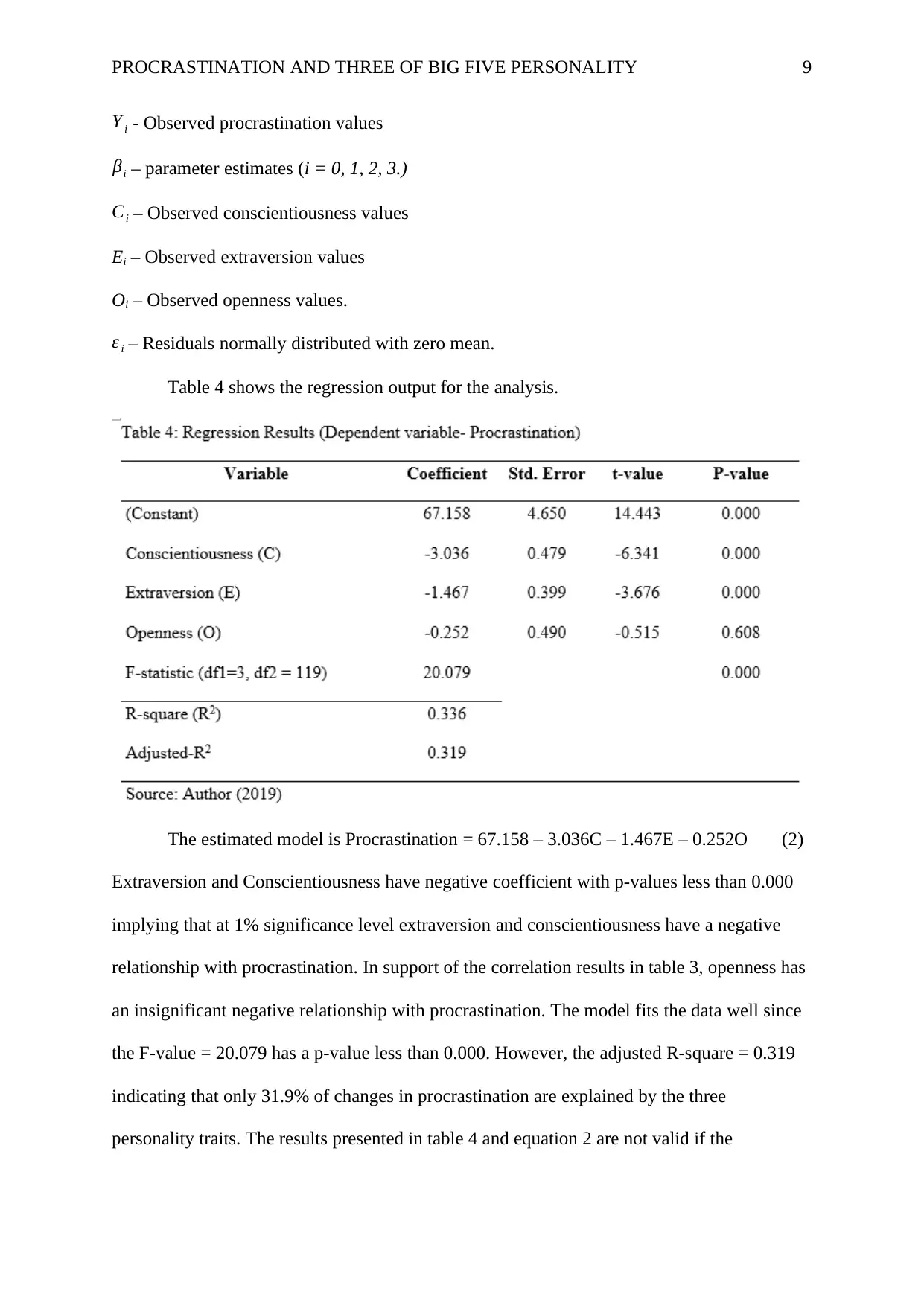
Table 4 shows the regression output for the analysis.
The estimated model is Procrastination = 67.158 – 3.036C – 1.467E – 0.252O (2)
Extraversion and Conscientiousness have negative coefficient with p-values less than 0.000
implying that at 1% significance level extraversion and conscientiousness have a negative
relationship with procrastination. In support of the correlation results in table 3, openness has
an insignificant negative relationship with procrastination. The model fits the data well since
the F-value = 20.079 has a p-value less than 0.000. However, the adjusted R-square = 0.319
indicating that only 31.9% of changes in procrastination are explained by the three
personality traits. The results presented in table 4 and equation 2 are not valid if the
Y i - Observed procrastination values
βi – parameter estimates (i = 0, 1, 2, 3.)
Ci – Observed conscientiousness values
Ei – Observed extraversion values
Oi – Observed openness values.
ε i – Residuals normally distributed with zero mean.
Table 4 shows the regression output for the analysis.
The estimated model is Procrastination = 67.158 – 3.036C – 1.467E – 0.252O (2)
Extraversion and Conscientiousness have negative coefficient with p-values less than 0.000
implying that at 1% significance level extraversion and conscientiousness have a negative
relationship with procrastination. In support of the correlation results in table 3, openness has
an insignificant negative relationship with procrastination. The model fits the data well since
the F-value = 20.079 has a p-value less than 0.000. However, the adjusted R-square = 0.319
indicating that only 31.9% of changes in procrastination are explained by the three
personality traits. The results presented in table 4 and equation 2 are not valid if the
⊘ This is a preview!⊘
Do you want full access?
Subscribe today to unlock all pages.
Trusted by 1+ million students worldwide
PROCRASTINATION AND THREE OF BIG FIVE PERSONALITY 10
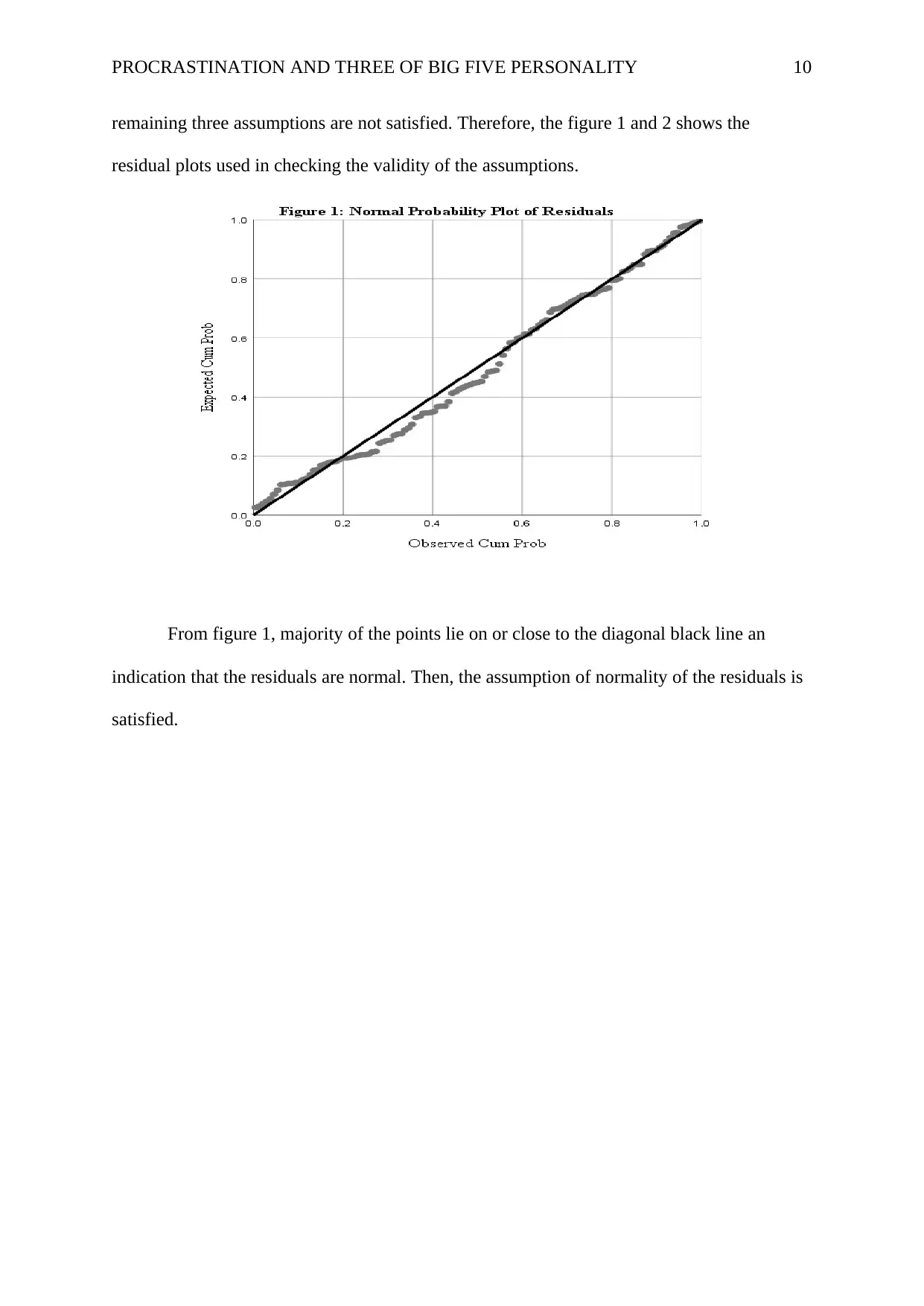
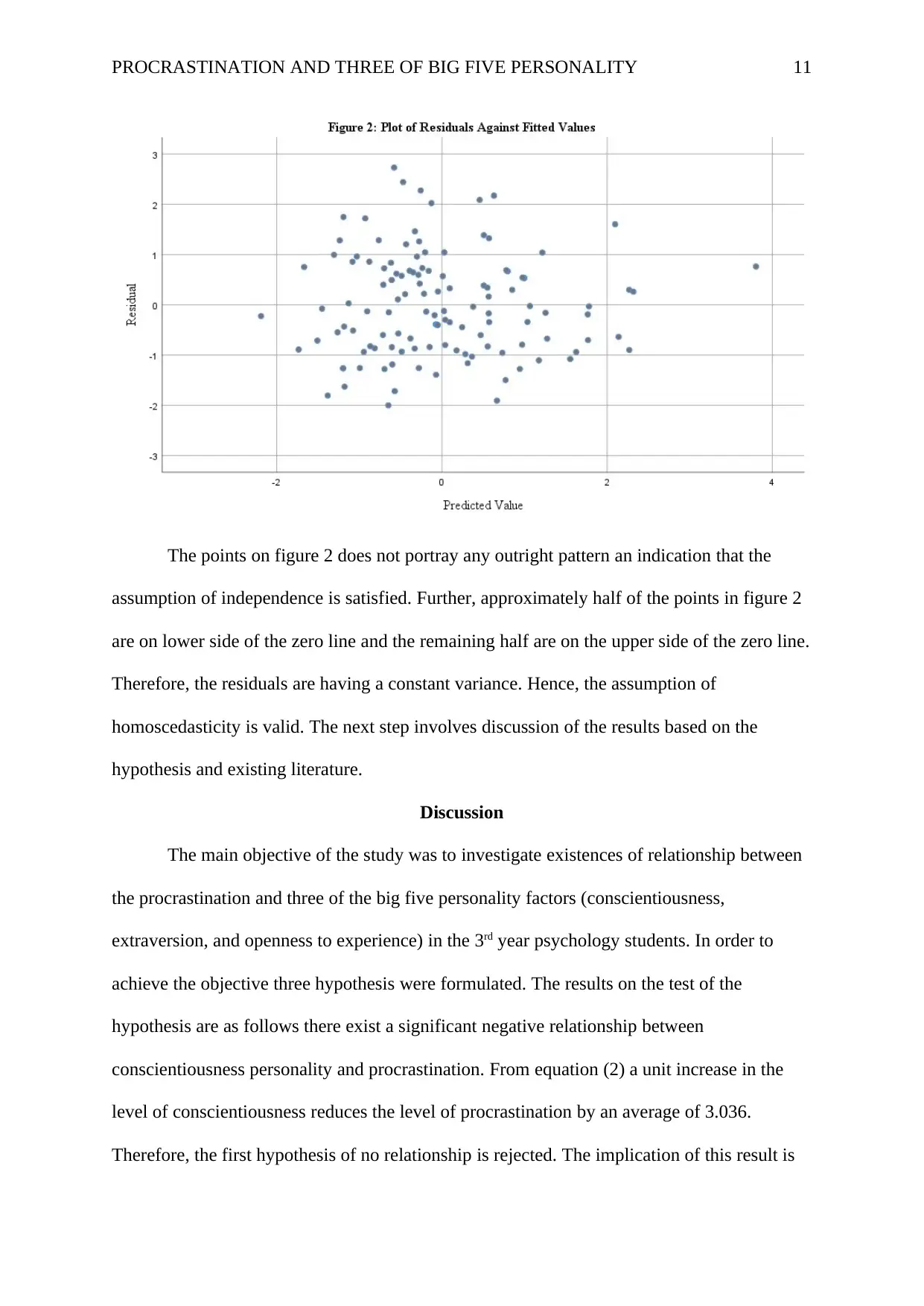
remaining three assumptions are not satisfied. Therefore, the figure 1 and 2 shows the
residual plots used in checking the validity of the assumptions.
From figure 1, majority of the points lie on or close to the diagonal black line an
indication that the residuals are normal. Then, the assumption of normality of the residuals is
satisfied.
remaining three assumptions are not satisfied. Therefore, the figure 1 and 2 shows the
residual plots used in checking the validity of the assumptions.
From figure 1, majority of the points lie on or close to the diagonal black line an
indication that the residuals are normal. Then, the assumption of normality of the residuals is
satisfied.
Paraphrase This Document
Need a fresh take? Get an instant paraphrase of this document with our AI Paraphraser
PROCRASTINATION AND THREE OF BIG FIVE PERSONALITY 11
The points on figure 2 does not portray any outright pattern an indication that the
assumption of independence is satisfied. Further, approximately half of the points in figure 2
are on lower side of the zero line and the remaining half are on the upper side of the zero line.
Therefore, the residuals are having a constant variance. Hence, the assumption of
homoscedasticity is valid. The next step involves discussion of the results based on the
hypothesis and existing literature.
Discussion
The main objective of the study was to investigate existences of relationship between
the procrastination and three of the big five personality factors (conscientiousness,
extraversion, and openness to experience) in the 3rd year psychology students. In order to
achieve the objective three hypothesis were formulated. The results on the test of the
hypothesis are as follows there exist a significant negative relationship between
conscientiousness personality and procrastination. From equation (2) a unit increase in the
level of conscientiousness reduces the level of procrastination by an average of 3.036.
Therefore, the first hypothesis of no relationship is rejected. The implication of this result is
The points on figure 2 does not portray any outright pattern an indication that the
assumption of independence is satisfied. Further, approximately half of the points in figure 2
are on lower side of the zero line and the remaining half are on the upper side of the zero line.
Therefore, the residuals are having a constant variance. Hence, the assumption of
homoscedasticity is valid. The next step involves discussion of the results based on the
hypothesis and existing literature.
Discussion
The main objective of the study was to investigate existences of relationship between
the procrastination and three of the big five personality factors (conscientiousness,
extraversion, and openness to experience) in the 3rd year psychology students. In order to
achieve the objective three hypothesis were formulated. The results on the test of the
hypothesis are as follows there exist a significant negative relationship between
conscientiousness personality and procrastination. From equation (2) a unit increase in the
level of conscientiousness reduces the level of procrastination by an average of 3.036.
Therefore, the first hypothesis of no relationship is rejected. The implication of this result is

PROCRASTINATION AND THREE OF BIG FIVE PERSONALITY 12
people with high level of conscientiousness are less likely to procrastinate. The results are in
line with Steel (2007) who found a strong negative correlation between conscientiousness and
procrastination.
Next, there exist a significant negative relationship between extraversion personality
and procrastination. Similarly, from equation (2) a unit increase in the level of extraversion
reduces the level of procrastination by an average of 1.46. Therefore, the second hypothesis
of no relationship is rejected. The implication of this result is that extroverts are less likely to
procrastinate. The results are in line with Steel (2007) and Moffitt et al. (2011) who found a
negative correlation between conscientiousness and procrastination. The third hypothesis is
not rejected indicating that the observed negative correlation between openness and
procrastination does not have an impact. Similar conclusion was arrived at by Steel (2007)
and Moffitt et al. (2011).
The research established that there exists a significant negative relationship between
two Big Five personality traits (conscientiousness and extraversion) and procrastination.
People who are extroverts and having high level of conscientiousness are less likely to
postpones activities (procrastination). Conversely, introverts with low level of
conscientiousness are having a high likelihood of postponing activities. In order to know
whether an individual will postpone a given task personality traits such as introversion and
consciousness should be examined.
people with high level of conscientiousness are less likely to procrastinate. The results are in
line with Steel (2007) who found a strong negative correlation between conscientiousness and
procrastination.
Next, there exist a significant negative relationship between extraversion personality
and procrastination. Similarly, from equation (2) a unit increase in the level of extraversion
reduces the level of procrastination by an average of 1.46. Therefore, the second hypothesis
of no relationship is rejected. The implication of this result is that extroverts are less likely to
procrastinate. The results are in line with Steel (2007) and Moffitt et al. (2011) who found a
negative correlation between conscientiousness and procrastination. The third hypothesis is
not rejected indicating that the observed negative correlation between openness and
procrastination does not have an impact. Similar conclusion was arrived at by Steel (2007)
and Moffitt et al. (2011).
The research established that there exists a significant negative relationship between
two Big Five personality traits (conscientiousness and extraversion) and procrastination.
People who are extroverts and having high level of conscientiousness are less likely to
postpones activities (procrastination). Conversely, introverts with low level of
conscientiousness are having a high likelihood of postponing activities. In order to know
whether an individual will postpone a given task personality traits such as introversion and
consciousness should be examined.
⊘ This is a preview!⊘
Do you want full access?
Subscribe today to unlock all pages.
Trusted by 1+ million students worldwide

1 out of 14


Related Documents


Your All-in-One AI-Powered Toolkit for Academic Success.
+13062052269
info@desklib.com
Available 24*7 on WhatsApp / Email
![[object Object]](/_next/static/media/star-bottom.7253800d.svg)
Unlock your academic potential
Copyright © 2020–2026 A2Z Services. All Rights Reserved. Developed and managed by ZUCOL.