COM 223E: A Persuasive Critique on Media Influencers Strategy
VerifiedAdded on 2023/06/07
|6
|1292
|308
Essay
AI Summary
This essay presents a persuasive argument regarding the use of media influencers for creating public awareness about the budget process in Singapore. It begins by agreeing with and critiquing a Straits Times article, highlighting the rising cost of living and the need for cost-effective budgeting strategies. The author, a social scientist, argues that media influencers are a useful tool for public awareness, supported by research and psychological principles related to attractiveness, similarity, trustworthiness, and expertise. The essay emphasizes the effectiveness of micro-influencers, the importance of perceived power and expertise, and the impact of attractiveness bias. While concurring with the view that social media influencers can reach a wider audience, the author concludes by advocating for the careful selection of influencers and the need for quality over quantity in public campaigns. Desklib offers a range of resources, including past papers and solved assignments, to support students in their academic pursuits.
Running head: PERSUASIVE WRITING 1
COM 223E: Writing for strategic communication
Student Name
Institutional Affiliations
Tutor
Date
COM 223E: Writing for strategic communication
Student Name
Institutional Affiliations
Tutor
Date
Paraphrase This Document
Need a fresh take? Get an instant paraphrase of this document with our AI Paraphraser

PERSUASIVE WRITING 2
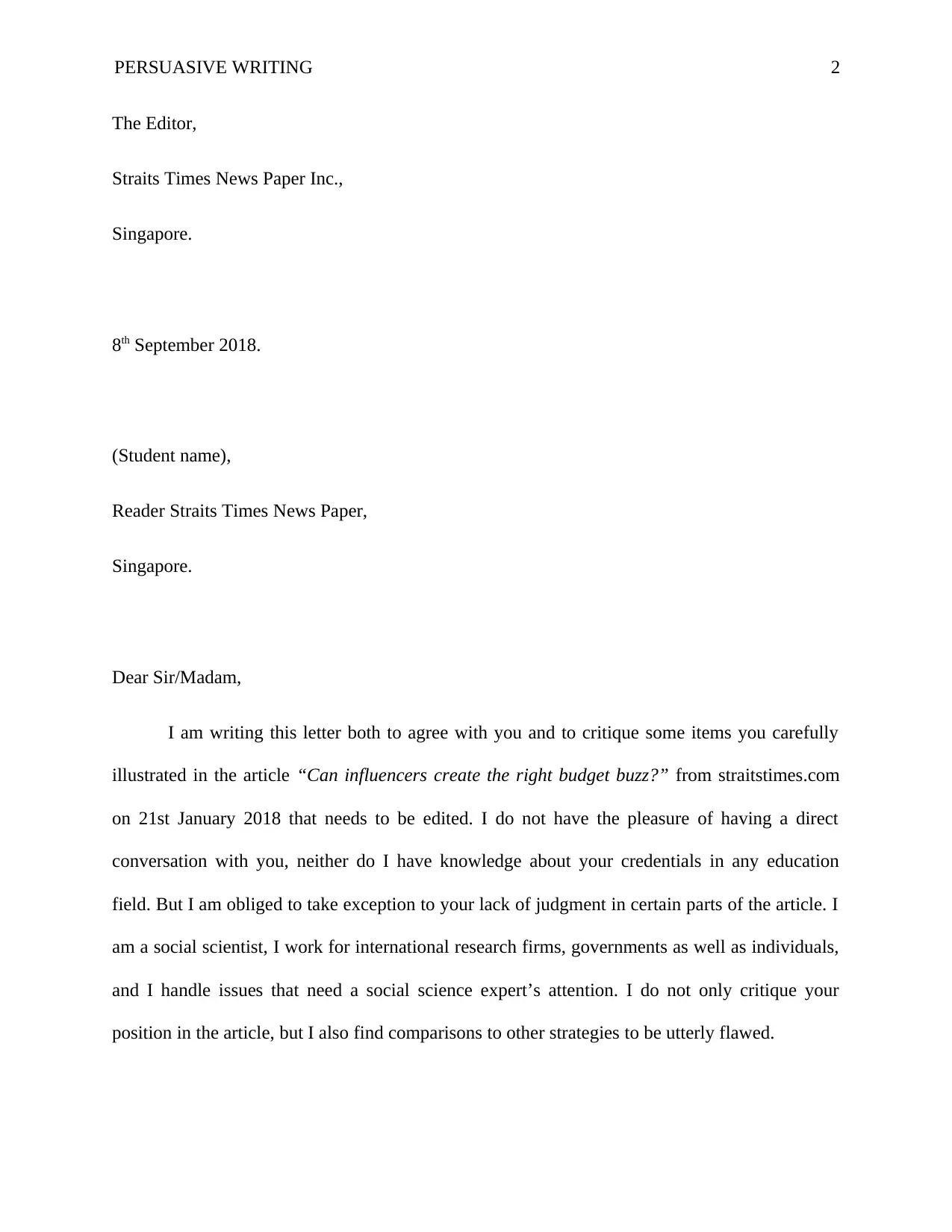
The Editor,
Straits Times News Paper Inc.,
Singapore.
8th September 2018.
(Student name),
Reader Straits Times News Paper,
Singapore.
Dear Sir/Madam,
I am writing this letter both to agree with you and to critique some items you carefully
illustrated in the article “Can influencers create the right budget buzz?” from straitstimes.com
on 21st January 2018 that needs to be edited. I do not have the pleasure of having a direct
conversation with you, neither do I have knowledge about your credentials in any education
field. But I am obliged to take exception to your lack of judgment in certain parts of the article. I
am a social scientist, I work for international research firms, governments as well as individuals,
and I handle issues that need a social science expert’s attention. I do not only critique your
position in the article, but I also find comparisons to other strategies to be utterly flawed.
The Editor,
Straits Times News Paper Inc.,
Singapore.
8th September 2018.
(Student name),
Reader Straits Times News Paper,
Singapore.
Dear Sir/Madam,
I am writing this letter both to agree with you and to critique some items you carefully
illustrated in the article “Can influencers create the right budget buzz?” from straitstimes.com
on 21st January 2018 that needs to be edited. I do not have the pleasure of having a direct
conversation with you, neither do I have knowledge about your credentials in any education
field. But I am obliged to take exception to your lack of judgment in certain parts of the article. I
am a social scientist, I work for international research firms, governments as well as individuals,
and I handle issues that need a social science expert’s attention. I do not only critique your
position in the article, but I also find comparisons to other strategies to be utterly flawed.

PERSUASIVE WRITING 3
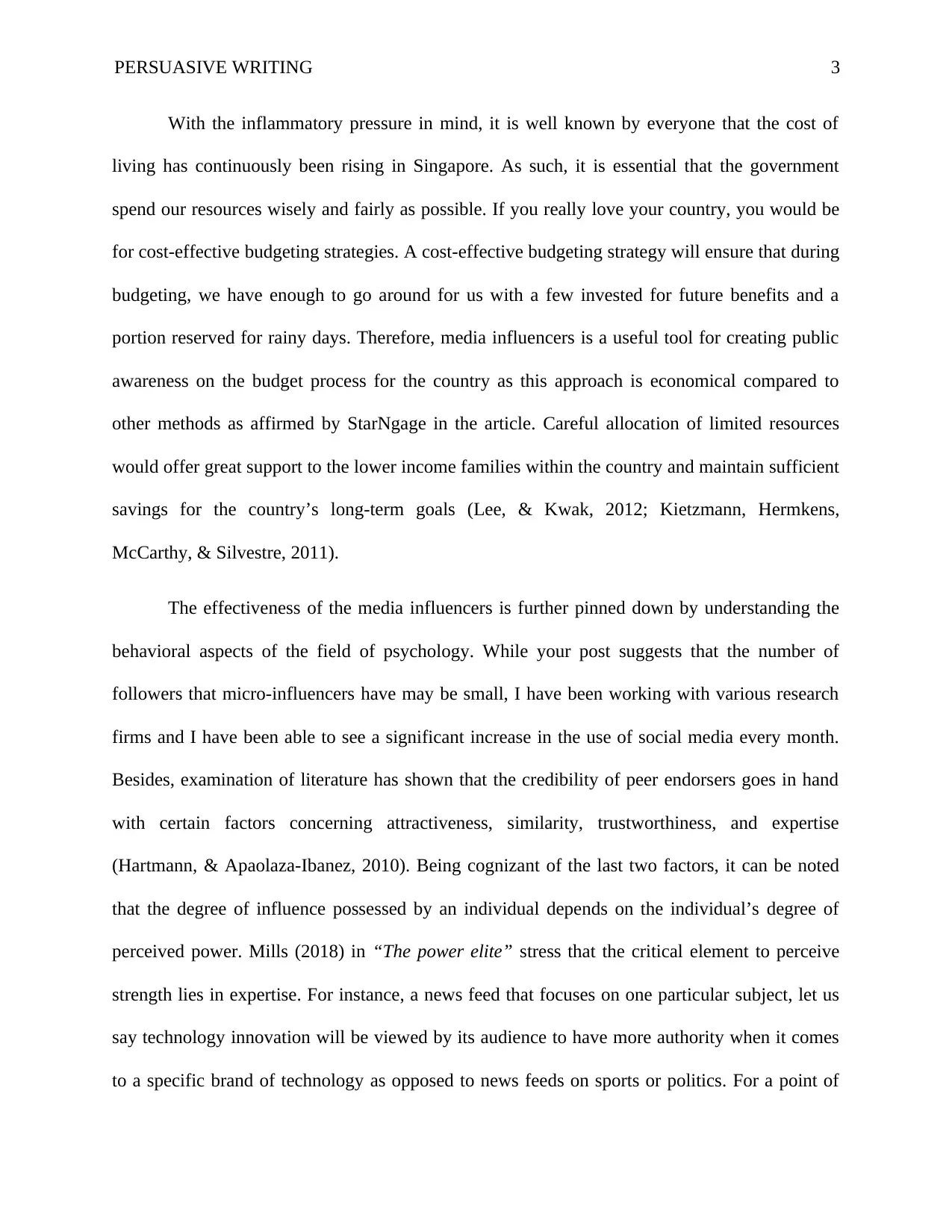
With the inflammatory pressure in mind, it is well known by everyone that the cost of
living has continuously been rising in Singapore. As such, it is essential that the government
spend our resources wisely and fairly as possible. If you really love your country, you would be
for cost-effective budgeting strategies. A cost-effective budgeting strategy will ensure that during
budgeting, we have enough to go around for us with a few invested for future benefits and a
portion reserved for rainy days. Therefore, media influencers is a useful tool for creating public
awareness on the budget process for the country as this approach is economical compared to
other methods as affirmed by StarNgage in the article. Careful allocation of limited resources
would offer great support to the lower income families within the country and maintain sufficient
savings for the country’s long-term goals (Lee, & Kwak, 2012; Kietzmann, Hermkens,
McCarthy, & Silvestre, 2011).
The effectiveness of the media influencers is further pinned down by understanding the
behavioral aspects of the field of psychology. While your post suggests that the number of
followers that micro-influencers have may be small, I have been working with various research
firms and I have been able to see a significant increase in the use of social media every month.
Besides, examination of literature has shown that the credibility of peer endorsers goes in hand
with certain factors concerning attractiveness, similarity, trustworthiness, and expertise
(Hartmann, & Apaolaza-Ibanez, 2010). Being cognizant of the last two factors, it can be noted
that the degree of influence possessed by an individual depends on the individual’s degree of
perceived power. Mills (2018) in “The power elite” stress that the critical element to perceive
strength lies in expertise. For instance, a news feed that focuses on one particular subject, let us
say technology innovation will be viewed by its audience to have more authority when it comes
to a specific brand of technology as opposed to news feeds on sports or politics. For a point of
With the inflammatory pressure in mind, it is well known by everyone that the cost of
living has continuously been rising in Singapore. As such, it is essential that the government
spend our resources wisely and fairly as possible. If you really love your country, you would be
for cost-effective budgeting strategies. A cost-effective budgeting strategy will ensure that during
budgeting, we have enough to go around for us with a few invested for future benefits and a
portion reserved for rainy days. Therefore, media influencers is a useful tool for creating public
awareness on the budget process for the country as this approach is economical compared to
other methods as affirmed by StarNgage in the article. Careful allocation of limited resources
would offer great support to the lower income families within the country and maintain sufficient
savings for the country’s long-term goals (Lee, & Kwak, 2012; Kietzmann, Hermkens,
McCarthy, & Silvestre, 2011).
The effectiveness of the media influencers is further pinned down by understanding the
behavioral aspects of the field of psychology. While your post suggests that the number of
followers that micro-influencers have may be small, I have been working with various research
firms and I have been able to see a significant increase in the use of social media every month.
Besides, examination of literature has shown that the credibility of peer endorsers goes in hand
with certain factors concerning attractiveness, similarity, trustworthiness, and expertise
(Hartmann, & Apaolaza-Ibanez, 2010). Being cognizant of the last two factors, it can be noted
that the degree of influence possessed by an individual depends on the individual’s degree of
perceived power. Mills (2018) in “The power elite” stress that the critical element to perceive
strength lies in expertise. For instance, a news feed that focuses on one particular subject, let us
say technology innovation will be viewed by its audience to have more authority when it comes
to a specific brand of technology as opposed to news feeds on sports or politics. For a point of
⊘ This is a preview!⊘
Do you want full access?
Subscribe today to unlock all pages.

Trusted by 1+ million students worldwide

PERSUASIVE WRITING 4
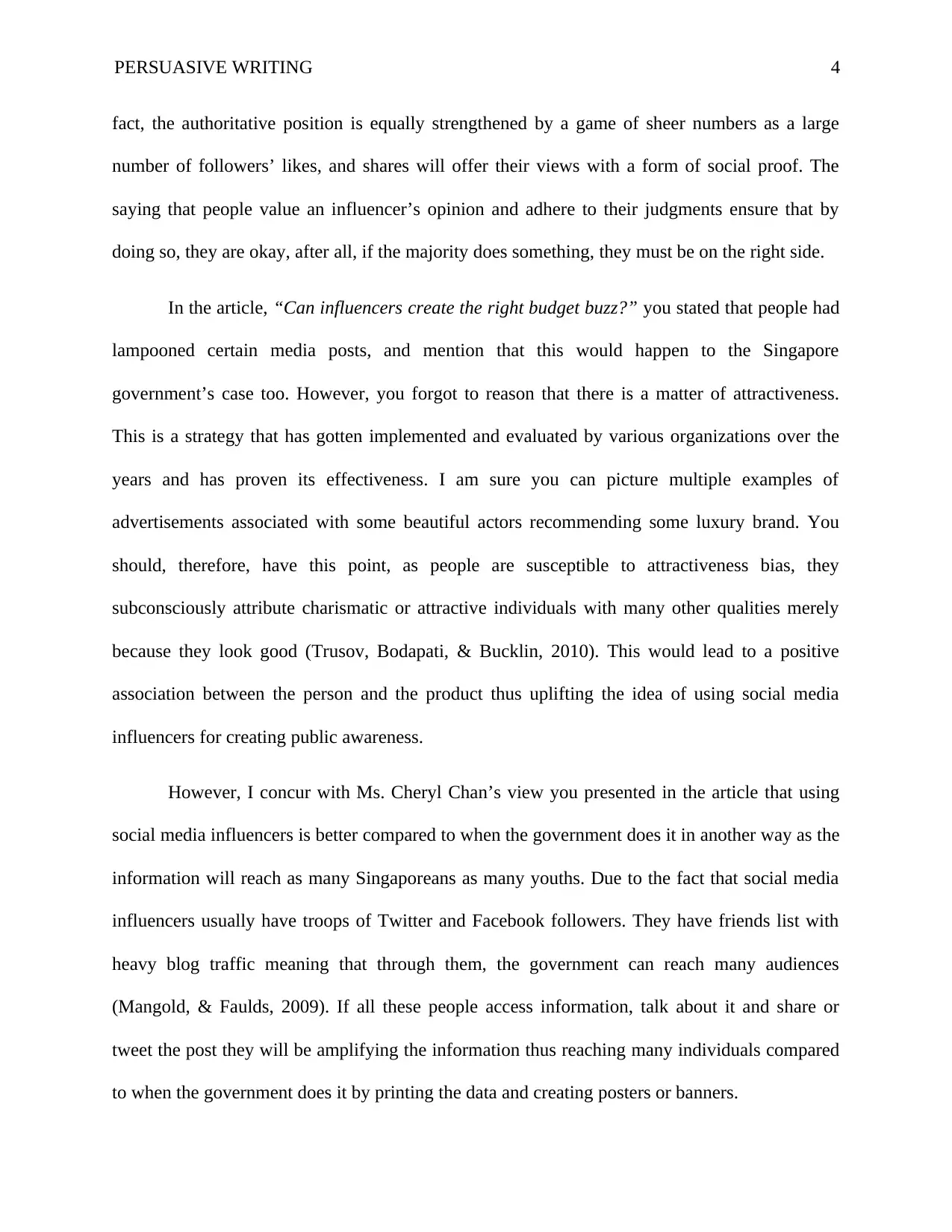
fact, the authoritative position is equally strengthened by a game of sheer numbers as a large
number of followers’ likes, and shares will offer their views with a form of social proof. The
saying that people value an influencer’s opinion and adhere to their judgments ensure that by
doing so, they are okay, after all, if the majority does something, they must be on the right side.
In the article, “Can influencers create the right budget buzz?” you stated that people had
lampooned certain media posts, and mention that this would happen to the Singapore
government’s case too. However, you forgot to reason that there is a matter of attractiveness.
This is a strategy that has gotten implemented and evaluated by various organizations over the
years and has proven its effectiveness. I am sure you can picture multiple examples of
advertisements associated with some beautiful actors recommending some luxury brand. You
should, therefore, have this point, as people are susceptible to attractiveness bias, they
subconsciously attribute charismatic or attractive individuals with many other qualities merely
because they look good (Trusov, Bodapati, & Bucklin, 2010). This would lead to a positive
association between the person and the product thus uplifting the idea of using social media
influencers for creating public awareness.
However, I concur with Ms. Cheryl Chan’s view you presented in the article that using
social media influencers is better compared to when the government does it in another way as the
information will reach as many Singaporeans as many youths. Due to the fact that social media
influencers usually have troops of Twitter and Facebook followers. They have friends list with
heavy blog traffic meaning that through them, the government can reach many audiences
(Mangold, & Faulds, 2009). If all these people access information, talk about it and share or
tweet the post they will be amplifying the information thus reaching many individuals compared
to when the government does it by printing the data and creating posters or banners.
fact, the authoritative position is equally strengthened by a game of sheer numbers as a large
number of followers’ likes, and shares will offer their views with a form of social proof. The
saying that people value an influencer’s opinion and adhere to their judgments ensure that by
doing so, they are okay, after all, if the majority does something, they must be on the right side.
In the article, “Can influencers create the right budget buzz?” you stated that people had
lampooned certain media posts, and mention that this would happen to the Singapore
government’s case too. However, you forgot to reason that there is a matter of attractiveness.
This is a strategy that has gotten implemented and evaluated by various organizations over the
years and has proven its effectiveness. I am sure you can picture multiple examples of
advertisements associated with some beautiful actors recommending some luxury brand. You
should, therefore, have this point, as people are susceptible to attractiveness bias, they
subconsciously attribute charismatic or attractive individuals with many other qualities merely
because they look good (Trusov, Bodapati, & Bucklin, 2010). This would lead to a positive
association between the person and the product thus uplifting the idea of using social media
influencers for creating public awareness.
However, I concur with Ms. Cheryl Chan’s view you presented in the article that using
social media influencers is better compared to when the government does it in another way as the
information will reach as many Singaporeans as many youths. Due to the fact that social media
influencers usually have troops of Twitter and Facebook followers. They have friends list with
heavy blog traffic meaning that through them, the government can reach many audiences
(Mangold, & Faulds, 2009). If all these people access information, talk about it and share or
tweet the post they will be amplifying the information thus reaching many individuals compared
to when the government does it by printing the data and creating posters or banners.
Paraphrase This Document
Need a fresh take? Get an instant paraphrase of this document with our AI Paraphraser

PERSUASIVE WRITING 5
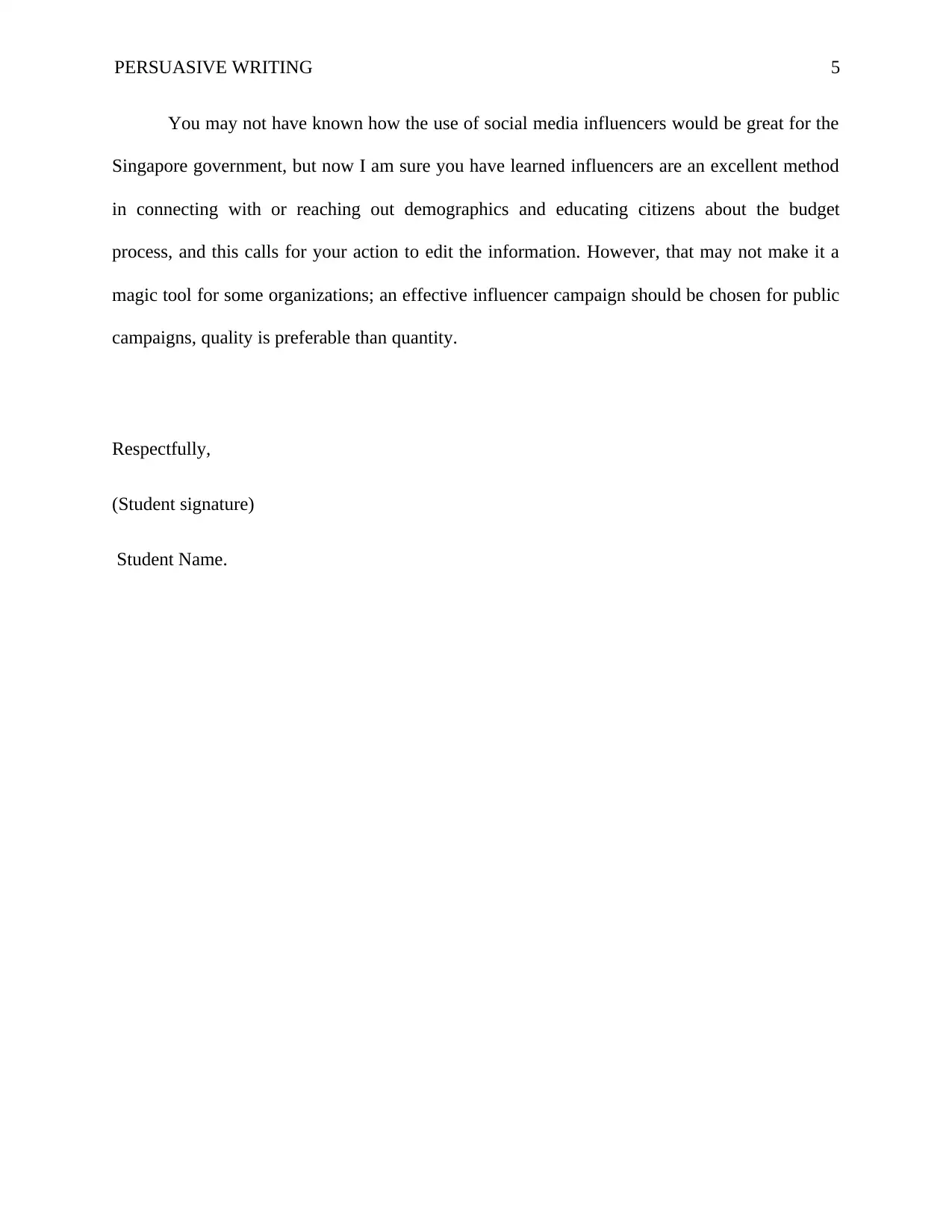
You may not have known how the use of social media influencers would be great for the
Singapore government, but now I am sure you have learned influencers are an excellent method
in connecting with or reaching out demographics and educating citizens about the budget
process, and this calls for your action to edit the information. However, that may not make it a
magic tool for some organizations; an effective influencer campaign should be chosen for public
campaigns, quality is preferable than quantity.
Respectfully,
(Student signature)
Student Name.
You may not have known how the use of social media influencers would be great for the
Singapore government, but now I am sure you have learned influencers are an excellent method
in connecting with or reaching out demographics and educating citizens about the budget
process, and this calls for your action to edit the information. However, that may not make it a
magic tool for some organizations; an effective influencer campaign should be chosen for public
campaigns, quality is preferable than quantity.
Respectfully,
(Student signature)
Student Name.

PERSUASIVE WRITING 6
References
Hartmann, P., & Apaolaza-Ibanez, V. (2010). Beyond savanna: An evolutionary and
environmental psychology approach to behavioral effects of nature scenery in green
advertising. Journal of Environmental Psychology, 30(1), 119-128.
Kietzmann, J. H., Hermkens, K., McCarthy, I. P., & Silvestre, B. S. (2011). Social media? Get
serious! Understanding the functional building blocks of social media. Business
horizons, 54(3), 241-251.
Lee, G., & Kwak, Y. H. (2012). An open government maturity model for social media-based
public engagement. Government information quarterly, 29(4), 492-503.
Mangold, W. G., & Faulds, D. J. (2009). Social media: The new hybrid element of the promotion
mix. Business horizons, 52(4), 357-365.
Mills, C. W. (2018). The power elite. In Inequality (pp. 71-86). Routledge.
Trusov, M., Bodapati, A. V., & Bucklin, R. E. (2010). Determining influential users in internet
social networks. Journal of Marketing Research, 47(4), 643-658.
References
Hartmann, P., & Apaolaza-Ibanez, V. (2010). Beyond savanna: An evolutionary and
environmental psychology approach to behavioral effects of nature scenery in green
advertising. Journal of Environmental Psychology, 30(1), 119-128.
Kietzmann, J. H., Hermkens, K., McCarthy, I. P., & Silvestre, B. S. (2011). Social media? Get
serious! Understanding the functional building blocks of social media. Business
horizons, 54(3), 241-251.
Lee, G., & Kwak, Y. H. (2012). An open government maturity model for social media-based
public engagement. Government information quarterly, 29(4), 492-503.
Mangold, W. G., & Faulds, D. J. (2009). Social media: The new hybrid element of the promotion
mix. Business horizons, 52(4), 357-365.
Mills, C. W. (2018). The power elite. In Inequality (pp. 71-86). Routledge.
Trusov, M., Bodapati, A. V., & Bucklin, R. E. (2010). Determining influential users in internet
social networks. Journal of Marketing Research, 47(4), 643-658.
⊘ This is a preview!⊘
Do you want full access?
Subscribe today to unlock all pages.

Trusted by 1+ million students worldwide
1 out of 6
Related Documents
Your All-in-One AI-Powered Toolkit for Academic Success.
+13062052269
info@desklib.com
Available 24*7 on WhatsApp / Email
Unlock your academic potential
Copyright © 2020–2025 A2Z Services. All Rights Reserved. Developed and managed by ZUCOL.