Case Study Report: Persuasive Communication in Modern Business

Verified

Added on  2023/04/21

|5
|1366
|163
Case Study
AI Summary
This case study analyzes the critical role of persuasive communication in business settings, examining its importance, characteristics, and various strategies. It delves into the core elements of persuasive communication, including ethos, logos, and pathos, providing detailed explanations of each component and their application in real-world scenarios. The study highlights how persuasive communication influences attitudes, beliefs, and actions within organizations, affecting sales, negotiations, and decision-making processes. Furthermore, it explores how businesses like Maggi, Cadbury, and Walmart utilize persuasive strategies in marketing campaigns and public relations to influence customer behavior and maintain a positive brand image. The case study concludes by emphasizing the significance of persuasive communication in achieving organizational goals and fostering effective communication among employees and customers.
Document Page
Persuasive Communication 0
Persuasive Communication
Student’s Name
tabler-icon-diamond-filled.svg

Paraphrase This Document

Need a fresh take? Get an instant paraphrase of this document with our AI Paraphraser
Document Page
Persuasive Communication 1
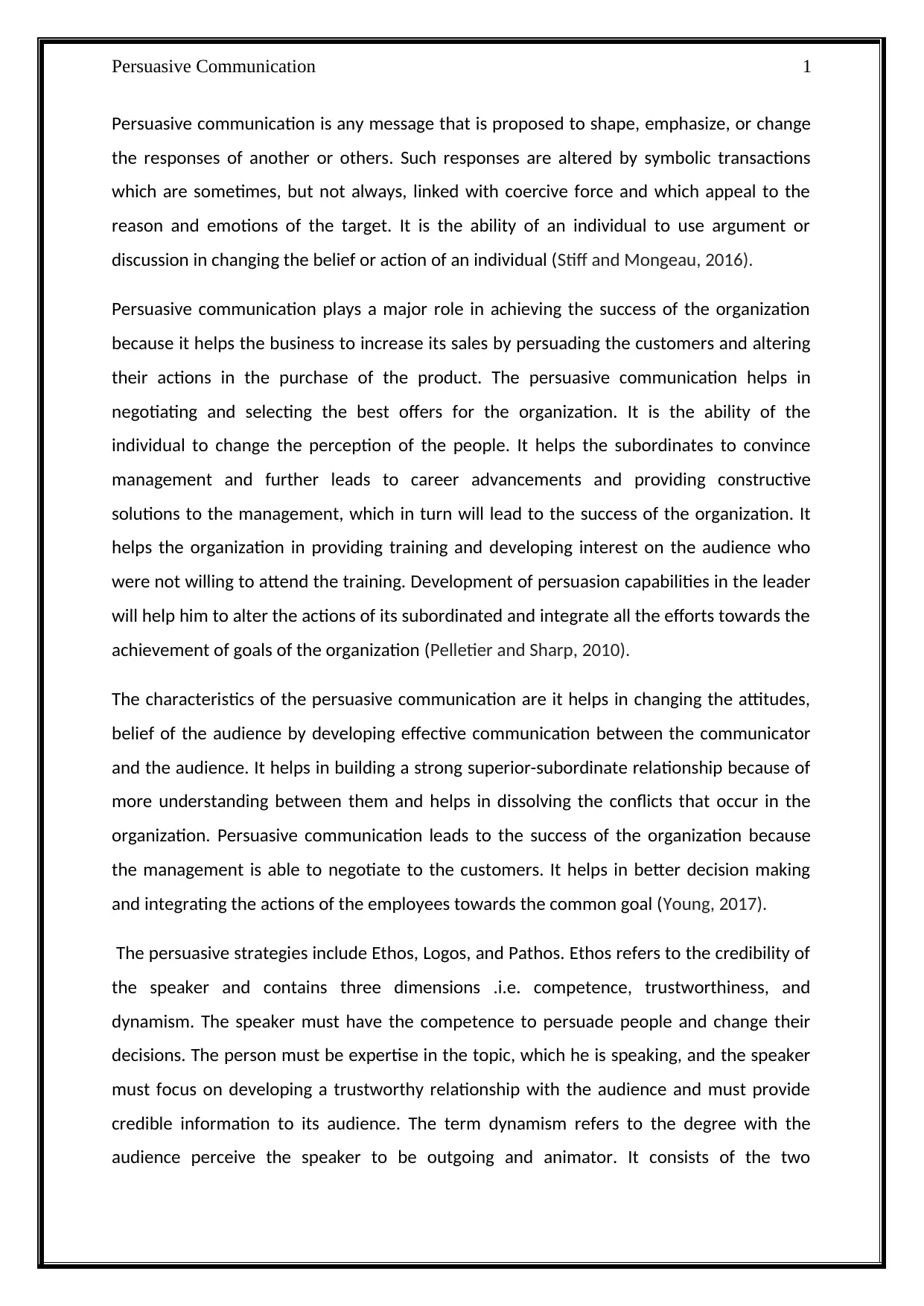
Persuasive communication is any message that is proposed to shape, emphasize, or change
the responses of another or others. Such responses are altered by symbolic transactions
which are sometimes, but not always, linked with coercive force and which appeal to the
reason and emotions of the target. It is the ability of an individual to use argument or
discussion in changing the belief or action of an individual (Stiff and Mongeau, 2016).
Persuasive communication plays a major role in achieving the success of the organization
because it helps the business to increase its sales by persuading the customers and altering
their actions in the purchase of the product. The persuasive communication helps in
negotiating and selecting the best offers for the organization. It is the ability of the
individual to change the perception of the people. It helps the subordinates to convince
management and further leads to career advancements and providing constructive
solutions to the management, which in turn will lead to the success of the organization. It
helps the organization in providing training and developing interest on the audience who
were not willing to attend the training. Development of persuasion capabilities in the leader
will help him to alter the actions of its subordinated and integrate all the efforts towards the
achievement of goals of the organization (Pelletier and Sharp, 2010).
The characteristics of the persuasive communication are it helps in changing the attitudes,
belief of the audience by developing effective communication between the communicator
and the audience. It helps in building a strong superior-subordinate relationship because of
more understanding between them and helps in dissolving the conflicts that occur in the
organization. Persuasive communication leads to the success of the organization because
the management is able to negotiate to the customers. It helps in better decision making
and integrating the actions of the employees towards the common goal (Young, 2017).
The persuasive strategies include Ethos, Logos, and Pathos. Ethos refers to the credibility of
the speaker and contains three dimensions .i.e. competence, trustworthiness, and
dynamism. The speaker must have the competence to persuade people and change their
decisions. The person must be expertise in the topic, which he is speaking, and the speaker
must focus on developing a trustworthy relationship with the audience and must provide
credible information to its audience. The term dynamism refers to the degree with the
audience perceive the speaker to be outgoing and animator. It consists of the two
Document Page
Persuasive Communication 2
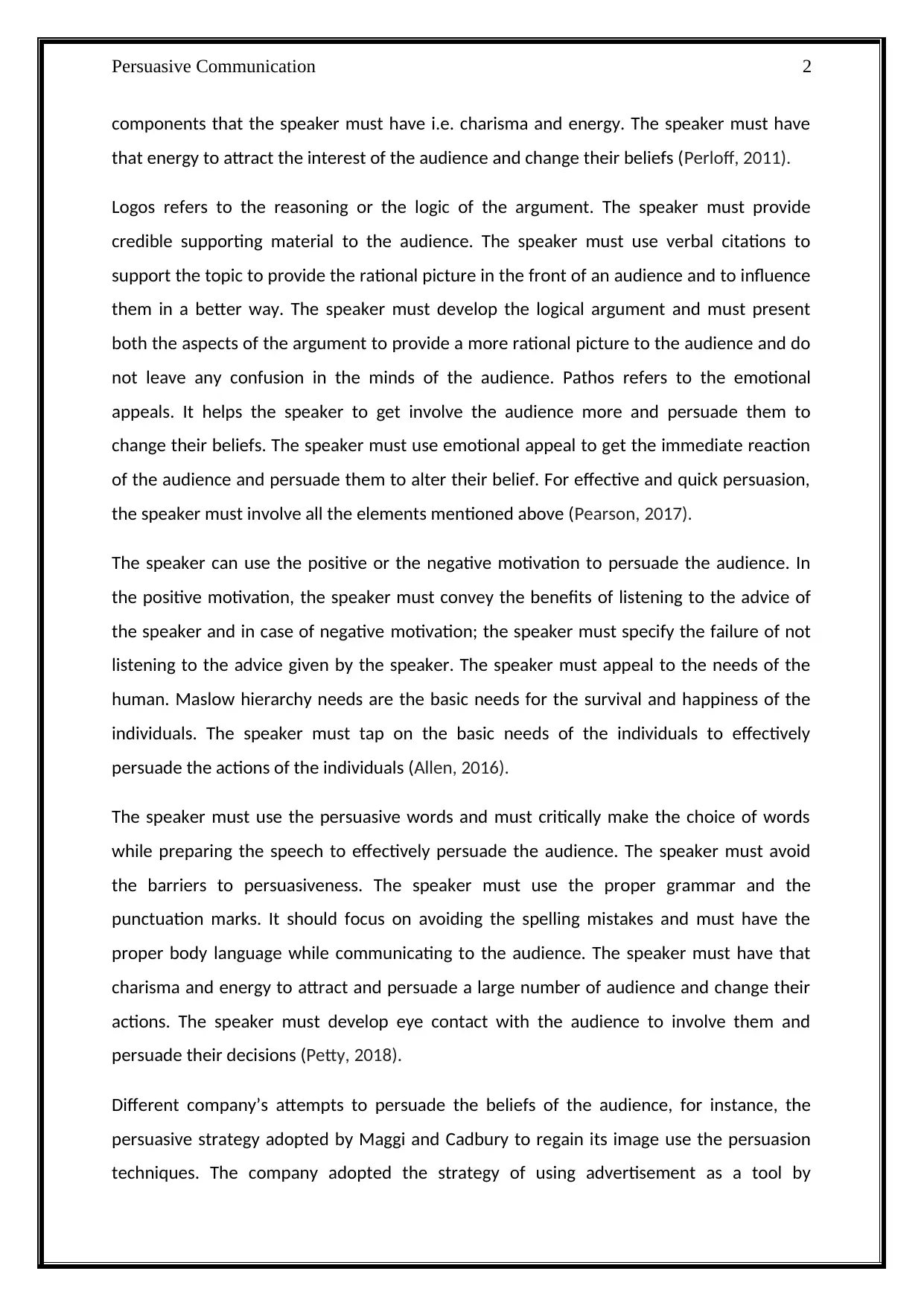
components that the speaker must have i.e. charisma and energy. The speaker must have
that energy to attract the interest of the audience and change their beliefs (Perloff, 2011).
Logos refers to the reasoning or the logic of the argument. The speaker must provide
credible supporting material to the audience. The speaker must use verbal citations to
support the topic to provide the rational picture in the front of an audience and to influence
them in a better way. The speaker must develop the logical argument and must present
both the aspects of the argument to provide a more rational picture to the audience and do
not leave any confusion in the minds of the audience. Pathos refers to the emotional
appeals. It helps the speaker to get involve the audience more and persuade them to
change their beliefs. The speaker must use emotional appeal to get the immediate reaction
of the audience and persuade them to alter their belief. For effective and quick persuasion,
the speaker must involve all the elements mentioned above (Pearson, 2017).
The speaker can use the positive or the negative motivation to persuade the audience. In
the positive motivation, the speaker must convey the benefits of listening to the advice of
the speaker and in case of negative motivation; the speaker must specify the failure of not
listening to the advice given by the speaker. The speaker must appeal to the needs of the
human. Maslow hierarchy needs are the basic needs for the survival and happiness of the
individuals. The speaker must tap on the basic needs of the individuals to effectively
persuade the actions of the individuals (Allen, 2016).
The speaker must use the persuasive words and must critically make the choice of words
while preparing the speech to effectively persuade the audience. The speaker must avoid
the barriers to persuasiveness. The speaker must use the proper grammar and the
punctuation marks. It should focus on avoiding the spelling mistakes and must have the
proper body language while communicating to the audience. The speaker must have that
charisma and energy to attract and persuade a large number of audience and change their
actions. The speaker must develop eye contact with the audience to involve them and
persuade their decisions (Petty, 2018).
Different company’s attempts to persuade the beliefs of the audience, for instance, the
persuasive strategy adopted by Maggi and Cadbury to regain its image use the persuasion
techniques. The company adopted the strategy of using advertisement as a tool by
Document Page
Persuasive Communication 3
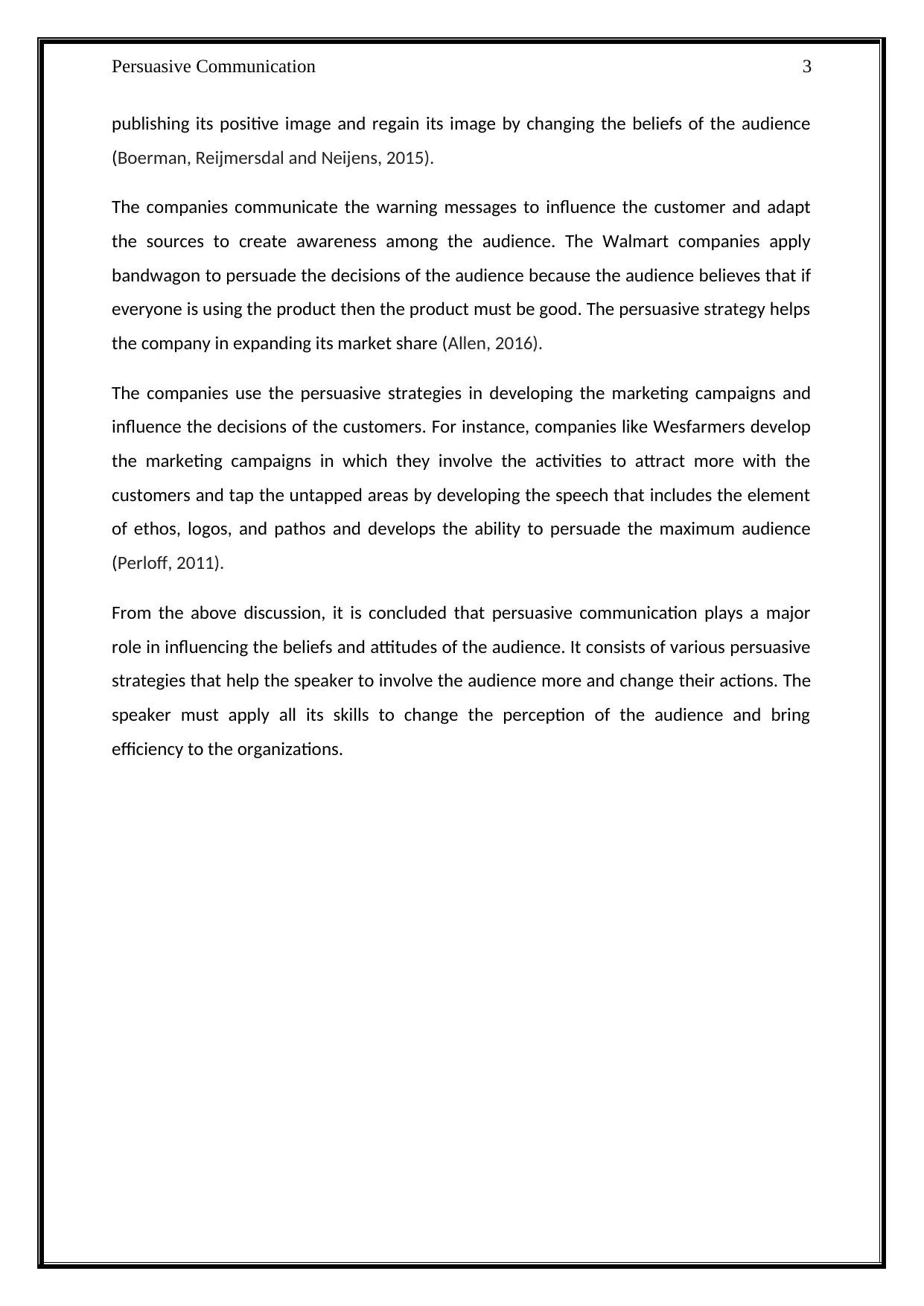
publishing its positive image and regain its image by changing the beliefs of the audience
(Boerman, Reijmersdal and Neijens, 2015).
The companies communicate the warning messages to influence the customer and adapt
the sources to create awareness among the audience. The Walmart companies apply
bandwagon to persuade the decisions of the audience because the audience believes that if
everyone is using the product then the product must be good. The persuasive strategy helps
the company in expanding its market share (Allen, 2016).
The companies use the persuasive strategies in developing the marketing campaigns and
influence the decisions of the customers. For instance, companies like Wesfarmers develop
the marketing campaigns in which they involve the activities to attract more with the
customers and tap the untapped areas by developing the speech that includes the element
of ethos, logos, and pathos and develops the ability to persuade the maximum audience
(Perloff, 2011).
From the above discussion, it is concluded that persuasive communication plays a major
role in influencing the beliefs and attitudes of the audience. It consists of various persuasive
strategies that help the speaker to involve the audience more and change their actions. The
speaker must apply all its skills to change the perception of the audience and bring
efficiency to the organizations.
tabler-icon-diamond-filled.svg

Paraphrase This Document

Need a fresh take? Get an instant paraphrase of this document with our AI Paraphraser
Document Page
Persuasive Communication 4
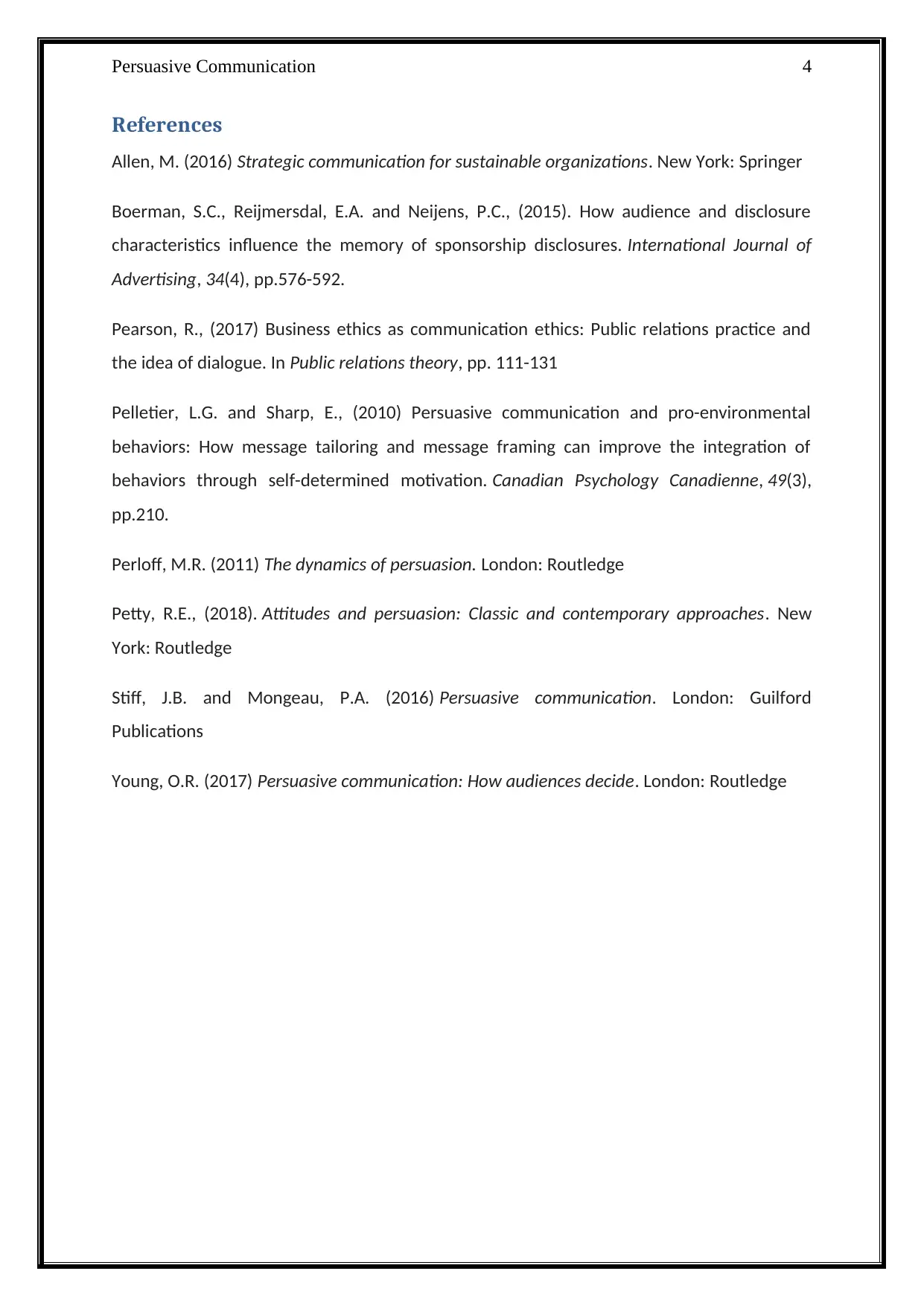
References
Allen, M. (2016) Strategic communication for sustainable organizations. New York: Springer
Boerman, S.C., Reijmersdal, E.A. and Neijens, P.C., (2015). How audience and disclosure
characteristics influence the memory of sponsorship disclosures. International Journal of
Advertising, 34(4), pp.576-592.
Pearson, R., (2017) Business ethics as communication ethics: Public relations practice and
the idea of dialogue. In Public relations theory, pp. 111-131
Pelletier, L.G. and Sharp, E., (2010) Persuasive communication and pro-environmental
behaviors: How message tailoring and message framing can improve the integration of
behaviors through self-determined motivation. Canadian Psychology Canadienne, 49(3),
pp.210.
Perloff, M.R. (2011) The dynamics of persuasion. London: Routledge
Petty, R.E., (2018). Attitudes and persuasion: Classic and contemporary approaches. New
York: Routledge
Stiff, J.B. and Mongeau, P.A. (2016) Persuasive communication. London: Guilford
Publications
Young, O.R. (2017) Persuasive communication: How audiences decide. London: Routledge
chevron_up_icon
1 out of 5
circle_padding
hide_on_mobile
zoom_out_icon
[object Object]