Petro China: Financial Performance and Global Crisis Impact
VerifiedAdded on 2021/04/17
|20
|4339
|59
Report
AI Summary
This report presents a comprehensive financial analysis of Petro China, examining its performance through various profitability, liquidity, and solvency ratios. The analysis reveals concerning trends in the company's financial health, with declining ratios in several key areas. The report further emphasizes the importance of external auditing, highlighting the role of KPMG Huazhen LLP in ensuring accurate financial reporting and compliance. The final section delves into the impact of the 2007/2008 global financial crisis on multinational companies like Petro China, discussing the lessons learned from the crisis and their implications for the company's future strategies. The report concludes with an overview of the financial challenges faced by Petro China and the significance of external audits in maintaining financial integrity.
Running head: PETRO CHINA
PETRO CHINA
Name of the Student
Name of the University
Author Note
PETRO CHINA
Name of the Student
Name of the University
Author Note

Paraphrase This Document
Need a fresh take? Get an instant paraphrase of this document with our AI Paraphraser
1PETRO CHINA
Executive Summary
The given report has been made and addressed to the non-financial directors of the
firm-Petro China. The report has been divided into three parts whereby each part
discusses different aspects of financial issues. The first part of the report reflects on the
performance of the firm and it could be seen that the company has not been performing
well. The second part of the report had analysed the importance of the external auditing
and it was found that external auditing forms an essential part of a firm and that Petro
China hired KPMG to do so. The last part of the report concentrates on the global
financial crisis and its impact on various companies like Petro China.
Executive Summary
The given report has been made and addressed to the non-financial directors of the
firm-Petro China. The report has been divided into three parts whereby each part
discusses different aspects of financial issues. The first part of the report reflects on the
performance of the firm and it could be seen that the company has not been performing
well. The second part of the report had analysed the importance of the external auditing
and it was found that external auditing forms an essential part of a firm and that Petro
China hired KPMG to do so. The last part of the report concentrates on the global
financial crisis and its impact on various companies like Petro China.
2PETRO CHINA
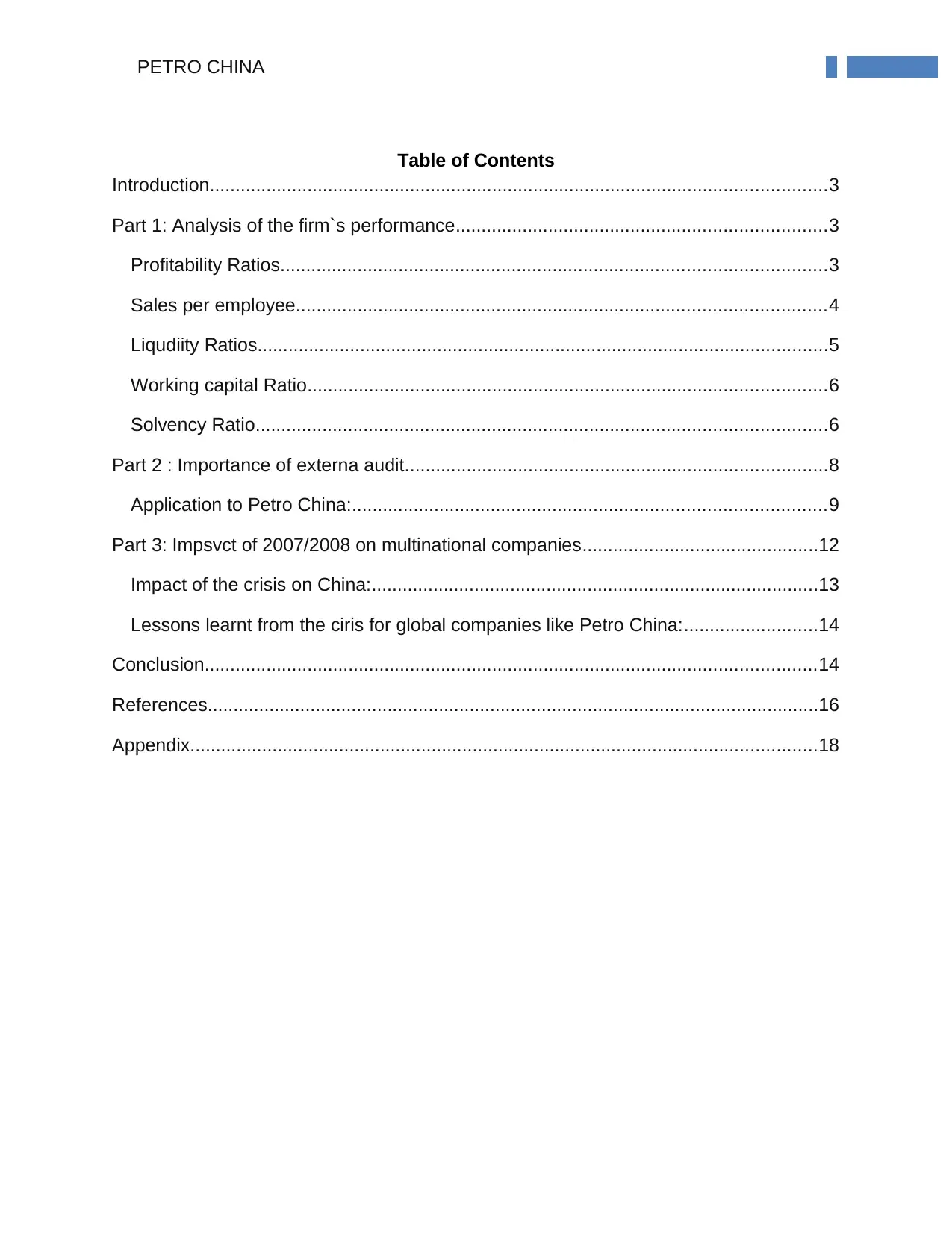
Table of Contents
Introduction........................................................................................................................3
Part 1: Analysis of the firm`s performance........................................................................3
Profitability Ratios..........................................................................................................3
Sales per employee.......................................................................................................4
Liqudiity Ratios...............................................................................................................5
Working capital Ratio.....................................................................................................6
Solvency Ratio...............................................................................................................6
Part 2 : Importance of externa audit..................................................................................8
Application to Petro China:............................................................................................9
Part 3: Impsvct of 2007/2008 on multinational companies..............................................12
Impact of the crisis on China:.......................................................................................13
Lessons learnt from the ciris for global companies like Petro China:..........................14
Conclusion.......................................................................................................................14
References.......................................................................................................................16
Appendix..........................................................................................................................18
Table of Contents
Introduction........................................................................................................................3
Part 1: Analysis of the firm`s performance........................................................................3
Profitability Ratios..........................................................................................................3
Sales per employee.......................................................................................................4
Liqudiity Ratios...............................................................................................................5
Working capital Ratio.....................................................................................................6
Solvency Ratio...............................................................................................................6
Part 2 : Importance of externa audit..................................................................................8
Application to Petro China:............................................................................................9
Part 3: Impsvct of 2007/2008 on multinational companies..............................................12
Impact of the crisis on China:.......................................................................................13
Lessons learnt from the ciris for global companies like Petro China:..........................14
Conclusion.......................................................................................................................14
References.......................................................................................................................16
Appendix..........................................................................................................................18
⊘ This is a preview!⊘
Do you want full access?
Subscribe today to unlock all pages.

Trusted by 1+ million students worldwide
3PETRO CHINA
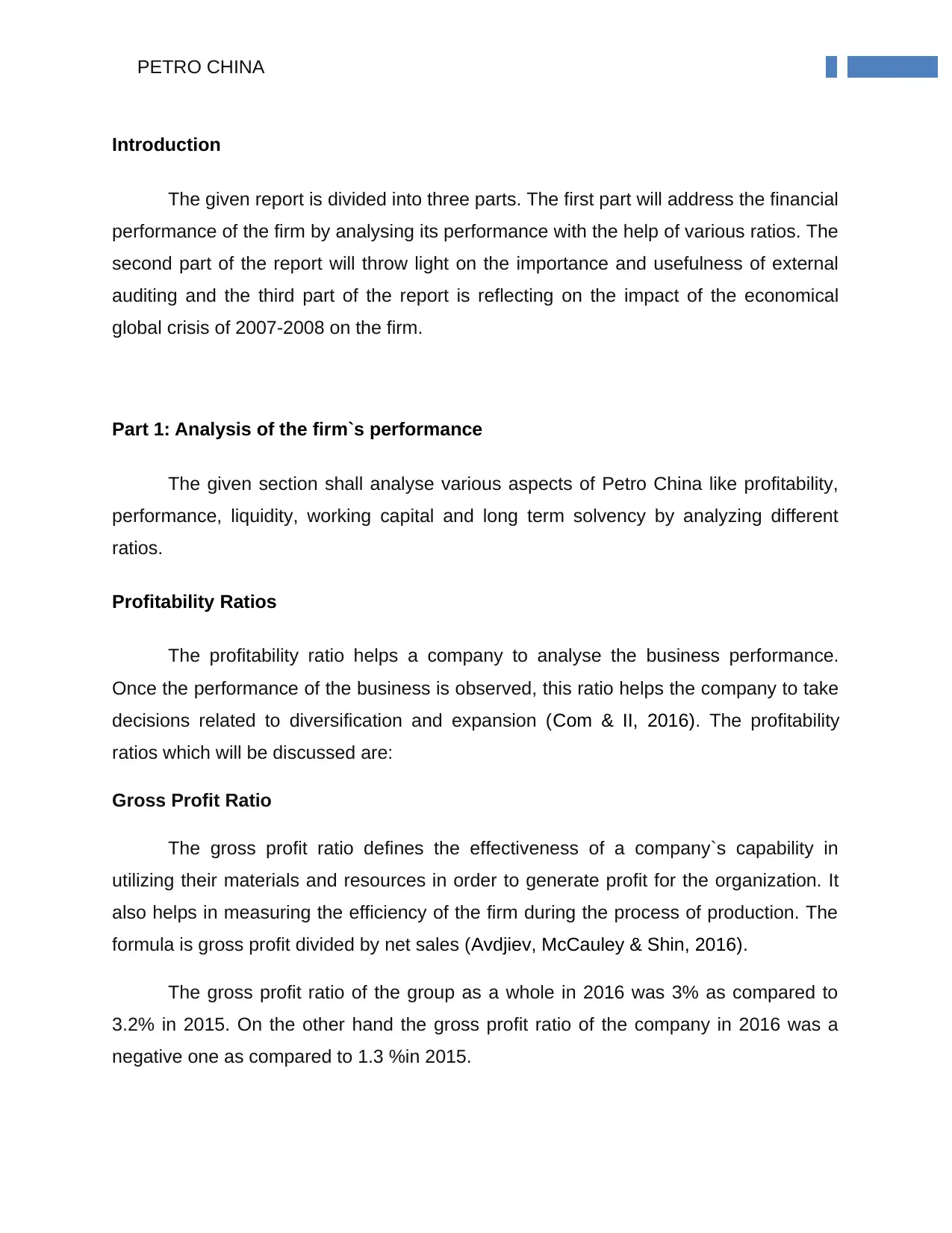
Introduction
The given report is divided into three parts. The first part will address the financial
performance of the firm by analysing its performance with the help of various ratios. The
second part of the report will throw light on the importance and usefulness of external
auditing and the third part of the report is reflecting on the impact of the economical
global crisis of 2007-2008 on the firm.
Part 1: Analysis of the firm`s performance
The given section shall analyse various aspects of Petro China like profitability,
performance, liquidity, working capital and long term solvency by analyzing different
ratios.
Profitability Ratios
The profitability ratio helps a company to analyse the business performance.
Once the performance of the business is observed, this ratio helps the company to take
decisions related to diversification and expansion (Com & II, 2016). The profitability
ratios which will be discussed are:
Gross Profit Ratio
The gross profit ratio defines the effectiveness of a company`s capability in
utilizing their materials and resources in order to generate profit for the organization. It
also helps in measuring the efficiency of the firm during the process of production. The
formula is gross profit divided by net sales (Avdjiev, McCauley & Shin, 2016).
The gross profit ratio of the group as a whole in 2016 was 3% as compared to
3.2% in 2015. On the other hand the gross profit ratio of the company in 2016 was a
negative one as compared to 1.3 %in 2015.
Introduction
The given report is divided into three parts. The first part will address the financial
performance of the firm by analysing its performance with the help of various ratios. The
second part of the report will throw light on the importance and usefulness of external
auditing and the third part of the report is reflecting on the impact of the economical
global crisis of 2007-2008 on the firm.
Part 1: Analysis of the firm`s performance
The given section shall analyse various aspects of Petro China like profitability,
performance, liquidity, working capital and long term solvency by analyzing different
ratios.
Profitability Ratios
The profitability ratio helps a company to analyse the business performance.
Once the performance of the business is observed, this ratio helps the company to take
decisions related to diversification and expansion (Com & II, 2016). The profitability
ratios which will be discussed are:
Gross Profit Ratio
The gross profit ratio defines the effectiveness of a company`s capability in
utilizing their materials and resources in order to generate profit for the organization. It
also helps in measuring the efficiency of the firm during the process of production. The
formula is gross profit divided by net sales (Avdjiev, McCauley & Shin, 2016).
The gross profit ratio of the group as a whole in 2016 was 3% as compared to
3.2% in 2015. On the other hand the gross profit ratio of the company in 2016 was a
negative one as compared to 1.3 %in 2015.
Paraphrase This Document
Need a fresh take? Get an instant paraphrase of this document with our AI Paraphraser
4PETRO CHINA
It can be stated that the company has not been performing relatively well. It is
less cost effective.
Net Profit Ratio
The Net Profit Ratio of the firm determines the amount of money which is left
from each sale after all the expenses have been given away. A higher net profit ratio
indicates that the business is quite efficient (Petrochina.com, 2018).
The net profit ratio of the group in 2016 was 1.8% as compared to 2.4%of 2015.
This means that the performance of the firm has dropped since the last year. On the
other hand the performance of the company in 2016 has been in negative of -0.015 as
compared to 0.019 in 2015.
The company has not being performing well.
Performance Ratios
The performance ratios are meant to measure the various aspects of the
company`s operations. It refers to the efficient use of an organization`s resources in
order to generate revenue for the firm (Bech, Gambacorta & Kharroubi, 2014). Two
primary Performance Ratios will be discussed in the given case:
Fixed asset turnover
The given ratio compares the revenue of the firm to its fixed assets. When the
given ratio is high it indicates that the firm has a small asset base with a large sales
income (Schoenmaker, 2017). This formula is the net sales divided by the net fixed
assets.
The fixed asset turn over for the group in 2016 is 2.4 as compared to 2.5 in 2015.
The ratio has fallen down since the last year. For the company, the fixed asset turnover
is 2.9 as compared to 3.04 in 2015. It can be stated that the company has been
performing well in the given case.
Sales per employee
It can be stated that the company has not been performing relatively well. It is
less cost effective.
Net Profit Ratio
The Net Profit Ratio of the firm determines the amount of money which is left
from each sale after all the expenses have been given away. A higher net profit ratio
indicates that the business is quite efficient (Petrochina.com, 2018).
The net profit ratio of the group in 2016 was 1.8% as compared to 2.4%of 2015.
This means that the performance of the firm has dropped since the last year. On the
other hand the performance of the company in 2016 has been in negative of -0.015 as
compared to 0.019 in 2015.
The company has not being performing well.
Performance Ratios
The performance ratios are meant to measure the various aspects of the
company`s operations. It refers to the efficient use of an organization`s resources in
order to generate revenue for the firm (Bech, Gambacorta & Kharroubi, 2014). Two
primary Performance Ratios will be discussed in the given case:
Fixed asset turnover
The given ratio compares the revenue of the firm to its fixed assets. When the
given ratio is high it indicates that the firm has a small asset base with a large sales
income (Schoenmaker, 2017). This formula is the net sales divided by the net fixed
assets.
The fixed asset turn over for the group in 2016 is 2.4 as compared to 2.5 in 2015.
The ratio has fallen down since the last year. For the company, the fixed asset turnover
is 2.9 as compared to 3.04 in 2015. It can be stated that the company has been
performing well in the given case.
Sales per employee
5PETRO CHINA
The given ratio makes an estimate about the revenues of the firm as compared
to its employees. A high ratio in the given case indicates large amount of sales with
fewer employees (Titman, Keown & Martin, 2017). The formula for the given ratio is net
sales divided by the total employees who work permanently for the firm.
The ratio for Petro China could be taken out only for 2016 and for the group due
to limited information. The ratio is 3.178 which indicate a good scenario for the firm.
Liquidity Ratios
The liquidity ratio of the firm decides the convenience of a firm to convert its
assets into cash or generate enough cash for the firm. Various assets like the accounts
receivable, securities and inventory are easy to convert in the short term and hence
they go in the calculation of the given ratios (Esty, 2014). The following ratios have been
discussed in the given scenario:
Current Ratio
The current ratio is calculated by dividing the current assets of the firm b the
current liabilities. If the given ratio is high in number then the firm has a greater
amount of assets as compared to its liabilities. This shall enable them firm to pay off
its debts easily.
The current ratio for the Petro China group is 0.764 in 2016 whereas the ratio was 1.1
in 2015. For the company, the given ratio was 0.73 in 2016 as compared to 0.8 in
2015 (Van den Berg, 2016). Hence, it can be stated that the company does not have
the capability to pay off the liabilities at present.
Quick Ratio
The quick ratio which is often known as the acid test ratio is considered to be
stricter in calculation as compared to the current ratio. It uses the most liquid able
assets in its numerators. The inventory aspect is not taken in the calculation of the given
ratio. The given ratio is more conservative than the current ratio.
The given ratio makes an estimate about the revenues of the firm as compared
to its employees. A high ratio in the given case indicates large amount of sales with
fewer employees (Titman, Keown & Martin, 2017). The formula for the given ratio is net
sales divided by the total employees who work permanently for the firm.
The ratio for Petro China could be taken out only for 2016 and for the group due
to limited information. The ratio is 3.178 which indicate a good scenario for the firm.
Liquidity Ratios
The liquidity ratio of the firm decides the convenience of a firm to convert its
assets into cash or generate enough cash for the firm. Various assets like the accounts
receivable, securities and inventory are easy to convert in the short term and hence
they go in the calculation of the given ratios (Esty, 2014). The following ratios have been
discussed in the given scenario:
Current Ratio
The current ratio is calculated by dividing the current assets of the firm b the
current liabilities. If the given ratio is high in number then the firm has a greater
amount of assets as compared to its liabilities. This shall enable them firm to pay off
its debts easily.
The current ratio for the Petro China group is 0.764 in 2016 whereas the ratio was 1.1
in 2015. For the company, the given ratio was 0.73 in 2016 as compared to 0.8 in
2015 (Van den Berg, 2016). Hence, it can be stated that the company does not have
the capability to pay off the liabilities at present.
Quick Ratio
The quick ratio which is often known as the acid test ratio is considered to be
stricter in calculation as compared to the current ratio. It uses the most liquid able
assets in its numerators. The inventory aspect is not taken in the calculation of the given
ratio. The given ratio is more conservative than the current ratio.
⊘ This is a preview!⊘
Do you want full access?
Subscribe today to unlock all pages.
Trusted by 1+ million students worldwide
6PETRO CHINA
Group has a quick ratio of 0.47 in 2016 as compared to 0.47 in 2015. This
reflects that the ratio has not changed. For the company, the ratio has dropped to 0.42
in 2016 as compared to 0.58 in 2015.
Overall, the given ratio for Petro China is quite low.
Cash Ratio
The cash ratio is even more conservative than the other liquidity ratios. The given
ratio just considers cash and its equivalents compared to current liabilities (Bodea &
Hicks, 2014).
For Petro China, the cash ratio for the group is 0.19 in 2016 as compared to
0.15 in 2015. For the firm, the ratio is a low rate of 0.04 in 2016 as compared to 0.03
in 2015. Although the ratio has improved from 2015, the ratio is still not up to the
industry standard.
Working capital Ratio
The working capital ratio is very similar to the current ratio of the firm. The
working capital ratio of less than 1.0 is not considered to be adequate for the firm. A
ratio above 2 is taken to be good for the firm.
For Petro China the given ratio is less than one in a range of 0.75-0.8 for the
given two years.
Solvency Ratio
The solvency ratio is measured as the enterprises capability of the firm to meet
the debts and various other obligations with reference to the long term and short term
liabilities (Chițu, Eichengreen & Mehl, 2013). The lower ratio of the firm is indicative of
its default to perform the debt obligations of the firm. The formula is calculated by
dividing the net income and depreciation of the firm by the short term as well as the long
term liabilities.The company`s solvency ratio in 2015is 0.29 as compared to the ratio of
0.36 in 2016.
Group has a quick ratio of 0.47 in 2016 as compared to 0.47 in 2015. This
reflects that the ratio has not changed. For the company, the ratio has dropped to 0.42
in 2016 as compared to 0.58 in 2015.
Overall, the given ratio for Petro China is quite low.
Cash Ratio
The cash ratio is even more conservative than the other liquidity ratios. The given
ratio just considers cash and its equivalents compared to current liabilities (Bodea &
Hicks, 2014).
For Petro China, the cash ratio for the group is 0.19 in 2016 as compared to
0.15 in 2015. For the firm, the ratio is a low rate of 0.04 in 2016 as compared to 0.03
in 2015. Although the ratio has improved from 2015, the ratio is still not up to the
industry standard.
Working capital Ratio
The working capital ratio is very similar to the current ratio of the firm. The
working capital ratio of less than 1.0 is not considered to be adequate for the firm. A
ratio above 2 is taken to be good for the firm.
For Petro China the given ratio is less than one in a range of 0.75-0.8 for the
given two years.
Solvency Ratio
The solvency ratio is measured as the enterprises capability of the firm to meet
the debts and various other obligations with reference to the long term and short term
liabilities (Chițu, Eichengreen & Mehl, 2013). The lower ratio of the firm is indicative of
its default to perform the debt obligations of the firm. The formula is calculated by
dividing the net income and depreciation of the firm by the short term as well as the long
term liabilities.The company`s solvency ratio in 2015is 0.29 as compared to the ratio of
0.36 in 2016.
Paraphrase This Document
Need a fresh take? Get an instant paraphrase of this document with our AI Paraphraser

7PETRO CHINA
Refer to the Appendix for calculations.
Refer to the Appendix for calculations.
8PETRO CHINA
Part 2: Importance of external audit.
An external audit can be described as a periodic auditing or reviewing of the
books of accounts undertaken by a qualified auditor who belongs to the external
environment and works independently. The primary purpose of this kind of an audit is to
ensure whether the accounting system of the business is accurate and up to date. The
reason why external audit is an important part of assurance and confidence are given
below:
It ensures compliance
The external auditing helps in determining whether all compliances have been
met with sufficiently. Accounting laws, standards and policies need to be followed at all
times and it has to be ensured that a business is conducting its operations legally
(Michael, Arthur & David, 2016). Therefore, as an external auditor is not a member of
the organization, they will be able to redirect the working of the company without any
threat of repercussions of future circumstances (Petrochina.com, 2018). It is usually
easier for an external auditor to understand minor problems and solve them easily
Provides Credibility
A review by an external auditor increases the creditability of the business
operations as the financial statements go under an external review who certifies the
accuracy of them. Creditability provides assurance to the owners of the business
regarding the honesty of the management and helps them in gaining confidence in them
(Haas & Lelyveld, 2014).
Provides critical analysis of internal processes.
The internal audit cannot undertake the auditing of the internal processes in an
accurate manner as they are the members of the organization. On the other hand, the
external auditors have the capability of observing the books of the accounts from the
Part 2: Importance of external audit.
An external audit can be described as a periodic auditing or reviewing of the
books of accounts undertaken by a qualified auditor who belongs to the external
environment and works independently. The primary purpose of this kind of an audit is to
ensure whether the accounting system of the business is accurate and up to date. The
reason why external audit is an important part of assurance and confidence are given
below:
It ensures compliance
The external auditing helps in determining whether all compliances have been
met with sufficiently. Accounting laws, standards and policies need to be followed at all
times and it has to be ensured that a business is conducting its operations legally
(Michael, Arthur & David, 2016). Therefore, as an external auditor is not a member of
the organization, they will be able to redirect the working of the company without any
threat of repercussions of future circumstances (Petrochina.com, 2018). It is usually
easier for an external auditor to understand minor problems and solve them easily
Provides Credibility
A review by an external auditor increases the creditability of the business
operations as the financial statements go under an external review who certifies the
accuracy of them. Creditability provides assurance to the owners of the business
regarding the honesty of the management and helps them in gaining confidence in them
(Haas & Lelyveld, 2014).
Provides critical analysis of internal processes.
The internal audit cannot undertake the auditing of the internal processes in an
accurate manner as they are the members of the organization. On the other hand, the
external auditors have the capability of observing the books of the accounts from the
⊘ This is a preview!⊘
Do you want full access?
Subscribe today to unlock all pages.
Trusted by 1+ million students worldwide
9PETRO CHINA
outside perspective and this can cause a better analysis of the results. He will also be
able to advise the company as to how the waste must be reduced and how to
implement accounting practices in the firm effectively (Claessens & Kodres, 2014).
Re-check the internal audit
The internal auditors often perform their duties well but since they are extremely
close to the business they tend to lack the accounting experience to audit the financial
statements of the firm (Bénétrix, Lane & Shambaugh, 2015). The external auditors will
be looking at the internal as well as the external factors in order to ensure that the work
done is accurate and double checked. It ensures that the owners have enough
confidence in the accuracy of the business and that they are assured that the business
has been functioning properly.
Helps in identification of weaknesses in the internal control of the business.
The review of the internal control helps in analysing the various paperwork trails
of the financial statements and systems which are used to document the various
transactions. It also checks upon the responsibility of the business finance manager and
helps in ensuring that the manager has been performing his task effectively.
Provides unbiased and expert recommendations
The external auditors are trained specifically in order to ensure that the focus is
on the improvement of the various processes of the business and the risk is reduced of
any misinterpretation (Deegan, 2013). He is not concerned about the dislikes and likes
of the business enterprise such as the aversion towards changes or the favourite
employees of the organization. The only purpose of n external auditor is to ensure that
the firm improves greatly.
Once the external auditors clear the case and state that all the books of accounts
are accurate it helps in providing confidence to both the employees as well as the
owners regarding their work (Scott, 2015).
Application to Petro China:
outside perspective and this can cause a better analysis of the results. He will also be
able to advise the company as to how the waste must be reduced and how to
implement accounting practices in the firm effectively (Claessens & Kodres, 2014).
Re-check the internal audit
The internal auditors often perform their duties well but since they are extremely
close to the business they tend to lack the accounting experience to audit the financial
statements of the firm (Bénétrix, Lane & Shambaugh, 2015). The external auditors will
be looking at the internal as well as the external factors in order to ensure that the work
done is accurate and double checked. It ensures that the owners have enough
confidence in the accuracy of the business and that they are assured that the business
has been functioning properly.
Helps in identification of weaknesses in the internal control of the business.
The review of the internal control helps in analysing the various paperwork trails
of the financial statements and systems which are used to document the various
transactions. It also checks upon the responsibility of the business finance manager and
helps in ensuring that the manager has been performing his task effectively.
Provides unbiased and expert recommendations
The external auditors are trained specifically in order to ensure that the focus is
on the improvement of the various processes of the business and the risk is reduced of
any misinterpretation (Deegan, 2013). He is not concerned about the dislikes and likes
of the business enterprise such as the aversion towards changes or the favourite
employees of the organization. The only purpose of n external auditor is to ensure that
the firm improves greatly.
Once the external auditors clear the case and state that all the books of accounts
are accurate it helps in providing confidence to both the employees as well as the
owners regarding their work (Scott, 2015).
Application to Petro China:
Paraphrase This Document
Need a fresh take? Get an instant paraphrase of this document with our AI Paraphraser
10PETRO CHINA
The company had hired an external auditing company KPMG Huazhen LLP.
Although an auditing company had been set up for the company, the management felt
that there is a need to hire external auditors in order to ensure that all the policies have
been met with accordingly and that the firm has a clear image in the given field.
The external auditors belonged to both international as well as the domestic
domain thereby seeing to it that all the aspects of the firm has been covered adequately
covered (Williams, 2014).
The company was also advised to improve its internal control testing and
identification of the risk. They also advised the company to strengthen the internal
control training and also provide enough support to the team members to ensure that
the accountability process is accurate and supervision of the employees is sufficient.
According to their analysis the following could be understood:
They had analysed the documents like the consolidated balance sheets, the
income statements, the consolidated company statements and the statements
representing shareholder`s equity.
According to them the financial statements of the company are very fair with
respect to all material aspects (Schaltegger & Burritt, 2017).
Their various financial statements have been presented with accordance to the
requirements of Accounting Standards for Business Enterprises issued by the
Ministry of Finance of the People’s Republic of China.
Their auditing procedure was conducted in accordance with China Standards on
Auditing for Certified Public Accountants.
Therefore, as observed, the company has made it a point to conduct the auditing
procedure internally as well as externally (May, 2013). This ensured that all the
accounting records were recorded adequately and not transparency existed in the
books of the accounts. The external auditors were hired in order to ensure that the
recordings had been done in accordance with the accounting board standards.
The company had hired an external auditing company KPMG Huazhen LLP.
Although an auditing company had been set up for the company, the management felt
that there is a need to hire external auditors in order to ensure that all the policies have
been met with accordingly and that the firm has a clear image in the given field.
The external auditors belonged to both international as well as the domestic
domain thereby seeing to it that all the aspects of the firm has been covered adequately
covered (Williams, 2014).
The company was also advised to improve its internal control testing and
identification of the risk. They also advised the company to strengthen the internal
control training and also provide enough support to the team members to ensure that
the accountability process is accurate and supervision of the employees is sufficient.
According to their analysis the following could be understood:
They had analysed the documents like the consolidated balance sheets, the
income statements, the consolidated company statements and the statements
representing shareholder`s equity.
According to them the financial statements of the company are very fair with
respect to all material aspects (Schaltegger & Burritt, 2017).
Their various financial statements have been presented with accordance to the
requirements of Accounting Standards for Business Enterprises issued by the
Ministry of Finance of the People’s Republic of China.
Their auditing procedure was conducted in accordance with China Standards on
Auditing for Certified Public Accountants.
Therefore, as observed, the company has made it a point to conduct the auditing
procedure internally as well as externally (May, 2013). This ensured that all the
accounting records were recorded adequately and not transparency existed in the
books of the accounts. The external auditors were hired in order to ensure that the
recordings had been done in accordance with the accounting board standards.
11PETRO CHINA
When the auditing was done in compliance with the various boards, the image of
the company increases in the eyes of the stakeholders and this encourages confidence
in the company from the point of view of the customers. On the other hand, as stated
previously it also provides the company a sense of assurance that all its financial
statements are as per the laws stated and the organization can achieve its goal with
enthusiasm.
When the auditing was done in compliance with the various boards, the image of
the company increases in the eyes of the stakeholders and this encourages confidence
in the company from the point of view of the customers. On the other hand, as stated
previously it also provides the company a sense of assurance that all its financial
statements are as per the laws stated and the organization can achieve its goal with
enthusiasm.
⊘ This is a preview!⊘
Do you want full access?
Subscribe today to unlock all pages.
Trusted by 1+ million students worldwide

1 out of 20


Related Documents


Your All-in-One AI-Powered Toolkit for Academic Success.
+13062052269
info@desklib.com
Available 24*7 on WhatsApp / Email
![[object Object]](/_next/static/media/star-bottom.7253800d.svg)
Unlock your academic potential
Copyright © 2020–2026 A2Z Services. All Rights Reserved. Developed and managed by ZUCOL.