Petrochina Financial Performance Report: 2015 and 2016 Analysis
VerifiedAdded on 2021/04/17
|16
|4092
|35
Report
AI Summary
This report presents a comprehensive financial analysis of Petrochina for the years 2015 and 2016, utilizing ratio analysis to evaluate profitability, performance, liquidity, working capital, and long-term solvency. The analysis reveals declines in profitability, performance, and working capital, while long-term solvency improved. The report also highlights the significance of independent audits, referencing KPMG's unqualified opinion of Petrochina, and discusses the impact of the global financial crisis on businesses, including Petrochina's adaptations. The findings suggest a need for improved operational efficiency and financial management strategies to enhance Petrochina's overall financial health and stakeholder confidence.

Financial Report on Petrochina

Paraphrase This Document
Need a fresh take? Get an instant paraphrase of this document with our AI Paraphraser
Summary
This report covers the financial analysis of a Chinese petroleum company Petrochina
by the help of ratio analysis for 2015 and 2016. It is seen that profitability,
performance, liquidity and working capital parameters for the company have shown a
decline. However, long term solvency of the organization improved. Importance of
independent audit in generating confidence has been discussed in this report. This
point has been discussed with respect to Petrochina by discussing the views of its
auditors, who gave the company an unqualified and standard opinion in 2016. The
report also presents a view of effect Global financial crisis had on business globally.
Corporate profitability declined and organizations all over the world suffered.
Petrochina and other organizations changed their processes from the lessons
learned from the crisis
This report covers the financial analysis of a Chinese petroleum company Petrochina
by the help of ratio analysis for 2015 and 2016. It is seen that profitability,
performance, liquidity and working capital parameters for the company have shown a
decline. However, long term solvency of the organization improved. Importance of
independent audit in generating confidence has been discussed in this report. This
point has been discussed with respect to Petrochina by discussing the views of its
auditors, who gave the company an unqualified and standard opinion in 2016. The
report also presents a view of effect Global financial crisis had on business globally.
Corporate profitability declined and organizations all over the world suffered.
Petrochina and other organizations changed their processes from the lessons
learned from the crisis
Contents
Introduction..........................................................................................................................................4
A) Financial Analysis of Petrochina.......................................................................................................4
Profitability........................................................................................................................................5
Performance......................................................................................................................................5
Liquidity.............................................................................................................................................6
Working Capital.................................................................................................................................7
Long Term Solvency...........................................................................................................................7
B) Independent Audit...........................................................................................................................8
Importance of Independent Audit.....................................................................................................8
Independent Audit in Case of Petrochina..........................................................................................9
C) Global Financial Crisis and its Affects.............................................................................................10
Effect on Businesses around the World...........................................................................................10
Lessons Learned for Global Companies like Petrochina..................................................................11
Conclusion...........................................................................................................................................12
References..........................................................................................................................................14
Appendix 1 Financial Data..................................................................................................................16
Appendix 2 Financial Ratios................................................................................................................16
Introduction..........................................................................................................................................4
A) Financial Analysis of Petrochina.......................................................................................................4
Profitability........................................................................................................................................5
Performance......................................................................................................................................5
Liquidity.............................................................................................................................................6
Working Capital.................................................................................................................................7
Long Term Solvency...........................................................................................................................7
B) Independent Audit...........................................................................................................................8
Importance of Independent Audit.....................................................................................................8
Independent Audit in Case of Petrochina..........................................................................................9
C) Global Financial Crisis and its Affects.............................................................................................10
Effect on Businesses around the World...........................................................................................10
Lessons Learned for Global Companies like Petrochina..................................................................11
Conclusion...........................................................................................................................................12
References..........................................................................................................................................14
Appendix 1 Financial Data..................................................................................................................16
Appendix 2 Financial Ratios................................................................................................................16
⊘ This is a preview!⊘
Do you want full access?
Subscribe today to unlock all pages.

Trusted by 1+ million students worldwide
Introduction
This report consists of discussions on three important aspects of financial
management. The three aspects covered are financial analysis of Petrochina, impact
of Global financial crisis on global businesses and importance of independent audit
in generating confidence. Petrochina is a major Chinese company involved in
production and distribution of oil and gas. Financial analysis of Petrochina has been
carried out with the help of ratio analysis on parameters of profitability, performance,
liquidity, working capital and solvency for the periods 2015 and 2016. Financial
analysis consists of evaluation of various quantitative and qualitative metrics for
assessing the performance of an organization. Financial analysis is an important tool
for not only judging a company’s own performance but it can also be used for relative
comparison with peers and competitors (Lee, Lee and Lee, 2016). The report also
covers the role of external audit in developing confidence and assurance. It
discusses how the independent audit can help organizations in improving their
efficiency and system. This point has also been discussed from the point of
Petrochina. The views of its external auditors have been presented and their
observations have discussed. The report also discusses the impact global financial
crisis of 2007/2008 had on global business. The report presents how global
businesses were severely impacted after the crisis and it took almost a decade for
them to recover. The report also gives a view of what lessons were learned from the
crisis. Lessons learned from the crisis have been discussed with respect to
Petrochina. The report discusses how Petrochina modified its procedures after the
crisis.
A) Financial Analysis of Petrochina
With the view of analysing and comparing the financial position of the
Petrochina for the years 2015 & 2016, this report makes use of technique of ratio
analysis. Ratio analysis is a process of calculating various quantitative ratios on the
basis of financial statements for evaluating the performance of an organization
(Tracy, 2012). Financial analysis of Petrochina has been carried out with respect to
profitability, performance, liquidity, working capital and long term solvency.
This report consists of discussions on three important aspects of financial
management. The three aspects covered are financial analysis of Petrochina, impact
of Global financial crisis on global businesses and importance of independent audit
in generating confidence. Petrochina is a major Chinese company involved in
production and distribution of oil and gas. Financial analysis of Petrochina has been
carried out with the help of ratio analysis on parameters of profitability, performance,
liquidity, working capital and solvency for the periods 2015 and 2016. Financial
analysis consists of evaluation of various quantitative and qualitative metrics for
assessing the performance of an organization. Financial analysis is an important tool
for not only judging a company’s own performance but it can also be used for relative
comparison with peers and competitors (Lee, Lee and Lee, 2016). The report also
covers the role of external audit in developing confidence and assurance. It
discusses how the independent audit can help organizations in improving their
efficiency and system. This point has also been discussed from the point of
Petrochina. The views of its external auditors have been presented and their
observations have discussed. The report also discusses the impact global financial
crisis of 2007/2008 had on global business. The report presents how global
businesses were severely impacted after the crisis and it took almost a decade for
them to recover. The report also gives a view of what lessons were learned from the
crisis. Lessons learned from the crisis have been discussed with respect to
Petrochina. The report discusses how Petrochina modified its procedures after the
crisis.
A) Financial Analysis of Petrochina
With the view of analysing and comparing the financial position of the
Petrochina for the years 2015 & 2016, this report makes use of technique of ratio
analysis. Ratio analysis is a process of calculating various quantitative ratios on the
basis of financial statements for evaluating the performance of an organization
(Tracy, 2012). Financial analysis of Petrochina has been carried out with respect to
profitability, performance, liquidity, working capital and long term solvency.
Paraphrase This Document
Need a fresh take? Get an instant paraphrase of this document with our AI Paraphraser
Profitability
Profitability is a measure of an organization’s ability to generate revenue in
excess of its costs. It can be accessed by the help of net margin and return of equity
ratios. Net margin is derived by dividing net profit by revenue. On the other had
return on equity is arrived by dividing net profit by equity ( Peterson & Fabozzi,
1999).
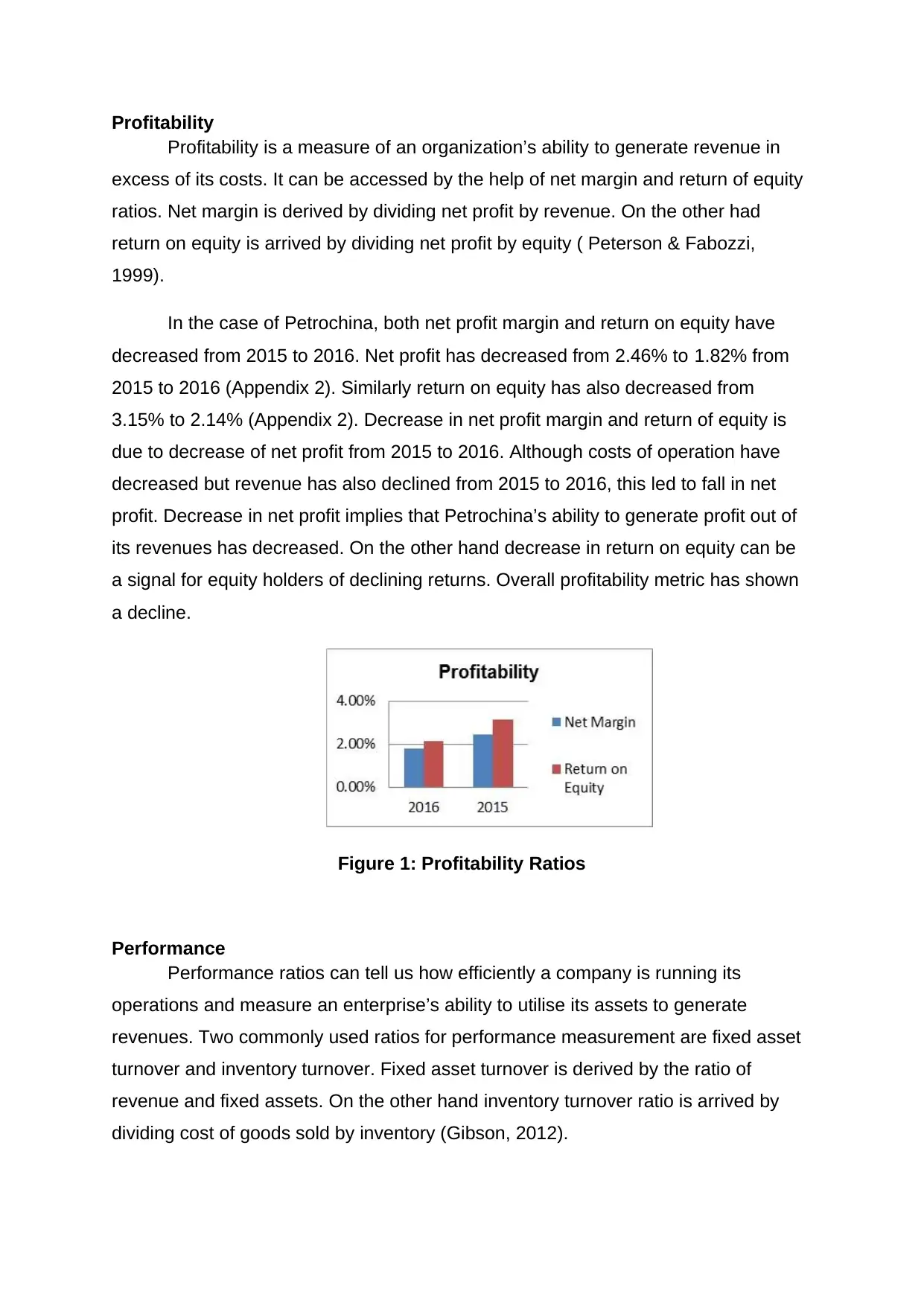
In the case of Petrochina, both net profit margin and return on equity have
decreased from 2015 to 2016. Net profit has decreased from 2.46% to 1.82% from
2015 to 2016 (Appendix 2). Similarly return on equity has also decreased from
3.15% to 2.14% (Appendix 2). Decrease in net profit margin and return of equity is
due to decrease of net profit from 2015 to 2016. Although costs of operation have
decreased but revenue has also declined from 2015 to 2016, this led to fall in net
profit. Decrease in net profit implies that Petrochina’s ability to generate profit out of
its revenues has decreased. On the other hand decrease in return on equity can be
a signal for equity holders of declining returns. Overall profitability metric has shown
a decline.
Figure 1: Profitability Ratios
Performance
Performance ratios can tell us how efficiently a company is running its
operations and measure an enterprise’s ability to utilise its assets to generate
revenues. Two commonly used ratios for performance measurement are fixed asset
turnover and inventory turnover. Fixed asset turnover is derived by the ratio of
revenue and fixed assets. On the other hand inventory turnover ratio is arrived by
dividing cost of goods sold by inventory (Gibson, 2012).
Profitability is a measure of an organization’s ability to generate revenue in
excess of its costs. It can be accessed by the help of net margin and return of equity
ratios. Net margin is derived by dividing net profit by revenue. On the other had
return on equity is arrived by dividing net profit by equity ( Peterson & Fabozzi,
1999).
In the case of Petrochina, both net profit margin and return on equity have
decreased from 2015 to 2016. Net profit has decreased from 2.46% to 1.82% from
2015 to 2016 (Appendix 2). Similarly return on equity has also decreased from
3.15% to 2.14% (Appendix 2). Decrease in net profit margin and return of equity is
due to decrease of net profit from 2015 to 2016. Although costs of operation have
decreased but revenue has also declined from 2015 to 2016, this led to fall in net
profit. Decrease in net profit implies that Petrochina’s ability to generate profit out of
its revenues has decreased. On the other hand decrease in return on equity can be
a signal for equity holders of declining returns. Overall profitability metric has shown
a decline.
Figure 1: Profitability Ratios
Performance
Performance ratios can tell us how efficiently a company is running its
operations and measure an enterprise’s ability to utilise its assets to generate
revenues. Two commonly used ratios for performance measurement are fixed asset
turnover and inventory turnover. Fixed asset turnover is derived by the ratio of
revenue and fixed assets. On the other hand inventory turnover ratio is arrived by
dividing cost of goods sold by inventory (Gibson, 2012).
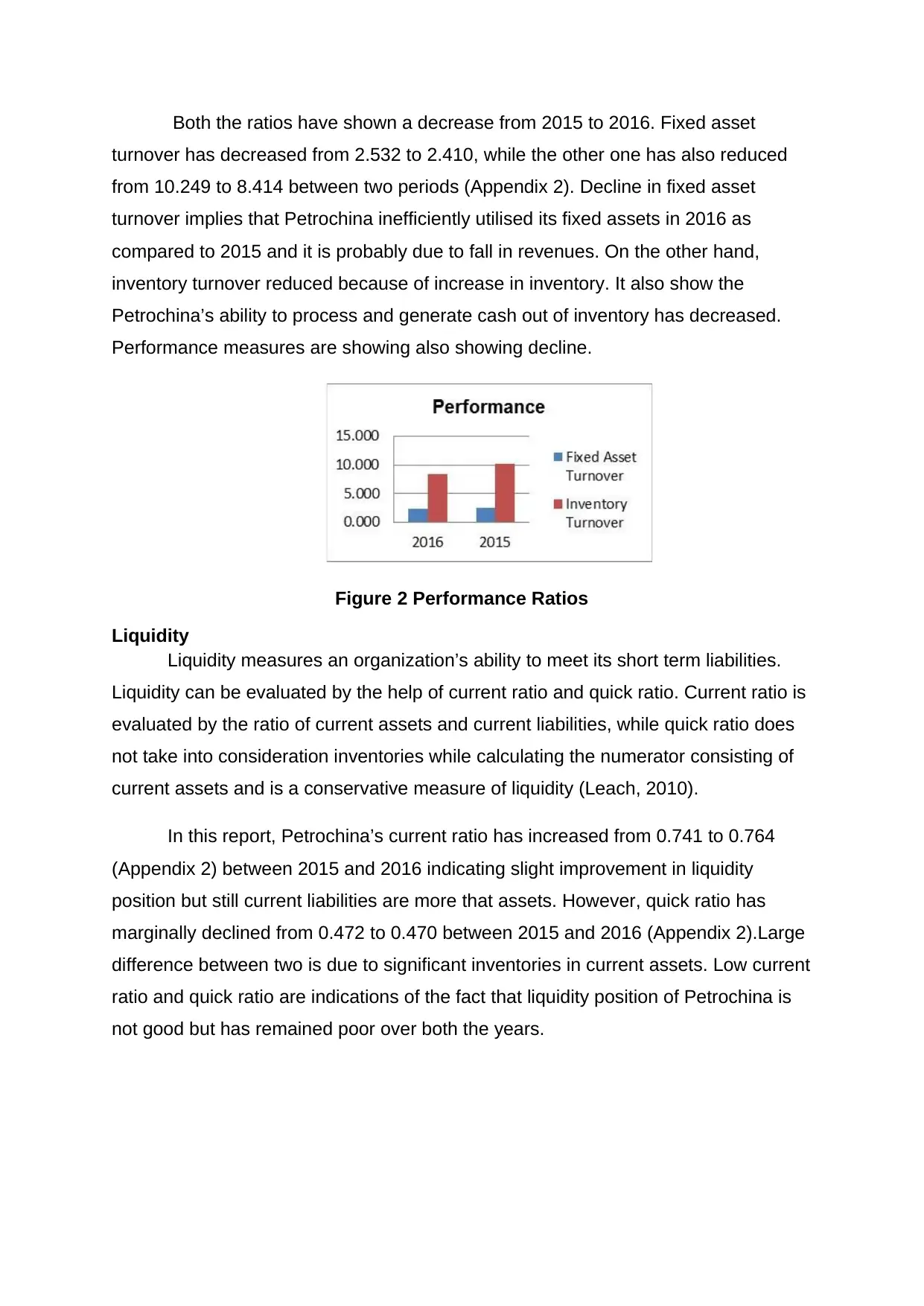
Both the ratios have shown a decrease from 2015 to 2016. Fixed asset
turnover has decreased from 2.532 to 2.410, while the other one has also reduced
from 10.249 to 8.414 between two periods (Appendix 2). Decline in fixed asset
turnover implies that Petrochina inefficiently utilised its fixed assets in 2016 as
compared to 2015 and it is probably due to fall in revenues. On the other hand,
inventory turnover reduced because of increase in inventory. It also show the
Petrochina’s ability to process and generate cash out of inventory has decreased.
Performance measures are showing also showing decline.
Figure 2 Performance Ratios
Liquidity
Liquidity measures an organization’s ability to meet its short term liabilities.
Liquidity can be evaluated by the help of current ratio and quick ratio. Current ratio is
evaluated by the ratio of current assets and current liabilities, while quick ratio does
not take into consideration inventories while calculating the numerator consisting of
current assets and is a conservative measure of liquidity (Leach, 2010).
In this report, Petrochina’s current ratio has increased from 0.741 to 0.764
(Appendix 2) between 2015 and 2016 indicating slight improvement in liquidity
position but still current liabilities are more that assets. However, quick ratio has
marginally declined from 0.472 to 0.470 between 2015 and 2016 (Appendix 2).Large
difference between two is due to significant inventories in current assets. Low current
ratio and quick ratio are indications of the fact that liquidity position of Petrochina is
not good but has remained poor over both the years.
turnover has decreased from 2.532 to 2.410, while the other one has also reduced
from 10.249 to 8.414 between two periods (Appendix 2). Decline in fixed asset
turnover implies that Petrochina inefficiently utilised its fixed assets in 2016 as
compared to 2015 and it is probably due to fall in revenues. On the other hand,
inventory turnover reduced because of increase in inventory. It also show the
Petrochina’s ability to process and generate cash out of inventory has decreased.
Performance measures are showing also showing decline.
Figure 2 Performance Ratios
Liquidity
Liquidity measures an organization’s ability to meet its short term liabilities.
Liquidity can be evaluated by the help of current ratio and quick ratio. Current ratio is
evaluated by the ratio of current assets and current liabilities, while quick ratio does
not take into consideration inventories while calculating the numerator consisting of
current assets and is a conservative measure of liquidity (Leach, 2010).
In this report, Petrochina’s current ratio has increased from 0.741 to 0.764
(Appendix 2) between 2015 and 2016 indicating slight improvement in liquidity
position but still current liabilities are more that assets. However, quick ratio has
marginally declined from 0.472 to 0.470 between 2015 and 2016 (Appendix 2).Large
difference between two is due to significant inventories in current assets. Low current
ratio and quick ratio are indications of the fact that liquidity position of Petrochina is
not good but has remained poor over both the years.
⊘ This is a preview!⊘
Do you want full access?
Subscribe today to unlock all pages.
Trusted by 1+ million students worldwide
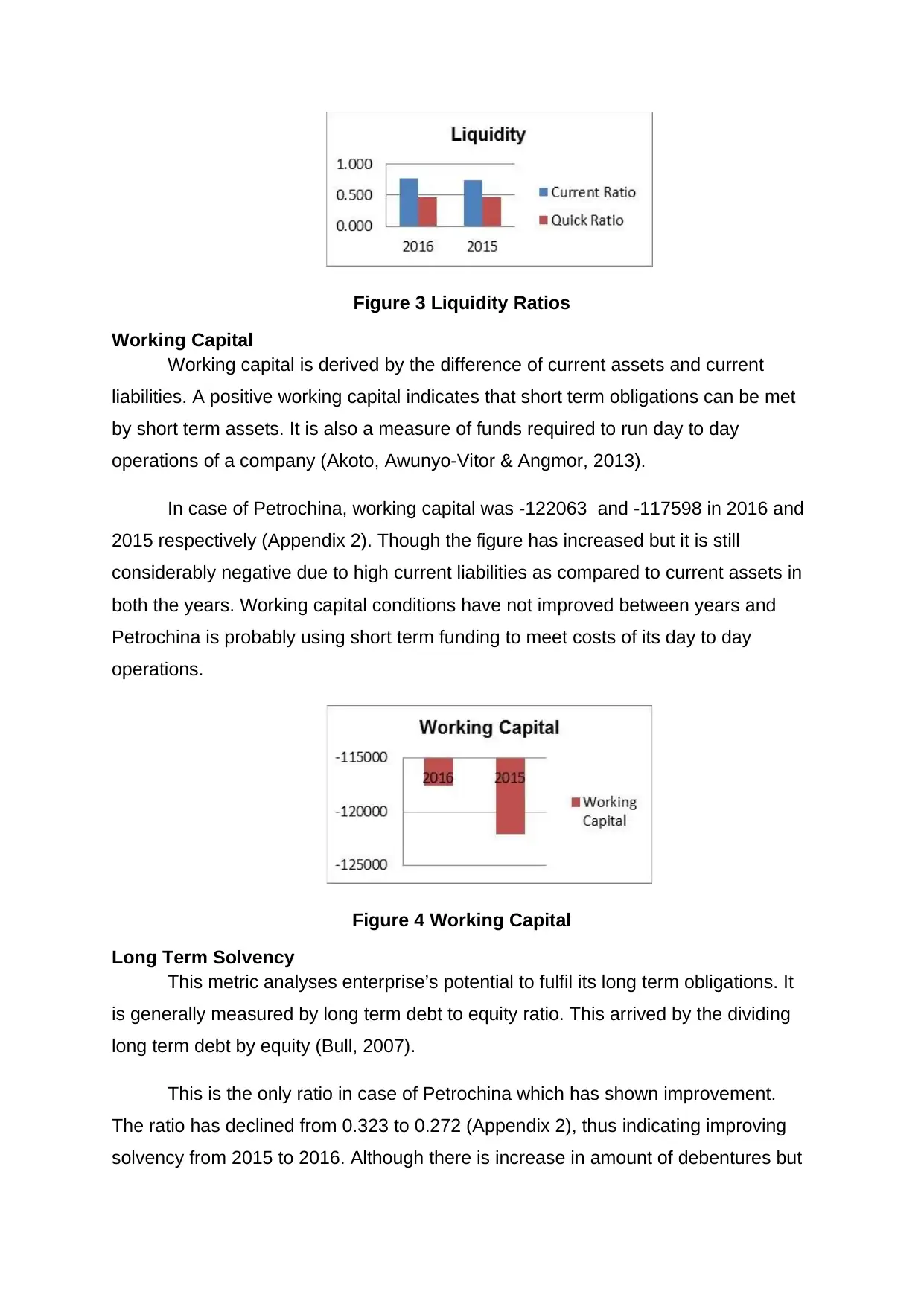
Figure 3 Liquidity Ratios
Working Capital
Working capital is derived by the difference of current assets and current
liabilities. A positive working capital indicates that short term obligations can be met
by short term assets. It is also a measure of funds required to run day to day
operations of a company (Akoto, Awunyo-Vitor & Angmor, 2013).
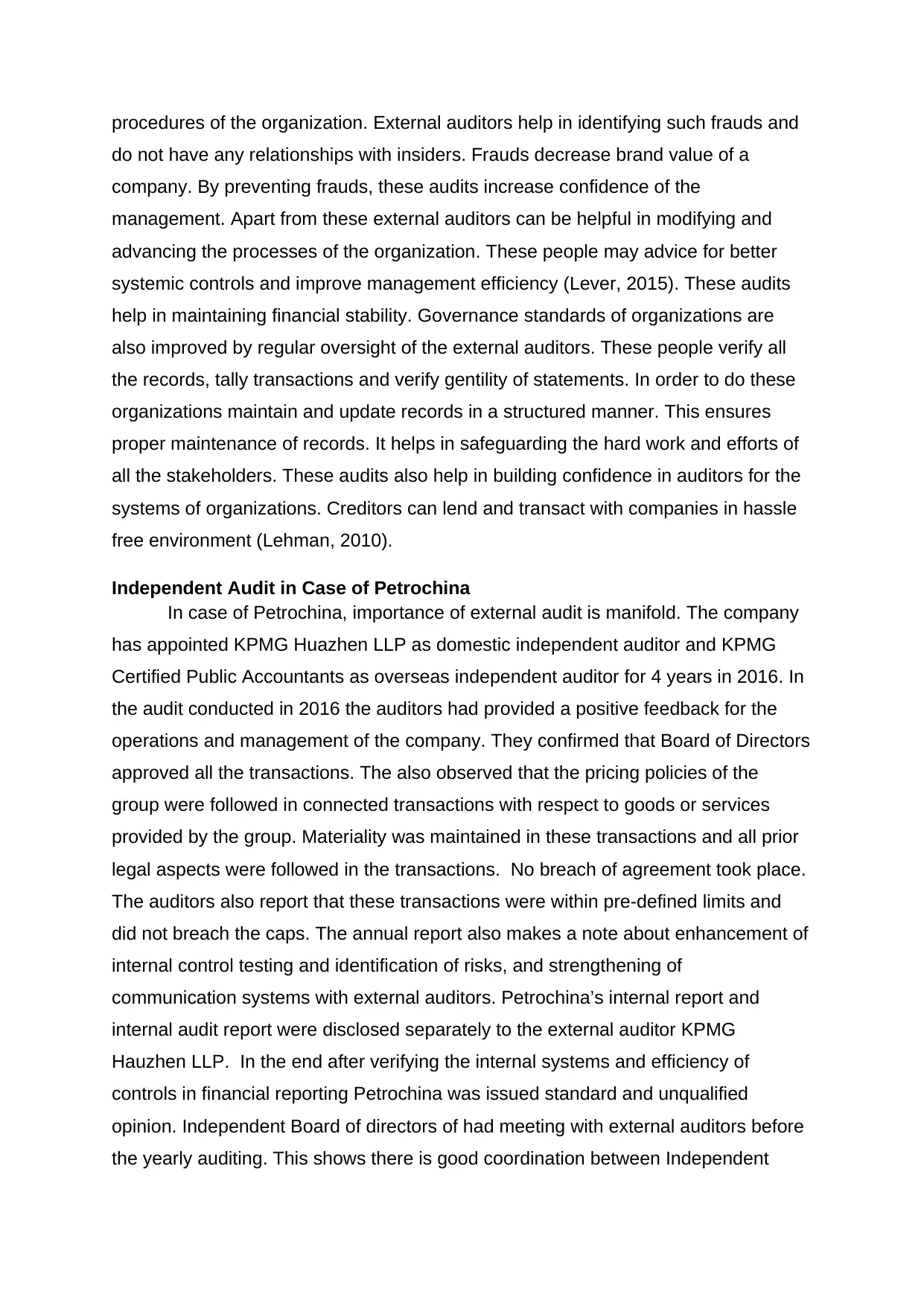
In case of Petrochina, working capital was -122063 and -117598 in 2016 and
2015 respectively (Appendix 2). Though the figure has increased but it is still
considerably negative due to high current liabilities as compared to current assets in
both the years. Working capital conditions have not improved between years and
Petrochina is probably using short term funding to meet costs of its day to day
operations.
Figure 4 Working Capital
Long Term Solvency
This metric analyses enterprise’s potential to fulfil its long term obligations. It
is generally measured by long term debt to equity ratio. This arrived by the dividing
long term debt by equity (Bull, 2007).
This is the only ratio in case of Petrochina which has shown improvement.
The ratio has declined from 0.323 to 0.272 (Appendix 2), thus indicating improving
solvency from 2015 to 2016. Although there is increase in amount of debentures but
Working Capital
Working capital is derived by the difference of current assets and current
liabilities. A positive working capital indicates that short term obligations can be met
by short term assets. It is also a measure of funds required to run day to day
operations of a company (Akoto, Awunyo-Vitor & Angmor, 2013).
In case of Petrochina, working capital was -122063 and -117598 in 2016 and
2015 respectively (Appendix 2). Though the figure has increased but it is still
considerably negative due to high current liabilities as compared to current assets in
both the years. Working capital conditions have not improved between years and
Petrochina is probably using short term funding to meet costs of its day to day
operations.
Figure 4 Working Capital
Long Term Solvency
This metric analyses enterprise’s potential to fulfil its long term obligations. It
is generally measured by long term debt to equity ratio. This arrived by the dividing
long term debt by equity (Bull, 2007).
This is the only ratio in case of Petrochina which has shown improvement.
The ratio has declined from 0.323 to 0.272 (Appendix 2), thus indicating improving
solvency from 2015 to 2016. Although there is increase in amount of debentures but
Paraphrase This Document
Need a fresh take? Get an instant paraphrase of this document with our AI Paraphraser
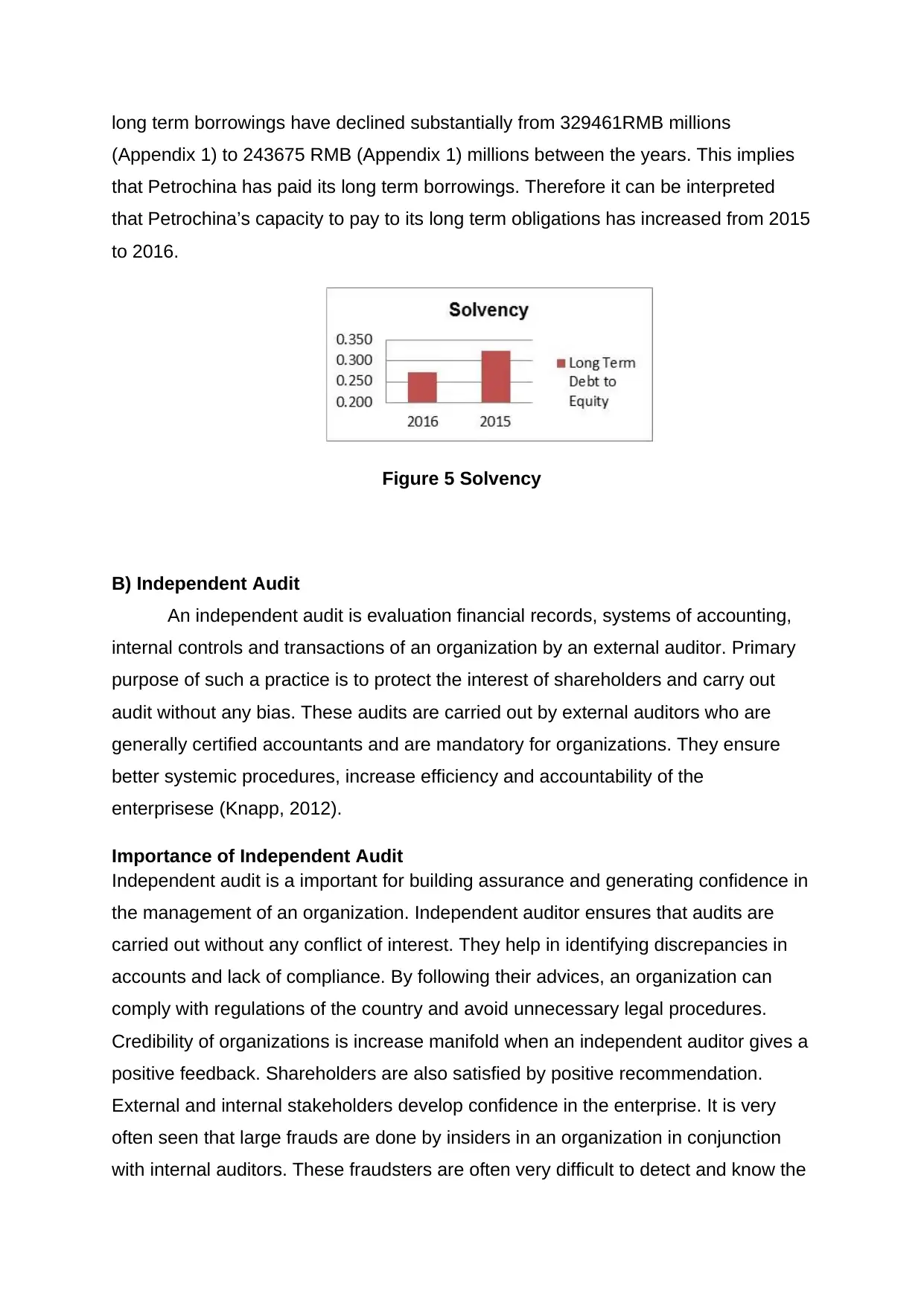
long term borrowings have declined substantially from 329461RMB millions
(Appendix 1) to 243675 RMB (Appendix 1) millions between the years. This implies
that Petrochina has paid its long term borrowings. Therefore it can be interpreted
that Petrochina’s capacity to pay to its long term obligations has increased from 2015
to 2016.
Figure 5 Solvency
B) Independent Audit
An independent audit is evaluation financial records, systems of accounting,
internal controls and transactions of an organization by an external auditor. Primary
purpose of such a practice is to protect the interest of shareholders and carry out
audit without any bias. These audits are carried out by external auditors who are
generally certified accountants and are mandatory for organizations. They ensure
better systemic procedures, increase efficiency and accountability of the
enterprisese (Knapp, 2012).
Importance of Independent Audit
Independent audit is a important for building assurance and generating confidence in
the management of an organization. Independent auditor ensures that audits are
carried out without any conflict of interest. They help in identifying discrepancies in
accounts and lack of compliance. By following their advices, an organization can
comply with regulations of the country and avoid unnecessary legal procedures.
Credibility of organizations is increase manifold when an independent auditor gives a
positive feedback. Shareholders are also satisfied by positive recommendation.
External and internal stakeholders develop confidence in the enterprise. It is very
often seen that large frauds are done by insiders in an organization in conjunction
with internal auditors. These fraudsters are often very difficult to detect and know the
(Appendix 1) to 243675 RMB (Appendix 1) millions between the years. This implies
that Petrochina has paid its long term borrowings. Therefore it can be interpreted
that Petrochina’s capacity to pay to its long term obligations has increased from 2015
to 2016.
Figure 5 Solvency
B) Independent Audit
An independent audit is evaluation financial records, systems of accounting,
internal controls and transactions of an organization by an external auditor. Primary
purpose of such a practice is to protect the interest of shareholders and carry out
audit without any bias. These audits are carried out by external auditors who are
generally certified accountants and are mandatory for organizations. They ensure
better systemic procedures, increase efficiency and accountability of the
enterprisese (Knapp, 2012).
Importance of Independent Audit
Independent audit is a important for building assurance and generating confidence in
the management of an organization. Independent auditor ensures that audits are
carried out without any conflict of interest. They help in identifying discrepancies in
accounts and lack of compliance. By following their advices, an organization can
comply with regulations of the country and avoid unnecessary legal procedures.
Credibility of organizations is increase manifold when an independent auditor gives a
positive feedback. Shareholders are also satisfied by positive recommendation.
External and internal stakeholders develop confidence in the enterprise. It is very
often seen that large frauds are done by insiders in an organization in conjunction
with internal auditors. These fraudsters are often very difficult to detect and know the
procedures of the organization. External auditors help in identifying such frauds and
do not have any relationships with insiders. Frauds decrease brand value of a
company. By preventing frauds, these audits increase confidence of the
management. Apart from these external auditors can be helpful in modifying and
advancing the processes of the organization. These people may advice for better
systemic controls and improve management efficiency (Lever, 2015). These audits
help in maintaining financial stability. Governance standards of organizations are
also improved by regular oversight of the external auditors. These people verify all
the records, tally transactions and verify gentility of statements. In order to do these
organizations maintain and update records in a structured manner. This ensures
proper maintenance of records. It helps in safeguarding the hard work and efforts of
all the stakeholders. These audits also help in building confidence in auditors for the
systems of organizations. Creditors can lend and transact with companies in hassle
free environment (Lehman, 2010).
Independent Audit in Case of Petrochina
In case of Petrochina, importance of external audit is manifold. The company
has appointed KPMG Huazhen LLP as domestic independent auditor and KPMG
Certified Public Accountants as overseas independent auditor for 4 years in 2016. In
the audit conducted in 2016 the auditors had provided a positive feedback for the
operations and management of the company. They confirmed that Board of Directors
approved all the transactions. The also observed that the pricing policies of the
group were followed in connected transactions with respect to goods or services
provided by the group. Materiality was maintained in these transactions and all prior
legal aspects were followed in the transactions. No breach of agreement took place.
The auditors also report that these transactions were within pre-defined limits and
did not breach the caps. The annual report also makes a note about enhancement of
internal control testing and identification of risks, and strengthening of
communication systems with external auditors. Petrochina’s internal report and
internal audit report were disclosed separately to the external auditor KPMG
Hauzhen LLP. In the end after verifying the internal systems and efficiency of
controls in financial reporting Petrochina was issued standard and unqualified
opinion. Independent Board of directors of had meeting with external auditors before
the yearly auditing. This shows there is good coordination between Independent
do not have any relationships with insiders. Frauds decrease brand value of a
company. By preventing frauds, these audits increase confidence of the
management. Apart from these external auditors can be helpful in modifying and
advancing the processes of the organization. These people may advice for better
systemic controls and improve management efficiency (Lever, 2015). These audits
help in maintaining financial stability. Governance standards of organizations are
also improved by regular oversight of the external auditors. These people verify all
the records, tally transactions and verify gentility of statements. In order to do these
organizations maintain and update records in a structured manner. This ensures
proper maintenance of records. It helps in safeguarding the hard work and efforts of
all the stakeholders. These audits also help in building confidence in auditors for the
systems of organizations. Creditors can lend and transact with companies in hassle
free environment (Lehman, 2010).
Independent Audit in Case of Petrochina
In case of Petrochina, importance of external audit is manifold. The company
has appointed KPMG Huazhen LLP as domestic independent auditor and KPMG
Certified Public Accountants as overseas independent auditor for 4 years in 2016. In
the audit conducted in 2016 the auditors had provided a positive feedback for the
operations and management of the company. They confirmed that Board of Directors
approved all the transactions. The also observed that the pricing policies of the
group were followed in connected transactions with respect to goods or services
provided by the group. Materiality was maintained in these transactions and all prior
legal aspects were followed in the transactions. No breach of agreement took place.
The auditors also report that these transactions were within pre-defined limits and
did not breach the caps. The annual report also makes a note about enhancement of
internal control testing and identification of risks, and strengthening of
communication systems with external auditors. Petrochina’s internal report and
internal audit report were disclosed separately to the external auditor KPMG
Hauzhen LLP. In the end after verifying the internal systems and efficiency of
controls in financial reporting Petrochina was issued standard and unqualified
opinion. Independent Board of directors of had meeting with external auditors before
the yearly auditing. This shows there is good coordination between Independent
⊘ This is a preview!⊘
Do you want full access?
Subscribe today to unlock all pages.
Trusted by 1+ million students worldwide
Board of directors and auditors in improving processes of the company. (Petrochina,
2016).
Thus this shows us that in case of Petrochina independent audit was carried
out in an effective manner. Disclosures by external auditors in annual report of the
company show us that it followed all legal procedures with integrity. A qualified and
standard opinion issued by the auditors of Petrochina has increased the confidence
of management and external stakeholders. It has also created assurances for
partners dealing with the enterprise.
Independent audits serve as a benchmark for organizations and help in
identifying gaps in their daily operating processes. They critique the organizations,
help in modifying processes and increase efficiency of the business. They also help
in government compliance, scam prevention, building controls and improving
compliance. Thus the process of independent audit helps in enhancing the
confidence of all the entities dealing with a company and they also help creating an
environment of trust, and generating assurance for all stakeholders (Miettinen,
2008).
C) Global Financial Crisis and its Affects
Global financial crisis of 2000/2008 which emanated from USA was as a
result of a real asset bubble and sub-prime crisis. With globalization and
development of technology world had become a small place to live in 21st century,
results of this crisis not only devastated organizations in USA and its neighbouring
countries but had its effect on Europe, Australia and Asia (Ciro, 2016). Signals of
upcoming crisis could be seen as early as in 2006 but it became inevitable with fall of
Lehman Brothers in September 2008.
Effect on Businesses around the World
Global financial crisis had a severe effect on economies and businesses
around the world. Almost all the sectors and industries had become a part of this
crisis. Banks were the ones that were affected most severely. It was believed that
they were too big to fail. But this thought did not prevail after this. Financial
institutions like Bank of America, Merrill Lynch and Royal Bank of Scotland were
bailed out. Due to this credit by private sector plunged and business confidence
declined ( Elliot, 2011). With the fall flow of credit and falling sales, the profits of
2016).
Thus this shows us that in case of Petrochina independent audit was carried
out in an effective manner. Disclosures by external auditors in annual report of the
company show us that it followed all legal procedures with integrity. A qualified and
standard opinion issued by the auditors of Petrochina has increased the confidence
of management and external stakeholders. It has also created assurances for
partners dealing with the enterprise.
Independent audits serve as a benchmark for organizations and help in
identifying gaps in their daily operating processes. They critique the organizations,
help in modifying processes and increase efficiency of the business. They also help
in government compliance, scam prevention, building controls and improving
compliance. Thus the process of independent audit helps in enhancing the
confidence of all the entities dealing with a company and they also help creating an
environment of trust, and generating assurance for all stakeholders (Miettinen,
2008).
C) Global Financial Crisis and its Affects
Global financial crisis of 2000/2008 which emanated from USA was as a
result of a real asset bubble and sub-prime crisis. With globalization and
development of technology world had become a small place to live in 21st century,
results of this crisis not only devastated organizations in USA and its neighbouring
countries but had its effect on Europe, Australia and Asia (Ciro, 2016). Signals of
upcoming crisis could be seen as early as in 2006 but it became inevitable with fall of
Lehman Brothers in September 2008.
Effect on Businesses around the World
Global financial crisis had a severe effect on economies and businesses
around the world. Almost all the sectors and industries had become a part of this
crisis. Banks were the ones that were affected most severely. It was believed that
they were too big to fail. But this thought did not prevail after this. Financial
institutions like Bank of America, Merrill Lynch and Royal Bank of Scotland were
bailed out. Due to this credit by private sector plunged and business confidence
declined ( Elliot, 2011). With the fall flow of credit and falling sales, the profits of
Paraphrase This Document
Need a fresh take? Get an instant paraphrase of this document with our AI Paraphraser
organizations started falling. International trade was deteriorated and economic
growth collapsed. There were job losses and falling profits led to decline in share
prices. There were increase in inventories and accounts receivables of companies
were at all-time high. Prior of the crisis, business had built huge capacities due to
high growth period of 2004-2007, but crisis led to capacity underutilization and
increasing fixed costs. This was felt in case of large automobile manufactures like
General Motors and Ford facing severe loses (Nieuwenhuis & Wells, 2015).
Rising unemployment and decreasing incomes led to further fall in demand of
goods and delayed purchases. All this led to a deflationary situation for businesses.
In deflationary conditions, consumers delay their purchases, which further leads to
falling demand for goods. This condition was particularly very concerning for low
credit rating firms and there cost of funding increased further, thus putting a severe
strain on their business models. It was believed that this crisis would not affect the
business in developing countries. But these businesses were affected due to trade
relationships with developed countries. Export business in developing countries were
affected due to slowing global demand. Large commodity exporting businesses in
Brazil and Russia suffered massively due fall in food and non-food commodity prices
(Batten & Szillagyi, 2011). However, there were few industries such as healthcare
and education that were comparatively less affected by the crisis. Certain countries
like India and China survived because of domestic demand. Thought the growth
rates of these countries also dropped but the business in these nations were
comparatively less affected by the crisis. The financial crisis was a once in a century
event after the great depression of 1930s (Kates, 2011). Though there were
improvements in business sentiments from 2010 onwards but it almost took a
decade for global growth to take off.
Lessons Learned for Global Companies like Petrochina
Petrochina is one the largest oil companies in the world and plays a significant
role in china in production and distribution of oil and natural gas in China. China is a
large exported of goods and massive consumer of oil. Petrochina was also affected
by global financial crisis as demand from developed world fell and oil import to China
was greatly reduced. Petrochina’s revenue and profit declined in 2008 and 2009
after the crisis (Petochina, 2009).
growth collapsed. There were job losses and falling profits led to decline in share
prices. There were increase in inventories and accounts receivables of companies
were at all-time high. Prior of the crisis, business had built huge capacities due to
high growth period of 2004-2007, but crisis led to capacity underutilization and
increasing fixed costs. This was felt in case of large automobile manufactures like
General Motors and Ford facing severe loses (Nieuwenhuis & Wells, 2015).
Rising unemployment and decreasing incomes led to further fall in demand of
goods and delayed purchases. All this led to a deflationary situation for businesses.
In deflationary conditions, consumers delay their purchases, which further leads to
falling demand for goods. This condition was particularly very concerning for low
credit rating firms and there cost of funding increased further, thus putting a severe
strain on their business models. It was believed that this crisis would not affect the
business in developing countries. But these businesses were affected due to trade
relationships with developed countries. Export business in developing countries were
affected due to slowing global demand. Large commodity exporting businesses in
Brazil and Russia suffered massively due fall in food and non-food commodity prices
(Batten & Szillagyi, 2011). However, there were few industries such as healthcare
and education that were comparatively less affected by the crisis. Certain countries
like India and China survived because of domestic demand. Thought the growth
rates of these countries also dropped but the business in these nations were
comparatively less affected by the crisis. The financial crisis was a once in a century
event after the great depression of 1930s (Kates, 2011). Though there were
improvements in business sentiments from 2010 onwards but it almost took a
decade for global growth to take off.
Lessons Learned for Global Companies like Petrochina
Petrochina is one the largest oil companies in the world and plays a significant
role in china in production and distribution of oil and natural gas in China. China is a
large exported of goods and massive consumer of oil. Petrochina was also affected
by global financial crisis as demand from developed world fell and oil import to China
was greatly reduced. Petrochina’s revenue and profit declined in 2008 and 2009
after the crisis (Petochina, 2009).
Global financial crisis changes the way business used to think and conduct
their operations. Prior to it the main crux of business and management was on
numbers and generating profits. It showed that businesses need to develop
sustainable models and change their methods of measurement (Webb, 2009).
Global businesses realised the importance of connected world and now were taking
decisions considering financial prudence. Businesses were now taking note of
systemic as well as non-systemic risks while developing processes. During financial
crisis credit rating agencies came under fire because of their inappropriate rating
procedures. Large businesses trusted these agencies in conducting their
businesses. After the crisis, businesses started doing their assessments of business
conditions and partners more diligently (Naciri, 2016).
For a company like Petrochina that too suffered during the crisis there were
lessons too. Petrochina realised that its operations are dependent on global
commodity cycle particularly that of oil. Massive excessive capacity that was build
prior to crisis by the company was underutilised as Chinese economy also slowed
down. This called for improvement in management and increasing efficiency of
operations. Petrochina improved its efficiency and increased control over
investments. The company also rebalanced its portfolio of investments. It also
adopted latest techniques and followed a scientific approach for production. It also
enhanced the company’s orientation towards the market. The company also
increased its application and enhanced coordination between production,
transportation and marketing. Business planning was more robust and new policies
were planned taking into strategic concerns in consideration. By the year 2009 the
financials had suffered but they were better than expected (Petrochina, 2009)
Conclusion
This report covers the analysis of Petrochina, a Chinese petroleum company
with respect to its financial performance. Financial performance assessment has
been carried out for the years 2015 and 2016 using ratio analysis. It is concluded
that profitability, performance, liquidity of the company had deteriorated from 2015 to
2016. Most importantly net profit margin declined from 2.46% in 2016 to 1.82% in
2015. Only parameter of financial analysis that showed improvement was solvency.
Long term debt to equity ratio decreased during the period of study from 0.323 to
their operations. Prior to it the main crux of business and management was on
numbers and generating profits. It showed that businesses need to develop
sustainable models and change their methods of measurement (Webb, 2009).
Global businesses realised the importance of connected world and now were taking
decisions considering financial prudence. Businesses were now taking note of
systemic as well as non-systemic risks while developing processes. During financial
crisis credit rating agencies came under fire because of their inappropriate rating
procedures. Large businesses trusted these agencies in conducting their
businesses. After the crisis, businesses started doing their assessments of business
conditions and partners more diligently (Naciri, 2016).
For a company like Petrochina that too suffered during the crisis there were
lessons too. Petrochina realised that its operations are dependent on global
commodity cycle particularly that of oil. Massive excessive capacity that was build
prior to crisis by the company was underutilised as Chinese economy also slowed
down. This called for improvement in management and increasing efficiency of
operations. Petrochina improved its efficiency and increased control over
investments. The company also rebalanced its portfolio of investments. It also
adopted latest techniques and followed a scientific approach for production. It also
enhanced the company’s orientation towards the market. The company also
increased its application and enhanced coordination between production,
transportation and marketing. Business planning was more robust and new policies
were planned taking into strategic concerns in consideration. By the year 2009 the
financials had suffered but they were better than expected (Petrochina, 2009)
Conclusion
This report covers the analysis of Petrochina, a Chinese petroleum company
with respect to its financial performance. Financial performance assessment has
been carried out for the years 2015 and 2016 using ratio analysis. It is concluded
that profitability, performance, liquidity of the company had deteriorated from 2015 to
2016. Most importantly net profit margin declined from 2.46% in 2016 to 1.82% in
2015. Only parameter of financial analysis that showed improvement was solvency.
Long term debt to equity ratio decreased during the period of study from 0.323 to
⊘ This is a preview!⊘
Do you want full access?
Subscribe today to unlock all pages.
Trusted by 1+ million students worldwide

1 out of 16


Related Documents


Your All-in-One AI-Powered Toolkit for Academic Success.
+13062052269
info@desklib.com
Available 24*7 on WhatsApp / Email
![[object Object]](/_next/static/media/star-bottom.7253800d.svg)
Unlock your academic potential
Copyright © 2020–2026 A2Z Services. All Rights Reserved. Developed and managed by ZUCOL.