Assessing Efficiency and Risk Transfer in UK Government PFI Contracts
VerifiedAdded on 2023/04/22
|9
|2415
|225
Essay
AI Summary
This essay provides an analysis of Private Finance Initiatives (PFIs) in the UK, examining their key benefits such as private sector efficiency, risk transfer, and extra investment into the public sector. It also critically evaluates the drawbacks, including debt costs, high administration costs, inflexibility, and potential increases in public sector debts. The essay appraises the extent to which PFI contracts deliver efficiency and risk transfers to the UK government, using case studies like the London Olympics and the Bombardier-Crossrail projects to illustrate both successes and failures. Ultimately, the essay concludes that while PFI contracts offer advantages like innovation and faster project completion, they also pose challenges related to cost efficiency and risk management, with the ultimate risk often falling on the government. The analysis shows that despite potential drawbacks, PFI contracts are increasingly utilized due to the technology and innovation they bring, even if it means higher overall costs.

1
Private Finance Initiatives (PFIs)
Private Finance Initiatives (PFIs)

Paraphrase This Document
Need a fresh take? Get an instant paraphrase of this document with our AI Paraphraser
2
Introduction
Private finance initiative (PFI) can be stated to be a public and private sector partnership
in which the private sector is given the contract for funding and managing the public sector
projects. The private firms are paid back the complete installment in the long period of time that
also includes the annual service charge required for maintaining the project. It has been
described as a new source of financing that is introduced by the Conservative government in the
year 1992. It has also been reported that about 700 public sector projects have been managed by
private firms between the years 1992-2011. In this context, the present report has been developed
for analyzing the key benefits of the private finance initiative (PFI) contracts. It is followed by
carrying out a critical analysis to the extent to which PFI contracts are helpful in providing
efficiency and risk transfers for the UK government.
2. Key Benefits of PFI
i. Efficiency of Private Sector
PFI is described as a method of providing funds for undertaking major capital projects in
which the private firms have the contract of completing and managing the public projects. It can
be described as one of the major government policies that are particularly developed for
increasing the involvement of private sector in the public services provision. The major examples
of the PFI’s projects include new schools, defense contracts, social housing, hospitals and road
construction projects. The major advantage that can be provided by the use of private sector for
funding the public projects under PFI is that it is better at managing the capital investment
projects. This is because it can provide larger benefits in terms of expertise, logistics,
construction design and engineering as compared with that of the public sector (Spackman,
2004). Private sector organisations are better at managing the investment projects and it helps to
achieve the overall cost effectiveness as compare to the public sector. Private sector has better
various innovative technologies, methods and design that is required to complete the projects in
lessor period of time and with increase of delivering the best project.
ii. Transfer of Risk to the Public Sector
Introduction
Private finance initiative (PFI) can be stated to be a public and private sector partnership
in which the private sector is given the contract for funding and managing the public sector
projects. The private firms are paid back the complete installment in the long period of time that
also includes the annual service charge required for maintaining the project. It has been
described as a new source of financing that is introduced by the Conservative government in the
year 1992. It has also been reported that about 700 public sector projects have been managed by
private firms between the years 1992-2011. In this context, the present report has been developed
for analyzing the key benefits of the private finance initiative (PFI) contracts. It is followed by
carrying out a critical analysis to the extent to which PFI contracts are helpful in providing
efficiency and risk transfers for the UK government.
2. Key Benefits of PFI
i. Efficiency of Private Sector
PFI is described as a method of providing funds for undertaking major capital projects in
which the private firms have the contract of completing and managing the public projects. It can
be described as one of the major government policies that are particularly developed for
increasing the involvement of private sector in the public services provision. The major examples
of the PFI’s projects include new schools, defense contracts, social housing, hospitals and road
construction projects. The major advantage that can be provided by the use of private sector for
funding the public projects under PFI is that it is better at managing the capital investment
projects. This is because it can provide larger benefits in terms of expertise, logistics,
construction design and engineering as compared with that of the public sector (Spackman,
2004). Private sector organisations are better at managing the investment projects and it helps to
achieve the overall cost effectiveness as compare to the public sector. Private sector has better
various innovative technologies, methods and design that is required to complete the projects in
lessor period of time and with increase of delivering the best project.
ii. Transfer of Risk to the Public Sector
3
It is also advantageous for the private sector institutions to carry out the projects under
PFI as the risk ultimately is with the public sector institutions. As such, the risk of not
completing the project on time or any loss is associated with the public sector firms only
involved within the project.
iii. Extra Investment into the Public Sector
The extra funding that the public sector can gain with the use of PFI can help them to
realize more economic and social benefits. The private sector provide funds for carrying out the
public sector projects under PFI and thus the outcome of such projects can be improved by
gaining extra funds that can be realized by the private sector firms. This is because it might be
difficult for the government to secure extra finance mainly owing to higher borrowing rates and
taxes.
iv. Other Advantage
Private sector firms possess higher competency and thus can enhance the quality of
products and services delivered by brining innovation and good design to projects. The projects
can deliver higher profitability for the investors by reducing the maintenance costs carried out by
the private sector companies (Gao and Schachler, 2007).
3. Criticisms of private finance initiative
i. Debt Cost
The major drawback associated with the use of private sector financing in the public
projects is that cost of debt is higher by 3-4 per cent as compared with that of government debt. It
has been estimated that paying off a debt of about £1bn that has been incurred through PFI is
equivalent to a direct government debt of £1.7 bn (Shaoul and Stapleton, 2008).
ii. High administration cost
The administration cost involved in public projects undertaken by the private sector firms
also incurs high cost due to larger expenditure involved o advisors and lawyers for carrying out
its various operational activities.
It is also advantageous for the private sector institutions to carry out the projects under
PFI as the risk ultimately is with the public sector institutions. As such, the risk of not
completing the project on time or any loss is associated with the public sector firms only
involved within the project.
iii. Extra Investment into the Public Sector
The extra funding that the public sector can gain with the use of PFI can help them to
realize more economic and social benefits. The private sector provide funds for carrying out the
public sector projects under PFI and thus the outcome of such projects can be improved by
gaining extra funds that can be realized by the private sector firms. This is because it might be
difficult for the government to secure extra finance mainly owing to higher borrowing rates and
taxes.
iv. Other Advantage
Private sector firms possess higher competency and thus can enhance the quality of
products and services delivered by brining innovation and good design to projects. The projects
can deliver higher profitability for the investors by reducing the maintenance costs carried out by
the private sector companies (Gao and Schachler, 2007).
3. Criticisms of private finance initiative
i. Debt Cost
The major drawback associated with the use of private sector financing in the public
projects is that cost of debt is higher by 3-4 per cent as compared with that of government debt. It
has been estimated that paying off a debt of about £1bn that has been incurred through PFI is
equivalent to a direct government debt of £1.7 bn (Shaoul and Stapleton, 2008).
ii. High administration cost
The administration cost involved in public projects undertaken by the private sector firms
also incurs high cost due to larger expenditure involved o advisors and lawyers for carrying out
its various operational activities.
⊘ This is a preview!⊘
Do you want full access?
Subscribe today to unlock all pages.

Trusted by 1+ million students worldwide
4
iii. Inflexibility
The long service contracts undertaken through PFI may face the issue of larger difficulty
faced in completion and also incurring higher costs. This is because in longer contracts there will
be incurring of higher maintenance costs (Mansor, 2016).
iv. Public Sector Debts
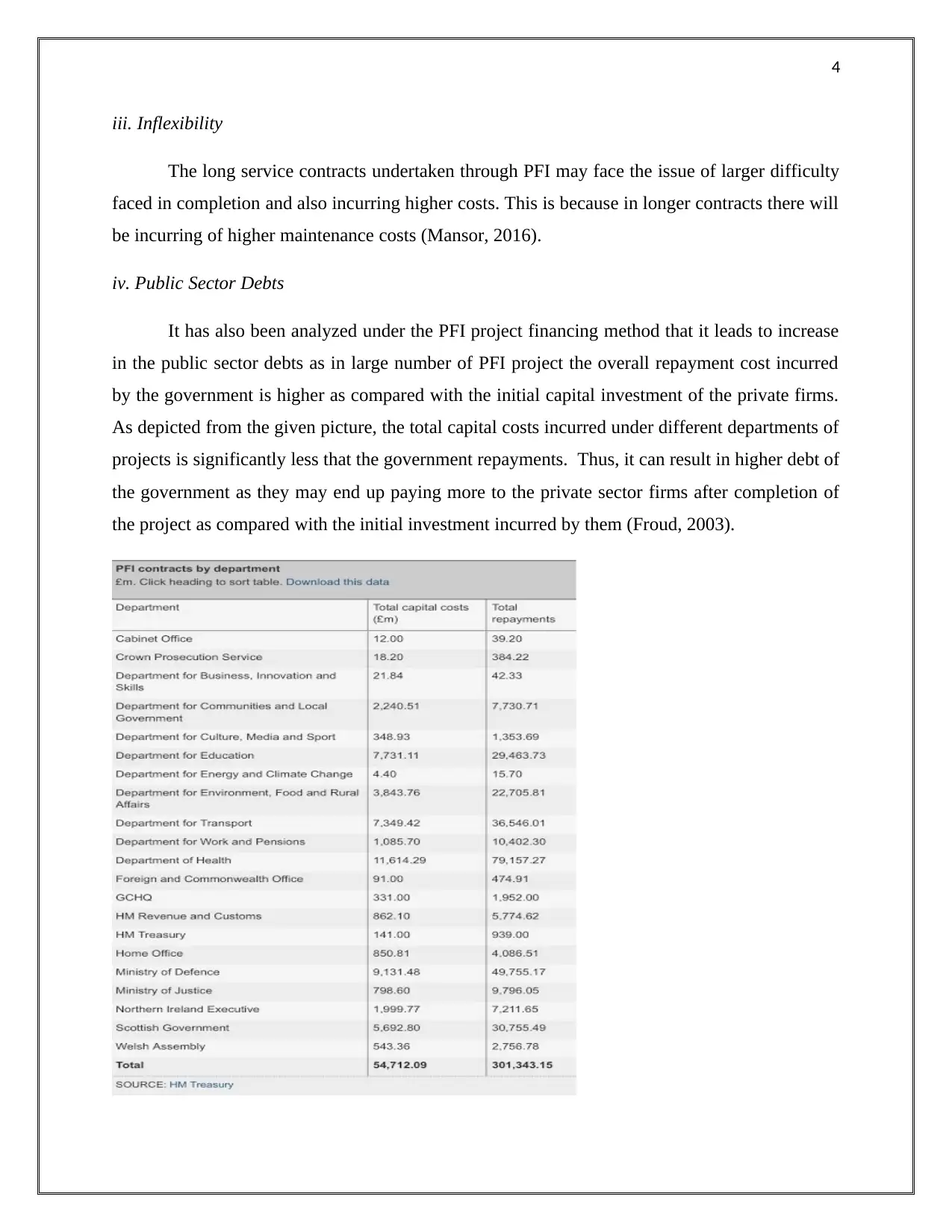
It has also been analyzed under the PFI project financing method that it leads to increase
in the public sector debts as in large number of PFI project the overall repayment cost incurred
by the government is higher as compared with the initial capital investment of the private firms.
As depicted from the given picture, the total capital costs incurred under different departments of
projects is significantly less that the government repayments. Thus, it can result in higher debt of
the government as they may end up paying more to the private sector firms after completion of
the project as compared with the initial investment incurred by them (Froud, 2003).
iii. Inflexibility
The long service contracts undertaken through PFI may face the issue of larger difficulty
faced in completion and also incurring higher costs. This is because in longer contracts there will
be incurring of higher maintenance costs (Mansor, 2016).
iv. Public Sector Debts
It has also been analyzed under the PFI project financing method that it leads to increase
in the public sector debts as in large number of PFI project the overall repayment cost incurred
by the government is higher as compared with the initial capital investment of the private firms.
As depicted from the given picture, the total capital costs incurred under different departments of
projects is significantly less that the government repayments. Thus, it can result in higher debt of
the government as they may end up paying more to the private sector firms after completion of
the project as compared with the initial investment incurred by them (Froud, 2003).
Paraphrase This Document
Need a fresh take? Get an instant paraphrase of this document with our AI Paraphraser
5
4. Critical appraisal to the extent to which PFI contracts are delivering efficiency and risk
transfers to the UK Government
Private Finance Initiative (PFI) plays an important role in government projects of United
Kingdom. The involvement of PFI has been increased a lot during the last few decades due to
advantages that government gets from the contracts they execute with Private Finance Initiative.
As discussed above that government lays down the contract with PFI because it helps in
increasing the efficiency and also helps in delivering best work. The projects performed by PFI
have lower maintenance cost and method used for delivering the contract to the private sector
player increases the competition at the time of tendering of all such projects. Apart from such
huge advantage, PFI contracts comes with major disadvantage of risk transfer. As the ultimate
risk of project lies with government and private sector organization has to bear lessor amount of
risk in case they failed to deliver the project. However, contract can have clause of risk transfer
with addition of some more amount to the contract. In risk transfer the whole risk transfer with
private sector and they have to bear all cost if project get failed. These are the reasons why the
there are increase in number of contracts with PFI despite of higher repayments as compare to
total capital cost.
There are many projects taken by the government of United Kingdom that are perfect
example of efficiency and risk transfer in case of contract with PFI:
Efficiency
The London Olympics: The London Olympics is the perfect example of delivering quality
project in lessor period of time and it was happened only with help of role of PFI in building and
establishing the major as well as minor establishments required as a set for the London
Olympics. Some of major projects that need to be completed in lessor time frame have been
executed via contract with PFI. Private sector companies have taken active interest in the bidding
process of projects that need to be built or rebuilt during planning phase of London Olympics.
The major concern for the projects to be taken under the London Olympics is the time period.
There is very less time available within which many projects have to be completed. PFIs have
come forward to take all such projects and help the government to deliver London Olympics in
4. Critical appraisal to the extent to which PFI contracts are delivering efficiency and risk
transfers to the UK Government
Private Finance Initiative (PFI) plays an important role in government projects of United
Kingdom. The involvement of PFI has been increased a lot during the last few decades due to
advantages that government gets from the contracts they execute with Private Finance Initiative.
As discussed above that government lays down the contract with PFI because it helps in
increasing the efficiency and also helps in delivering best work. The projects performed by PFI
have lower maintenance cost and method used for delivering the contract to the private sector
player increases the competition at the time of tendering of all such projects. Apart from such
huge advantage, PFI contracts comes with major disadvantage of risk transfer. As the ultimate
risk of project lies with government and private sector organization has to bear lessor amount of
risk in case they failed to deliver the project. However, contract can have clause of risk transfer
with addition of some more amount to the contract. In risk transfer the whole risk transfer with
private sector and they have to bear all cost if project get failed. These are the reasons why the
there are increase in number of contracts with PFI despite of higher repayments as compare to
total capital cost.
There are many projects taken by the government of United Kingdom that are perfect
example of efficiency and risk transfer in case of contract with PFI:
Efficiency
The London Olympics: The London Olympics is the perfect example of delivering quality
project in lessor period of time and it was happened only with help of role of PFI in building and
establishing the major as well as minor establishments required as a set for the London
Olympics. Some of major projects that need to be completed in lessor time frame have been
executed via contract with PFI. Private sector companies have taken active interest in the bidding
process of projects that need to be built or rebuilt during planning phase of London Olympics.
The major concern for the projects to be taken under the London Olympics is the time period.
There is very less time available within which many projects have to be completed. PFIs have
come forward to take all such projects and help the government to deliver London Olympics in
6
best way possible. So it can be said that through use of PFI government can complete its some of
the major project in less time frame and in cost efficient manner (National Audit office, 2012).
Kennels at the defense Animal centre in Melton: In year 2011, a contract was awarded to PFI
for building the new dog accommodation, stables and training facilities and other houses of
defense animals in Melton and this project has capital value of 11 million sterling pounds. But
when the project was completed it was estimated that this project has cost more than 109 million
pounds for the same project that was estimated for 11 million pound. It can be said that it was
pure failure of communication and shows that there lacks major cost efficiency that was
promised at the time of executing the contract (The telegraph, 2011).
So overall it can be said that PFI have failed to deliver cost efficiency but they are best
when it come of technology, methods used and innovation.
Risk Transfers
The major advantage of PFI as discussed above is transferring risk to the private sector
and thus the risk of project failure is also shared by the private sector companies. It involves
transferring risk to the private financier for development and the client possess less risk as it is
largely transferred to the contractor. This is the major reason responsible for the use of PFI by
the government in carrying out complex public projects despite of incurring higher costs on its
use (Froud, 2003). The fact can be demonstrated from the following case study examples:
Bombardier-Crossrail Projects: Crossrail is regarded to be the largest infrastructure project in
Europe that attempts to develop a long route of about 118 km. The trains are meant to set to stop
at about 41 stations and carry approx 200 million passengers on an annual basis. The project has
been running over a long period of time but still has not been completed. The project has been
given to Bombardier, a private transportation company of the UK, but has failed to complete the
project on time largely due to uncertainty and risks associated with it. Therefore, it can be said
from this case example that the risk is transferred by the public sector to private sector
companies and therefore there remain less financial risk with the government that it would have
to be incurred of the project fails (Ford, 2018).
best way possible. So it can be said that through use of PFI government can complete its some of
the major project in less time frame and in cost efficient manner (National Audit office, 2012).
Kennels at the defense Animal centre in Melton: In year 2011, a contract was awarded to PFI
for building the new dog accommodation, stables and training facilities and other houses of
defense animals in Melton and this project has capital value of 11 million sterling pounds. But
when the project was completed it was estimated that this project has cost more than 109 million
pounds for the same project that was estimated for 11 million pound. It can be said that it was
pure failure of communication and shows that there lacks major cost efficiency that was
promised at the time of executing the contract (The telegraph, 2011).
So overall it can be said that PFI have failed to deliver cost efficiency but they are best
when it come of technology, methods used and innovation.
Risk Transfers
The major advantage of PFI as discussed above is transferring risk to the private sector
and thus the risk of project failure is also shared by the private sector companies. It involves
transferring risk to the private financier for development and the client possess less risk as it is
largely transferred to the contractor. This is the major reason responsible for the use of PFI by
the government in carrying out complex public projects despite of incurring higher costs on its
use (Froud, 2003). The fact can be demonstrated from the following case study examples:
Bombardier-Crossrail Projects: Crossrail is regarded to be the largest infrastructure project in
Europe that attempts to develop a long route of about 118 km. The trains are meant to set to stop
at about 41 stations and carry approx 200 million passengers on an annual basis. The project has
been running over a long period of time but still has not been completed. The project has been
given to Bombardier, a private transportation company of the UK, but has failed to complete the
project on time largely due to uncertainty and risks associated with it. Therefore, it can be said
from this case example that the risk is transferred by the public sector to private sector
companies and therefore there remain less financial risk with the government that it would have
to be incurred of the project fails (Ford, 2018).
⊘ This is a preview!⊘
Do you want full access?
Subscribe today to unlock all pages.
Trusted by 1+ million students worldwide

7
The Edinburg PFI school controversy: 17 schools shut due to poor building conditions:
A major example depicting the case of risk transference in case of PFI is Edinburg PFI
school controversy. The case was brought in the limelight after a wall collapse at an Edinburg
primary school that is developed under the PFI system. It has been claimed that over-reliance on
the part of the council on the contractors and sub-contractors has led for the collapse of the
school building. As per the reports, there were faults detected in the metal ties that are attached
to the outer brick eventually leading to the collapse of the building. The case also depicts the
risk transfer in case of PFI to private sector institutions as Edinburg Council has refused to pay
the private finance system charges for the shutdown of 17 schools due to construction of faulty
buildings. The council has also filed a compensation claim against the PFI firm and also applying
deductions for the non-availability of schools. Therefore, it can be said that the risk is transferred
to the private sector institutions in case of PFI as public sector firms claims only little
responsibility of the project failure (The Guardian, 2016).
Conclusion
Private Finance Initiative are first started in United Kingdom and it has now used in most
of developing as well as developed countries. The PFI contract comes with many advantages but
it has also some disadvantages that make it difficult to use this method in all the government
projects. The analysis of some of major projects taken up by the government of United Kingdom
shows that contract with PFIs leads to increase in overall decided capital cost of the project. Also
the risk of failure lies mainly with government because risk transfer leads to increase in cost of
the project. Despite of all these issues the contracts with PFI are increasing due to technology
and innovation they deliver in lessor period of time.
The Edinburg PFI school controversy: 17 schools shut due to poor building conditions:
A major example depicting the case of risk transference in case of PFI is Edinburg PFI
school controversy. The case was brought in the limelight after a wall collapse at an Edinburg
primary school that is developed under the PFI system. It has been claimed that over-reliance on
the part of the council on the contractors and sub-contractors has led for the collapse of the
school building. As per the reports, there were faults detected in the metal ties that are attached
to the outer brick eventually leading to the collapse of the building. The case also depicts the
risk transfer in case of PFI to private sector institutions as Edinburg Council has refused to pay
the private finance system charges for the shutdown of 17 schools due to construction of faulty
buildings. The council has also filed a compensation claim against the PFI firm and also applying
deductions for the non-availability of schools. Therefore, it can be said that the risk is transferred
to the private sector institutions in case of PFI as public sector firms claims only little
responsibility of the project failure (The Guardian, 2016).
Conclusion
Private Finance Initiative are first started in United Kingdom and it has now used in most
of developing as well as developed countries. The PFI contract comes with many advantages but
it has also some disadvantages that make it difficult to use this method in all the government
projects. The analysis of some of major projects taken up by the government of United Kingdom
shows that contract with PFIs leads to increase in overall decided capital cost of the project. Also
the risk of failure lies mainly with government because risk transfer leads to increase in cost of
the project. Despite of all these issues the contracts with PFI are increasing due to technology
and innovation they deliver in lessor period of time.
Paraphrase This Document
Need a fresh take? Get an instant paraphrase of this document with our AI Paraphraser
8
References
Ford, J. 2018. Crossrail: how Europe’s largest transport project stalled. [Online]. Available at:
https://www.ft.com/content/0d020876-ffc4-11e8-aebf-99e208d3e521 [Accessed on: 25 February
2019].
Froud, J. 2003. The Private Finance Initiative: Risk, Uncertainty and the State. Accounting,
Organizations and Society 28(6), pp. 567-589.
Gao, S. and Schachler, M. 2007. Public Bodies’ Perceptions on Risk Transfer in the UK’s
Private Finance Initiative. Journal of Finance and Management in Public Service 3(1), pp. 25-
39.
Mansor, N. 2016. Incomplete Contract in Private Finance Initiative (PFI) contracts: causes,
implications and strategies. Social and Behavioral Sciences 222, pp. 93-102.
National Audit office. 2012. Preparations for the London 2012 Olympic and Paralympic Games:
Progress Report June 2008. [Online]. Available at:
https://www.nao.org.uk/wp-content/uploads/2008/06/0708490.pdf [Accessed on: 25 February
2019].
Shaoul, J. and Stapleton, P. 2008. The Cost of Using Private Finance to Build, Finance and
Operate Hospitals. Public Money & Management, 28(2), pp. 101‐108.
Spackman, M. 2004. Public-Private Partnerships: Lessons from the British Approach. Economic
Systems, 26, pp. 283-301.
The Guardian. 2016. Edinburgh council refusing to pay £1.5m PFI charges following school
closures. [Online]. Available at: https://www.theguardian.com/uk-news/2016/apr/13/edinburgh-
council-refusing-pay-15m-pfi-charges-school-closures [Accessed on: 25 February 2019].
The telegraph. 2011. Army kennels cost more than hotel. [Online]. Available at:
https://www.telegraph.co.uk/news/health/news/8285155/Army-kennels-cost-more-than-
hotel.html [Accessed on: 25 February 2019].
References
Ford, J. 2018. Crossrail: how Europe’s largest transport project stalled. [Online]. Available at:
https://www.ft.com/content/0d020876-ffc4-11e8-aebf-99e208d3e521 [Accessed on: 25 February
2019].
Froud, J. 2003. The Private Finance Initiative: Risk, Uncertainty and the State. Accounting,
Organizations and Society 28(6), pp. 567-589.
Gao, S. and Schachler, M. 2007. Public Bodies’ Perceptions on Risk Transfer in the UK’s
Private Finance Initiative. Journal of Finance and Management in Public Service 3(1), pp. 25-
39.
Mansor, N. 2016. Incomplete Contract in Private Finance Initiative (PFI) contracts: causes,
implications and strategies. Social and Behavioral Sciences 222, pp. 93-102.
National Audit office. 2012. Preparations for the London 2012 Olympic and Paralympic Games:
Progress Report June 2008. [Online]. Available at:
https://www.nao.org.uk/wp-content/uploads/2008/06/0708490.pdf [Accessed on: 25 February
2019].
Shaoul, J. and Stapleton, P. 2008. The Cost of Using Private Finance to Build, Finance and
Operate Hospitals. Public Money & Management, 28(2), pp. 101‐108.
Spackman, M. 2004. Public-Private Partnerships: Lessons from the British Approach. Economic
Systems, 26, pp. 283-301.
The Guardian. 2016. Edinburgh council refusing to pay £1.5m PFI charges following school
closures. [Online]. Available at: https://www.theguardian.com/uk-news/2016/apr/13/edinburgh-
council-refusing-pay-15m-pfi-charges-school-closures [Accessed on: 25 February 2019].
The telegraph. 2011. Army kennels cost more than hotel. [Online]. Available at:
https://www.telegraph.co.uk/news/health/news/8285155/Army-kennels-cost-more-than-
hotel.html [Accessed on: 25 February 2019].

9
⊘ This is a preview!⊘
Do you want full access?
Subscribe today to unlock all pages.
Trusted by 1+ million students worldwide

1 out of 9


Related Documents


Your All-in-One AI-Powered Toolkit for Academic Success.
+13062052269
info@desklib.com
Available 24*7 on WhatsApp / Email
![[object Object]](/_next/static/media/star-bottom.7253800d.svg)
Unlock your academic potential
Copyright © 2020–2025 A2Z Services. All Rights Reserved. Developed and managed by ZUCOL.