Comprehensive Practical Report: Granulation Techniques & Analysis

Verified

Added on  2023/04/08

|7
|766
|69
Report
AI Summary
This report provides a practical analysis of granulation, a process used to form granules from solid products in pharmaceutical manufacturing. It highlights various granulation methods, including wet and dry granulation, and discusses the importance of converting powdered drugs into a form that allows for improved flow and uniform compaction. The report details the method used for preparing a new drug, including mixing powders, adding a PVP solution, and drying the granules. It presents results and data analysis, including frequency distribution and cumulative oversize/undersize graphs, to determine particle size distribution. The discussion interprets these graphs, noting the abundance of different granule types and the modal particle size. The report concludes that while granules can be produced through a dry process, wet granulation is preferable. Desklib provides this and other solved assignments to aid students in their studies.
Document Page
Running head: GRANULATION PRACTICAL REPORT 1
Granulation Practical Report
Name of the student
Name of the university
tabler-icon-diamond-filled.svg

Paraphrase This Document

Need a fresh take? Get an instant paraphrase of this document with our AI Paraphraser
Document Page
GRANULATION PRACTICAL REPORT 2
Granulation Practical Report
Introduction
Granulation is the process of forming granules from solid products such as making
powder or sugar. It is necessary to convert the powdered drug form into a new form that will
allow improved flow and uniform compaction. The powdered particles combined to each other
forming agglomerate. This increases the overall size of the tablet. There are several methods that
can be used in the granulation in making complete or partial solid dosage formulated and in the
granulation of active pharmaceutical ingredients. They include, wet and dry granulation, fluid
bed granulation, moisture activated granulation, melt granulation. Spray drying granulation and
rotary granulation. Tablets are prepared through the compression of granules. Alternatively, they
can also be prepared through the direct compression. Tablets often contain excipients that have
various functions, for example, gelatin is used to hold particles together
Sieve analysis is a procedure that is used to analyze the particle distribution of a
granulated material. The product is passed through series sieves that have sizes, which
progressively decrease in size. The material stopped by each sieve is weighed and analyzed a s a
faction of the entire granulated product
Method
The method outline is for the preparation of a new drug. Weigh and mix the powders in
the planetary mixer for 5 minutes noting the speed and the paddle motion settings. Add the PVP
solution to a required consistency. The volume varies since some of the small particles dissolve
and occupy the intracellular spaces in the molecules of the solution. Granulate and collect the
granules on the moisture analyzer.
Document Page
GRANULATION PRACTICAL REPORT 3
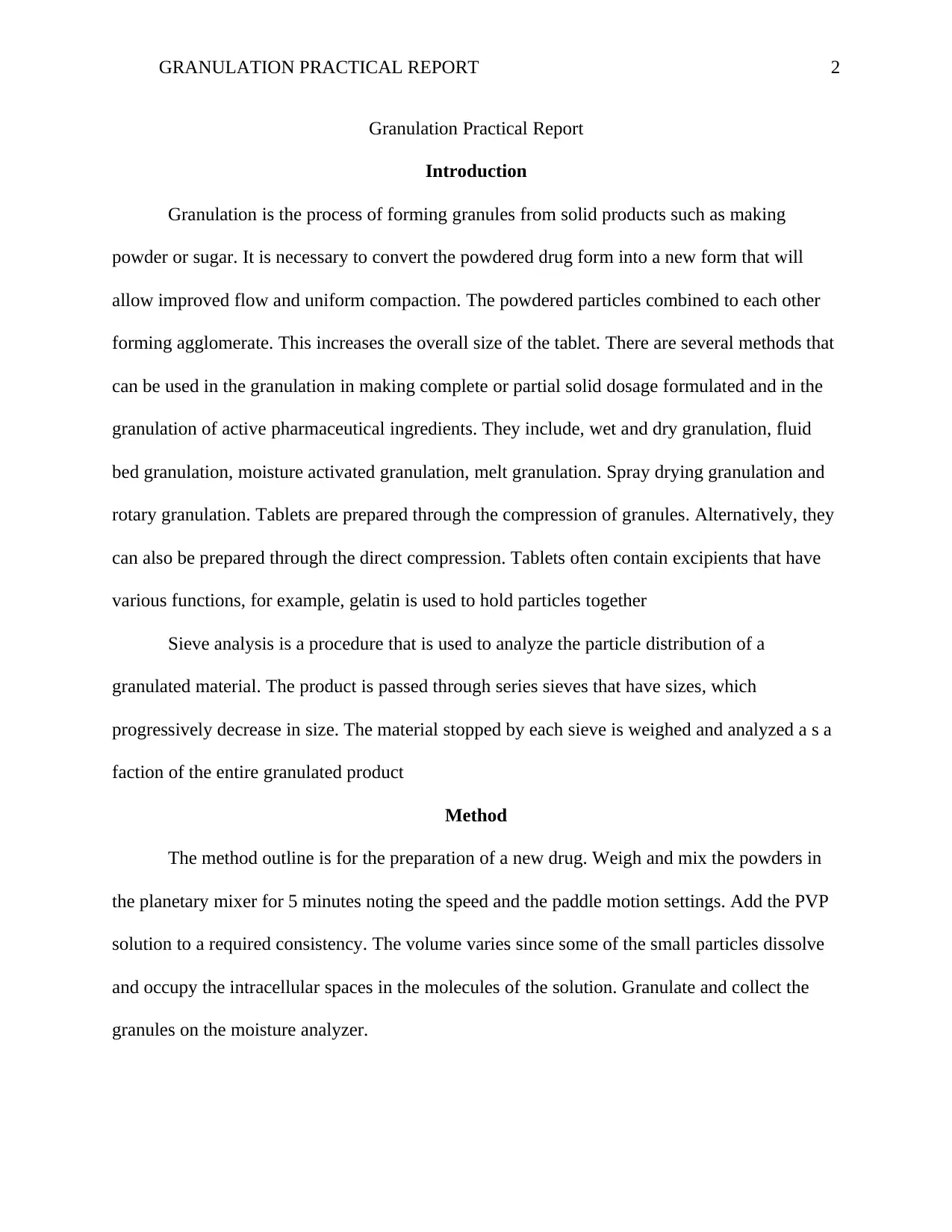
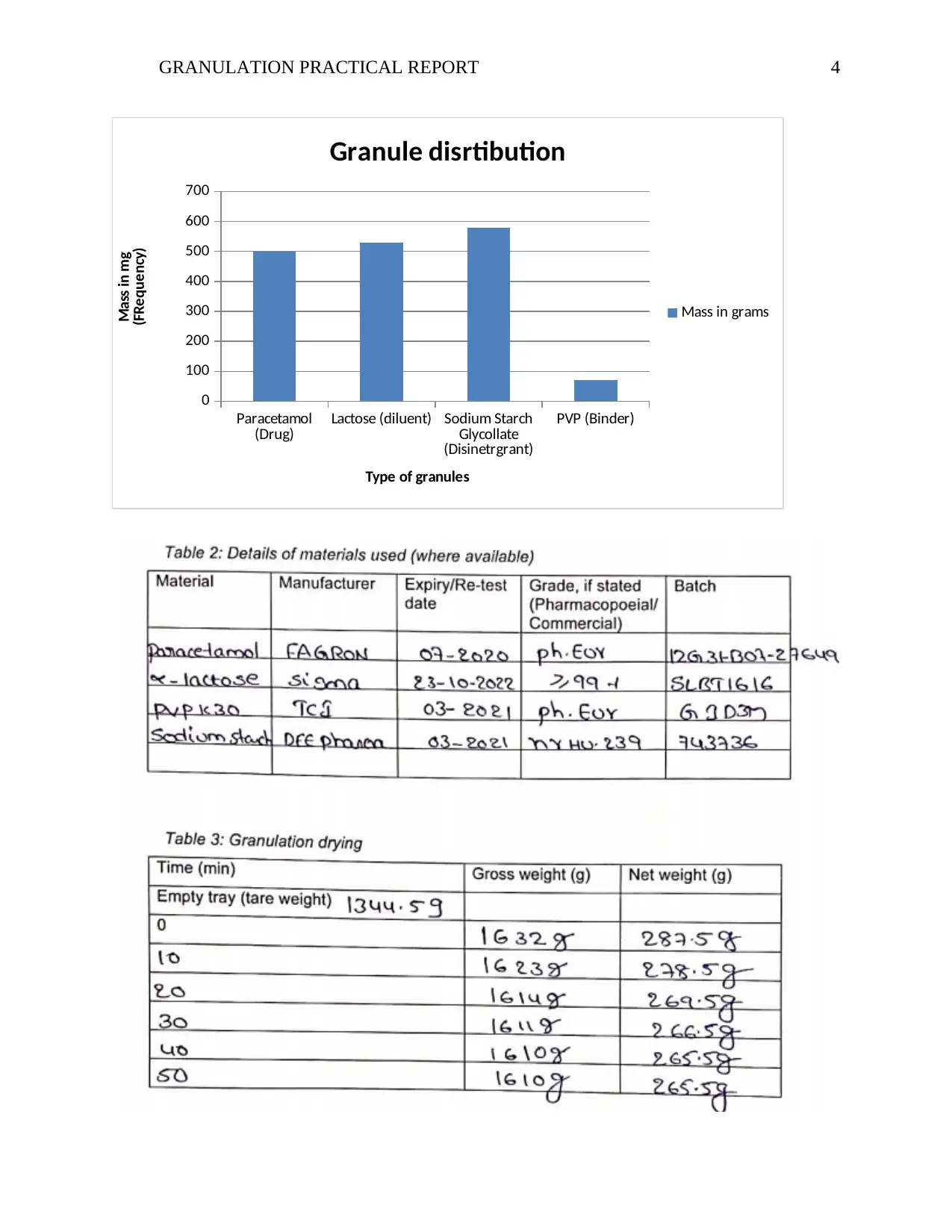
Place the tray in an oven to dry at temperature of 70°C. Note all the relevant data, for
example, batch number, expiry date, in a table. Remove and weigh the tray at selected intervals
allowing them to cool for 2miutes before weighing. Ensure that that the granules are turned over
to allow even drying. After the last point time, measure the residual solvents using a moisture
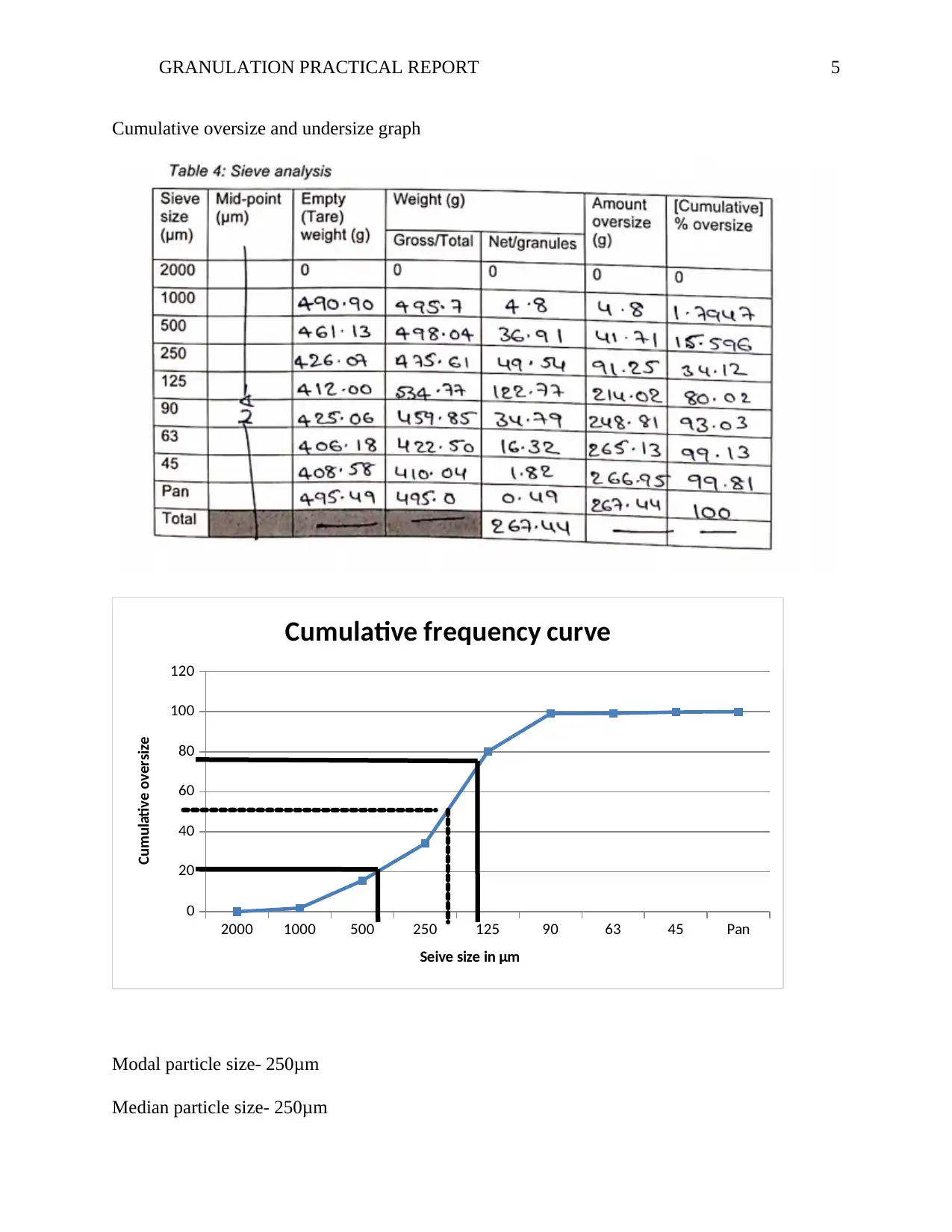
balance. Using a sieve shaker perform a sieve analysis by running the products for 5minutes.
Record all the values.
Results and Data Analysis
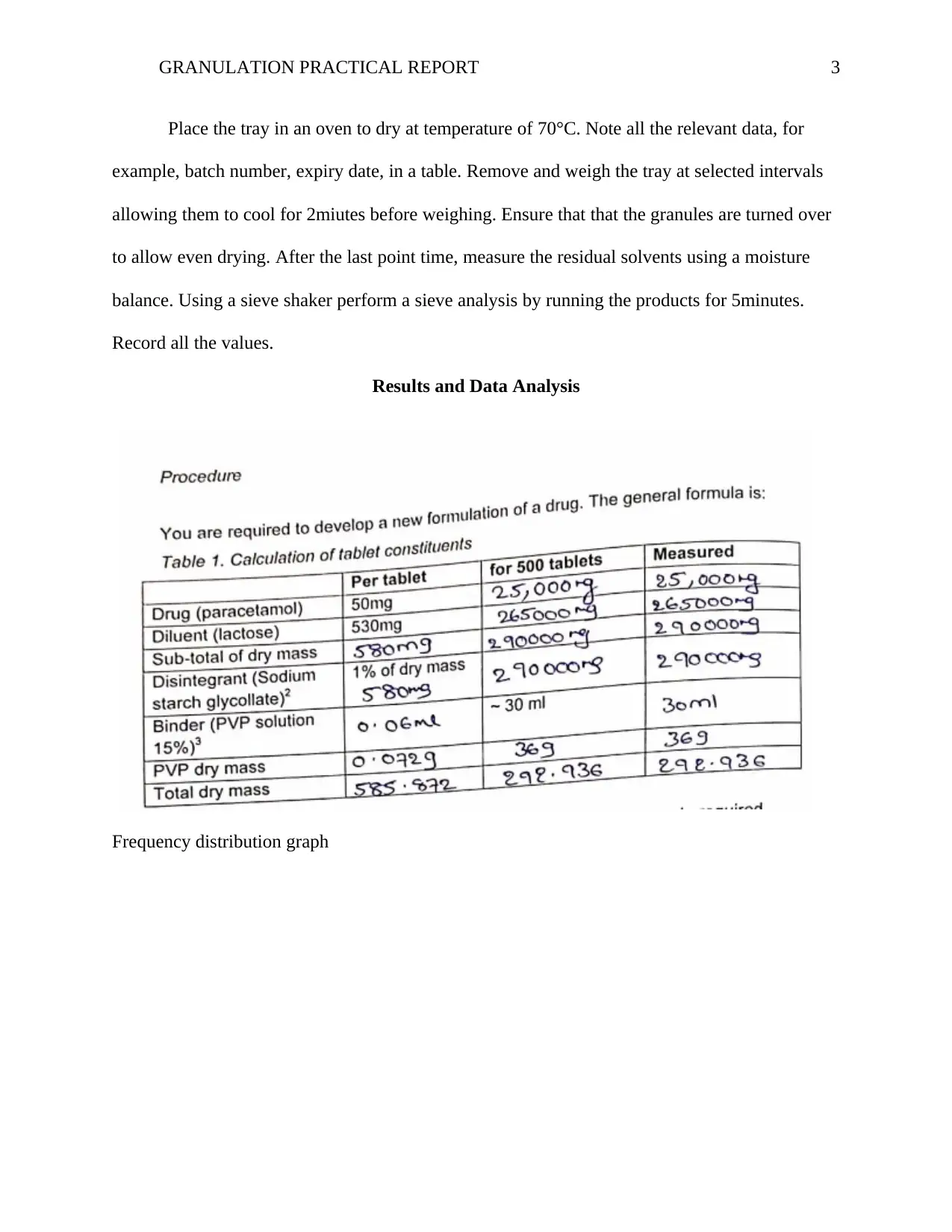
Frequency distribution graph
Document Page
GRANULATION PRACTICAL REPORT 4
Paracetamol
(Drug) Lactose (diluent) Sodium Starch
Glycollate
(Disinetrgrant)
PVP (Binder)
0
100
200
300
400
500
600
700
Granule disrtibution
Mass in grams
Type of granules
Mass in mg
(FRequency)
tabler-icon-diamond-filled.svg

Paraphrase This Document

Need a fresh take? Get an instant paraphrase of this document with our AI Paraphraser
Document Page
GRANULATION PRACTICAL REPORT 5
Cumulative oversize and undersize graph
2000 1000 500 250 125 90 63 45 Pan
0
20
40
60
80
100
120
Cumulative frequency curve
Seive size in μm
Cumulative oversize
Modal particle size- 250μm
Median particle size- 250μm
Document Page
GRANULATION PRACTICAL REPORT 6
Interquartile range- 500μm to 125μm
Discussion
The graph is a negative skew. This is because it has a long skew (tail) on the left.
The graph has a logistic kurtosis. It has its peak towards the positive sides.
The frequency distribution graph shows that Sodium starch glycolate is the most
abundant type of granules in a tablet. It has a high frequency of almost 600 g. The PVP, which is
the binder, has a low frequency and is found the least quantity in a tablet that is being developed.
The graph also shows that paracetamol and lactose are also available in high amounts
The cumulative frequency graph shows that the modal particle size is 250μm. this means
that most of the tablets that are being produced are about that size. Very few tablets have a size
below 90μm. on the other and very few particles have a size above 1000μm. Most of the tablets
range between 500μm to 125μm
Conclusion
In conclusion, granules can be produced through a dry process. However, it is preferable to
produce them through wet granulation where the wet mass is forced through a wire mesh.
Document Page
GRANULATION PRACTICAL REPORT 7
References
Fu Y, Jeong SH, Park K. Fast-melting tablets based on highly plastic granules. Journal of
controlled release. 2005 Dec 5
Fujimoto Y, Takahashi K, Hirai N, Takatani-Nakase T Preparation and Evaluation of Dispersion
Tablets through a Simple and Manufacturable Wet Granulation Method through Porous
Calcium Silicate Chemical and Pharmaceutical Bulletin 2016 Apr 1.
Kawale SR, Patel MR, inventors; Navinta LLC, assignee Direct compression and dry granulation
processes for preparing carglumic acid tablets that having less impurities than those
produced through wet granulation process. United States patent application US
10/064,826 2018 Sep 4
Politi G, Heilakka E, inventors; Atacama Labs Oy, assignee. Granules, tablets and granulation.
United States patent US 8,968,788. 2015 Mar 3.
chevron_up_icon
1 out of 7
circle_padding
hide_on_mobile
zoom_out_icon
[object Object]