PHIL 201 - Comparing Perspectives: Plato, Descartes & The Matrix

Verified

Added on  2023/05/31

|4
|928
|269
Essay
AI Summary
This essay provides a comparative analysis of the concepts of reality and illusion as explored in Plato's 'Allegory of the Cave,' Descartes' 'Meditations on First Philosophy,' and the film 'The Matrix.' It highlights the common theme of questioning perceived reality and the existence of a 'true reality' hidden from human perception. The essay discusses the conflict between perceived reality and true reality, noting differences in their resolutions. Plato suggests freedom requires external control, Descartes struggles to find truth, while Neo in 'The Matrix' achieves it, though some prefer the illusion, like Cypher. The essay further explores the preference for harsh reality over blissful ignorance, arguing for the importance of freedom and self-determination, contrasting Plato's view with Cypher's choice in 'The Matrix'. Desklib offers a wealth of resources for students seeking solved assignments and study materials.
Document Page
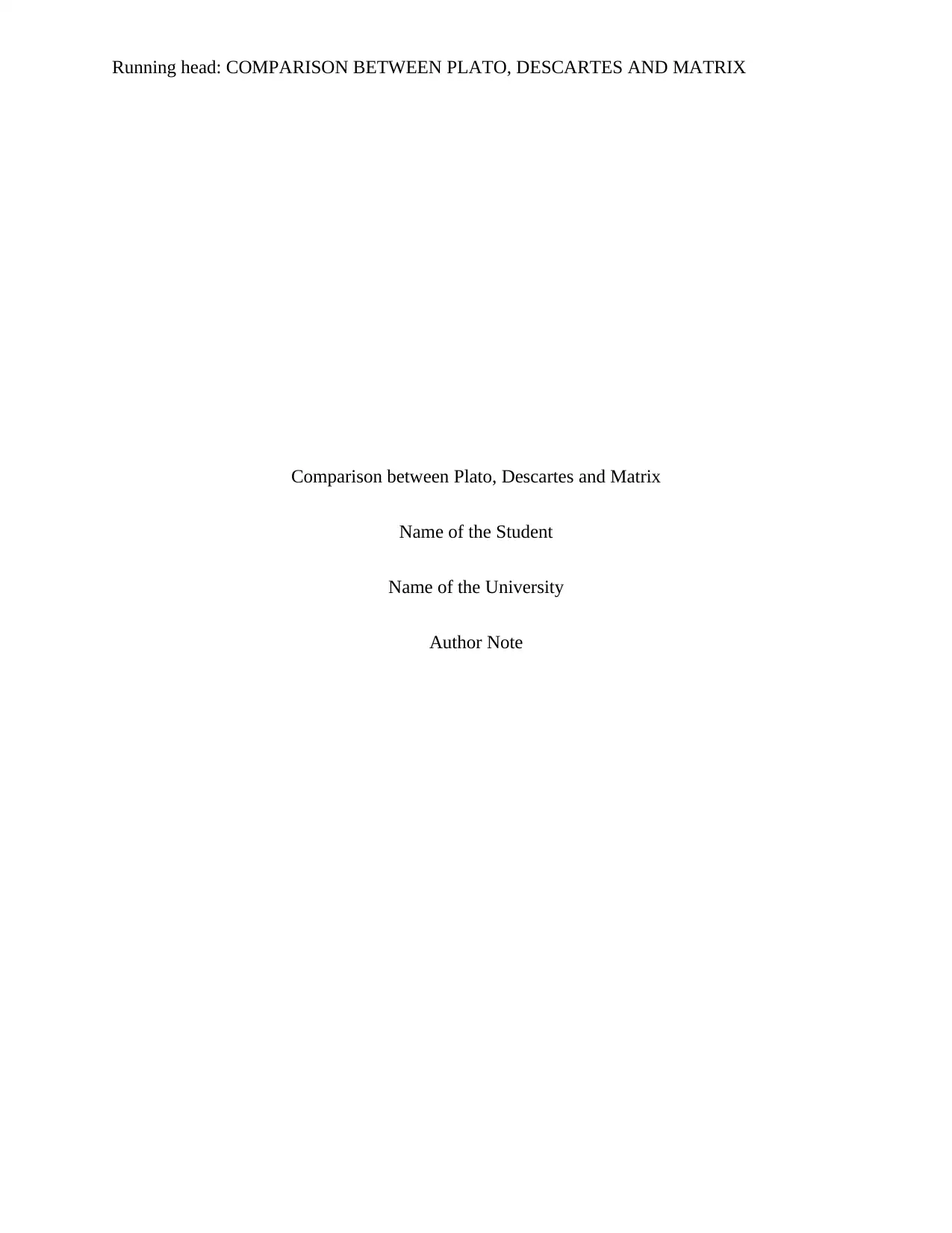
Running head: COMPARISON BETWEEN PLATO, DESCARTES AND MATRIX
Comparison between Plato, Descartes and Matrix
Name of the Student
Name of the University
Author Note
tabler-icon-diamond-filled.svg

Paraphrase This Document

Need a fresh take? Get an instant paraphrase of this document with our AI Paraphraser
Document Page
1COMPARISON BETWEEN PLATO, DESCARTES AND MATRIX
Comparison amongst The Matrix, Plato and Descartes
The confusion between reality and illusion is consistent within the philosophies of Plato
and Descartes and in the idea of the movie Matrix. Plato is known for his famous ‘Allegory of
the Cave’ where he metamorphically opines that human beings are being kept chained in a cave
(Mitchell and Lucas). The ‘reality’ that is shown to them is actually an illusion projected by
those who control the important affairs of society such as the politicians and those who control
the economic affairs of the State. He believes that these human beings should find out a way to
break free of the chains and escape the cave. Once out of the cave, they will be able to see the
actual ‘reality’ with their own eyes, guided by the light of the Sun (Friedlander). Descartes has a
similar philosophy whereby he maintains that the human beings are, in reality, kept clouded in
illusion (Descartes and Lafleur). He is of the view that certain malicious demons control this
illusion, which affects the human beings. He questions the prevailing circumstances of society in
this context (Williams). The movie Matrix is based along similar lines. Neo, a computer
programmer finds out that the ‘reality’ which he believed to be true his entire life is, in fact, an
illusion controlled by a super computer (Wachowski and Director). In all of these stories, the
main aim by the authors and the producer is to show that there exists a conflict between the
‘reality’ that is perceived by human beings and the ‘true reality’.
However, there exists some major differences between them. Plato believed that human
beings could only be free of the chains if it was so wished by the people controlling them
(Friedlander). Descartes could never find out the truth as he began to question his own logic of
reasoning (Descartes and Lafleur). Neo, in contrast, was able to find out ‘true reality’. However,
Document Page
2COMPARISON BETWEEN PLATO, DESCARTES AND MATRIX
in comparison to Plato, a character in Matrix named Cypher, wanted to stay in the illusive world
(Wachowski and Director).
Harshness of Reality versus Ignorance of Bliss
In his ‘Allegory of the Cave’, Plato believed that the human beings who were being kept
chained in the Cave, would like to escape (Peterson). Inside the Cave, they only saw the illusions
in the reflections of the shadows shown to them by their ‘masters’. In order to escape this, the
individuals need to be free of their chains and see ‘true’ reality by coming out of the Cave. Plato
was of the opinion that harsh reality, as compared to lukewarm illusion, is favorable to human
beings (Friedlander). They wanted to have a voice on the issues affecting them. In the movie
Matrix, the character of Cypher has been portrayed different. When he got to know about the
cloud of illusion that had descended over humankind, he could not cope with this knowledge
(Wachowski and Director). Thus, instead of fighting the hard battle to free himself from the
clutches of illusion, he chose to be within its sweet embrace and spend the rest of life being
controlled by someone else.
The harshness of reality is better than being in ignorance. The battle to win one’s freedom
to see the reality can be immensely challenging, both within the self and with the eternal
environment. Once the human body is suited to a certain way of life, it is very reluctant to
change the prevailing situation. However, once people are in ‘true reality’, they can be the master
of their own fate; no one else can exercise control over them. The freedom to choose one’s way
of life is the most fundamental freedom guaranteed by nature itself. Being under the control of
someone is a gross violation of this freedom. People should have the freedom to make decisions
by themselves.
Document Page
3COMPARISON BETWEEN PLATO, DESCARTES AND MATRIX
References:
Descartes, René, and Laurence J. Lafleur. Meditations on first philosophy. Indianapolis: Bobbs-
Merrill, 1960.
Friedlander, Paul. Plato: An Introduction. Princeton University Press, 2015.
Mitchell, Basil, and John Randolph Lucas. An engagement with Plato's Republic: a companion
to the Republic. Routledge, 2017.
Peterson, Valerie V. "Plato’s Allegory of the Cave: literacy and “the good”." Review of
Communication 17.4 (2017): 273-287.
Wachowski, A. and (Director). The Matrix [Motion Picture]. 1999.
Williams, Bernard. Descartes: The project of pure enquiry. Routledge, 2014.
chevron_up_icon
1 out of 4
circle_padding
hide_on_mobile
zoom_out_icon
[object Object]