Analysis Report: Phishing and Voice Phishing Attacks and Prevention

Verified

Added on  2022/12/14

|5
|724
|314
Report
AI Summary
This report examines the increasing prevalence of phishing and voice phishing attacks in the digital age, highlighting how attackers exploit technological advancements to compromise user data. The report details the common tactics employed by attackers, such as impersonating banks or organizations to steal sensitive information like credit card numbers and login credentials. It outlines the messages and techniques used to trick users into divulging personal details, emphasizing the importance of user education and awareness in mitigating these threats. The report also provides recommendations for users to resist these attacks, including verifying message authenticity and exercising caution when sharing personal information. Finally, the report concludes by summarizing the different forms of phishing, the impact on user privacy, and the significance of vigilance in preventing such attacks.
Document Page
PHISHING OR
VOICE PHISHING
tabler-icon-diamond-filled.svg

Paraphrase This Document

Need a fresh take? Get an instant paraphrase of this document with our AI Paraphraser
Document Page
Table of Contents
INTRODUCTION...........................................................................................................................3
MAIN BODY...................................................................................................................................3
What attackers typically ask and how they craft their attacks....................................................3
What messages do the attacker commonly use...........................................................................3
How do attackers trick users into entering the information........................................................4
Write your recommendations that would help users resist these attacks....................................4
CONCLUSION................................................................................................................................4
REFERENCES................................................................................................................................5
Document Page
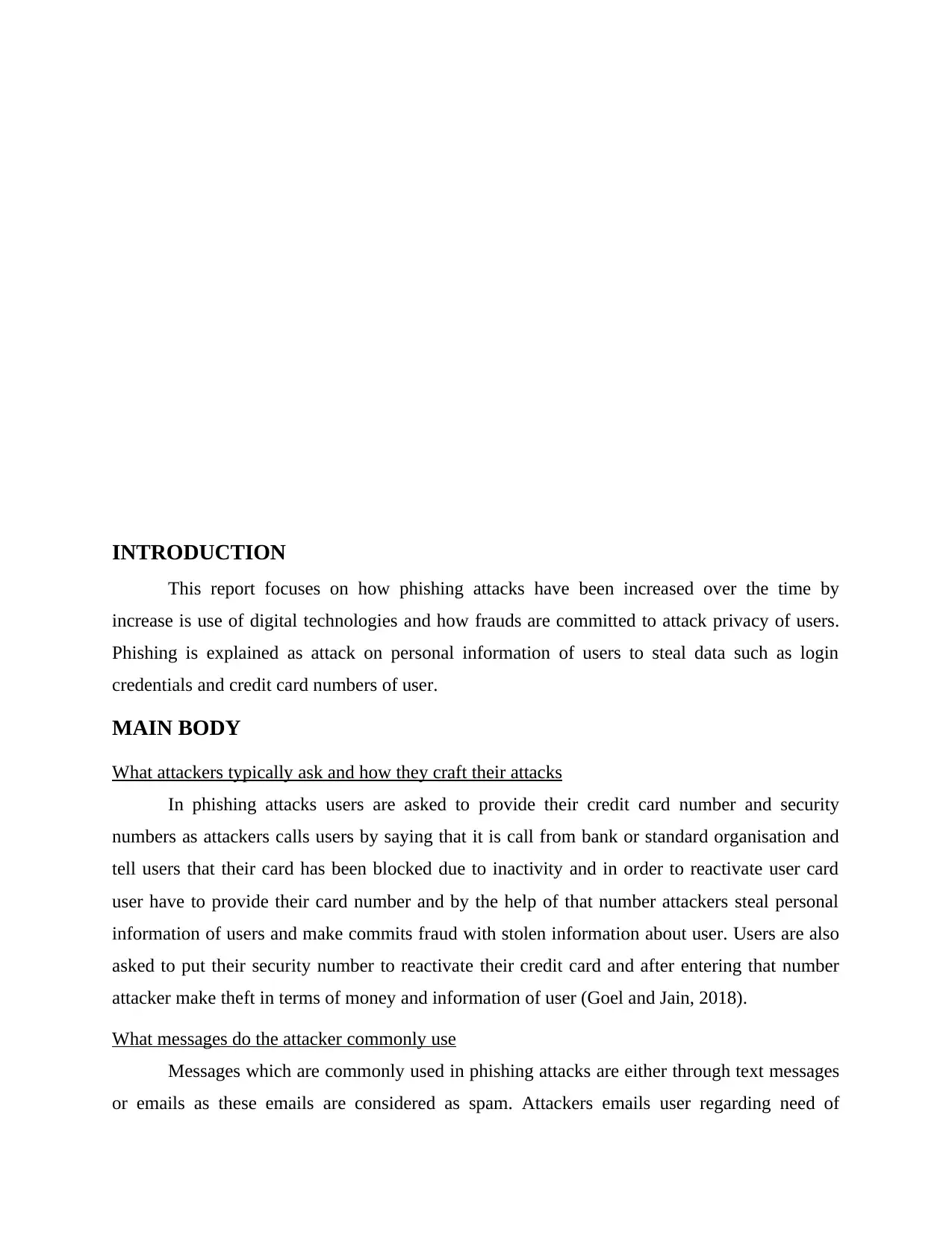
INTRODUCTION
This report focuses on how phishing attacks have been increased over the time by
increase is use of digital technologies and how frauds are committed to attack privacy of users.
Phishing is explained as attack on personal information of users to steal data such as login
credentials and credit card numbers of user.
MAIN BODY
What attackers typically ask and how they craft their attacks
In phishing attacks users are asked to provide their credit card number and security
numbers as attackers calls users by saying that it is call from bank or standard organisation and
tell users that their card has been blocked due to inactivity and in order to reactivate user card
user have to provide their card number and by the help of that number attackers steal personal
information of users and make commits fraud with stolen information about user. Users are also
asked to put their security number to reactivate their credit card and after entering that number
attacker make theft in terms of money and information of user (Goel and Jain, 2018).
What messages do the attacker commonly use
Messages which are commonly used in phishing attacks are either through text messages
or emails as these emails are considered as spam. Attackers emails user regarding need of
Document Page
particular number or detail for unblocking credit or debit card. When user puts their credit card
number attackers can access personal information of user and also attackers can use personal
informatio of user to commit frauds and crimes. Most common phishing message are sent by
email which is sent to million users and those users are asked to put in their personal details.
How do attackers trick users into entering the information
Attackers trick users into entering information by sending spam messages at email of
users and focuses on getting data of user which can be a username or password of user account.
Classic scheme of scam involves sending an email to users which looks like a message from any
major bank and when users click the link which is provided in email user is redirected to a
malicious site which is designed similar to bank website and when user enter its username and
password attackers gets all personal information of user which can be used by attacker (Gupta,
Arachchilage and Psannis, 2018).
Write your recommendations that would help users resist these attacks
These attacks can be reduced by educating users about these types of attacks and
providing them proper information about these attacks from different modes. Users can resist
these attacks by checking authenticity of messages. Users should be aware about information
which is entered by them and after checking and ensuring authenticity information should be
provided by user (Peng, Harris and Sawa, 2018).
CONCLUSION
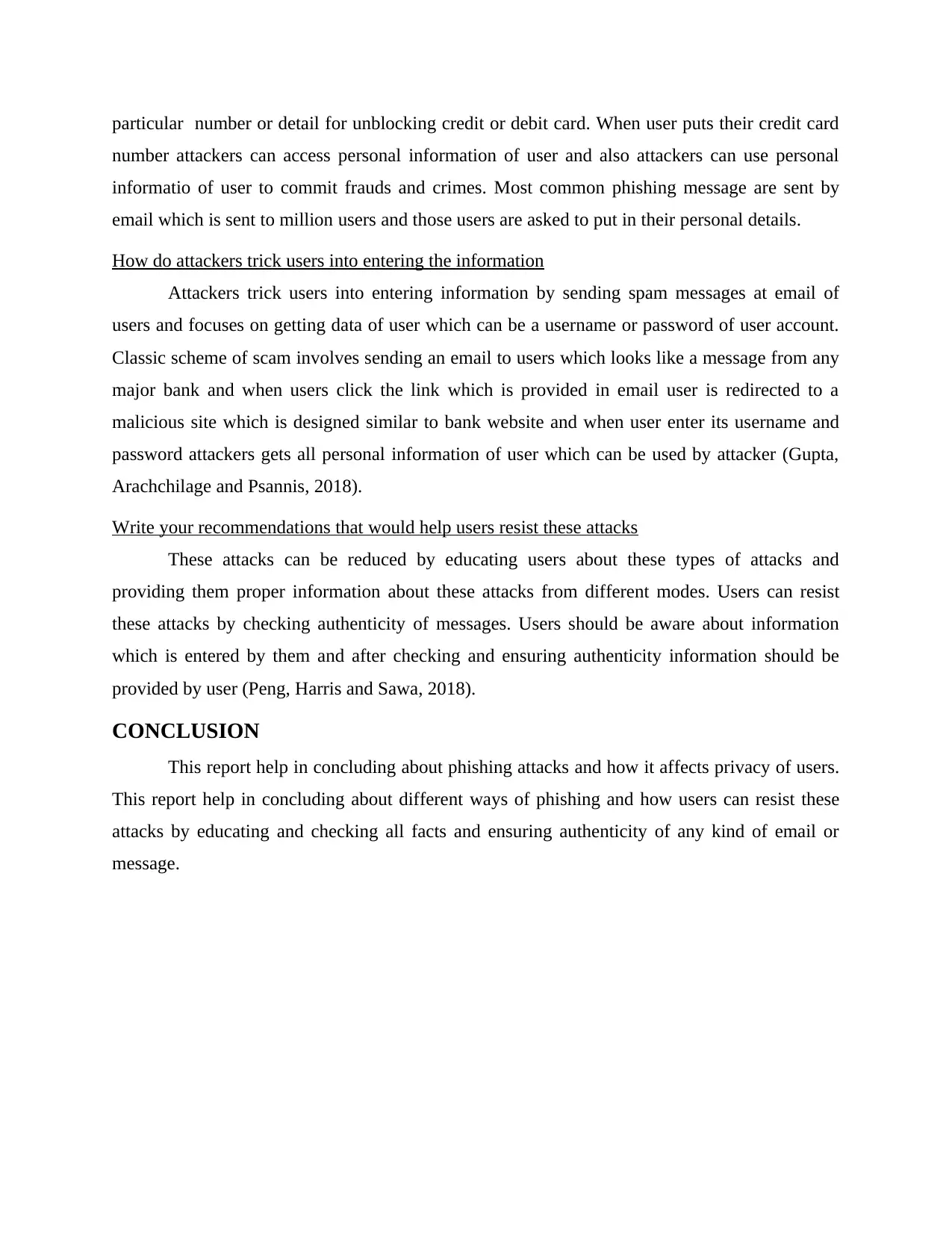
This report help in concluding about phishing attacks and how it affects privacy of users.
This report help in concluding about different ways of phishing and how users can resist these
attacks by educating and checking all facts and ensuring authenticity of any kind of email or
message.
tabler-icon-diamond-filled.svg

Paraphrase This Document

Need a fresh take? Get an instant paraphrase of this document with our AI Paraphraser
Document Page
REFERENCES
Books and Journals
Goel, D. and Jain, A. K., 2018. Mobile phishing attacks and defence mechanisms: State of art
and open research challenges. Computers & Security. 73. pp.519-544.
Gupta, B. B., Arachchilage, N. A. and Psannis, K. E., 2018. Defending against phishing attacks:
taxonomy of methods, current issues and future directions. Telecommunication Systems.
67(2). pp.247-267.
Peng, T., Harris, I. and Sawa, Y., 2018, January. Detecting phishing attacks using natural
language processing and machine learning. In 2018 ieee 12th international conference on
semantic computing (icsc) (pp. 300-301). IEEE.
chevron_up_icon
1 out of 5
circle_padding
hide_on_mobile
zoom_out_icon
[object Object]