Phosphoric Acid Corrosion: Mechanisms, Damage and Prevention
VerifiedAdded on 2023/06/14
|20
|4416
|344
Report
AI Summary
This report provides a comprehensive analysis of phosphoric acid corrosion, covering its various forms, mechanisms, affected materials and equipment, and the resulting damage. It details how phosphoric acid interacts with ferrous metals and alloys, leading to corrosion, and discusses the role of factors like temperature and impurities in accelerating the process. The report also explores prevention strategies, including the use of protective coatings and appropriate alloy selection, to mitigate the impact of corrosion on industrial equipment and infrastructure. Visual examples and case studies illustrate the effects of phosphoric acid corrosion on different materials, emphasizing the importance of corrosion resistance in maintaining the integrity and lifespan of metallic structures. This document is available on Desklib, a platform that offers a wide range of study resources for students.

Running Head: Corrosion
Corrosion
Corrosion

Paraphrase This Document
Need a fresh take? Get an instant paraphrase of this document with our AI Paraphraser
Corrosion 1
Table of Contents
Introduction...........................................................................................................................................2
Forms of corrosion................................................................................................................................2
Mechanism of the corrosion form..........................................................................................................4
Affected Materials and equipment.........................................................................................................5
Appearance or Damage due to corrosion...............................................................................................7
Prevention............................................................................................................................................12
Conclusion...........................................................................................................................................15
References...........................................................................................................................................16
Table of Contents
Introduction...........................................................................................................................................2
Forms of corrosion................................................................................................................................2
Mechanism of the corrosion form..........................................................................................................4
Affected Materials and equipment.........................................................................................................5
Appearance or Damage due to corrosion...............................................................................................7
Prevention............................................................................................................................................12
Conclusion...........................................................................................................................................15
References...........................................................................................................................................16
Corrosion 2
Introduction
In this report brief description about the phosphoric acid corrosion is discussed how it
occurs, what are the different forms of phosphoric acid corrosion, ways to protect the element
from phosphoric acid corrosion and what is the damage associated with this type of
corrosion. A detail study about the effects of phosphoric acid on the metal is carried out.
Generally, corrosion is treated as a breakdown of metals but with time it causes metals to
disappear thus it is necessary to protect metals from corrosion. There are various factors
associated with phosphoric acid corrosion which contribute in the corrosion of metal. Hence,
where protective measures are discussed to maximize the lifespan of metals and improve
their functionality.
Forms of corrosion
It is a universal phenomenon that is present in every sector. There are various lose due to
phosphoric acid corrosion and are caused by chemicals and electrochemical means present in
the environment (Kain, 2016). Various forms how phosphoric acid gets corroded:
Phosphoric acid gets corroded with ferrous metals and alloys that decompose
whenever it reacts with high temperature. It also reacts with alcohol and produce high
toxic flames.
Phosphoric acid is also used among food products especially like sodas. This form of
phosphoric acid has a divergent effect on kidney and bones. The salt is formed by
replacing the hydrogen atom from its structure. It was also researched that different
forms of phosphoric acid originate from crude acid present it the rocks. These can
also be created by hydrating the phosphorous oxide.
Introduction
In this report brief description about the phosphoric acid corrosion is discussed how it
occurs, what are the different forms of phosphoric acid corrosion, ways to protect the element
from phosphoric acid corrosion and what is the damage associated with this type of
corrosion. A detail study about the effects of phosphoric acid on the metal is carried out.
Generally, corrosion is treated as a breakdown of metals but with time it causes metals to
disappear thus it is necessary to protect metals from corrosion. There are various factors
associated with phosphoric acid corrosion which contribute in the corrosion of metal. Hence,
where protective measures are discussed to maximize the lifespan of metals and improve
their functionality.
Forms of corrosion
It is a universal phenomenon that is present in every sector. There are various lose due to
phosphoric acid corrosion and are caused by chemicals and electrochemical means present in
the environment (Kain, 2016). Various forms how phosphoric acid gets corroded:
Phosphoric acid gets corroded with ferrous metals and alloys that decompose
whenever it reacts with high temperature. It also reacts with alcohol and produce high
toxic flames.
Phosphoric acid is also used among food products especially like sodas. This form of
phosphoric acid has a divergent effect on kidney and bones. The salt is formed by
replacing the hydrogen atom from its structure. It was also researched that different
forms of phosphoric acid originate from crude acid present it the rocks. These can
also be created by hydrating the phosphorous oxide.
⊘ This is a preview!⊘
Do you want full access?
Subscribe today to unlock all pages.

Trusted by 1+ million students worldwide
Corrosion 3
There are different forms of phosphoric acid and the corrosion depends on the
impurities present in them. Wet phosphoric acid is used as a cleaning agent abut can
attack gold.
The material used in the construction of phosphoric acid is described. This process
goes through combustion of phosphoric acid and form P2O5 which reacts with water
to form the acid. It was stated that acceleration of phosphoric acid corrosion is due to
various metals and the temperature present at the time of process. The impurities
present in the gas stream and the mist in it causes corrosion. Whenever a high
concentrated phosphoric acid is made in the laboratories corrosion issues arises. This
also states that when phosphoric acid is exposed with stainless steel corrosion
increases.
Specially, discussing about the Phosphoric Acid Corrosion it is treated as a disease that is
associated with using phosphoric acid as a crystal. Wet phosphoric acid is very dangerous as
compared to dry phosphoric acid as it doesn’t cause any corrosion (Blanc, Lavelle &
Mankowski, 2010). This type of corrosion is generally seen in dead zone are where wet acid
is easily released. To prevent this type of corrosion alloy 20 or water level to 340L is needed.
It affects some chemical processes and hydrocarbon processes. The only reason of corrosion
via Phosphoric Acid Corrosion is water and temperature. These two factors lead to aggressive
corrosion. This corrosion is formed by reaction of water with pure chemicals with the
presence of saturated air. This is strongly corrosive for ferrous alloys thus it is essential to
protect all the steel equipment’s used in the manufacturing of Phosphoric acid (Zhang, et. al,
2016).
There are different forms of phosphoric acid and the corrosion depends on the
impurities present in them. Wet phosphoric acid is used as a cleaning agent abut can
attack gold.
The material used in the construction of phosphoric acid is described. This process
goes through combustion of phosphoric acid and form P2O5 which reacts with water
to form the acid. It was stated that acceleration of phosphoric acid corrosion is due to
various metals and the temperature present at the time of process. The impurities
present in the gas stream and the mist in it causes corrosion. Whenever a high
concentrated phosphoric acid is made in the laboratories corrosion issues arises. This
also states that when phosphoric acid is exposed with stainless steel corrosion
increases.
Specially, discussing about the Phosphoric Acid Corrosion it is treated as a disease that is
associated with using phosphoric acid as a crystal. Wet phosphoric acid is very dangerous as
compared to dry phosphoric acid as it doesn’t cause any corrosion (Blanc, Lavelle &
Mankowski, 2010). This type of corrosion is generally seen in dead zone are where wet acid
is easily released. To prevent this type of corrosion alloy 20 or water level to 340L is needed.
It affects some chemical processes and hydrocarbon processes. The only reason of corrosion
via Phosphoric Acid Corrosion is water and temperature. These two factors lead to aggressive
corrosion. This corrosion is formed by reaction of water with pure chemicals with the
presence of saturated air. This is strongly corrosive for ferrous alloys thus it is essential to
protect all the steel equipment’s used in the manufacturing of Phosphoric acid (Zhang, et. al,
2016).
Paraphrase This Document
Need a fresh take? Get an instant paraphrase of this document with our AI Paraphraser
Corrosion 4
Mechanism of the phosphoric acid corrosion
The phosphoric acid corrosion form was standardized by the potentiometric acid
water. The concentration medium is around1.0M and this type of acid is also used to remove
rust by converting it to carbon dioxide to a form which gets dissolved in water easily. In this
section focusing more about how phosphoric acid corrosion is formed and how it affects the
productivity. Firstly generalizing, how corrosion is formed due to metal or oxygen present in
the atmosphere or electrolyte. There are few metals that have natural tendency to get
corroded thus to reduce that they need to be stored separately (Indira, et. al, 2015). Corrosion
can be formed by phosphoric acid in two ways; one is occurring over an entire surface area or
attacking at a single localised surface. This is very difficult to prevent before it actually
happens. This corrosion is formed due to reduction-oxidation reaction between the metals
(Oskooie, Motlagh & Aghajani, 2016).
Phosphoric acid is considered as incompatible with caustics and reacts with metals
fast that leads to formation of hydrogen gas. Phosphoric acid is also known as Meta
phosphoric or white phosphoric (Helle, 2015). These acids are also produced by electric
furnace method to remove the impurities from the acid. The pure form of phosphorus acid is
similar to dilute sulphuric acid as it doesn’t have oxidizing power. Based on some
experimental outcomes predictions, it was stated that formation of Pbj(PO4)2 is an
transitional state in the corrosion of Pb to PbO2. This appears very reasonable as provision
for this mechanism is attained by formation of Pbj(PO4)2 layers on Pb electrodes. PbO2 is
oxidized in the form of H2SO4 so that rate of discharged can be studied from PbO to PbSO4.
According to the thermodynamic model it was assumed that POD2 can be designed
by anodizing lead electrode in the solution containing phosphate. Therefore, whenever a pure
lead electrode is engraved in acetic acid just for 30 sec (Thomas, et. al, 2015). A pure form of
lead sheet is usually pre-treated for one hr. in the similar way as Pb3 film is done.
Mechanism of the phosphoric acid corrosion
The phosphoric acid corrosion form was standardized by the potentiometric acid
water. The concentration medium is around1.0M and this type of acid is also used to remove
rust by converting it to carbon dioxide to a form which gets dissolved in water easily. In this
section focusing more about how phosphoric acid corrosion is formed and how it affects the
productivity. Firstly generalizing, how corrosion is formed due to metal or oxygen present in
the atmosphere or electrolyte. There are few metals that have natural tendency to get
corroded thus to reduce that they need to be stored separately (Indira, et. al, 2015). Corrosion
can be formed by phosphoric acid in two ways; one is occurring over an entire surface area or
attacking at a single localised surface. This is very difficult to prevent before it actually
happens. This corrosion is formed due to reduction-oxidation reaction between the metals
(Oskooie, Motlagh & Aghajani, 2016).
Phosphoric acid is considered as incompatible with caustics and reacts with metals
fast that leads to formation of hydrogen gas. Phosphoric acid is also known as Meta
phosphoric or white phosphoric (Helle, 2015). These acids are also produced by electric
furnace method to remove the impurities from the acid. The pure form of phosphorus acid is
similar to dilute sulphuric acid as it doesn’t have oxidizing power. Based on some
experimental outcomes predictions, it was stated that formation of Pbj(PO4)2 is an
transitional state in the corrosion of Pb to PbO2. This appears very reasonable as provision
for this mechanism is attained by formation of Pbj(PO4)2 layers on Pb electrodes. PbO2 is
oxidized in the form of H2SO4 so that rate of discharged can be studied from PbO to PbSO4.
According to the thermodynamic model it was assumed that POD2 can be designed
by anodizing lead electrode in the solution containing phosphate. Therefore, whenever a pure
lead electrode is engraved in acetic acid just for 30 sec (Thomas, et. al, 2015). A pure form of
lead sheet is usually pre-treated for one hr. in the similar way as Pb3 film is done.
Corrosion 5
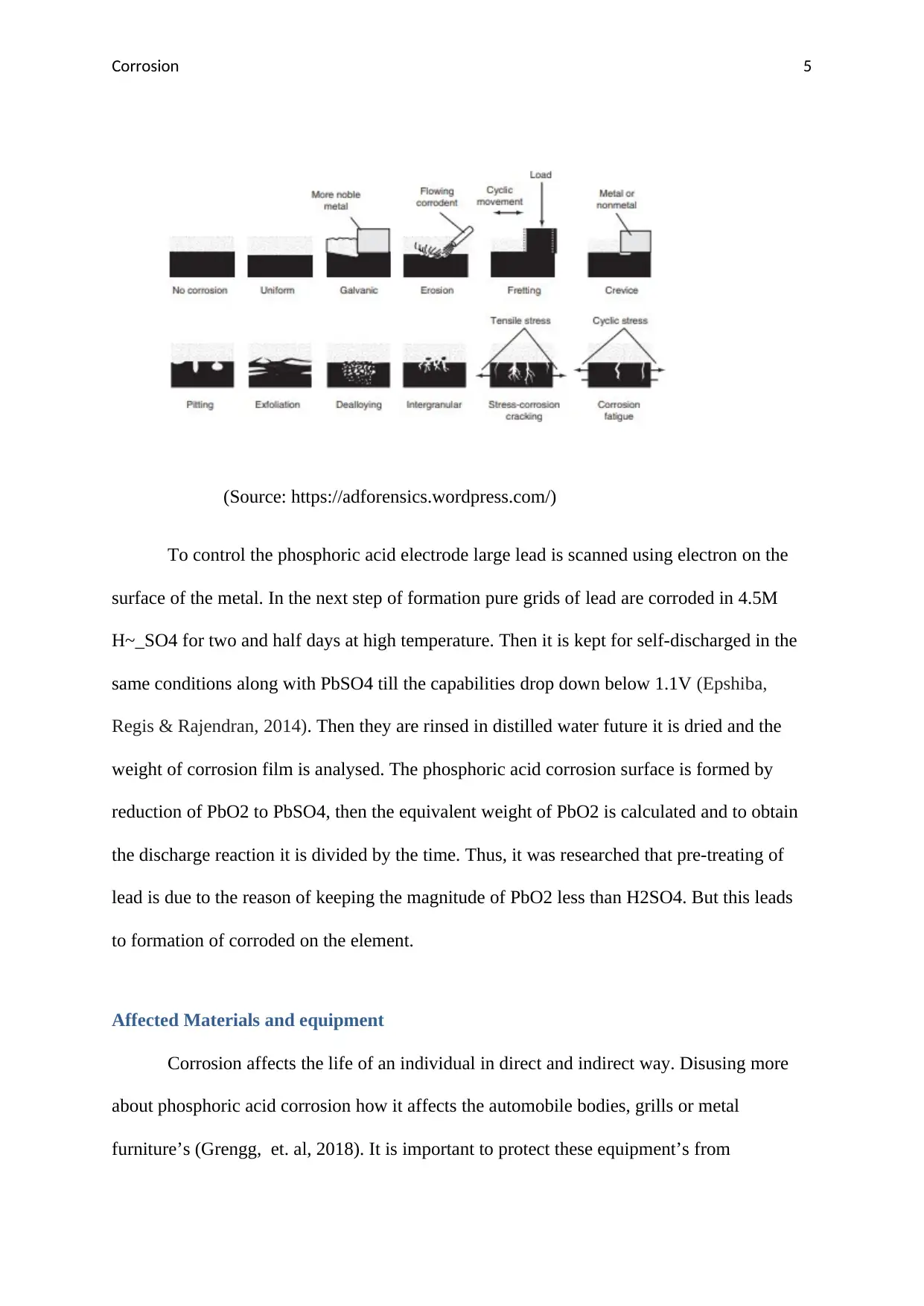
(Source: https://adforensics.wordpress.com/)
To control the phosphoric acid electrode large lead is scanned using electron on the
surface of the metal. In the next step of formation pure grids of lead are corroded in 4.5M
H~_SO4 for two and half days at high temperature. Then it is kept for self-discharged in the
same conditions along with PbSO4 till the capabilities drop down below 1.1V (Epshiba,
Regis & Rajendran, 2014). Then they are rinsed in distilled water future it is dried and the
weight of corrosion film is analysed. The phosphoric acid corrosion surface is formed by
reduction of PbO2 to PbSO4, then the equivalent weight of PbO2 is calculated and to obtain
the discharge reaction it is divided by the time. Thus, it was researched that pre-treating of
lead is due to the reason of keeping the magnitude of PbO2 less than H2SO4. But this leads
to formation of corroded on the element.
Affected Materials and equipment
Corrosion affects the life of an individual in direct and indirect way. Disusing more
about phosphoric acid corrosion how it affects the automobile bodies, grills or metal
furniture’s (Grengg, et. al, 2018). It is important to protect these equipment’s from
(Source: https://adforensics.wordpress.com/)
To control the phosphoric acid electrode large lead is scanned using electron on the
surface of the metal. In the next step of formation pure grids of lead are corroded in 4.5M
H~_SO4 for two and half days at high temperature. Then it is kept for self-discharged in the
same conditions along with PbSO4 till the capabilities drop down below 1.1V (Epshiba,
Regis & Rajendran, 2014). Then they are rinsed in distilled water future it is dried and the
weight of corrosion film is analysed. The phosphoric acid corrosion surface is formed by
reduction of PbO2 to PbSO4, then the equivalent weight of PbO2 is calculated and to obtain
the discharge reaction it is divided by the time. Thus, it was researched that pre-treating of
lead is due to the reason of keeping the magnitude of PbO2 less than H2SO4. But this leads
to formation of corroded on the element.
Affected Materials and equipment
Corrosion affects the life of an individual in direct and indirect way. Disusing more
about phosphoric acid corrosion how it affects the automobile bodies, grills or metal
furniture’s (Grengg, et. al, 2018). It is important to protect these equipment’s from
⊘ This is a preview!⊘
Do you want full access?
Subscribe today to unlock all pages.
Trusted by 1+ million students worldwide
Corrosion 6
phosphoric acid corrosion, this could be done by painting the tools. Phosphoric acid corrosion
is seen on steel results in entire failure of the product. It can be a dangerous for businesses
and governments as they go through huge losses because of corrosion. Corrosion in industry
affects equipment’s and products used in the organisation (Li, et. al, 2015).
The material should be choose in a right way so that it doesn’t cause any failure to the
metals and alloys as every metal has a unique and integral corrosion behaviour that range
from high resistance that is gold and silver to the low corrosion of active metals like sodium
and magnesium. The material made with these elements has greater chances of corrosion
(Vasu, et. al, 2017). Furthermore, the resistance of phosphoric acid corrosion is directly
related to the environment to which it is exposed (Yi, et. al, 2016). The chemical
composition of the equipment, the temperature of the surroundings, the chemical
composition, and velocity all contributes in the corrosion factor. Any kind of corrosion is a
real threat to the reliability of personal property as well all the public roads and
infrastructures (Mameng, et. al, 2016).
But there are various alloys available that provide resistance to corrosion and provide
innovative ideas to specialize in resistance to corrosion in small parts to large custom
components. Any atom that is composed of helium or non-metals which have properties like
shinning of metal or malleability that means it can be easily moulded in any shape, or which
act as an excellent conductor. Due to corrosion these metals are destroyed. Whenever oxygen
reacts with such metals an oxide layer is formed above the metals. For some metal oxide
layer acts a protective layer and for some metals like iron or steel they create a serious
problem of corrosion. It creates a layer of rust that keeps on penetrating in the system by
exploding the other metals and at last diminishes the entire metal due to corrosion.
phosphoric acid corrosion, this could be done by painting the tools. Phosphoric acid corrosion
is seen on steel results in entire failure of the product. It can be a dangerous for businesses
and governments as they go through huge losses because of corrosion. Corrosion in industry
affects equipment’s and products used in the organisation (Li, et. al, 2015).
The material should be choose in a right way so that it doesn’t cause any failure to the
metals and alloys as every metal has a unique and integral corrosion behaviour that range
from high resistance that is gold and silver to the low corrosion of active metals like sodium
and magnesium. The material made with these elements has greater chances of corrosion
(Vasu, et. al, 2017). Furthermore, the resistance of phosphoric acid corrosion is directly
related to the environment to which it is exposed (Yi, et. al, 2016). The chemical
composition of the equipment, the temperature of the surroundings, the chemical
composition, and velocity all contributes in the corrosion factor. Any kind of corrosion is a
real threat to the reliability of personal property as well all the public roads and
infrastructures (Mameng, et. al, 2016).
But there are various alloys available that provide resistance to corrosion and provide
innovative ideas to specialize in resistance to corrosion in small parts to large custom
components. Any atom that is composed of helium or non-metals which have properties like
shinning of metal or malleability that means it can be easily moulded in any shape, or which
act as an excellent conductor. Due to corrosion these metals are destroyed. Whenever oxygen
reacts with such metals an oxide layer is formed above the metals. For some metal oxide
layer acts a protective layer and for some metals like iron or steel they create a serious
problem of corrosion. It creates a layer of rust that keeps on penetrating in the system by
exploding the other metals and at last diminishes the entire metal due to corrosion.
Paraphrase This Document
Need a fresh take? Get an instant paraphrase of this document with our AI Paraphraser
Corrosion 7
The phenomena of phosphoric acid corrosion lead to formation of rust on metal.
Metals are covered with the layer of rust that is due to corrosion and it is necessary to have a
corrosion resistance of metal. As metals are highly reactive due to the electrons present in
their valence shell and when they have chemical reaction they lose their electrons from
valence shell (Lamaka, et. al, 2016). Due to phosphoric acid corrosion metals are destroyed
even when explored in the atmosphere, as they react with moisture in the atmosphere and
form metallic oxide which degrades the metal. There are processes which are used to convert
the corroded metal back to normal condition by using metallurgy. The weakening of metallic
shallow because of corrosion decreases the effectiveness of the equipment which in turn
causes financial loss to the industries. Therefore it is very important to know the
characteristics of metal and avoid the conditions which may lead to corrosion (Cao, et. al,
2015).
Appearance or Damage due to corrosion
It is not only metals that suffer from corrosion but elements like rubber, plastic or
ceramics are subjected to environmental degradation. Even some body parts in human body
can suffer from environmental damage and lead to some severe disease like cancer, diabetes
or cardio disease (Wang, et. al, 2015). The damage caused by phosphoric acid corrosion is
loss of entire material, cost of maintenance, loss of metal safety and reliability. The direct
loses caused by this corrosion is cost, time and material. Indirect loss includes contamination
of product, loss of production or leakage of valuable products. In case of large industries it
damages property as corrosion attacks large machines, bridges, tanks and pipelines. It was
estimated that annually every industry suffer financial loss due to corrosion (Yasir, et. al,
2017).
The phenomena of phosphoric acid corrosion lead to formation of rust on metal.
Metals are covered with the layer of rust that is due to corrosion and it is necessary to have a
corrosion resistance of metal. As metals are highly reactive due to the electrons present in
their valence shell and when they have chemical reaction they lose their electrons from
valence shell (Lamaka, et. al, 2016). Due to phosphoric acid corrosion metals are destroyed
even when explored in the atmosphere, as they react with moisture in the atmosphere and
form metallic oxide which degrades the metal. There are processes which are used to convert
the corroded metal back to normal condition by using metallurgy. The weakening of metallic
shallow because of corrosion decreases the effectiveness of the equipment which in turn
causes financial loss to the industries. Therefore it is very important to know the
characteristics of metal and avoid the conditions which may lead to corrosion (Cao, et. al,
2015).
Appearance or Damage due to corrosion
It is not only metals that suffer from corrosion but elements like rubber, plastic or
ceramics are subjected to environmental degradation. Even some body parts in human body
can suffer from environmental damage and lead to some severe disease like cancer, diabetes
or cardio disease (Wang, et. al, 2015). The damage caused by phosphoric acid corrosion is
loss of entire material, cost of maintenance, loss of metal safety and reliability. The direct
loses caused by this corrosion is cost, time and material. Indirect loss includes contamination
of product, loss of production or leakage of valuable products. In case of large industries it
damages property as corrosion attacks large machines, bridges, tanks and pipelines. It was
estimated that annually every industry suffer financial loss due to corrosion (Yasir, et. al,
2017).
Corrosion 8
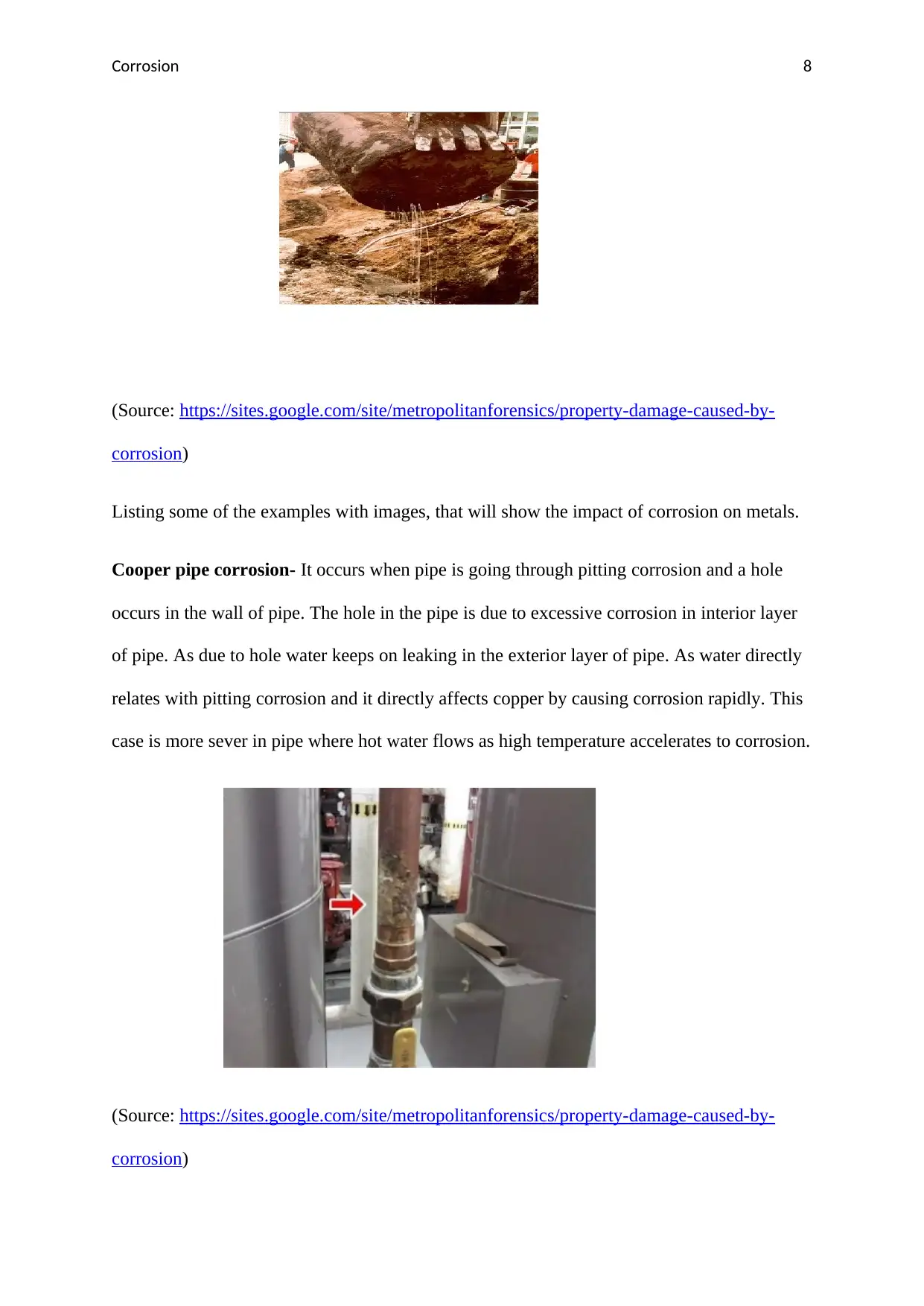
(Source: https://sites.google.com/site/metropolitanforensics/property-damage-caused-by-
corrosion)
Listing some of the examples with images, that will show the impact of corrosion on metals.
Cooper pipe corrosion- It occurs when pipe is going through pitting corrosion and a hole
occurs in the wall of pipe. The hole in the pipe is due to excessive corrosion in interior layer
of pipe. As due to hole water keeps on leaking in the exterior layer of pipe. As water directly
relates with pitting corrosion and it directly affects copper by causing corrosion rapidly. This
case is more sever in pipe where hot water flows as high temperature accelerates to corrosion.
(Source: https://sites.google.com/site/metropolitanforensics/property-damage-caused-by-
corrosion)
(Source: https://sites.google.com/site/metropolitanforensics/property-damage-caused-by-
corrosion)
Listing some of the examples with images, that will show the impact of corrosion on metals.
Cooper pipe corrosion- It occurs when pipe is going through pitting corrosion and a hole
occurs in the wall of pipe. The hole in the pipe is due to excessive corrosion in interior layer
of pipe. As due to hole water keeps on leaking in the exterior layer of pipe. As water directly
relates with pitting corrosion and it directly affects copper by causing corrosion rapidly. This
case is more sever in pipe where hot water flows as high temperature accelerates to corrosion.
(Source: https://sites.google.com/site/metropolitanforensics/property-damage-caused-by-
corrosion)
⊘ This is a preview!⊘
Do you want full access?
Subscribe today to unlock all pages.
Trusted by 1+ million students worldwide
Corrosion 9
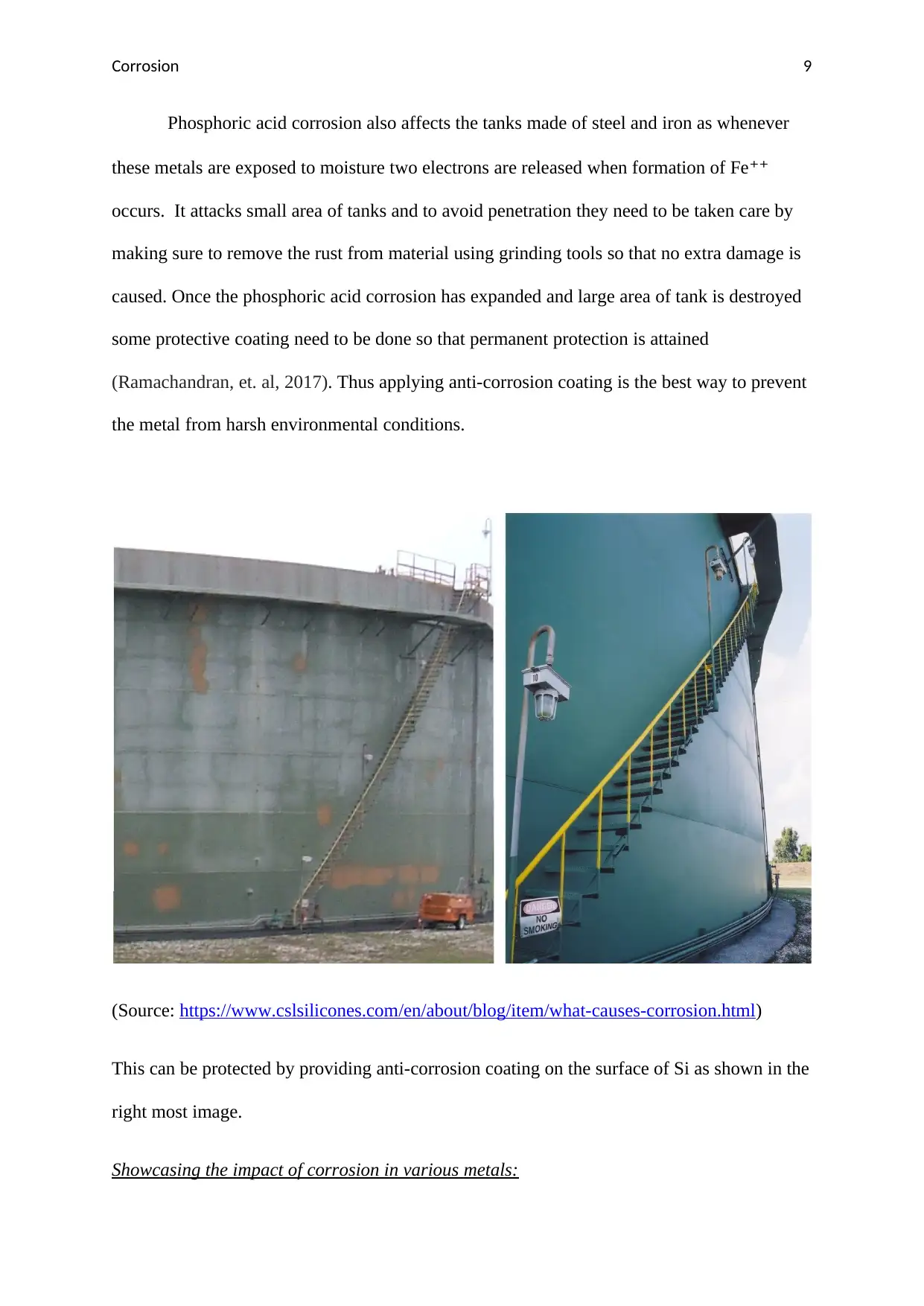
Phosphoric acid corrosion also affects the tanks made of steel and iron as whenever
these metals are exposed to moisture two electrons are released when formation of Fe⁺⁺
occurs. It attacks small area of tanks and to avoid penetration they need to be taken care by
making sure to remove the rust from material using grinding tools so that no extra damage is
caused. Once the phosphoric acid corrosion has expanded and large area of tank is destroyed
some protective coating need to be done so that permanent protection is attained
(Ramachandran, et. al, 2017). Thus applying anti-corrosion coating is the best way to prevent
the metal from harsh environmental conditions.
(Source: https://www.cslsilicones.com/en/about/blog/item/what-causes-corrosion.html)
This can be protected by providing anti-corrosion coating on the surface of Si as shown in the
right most image.
Showcasing the impact of corrosion in various metals:
Phosphoric acid corrosion also affects the tanks made of steel and iron as whenever
these metals are exposed to moisture two electrons are released when formation of Fe⁺⁺
occurs. It attacks small area of tanks and to avoid penetration they need to be taken care by
making sure to remove the rust from material using grinding tools so that no extra damage is
caused. Once the phosphoric acid corrosion has expanded and large area of tank is destroyed
some protective coating need to be done so that permanent protection is attained
(Ramachandran, et. al, 2017). Thus applying anti-corrosion coating is the best way to prevent
the metal from harsh environmental conditions.
(Source: https://www.cslsilicones.com/en/about/blog/item/what-causes-corrosion.html)
This can be protected by providing anti-corrosion coating on the surface of Si as shown in the
right most image.
Showcasing the impact of corrosion in various metals:
Paraphrase This Document
Need a fresh take? Get an instant paraphrase of this document with our AI Paraphraser
Corrosion 10
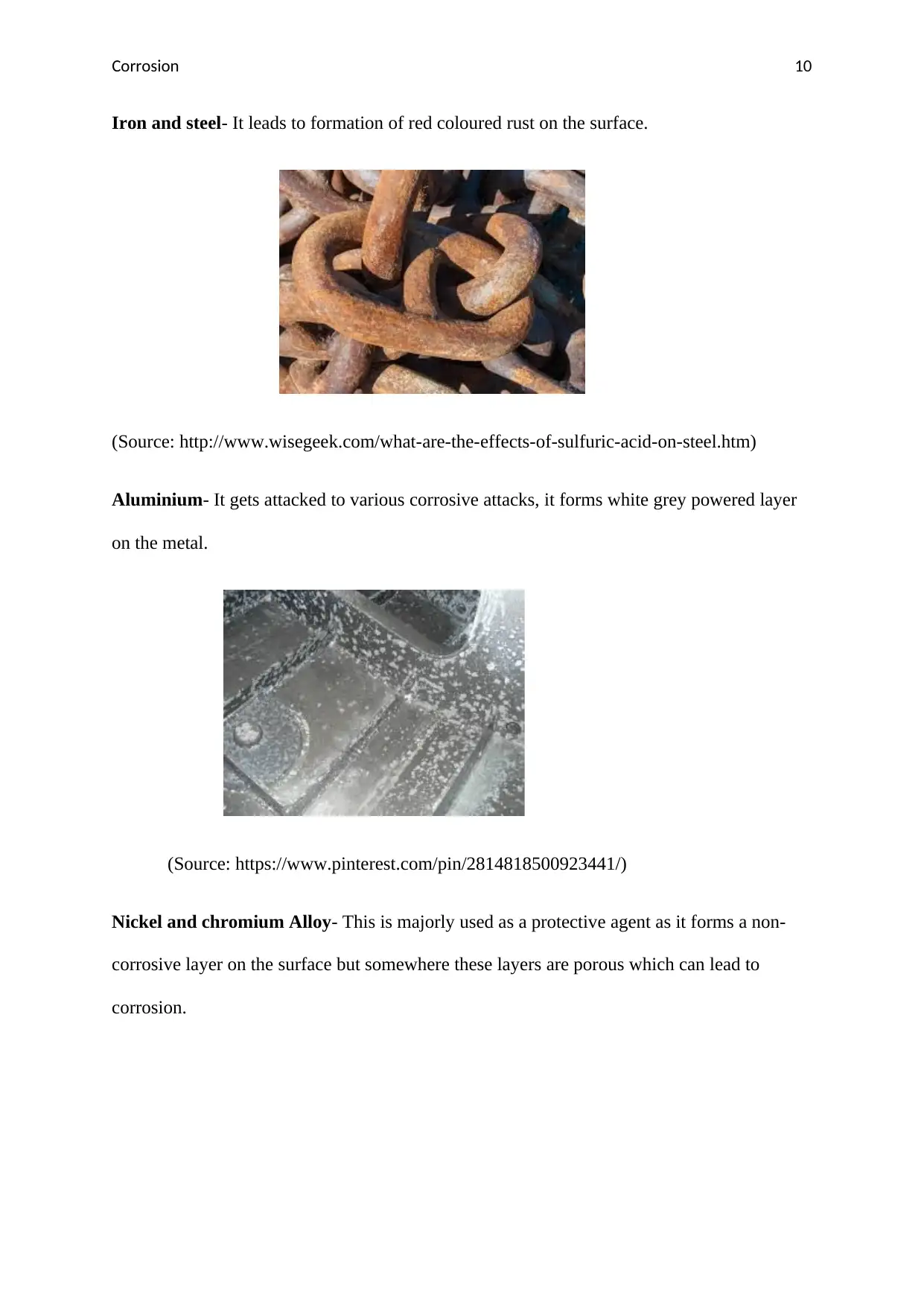
Iron and steel- It leads to formation of red coloured rust on the surface.
(Source: http://www.wisegeek.com/what-are-the-effects-of-sulfuric-acid-on-steel.htm)
Aluminium- It gets attacked to various corrosive attacks, it forms white grey powered layer
on the metal.
(Source: https://www.pinterest.com/pin/2814818500923441/)
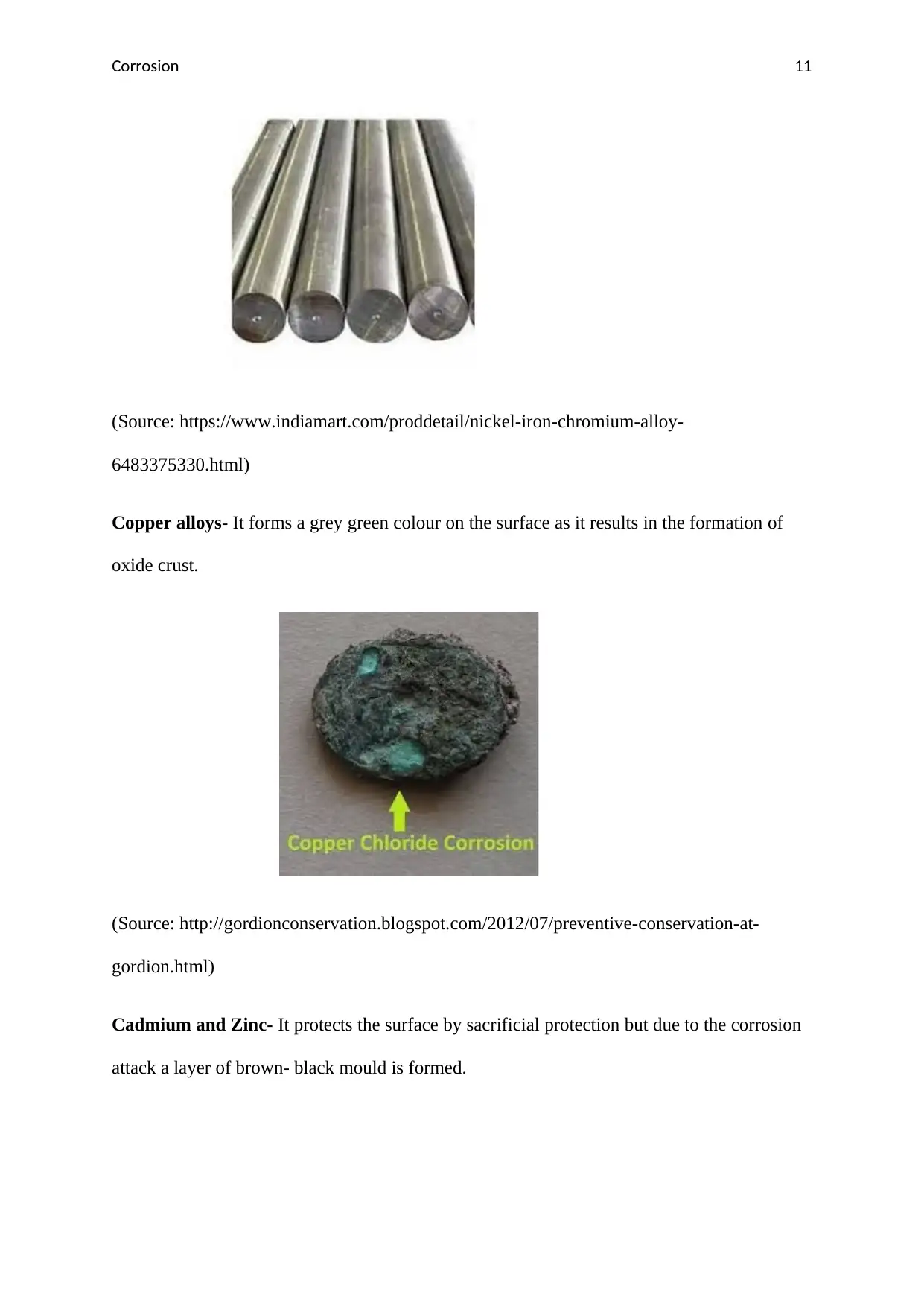
Nickel and chromium Alloy- This is majorly used as a protective agent as it forms a non-
corrosive layer on the surface but somewhere these layers are porous which can lead to
corrosion.
Iron and steel- It leads to formation of red coloured rust on the surface.
(Source: http://www.wisegeek.com/what-are-the-effects-of-sulfuric-acid-on-steel.htm)
Aluminium- It gets attacked to various corrosive attacks, it forms white grey powered layer
on the metal.
(Source: https://www.pinterest.com/pin/2814818500923441/)
Nickel and chromium Alloy- This is majorly used as a protective agent as it forms a non-
corrosive layer on the surface but somewhere these layers are porous which can lead to
corrosion.
Corrosion 11
(Source: https://www.indiamart.com/proddetail/nickel-iron-chromium-alloy-
6483375330.html)
Copper alloys- It forms a grey green colour on the surface as it results in the formation of
oxide crust.
(Source: http://gordionconservation.blogspot.com/2012/07/preventive-conservation-at-
gordion.html)
Cadmium and Zinc- It protects the surface by sacrificial protection but due to the corrosion
attack a layer of brown- black mould is formed.
(Source: https://www.indiamart.com/proddetail/nickel-iron-chromium-alloy-
6483375330.html)
Copper alloys- It forms a grey green colour on the surface as it results in the formation of
oxide crust.
(Source: http://gordionconservation.blogspot.com/2012/07/preventive-conservation-at-
gordion.html)
Cadmium and Zinc- It protects the surface by sacrificial protection but due to the corrosion
attack a layer of brown- black mould is formed.
⊘ This is a preview!⊘
Do you want full access?
Subscribe today to unlock all pages.
Trusted by 1+ million students worldwide

1 out of 20


Related Documents


Your All-in-One AI-Powered Toolkit for Academic Success.
+13062052269
info@desklib.com
Available 24*7 on WhatsApp / Email
![[object Object]](/_next/static/media/star-bottom.7253800d.svg)
Unlock your academic potential
Copyright © 2020–2025 A2Z Services. All Rights Reserved. Developed and managed by ZUCOL.