University Photography Assignment: Social Reform Through Photography

Verified

Added on  2022/09/18

|6
|698
|38
Homework Assignment
AI Summary
This assignment explores the use of photography as a tool for social reform, focusing on the works of Lewis Hine and Jacob Riis. The assignment analyzes the distinct approaches of these photographers, highlighting how Hine's sympathetic style contrasted with Riis's method of capturing moments to expose social and political corruption. Furthermore, the assignment discusses the Resettlement Administration (RA) and its use of photography during the Depression era, showcasing photographers like Walker Evans and Dorothea Lange, who documented the lives of rural Americans. The analysis includes the techniques employed by the photographers, such as dramatization and the use of eye-level camera angles, to evoke sympathy and support for social reform initiatives. The assignment draws from the course readings to support the analysis.
Document Page
Running head: PHOTOGRAPHY IN SOCIAL REFORMATION
PHOTOGRAPHY IN SOCIAL REFORMATION
Name of the student:
Name of the university:
Author Note:
tabler-icon-diamond-filled.svg

Paraphrase This Document

Need a fresh take? Get an instant paraphrase of this document with our AI Paraphraser
Document Page
1PHOTOGRAPHY IN SOCIAL REFORMATION
Table of Contents
Answer 1....................................................................................................................................2
Answer 2....................................................................................................................................3
References..................................................................................................................................5
Document Page
2PHOTOGRAPHY IN SOCIAL REFORMATION
Answer 1
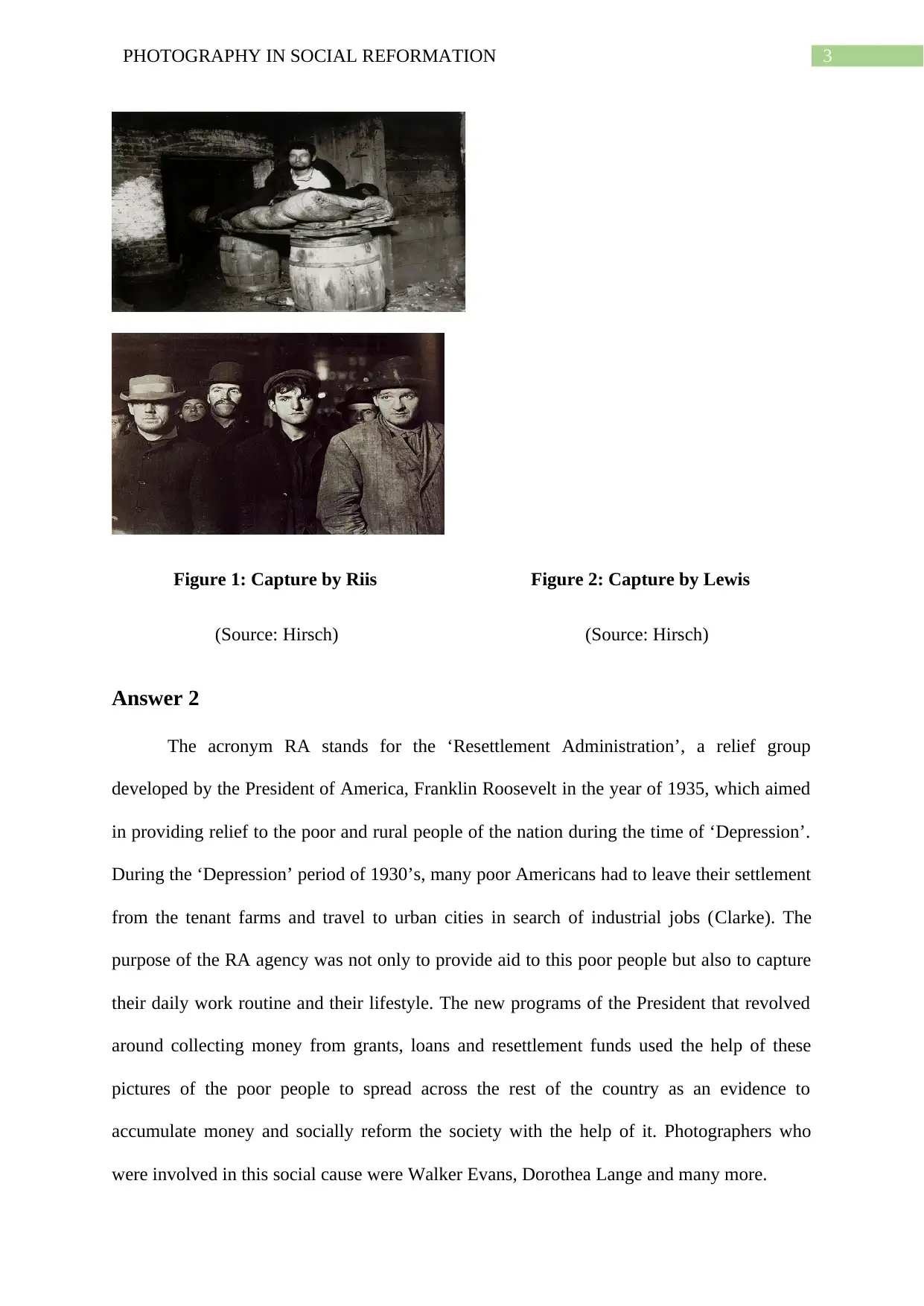
Lewis Hine, a renowned sociologist from University of Columbia used sympathetic
style of photography as a method to prove that the new migrants were deprived from any kind
of social benefits and were hold responsible for crimes and corruption they did not even
commit. Furthermore, he had the urge to change the laws of child labour in America and thus
visited factories in disguise to shoot pictures. He incorporated the technique of capturing
pictures of the migrants in their natural state where they are not even aware of the camera
(Hirsch). Thus, in his pictures the objects were the centre of focus and created a prominent
presence that resonated through the photograph.
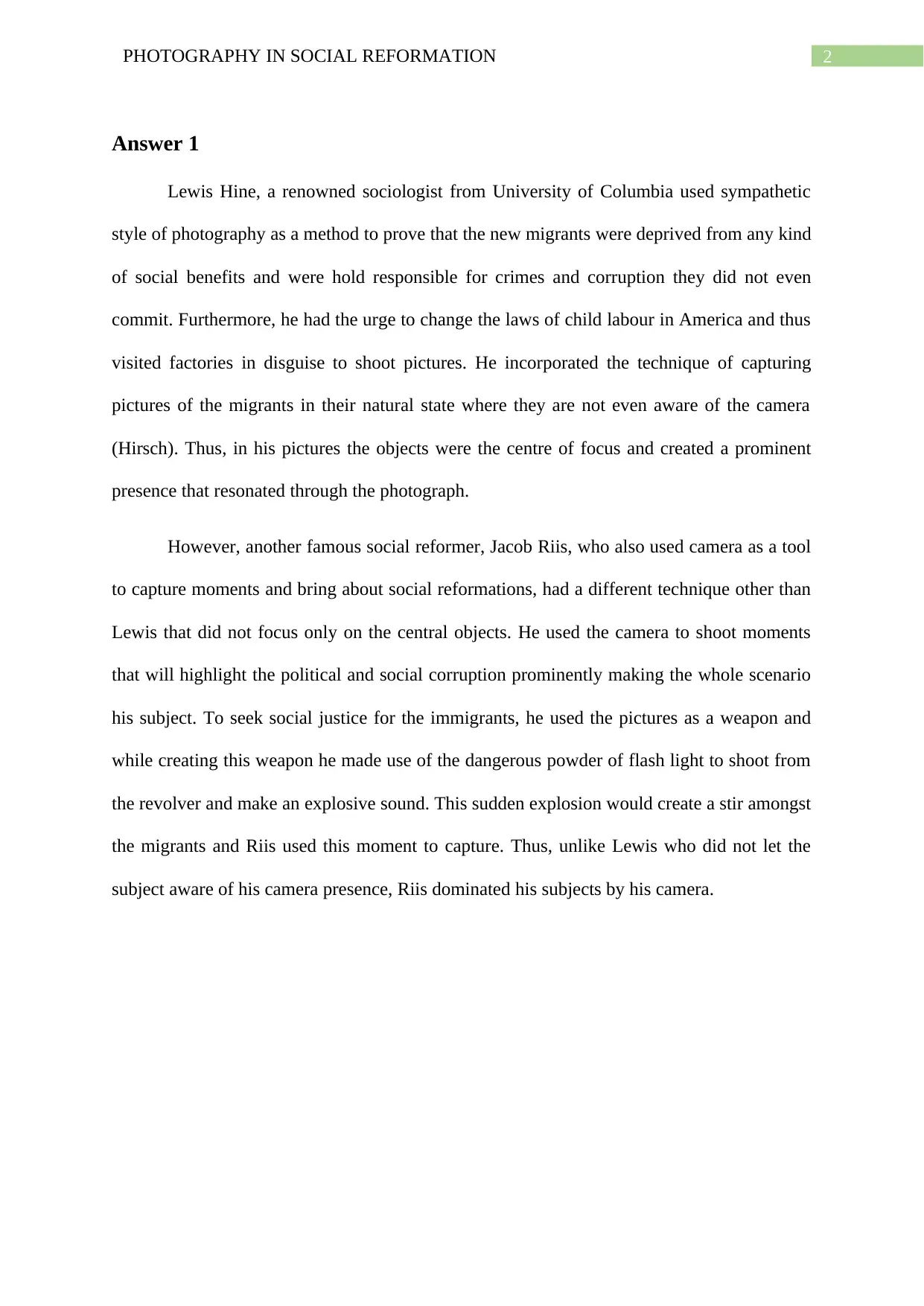
However, another famous social reformer, Jacob Riis, who also used camera as a tool
to capture moments and bring about social reformations, had a different technique other than
Lewis that did not focus only on the central objects. He used the camera to shoot moments
that will highlight the political and social corruption prominently making the whole scenario
his subject. To seek social justice for the immigrants, he used the pictures as a weapon and
while creating this weapon he made use of the dangerous powder of flash light to shoot from
the revolver and make an explosive sound. This sudden explosion would create a stir amongst
the migrants and Riis used this moment to capture. Thus, unlike Lewis who did not let the
subject aware of his camera presence, Riis dominated his subjects by his camera.
Document Page
3PHOTOGRAPHY IN SOCIAL REFORMATION
Figure 1: Capture by Riis Figure 2: Capture by Lewis
(Source: Hirsch) (Source: Hirsch)
Answer 2
The acronym RA stands for the ‘Resettlement Administration’, a relief group
developed by the President of America, Franklin Roosevelt in the year of 1935, which aimed
in providing relief to the poor and rural people of the nation during the time of ‘Depression’.
During the ‘Depression’ period of 1930’s, many poor Americans had to leave their settlement
from the tenant farms and travel to urban cities in search of industrial jobs (Clarke). The
purpose of the RA agency was not only to provide aid to this poor people but also to capture
their daily work routine and their lifestyle. The new programs of the President that revolved
around collecting money from grants, loans and resettlement funds used the help of these
pictures of the poor people to spread across the rest of the country as an evidence to
accumulate money and socially reform the society with the help of it. Photographers who
were involved in this social cause were Walker Evans, Dorothea Lange and many more.
tabler-icon-diamond-filled.svg

Paraphrase This Document

Need a fresh take? Get an instant paraphrase of this document with our AI Paraphraser
Document Page
4PHOTOGRAPHY IN SOCIAL REFORMATION
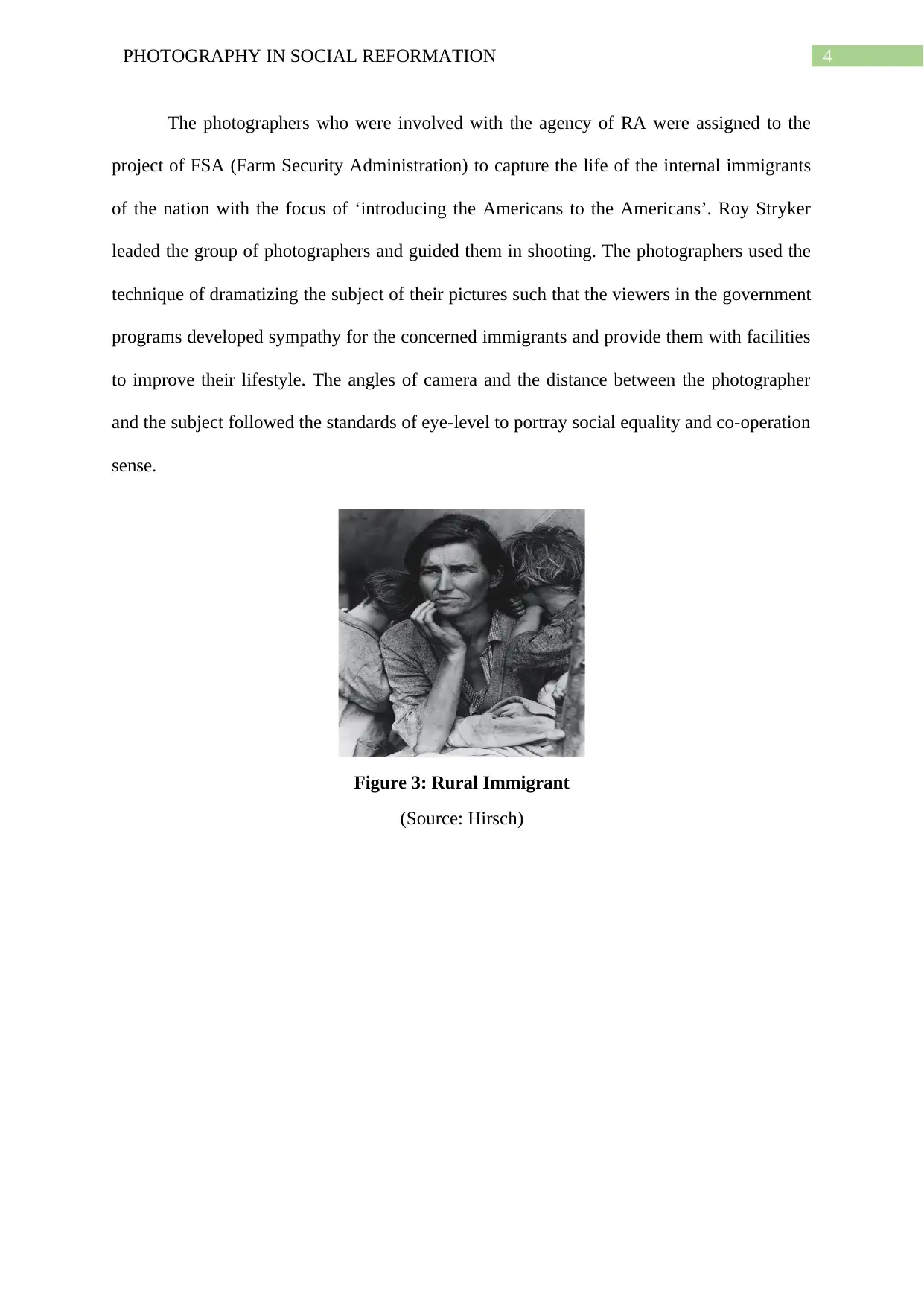
The photographers who were involved with the agency of RA were assigned to the
project of FSA (Farm Security Administration) to capture the life of the internal immigrants
of the nation with the focus of ‘introducing the Americans to the Americans’. Roy Stryker
leaded the group of photographers and guided them in shooting. The photographers used the
technique of dramatizing the subject of their pictures such that the viewers in the government
programs developed sympathy for the concerned immigrants and provide them with facilities
to improve their lifestyle. The angles of camera and the distance between the photographer
and the subject followed the standards of eye-level to portray social equality and co-operation
sense.
Figure 3: Rural Immigrant
(Source: Hirsch)
Document Page
5PHOTOGRAPHY IN SOCIAL REFORMATION
References
Clarke, Graham. The photograph. Oxford History of Art (Paperba, 1997.
Hirsch, Robert. Seizing the Light: A Social & Aesthetic History of Photography. Taylor &
Francis, 2017.
chevron_up_icon
1 out of 6
circle_padding
hide_on_mobile
zoom_out_icon
[object Object]