Deakin University HBS108 Assignment 1: Physical Activity Analysis

Verified

Added on  2020/07/23

|11
|1820
|418
Homework Assignment
AI Summary
This assignment analyzes physical activity patterns among Australian adults, focusing on age and gender differences. The solution begins by defining variables related to physical activity and compares activity levels between males and females, highlighting that males are more active. It then examines the proportion of age groups engaged in physical activity, showing a decline with age, and identifies the 20-year-old age group as a focus for promoting physical activity. The research study is quantitative, employing statistical tools. The assignment analyzes results, revealing significant mean differences between younger and older adults in terms of barriers to exercise. Ethical principles for health research are outlined, and factors affecting physical activity, such as time constraints and societal perceptions, are discussed. The assignment includes a search for a research article on neighborhood facilities and physical activity, along with recommendations for interventions to increase physical activity levels, such as fostering athletic images, government initiatives, and promotional campaigns. The assignment concludes with references to relevant books, journals, and online resources.
Document Page
SOURCING, IDENTIFYING AND
EVALUATION
tabler-icon-diamond-filled.svg

Paraphrase This Document

Need a fresh take? Get an instant paraphrase of this document with our AI Paraphraser
Document Page
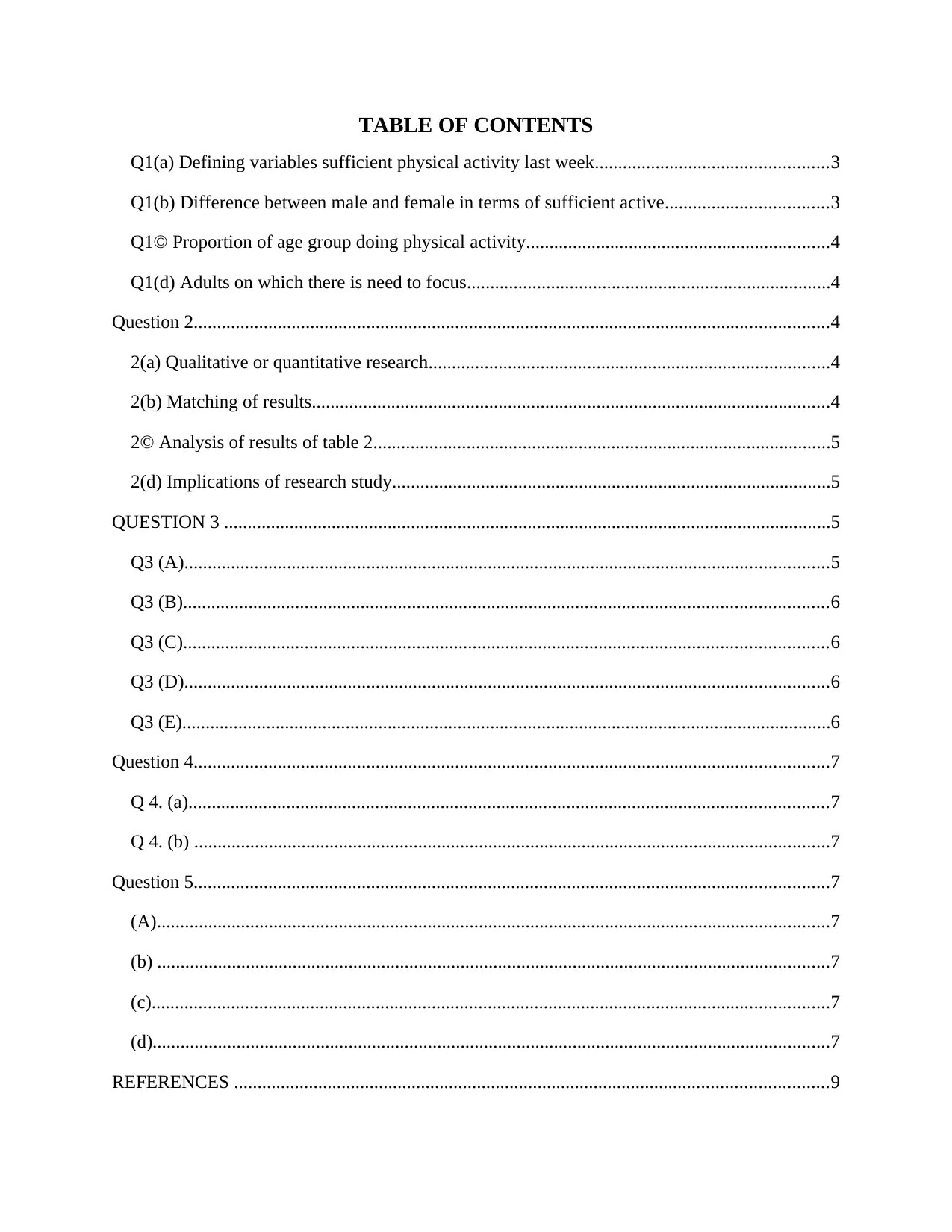
TABLE OF CONTENTS
Q1(a) Defining variables sufficient physical activity last week..................................................3
Q1(b) Difference between male and female in terms of sufficient active...................................3
Q1© Proportion of age group doing physical activity.................................................................4
Q1(d) Adults on which there is need to focus..............................................................................4
Question 2........................................................................................................................................4
2(a) Qualitative or quantitative research......................................................................................4
2(b) Matching of results...............................................................................................................4
2© Analysis of results of table 2..................................................................................................5
2(d) Implications of research study..............................................................................................5
QUESTION 3 ..................................................................................................................................5
Q3 (A)..........................................................................................................................................5
Q3 (B)..........................................................................................................................................6
Q3 (C)..........................................................................................................................................6
Q3 (D)..........................................................................................................................................6
Q3 (E)...........................................................................................................................................6
Question 4........................................................................................................................................7
Q 4. (a).........................................................................................................................................7
Q 4. (b) ........................................................................................................................................7
Question 5........................................................................................................................................7
(A)................................................................................................................................................7
(b) ................................................................................................................................................7
(c).................................................................................................................................................7
(d).................................................................................................................................................7
REFERENCES ...............................................................................................................................9
Document Page
Document Page
Question 1
Q1(a) Defining variables sufficient physical activity last week
Variable sufficient physical activity last week indicate number of people that do physical
activities on weekly basis.
Q1(b) Difference between male and female in terms of sufficient active
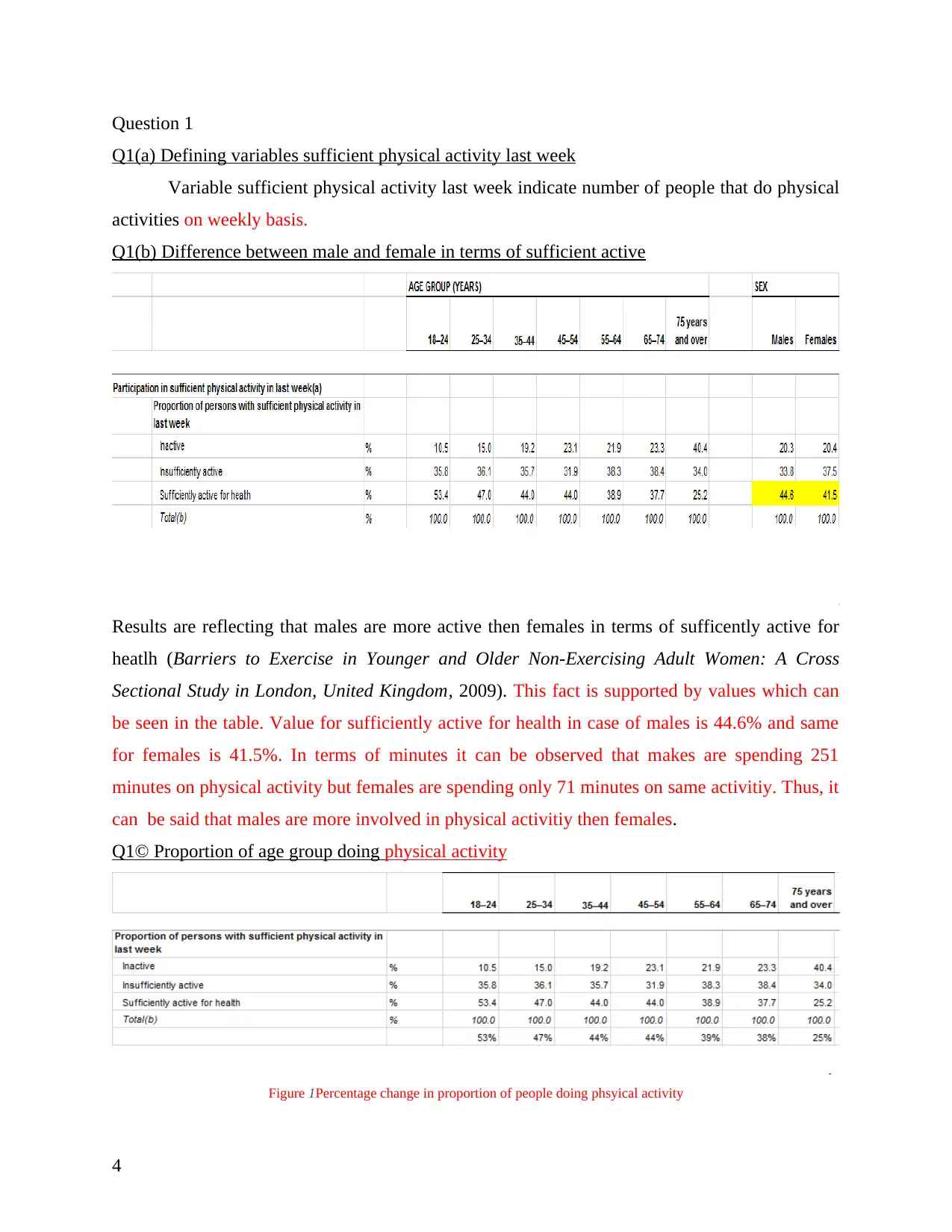
Results are reflecting that males are more active then females in terms of sufficently active for
heatlh (Barriers to Exercise in Younger and Older Non-Exercising Adult Women: A Cross
Sectional Study in London, United Kingdom, 2009). This fact is supported by values which can
be seen in the table. Value for sufficiently active for health in case of males is 44.6% and same
for females is 41.5%. In terms of minutes it can be observed that makes are spending 251
minutes on physical activity but females are spending only 71 minutes on same activitiy. Thus, it
can be said that males are more involved in physical activitiy then females.
Q1© Proportion of age group doing physical activity
Figure 1Percentage change in proportion of people doing phsyical activity
4
tabler-icon-diamond-filled.svg

Paraphrase This Document

Need a fresh take? Get an instant paraphrase of this document with our AI Paraphraser
Document Page
It can be seen from table given above that proportio of people sufficiently active for
health decline with passage of age group. In case of 18-24 age group proportion of people doing
physical exercise was 53% which declined to 44% for 45-54 age group people. This proportion
further redyced to 38% for those who are in age class of 65-74.
Q1(d) Adults on which there is need to focus
On the basis of analysis of facts it can be said that those youngsters that comes in the age
group of 20 are the adults on which there is need to focus for promoting sufficient physical
activitiy.
Question 2
2(a) Qualitative or quantitative research
Research study is quantiative in nature because statistical tools are applied on data set.
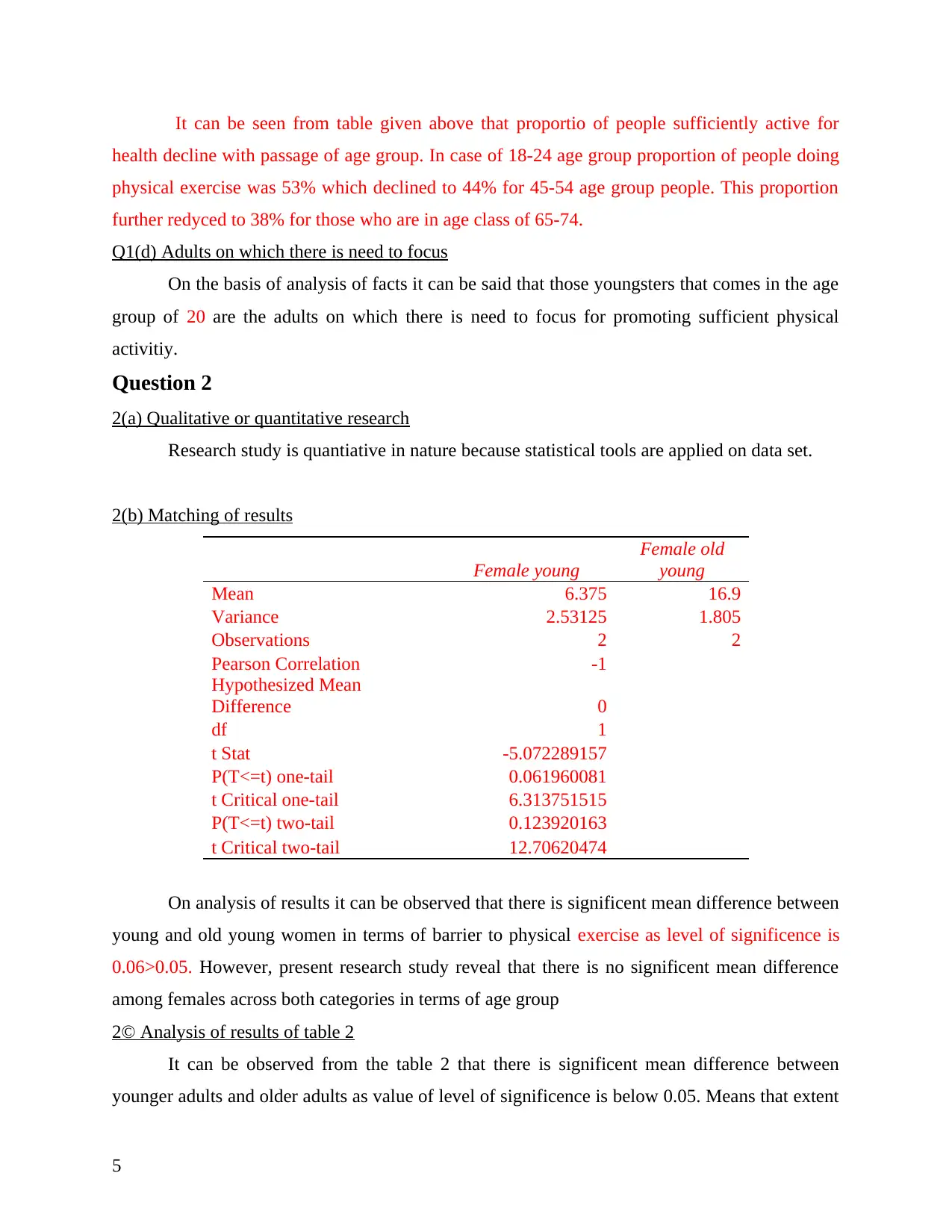
2(b) Matching of results
Female young
Female old
young
Mean 6.375 16.9
Variance 2.53125 1.805
Observations 2 2
Pearson Correlation -1
Hypothesized Mean
Difference 0
df 1
t Stat -5.072289157
P(T<=t) one-tail 0.061960081
t Critical one-tail 6.313751515
P(T<=t) two-tail 0.123920163
t Critical two-tail 12.70620474
On analysis of results it can be observed that there is significent mean difference between
young and old young women in terms of barrier to physical exercise as level of significence is
0.06>0.05. However, present research study reveal that there is no significent mean difference
among females across both categories in terms of age group
2© Analysis of results of table 2
It can be observed from the table 2 that there is significent mean difference between
younger adults and older adults as value of level of significence is below 0.05. Means that extent
5
Document Page
to which barrier from physical activity measured in case of young adults differ from same that is
observed in case of old adults. Same trends are observed in case of exericise milieu, time
expenditure and family discouragement. However, in case of time expenditure level of
significence value is 0.01 which is below 0.05 and this means that there is no significent mean
difference in terms of time among old and young female adults.
2(d) Implications of research study
Findings of the study reveals that motherhood presents a meaningful challenge for
maintaining PA. Implication of the study will help for giving impact on the socio-economic and
cultural aspects. A deep understanding of this aspect will support for gaining deep understanding
about how motherhood contributes towards the perceived barriers to exercise is required.
Implication of the study will provide evidence for the policymakers for effectively targeting
exercise barriers for adult women. Outcomes of the study will support for providing support to
the mothers to whom exercise is required.
QUESTION 3
Q3 (A)
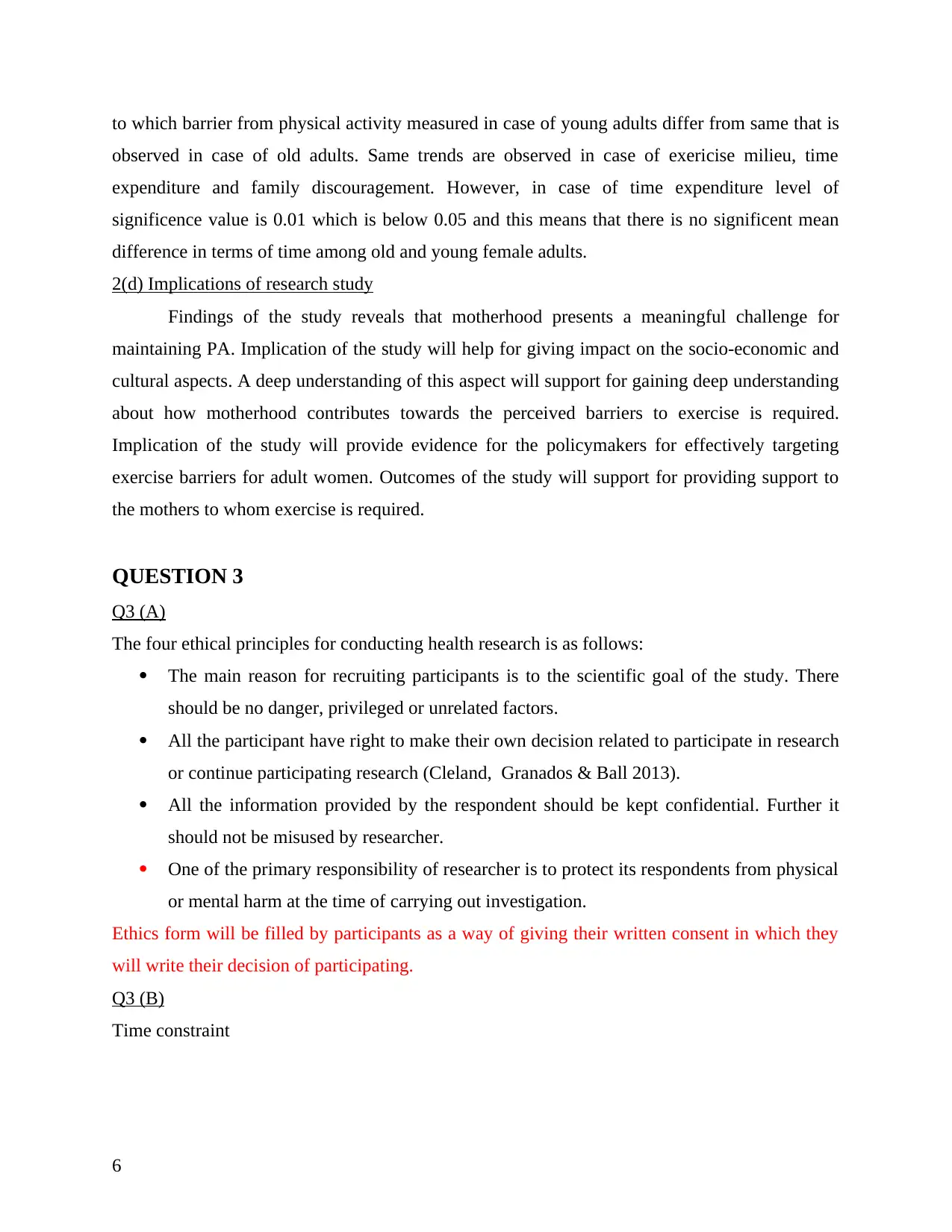
The four ethical principles for conducting health research is as follows:
The main reason for recruiting participants is to the scientific goal of the study. There
should be no danger, privileged or unrelated factors.
All the participant have right to make their own decision related to participate in research
or continue participating research (Cleland, Granados & Ball 2013).
All the information provided by the respondent should be kept confidential. Further it
should not be misused by researcher.
One of the primary responsibility of researcher is to protect its respondents from physical
or mental harm at the time of carrying out investigation.
Ethics form will be filled by participants as a way of giving their written consent in which they
will write their decision of participating.
Q3 (B)
Time constraint
6
Document Page
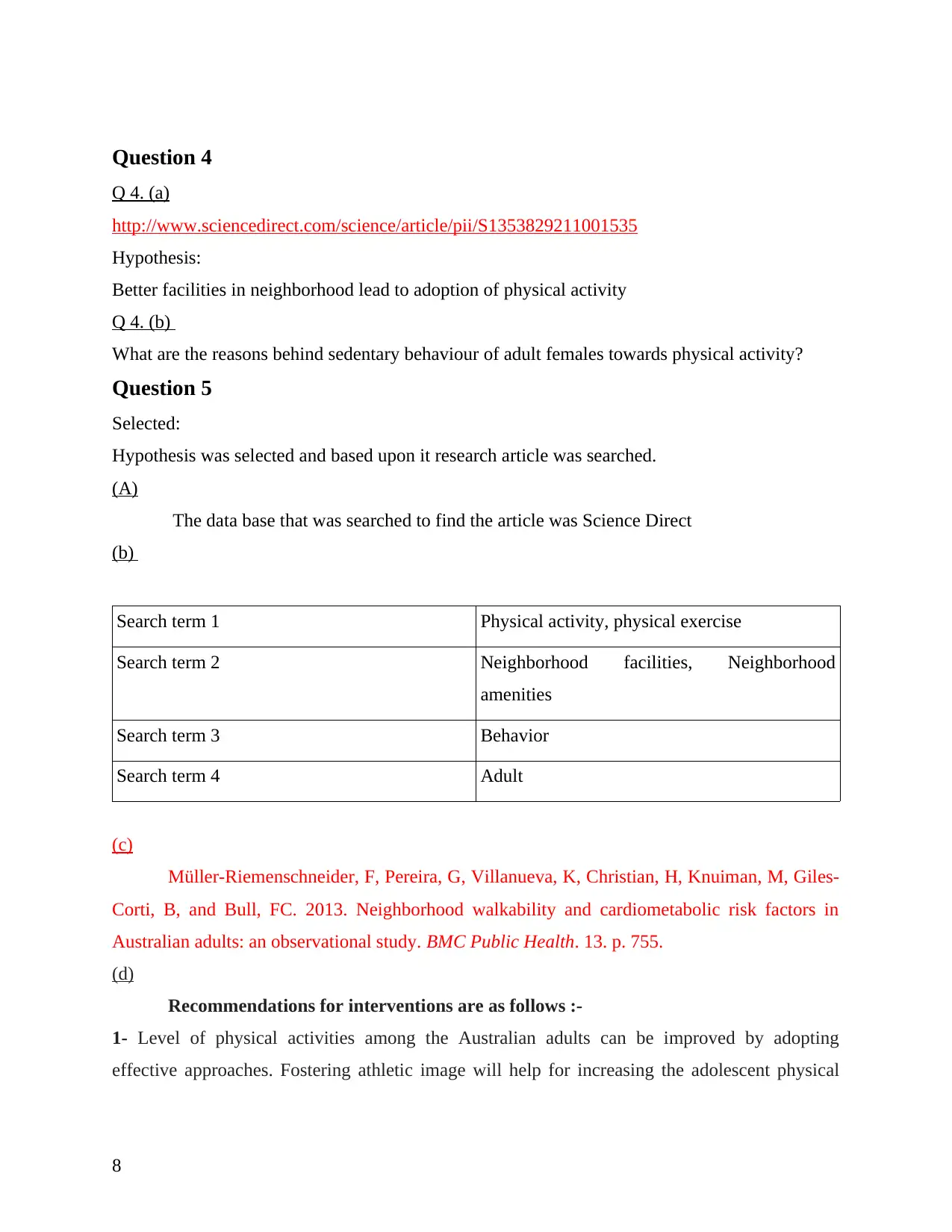
Young women state that time is one of the main reason due to which they avoid physical
exercise and sports. They need to fulfil some domestic family duties along with this they need to
study. Daily activities do not leave enough time to exercise.
Q3 (C)
Yes, conflict with boys result in that girls drop out of sports than boys. As because of this
reason parents not allow them to participate in sports. Parents may have fear they get harm from
boys because of conflict.
Q3 (D)
As parents think that girls' role is to manage their home instead of participating in sports
(Slater and Tiggemann, 2010). Yes this perception of 'uncool' come from parents, boys and
teachers. Uncool seen to apply on girls and not on boys because many girls are of reserved nature
and they do not show off in front of other as boys do. .
Q3 (E)
Yes “Transition from primary school to high school” lead to create barrier for girls in
taking participate in physical activities. It demotivate them and in secondary school they are not
provided physical activity facility. Along with this they there is no sport facility conducted in
secondary school.
7
tabler-icon-diamond-filled.svg

Paraphrase This Document

Need a fresh take? Get an instant paraphrase of this document with our AI Paraphraser
Document Page
Question 4
Q 4. (a)
http://www.sciencedirect.com/science/article/pii/S1353829211001535
Hypothesis:
Better facilities in neighborhood lead to adoption of physical activity
Q 4. (b)
What are the reasons behind sedentary behaviour of adult females towards physical activity?
Question 5
Selected:
Hypothesis was selected and based upon it research article was searched.
(A)
The data base that was searched to find the article was Science Direct
(b)
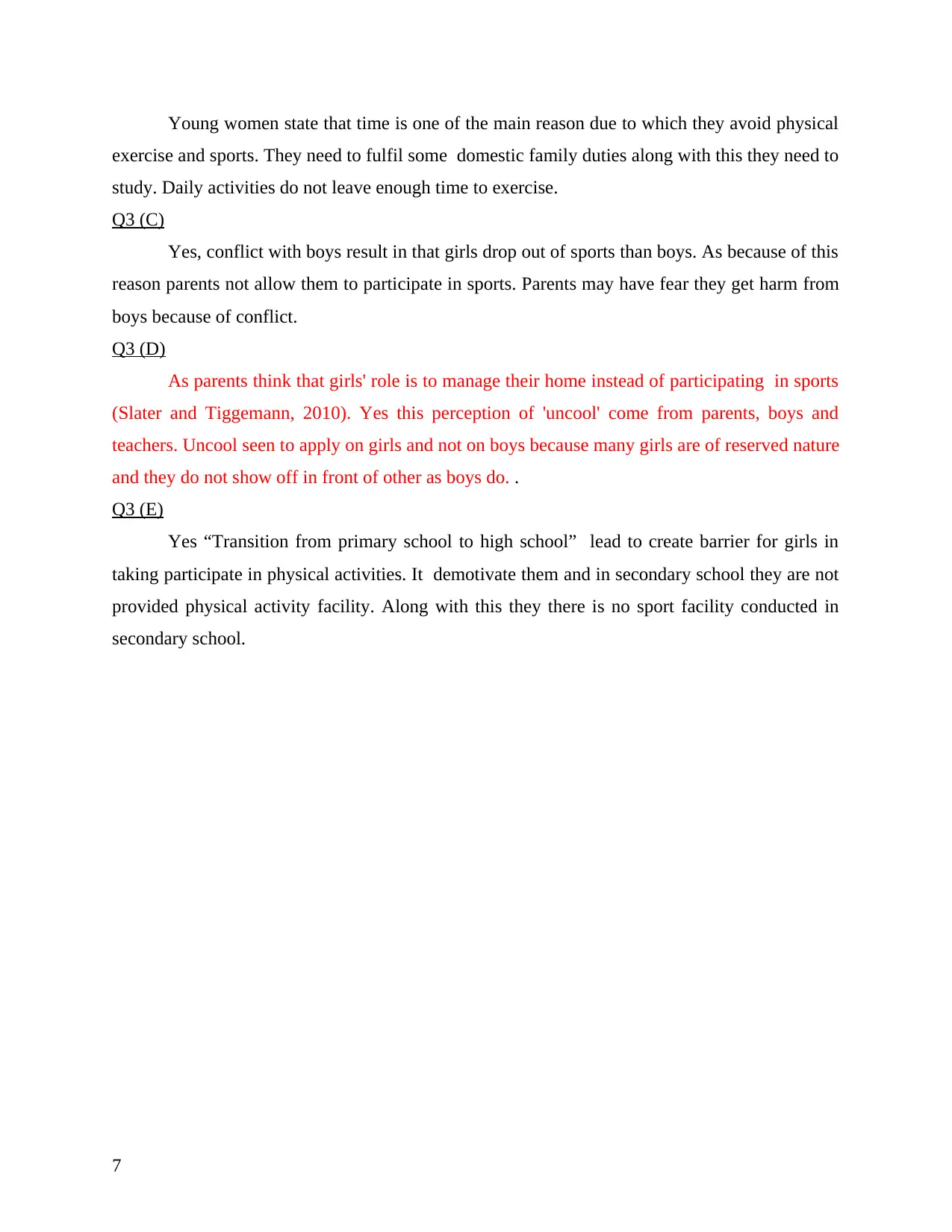
Search term 1 Physical activity, physical exercise
Search term 2 Neighborhood facilities, Neighborhood
amenities
Search term 3 Behavior
Search term 4 Adult
(c)
Müller-Riemenschneider, F, Pereira, G, Villanueva, K, Christian, H, Knuiman, M, Giles-
Corti, B, and Bull, FC. 2013. Neighborhood walkability and cardiometabolic risk factors in
Australian adults: an observational study. BMC Public Health. 13. p. 755.
(d)
Recommendations for interventions are as follows :-
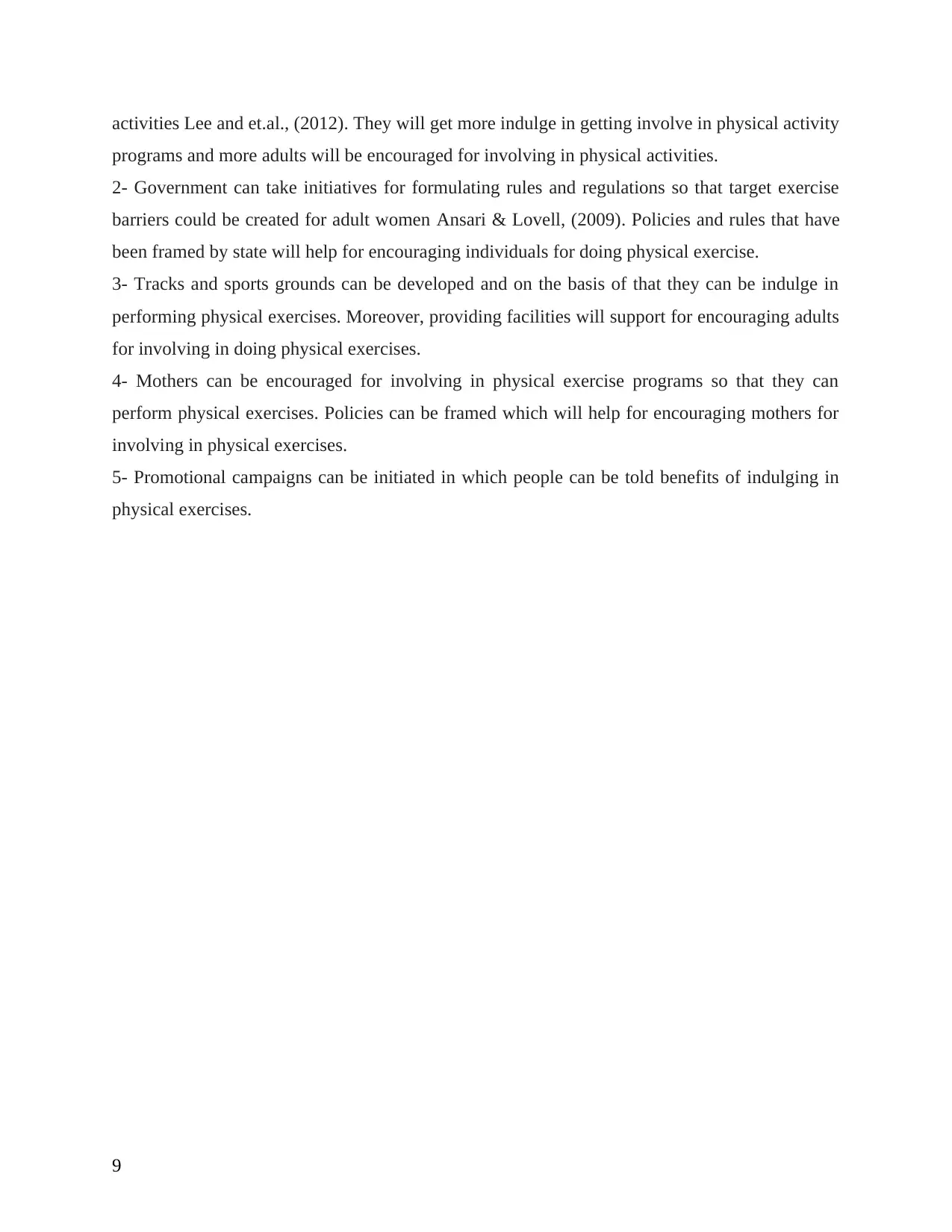
1- Level of physical activities among the Australian adults can be improved by adopting
effective approaches. Fostering athletic image will help for increasing the adolescent physical
8
Document Page
activities Lee and et.al., (2012). They will get more indulge in getting involve in physical activity
programs and more adults will be encouraged for involving in physical activities.
2- Government can take initiatives for formulating rules and regulations so that target exercise
barriers could be created for adult women Ansari & Lovell, (2009). Policies and rules that have
been framed by state will help for encouraging individuals for doing physical exercise.
3- Tracks and sports grounds can be developed and on the basis of that they can be indulge in
performing physical exercises. Moreover, providing facilities will support for encouraging adults
for involving in doing physical exercises.
4- Mothers can be encouraged for involving in physical exercise programs so that they can
perform physical exercises. Policies can be framed which will help for encouraging mothers for
involving in physical exercises.
5- Promotional campaigns can be initiated in which people can be told benefits of indulging in
physical exercises.
9
Document Page
REFERENCES
Books and journals
Cleland V, Granados A, Crawford D, Winzenberg T & Ball K (2013) ‘Effectiveness of
interventions to promote physical activity among socioeconomically disadvantaged women:
a systematic review and meta-analysis’, Obesity reviews, vol. 14, iss. 3, pp. 197-212.
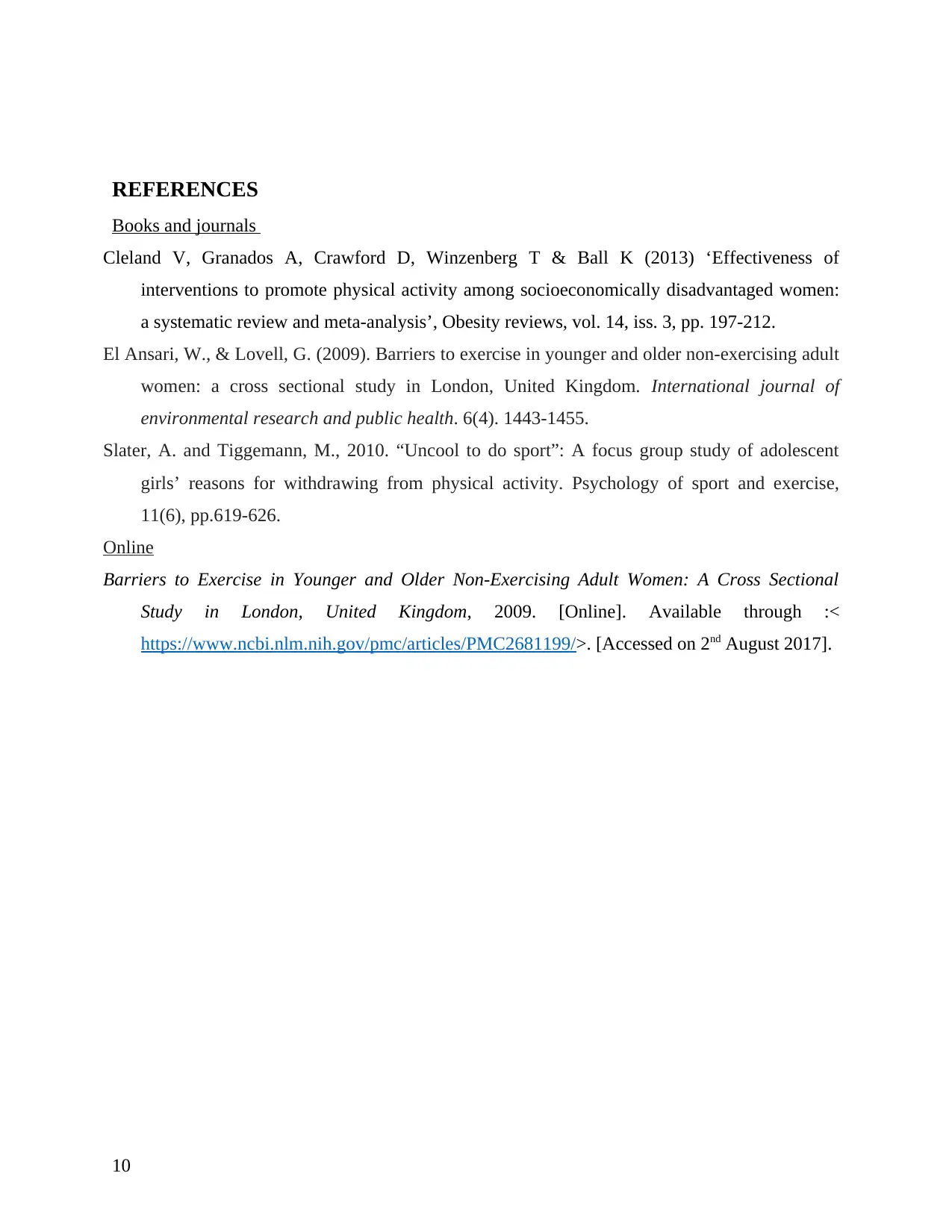
El Ansari, W., & Lovell, G. (2009). Barriers to exercise in younger and older non-exercising adult
women: a cross sectional study in London, United Kingdom. International journal of
environmental research and public health. 6(4). 1443-1455.
Slater, A. and Tiggemann, M., 2010. “Uncool to do sport”: A focus group study of adolescent
girls’ reasons for withdrawing from physical activity. Psychology of sport and exercise,
11(6), pp.619-626.
Online
Barriers to Exercise in Younger and Older Non-Exercising Adult Women: A Cross Sectional
Study in London, United Kingdom, 2009. [Online]. Available through :<
https://www.ncbi.nlm.nih.gov/pmc/articles/PMC2681199/>. [Accessed on 2nd August 2017].
10
tabler-icon-diamond-filled.svg

Paraphrase This Document

Need a fresh take? Get an instant paraphrase of this document with our AI Paraphraser
Document Page
11 | P a g e
chevron_up_icon
1 out of 11
circle_padding
hide_on_mobile
zoom_out_icon
[object Object]