Reflective Report: Year 4 Physical Education Punt Kick Lesson Analysis

Verified

Added on  2022/09/26

|4
|765
|21
Report
AI Summary
This report analyzes a Year 4 physical education lesson centered around the punt kick, aligning with the Australian Curriculum's Health and Physical Education strand. The lesson began with a kick-to-kick drill to warm up and demonstrate fundamental movement skills, followed by instructional cues to guide students on proper technique. The report highlights the use of the skill, drill, and game format for effective learning, emphasizing student participation and cooperation. The objective was for students to accurately kick a lofted punt kick to a partner, demonstrating correct technique. Teaching strategies included task teaching and peer teaching to empower students. The report underscores the importance of physical exercise for students' overall well-being and offers references to relevant educational resources. The assignment also details the lesson plan, including learning goals, content descriptors, and assessment methods.
Document Page
Running head: PHYSICAL EDUCATION
Physical Education
Student’s Name
Unit Name
Unit Code
Affiliate college
Date of Submission
1
tabler-icon-diamond-filled.svg

Paraphrase This Document

Need a fresh take? Get an instant paraphrase of this document with our AI Paraphraser
Document Page
PHYSICAL EDUCATION
Introduction
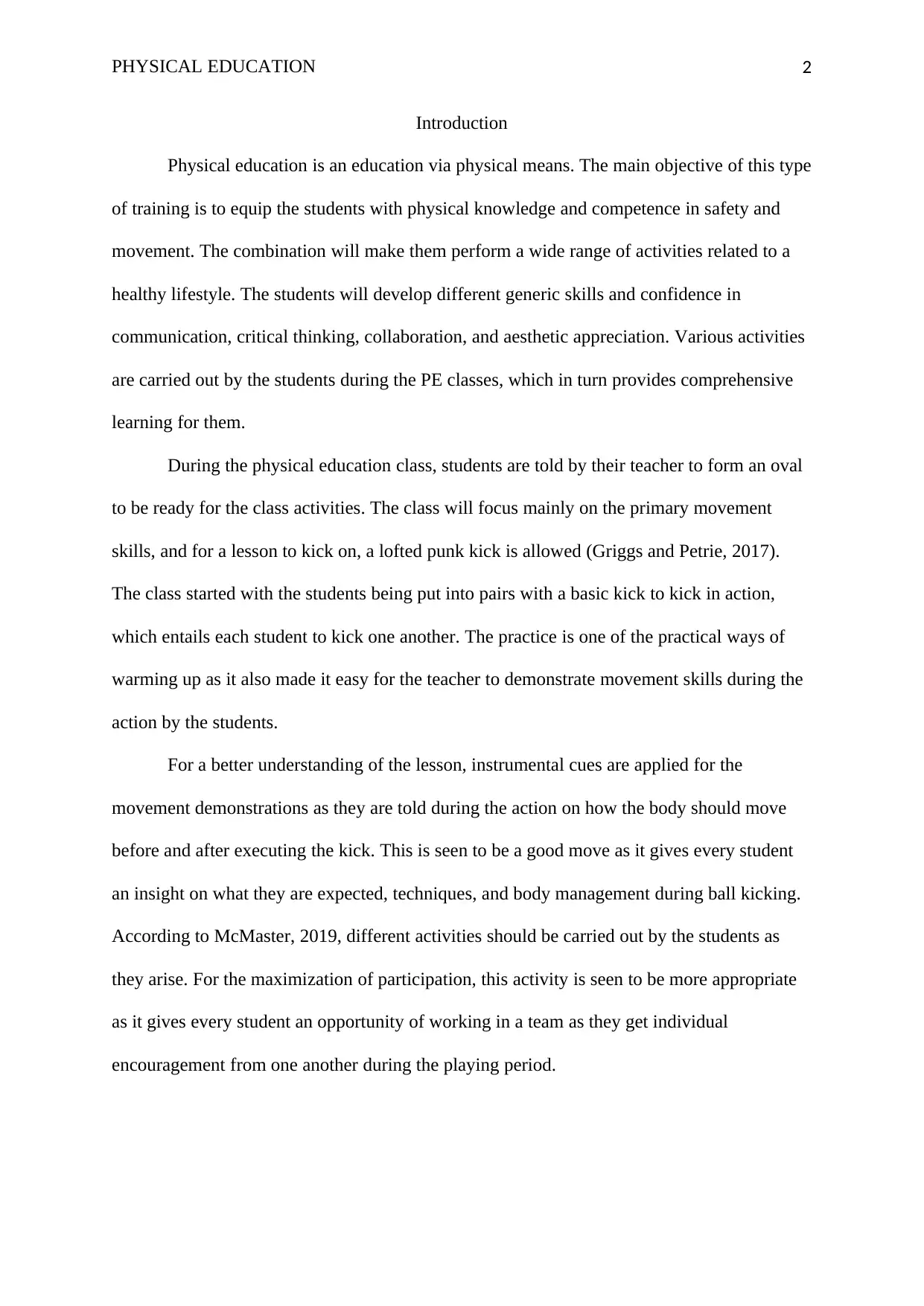
Physical education is an education via physical means. The main objective of this type
of training is to equip the students with physical knowledge and competence in safety and
movement. The combination will make them perform a wide range of activities related to a
healthy lifestyle. The students will develop different generic skills and confidence in
communication, critical thinking, collaboration, and aesthetic appreciation. Various activities
are carried out by the students during the PE classes, which in turn provides comprehensive
learning for them.
During the physical education class, students are told by their teacher to form an oval
to be ready for the class activities. The class will focus mainly on the primary movement
skills, and for a lesson to kick on, a lofted punk kick is allowed (Griggs and Petrie, 2017).
The class started with the students being put into pairs with a basic kick to kick in action,
which entails each student to kick one another. The practice is one of the practical ways of
warming up as it also made it easy for the teacher to demonstrate movement skills during the
action by the students.
For a better understanding of the lesson, instrumental cues are applied for the
movement demonstrations as they are told during the action on how the body should move
before and after executing the kick. This is seen to be a good move as it gives every student
an insight on what they are expected, techniques, and body management during ball kicking.
According to McMaster, 2019, different activities should be carried out by the students as
they arise. For the maximization of participation, this activity is seen to be more appropriate
as it gives every student an opportunity of working in a team as they get individual
encouragement from one another during the playing period.
2
Document Page
PHYSICAL EDUCATION
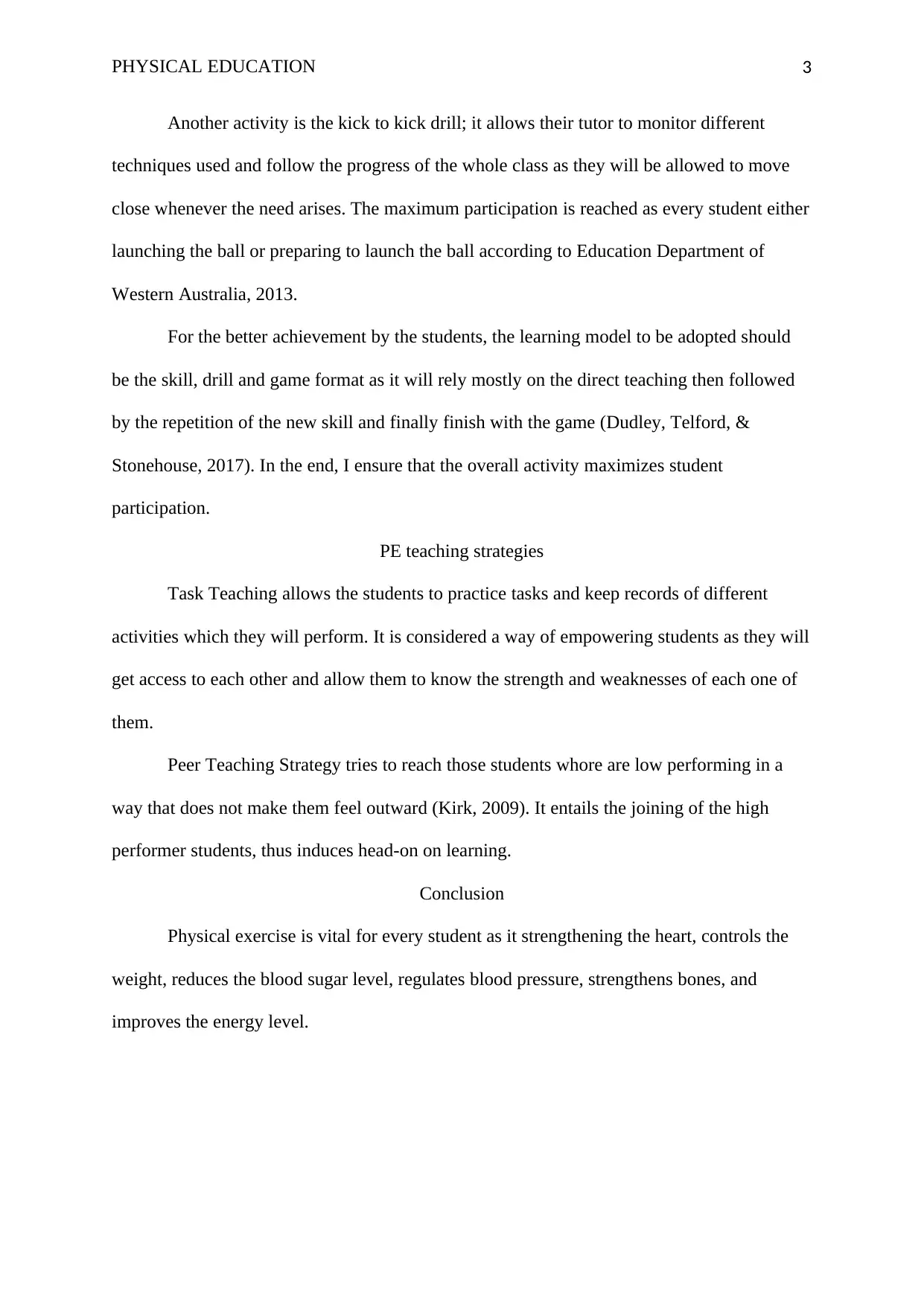
Another activity is the kick to kick drill; it allows their tutor to monitor different
techniques used and follow the progress of the whole class as they will be allowed to move
close whenever the need arises. The maximum participation is reached as every student either
launching the ball or preparing to launch the ball according to Education Department of
Western Australia, 2013.
For the better achievement by the students, the learning model to be adopted should
be the skill, drill and game format as it will rely mostly on the direct teaching then followed
by the repetition of the new skill and finally finish with the game (Dudley, Telford, &
Stonehouse, 2017). In the end, I ensure that the overall activity maximizes student
participation.
PE teaching strategies
Task Teaching allows the students to practice tasks and keep records of different
activities which they will perform. It is considered a way of empowering students as they will
get access to each other and allow them to know the strength and weaknesses of each one of
them.
Peer Teaching Strategy tries to reach those students whore are low performing in a
way that does not make them feel outward (Kirk, 2009). It entails the joining of the high
performer students, thus induces head-on on learning.
Conclusion
Physical exercise is vital for every student as it strengthening the heart, controls the
weight, reduces the blood sugar level, regulates blood pressure, strengthens bones, and
improves the energy level.
3
Document Page
PHYSICAL EDUCATION
References
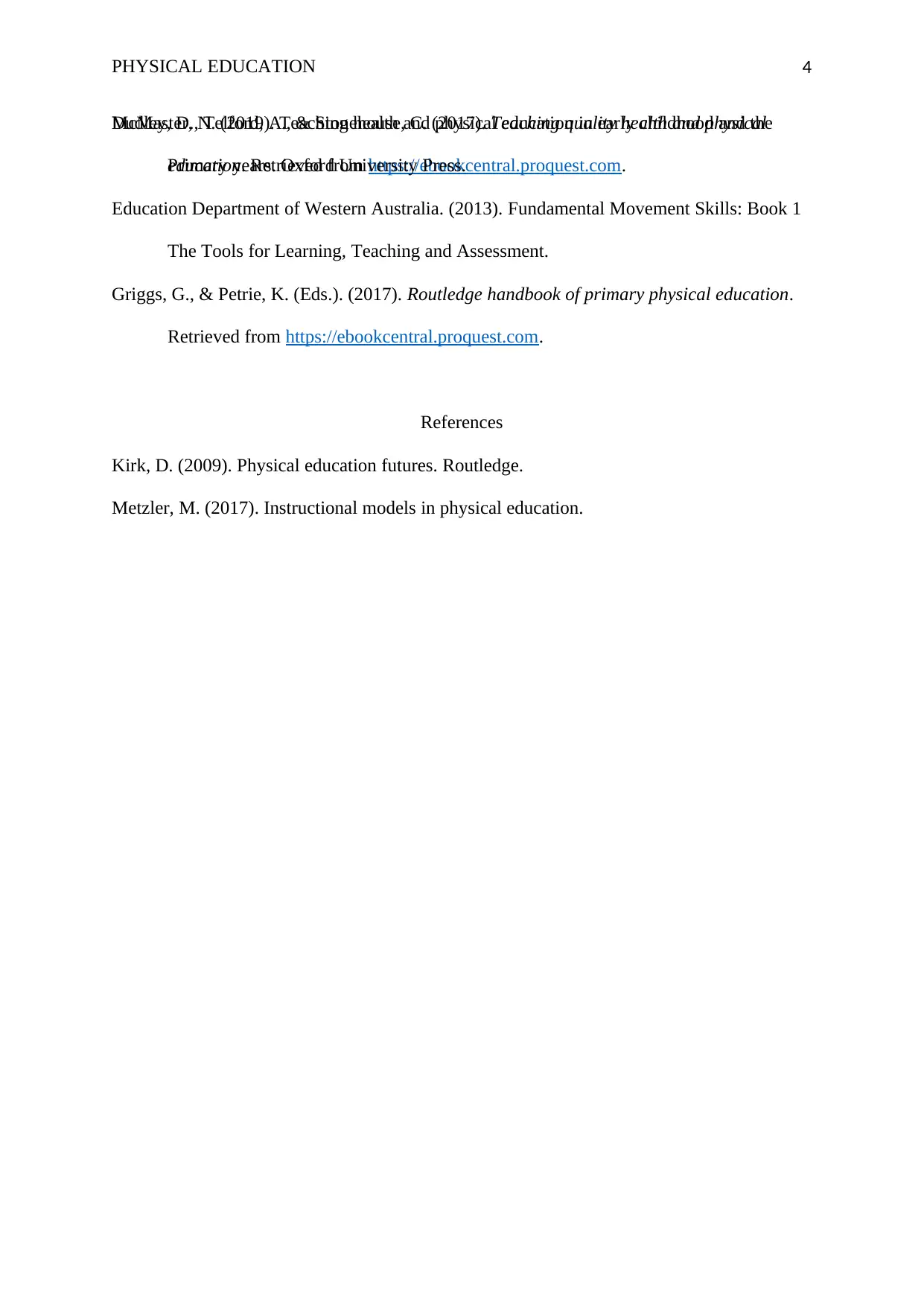
Kirk, D. (2009). Physical education futures. Routledge.
Metzler, M. (2017). Instructional models in physical education.
Dudley, D., Telford, A., & Stonehouse, C. (2017). Teaching quality health and physical
education. Retrieved from https://ebookcentral.proquest.com.
Education Department of Western Australia. (2013). Fundamental Movement Skills: Book 1
The Tools for Learning, Teaching and Assessment.
Griggs, G., & Petrie, K. (Eds.). (2017). Routledge handbook of primary physical education.
Retrieved from https://ebookcentral.proquest.com.
McMaster, N. (2019). Teaching health and physical education in early childhood and the
Primary years. Oxford University Press.
4
chevron_up_icon
1 out of 4
circle_padding
hide_on_mobile
zoom_out_icon
[object Object]