Year 11 Physical Education: Touch Football Reflection Report

Verified

Added on  2020/03/01

|5
|981
|46
Report
AI Summary
This report presents a reflection on a Year 11 Physical Education touch football unit. It begins with an introduction outlining the assignment's purpose: to analyze the learning experience, evaluate individual and group involvement using Figueroa's Framework, and develop strategies for enhancing the sporting experience. The report then delves into Figueroa's Framework, emphasizing the importance of access and equity. The student's performance and progress are detailed, including previous experience, preparation, skills, fitness level, and areas for improvement. The report also examines the student's beliefs and attitudes, highlighting the impact of motivation, self-doubt, and stereotypes. It addresses issues of value, respect, equality, and safety within the class environment. Recommendations for improvement, such as a whole-of-school approach and teacher training, are provided. The report concludes with a personal reflection on the lessons learned, emphasizing the importance of attitude, motivation, equality, and encouragement. The report includes a comprehensive list of references.
Document Page
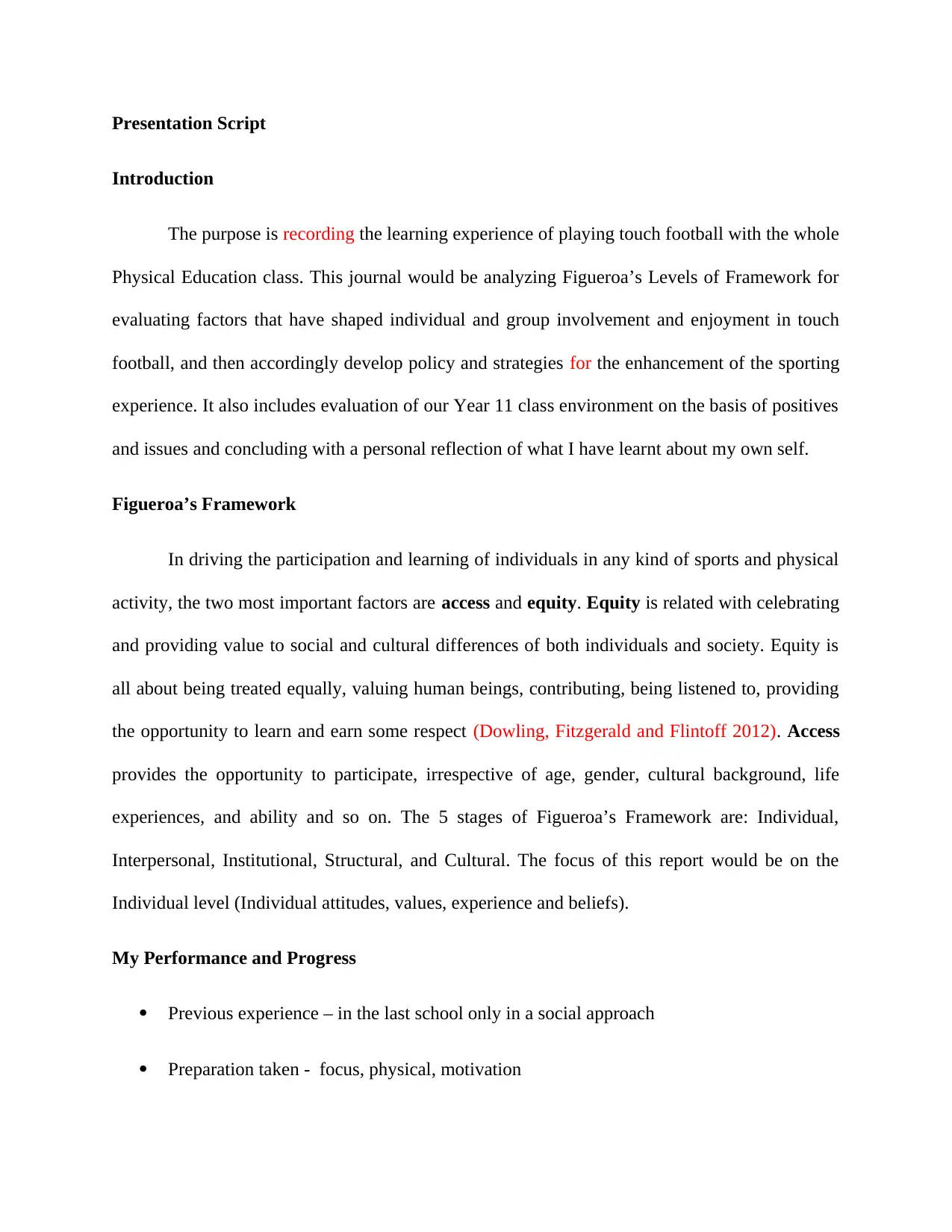
Presentation Script
Introduction
The purpose is recording the learning experience of playing touch football with the whole
Physical Education class. This journal would be analyzing Figueroa’s Levels of Framework for
evaluating factors that have shaped individual and group involvement and enjoyment in touch
football, and then accordingly develop policy and strategies for the enhancement of the sporting
experience. It also includes evaluation of our Year 11 class environment on the basis of positives
and issues and concluding with a personal reflection of what I have learnt about my own self.
Figueroa’s Framework
In driving the participation and learning of individuals in any kind of sports and physical
activity, the two most important factors are access and equity. Equity is related with celebrating
and providing value to social and cultural differences of both individuals and society. Equity is
all about being treated equally, valuing human beings, contributing, being listened to, providing
the opportunity to learn and earn some respect (Dowling, Fitzgerald and Flintoff 2012). Access
provides the opportunity to participate, irrespective of age, gender, cultural background, life
experiences, and ability and so on. The 5 stages of Figueroa’s Framework are: Individual,
Interpersonal, Institutional, Structural, and Cultural. The focus of this report would be on the
Individual level (Individual attitudes, values, experience and beliefs).
My Performance and Progress
Previous experience – in the last school only in a social approach
Preparation taken - focus, physical, motivation
tabler-icon-diamond-filled.svg

Paraphrase This Document

Need a fresh take? Get an instant paraphrase of this document with our AI Paraphraser
Document Page
Skills – running, passing, defense, communication
Average fitness level
Good understanding of the game
Need improvement: confidence and self-motivation
Weekly progress: Week 2 - skills and camping, Week 5 to 6 – drills, game playing
My Beliefs and Attitudes
Starting the touch football unit
Affected by learning motivation levels
Week 1-2: self-doubts, self-belief, stereotypes
Week 3-5: desire to learn and advanced attitude, resulting in better outcomes
Week 6: effect of carnivals on health and energy (Kane 2015)
Value, Respect, Equality and Stereotypes
Weeks 1-2: In the beginning I was feeling like I did not fit in, which later turned a
positive leaf
Weeks 3-6: As my skills improved with practice and I gained confidence, I started feeling
more accepted, respected, valued and treated like an equal
I sensed the major stereotypes existed in the aspects of culture, ability and gender
Equality issues were also faced in the same aspects of culture, ability and gender
Safety in Class
Document Page
Asking if someone is ready or not so that no mishaps happen
Using proper sports equipment for avoiding accidents
Proper coordination among team members to make sure everyone is aware of what is
happening
Recommendations
Take whole-of-school method for making sure all players are included and equality is
maintained
Allowing for physical movement in all school-related strategy decisions
Labelling physical education as a central subject to ensure access
Observing physical education and openings for physical activity in schools
Providing pre-service training and professional improvement for teachers so that equity is
maintained
Confirming equity in admission to physical activity and physical education
Reflection
I learnt in this term that attitude is the key to motivation and learning. The amount I put
in the task is what I would get out of the lesson. I understood I can learn and improve myself in
any sport if I wish and try to. Equality should be given importance, not only winning. Otherwise,
someone or the other would feel left out or unimportant. Encouragement must be two-way
approach. If I encourage someone, they would someday encourage me back. Application of these
Document Page
learnings in touch football would help me become a team player, all the while making sure I
respect others and maintain safety.
tabler-icon-diamond-filled.svg

Paraphrase This Document

Need a fresh take? Get an instant paraphrase of this document with our AI Paraphraser
Document Page
References
Burrows, L., Macdonald, D. and Wright, J. eds., 2013. Critical Inquiry and Problem Solving in
Physical Education: Working with Students in Schools. Routledge.
Dowling, F., Fitzgerald, H. and Flintoff, A. eds., 2012. Equity and difference in physical
education, youth sport and health: A narrative approach. Routledge.
Figueroa, R. and An, R., 2017. Motor skill competence and physical activity in preschoolers: a
review. Maternal and child health journal, 21(1), pp.136-146.
Hard, E.S.P., Schools, H.K., Breaks, I.C.P.A. and Game, B.O., 2012. Physical activity. Fitness
and health: Internatio.
Holt, N.L., Sehn, Z.L., Spence, J.C., Newton, A.S. and Ball, G.D., 2012. Physical education and
sport programs at an inner city school: exploring possibilities for positive youth
development. Physical Education & Sport Pedagogy, 17(1), pp.97-113.
Horine, L. and Stotlar, D., 2013. Administration of physical education and sport programs.
Waveland Press.
Kane, J.E. ed., 2015. Psychological aspects of physical education and sport. Routledge.
McIntosh, P.C., 2013. Landmarks in the history of physical education (Vol. 22). Routledge.
Stolz, S. and Pill, S., 2014. Teaching games and sport for understanding: Exploring and
reconsidering its relevance in physical education. European Physical Education Review, 20(1),
pp.36-71.
Winnick, J. and Porretta, D. eds., 2016. Adapted Physical Education and Sport, 6E. Human
Kinetics.
chevron_up_icon
1 out of 5
circle_padding
hide_on_mobile
zoom_out_icon
[object Object]