A Report on Ethical Issues and Challenges in Physical Therapy

Verified

Added on  2023/01/18

|3
|469
|83
Report
AI Summary
This report delves into the ethical challenges prevalent in the field of physical therapy. It highlights the critical importance of maintaining professional boundaries, particularly addressing issues such as dual relationships and the potential for boundary violations. The report emphasizes the impact of ethical breaches on the patient-therapist relationship, the patient's recovery, and the therapist's career. It underscores the need for self-awareness and proactive measures to prevent ethical dilemmas, with an emphasis on immediate resolution of any boundary issues. The report references key sources to support its analysis of the ethical landscape in physical therapy, offering valuable insights into navigating the complexities of this healthcare profession.
Document Page
RUNNING HEAD: ETHICAL ISSUES IN PHYSICAL THERAPY
ETHICAL ISSUES IN PHYSICAL THERAPY
Name of Student
Name of University
Author note
tabler-icon-diamond-filled.svg

Paraphrase This Document

Need a fresh take? Get an instant paraphrase of this document with our AI Paraphraser
Document Page
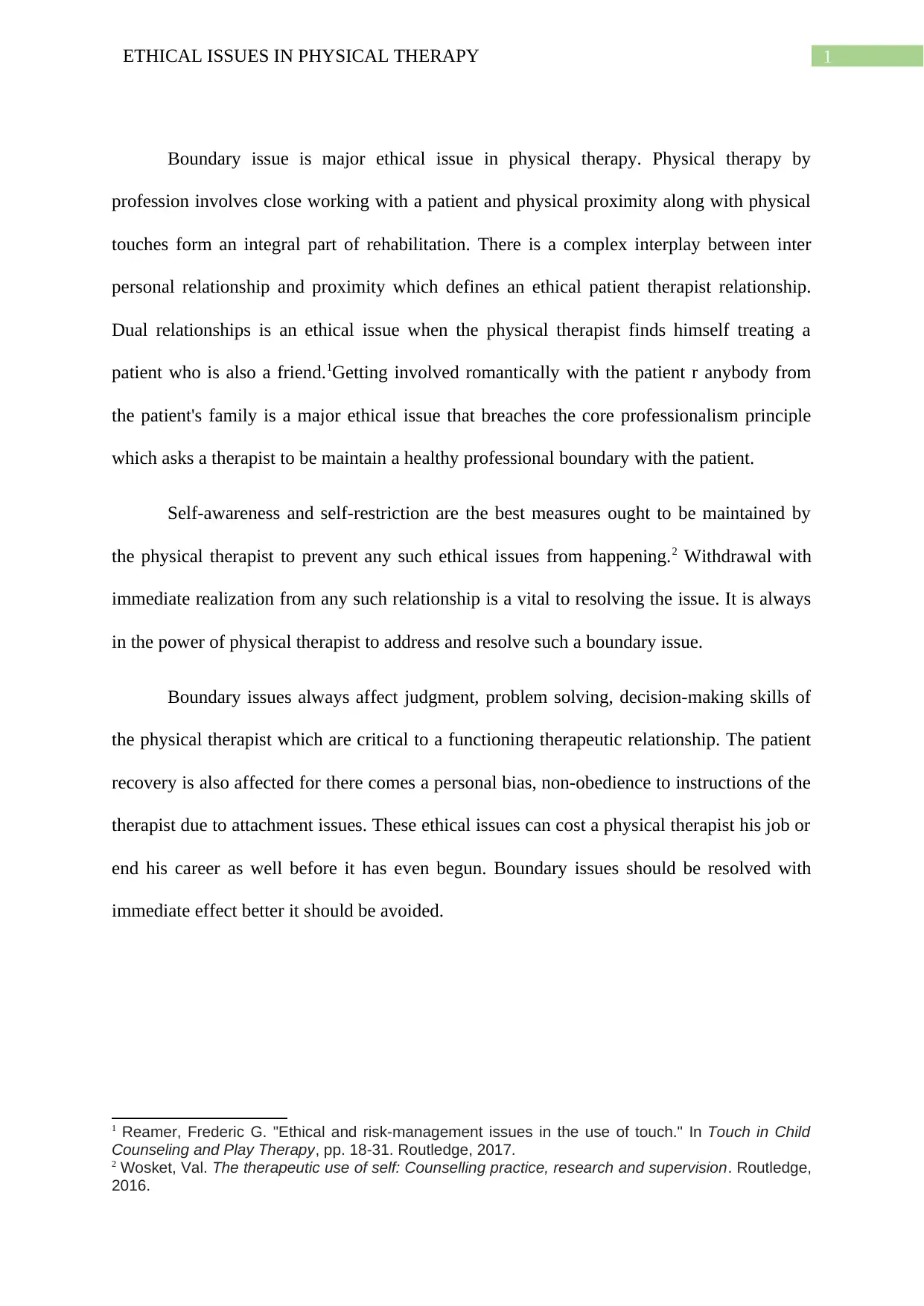
1ETHICAL ISSUES IN PHYSICAL THERAPY
Boundary issue is major ethical issue in physical therapy. Physical therapy by
profession involves close working with a patient and physical proximity along with physical
touches form an integral part of rehabilitation. There is a complex interplay between inter
personal relationship and proximity which defines an ethical patient therapist relationship.
Dual relationships is an ethical issue when the physical therapist finds himself treating a
patient who is also a friend.1Getting involved romantically with the patient r anybody from
the patient's family is a major ethical issue that breaches the core professionalism principle
which asks a therapist to be maintain a healthy professional boundary with the patient.
Self-awareness and self-restriction are the best measures ought to be maintained by
the physical therapist to prevent any such ethical issues from happening.2 Withdrawal with
immediate realization from any such relationship is a vital to resolving the issue. It is always
in the power of physical therapist to address and resolve such a boundary issue.
Boundary issues always affect judgment, problem solving, decision-making skills of
the physical therapist which are critical to a functioning therapeutic relationship. The patient
recovery is also affected for there comes a personal bias, non-obedience to instructions of the
therapist due to attachment issues. These ethical issues can cost a physical therapist his job or
end his career as well before it has even begun. Boundary issues should be resolved with
immediate effect better it should be avoided.
1 Reamer, Frederic G. "Ethical and risk-management issues in the use of touch." In Touch in Child
Counseling and Play Therapy, pp. 18-31. Routledge, 2017.
2 Wosket, Val. The therapeutic use of self: Counselling practice, research and supervision. Routledge,
2016.
Document Page
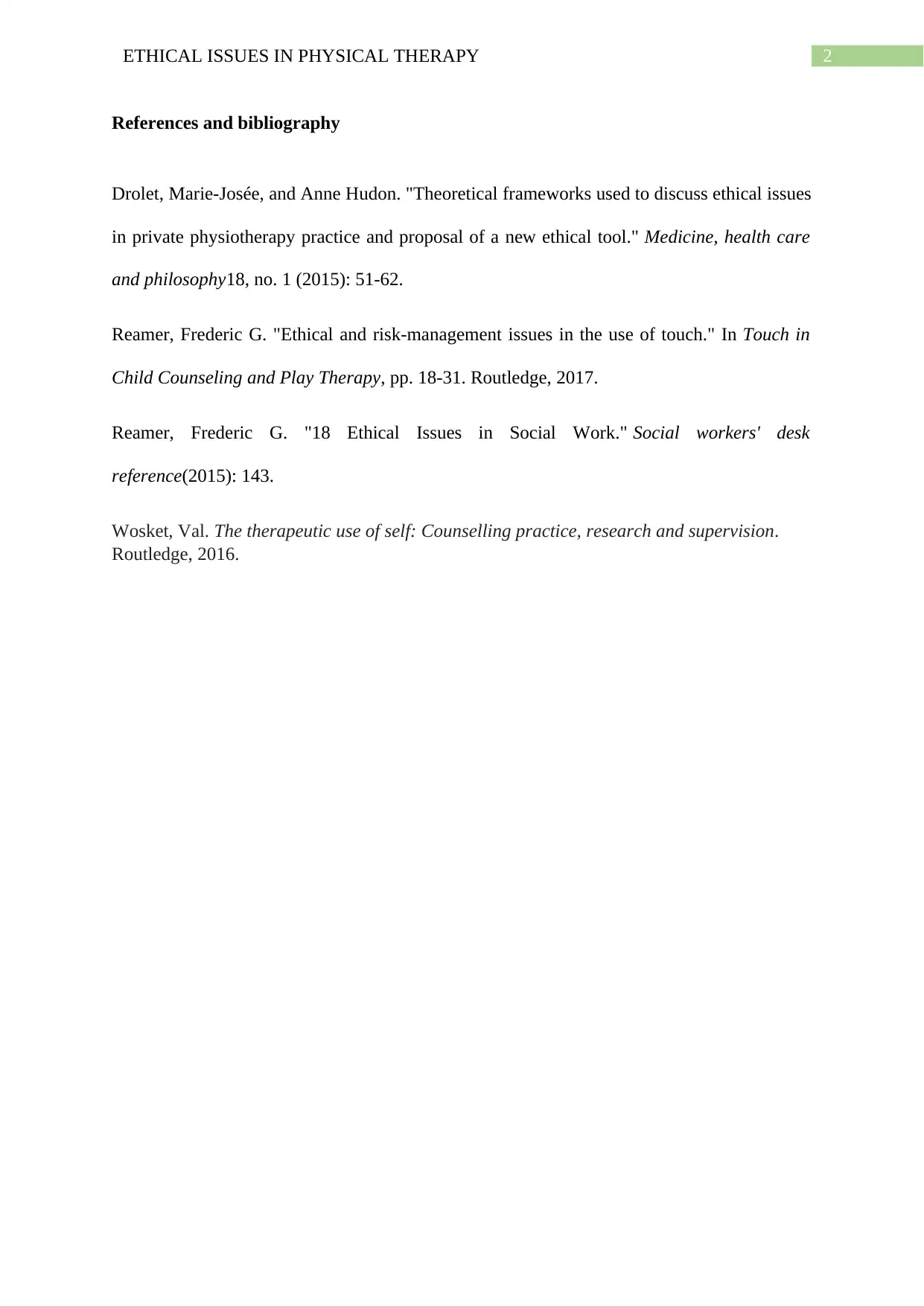
2ETHICAL ISSUES IN PHYSICAL THERAPY
References and bibliography
Drolet, Marie-Josée, and Anne Hudon. "Theoretical frameworks used to discuss ethical issues
in private physiotherapy practice and proposal of a new ethical tool." Medicine, health care
and philosophy18, no. 1 (2015): 51-62.
Reamer, Frederic G. "Ethical and risk-management issues in the use of touch." In Touch in
Child Counseling and Play Therapy, pp. 18-31. Routledge, 2017.
Reamer, Frederic G. "18 Ethical Issues in Social Work." Social workers' desk
reference(2015): 143.
Wosket, Val. The therapeutic use of self: Counselling practice, research and supervision.
Routledge, 2016.
chevron_up_icon
1 out of 3
circle_padding
hide_on_mobile
zoom_out_icon
[object Object]