Physics Assignment: Biomechanics Problem Solutions - Cliffs and Motion

Verified

Added on  2023/02/01

|5
|506
|87
Homework Assignment
AI Summary
This document presents solutions to two biomechanics problems. The first problem involves a rock rolling off a cliff with a given horizontal velocity and horizontal distance, requiring the calculation of the vertical displacement. The solution utilizes kinematic equations, considering horizontal and vertical motion separately, and involves solving a quadratic equation. The second problem involves a tennis ball rolling off a cliff with a given horizontal velocity and cliff height, requiring the calculation of the horizontal distance the ball travels. This solution also uses kinematic equations, calculating the time of flight from the vertical motion and then determining the horizontal displacement. Both solutions provide step-by-step calculations and references to relevant physics resources.

Document Page
1Biomechanics
Biomechanics
tabler-icon-diamond-filled.svg

Paraphrase This Document

Need a fresh take? Get an instant paraphrase of this document with our AI Paraphraser
Document Page
2Biomechanics
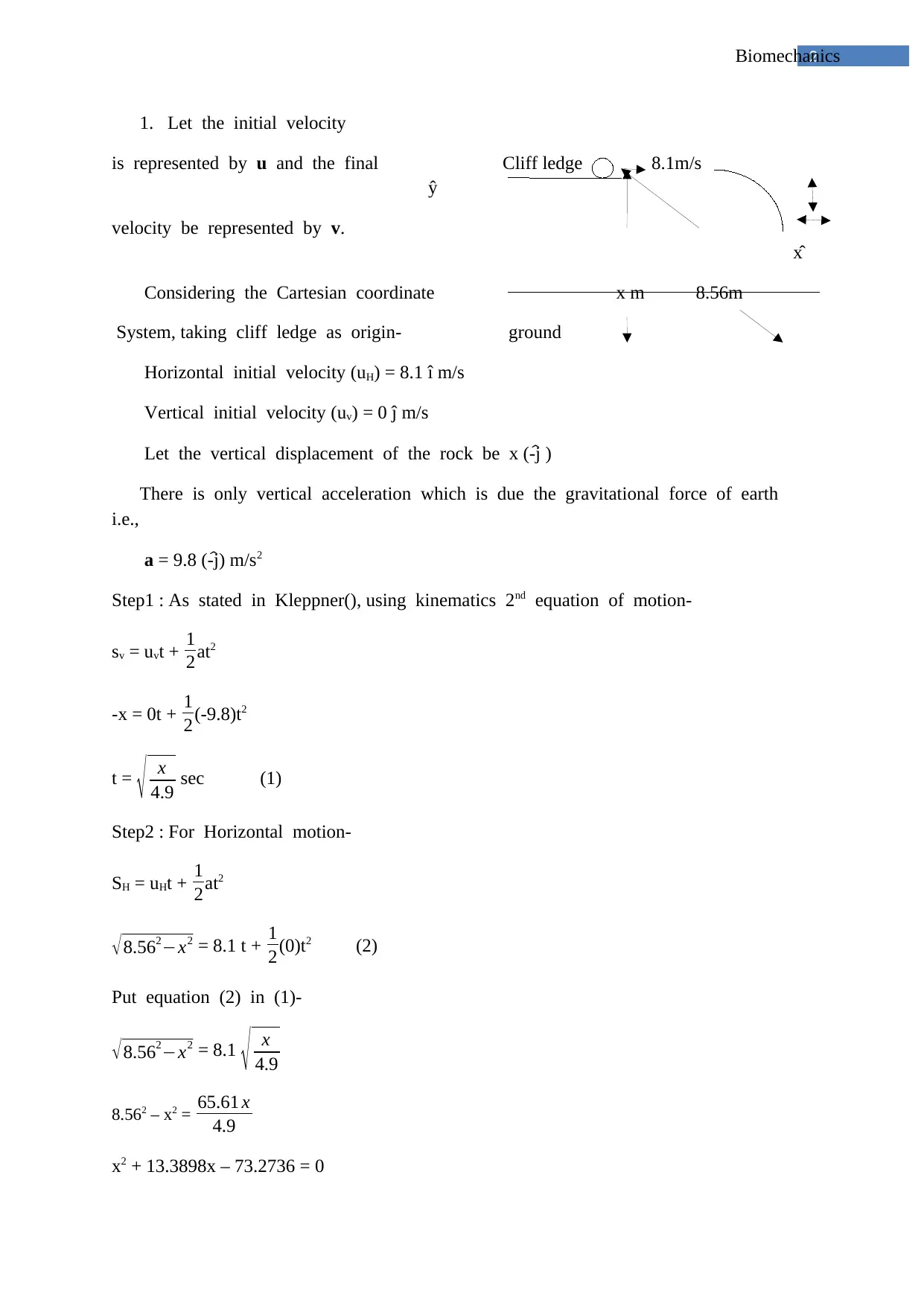
1. Let the initial velocity
is represented by u and the final Cliff ledge 8.1m/s
velocity be represented by v.

Considering the Cartesian coordinate x m 8.56m
System, taking cliff ledge as origin- ground
Horizontal initial velocity (uH) = 8.1 î m/s
Vertical initial velocity (uv) = 0 ĵ m/s
Let the vertical displacement of the rock be x (-ĵ )
There is only vertical acceleration which is due the gravitational force of earth
i.e.,
a = 9.8 (-ĵ ) m/s2
Step1 : As stated in Kleppner(), using kinematics 2nd equation of motion-
sv = uvt + 1
2at2
-x = 0t + 1
2(-9.8)t2
t = x
4.9 sec (1)
Step2 : For Horizontal motion-
SH = uHt + 1
2at2
8.562x2 = 8.1 t + 1
2(0)t2 (2)
Put equation (2) in (1)-
8.562x2 = 8.1 x
4.9
8.562 – x2 = 65.61 x
4.9
x2 + 13.3898x – 73.2736 = 0
Document Page
3Biomechanics
According to Arfken(2011), roots of the quadratic equation are given as :
x = b ± b24 ac
2a
x = 13.3898± 13.389824 ( 1 ) (73.2736)
2
x = 13.3898± 21.7322
2
x = 4.17 or -17.56
Negative solution is not possible. So,
x = 4.17 (-ĵ ) is the vertical displacement of the rock from the ledge to the ground.
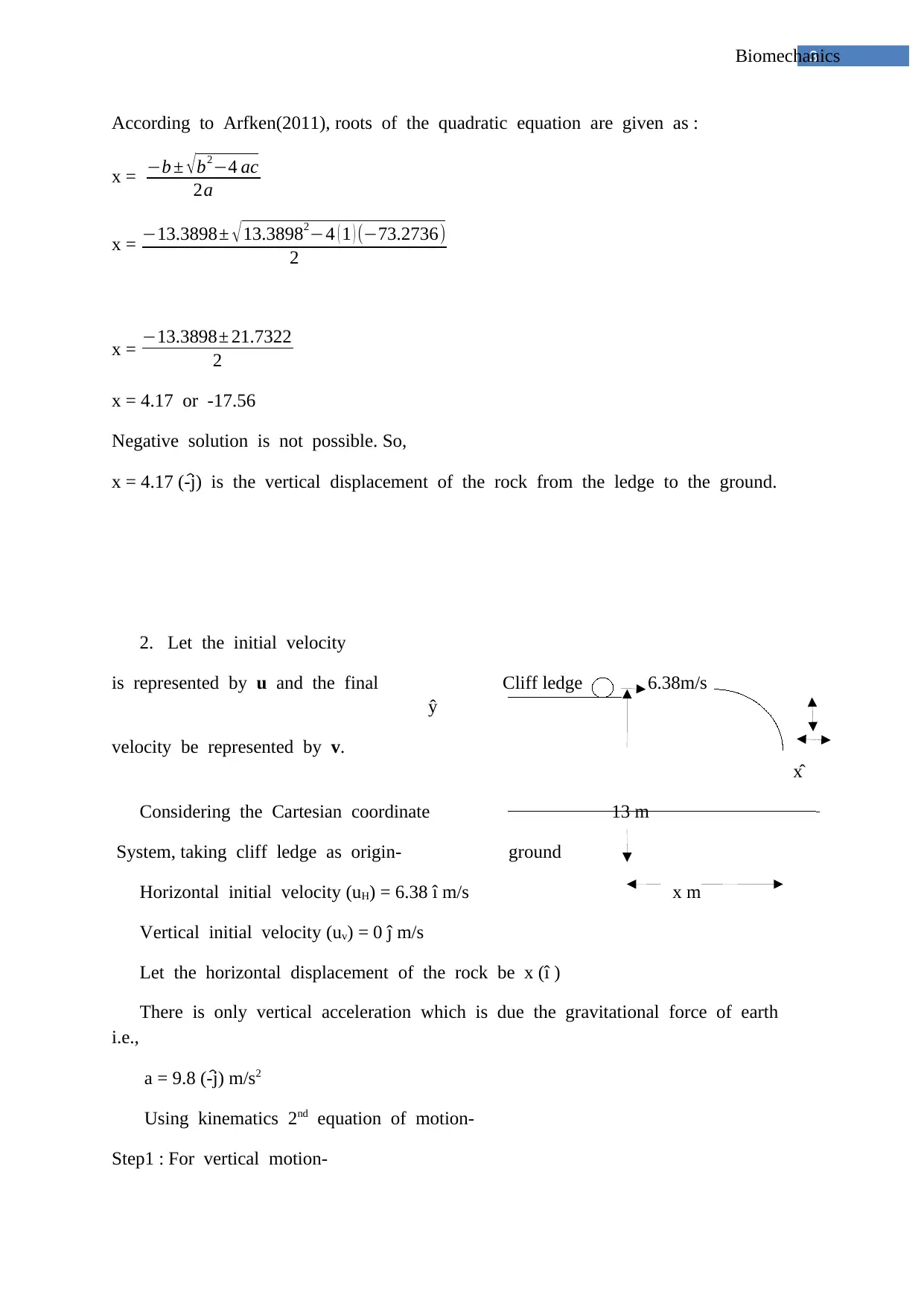
2. Let the initial velocity
is represented by u and the final Cliff ledge 6.38m/s
velocity be represented by v.

Considering the Cartesian coordinate 13 m
System, taking cliff ledge as origin- ground
Horizontal initial velocity (uH) = 6.38 î m/s x m
Vertical initial velocity (uv) = 0 ĵ m/s
Let the horizontal displacement of the rock be x (î )
There is only vertical acceleration which is due the gravitational force of earth
i.e.,
a = 9.8 (-ĵ ) m/s2
Using kinematics 2nd equation of motion-
Step1 : For vertical motion-
Document Page
4Biomechanics
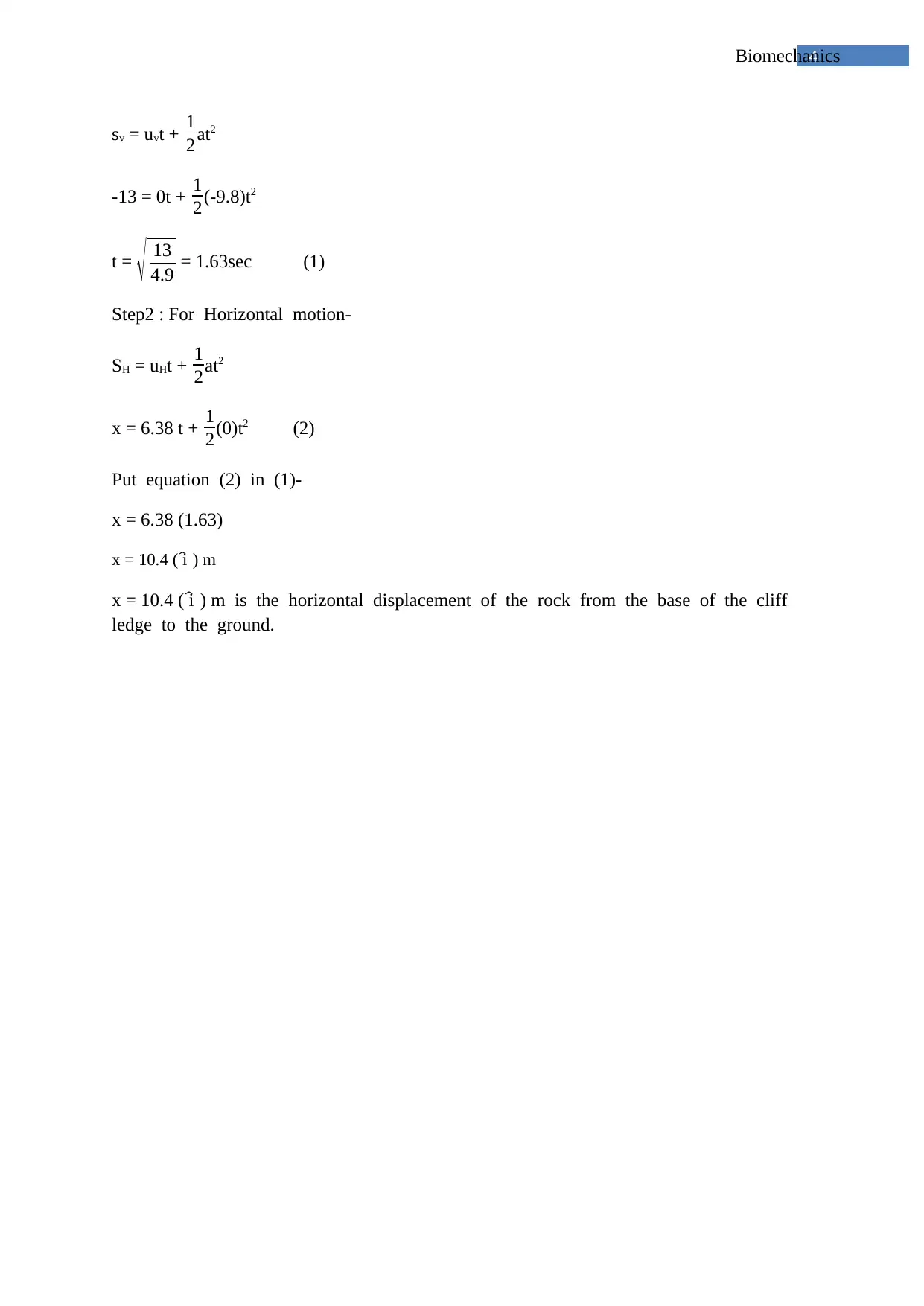
sv = uvt + 1
2at2
-13 = 0t + 1
2(-9.8)t2
t = 13
4.9 = 1.63sec (1)
Step2 : For Horizontal motion-
SH = uHt + 1
2at2
x = 6.38 t + 1
2(0)t2 (2)
Put equation (2) in (1)-
x = 6.38 (1.63)
x = 10.4 ( î ) m
x = 10.4 ( î ) m is the horizontal displacement of the rock from the base of the cliff
ledge to the ground.
tabler-icon-diamond-filled.svg

Paraphrase This Document

Need a fresh take? Get an instant paraphrase of this document with our AI Paraphraser
Document Page
5Biomechanics
References-
D. Kleppner. An Introduction to Mechanics. Chennai : McGraw Hill Education, 2017
G. Arfken. Mathematical Methods for Physicists, 7th Edition. Cambridge : Academic
Press,2011
chevron_up_icon
1 out of 5
circle_padding
hide_on_mobile
zoom_out_icon
[object Object]