Theoretical Perspectives of Piaget & Bronfenbrenner on Development

Verified

Added on  2023/05/29

|4
|1055
|380
Essay
AI Summary
This essay describes and analyzes the theoretical perspectives of Jean Piaget and Urie Bronfenbrenner in relation to physical development. It discusses Piaget's cognitive development theory, outlining the sensorimotor, preoperational, concrete operational, and formal operational stages, highlighting key developmental changes at each stage. Furthermore, it explores Bronfenbrenner's ecological systems theory, emphasizing the roles of the microsystem, mesosystem, exosystem, and macrosystem in a child's development. The essay then analyzes how these theoretical perspectives inform current frameworks in early childhood education, emphasizing their role in designing appropriate academic materials and resources, and acknowledging that current frameworks are built upon these foundational theories, promoting active learning and investigation.
Document Page
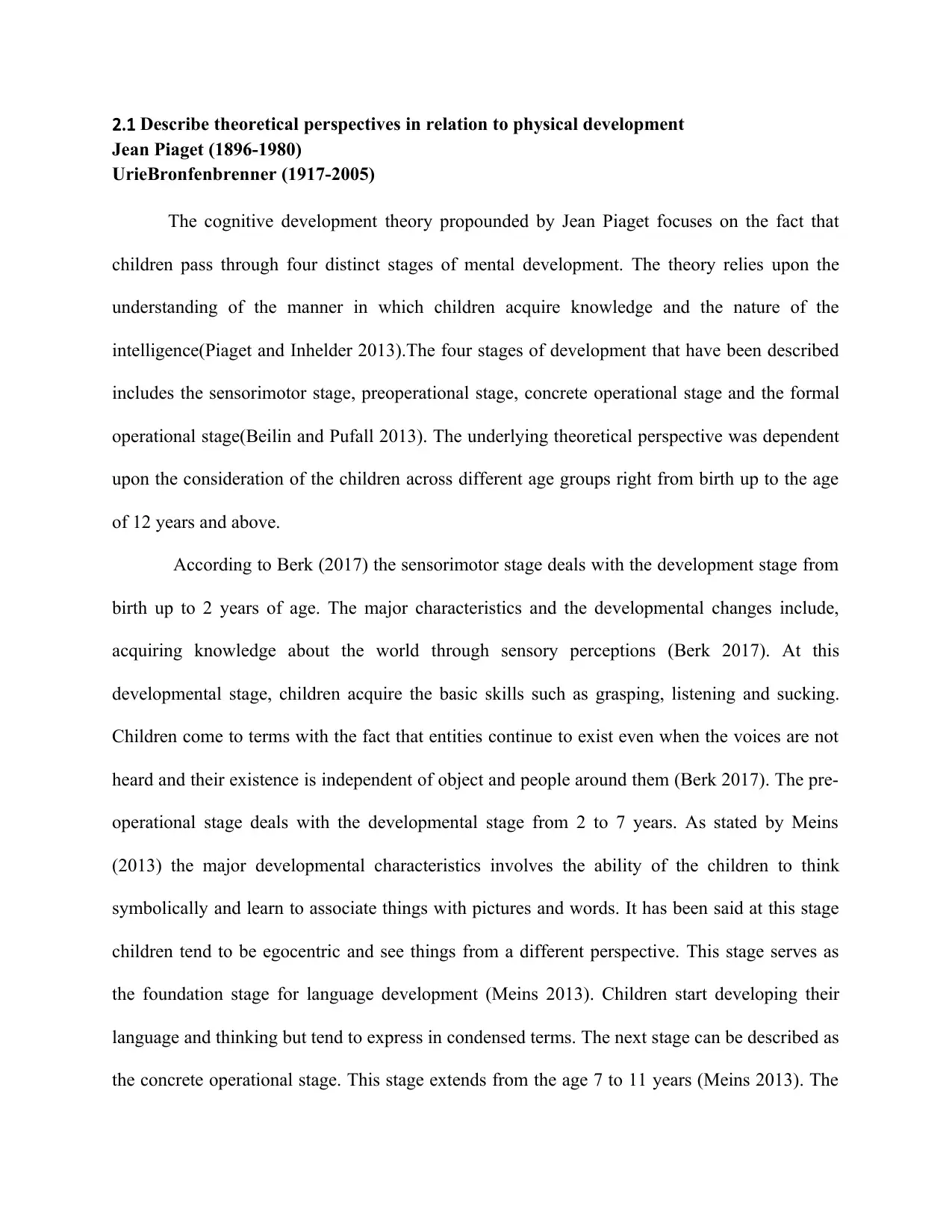
2.1 Describe theoretical perspectives in relation to physical development
Jean Piaget (1896-1980)
UrieBronfenbrenner (1917-2005)
The cognitive development theory propounded by Jean Piaget focuses on the fact that
children pass through four distinct stages of mental development. The theory relies upon the
understanding of the manner in which children acquire knowledge and the nature of the
intelligence(Piaget and Inhelder 2013).The four stages of development that have been described
includes the sensorimotor stage, preoperational stage, concrete operational stage and the formal
operational stage(Beilin and Pufall 2013). The underlying theoretical perspective was dependent
upon the consideration of the children across different age groups right from birth up to the age
of 12 years and above.
According to Berk (2017) the sensorimotor stage deals with the development stage from
birth up to 2 years of age. The major characteristics and the developmental changes include,
acquiring knowledge about the world through sensory perceptions (Berk 2017). At this
developmental stage, children acquire the basic skills such as grasping, listening and sucking.
Children come to terms with the fact that entities continue to exist even when the voices are not
heard and their existence is independent of object and people around them (Berk 2017). The pre-
operational stage deals with the developmental stage from 2 to 7 years. As stated by Meins
(2013) the major developmental characteristics involves the ability of the children to think
symbolically and learn to associate things with pictures and words. It has been said at this stage
children tend to be egocentric and see things from a different perspective. This stage serves as
the foundation stage for language development (Meins 2013). Children start developing their
language and thinking but tend to express in condensed terms. The next stage can be described as
the concrete operational stage. This stage extends from the age 7 to 11 years (Meins 2013). The
tabler-icon-diamond-filled.svg

Paraphrase This Document

Need a fresh take? Get an instant paraphrase of this document with our AI Paraphraser
Document Page
major characteristics and the developmental changes include, development of critical and logical
thinking about concrete events (Mischel 2013). In addition to this children also start
comprehending things with logic and reasoning. The last stage that is the formal operational
stage extends from age 12 and above(Piaget and Inhelder 2013). At this age, the children develop
the skills to comprehend abstract concepts and analyse complex problems based upon analytical
reasoning(Piaget and Inhelder 2013). The perspectives widen and children are able to deal with
complicated issues such as political, ethical, social and philosophical issues (Piaget and Inhelder
2013).
Urie Bronfenbrenner propounded the ecological systems theory that emphasised upon
the fact that the growth and development of a child is dependent upon the exposed environment.
The theory mentions four aspects of environment that regulates the upbringing of the child
microsystem, mesosystem, exosystem and macrosystem (Lau and Ng 2014). The microsystem
has been explained to be the immediate environment where a child grows up. It incorporates the
carers and parents and the caring relationship shared with the child. The temperament of the
child is influenced by the nurturing relationship shared by the caregivers within the microsystem.
The mesosystem includes several Microsystems that must work in favour of the child’s
development so as to avoid conflicting experiences (Lau and Ng 2014). The exosystem forms the
external environment that has an indirect impact on the development of the child. Though the
children do not interact directly with the exosystem, it still has an impact on the upbringing of
the child. For instance poor work life balance of parents can negatively affect the child. The
macrosystem includes the government policies and welfare policies that ensure a healthy growth
and development (Lau and Ng 2014).
Document Page
2.2 analyse how theoretical perspectives in relation to physical development inform current
frameworks.
The theories discussed above form an underlying basis of the early year framework for
imparting elementary education. The theoretical perspectives help in understanding the level of
intellectual development along with the physical growth and progression and the impact of the
concerned envrionmnt. As mentioned by Demetriou (2016) the considerations help in designing
appropriate academic materials and resources to support the academic and social development of
the children. In addition to this, it should also be noted that the current development frameworks
are created on the basis of Piaget’s and Bronfenbrenner’s development theories that serve as a
foundation stone. The underlying basis of the current theories and frameworks of early childhood
education and cognitive development is based upon the fact that children are not merely passive
recipients of knowledge but stimulated learners (Beilin and Pufall 2013). The exposure to the
world stimulates a spirit of investigation and experimentation in order to develop a crystal clear
understanding about the manner in which the world works. It is extremely important to
thoroughly consider the developmental stage and environmental exposure in order to promote a
healthy growth and development.
Document Page
References:
Beilin, H., andPufall, P. B. 2013. Piaget's theory: prospects and possibilities. Psychology
Press.pp.75
Berk, L., 2017. Development through the lifespan. Pearson Education India.pp.111-114
Demetriou, A., Shayer, M. and Efklides, A., 2016. Neo-Piagetian theories of cognitive
development: Implications and applications for education. Routledge.pp.68
Meins, E., 2013. Security of attachment and the social development of cognition. Psychology
press.pp.119
Mischel, T. ed., 2013. Cognitive development and epistemology. Academic Press.pp.24-26
Piaget, J. and Inhelder, B., 2013. The growth of logical thinking from childhood to adolescence:
An essay on the construction of formal operational structures. Routledge.pp.33-42
Lau, J. and Ng, K.M., 2014. Conceptualizing the counseling training environment using
Bronfenbrenner’s ecological theory. International Journal for the Advancement of
Counselling, 36(4), pp.423-439.
chevron_up_icon
1 out of 4
circle_padding
hide_on_mobile
zoom_out_icon
[object Object]