HI5004 Marketing Management Group Report: Pic's Peanut Butter Strategy

Verified

Added on  2022/09/15

|7
|1427
|16
Report
AI Summary
This report provides a comprehensive marketing analysis of Pic's Peanut Butter, a prominent brand in the Australian market. It begins with an introduction to the company and its product, followed by an examination of the competitive landscape, including key competitors like Scoop Wholefoods and Mayver’s. The report then delves into the environmental conditions affecting Pic’s, such as consumer preferences and market dynamics, and assesses the demand for its products. A significant portion of the report focuses on the application of the STP model (segmentation, targeting, and positioning) to Pic's, highlighting its demographic targeting and brand positioning strategies. The report concludes by summarizing the key findings, emphasizing Pic's strong brand presence and successful marketing strategies, which have resulted in increased demand and market share. The report also references the company's expansion efforts, including the construction of a new factory to meet growing consumer demand. The analysis provides valuable insights into Pic's marketing approaches and their effectiveness in the competitive food retail sector.
Document Page
Running Head: MARKETING MANAGEMENT 0
Marketing management
Students details:
tabler-icon-diamond-filled.svg

Paraphrase This Document

Need a fresh take? Get an instant paraphrase of this document with our AI Paraphraser
Document Page
MARKETING MANAGEMENT 1
Contents
Introduction......................................................................................................................................2
Competition faced by Pic’s..............................................................................................................2
Environmental conditions of Pic’s...................................................................................................3
Demand for PPB..............................................................................................................................3
STP (segmentation, Targeting, and positioning statements) of Pic’s..............................................3
Conclusion.......................................................................................................................................3
Bibliography....................................................................................................................................5
Document Page
MARKETING MANAGEMENT 2
Introduction
The following report is based on the brand positioning and brand equity of firm producing
consumer goods. In the report, we have chosen ‘PPB’ (PPB) as our product, which is one of the
most famous and most consumed peanut butter in Australia. The report gives information about
competition faced by the company, the environment in which the company deals the demand of
product and detailed information about the target market of the company. STP stands for
segmentation, targeting and positioning, this model helps in delivering relevant messages to the
targeted audience to promote sales.
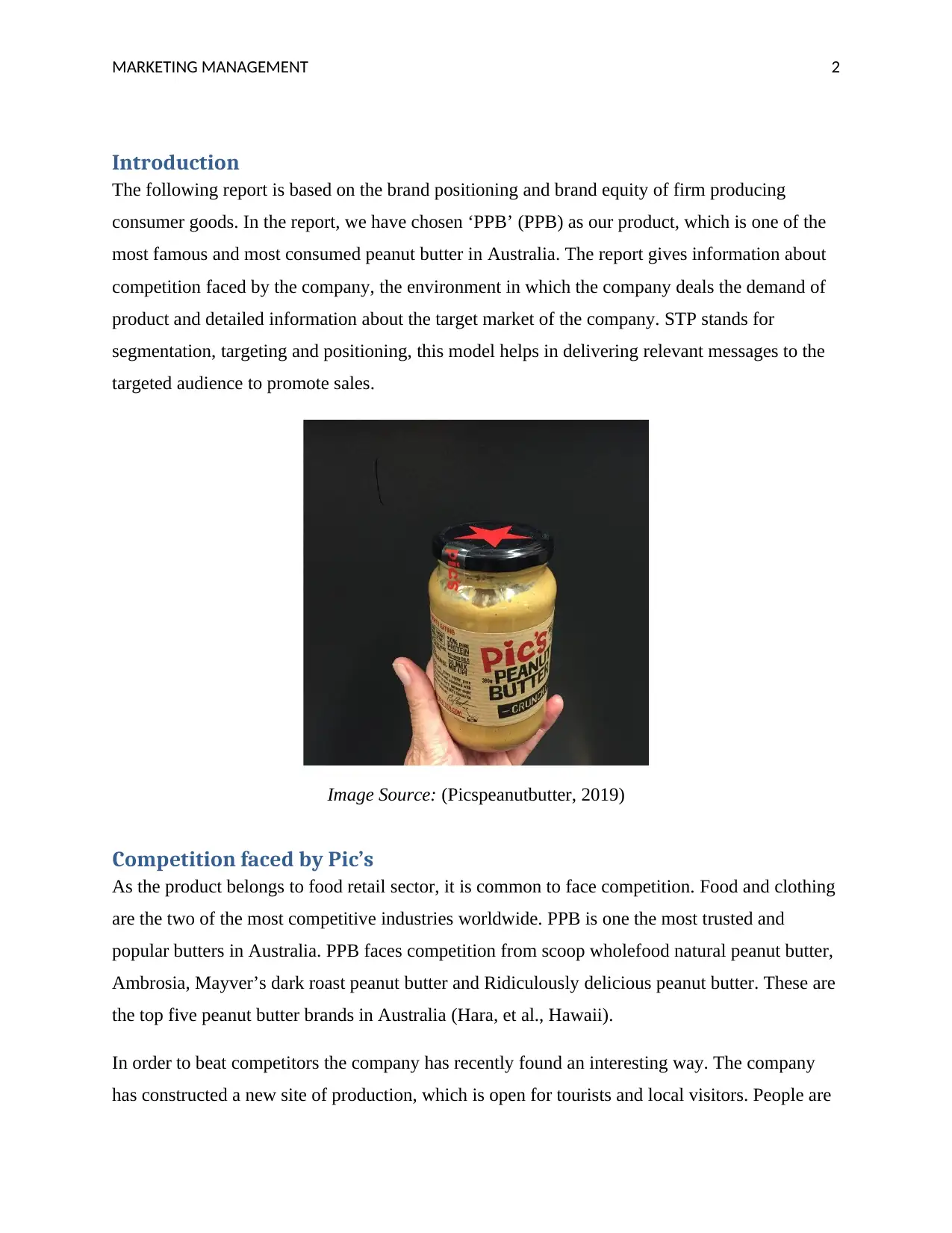
Image Source: (Picspeanutbutter, 2019)
Competition faced by Pic’s
As the product belongs to food retail sector, it is common to face competition. Food and clothing
are the two of the most competitive industries worldwide. PPB is one the most trusted and
popular butters in Australia. PPB faces competition from scoop wholefood natural peanut butter,
Ambrosia, Mayver’s dark roast peanut butter and Ridiculously delicious peanut butter. These are
the top five peanut butter brands in Australia (Hara, et al., Hawaii).
In order to beat competitors the company has recently found an interesting way. The company
has constructed a new site of production, which is open for tourists and local visitors. People are
Document Page
MARKETING MANAGEMENT 3
allowed to visit PPB factory and see how it is prepared. This friendly treatment provided by
company to the consumers has resulted in favor of company’s overall returns (Cardinali, 2014).
Environmental conditions of Pic’s.
PPB is a consumer products company, which are willing to maximize profits and increase their
share in market in a competitive and interconnected business environment. The organizations,
which provide consumer’s goods have to deal with the unforeseen challenges like change in the
taste and preference of people, turn or extend their compact business to next level and executing
structural and functional strategies that will lead to growth of the company.
PPB in a competitive business environment where there exists large number of firms who are
offering similar product to the consumers. Competition gives birth to some major issues with
PPB has to deal with. For instance, quality, quantity and price of the products are influenced
because of competition. The quality of product should be maintained, as the firm cannot afford to
lose consumers because of poor quality of butter. Secondly, the quantity of the butter offered in
jars should be in accordance to the basic quantity standards. Lastly, the price of the product
diminishes because of various competitors existing in marketplace. The existence of competitors
influences the revenue of the firms. Therefore, in order to remain in the competition PPB is
required to maintain the quality of the product (Reeves & Deimler, 2012).
Demand for PPB
Even after facing numerous hardships and competition, the PPB company has managed to defeat
all its competitors in terms of market demands. The increasing demand of PPB has brought the
company to an extent where there is an immediate need to build a completely new factory for
production. As per the reports of PPB company, the brand loyalty of consumers and popularity
of Pic’s in market has generated a sudden increase in the demand of butter. Another reason of
increased demand of PPB is its nutrition factors and ingredients, which are good for the health of
children, adults and old aged people as well (Vinson & Cai, 2012). The company has recently
opened a new Saxton Rd factory of about 2500 sq. meters, which will be larger than two Pic’s
production sites combined. It is project of worth about $10 million built by joining hands with
coman’s construction. As per the reports of PPB produces thousand s of jars of butter which is
insufficient sometimes to meet the needs. This is because the firm has setup new factory, now the
tabler-icon-diamond-filled.svg

Paraphrase This Document

Need a fresh take? Get an instant paraphrase of this document with our AI Paraphraser
Document Page
MARKETING MANAGEMENT 4
production will increase at pace rate. It should be noted that the increase in demand of PPB has
reduced the sales of rivalry firms (Stuff, 2018).
STP (segmentation, Targeting, and positioning statements) of Pic’s
The model of Segmentation, targeting and positioning helps the firms in dealing effectively in
the market conditions. The model is followed by PPB to achieve its set targets.
Segmentation- There are different ways to segment target market. For example- the
demographic, geographic, psychographic and behavioral factors can be considered while
segmenting. Herein, Pic’s has focused on the demographic factors which states that the
peanut butter is good for people of all age groups. The crunchy and soothing taste of
butter is loved by children and helps in providing them essential nutrients without making
any compromise with taste (Weinstein, 2013).
Targeting- It is never ending benefit for PPB company that the gates to purchase the
butter are opened for people belonging from different sections of society. The brand can
promote its product among all age groups, sexes, religions and economic classes. The
reasonable price of product makes it affordable for every economic class.
Positioning- The term position signifies place; herein the positioning is referred to
understand the demands of targeted audience. Pic’s is required to acknowledge its
targeted audience about why PPB is more likeable and beneficiary than other butters
(Weinstein, 2013).
Conclusion
As per the above report, it can be concluded that PPB is one of the most trusted butter brands in
the Australian market. The firm faces competition from various other organizations like
Ambrosia, Mayver’s and scoop whole foods. It manages to lead the competition by providing
best quality of services to the consumers. Defeating all the challenges firm has managed to cover
most of the Australia market (in regards to sale of peanut butter). The demand of PPB has
substantially increased, as it’s good for health of everyone. The firm has developed great
marketing mix strategies by understanding the valuable segments and targeted audience. This is
Document Page
MARKETING MANAGEMENT 5
because the consumers love PPB.
Document Page
MARKETING MANAGEMENT 6
Bibliography
Cardinali, M. a. B. S., 2014. Interformat competition in the grocery retailing. Journal of
Retailing and Consumer Services, 21(4), pp. 438-448.
Hara, A. H., Aoki, K. L., Cabral, S. K. & Niino-DuPonte, R., Hawaii. Attractiveness of gel,
granular, paste, and solid formulations of ant bait insecticides to the little fire ant, Wasmannia
auropunctata. 46 ed. 2014: Hawaiian Entomological Society.
Picspeanutbutter, 2019. Nice to see you, lovely peanut butter lover. [Online]
Available at: https://www.picspeanutbutter.com/go-to-stories/really-good-stuff/nice-to-see-you-
lovely-peanut-butter-lover/
[Accessed 24 August 2019].
Reeves, M. & Deimler, M., 2012. Adaptability: The new competitive advantage.. Own the
Future: 50 Ways to Win from the Boston Consulting Group, pp. 19-26.
Stuff, 2018. Peanut butter empire spreading out to take on world. [Online]
Available at: https://www.stuff.co.nz/business/104904803/start-spreading-the-news-pics-new-
factory-will-soon-be-the-toast-of-the-town
[Accessed 25 August 2019].
Vinson, J. A. & Cai, Y., 2012. Nuts, especially walnuts, have both antioxidant quantity and
efficacy and exhibit significant potential health benefits.. Food & function, 3(2), pp. 134-140.
Weinstein, A., 2013. Handbook of market segmentation: Strategic targeting for business and
technology firms. . In: Market Segmentatiion. London: Routledge, p. 260.
chevron_up_icon
1 out of 7
circle_padding
hide_on_mobile
zoom_out_icon
[object Object]