Case Study on Piece Rate System Implementation at Quality Footwear Ltd
VerifiedAdded on 2020/01/07
|7
|1708
|237
Case Study
AI Summary
This case study examines the implementation of a piece rate system at Quality Footwear Ltd (QF Ltd), a company producing industrial safety footwear. The report analyzes the suitability of the piece rate system, its different types (straight, increasing, and decreasing), and the advantages such as increased productivity and effective cost control. However, it also highlights the disadvantages, including potential for compromised quality and employee dissatisfaction. The study references various academic sources to support its findings, ultimately concluding that the piece rate system may not be appropriate for QF Ltd given its emphasis on quality, and suggesting that the CEO should carefully consider the system's implications before implementation. The case study provides a comprehensive overview of the piece rate system's impact on the company's performance and financial conditions.

CASE STUDY
Paraphrase This Document
Need a fresh take? Get an instant paraphrase of this document with our AI Paraphraser

TABLE OF CONTENTS
INTRODUCTION................................................................................................................................1
Piece rate system..............................................................................................................................1
Suitability of Piece rate system........................................................................................................1
Kinds of Piece rate system...............................................................................................................2
Advantages of Piece rate system.....................................................................................................2
Disadvantages of piece rate system.................................................................................................3
CONCLUSION....................................................................................................................................4
REFERENCES.....................................................................................................................................5
INTRODUCTION................................................................................................................................1
Piece rate system..............................................................................................................................1
Suitability of Piece rate system........................................................................................................1
Kinds of Piece rate system...............................................................................................................2
Advantages of Piece rate system.....................................................................................................2
Disadvantages of piece rate system.................................................................................................3
CONCLUSION....................................................................................................................................4
REFERENCES.....................................................................................................................................5

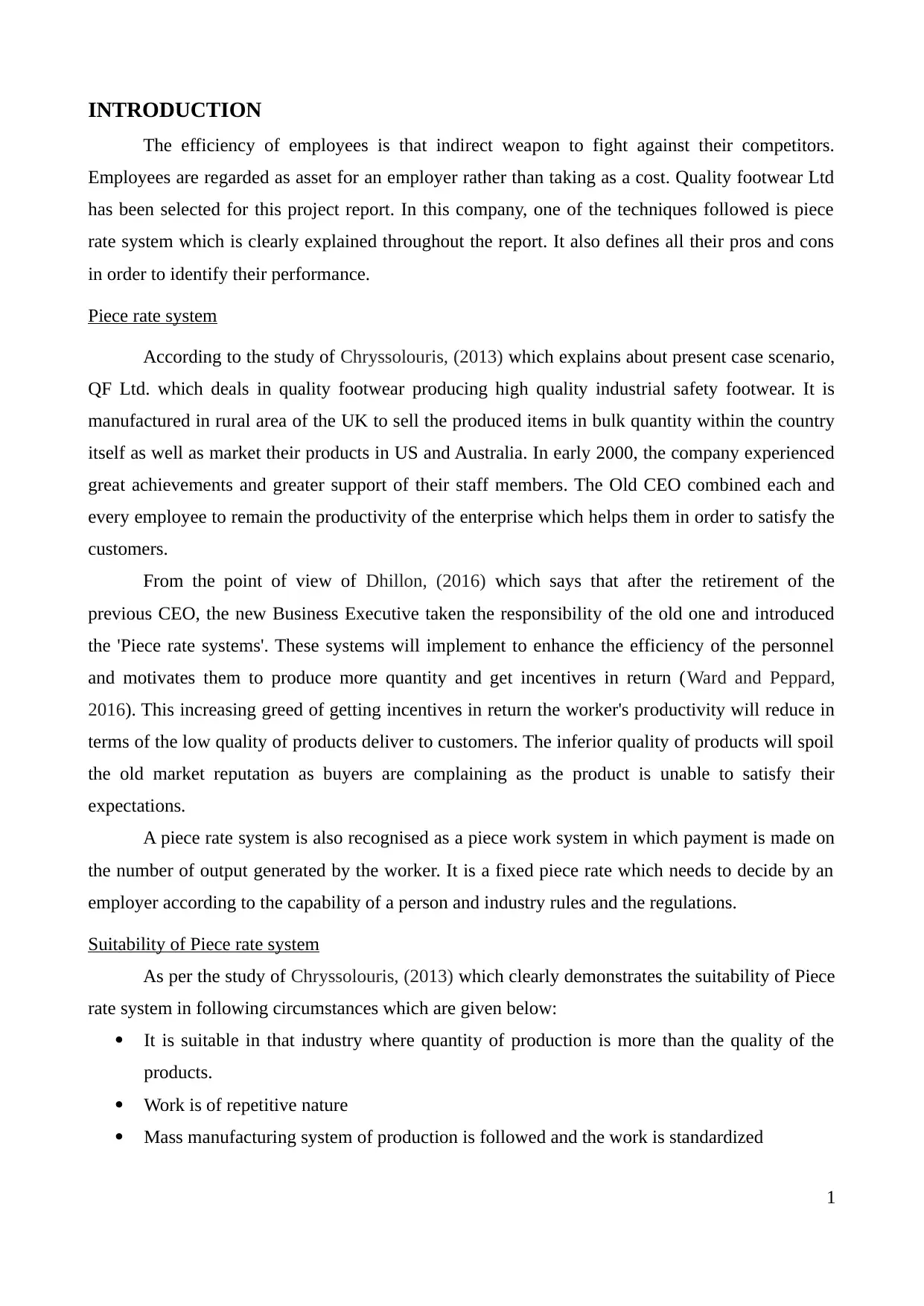
INTRODUCTION
The efficiency of employees is that indirect weapon to fight against their competitors.
Employees are regarded as asset for an employer rather than taking as a cost. Quality footwear Ltd
has been selected for this project report. In this company, one of the techniques followed is piece
rate system which is clearly explained throughout the report. It also defines all their pros and cons
in order to identify their performance.
Piece rate system
According to the study of Chryssolouris, (2013) which explains about present case scenario,
QF Ltd. which deals in quality footwear producing high quality industrial safety footwear. It is
manufactured in rural area of the UK to sell the produced items in bulk quantity within the country
itself as well as market their products in US and Australia. In early 2000, the company experienced
great achievements and greater support of their staff members. The Old CEO combined each and
every employee to remain the productivity of the enterprise which helps them in order to satisfy the
customers.
From the point of view of Dhillon, (2016) which says that after the retirement of the
previous CEO, the new Business Executive taken the responsibility of the old one and introduced
the 'Piece rate systems'. These systems will implement to enhance the efficiency of the personnel
and motivates them to produce more quantity and get incentives in return (Ward and Peppard,
2016). This increasing greed of getting incentives in return the worker's productivity will reduce in
terms of the low quality of products deliver to customers. The inferior quality of products will spoil
the old market reputation as buyers are complaining as the product is unable to satisfy their
expectations.
A piece rate system is also recognised as a piece work system in which payment is made on
the number of output generated by the worker. It is a fixed piece rate which needs to decide by an
employer according to the capability of a person and industry rules and the regulations.
Suitability of Piece rate system
As per the study of Chryssolouris, (2013) which clearly demonstrates the suitability of Piece
rate system in following circumstances which are given below:
It is suitable in that industry where quantity of production is more than the quality of the
products.
Work is of repetitive nature
Mass manufacturing system of production is followed and the work is standardized
1
The efficiency of employees is that indirect weapon to fight against their competitors.
Employees are regarded as asset for an employer rather than taking as a cost. Quality footwear Ltd
has been selected for this project report. In this company, one of the techniques followed is piece
rate system which is clearly explained throughout the report. It also defines all their pros and cons
in order to identify their performance.
Piece rate system
According to the study of Chryssolouris, (2013) which explains about present case scenario,
QF Ltd. which deals in quality footwear producing high quality industrial safety footwear. It is
manufactured in rural area of the UK to sell the produced items in bulk quantity within the country
itself as well as market their products in US and Australia. In early 2000, the company experienced
great achievements and greater support of their staff members. The Old CEO combined each and
every employee to remain the productivity of the enterprise which helps them in order to satisfy the
customers.
From the point of view of Dhillon, (2016) which says that after the retirement of the
previous CEO, the new Business Executive taken the responsibility of the old one and introduced
the 'Piece rate systems'. These systems will implement to enhance the efficiency of the personnel
and motivates them to produce more quantity and get incentives in return (Ward and Peppard,
2016). This increasing greed of getting incentives in return the worker's productivity will reduce in
terms of the low quality of products deliver to customers. The inferior quality of products will spoil
the old market reputation as buyers are complaining as the product is unable to satisfy their
expectations.
A piece rate system is also recognised as a piece work system in which payment is made on
the number of output generated by the worker. It is a fixed piece rate which needs to decide by an
employer according to the capability of a person and industry rules and the regulations.
Suitability of Piece rate system
As per the study of Chryssolouris, (2013) which clearly demonstrates the suitability of Piece
rate system in following circumstances which are given below:
It is suitable in that industry where quantity of production is more than the quality of the
products.
Work is of repetitive nature
Mass manufacturing system of production is followed and the work is standardized
1
⊘ This is a preview!⊘
Do you want full access?
Subscribe today to unlock all pages.

Trusted by 1+ million students worldwide

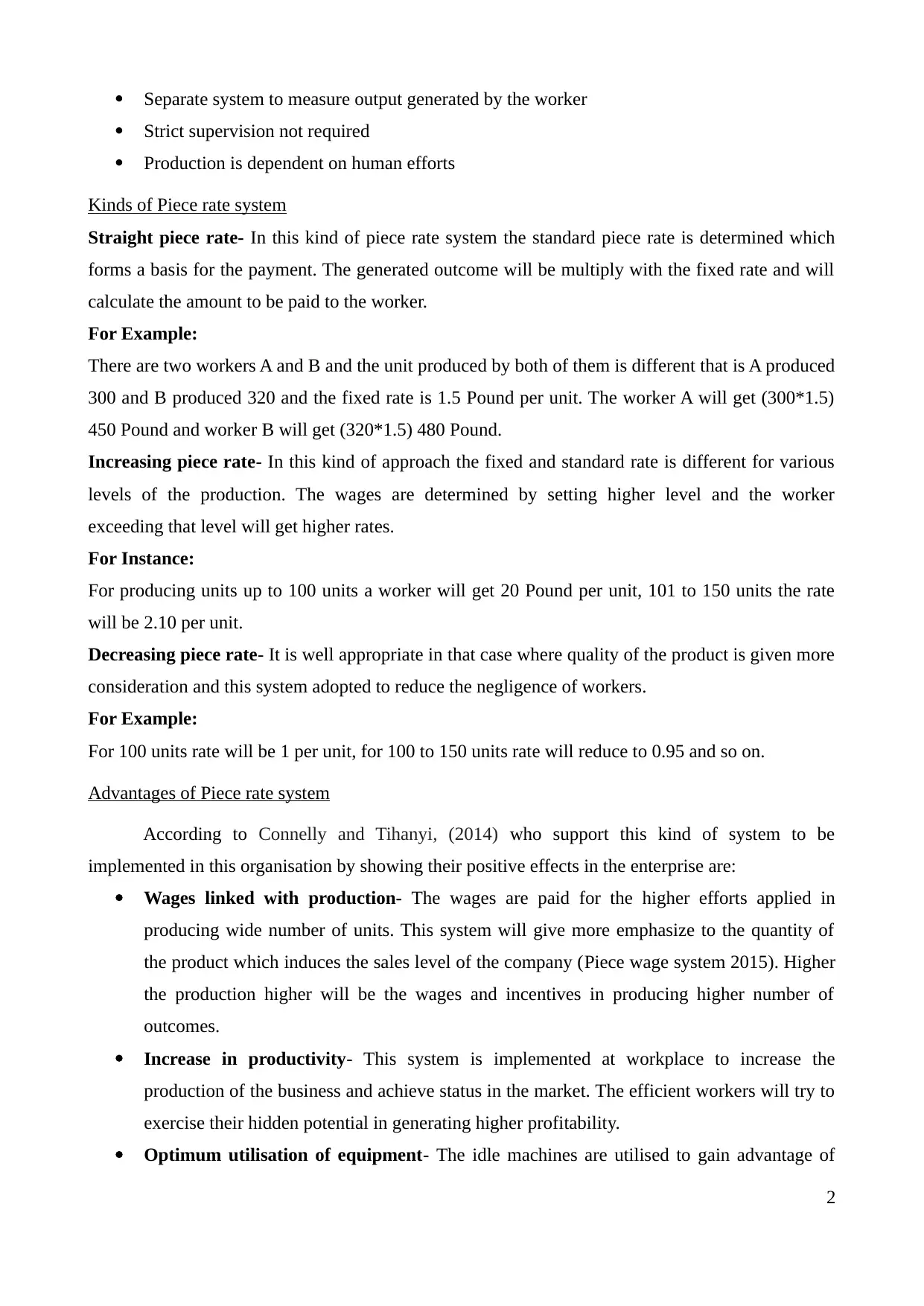
Separate system to measure output generated by the worker
Strict supervision not required
Production is dependent on human efforts
Kinds of Piece rate system
Straight piece rate- In this kind of piece rate system the standard piece rate is determined which
forms a basis for the payment. The generated outcome will be multiply with the fixed rate and will
calculate the amount to be paid to the worker.
For Example:
There are two workers A and B and the unit produced by both of them is different that is A produced
300 and B produced 320 and the fixed rate is 1.5 Pound per unit. The worker A will get (300*1.5)
450 Pound and worker B will get (320*1.5) 480 Pound.
Increasing piece rate- In this kind of approach the fixed and standard rate is different for various
levels of the production. The wages are determined by setting higher level and the worker
exceeding that level will get higher rates.
For Instance:
For producing units up to 100 units a worker will get 20 Pound per unit, 101 to 150 units the rate
will be 2.10 per unit.
Decreasing piece rate- It is well appropriate in that case where quality of the product is given more
consideration and this system adopted to reduce the negligence of workers.
For Example:
For 100 units rate will be 1 per unit, for 100 to 150 units rate will reduce to 0.95 and so on.
Advantages of Piece rate system
According to Connelly and Tihanyi, (2014) who support this kind of system to be
implemented in this organisation by showing their positive effects in the enterprise are:
Wages linked with production- The wages are paid for the higher efforts applied in
producing wide number of units. This system will give more emphasize to the quantity of
the product which induces the sales level of the company (Piece wage system 2015). Higher
the production higher will be the wages and incentives in producing higher number of
outcomes.
Increase in productivity- This system is implemented at workplace to increase the
production of the business and achieve status in the market. The efficient workers will try to
exercise their hidden potential in generating higher profitability.
Optimum utilisation of equipment- The idle machines are utilised to gain advantage of
2
Strict supervision not required
Production is dependent on human efforts
Kinds of Piece rate system
Straight piece rate- In this kind of piece rate system the standard piece rate is determined which
forms a basis for the payment. The generated outcome will be multiply with the fixed rate and will
calculate the amount to be paid to the worker.
For Example:
There are two workers A and B and the unit produced by both of them is different that is A produced
300 and B produced 320 and the fixed rate is 1.5 Pound per unit. The worker A will get (300*1.5)
450 Pound and worker B will get (320*1.5) 480 Pound.
Increasing piece rate- In this kind of approach the fixed and standard rate is different for various
levels of the production. The wages are determined by setting higher level and the worker
exceeding that level will get higher rates.
For Instance:
For producing units up to 100 units a worker will get 20 Pound per unit, 101 to 150 units the rate
will be 2.10 per unit.
Decreasing piece rate- It is well appropriate in that case where quality of the product is given more
consideration and this system adopted to reduce the negligence of workers.
For Example:
For 100 units rate will be 1 per unit, for 100 to 150 units rate will reduce to 0.95 and so on.
Advantages of Piece rate system
According to Connelly and Tihanyi, (2014) who support this kind of system to be
implemented in this organisation by showing their positive effects in the enterprise are:
Wages linked with production- The wages are paid for the higher efforts applied in
producing wide number of units. This system will give more emphasize to the quantity of
the product which induces the sales level of the company (Piece wage system 2015). Higher
the production higher will be the wages and incentives in producing higher number of
outcomes.
Increase in productivity- This system is implemented at workplace to increase the
production of the business and achieve status in the market. The efficient workers will try to
exercise their hidden potential in generating higher profitability.
Optimum utilisation of equipment- The idle machines are utilised to gain advantage of
2
Paraphrase This Document
Need a fresh take? Get an instant paraphrase of this document with our AI Paraphraser

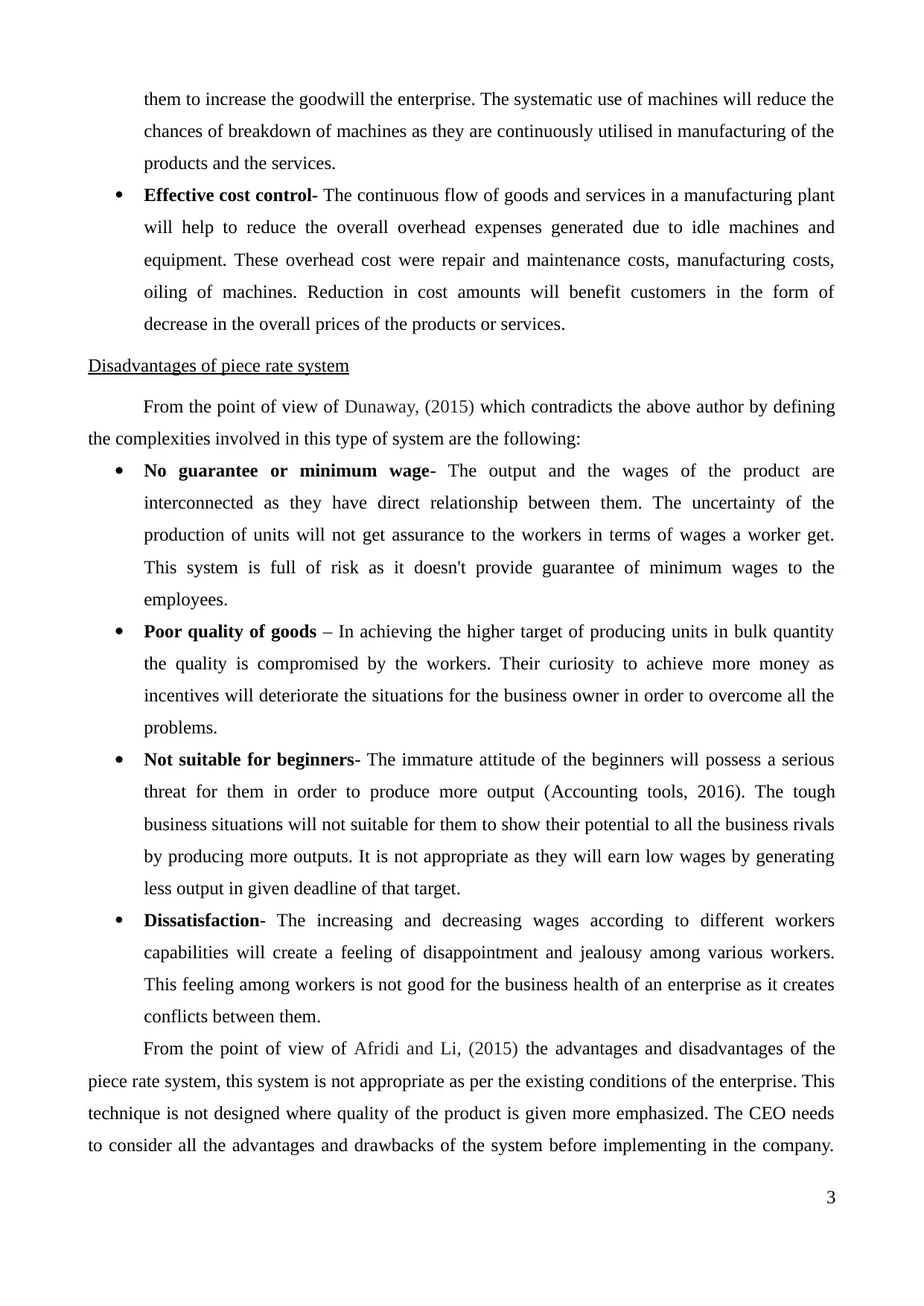
them to increase the goodwill the enterprise. The systematic use of machines will reduce the
chances of breakdown of machines as they are continuously utilised in manufacturing of the
products and the services.
Effective cost control- The continuous flow of goods and services in a manufacturing plant
will help to reduce the overall overhead expenses generated due to idle machines and
equipment. These overhead cost were repair and maintenance costs, manufacturing costs,
oiling of machines. Reduction in cost amounts will benefit customers in the form of
decrease in the overall prices of the products or services.
Disadvantages of piece rate system
From the point of view of Dunaway, (2015) which contradicts the above author by defining
the complexities involved in this type of system are the following:
No guarantee or minimum wage- The output and the wages of the product are
interconnected as they have direct relationship between them. The uncertainty of the
production of units will not get assurance to the workers in terms of wages a worker get.
This system is full of risk as it doesn't provide guarantee of minimum wages to the
employees.
Poor quality of goods – In achieving the higher target of producing units in bulk quantity
the quality is compromised by the workers. Their curiosity to achieve more money as
incentives will deteriorate the situations for the business owner in order to overcome all the
problems.
Not suitable for beginners- The immature attitude of the beginners will possess a serious
threat for them in order to produce more output (Accounting tools, 2016). The tough
business situations will not suitable for them to show their potential to all the business rivals
by producing more outputs. It is not appropriate as they will earn low wages by generating
less output in given deadline of that target.
Dissatisfaction- The increasing and decreasing wages according to different workers
capabilities will create a feeling of disappointment and jealousy among various workers.
This feeling among workers is not good for the business health of an enterprise as it creates
conflicts between them.
From the point of view of Afridi and Li, (2015) the advantages and disadvantages of the
piece rate system, this system is not appropriate as per the existing conditions of the enterprise. This
technique is not designed where quality of the product is given more emphasized. The CEO needs
to consider all the advantages and drawbacks of the system before implementing in the company.
3
chances of breakdown of machines as they are continuously utilised in manufacturing of the
products and the services.
Effective cost control- The continuous flow of goods and services in a manufacturing plant
will help to reduce the overall overhead expenses generated due to idle machines and
equipment. These overhead cost were repair and maintenance costs, manufacturing costs,
oiling of machines. Reduction in cost amounts will benefit customers in the form of
decrease in the overall prices of the products or services.
Disadvantages of piece rate system
From the point of view of Dunaway, (2015) which contradicts the above author by defining
the complexities involved in this type of system are the following:
No guarantee or minimum wage- The output and the wages of the product are
interconnected as they have direct relationship between them. The uncertainty of the
production of units will not get assurance to the workers in terms of wages a worker get.
This system is full of risk as it doesn't provide guarantee of minimum wages to the
employees.
Poor quality of goods – In achieving the higher target of producing units in bulk quantity
the quality is compromised by the workers. Their curiosity to achieve more money as
incentives will deteriorate the situations for the business owner in order to overcome all the
problems.
Not suitable for beginners- The immature attitude of the beginners will possess a serious
threat for them in order to produce more output (Accounting tools, 2016). The tough
business situations will not suitable for them to show their potential to all the business rivals
by producing more outputs. It is not appropriate as they will earn low wages by generating
less output in given deadline of that target.
Dissatisfaction- The increasing and decreasing wages according to different workers
capabilities will create a feeling of disappointment and jealousy among various workers.
This feeling among workers is not good for the business health of an enterprise as it creates
conflicts between them.
From the point of view of Afridi and Li, (2015) the advantages and disadvantages of the
piece rate system, this system is not appropriate as per the existing conditions of the enterprise. This
technique is not designed where quality of the product is given more emphasized. The CEO needs
to consider all the advantages and drawbacks of the system before implementing in the company.
3

Every action of top authority will directly affect the performance of an institution.
CONCLUSION
It can be summarised from the above study that Piece rate system is not appropriate in the
given condition. This system will decrease the achievement level of the enterprise as it will spoil the
financial conditions of the business. The implemented systems can be improved in order to enhance
the sales level which was 50% Dropped due to lagging in delivering high quality product to their
customers.
4
CONCLUSION
It can be summarised from the above study that Piece rate system is not appropriate in the
given condition. This system will decrease the achievement level of the enterprise as it will spoil the
financial conditions of the business. The implemented systems can be improved in order to enhance
the sales level which was 50% Dropped due to lagging in delivering high quality product to their
customers.
4
⊘ This is a preview!⊘
Do you want full access?
Subscribe today to unlock all pages.

Trusted by 1+ million students worldwide

REFERENCES
Books and Journals
Afridi, F. and Li, 2015. Social identity and inequality: The impact of China's hukou system. Journal
of Public Economics. 123. pp. 17-29.
Conrads, J. and Irlenbusch, B. 2013. Lying and team incentives. Journal of Economic Psychology.
34. pp.1-7.
Dunaway, W. A., 2015. The double register of history: Situating the forgotten woman and her
household in capitalist commodity chains. Journal of World-Systems Research. 7(1). pp.2-29.
Schulte, M. and Theuvsen, L., 2015. Influence of incentive system design on individual farm
performance: A survey in the German strawberry and asparagus sectors. European Journal Of
Horticultural Science. 80(5). pp.249-259.
Connelly, B. L. and Tihanyi, 2014. Tournament theory thirty years of contests and competitions.
Journal of Management. 40(1). pp.16-47.
Ward, J. and Peppard, J., 2016. The Strategic Management of Information Systems: Building a
Digital Strategy. John Wiley & Sons.
Chryssolouris, G., 2013. Manufacturing systems: theory and practice. Springer Science & Business
Media.
Dhillon, B. S., 2016. Transportation systems reliability and safety. CRC press.
Online
Piece wage system. 2015. [Online]. Available through:
<http://www.yourarticlelibrary.com/employee-management/wages/piece-wage-system-
advantages-limitations-and-other-details/34665/>. [Accessed on 29th August 2016].
Accounting tools, 2016. [Online]. Available through: <http://www.accountingtools.com/piece-rate
pay>. [Accessed on 29th August 2016].
5
Books and Journals
Afridi, F. and Li, 2015. Social identity and inequality: The impact of China's hukou system. Journal
of Public Economics. 123. pp. 17-29.
Conrads, J. and Irlenbusch, B. 2013. Lying and team incentives. Journal of Economic Psychology.
34. pp.1-7.
Dunaway, W. A., 2015. The double register of history: Situating the forgotten woman and her
household in capitalist commodity chains. Journal of World-Systems Research. 7(1). pp.2-29.
Schulte, M. and Theuvsen, L., 2015. Influence of incentive system design on individual farm
performance: A survey in the German strawberry and asparagus sectors. European Journal Of
Horticultural Science. 80(5). pp.249-259.
Connelly, B. L. and Tihanyi, 2014. Tournament theory thirty years of contests and competitions.
Journal of Management. 40(1). pp.16-47.
Ward, J. and Peppard, J., 2016. The Strategic Management of Information Systems: Building a
Digital Strategy. John Wiley & Sons.
Chryssolouris, G., 2013. Manufacturing systems: theory and practice. Springer Science & Business
Media.
Dhillon, B. S., 2016. Transportation systems reliability and safety. CRC press.
Online
Piece wage system. 2015. [Online]. Available through:
<http://www.yourarticlelibrary.com/employee-management/wages/piece-wage-system-
advantages-limitations-and-other-details/34665/>. [Accessed on 29th August 2016].
Accounting tools, 2016. [Online]. Available through: <http://www.accountingtools.com/piece-rate
pay>. [Accessed on 29th August 2016].
5
1 out of 7
Related Documents
Your All-in-One AI-Powered Toolkit for Academic Success.
+13062052269
info@desklib.com
Available 24*7 on WhatsApp / Email
Unlock your academic potential
Copyright © 2020–2025 A2Z Services. All Rights Reserved. Developed and managed by ZUCOL.