Pill Testing Ethical Implications: HLSC220, ACU, Semester 1, 2019
VerifiedAdded on 2023/01/16
|6
|1364
|47
Essay
AI Summary
This essay examines the ethical considerations of pill testing in Australia, a harm reduction strategy aimed at informing drug users about the content and purity of substances. While pill testing can raise awareness and potentially reduce harm associated with illicit drug use, the essay argues that making it mandatory infringes upon individual moral values and ethical principles, particularly beneficence and autonomy. The essay also highlights medical concerns, such as the inaccuracy and insensitivity of pill testing to new designer drugs. It concludes that pill testing should only be conducted with informed consent, ensuring individuals are fully aware of the potential adverse effects and retaining the right to choose whether or not to participate. Desklib provides access to this essay along with numerous other student-contributed assignments.
Running head: ETHICS OF PILL TESTING
Topic: ETHICS OF PILL TESTING
Name of Student:
Name of the University:
Author’s Note:
Topic: ETHICS OF PILL TESTING
Name of Student:
Name of the University:
Author’s Note:
Paraphrase This Document
Need a fresh take? Get an instant paraphrase of this document with our AI Paraphraser

1ETHICS OF PILL TESTING
Introduction:
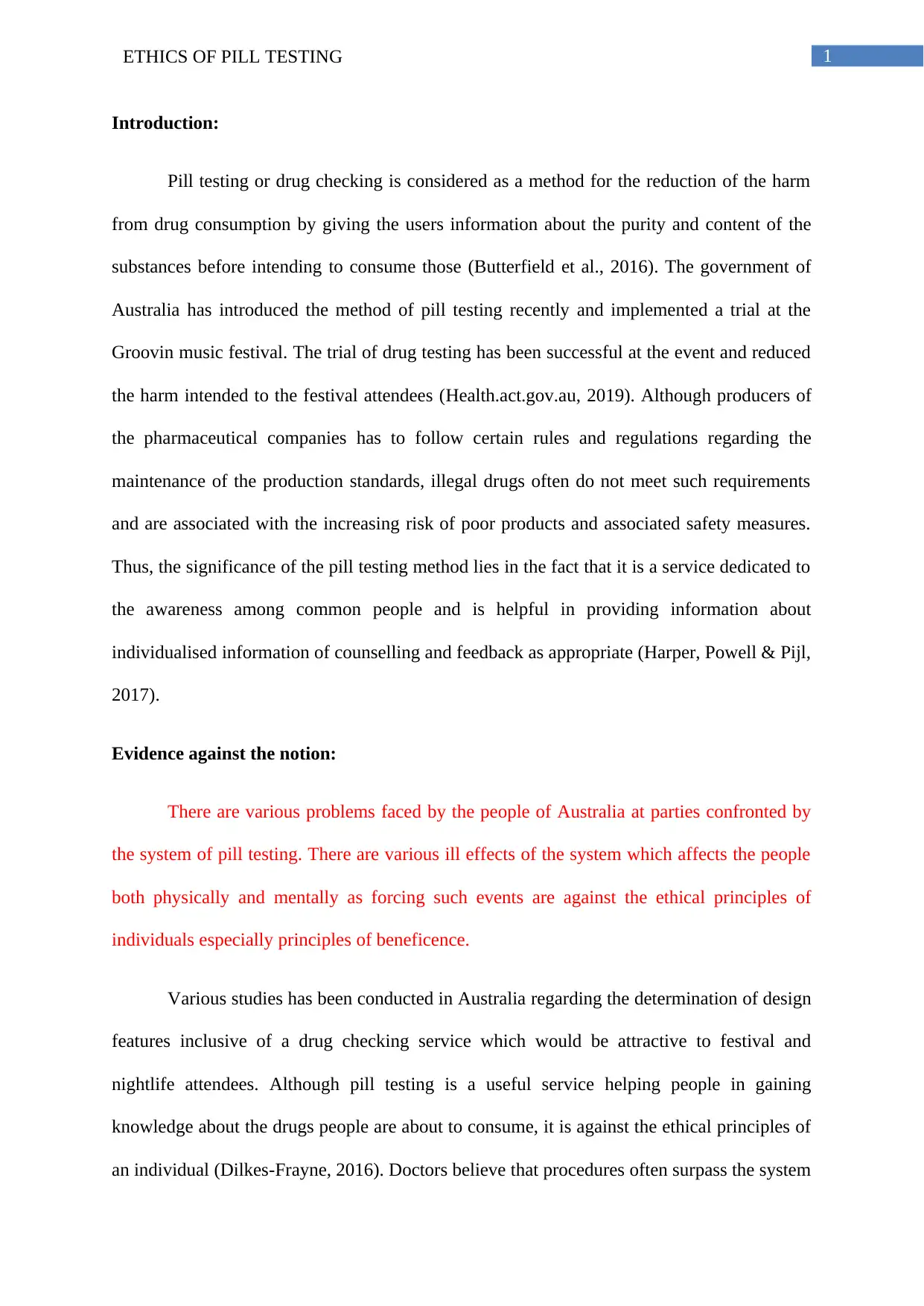
Pill testing or drug checking is considered as a method for the reduction of the harm
from drug consumption by giving the users information about the purity and content of the
substances before intending to consume those (Butterfield et al., 2016). The government of
Australia has introduced the method of pill testing recently and implemented a trial at the
Groovin music festival. The trial of drug testing has been successful at the event and reduced
the harm intended to the festival attendees (Health.act.gov.au, 2019). Although producers of
the pharmaceutical companies has to follow certain rules and regulations regarding the
maintenance of the production standards, illegal drugs often do not meet such requirements
and are associated with the increasing risk of poor products and associated safety measures.
Thus, the significance of the pill testing method lies in the fact that it is a service dedicated to
the awareness among common people and is helpful in providing information about
individualised information of counselling and feedback as appropriate (Harper, Powell & Pijl,
2017).
Evidence against the notion:
There are various problems faced by the people of Australia at parties confronted by
the system of pill testing. There are various ill effects of the system which affects the people
both physically and mentally as forcing such events are against the ethical principles of
individuals especially principles of beneficence.
Various studies has been conducted in Australia regarding the determination of design
features inclusive of a drug checking service which would be attractive to festival and
nightlife attendees. Although pill testing is a useful service helping people in gaining
knowledge about the drugs people are about to consume, it is against the ethical principles of
an individual (Dilkes-Frayne, 2016). Doctors believe that procedures often surpass the system
Introduction:
Pill testing or drug checking is considered as a method for the reduction of the harm
from drug consumption by giving the users information about the purity and content of the
substances before intending to consume those (Butterfield et al., 2016). The government of
Australia has introduced the method of pill testing recently and implemented a trial at the
Groovin music festival. The trial of drug testing has been successful at the event and reduced
the harm intended to the festival attendees (Health.act.gov.au, 2019). Although producers of
the pharmaceutical companies has to follow certain rules and regulations regarding the
maintenance of the production standards, illegal drugs often do not meet such requirements
and are associated with the increasing risk of poor products and associated safety measures.
Thus, the significance of the pill testing method lies in the fact that it is a service dedicated to
the awareness among common people and is helpful in providing information about
individualised information of counselling and feedback as appropriate (Harper, Powell & Pijl,
2017).
Evidence against the notion:
There are various problems faced by the people of Australia at parties confronted by
the system of pill testing. There are various ill effects of the system which affects the people
both physically and mentally as forcing such events are against the ethical principles of
individuals especially principles of beneficence.
Various studies has been conducted in Australia regarding the determination of design
features inclusive of a drug checking service which would be attractive to festival and
nightlife attendees. Although pill testing is a useful service helping people in gaining
knowledge about the drugs people are about to consume, it is against the ethical principles of
an individual (Dilkes-Frayne, 2016). Doctors believe that procedures often surpass the system

2ETHICS OF PILL TESTING
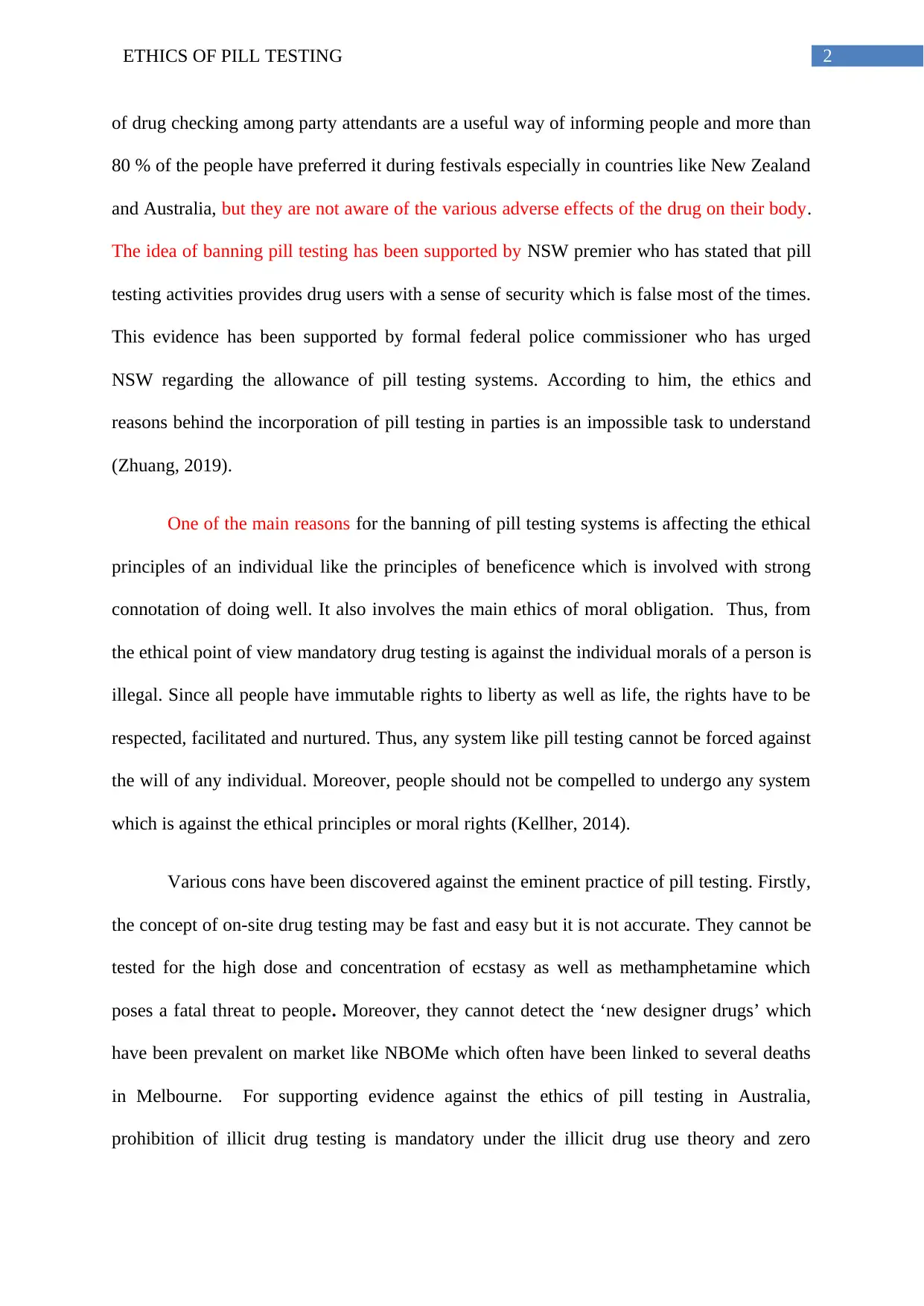
of drug checking among party attendants are a useful way of informing people and more than
80 % of the people have preferred it during festivals especially in countries like New Zealand
and Australia, but they are not aware of the various adverse effects of the drug on their body.
The idea of banning pill testing has been supported by NSW premier who has stated that pill
testing activities provides drug users with a sense of security which is false most of the times.
This evidence has been supported by formal federal police commissioner who has urged
NSW regarding the allowance of pill testing systems. According to him, the ethics and
reasons behind the incorporation of pill testing in parties is an impossible task to understand
(Zhuang, 2019).
One of the main reasons for the banning of pill testing systems is affecting the ethical
principles of an individual like the principles of beneficence which is involved with strong
connotation of doing well. It also involves the main ethics of moral obligation. Thus, from
the ethical point of view mandatory drug testing is against the individual morals of a person is
illegal. Since all people have immutable rights to liberty as well as life, the rights have to be
respected, facilitated and nurtured. Thus, any system like pill testing cannot be forced against
the will of any individual. Moreover, people should not be compelled to undergo any system
which is against the ethical principles or moral rights (Kellher, 2014).
Various cons have been discovered against the eminent practice of pill testing. Firstly,
the concept of on-site drug testing may be fast and easy but it is not accurate. They cannot be
tested for the high dose and concentration of ecstasy as well as methamphetamine which
poses a fatal threat to people. Moreover, they cannot detect the ‘new designer drugs’ which
have been prevalent on market like NBOMe which often have been linked to several deaths
in Melbourne. For supporting evidence against the ethics of pill testing in Australia,
prohibition of illicit drug testing is mandatory under the illicit drug use theory and zero
of drug checking among party attendants are a useful way of informing people and more than
80 % of the people have preferred it during festivals especially in countries like New Zealand
and Australia, but they are not aware of the various adverse effects of the drug on their body.
The idea of banning pill testing has been supported by NSW premier who has stated that pill
testing activities provides drug users with a sense of security which is false most of the times.
This evidence has been supported by formal federal police commissioner who has urged
NSW regarding the allowance of pill testing systems. According to him, the ethics and
reasons behind the incorporation of pill testing in parties is an impossible task to understand
(Zhuang, 2019).
One of the main reasons for the banning of pill testing systems is affecting the ethical
principles of an individual like the principles of beneficence which is involved with strong
connotation of doing well. It also involves the main ethics of moral obligation. Thus, from
the ethical point of view mandatory drug testing is against the individual morals of a person is
illegal. Since all people have immutable rights to liberty as well as life, the rights have to be
respected, facilitated and nurtured. Thus, any system like pill testing cannot be forced against
the will of any individual. Moreover, people should not be compelled to undergo any system
which is against the ethical principles or moral rights (Kellher, 2014).
Various cons have been discovered against the eminent practice of pill testing. Firstly,
the concept of on-site drug testing may be fast and easy but it is not accurate. They cannot be
tested for the high dose and concentration of ecstasy as well as methamphetamine which
poses a fatal threat to people. Moreover, they cannot detect the ‘new designer drugs’ which
have been prevalent on market like NBOMe which often have been linked to several deaths
in Melbourne. For supporting evidence against the ethics of pill testing in Australia,
prohibition of illicit drug testing is mandatory under the illicit drug use theory and zero
⊘ This is a preview!⊘
Do you want full access?
Subscribe today to unlock all pages.

Trusted by 1+ million students worldwide

3ETHICS OF PILL TESTING
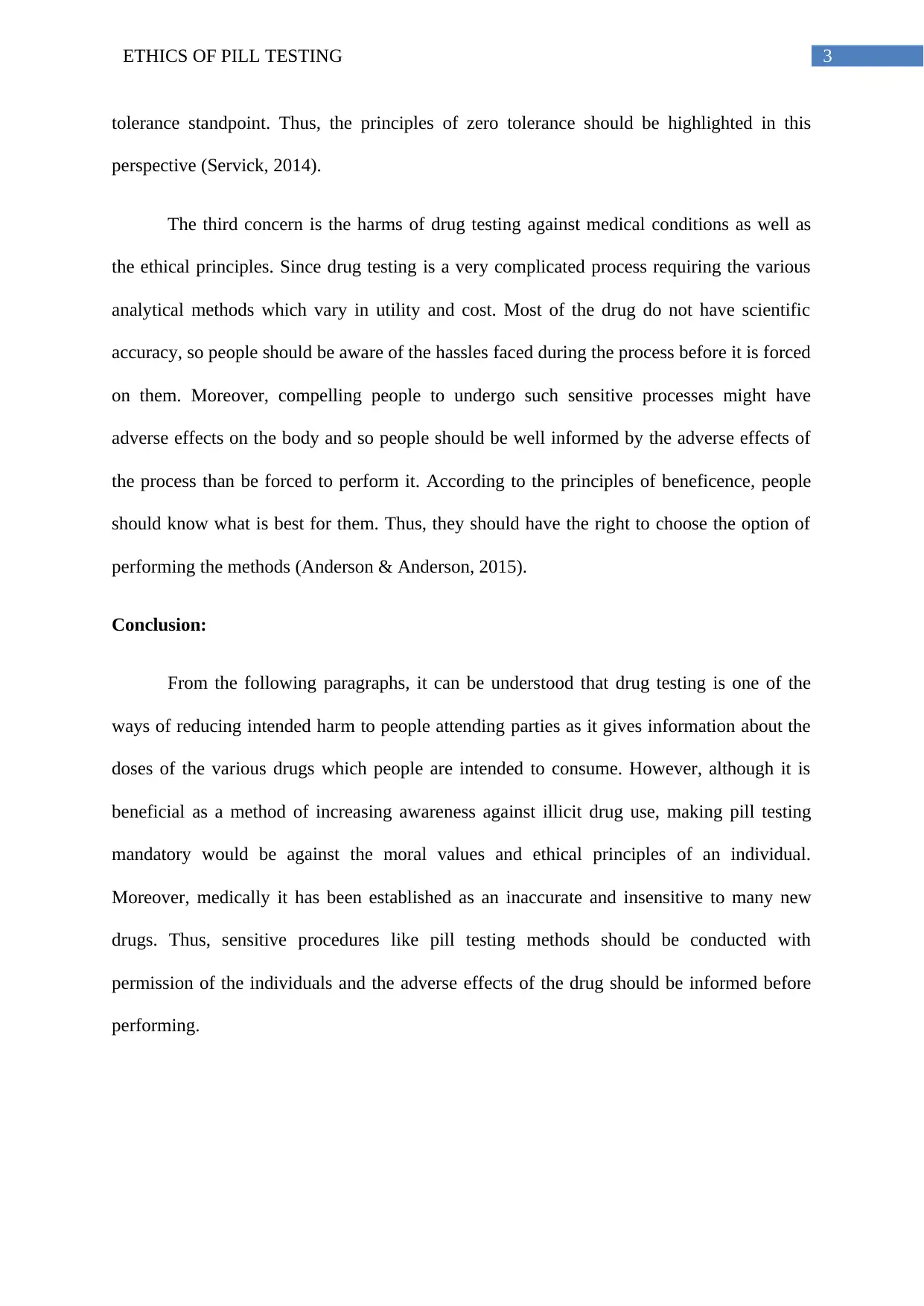
tolerance standpoint. Thus, the principles of zero tolerance should be highlighted in this
perspective (Servick, 2014).
The third concern is the harms of drug testing against medical conditions as well as
the ethical principles. Since drug testing is a very complicated process requiring the various
analytical methods which vary in utility and cost. Most of the drug do not have scientific
accuracy, so people should be aware of the hassles faced during the process before it is forced
on them. Moreover, compelling people to undergo such sensitive processes might have
adverse effects on the body and so people should be well informed by the adverse effects of
the process than be forced to perform it. According to the principles of beneficence, people
should know what is best for them. Thus, they should have the right to choose the option of
performing the methods (Anderson & Anderson, 2015).
Conclusion:
From the following paragraphs, it can be understood that drug testing is one of the
ways of reducing intended harm to people attending parties as it gives information about the
doses of the various drugs which people are intended to consume. However, although it is
beneficial as a method of increasing awareness against illicit drug use, making pill testing
mandatory would be against the moral values and ethical principles of an individual.
Moreover, medically it has been established as an inaccurate and insensitive to many new
drugs. Thus, sensitive procedures like pill testing methods should be conducted with
permission of the individuals and the adverse effects of the drug should be informed before
performing.
tolerance standpoint. Thus, the principles of zero tolerance should be highlighted in this
perspective (Servick, 2014).
The third concern is the harms of drug testing against medical conditions as well as
the ethical principles. Since drug testing is a very complicated process requiring the various
analytical methods which vary in utility and cost. Most of the drug do not have scientific
accuracy, so people should be aware of the hassles faced during the process before it is forced
on them. Moreover, compelling people to undergo such sensitive processes might have
adverse effects on the body and so people should be well informed by the adverse effects of
the process than be forced to perform it. According to the principles of beneficence, people
should know what is best for them. Thus, they should have the right to choose the option of
performing the methods (Anderson & Anderson, 2015).
Conclusion:
From the following paragraphs, it can be understood that drug testing is one of the
ways of reducing intended harm to people attending parties as it gives information about the
doses of the various drugs which people are intended to consume. However, although it is
beneficial as a method of increasing awareness against illicit drug use, making pill testing
mandatory would be against the moral values and ethical principles of an individual.
Moreover, medically it has been established as an inaccurate and insensitive to many new
drugs. Thus, sensitive procedures like pill testing methods should be conducted with
permission of the individuals and the adverse effects of the drug should be informed before
performing.
Paraphrase This Document
Need a fresh take? Get an instant paraphrase of this document with our AI Paraphraser

4ETHICS OF PILL TESTING
References
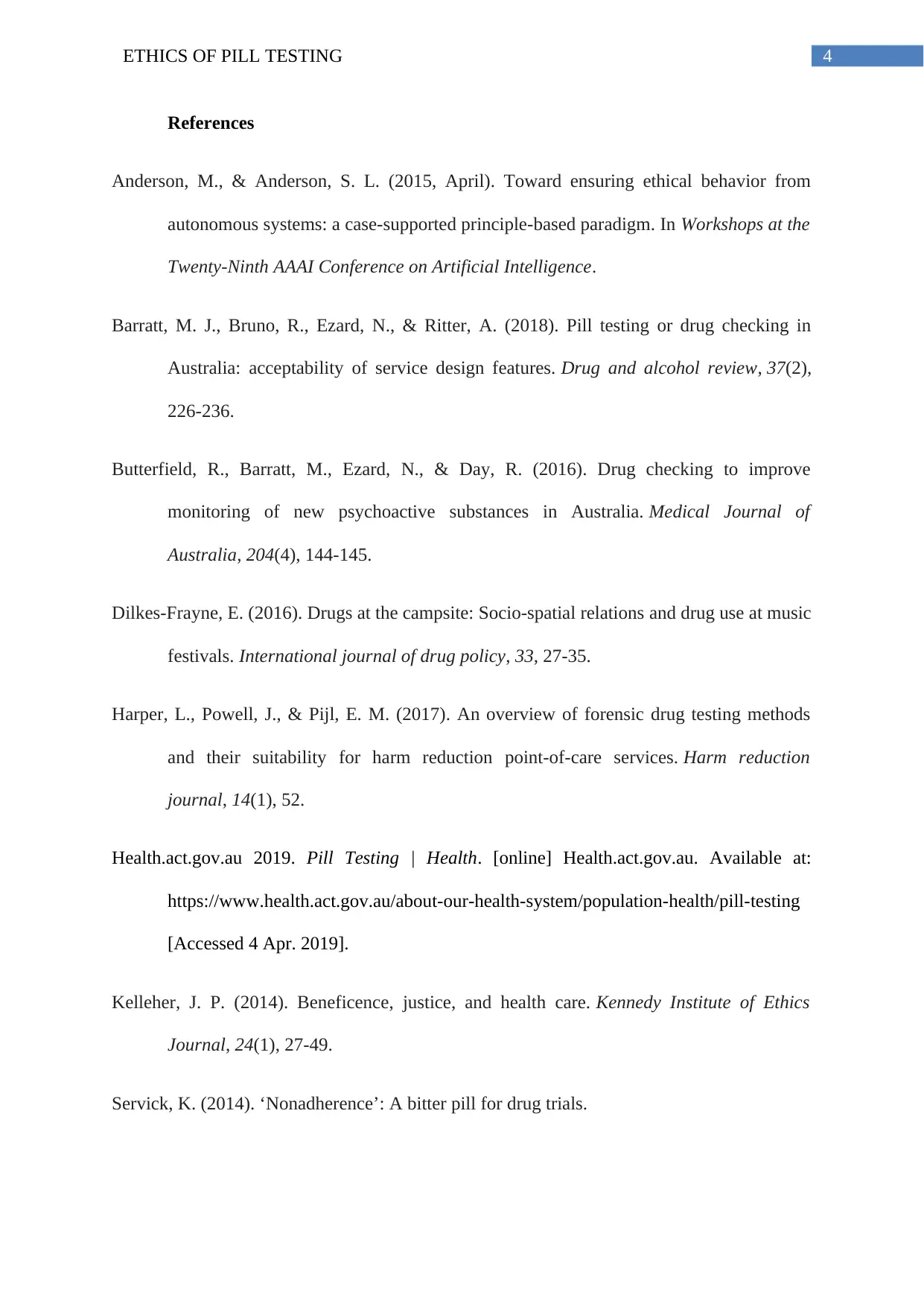
Anderson, M., & Anderson, S. L. (2015, April). Toward ensuring ethical behavior from
autonomous systems: a case-supported principle-based paradigm. In Workshops at the
Twenty-Ninth AAAI Conference on Artificial Intelligence.
Barratt, M. J., Bruno, R., Ezard, N., & Ritter, A. (2018). Pill testing or drug checking in
Australia: acceptability of service design features. Drug and alcohol review, 37(2),
226-236.
Butterfield, R., Barratt, M., Ezard, N., & Day, R. (2016). Drug checking to improve
monitoring of new psychoactive substances in Australia. Medical Journal of
Australia, 204(4), 144-145.
Dilkes-Frayne, E. (2016). Drugs at the campsite: Socio-spatial relations and drug use at music
festivals. International journal of drug policy, 33, 27-35.
Harper, L., Powell, J., & Pijl, E. M. (2017). An overview of forensic drug testing methods
and their suitability for harm reduction point-of-care services. Harm reduction
journal, 14(1), 52.
Health.act.gov.au 2019. Pill Testing | Health. [online] Health.act.gov.au. Available at:
https://www.health.act.gov.au/about-our-health-system/population-health/pill-testing
[Accessed 4 Apr. 2019].
Kelleher, J. P. (2014). Beneficence, justice, and health care. Kennedy Institute of Ethics
Journal, 24(1), 27-49.
Servick, K. (2014). ‘Nonadherence’: A bitter pill for drug trials.
References
Anderson, M., & Anderson, S. L. (2015, April). Toward ensuring ethical behavior from
autonomous systems: a case-supported principle-based paradigm. In Workshops at the
Twenty-Ninth AAAI Conference on Artificial Intelligence.
Barratt, M. J., Bruno, R., Ezard, N., & Ritter, A. (2018). Pill testing or drug checking in
Australia: acceptability of service design features. Drug and alcohol review, 37(2),
226-236.
Butterfield, R., Barratt, M., Ezard, N., & Day, R. (2016). Drug checking to improve
monitoring of new psychoactive substances in Australia. Medical Journal of
Australia, 204(4), 144-145.
Dilkes-Frayne, E. (2016). Drugs at the campsite: Socio-spatial relations and drug use at music
festivals. International journal of drug policy, 33, 27-35.
Harper, L., Powell, J., & Pijl, E. M. (2017). An overview of forensic drug testing methods
and their suitability for harm reduction point-of-care services. Harm reduction
journal, 14(1), 52.
Health.act.gov.au 2019. Pill Testing | Health. [online] Health.act.gov.au. Available at:
https://www.health.act.gov.au/about-our-health-system/population-health/pill-testing
[Accessed 4 Apr. 2019].
Kelleher, J. P. (2014). Beneficence, justice, and health care. Kennedy Institute of Ethics
Journal, 24(1), 27-49.
Servick, K. (2014). ‘Nonadherence’: A bitter pill for drug trials.

5ETHICS OF PILL TESTING
Zhuang, Y. 2019. What is pill testing?. [online] The Sydney Morning Herald. Available at:
https://www.smh.com.au/national/what-is-pill-testing-20190103-p50pg5.html
[Accessed 4 Apr. 2019].
Zhuang, Y. 2019. What is pill testing?. [online] The Sydney Morning Herald. Available at:
https://www.smh.com.au/national/what-is-pill-testing-20190103-p50pg5.html
[Accessed 4 Apr. 2019].
⊘ This is a preview!⊘
Do you want full access?
Subscribe today to unlock all pages.

Trusted by 1+ million students worldwide
1 out of 6
Related Documents
Your All-in-One AI-Powered Toolkit for Academic Success.
+13062052269
info@desklib.com
Available 24*7 on WhatsApp / Email
Unlock your academic potential
Copyright © 2020–2025 A2Z Services. All Rights Reserved. Developed and managed by ZUCOL.