Pilot Study Design: Sickness Absence in Nursing Staff Study
VerifiedAdded on 2020/05/04
|21
|5608
|44
Project
AI Summary
This project presents a detailed pilot study design aimed at investigating the correlation between nursing shift length and the rate of sickness absences among nursing staff. The study begins with a comprehensive literature search, including grey literature and database searches, to gather relevant evidence on the topic. The design employs a quantitative approach, guided by the evidence-based practice model, to address the research question: Does an increase in shift length (from 7.5-hour shifts to 12-hour shifts) increase the rate of sickness absence in nurses working in acute care settings? A cohort study design is proposed, involving two groups of nurses in a renal unit, with quota sampling used to select participants. Data collection methods include a modified survey questionnaire and longitudinal record-keeping of sick leaves. The project also addresses ethical considerations, data analysis techniques, and plans for dissemination and implementation of the findings. The study seeks to provide empirical evidence to support the relationship between shift length and sickness absence, potentially informing changes in nursing practice.
Running head: PILOT STUDY DESIGN 1
A DESIGN OF A PILOT STUDY TO INVESTIGATE WHETHER INCREASE IN
SHIFT LENGTH (FROM 7.5 HR TO 12 HR SHIFTS) INCREASES THE RATE OF
SICKNESS ABSENCES AMONG NURSING STAFF
Name
Institution
A DESIGN OF A PILOT STUDY TO INVESTIGATE WHETHER INCREASE IN
SHIFT LENGTH (FROM 7.5 HR TO 12 HR SHIFTS) INCREASES THE RATE OF
SICKNESS ABSENCES AMONG NURSING STAFF
Name
Institution

Paraphrase This Document
Need a fresh take? Get an instant paraphrase of this document with our AI Paraphraser
PILOT STUDY DESIGN 2
Contents
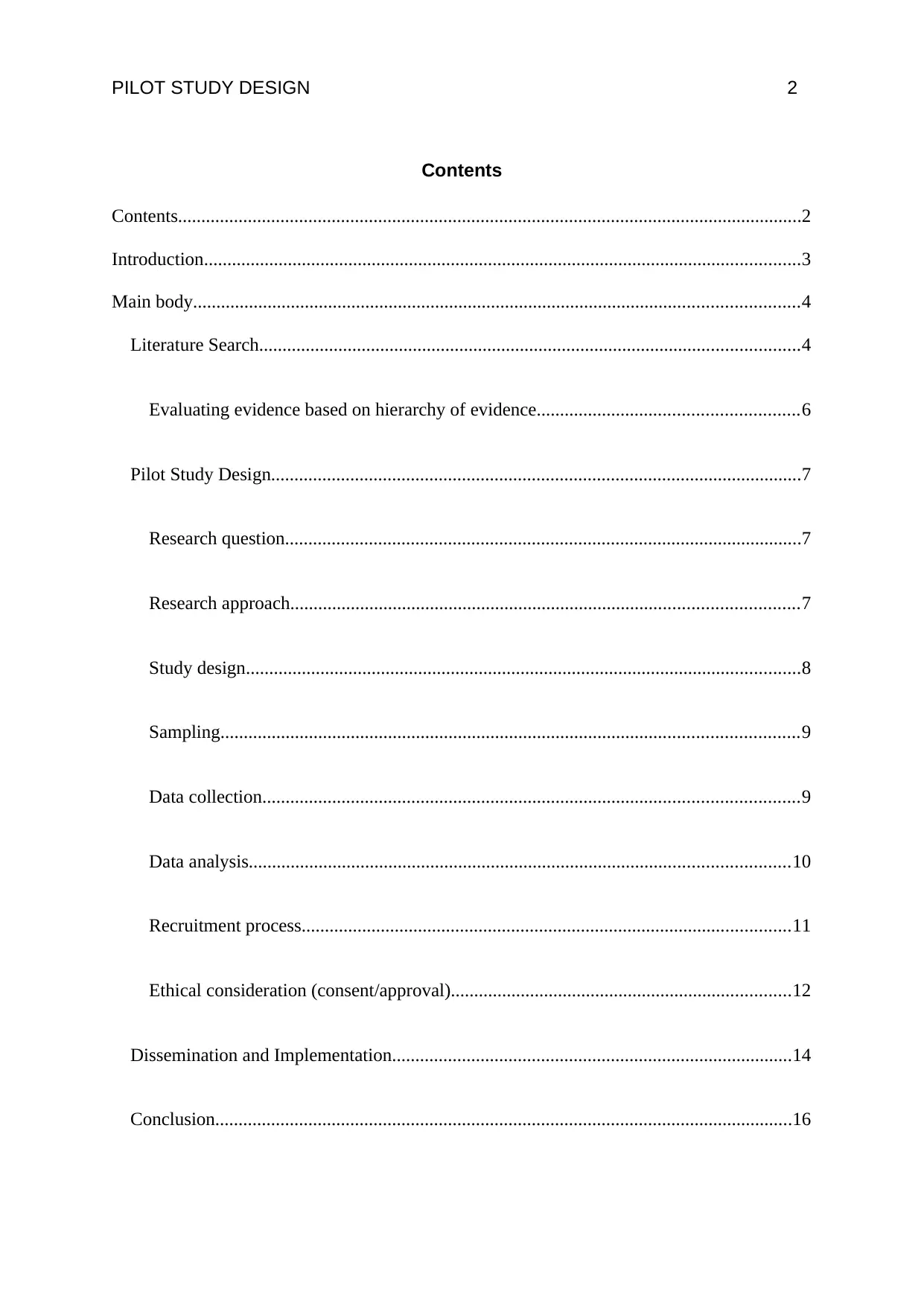
Contents......................................................................................................................................2
Introduction................................................................................................................................3
Main body..................................................................................................................................4
Literature Search....................................................................................................................4
Evaluating evidence based on hierarchy of evidence........................................................6
Pilot Study Design..................................................................................................................7
Research question...............................................................................................................7
Research approach.............................................................................................................7
Study design.......................................................................................................................8
Sampling............................................................................................................................9
Data collection...................................................................................................................9
Data analysis....................................................................................................................10
Recruitment process.........................................................................................................11
Ethical consideration (consent/approval).........................................................................12
Dissemination and Implementation......................................................................................14
Conclusion............................................................................................................................16
Contents
Contents......................................................................................................................................2
Introduction................................................................................................................................3
Main body..................................................................................................................................4
Literature Search....................................................................................................................4
Evaluating evidence based on hierarchy of evidence........................................................6
Pilot Study Design..................................................................................................................7
Research question...............................................................................................................7
Research approach.............................................................................................................7
Study design.......................................................................................................................8
Sampling............................................................................................................................9
Data collection...................................................................................................................9
Data analysis....................................................................................................................10
Recruitment process.........................................................................................................11
Ethical consideration (consent/approval).........................................................................12
Dissemination and Implementation......................................................................................14
Conclusion............................................................................................................................16
PILOT STUDY DESIGN 3
Introduction
Long work shifts of 15 hours or more for hospital staff nurses are common and also
popular in most hospitals in Singapore and abroad. However, little is known about
the effect of working longer hours on the level of care the nurses provide to their
patient or let alone on the nurses' health. A limited amount of research has been
done on the impact of long shifts on nurses (Trinkoff, Le, Geiger-Brown, & Lipscomb,
2007), or on the quality of care that they do provide (Stone, et al., 2007; Trinkoff, et
al., 2007). Further, it is not adequately understood whether long shifts increase the
rate of sickness absence among nursing staff. There is thus the need of investigating
the relationship between hospital nurses’ shift length and the frequency of their
sickness absences.
This paper discusses how a pilot study can be designed and undertaken for the
purposes of achieving this goal. There are three main sections. The first section is a
discussion on the search for evidence, including the sources of relevant literature
and evaluation of this evidence. The design of the study is discussed in the second
section. This includes the research question and research approach to be adopted,
and also the data collection and analysis procedures. The last section is a discussion
on the dissemination of the work and implementation for change in practice.
Introduction
Long work shifts of 15 hours or more for hospital staff nurses are common and also
popular in most hospitals in Singapore and abroad. However, little is known about
the effect of working longer hours on the level of care the nurses provide to their
patient or let alone on the nurses' health. A limited amount of research has been
done on the impact of long shifts on nurses (Trinkoff, Le, Geiger-Brown, & Lipscomb,
2007), or on the quality of care that they do provide (Stone, et al., 2007; Trinkoff, et
al., 2007). Further, it is not adequately understood whether long shifts increase the
rate of sickness absence among nursing staff. There is thus the need of investigating
the relationship between hospital nurses’ shift length and the frequency of their
sickness absences.
This paper discusses how a pilot study can be designed and undertaken for the
purposes of achieving this goal. There are three main sections. The first section is a
discussion on the search for evidence, including the sources of relevant literature
and evaluation of this evidence. The design of the study is discussed in the second
section. This includes the research question and research approach to be adopted,
and also the data collection and analysis procedures. The last section is a discussion
on the dissemination of the work and implementation for change in practice.
⊘ This is a preview!⊘
Do you want full access?
Subscribe today to unlock all pages.

Trusted by 1+ million students worldwide
PILOT STUDY DESIGN 4
Main body
Literature Search
Evidence relevant to the chosen scenario will be obtained through a systematic
literature search. This may include grey literature sources, encyclopaedias and
relevant databases. Grey sources include literature that is yet to be formally
published in books or journal articles. Some of the grey sources relevant to this study
may include theses, MOH reports, conference proceedings and other official
documents. The use of grey literature may be debated in some cases owing to the
fact that it is not peer-reviewed nor evaluated. However, in the recent past, many
authors have come to emphasize the importance of grey literature as a tool that fills
the void brought about by the delay between research and publication, and the
failure to publish some research, which all prevent the access to useful information
(Pappa & William, 2011). This is justification enough to include grey literature
sources in the search for literature for this study in light of the fact that minimal
research has been undertaken on this topic. With regard to database search, some
of the databases applicable in this study include CINAHL Journal Databases,
ScienceDirect, MEDLINE, Singapore Ministry of Health (MOH), Singapore Nursing
journal, PubMed Central and the Cochrane Database of Systematic Reviews. The
search for literature can then be carried using keywords derived from the question
under study. The terms ‘Shift Length’, ‘8 hour or 12 hour shift’, long shifts, and
‘sickness Absence’ can be used for the search of the databases. The only filter
applicable to the search is that the sources ought to be within the last 5-10 years. A
Main body
Literature Search
Evidence relevant to the chosen scenario will be obtained through a systematic
literature search. This may include grey literature sources, encyclopaedias and
relevant databases. Grey sources include literature that is yet to be formally
published in books or journal articles. Some of the grey sources relevant to this study
may include theses, MOH reports, conference proceedings and other official
documents. The use of grey literature may be debated in some cases owing to the
fact that it is not peer-reviewed nor evaluated. However, in the recent past, many
authors have come to emphasize the importance of grey literature as a tool that fills
the void brought about by the delay between research and publication, and the
failure to publish some research, which all prevent the access to useful information
(Pappa & William, 2011). This is justification enough to include grey literature
sources in the search for literature for this study in light of the fact that minimal
research has been undertaken on this topic. With regard to database search, some
of the databases applicable in this study include CINAHL Journal Databases,
ScienceDirect, MEDLINE, Singapore Ministry of Health (MOH), Singapore Nursing
journal, PubMed Central and the Cochrane Database of Systematic Reviews. The
search for literature can then be carried using keywords derived from the question
under study. The terms ‘Shift Length’, ‘8 hour or 12 hour shift’, long shifts, and
‘sickness Absence’ can be used for the search of the databases. The only filter
applicable to the search is that the sources ought to be within the last 5-10 years. A
Paraphrase This Document
Need a fresh take? Get an instant paraphrase of this document with our AI Paraphraser
PILOT STUDY DESIGN 5
check on the reference lists of the retrieved publications can also be done to uncover
any relevant studies that can be adopted.
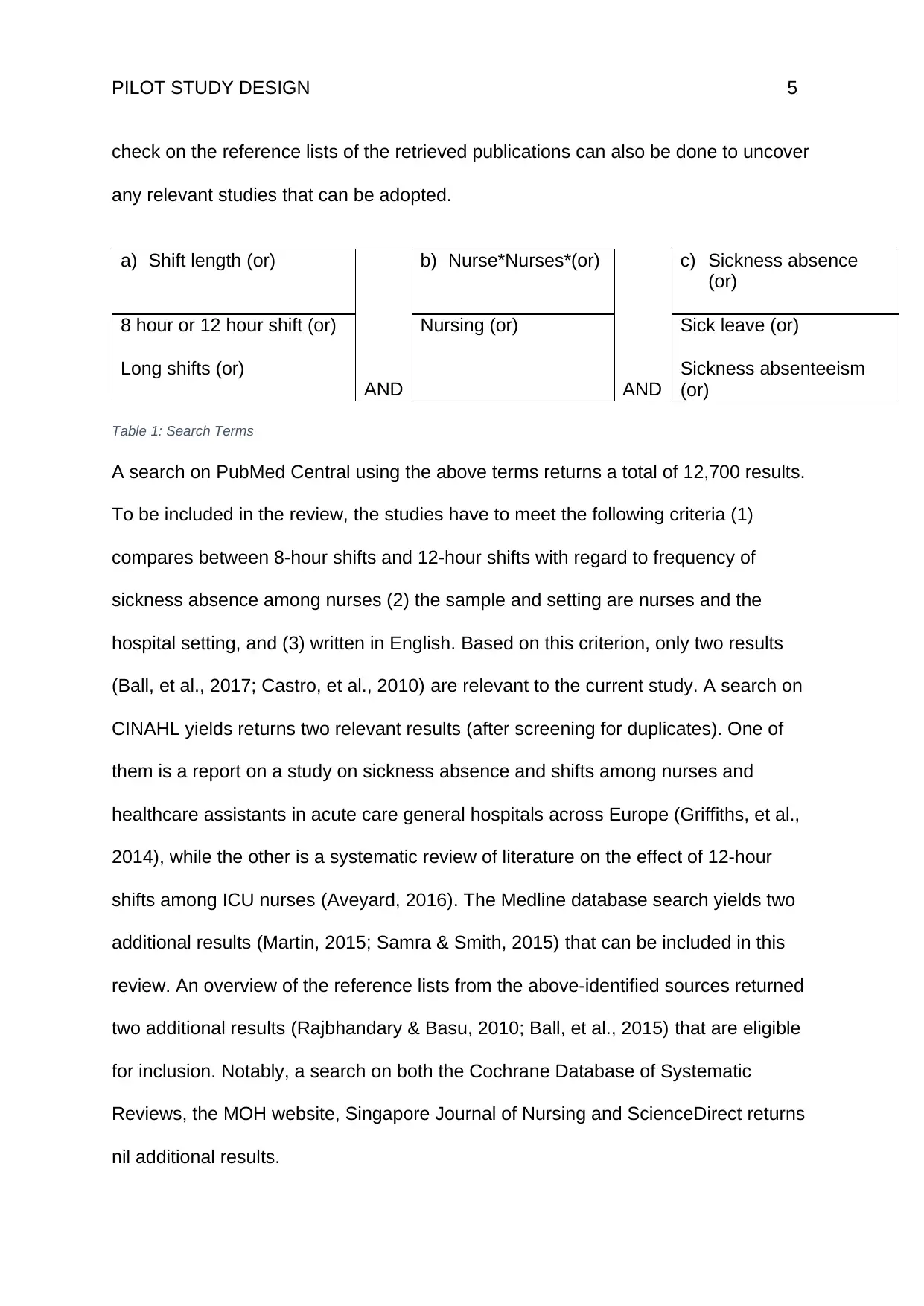
a) Shift length (or)
AND
b) Nurse*Nurses*(or)
AND
c) Sickness absence
(or)
8 hour or 12 hour shift (or)
Long shifts (or)
Nursing (or) Sick leave (or)
Sickness absenteeism
(or)
Table 1: Search Terms
A search on PubMed Central using the above terms returns a total of 12,700 results.
To be included in the review, the studies have to meet the following criteria (1)
compares between 8-hour shifts and 12-hour shifts with regard to frequency of
sickness absence among nurses (2) the sample and setting are nurses and the
hospital setting, and (3) written in English. Based on this criterion, only two results
(Ball, et al., 2017; Castro, et al., 2010) are relevant to the current study. A search on
CINAHL yields returns two relevant results (after screening for duplicates). One of
them is a report on a study on sickness absence and shifts among nurses and
healthcare assistants in acute care general hospitals across Europe (Griffiths, et al.,
2014), while the other is a systematic review of literature on the effect of 12-hour
shifts among ICU nurses (Aveyard, 2016). The Medline database search yields two
additional results (Martin, 2015; Samra & Smith, 2015) that can be included in this
review. An overview of the reference lists from the above-identified sources returned
two additional results (Rajbhandary & Basu, 2010; Ball, et al., 2015) that are eligible
for inclusion. Notably, a search on both the Cochrane Database of Systematic
Reviews, the MOH website, Singapore Journal of Nursing and ScienceDirect returns
nil additional results.
check on the reference lists of the retrieved publications can also be done to uncover
any relevant studies that can be adopted.
a) Shift length (or)
AND
b) Nurse*Nurses*(or)
AND
c) Sickness absence
(or)
8 hour or 12 hour shift (or)
Long shifts (or)
Nursing (or) Sick leave (or)
Sickness absenteeism
(or)
Table 1: Search Terms
A search on PubMed Central using the above terms returns a total of 12,700 results.
To be included in the review, the studies have to meet the following criteria (1)
compares between 8-hour shifts and 12-hour shifts with regard to frequency of
sickness absence among nurses (2) the sample and setting are nurses and the
hospital setting, and (3) written in English. Based on this criterion, only two results
(Ball, et al., 2017; Castro, et al., 2010) are relevant to the current study. A search on
CINAHL yields returns two relevant results (after screening for duplicates). One of
them is a report on a study on sickness absence and shifts among nurses and
healthcare assistants in acute care general hospitals across Europe (Griffiths, et al.,
2014), while the other is a systematic review of literature on the effect of 12-hour
shifts among ICU nurses (Aveyard, 2016). The Medline database search yields two
additional results (Martin, 2015; Samra & Smith, 2015) that can be included in this
review. An overview of the reference lists from the above-identified sources returned
two additional results (Rajbhandary & Basu, 2010; Ball, et al., 2015) that are eligible
for inclusion. Notably, a search on both the Cochrane Database of Systematic
Reviews, the MOH website, Singapore Journal of Nursing and ScienceDirect returns
nil additional results.
PILOT STUDY DESIGN 6
Evaluating evidence based on hierarchy of evidence
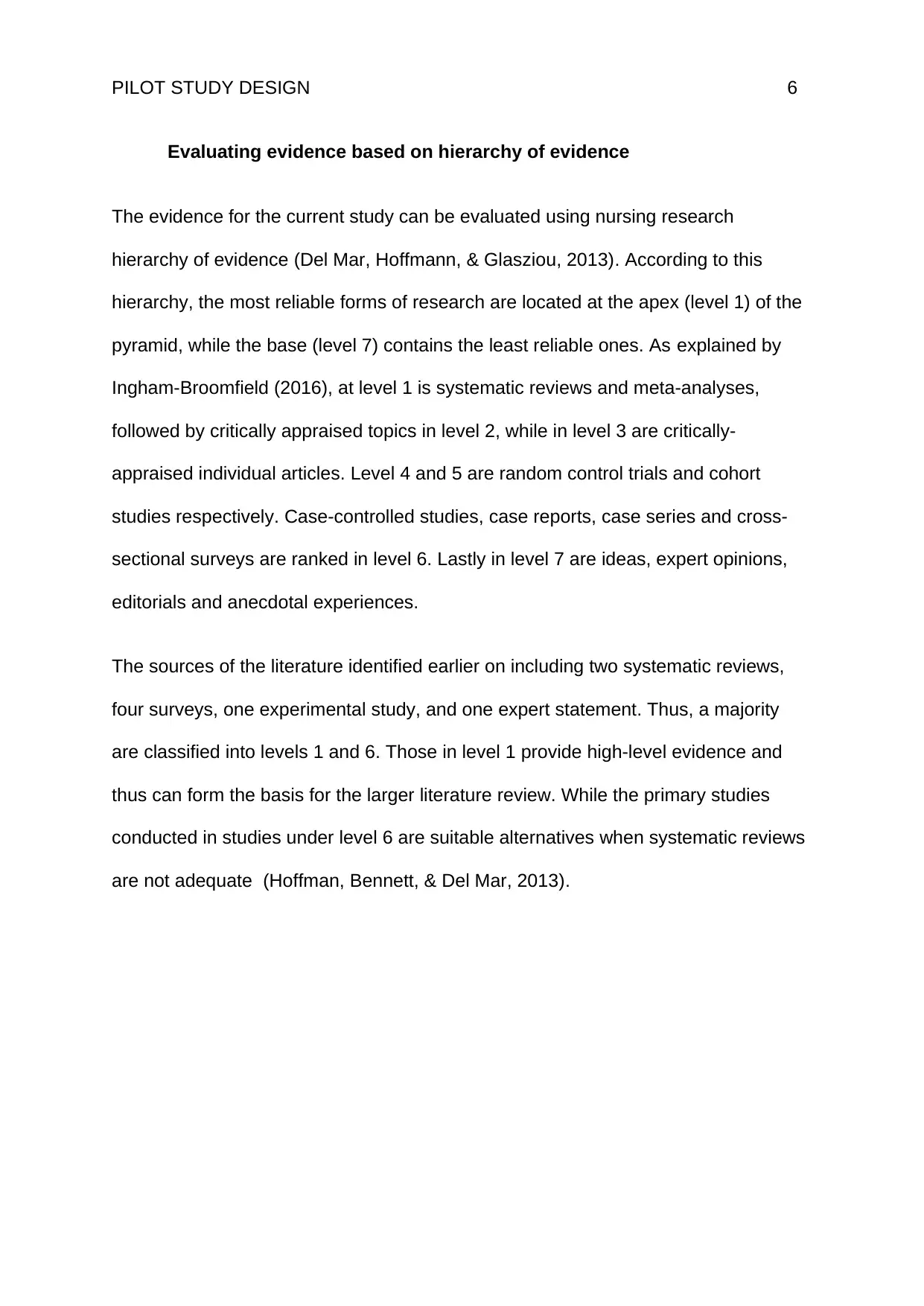
The evidence for the current study can be evaluated using nursing research
hierarchy of evidence (Del Mar, Hoffmann, & Glasziou, 2013). According to this
hierarchy, the most reliable forms of research are located at the apex (level 1) of the
pyramid, while the base (level 7) contains the least reliable ones. As explained by
Ingham-Broomfield (2016), at level 1 is systematic reviews and meta-analyses,
followed by critically appraised topics in level 2, while in level 3 are critically-
appraised individual articles. Level 4 and 5 are random control trials and cohort
studies respectively. Case-controlled studies, case reports, case series and cross-
sectional surveys are ranked in level 6. Lastly in level 7 are ideas, expert opinions,
editorials and anecdotal experiences.
The sources of the literature identified earlier on including two systematic reviews,
four surveys, one experimental study, and one expert statement. Thus, a majority
are classified into levels 1 and 6. Those in level 1 provide high-level evidence and
thus can form the basis for the larger literature review. While the primary studies
conducted in studies under level 6 are suitable alternatives when systematic reviews
are not adequate (Hoffman, Bennett, & Del Mar, 2013).
Evaluating evidence based on hierarchy of evidence
The evidence for the current study can be evaluated using nursing research
hierarchy of evidence (Del Mar, Hoffmann, & Glasziou, 2013). According to this
hierarchy, the most reliable forms of research are located at the apex (level 1) of the
pyramid, while the base (level 7) contains the least reliable ones. As explained by
Ingham-Broomfield (2016), at level 1 is systematic reviews and meta-analyses,
followed by critically appraised topics in level 2, while in level 3 are critically-
appraised individual articles. Level 4 and 5 are random control trials and cohort
studies respectively. Case-controlled studies, case reports, case series and cross-
sectional surveys are ranked in level 6. Lastly in level 7 are ideas, expert opinions,
editorials and anecdotal experiences.
The sources of the literature identified earlier on including two systematic reviews,
four surveys, one experimental study, and one expert statement. Thus, a majority
are classified into levels 1 and 6. Those in level 1 provide high-level evidence and
thus can form the basis for the larger literature review. While the primary studies
conducted in studies under level 6 are suitable alternatives when systematic reviews
are not adequate (Hoffman, Bennett, & Del Mar, 2013).
⊘ This is a preview!⊘
Do you want full access?
Subscribe today to unlock all pages.
Trusted by 1+ million students worldwide
PILOT STUDY DESIGN 7
Pilot Study Design
Research question
In nurses working in acute care settings, does the increase in shift length (from 7.5-
hour shifts to 12-hour shifts) increase their rate of sickness absence?
Research approach
This study will take a quantitative approach and it will be guided by the evidence-
based practice model by Rosswurm and Larabee (1999) for the purposes of
conducting the study. The model is recommended by some authors including Melnyk
and Fineout-Overholt (2011) who claim that the model serves as an important guide
for practitioners in the health sector with regard to the entire evidence-based practice
process. There are six steps to the model; 1) assessment of the need for change, 2)
linking the problem to interventions and selected outcomes, 3) synthesizing
evidence, 4) designing a practice change, 5) implementing and evaluating the
practice change, and 6) integrating and maintaining the practice change (Martin,
2015).
In the current study, the first step of assessing for the need for change begins with
the need for change highlighted by the manager's observations of an increased rate
of sickness absence among the nursing staff. The second step is the identification of
outcome indicators, in this case being sickness absence. The third step (literature
search) is guided by the PICO(T) question “In nurses working in acute care settings
(p), does the increase (I) in shift length (from 7.5-hour shifts to 12-hour shifts) (C)
increase their rate of sickness absence (O)? A concise literature search as indicated
Pilot Study Design
Research question
In nurses working in acute care settings, does the increase in shift length (from 7.5-
hour shifts to 12-hour shifts) increase their rate of sickness absence?
Research approach
This study will take a quantitative approach and it will be guided by the evidence-
based practice model by Rosswurm and Larabee (1999) for the purposes of
conducting the study. The model is recommended by some authors including Melnyk
and Fineout-Overholt (2011) who claim that the model serves as an important guide
for practitioners in the health sector with regard to the entire evidence-based practice
process. There are six steps to the model; 1) assessment of the need for change, 2)
linking the problem to interventions and selected outcomes, 3) synthesizing
evidence, 4) designing a practice change, 5) implementing and evaluating the
practice change, and 6) integrating and maintaining the practice change (Martin,
2015).
In the current study, the first step of assessing for the need for change begins with
the need for change highlighted by the manager's observations of an increased rate
of sickness absence among the nursing staff. The second step is the identification of
outcome indicators, in this case being sickness absence. The third step (literature
search) is guided by the PICO(T) question “In nurses working in acute care settings
(p), does the increase (I) in shift length (from 7.5-hour shifts to 12-hour shifts) (C)
increase their rate of sickness absence (O)? A concise literature search as indicated
Paraphrase This Document
Need a fresh take? Get an instant paraphrase of this document with our AI Paraphraser
PILOT STUDY DESIGN 8
above can help generate information on outcomes and interventions that relate to
sickness absence among nurses and shift length which can help improve both the
nurses' health, output, and patient safety. In the 4th step, the change is to compare
the instances of sick absence in nurses working in 8-hour shifts against those in 12-
hour. The design involves recruiting two groups of nurses in a particular unit and
observing their frequency of asking for sick leaves, within a specified period of time.
This approach is basically observational and it aims at yielding quantitative data. A
quantitative approach starts with a hypothesis, followed by the collection of data
which is used to determine whether there is adequate empirical evidence to support
the hypothesis. The preference for a quantitative approach for the current study is
pegged on the principle that quantitative methods facilitate the discovery of
quantifiable information which facilitates the testing and validation of already
constructed theories about a given phenomenon, and also in the ability to generalise
the research findings to other populations of nurses other than those included in the
study (Johnson & Christensen, 2013). Since the study takes an observation
approach, no new change is going to be introduced, and as a result step, 5 of the
model cannot be applied in this study. The final step (step 6) involves integrating and
maintaining the change. This step will be guided by the availability of enough
evidence to support that nurses working on longer shifts take sickness leaves more
often, compared to their counterparts who work 7.5-hour shifts.
Study design
A review of the identified studies reveals that the common study design adopted in
the study of this subject matter is cross-sectional surveys. However, these studies
were to collect data on more than the frequency of sickness absence, but rather
above can help generate information on outcomes and interventions that relate to
sickness absence among nurses and shift length which can help improve both the
nurses' health, output, and patient safety. In the 4th step, the change is to compare
the instances of sick absence in nurses working in 8-hour shifts against those in 12-
hour. The design involves recruiting two groups of nurses in a particular unit and
observing their frequency of asking for sick leaves, within a specified period of time.
This approach is basically observational and it aims at yielding quantitative data. A
quantitative approach starts with a hypothesis, followed by the collection of data
which is used to determine whether there is adequate empirical evidence to support
the hypothesis. The preference for a quantitative approach for the current study is
pegged on the principle that quantitative methods facilitate the discovery of
quantifiable information which facilitates the testing and validation of already
constructed theories about a given phenomenon, and also in the ability to generalise
the research findings to other populations of nurses other than those included in the
study (Johnson & Christensen, 2013). Since the study takes an observation
approach, no new change is going to be introduced, and as a result step, 5 of the
model cannot be applied in this study. The final step (step 6) involves integrating and
maintaining the change. This step will be guided by the availability of enough
evidence to support that nurses working on longer shifts take sickness leaves more
often, compared to their counterparts who work 7.5-hour shifts.
Study design
A review of the identified studies reveals that the common study design adopted in
the study of this subject matter is cross-sectional surveys. However, these studies
were to collect data on more than the frequency of sickness absence, but rather
PILOT STUDY DESIGN 9
includes other parameters such as job satisfaction, and patient safety. In the
contrary, the current study tries to investigate one variable (sickness absence) in a
prospective manner. A cohort study design is thus suited. Out of the identified
sample, those who will be on 7.5-hour shifts will be assigned as one cohort whereas
those working on 12-hour shifts be assigned as another cohort cases. They will be
then studied prospectively for a specified period of time. This follows the principle of
exposure and then tracking the outcomes.
Sampling
The study will be administered among 50 registered nurses in the renal unit. Quota
sampling will be used to select the study subjects. The basis of the quota will be the
shift characteristics. Quotas control the factors that are relevant to the particular
measures that the study intends to make. The 20 RNs will be divided into 10 each
for either shift. Quota sampling is ideal for the current study because it allows for the
selections of a sample that represents the subgroups that the study is interested in. It
is ideal for the investigation of traits or characteristics of a subgroup, it facilitates
observation of relationships between subgroups. The justification for quota sampling
is pegged on the fact that it is empirical as evidenced by its long track record of
producing satisfactory results where adopted (Mortimore, 2017).
Data collection
Data collection will be divided into two sections. The first part will involve a survey
questionnaire, while the second part will be record-keeping noting the frequency of
sick leaves taken by each quota of nurses in the longitudinal follow-up. The survey
questionnaire will be modified from the validated International Hospital Outcomes
includes other parameters such as job satisfaction, and patient safety. In the
contrary, the current study tries to investigate one variable (sickness absence) in a
prospective manner. A cohort study design is thus suited. Out of the identified
sample, those who will be on 7.5-hour shifts will be assigned as one cohort whereas
those working on 12-hour shifts be assigned as another cohort cases. They will be
then studied prospectively for a specified period of time. This follows the principle of
exposure and then tracking the outcomes.
Sampling
The study will be administered among 50 registered nurses in the renal unit. Quota
sampling will be used to select the study subjects. The basis of the quota will be the
shift characteristics. Quotas control the factors that are relevant to the particular
measures that the study intends to make. The 20 RNs will be divided into 10 each
for either shift. Quota sampling is ideal for the current study because it allows for the
selections of a sample that represents the subgroups that the study is interested in. It
is ideal for the investigation of traits or characteristics of a subgroup, it facilitates
observation of relationships between subgroups. The justification for quota sampling
is pegged on the fact that it is empirical as evidenced by its long track record of
producing satisfactory results where adopted (Mortimore, 2017).
Data collection
Data collection will be divided into two sections. The first part will involve a survey
questionnaire, while the second part will be record-keeping noting the frequency of
sick leaves taken by each quota of nurses in the longitudinal follow-up. The survey
questionnaire will be modified from the validated International Hospital Outcomes
⊘ This is a preview!⊘
Do you want full access?
Subscribe today to unlock all pages.
Trusted by 1+ million students worldwide
PILOT STUDY DESIGN 10
Study questionnaire (Bruyneel, Heede, Diya, Aiken, & Sermeus, 2009), and it will be
administered at the beginning of the study to collect data on the participants’ socio-
demographics, shift length, incidence of mandatory or inadvertent overtime, number
of overtime hours worked in the last 30 days, and the number of sick leaves taken in
the last three months. A self-completed questionnaire is preferred in this case as it
will facilitate obtaining accurate information from the subjects, facilitates data entry
and processing through coding, and also provides a standard form for the recording
of responses (Office for National Statistics (ONS), 2010). The longitudinal collection
of data will facilitate the collection of data on aspects such as the length of shifts,
overtime hours worked, number of sickness absences per subject, the frequency and
duration of absence, and the liable ailment. This information will be self-reported by
the nurse who will be required to log in to a provided website and make a record of
these parameters after a specified duration (daily or weekly). The preference for a
longitudinal study is based on the capacity of the approach to collect data that can
facilitate the evaluation of the relationship between exposure and various outcomes
through a considerable length of time (Caruana, Roman, Hernández-Sánchez, &
Solli, 2015).
Data analysis
Descriptive analysis will be undertaken, measures are to be described using
frequencies, percentages and mean scores by shift length, overtime hours worked,
and sickness absences. Multivariate logistic regression will then be used to establish
if there are any statistical associations between shift length and the reported number
sickness absences while accounting for other factors such as the total number of
overtime hours worked, and the number of hours spent in other jobs other than
Study questionnaire (Bruyneel, Heede, Diya, Aiken, & Sermeus, 2009), and it will be
administered at the beginning of the study to collect data on the participants’ socio-
demographics, shift length, incidence of mandatory or inadvertent overtime, number
of overtime hours worked in the last 30 days, and the number of sick leaves taken in
the last three months. A self-completed questionnaire is preferred in this case as it
will facilitate obtaining accurate information from the subjects, facilitates data entry
and processing through coding, and also provides a standard form for the recording
of responses (Office for National Statistics (ONS), 2010). The longitudinal collection
of data will facilitate the collection of data on aspects such as the length of shifts,
overtime hours worked, number of sickness absences per subject, the frequency and
duration of absence, and the liable ailment. This information will be self-reported by
the nurse who will be required to log in to a provided website and make a record of
these parameters after a specified duration (daily or weekly). The preference for a
longitudinal study is based on the capacity of the approach to collect data that can
facilitate the evaluation of the relationship between exposure and various outcomes
through a considerable length of time (Caruana, Roman, Hernández-Sánchez, &
Solli, 2015).
Data analysis
Descriptive analysis will be undertaken, measures are to be described using
frequencies, percentages and mean scores by shift length, overtime hours worked,
and sickness absences. Multivariate logistic regression will then be used to establish
if there are any statistical associations between shift length and the reported number
sickness absences while accounting for other factors such as the total number of
overtime hours worked, and the number of hours spent in other jobs other than
Paraphrase This Document
Need a fresh take? Get an instant paraphrase of this document with our AI Paraphraser
PILOT STUDY DESIGN 11
nursing (if any). Multivariate logistic regression is applicable in this case as there
exists one nominal variable (sickness state), and two or more measurable variables
(shift length, and overtime working). The potential predictors are likely to include the
shift length, working beyond the stipulated shift length, full or part-time work, and
age. A multilevel logistic model will be fitted to each set of dichotomous measures.
Some of the demographic measures such as age, whether working in another job
other than the current one and the duration of the service can be used as control
variables. All analyses will be conducted using STATA or SPSS.
Recruitment process
The recruitment process will be guided by a 2016 systematic review by
LouiseThornton and fellows on recruitment process particularly in this social media
era. The study participants will be recruited from nurses in the renal unit. The
researcher will first contact the nursing administrator who will, in turn, introduce the
researcher to the nurse manager in charge of the department where recruitment is to
occur. The recruitment of the participants will be based on the hospital’s
interpretation of regulations in nursing research and Nursing Practice Guidelines in
the country as espoused by the National Medical Research Council of the Ministry of
Health. The researcher will then involve the nursing administration and the nursing
staff in the screening process for eligible participants.
Next, the prospective participants will receive an email inviting them to participate in
the study. The email will also include a request for a contact email address or phone
number and the ideal time when the researcher can review the information about the
study with them, and also seek their informed consent. For those who will respond
nursing (if any). Multivariate logistic regression is applicable in this case as there
exists one nominal variable (sickness state), and two or more measurable variables
(shift length, and overtime working). The potential predictors are likely to include the
shift length, working beyond the stipulated shift length, full or part-time work, and
age. A multilevel logistic model will be fitted to each set of dichotomous measures.
Some of the demographic measures such as age, whether working in another job
other than the current one and the duration of the service can be used as control
variables. All analyses will be conducted using STATA or SPSS.
Recruitment process
The recruitment process will be guided by a 2016 systematic review by
LouiseThornton and fellows on recruitment process particularly in this social media
era. The study participants will be recruited from nurses in the renal unit. The
researcher will first contact the nursing administrator who will, in turn, introduce the
researcher to the nurse manager in charge of the department where recruitment is to
occur. The recruitment of the participants will be based on the hospital’s
interpretation of regulations in nursing research and Nursing Practice Guidelines in
the country as espoused by the National Medical Research Council of the Ministry of
Health. The researcher will then involve the nursing administration and the nursing
staff in the screening process for eligible participants.
Next, the prospective participants will receive an email inviting them to participate in
the study. The email will also include a request for a contact email address or phone
number and the ideal time when the researcher can review the information about the
study with them, and also seek their informed consent. For those who will respond
PILOT STUDY DESIGN 12
positively with the required details, a consent form will be sent in advance, followed
by phoning the participants at the requested appointment time they had indicated, for
the purposes of reviewing the consent form, the study procedures, and answer any
questions. The participants will also be informed of the requirements that they have
to fulfil for the study. No monetary incentives will be provided for participating in the
study due to the shortage of the same.
Ethical consideration (consent/approval)
Research ethics involves the requirements on daily work, protecting the dignity of
subjects and publishing the research information. However, when nurses are the
study subjects, three value systems come into play; nursing and science which may
conflict with the values of the participants (Fouka & Mantzorou, 2011). Therefore,
there is the need to ensure that ethical practices are adopted in each and every
phase of research, especially during data collection, data analysis, interpretation and
reporting of findings. As put forth by Diener and Crandal (1978) and cited by Tan-
Kuick, (2012), there are 4 aspects of ethics that need to be defended in all forms.
These include; 1) ensuring no harm is caused to the participants due to the study, 2)
ensuring that informed consent is obtained from the study subjects, 3) protecting the
privacy of the subjects; and 4) ensuring that deception is not used. These principles
of appropriate ethical practice are envisioned in various professional bodies including
Singapore Nurses Association and the Singapore Nursing Board. For the purposes
of carrying out this pilot study, the above-mentioned principles need to be strictly
adhered to. In addition, permission to conduct the study will have to be sought from
the hospital’s human research ethics committee before the actual commencement of
the entire process (Masic, Hodzic, & Mulic, 2014).
positively with the required details, a consent form will be sent in advance, followed
by phoning the participants at the requested appointment time they had indicated, for
the purposes of reviewing the consent form, the study procedures, and answer any
questions. The participants will also be informed of the requirements that they have
to fulfil for the study. No monetary incentives will be provided for participating in the
study due to the shortage of the same.
Ethical consideration (consent/approval)
Research ethics involves the requirements on daily work, protecting the dignity of
subjects and publishing the research information. However, when nurses are the
study subjects, three value systems come into play; nursing and science which may
conflict with the values of the participants (Fouka & Mantzorou, 2011). Therefore,
there is the need to ensure that ethical practices are adopted in each and every
phase of research, especially during data collection, data analysis, interpretation and
reporting of findings. As put forth by Diener and Crandal (1978) and cited by Tan-
Kuick, (2012), there are 4 aspects of ethics that need to be defended in all forms.
These include; 1) ensuring no harm is caused to the participants due to the study, 2)
ensuring that informed consent is obtained from the study subjects, 3) protecting the
privacy of the subjects; and 4) ensuring that deception is not used. These principles
of appropriate ethical practice are envisioned in various professional bodies including
Singapore Nurses Association and the Singapore Nursing Board. For the purposes
of carrying out this pilot study, the above-mentioned principles need to be strictly
adhered to. In addition, permission to conduct the study will have to be sought from
the hospital’s human research ethics committee before the actual commencement of
the entire process (Masic, Hodzic, & Mulic, 2014).
⊘ This is a preview!⊘
Do you want full access?
Subscribe today to unlock all pages.
Trusted by 1+ million students worldwide

1 out of 21


Related Documents


Your All-in-One AI-Powered Toolkit for Academic Success.
+13062052269
info@desklib.com
Available 24*7 on WhatsApp / Email
![[object Object]](/_next/static/media/star-bottom.7253800d.svg)
Unlock your academic potential
Copyright © 2020–2026 A2Z Services. All Rights Reserved. Developed and managed by ZUCOL.