Hospitality Sector Analysis: Customer Trends and Experiences Economy
VerifiedAdded on 2021/02/21
|9
|2536
|313
Report
AI Summary
This business report examines the hospitality sector, focusing on Pine and Gilmore's experiences economy and its impact on hotels. It explores the progression of economic value, commoditization, and customization. The report analyzes the influence of customer trends, highlighting the need for hotels to prioritize authenticity and personalized experiences. It discusses how established brands adapt to changing customer preferences and the shift towards customer-oriented services, including examples of hotels implementing innovative strategies to enhance customer satisfaction and gain a competitive edge. The report concludes by emphasizing the importance of adapting services to meet evolving customer demands and the role of economic progression in understanding customer expectations within the industry.

Business report

Paraphrase This Document
Need a fresh take? Get an instant paraphrase of this document with our AI Paraphraser
Table of content
INTRODUCTION ..........................................................................................................................1
MAIN BODY...................................................................................................................................1
Discussion of Pine and Gilmore's Experiences Economy......................................................1
Critical Reflection on Impact of Customer Trends Which Created Need for Hotels to Make in
the Authenticity and Experiences of Their Services..............................................................3
Changes in Hotel Market Due to Changes in Customer Sensibility and How Established
Brands Have Adapted Personalised and Unique Experiences...............................................5
CONCLUSION................................................................................................................................5
REFERENCES................................................................................................................................7
INTRODUCTION ..........................................................................................................................1
MAIN BODY...................................................................................................................................1
Discussion of Pine and Gilmore's Experiences Economy......................................................1
Critical Reflection on Impact of Customer Trends Which Created Need for Hotels to Make in
the Authenticity and Experiences of Their Services..............................................................3
Changes in Hotel Market Due to Changes in Customer Sensibility and How Established
Brands Have Adapted Personalised and Unique Experiences...............................................5
CONCLUSION................................................................................................................................5
REFERENCES................................................................................................................................7
INTRODUCTION
Hospitality sector is very broad in size which includes numerous of services such as food
and drinks, event planning, lodging, theme parks, cruise line, travelling, transportation and other
associated services related to tourism industry. This sector is one of the fastest growing industry
among all that also contributes in growth of nations. The main motive of this industry is to
provide effective services to customers in order to satisfy them with better customer experience.
The current report will mainly emphasis on Pine and Gilmore's experiences economy with major
concern on specific theory of progression (Hudson and Hudson, 2017). The theory is mainly
consist of two main driver forces that is Commoditization and customisation. It will further
include information on influence of changes over customer behaviour trends within hotel
industry. Along with this, it also provides knowledge on the different trend on working pattern of
the same industry. Later, it will provide discussion on various changes that are identified in
hospitality sector which are developed due to various changes that came in customers taste and
preferences. At last, it will also describe about various efforts initiated by hospitality sector like
unique experiences and personalised services for improvising customers experience.
MAIN BODY
Discussion of Pine and Gilmore's Experiences Economy
Pine and Gilmore's experience economy simply states that customers experience and
satisfaction level varies from ancient time to current time. In order to support this statement, an
article has been taken into consideration that was initially published by Joseph Pine II and James
H. Gilmore who explained about different experiences of next economy. In the earlier time it has
been identified that people were feeling more attracted towards products and services. At that
time, they do not even care about quality of products and services they only want that they
number of products or not (Ariffin, 2013). The main concern of these people were to buy the
product and use it. But, while observing current scenario, it has been identified that perception of
today's individual is quite different because they thinks as well as compares a lot before buying
single product from marketplace. Customers of today's world are ready to pay for different
products which have unique features. This clearly depicts changing expectation of customers
from the industry.
Theory of Economic Progression
1
Hospitality sector is very broad in size which includes numerous of services such as food
and drinks, event planning, lodging, theme parks, cruise line, travelling, transportation and other
associated services related to tourism industry. This sector is one of the fastest growing industry
among all that also contributes in growth of nations. The main motive of this industry is to
provide effective services to customers in order to satisfy them with better customer experience.
The current report will mainly emphasis on Pine and Gilmore's experiences economy with major
concern on specific theory of progression (Hudson and Hudson, 2017). The theory is mainly
consist of two main driver forces that is Commoditization and customisation. It will further
include information on influence of changes over customer behaviour trends within hotel
industry. Along with this, it also provides knowledge on the different trend on working pattern of
the same industry. Later, it will provide discussion on various changes that are identified in
hospitality sector which are developed due to various changes that came in customers taste and
preferences. At last, it will also describe about various efforts initiated by hospitality sector like
unique experiences and personalised services for improvising customers experience.
MAIN BODY
Discussion of Pine and Gilmore's Experiences Economy
Pine and Gilmore's experience economy simply states that customers experience and
satisfaction level varies from ancient time to current time. In order to support this statement, an
article has been taken into consideration that was initially published by Joseph Pine II and James
H. Gilmore who explained about different experiences of next economy. In the earlier time it has
been identified that people were feeling more attracted towards products and services. At that
time, they do not even care about quality of products and services they only want that they
number of products or not (Ariffin, 2013). The main concern of these people were to buy the
product and use it. But, while observing current scenario, it has been identified that perception of
today's individual is quite different because they thinks as well as compares a lot before buying
single product from marketplace. Customers of today's world are ready to pay for different
products which have unique features. This clearly depicts changing expectation of customers
from the industry.
Theory of Economic Progression
1
⊘ This is a preview!⊘
Do you want full access?
Subscribe today to unlock all pages.

Trusted by 1+ million students worldwide
This theory simply states that business organisation requires emphasising in provided
differentiated products to their customers in order to lead the market for long term. Theory of
economic progression mainly provides description over economic offering along with the
experiences and various changes that are taking place into customer’s taste and preferences.
Also, it can be said that whenever business organisation are offering differentiated products they
simply provides differentiated experience to those customers which are not gained by them
anywhere else (Brun and Castelli, 2013).
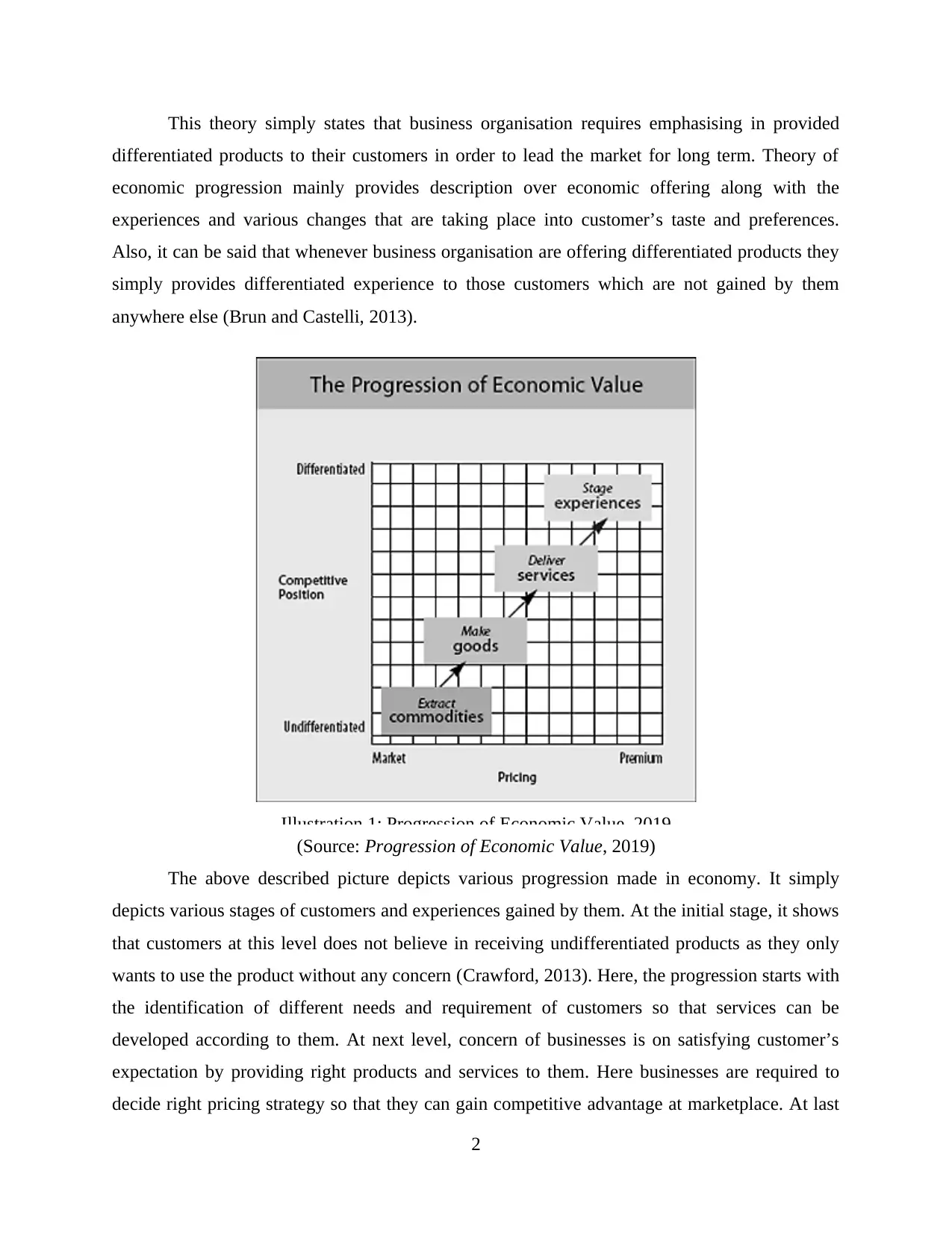
(Source: Progression of Economic Value, 2019)
The above described picture depicts various progression made in economy. It simply
depicts various stages of customers and experiences gained by them. At the initial stage, it shows
that customers at this level does not believe in receiving undifferentiated products as they only
wants to use the product without any concern (Crawford, 2013). Here, the progression starts with
the identification of different needs and requirement of customers so that services can be
developed according to them. At next level, concern of businesses is on satisfying customer’s
expectation by providing right products and services to them. Here businesses are required to
decide right pricing strategy so that they can gain competitive advantage at marketplace. At last
2
Illustration 1: Progression of Economic Value, 2019
differentiated products to their customers in order to lead the market for long term. Theory of
economic progression mainly provides description over economic offering along with the
experiences and various changes that are taking place into customer’s taste and preferences.
Also, it can be said that whenever business organisation are offering differentiated products they
simply provides differentiated experience to those customers which are not gained by them
anywhere else (Brun and Castelli, 2013).
(Source: Progression of Economic Value, 2019)
The above described picture depicts various progression made in economy. It simply
depicts various stages of customers and experiences gained by them. At the initial stage, it shows
that customers at this level does not believe in receiving undifferentiated products as they only
wants to use the product without any concern (Crawford, 2013). Here, the progression starts with
the identification of different needs and requirement of customers so that services can be
developed according to them. At next level, concern of businesses is on satisfying customer’s
expectation by providing right products and services to them. Here businesses are required to
decide right pricing strategy so that they can gain competitive advantage at marketplace. At last
2
Illustration 1: Progression of Economic Value, 2019
Paraphrase This Document
Need a fresh take? Get an instant paraphrase of this document with our AI Paraphraser
stage, it is essential for businesses to emphasise on the adopting differentiated strategy so that
they can provide effective products and services to customers which can satisfy them at extent
level. Here, it has been seen that businesses opt premium pricing strategy because they highly
differentiated services to customers which satisfy them at higher level. The overall analysis of
customers, it has been identified that these customers now believes in attaining better
experiences with high quality products (Crick and Spencer, 2011). The main two forces that
influence process of economic progression are commoditization and customization. Both of them
are described as below in effective manner:
Commoditization: It is the process of converting raw material into useful product. Here,
main concern of businesses is on developing product without concerning about unique feature,
brand identity and individual characteristics so that the product can easily be exchanged with one
another. Here, competition is mainly developed on the basis of price.
Customisation: In this major concern of business organisation is to develop products and
services according to the requirement of customers. Here, changes in customers need and
demands are given as preference in order to satisfy them at higher extent. In this business
organisation believes in providing personalised services to customers by marketing and
manufacturing so that economies of large production can be attained.
With reference to hotel industry, it has been identified that all enterprises belonging to
this sector are required to provide differentiated products to customers so that differentiated
experience can also be attained by them (Grigorian, Pernod and Petersen, 2014).
Critical Reflection on Impact of Customer Trends Which Created Need for Hotels to Make in the
Authenticity and Experiences of Their Services
Over the years, it has been identified that services that are being provided by hotels got
changed. This has happened due to change among taste of customers and trends. It is being
analysed that, trends among hospitality sector or any other one, keeps a rapid changing nature,
where there are ample number of reasons for it like global business expansion and so on.
Basically, these are said to be some of the crucial differentiations, which helps hotels and other
firms in maintaining competitive advantages and many more. Including this, it can be said that at
present customers have became as the individuals who has full knowledge in regards to trends
based on their experiences they look forward to have quality rather than the quantity (Lusch and
Vargo, 2014).
3
they can provide effective products and services to customers which can satisfy them at extent
level. Here, it has been seen that businesses opt premium pricing strategy because they highly
differentiated services to customers which satisfy them at higher level. The overall analysis of
customers, it has been identified that these customers now believes in attaining better
experiences with high quality products (Crick and Spencer, 2011). The main two forces that
influence process of economic progression are commoditization and customization. Both of them
are described as below in effective manner:
Commoditization: It is the process of converting raw material into useful product. Here,
main concern of businesses is on developing product without concerning about unique feature,
brand identity and individual characteristics so that the product can easily be exchanged with one
another. Here, competition is mainly developed on the basis of price.
Customisation: In this major concern of business organisation is to develop products and
services according to the requirement of customers. Here, changes in customers need and
demands are given as preference in order to satisfy them at higher extent. In this business
organisation believes in providing personalised services to customers by marketing and
manufacturing so that economies of large production can be attained.
With reference to hotel industry, it has been identified that all enterprises belonging to
this sector are required to provide differentiated products to customers so that differentiated
experience can also be attained by them (Grigorian, Pernod and Petersen, 2014).
Critical Reflection on Impact of Customer Trends Which Created Need for Hotels to Make in the
Authenticity and Experiences of Their Services
Over the years, it has been identified that services that are being provided by hotels got
changed. This has happened due to change among taste of customers and trends. It is being
analysed that, trends among hospitality sector or any other one, keeps a rapid changing nature,
where there are ample number of reasons for it like global business expansion and so on.
Basically, these are said to be some of the crucial differentiations, which helps hotels and other
firms in maintaining competitive advantages and many more. Including this, it can be said that at
present customers have became as the individuals who has full knowledge in regards to trends
based on their experiences they look forward to have quality rather than the quantity (Lusch and
Vargo, 2014).
3
If it is critically analysed then it can easily be said that, because of enhancement within
the information and conduct of clients it has turned out to be significant for organizations to
make changes in the administrations gave to them in and as indicated by customer's requirements
and neediness. It is on the grounds that the market is not syndication rather it is Monopolistic
Competition.
Some of negative along with positive impacts among different range of trends like
development among experiences and technology, economic obligations including social
responsibilities has affected hotels and some of these are presented underneath:
Experiences of customers over business hotels has impacted in both positive and in
negative sense. Basically, deep research or investigation is required for hotels in order to
meet the satisfaction level of consumers. But, this may lead to pull out wrong information
as well, which may impact negatively upon investments made by the hotels.
Online business (e-commerce) has changed the way for hotel's working and procedures.
This means, hotels has majorly maintained a range of decision making choices about
bookings. This has impacted positively upon overall performance level in specified time
frame (Schmitt and Zaratonello, 2013).
The pattern of social and monetary commitment has additionally turned out to be
significant worry for hotels. As the satisfaction of which will give the organization
positive outcomes and non satisfaction will give negative goals. This factor is
additionally considered by the clients as these days on single perspective as well as
clients utilize administrations of hotels looking on its general working and procedures.
This makes it significant for organizations to work morally so as to have positive effect
on working of the particular hotel.
Henceforth, it could be summarised that within the hotel business sector, there are ample
number of modifications took place, which has helped them in meeting the requirements of
customers so that they could feel satisfied after receiving services from a particular hotel.
Alongside the advantages, it is additionally significant for hotels to focus upon a range of
negative or destructive effects too that the association could have wile managing in the present
business world. Along these lines, it will be conceivable to give clients with a separated
encounters to their clients for the advancement and development of their associations (Walls,
Wang and Joon-Wuk Kwun, 2011).
4
the information and conduct of clients it has turned out to be significant for organizations to
make changes in the administrations gave to them in and as indicated by customer's requirements
and neediness. It is on the grounds that the market is not syndication rather it is Monopolistic
Competition.
Some of negative along with positive impacts among different range of trends like
development among experiences and technology, economic obligations including social
responsibilities has affected hotels and some of these are presented underneath:
Experiences of customers over business hotels has impacted in both positive and in
negative sense. Basically, deep research or investigation is required for hotels in order to
meet the satisfaction level of consumers. But, this may lead to pull out wrong information
as well, which may impact negatively upon investments made by the hotels.
Online business (e-commerce) has changed the way for hotel's working and procedures.
This means, hotels has majorly maintained a range of decision making choices about
bookings. This has impacted positively upon overall performance level in specified time
frame (Schmitt and Zaratonello, 2013).
The pattern of social and monetary commitment has additionally turned out to be
significant worry for hotels. As the satisfaction of which will give the organization
positive outcomes and non satisfaction will give negative goals. This factor is
additionally considered by the clients as these days on single perspective as well as
clients utilize administrations of hotels looking on its general working and procedures.
This makes it significant for organizations to work morally so as to have positive effect
on working of the particular hotel.
Henceforth, it could be summarised that within the hotel business sector, there are ample
number of modifications took place, which has helped them in meeting the requirements of
customers so that they could feel satisfied after receiving services from a particular hotel.
Alongside the advantages, it is additionally significant for hotels to focus upon a range of
negative or destructive effects too that the association could have wile managing in the present
business world. Along these lines, it will be conceivable to give clients with a separated
encounters to their clients for the advancement and development of their associations (Walls,
Wang and Joon-Wuk Kwun, 2011).
4
⊘ This is a preview!⊘
Do you want full access?
Subscribe today to unlock all pages.
Trusted by 1+ million students worldwide
Changes in Hotel Market Due to Changes in Customer Sensibility and How Established Brands
Have Adapted Personalised and Unique Experiences
Due to changes in the taste and preferences of customers in present time,several
improvements or changes is to be needed in working hotels. If it is compared with past
preferences of the customers they only need a place to spend over night. But with the passing of
time, customers taste and preferences is getting changed and the number of hotels which provide
good services increased. As the needs and demands of customers changed, Hotels are now
shifted towards the customer oriented services that is providing services according to demand of
the customers. In the present scenario, the competition between the hotels increased to much
extent that there is a need to develop innovative and personalised services for the customers. It
not only ensures the profit but also ensures proper survival and growth in the market and also
contributes towards the development of environment as well.
Another reason of personalising and customising their services is competition from the
established brands , not only from international hotels but also from local hotels as well. For
example Holiday Inn, To increase its revenues it provides customised room services to its
customers which acts as a competitive advantage over their competitors. Another example is
related to Premier Inn, to know about its services where they are lacking, to make possible
improvements in their services and to capture more market share they takes the feedback of
customers at the time of checking out. Hotel Crown Plaza has also made changes in the design of
their guest rooms so that the sales of their services will be increased and high profit can be
generated. Likewise, Hotel Marriott is also working upon increasing the breadth of their hotel
rooms so that it can be convenient and comfortable for their customers as it directly leads to
increase in number of sales as well as profit of the organisation (Lusch and Vargo, 2014).
CONCLUSION
From the above described report, it is concluded that hospitality sector is very dense in
nature and its growth completely depends on the satisfaction level of customers. Here, it is
essential for every company belonging to this sector to upgrade their services according to
changing demand of customers so that they can more satisfied and comfortable while using the
services. It has been also identified that the customers of today’s world wants customised
services because they feel more attracted towards it believes that it can provide them better
experience. Usage of theory of economic progression had contributed in the enhancement of
5
Have Adapted Personalised and Unique Experiences
Due to changes in the taste and preferences of customers in present time,several
improvements or changes is to be needed in working hotels. If it is compared with past
preferences of the customers they only need a place to spend over night. But with the passing of
time, customers taste and preferences is getting changed and the number of hotels which provide
good services increased. As the needs and demands of customers changed, Hotels are now
shifted towards the customer oriented services that is providing services according to demand of
the customers. In the present scenario, the competition between the hotels increased to much
extent that there is a need to develop innovative and personalised services for the customers. It
not only ensures the profit but also ensures proper survival and growth in the market and also
contributes towards the development of environment as well.
Another reason of personalising and customising their services is competition from the
established brands , not only from international hotels but also from local hotels as well. For
example Holiday Inn, To increase its revenues it provides customised room services to its
customers which acts as a competitive advantage over their competitors. Another example is
related to Premier Inn, to know about its services where they are lacking, to make possible
improvements in their services and to capture more market share they takes the feedback of
customers at the time of checking out. Hotel Crown Plaza has also made changes in the design of
their guest rooms so that the sales of their services will be increased and high profit can be
generated. Likewise, Hotel Marriott is also working upon increasing the breadth of their hotel
rooms so that it can be convenient and comfortable for their customers as it directly leads to
increase in number of sales as well as profit of the organisation (Lusch and Vargo, 2014).
CONCLUSION
From the above described report, it is concluded that hospitality sector is very dense in
nature and its growth completely depends on the satisfaction level of customers. Here, it is
essential for every company belonging to this sector to upgrade their services according to
changing demand of customers so that they can more satisfied and comfortable while using the
services. It has been also identified that the customers of today’s world wants customised
services because they feel more attracted towards it believes that it can provide them better
experience. Usage of theory of economic progression had contributed in the enhancement of
5
Paraphrase This Document
Need a fresh take? Get an instant paraphrase of this document with our AI Paraphraser
knowledge on customer’s expectation from the business enterprises. It also aware about
changing perception of customers towards products and services. In this, hospitality sector is
placing higher efforts to develop their services accordance to customers for enhancing their
sustainability in the industry for longer period of time.
6
changing perception of customers towards products and services. In this, hospitality sector is
placing higher efforts to develop their services accordance to customers for enhancing their
sustainability in the industry for longer period of time.
6
REFERENCES
Books and Journals
Hudson, S. & Hudson, L. (2017). Customer Service for Hospitality and Tourism, Goodfellows
Publishing, distributed by e-hotelier.
Ariffin, A.A.M. (2013). Generic dimensionality of hospitality in the hotel industry: A host- guest
relationship perspective. International Journal of Hospitality Management, 35, 171-179.
Brun, A., & Castelli, C. (2013). The nature of luxury: a consumer perspective. International
Journal of Retail & Distribution Management, 41 (11/12) ,832-847.
Crawford, A. (2013). Hospitality operators understanding of service: a qualitative approach.
International Journal of Contemporary Hospitality Management, 25(1), 65-81.
Crick, A. P., & Spencer, A. (2011). Hospitality quality: new directions and new challenges.
International Journal of Contemporary Hospitality Management, 23(4), 463-478.
Grigorian, V., Pernod, R., & Espinoza Petersen, F. (2014). Designing Luxury Experience.
ESMT: European School of Management and Technology, 14(4)
Heackel, S.H., Carbone, L.P., & Berry, L.L. (2003). How to lead the customer experience to
create a total brand experience: Firms must provide the right directions. Marketing
Management, 121(1), 18-23.
Lashley, C. (2008). Studying hospitality: Insights from social sciences. Scandinavian Journal of
Hospitality and Tourism, 8(1), 69-84.
Lusch, R.F., & Vargo, S.L. (2014).The service-dominant logic of marketing. United Kingdom:
Routledge
Meyer, C., & Schwager, A. (2007). Understanding Customer experience. Harvard Business
Review, 85 (2), 117-126.
Schmitt, B., & Zaratonello, L. (2013). Consumer experience and experiential marketing: A
critical Review. Review of Marketing Research,10, 25-61.
Walls, A., Wang, Y.R., & Joon-Wuk Kwun, D. (2011). Understanding the customer experience:
An exploratory study of luxury hotels. Journal of Hospitality Marketing &
Management, 20, 166-197.
7
Books and Journals
Hudson, S. & Hudson, L. (2017). Customer Service for Hospitality and Tourism, Goodfellows
Publishing, distributed by e-hotelier.
Ariffin, A.A.M. (2013). Generic dimensionality of hospitality in the hotel industry: A host- guest
relationship perspective. International Journal of Hospitality Management, 35, 171-179.
Brun, A., & Castelli, C. (2013). The nature of luxury: a consumer perspective. International
Journal of Retail & Distribution Management, 41 (11/12) ,832-847.
Crawford, A. (2013). Hospitality operators understanding of service: a qualitative approach.
International Journal of Contemporary Hospitality Management, 25(1), 65-81.
Crick, A. P., & Spencer, A. (2011). Hospitality quality: new directions and new challenges.
International Journal of Contemporary Hospitality Management, 23(4), 463-478.
Grigorian, V., Pernod, R., & Espinoza Petersen, F. (2014). Designing Luxury Experience.
ESMT: European School of Management and Technology, 14(4)
Heackel, S.H., Carbone, L.P., & Berry, L.L. (2003). How to lead the customer experience to
create a total brand experience: Firms must provide the right directions. Marketing
Management, 121(1), 18-23.
Lashley, C. (2008). Studying hospitality: Insights from social sciences. Scandinavian Journal of
Hospitality and Tourism, 8(1), 69-84.
Lusch, R.F., & Vargo, S.L. (2014).The service-dominant logic of marketing. United Kingdom:
Routledge
Meyer, C., & Schwager, A. (2007). Understanding Customer experience. Harvard Business
Review, 85 (2), 117-126.
Schmitt, B., & Zaratonello, L. (2013). Consumer experience and experiential marketing: A
critical Review. Review of Marketing Research,10, 25-61.
Walls, A., Wang, Y.R., & Joon-Wuk Kwun, D. (2011). Understanding the customer experience:
An exploratory study of luxury hotels. Journal of Hospitality Marketing &
Management, 20, 166-197.
7
⊘ This is a preview!⊘
Do you want full access?
Subscribe today to unlock all pages.
Trusted by 1+ million students worldwide

1 out of 9


Related Documents


Your All-in-One AI-Powered Toolkit for Academic Success.
+13062052269
info@desklib.com
Available 24*7 on WhatsApp / Email
![[object Object]](/_next/static/media/star-bottom.7253800d.svg)
Unlock your academic potential
Copyright © 2020–2026 A2Z Services. All Rights Reserved. Developed and managed by ZUCOL.