Essay: Academic Integrity, Plagiarism, Benefits, and Consequences
VerifiedAdded on 2021/06/18
|6
|1163
|174
Essay
AI Summary
This essay delves into the critical aspects of academic integrity and plagiarism. It highlights the importance of honesty and ethical conduct in academic and research endeavors. The essay explores three key points of academic integrity, emphasizing the significance of giving credit to others, trusting one's intellectual capacity, and accepting responsibility for one's work. It then defines and differentiates between three types of plagiarism: direct, self, and accidental plagiarism. Furthermore, the essay outlines the benefits of upholding academic integrity, such as fostering original work and enhancing learning, and contrasts these with the negative consequences of violating it, including reputational damage and legal repercussions. The essay underscores the harmful nature of plagiarism, emphasizing its detrimental impact on research quality, recognition, and career prospects. It concludes by advocating for the adoption of ethical practices, urging students and researchers to avoid plagiarism and maintain integrity in their academic pursuits.
Running head: ACADEMIC INTEGRITY AND PLAGIARISM
ACADEMIC INTEGRITY AND PLAGIARISM
Name of the Student
Name of the University
Author note:
ACADEMIC INTEGRITY AND PLAGIARISM
Name of the Student
Name of the University
Author note:
Paraphrase This Document
Need a fresh take? Get an instant paraphrase of this document with our AI Paraphraser

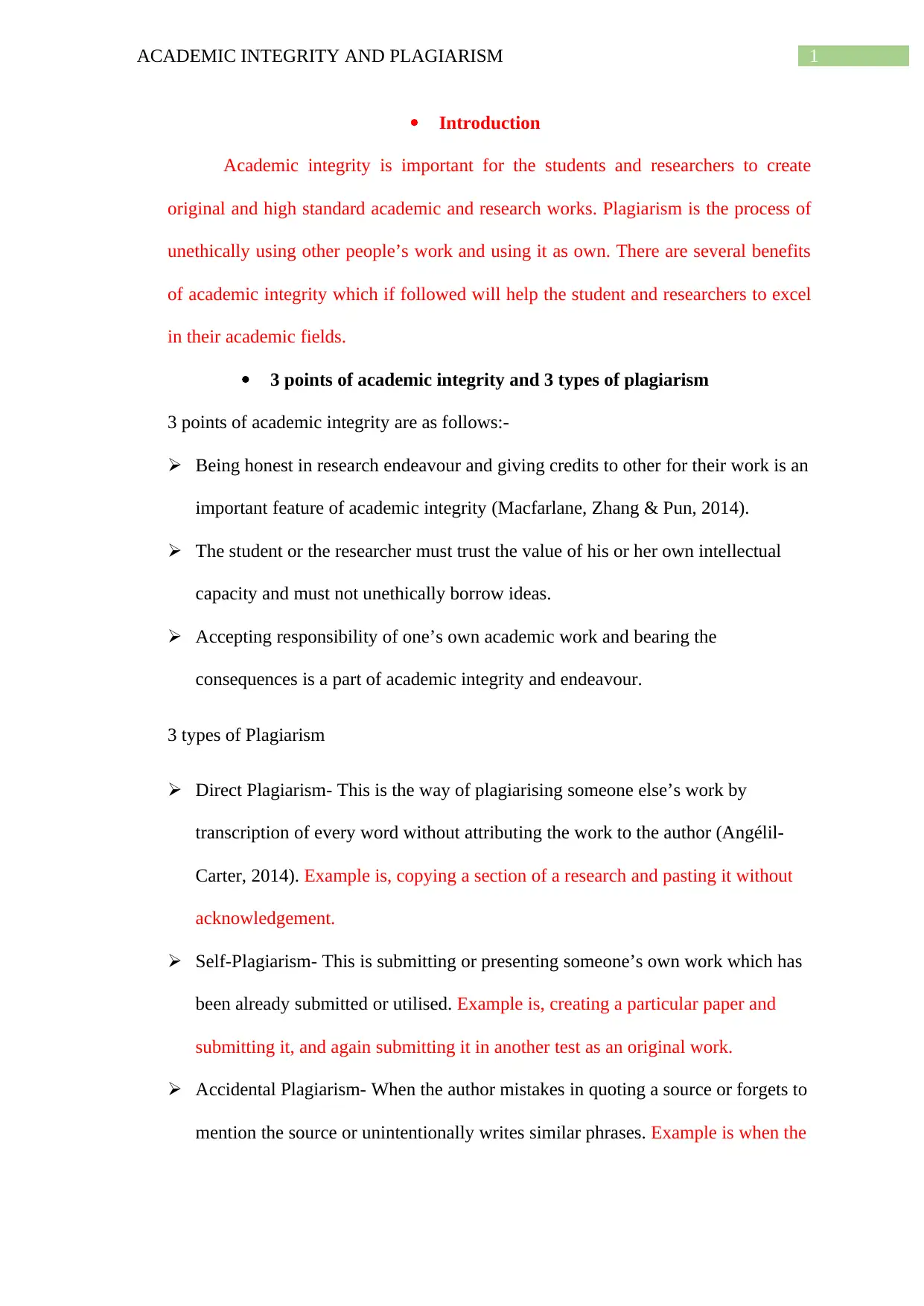
1ACADEMIC INTEGRITY AND PLAGIARISM
Introduction
Academic integrity is important for the students and researchers to create
original and high standard academic and research works. Plagiarism is the process of
unethically using other people’s work and using it as own. There are several benefits
of academic integrity which if followed will help the student and researchers to excel
in their academic fields.
3 points of academic integrity and 3 types of plagiarism
3 points of academic integrity are as follows:-
Being honest in research endeavour and giving credits to other for their work is an
important feature of academic integrity (Macfarlane, Zhang & Pun, 2014).
The student or the researcher must trust the value of his or her own intellectual
capacity and must not unethically borrow ideas.
Accepting responsibility of one’s own academic work and bearing the
consequences is a part of academic integrity and endeavour.
3 types of Plagiarism
Direct Plagiarism- This is the way of plagiarising someone else’s work by
transcription of every word without attributing the work to the author (Angélil-
Carter, 2014). Example is, copying a section of a research and pasting it without
acknowledgement.
Self-Plagiarism- This is submitting or presenting someone’s own work which has
been already submitted or utilised. Example is, creating a particular paper and
submitting it, and again submitting it in another test as an original work.
Accidental Plagiarism- When the author mistakes in quoting a source or forgets to
mention the source or unintentionally writes similar phrases. Example is when the
Introduction
Academic integrity is important for the students and researchers to create
original and high standard academic and research works. Plagiarism is the process of
unethically using other people’s work and using it as own. There are several benefits
of academic integrity which if followed will help the student and researchers to excel
in their academic fields.
3 points of academic integrity and 3 types of plagiarism
3 points of academic integrity are as follows:-
Being honest in research endeavour and giving credits to other for their work is an
important feature of academic integrity (Macfarlane, Zhang & Pun, 2014).
The student or the researcher must trust the value of his or her own intellectual
capacity and must not unethically borrow ideas.
Accepting responsibility of one’s own academic work and bearing the
consequences is a part of academic integrity and endeavour.
3 types of Plagiarism
Direct Plagiarism- This is the way of plagiarising someone else’s work by
transcription of every word without attributing the work to the author (Angélil-
Carter, 2014). Example is, copying a section of a research and pasting it without
acknowledgement.
Self-Plagiarism- This is submitting or presenting someone’s own work which has
been already submitted or utilised. Example is, creating a particular paper and
submitting it, and again submitting it in another test as an original work.
Accidental Plagiarism- When the author mistakes in quoting a source or forgets to
mention the source or unintentionally writes similar phrases. Example is when the

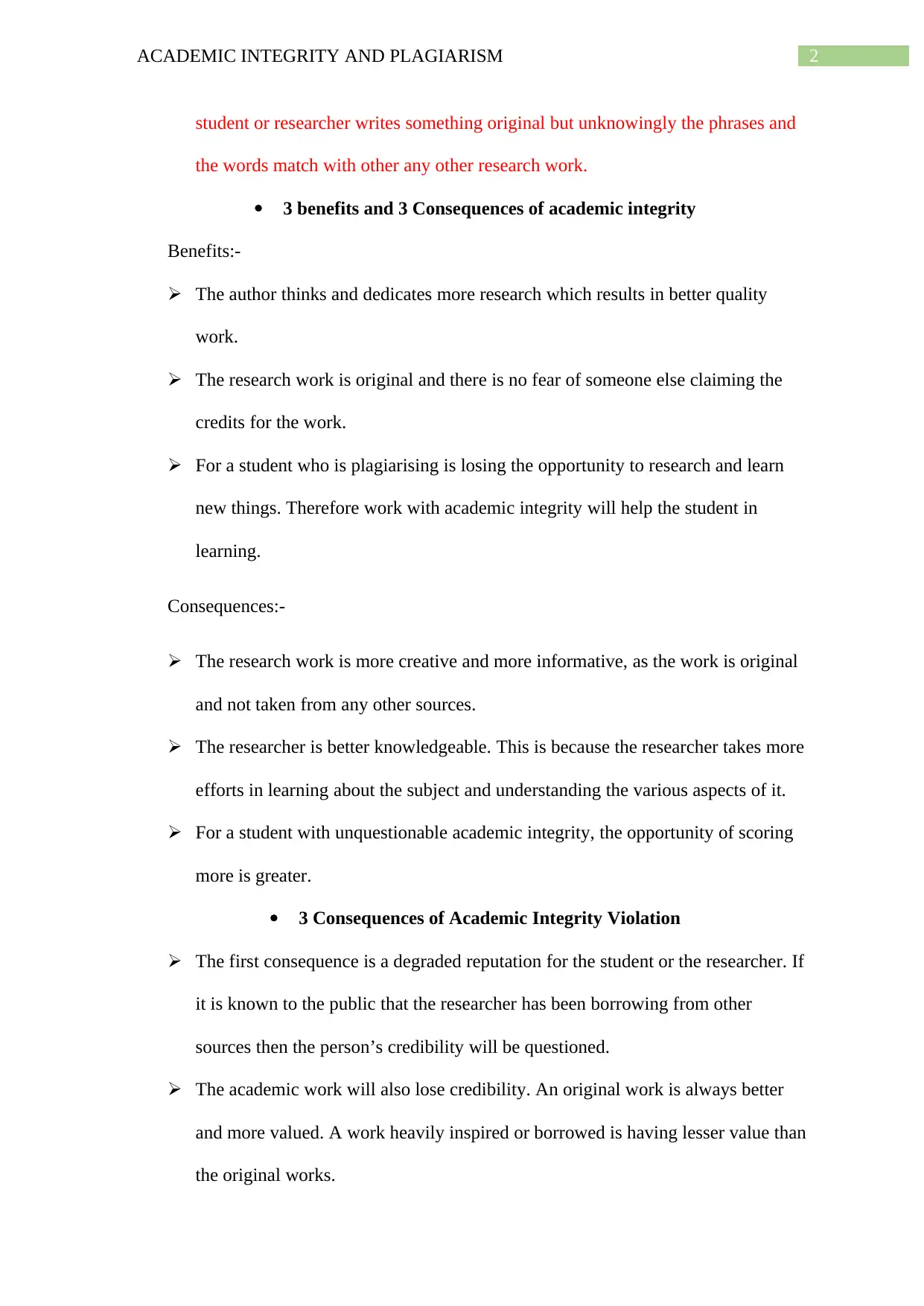
2ACADEMIC INTEGRITY AND PLAGIARISM
student or researcher writes something original but unknowingly the phrases and
the words match with other any other research work.
3 benefits and 3 Consequences of academic integrity
Benefits:-
The author thinks and dedicates more research which results in better quality
work.
The research work is original and there is no fear of someone else claiming the
credits for the work.
For a student who is plagiarising is losing the opportunity to research and learn
new things. Therefore work with academic integrity will help the student in
learning.
Consequences:-
The research work is more creative and more informative, as the work is original
and not taken from any other sources.
The researcher is better knowledgeable. This is because the researcher takes more
efforts in learning about the subject and understanding the various aspects of it.
For a student with unquestionable academic integrity, the opportunity of scoring
more is greater.
3 Consequences of Academic Integrity Violation
The first consequence is a degraded reputation for the student or the researcher. If
it is known to the public that the researcher has been borrowing from other
sources then the person’s credibility will be questioned.
The academic work will also lose credibility. An original work is always better
and more valued. A work heavily inspired or borrowed is having lesser value than
the original works.
student or researcher writes something original but unknowingly the phrases and
the words match with other any other research work.
3 benefits and 3 Consequences of academic integrity
Benefits:-
The author thinks and dedicates more research which results in better quality
work.
The research work is original and there is no fear of someone else claiming the
credits for the work.
For a student who is plagiarising is losing the opportunity to research and learn
new things. Therefore work with academic integrity will help the student in
learning.
Consequences:-
The research work is more creative and more informative, as the work is original
and not taken from any other sources.
The researcher is better knowledgeable. This is because the researcher takes more
efforts in learning about the subject and understanding the various aspects of it.
For a student with unquestionable academic integrity, the opportunity of scoring
more is greater.
3 Consequences of Academic Integrity Violation
The first consequence is a degraded reputation for the student or the researcher. If
it is known to the public that the researcher has been borrowing from other
sources then the person’s credibility will be questioned.
The academic work will also lose credibility. An original work is always better
and more valued. A work heavily inspired or borrowed is having lesser value than
the original works.
⊘ This is a preview!⊘
Do you want full access?
Subscribe today to unlock all pages.

Trusted by 1+ million students worldwide

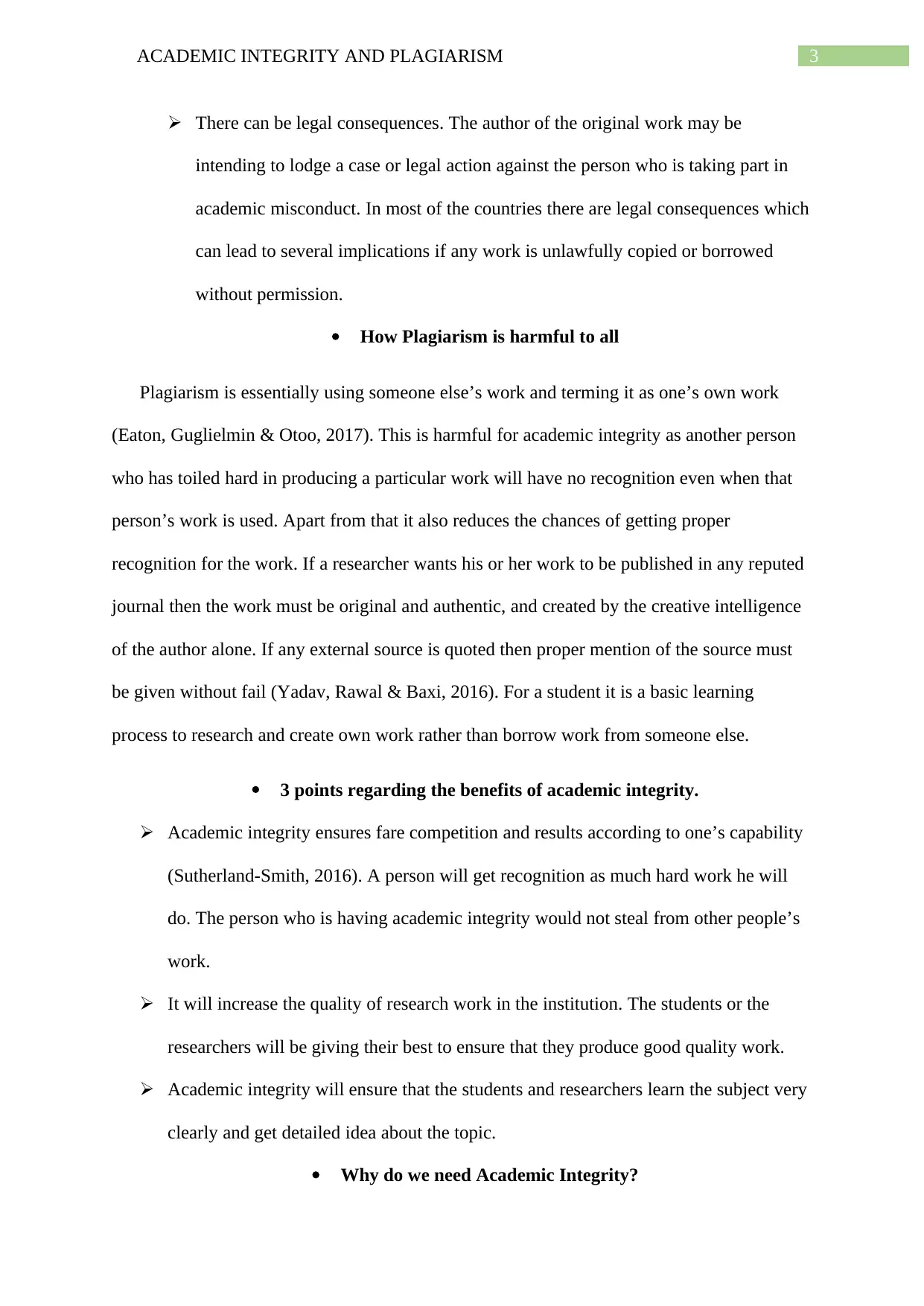
3ACADEMIC INTEGRITY AND PLAGIARISM
There can be legal consequences. The author of the original work may be
intending to lodge a case or legal action against the person who is taking part in
academic misconduct. In most of the countries there are legal consequences which
can lead to several implications if any work is unlawfully copied or borrowed
without permission.
How Plagiarism is harmful to all
Plagiarism is essentially using someone else’s work and terming it as one’s own work
(Eaton, Guglielmin & Otoo, 2017). This is harmful for academic integrity as another person
who has toiled hard in producing a particular work will have no recognition even when that
person’s work is used. Apart from that it also reduces the chances of getting proper
recognition for the work. If a researcher wants his or her work to be published in any reputed
journal then the work must be original and authentic, and created by the creative intelligence
of the author alone. If any external source is quoted then proper mention of the source must
be given without fail (Yadav, Rawal & Baxi, 2016). For a student it is a basic learning
process to research and create own work rather than borrow work from someone else.
3 points regarding the benefits of academic integrity.
Academic integrity ensures fare competition and results according to one’s capability
(Sutherland-Smith, 2016). A person will get recognition as much hard work he will
do. The person who is having academic integrity would not steal from other people’s
work.
It will increase the quality of research work in the institution. The students or the
researchers will be giving their best to ensure that they produce good quality work.
Academic integrity will ensure that the students and researchers learn the subject very
clearly and get detailed idea about the topic.
Why do we need Academic Integrity?
There can be legal consequences. The author of the original work may be
intending to lodge a case or legal action against the person who is taking part in
academic misconduct. In most of the countries there are legal consequences which
can lead to several implications if any work is unlawfully copied or borrowed
without permission.
How Plagiarism is harmful to all
Plagiarism is essentially using someone else’s work and terming it as one’s own work
(Eaton, Guglielmin & Otoo, 2017). This is harmful for academic integrity as another person
who has toiled hard in producing a particular work will have no recognition even when that
person’s work is used. Apart from that it also reduces the chances of getting proper
recognition for the work. If a researcher wants his or her work to be published in any reputed
journal then the work must be original and authentic, and created by the creative intelligence
of the author alone. If any external source is quoted then proper mention of the source must
be given without fail (Yadav, Rawal & Baxi, 2016). For a student it is a basic learning
process to research and create own work rather than borrow work from someone else.
3 points regarding the benefits of academic integrity.
Academic integrity ensures fare competition and results according to one’s capability
(Sutherland-Smith, 2016). A person will get recognition as much hard work he will
do. The person who is having academic integrity would not steal from other people’s
work.
It will increase the quality of research work in the institution. The students or the
researchers will be giving their best to ensure that they produce good quality work.
Academic integrity will ensure that the students and researchers learn the subject very
clearly and get detailed idea about the topic.
Why do we need Academic Integrity?
Paraphrase This Document
Need a fresh take? Get an instant paraphrase of this document with our AI Paraphraser

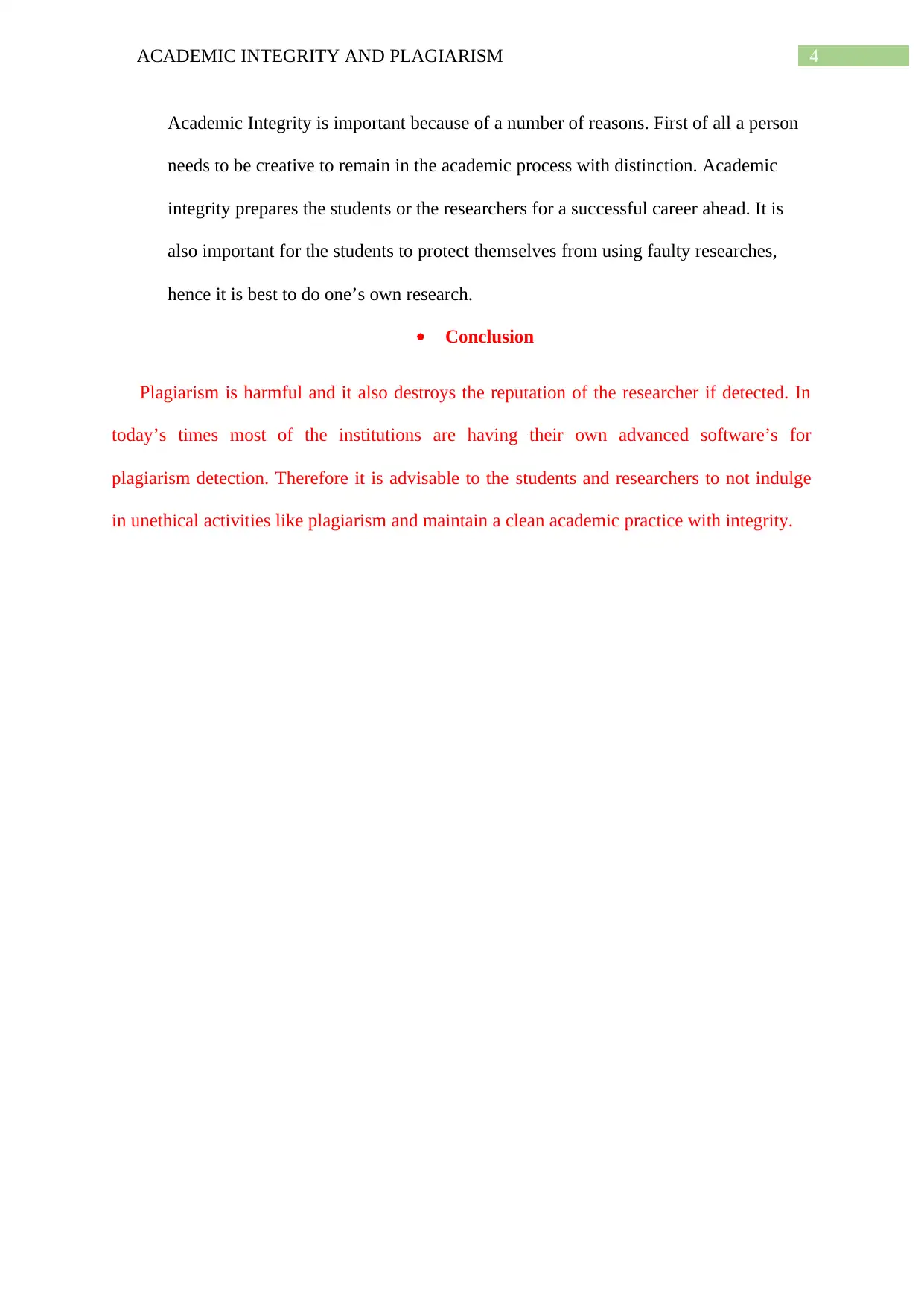
4ACADEMIC INTEGRITY AND PLAGIARISM
Academic Integrity is important because of a number of reasons. First of all a person
needs to be creative to remain in the academic process with distinction. Academic
integrity prepares the students or the researchers for a successful career ahead. It is
also important for the students to protect themselves from using faulty researches,
hence it is best to do one’s own research.
Conclusion
Plagiarism is harmful and it also destroys the reputation of the researcher if detected. In
today’s times most of the institutions are having their own advanced software’s for
plagiarism detection. Therefore it is advisable to the students and researchers to not indulge
in unethical activities like plagiarism and maintain a clean academic practice with integrity.
Academic Integrity is important because of a number of reasons. First of all a person
needs to be creative to remain in the academic process with distinction. Academic
integrity prepares the students or the researchers for a successful career ahead. It is
also important for the students to protect themselves from using faulty researches,
hence it is best to do one’s own research.
Conclusion
Plagiarism is harmful and it also destroys the reputation of the researcher if detected. In
today’s times most of the institutions are having their own advanced software’s for
plagiarism detection. Therefore it is advisable to the students and researchers to not indulge
in unethical activities like plagiarism and maintain a clean academic practice with integrity.

5ACADEMIC INTEGRITY AND PLAGIARISM
Reference:
Angélil-Carter, S. (2014). Stolen language?: Plagiarism in writing. Routledge.
Eaton, S. E., Guglielmin, M., & Otoo, B. (2017). Plagiarism: Moving from punitive to pro-
active approaches.
Macfarlane, B., Zhang, J., & Pun, A. (2014). Academic integrity: a review of the
literature. Studies in Higher Education, 39(2), 339-358.
Sutherland-Smith, W. (2016). Academic integrity in the digital age: introduction. Handbook
of academic integrity, 571-573.
Yadav, S., Rawal, G., & Baxi, M. (2016). Plagiarism-A serious scientific misconduct. Int J
Health Sci Res, 6(2), 364-366.
Reference:
Angélil-Carter, S. (2014). Stolen language?: Plagiarism in writing. Routledge.
Eaton, S. E., Guglielmin, M., & Otoo, B. (2017). Plagiarism: Moving from punitive to pro-
active approaches.
Macfarlane, B., Zhang, J., & Pun, A. (2014). Academic integrity: a review of the
literature. Studies in Higher Education, 39(2), 339-358.
Sutherland-Smith, W. (2016). Academic integrity in the digital age: introduction. Handbook
of academic integrity, 571-573.
Yadav, S., Rawal, G., & Baxi, M. (2016). Plagiarism-A serious scientific misconduct. Int J
Health Sci Res, 6(2), 364-366.
⊘ This is a preview!⊘
Do you want full access?
Subscribe today to unlock all pages.

Trusted by 1+ million students worldwide
1 out of 6
Related Documents
Your All-in-One AI-Powered Toolkit for Academic Success.
+13062052269
info@desklib.com
Available 24*7 on WhatsApp / Email
Unlock your academic potential
Copyright © 2020–2025 A2Z Services. All Rights Reserved. Developed and managed by ZUCOL.