The Science of Plant Nutrition: Photosynthesis and Food Sources Report

Verified

Added on  2022/11/15

|16
|965
|112
Report
AI Summary
This report delves into the process of photosynthesis, explaining how plants, unlike animals, produce their own food. It clarifies the common misconception that plants obtain food from the soil, emphasizing that the soil provides water, nutrients, and anchorage, but not food. The report details the process of photosynthesis, including the role of chlorophyll, sunlight, carbon dioxide, and water. It outlines the two stages of photosynthesis: the light-dependent stage and the light-independent stage. The report also discusses the adaptations of leaves for photosynthesis, such as their thin structure, the presence of xylem and phloem, and the arrangement of chlorophyll. It references several scientific sources to support the explanations of photosynthesis, plant structure and plant nutrition. In conclusion, the report highlights that plants are solar-powered organisms and that photosynthesis is the process that captures solar energy and transfers it to other living organisms.
Document Page
Plants get food from soil.
Student
Code
Supervisor’s
Institution
Submission day
tabler-icon-diamond-filled.svg

Paraphrase This Document

Need a fresh take? Get an instant paraphrase of this document with our AI Paraphraser
Document Page
PLANTS EAT FROM THE SOIL.
Document Page
BEGINNING
According to Ballard (2015), plants are multicellular organisms
which grow in water and earth, make their food by use of
inorganic substances, show slow response to changes in the
environment and lacks nervous system and specialised sense
organs.(p. 17). With over 250,000 species of plants identified by
the scientist today, the most common types that are easily
identifiable include; ferns, grass, green algae, mosses, shrubs
and tress (Ballard 2015, p. 36).
Document Page
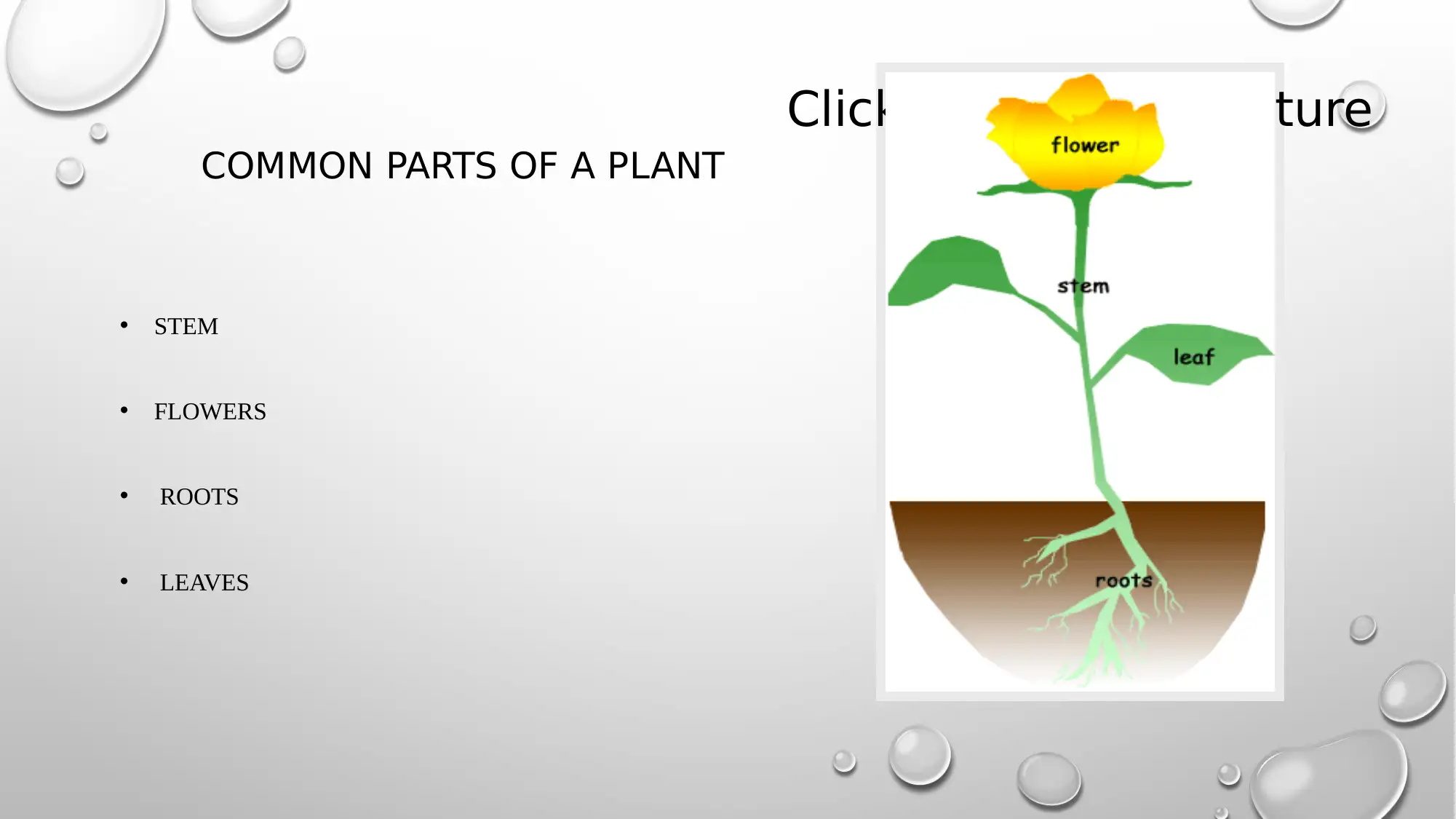
COMMON PARTS OF A PLANT
Click icon to add picture
STEM
FLOWERS
ROOTS
LEAVES
tabler-icon-diamond-filled.svg

Paraphrase This Document

Need a fresh take? Get an instant paraphrase of this document with our AI Paraphraser
Document Page
like other living things such as animals and insects, plants
require energy to perform normal biological activities such a
growth and development, respiration and reproduction
(Maloof 2016 , p. 78). to many people especially gardeners,
it is common knowledge that plants have their food made by
the soil and they take them through the roots. To Farmers,
who are keen on every step of plants development it is
evident that Plants lacks ability to make their own food as
well as power to move from one place to another in search
of food. The contact between plants and soil is the only way
through which plants get their food. It is for this reasons that
farmers ensure to use fertilizers “pre-prepared food for
plants” when planting or when they feel the ground lacks
Document Page
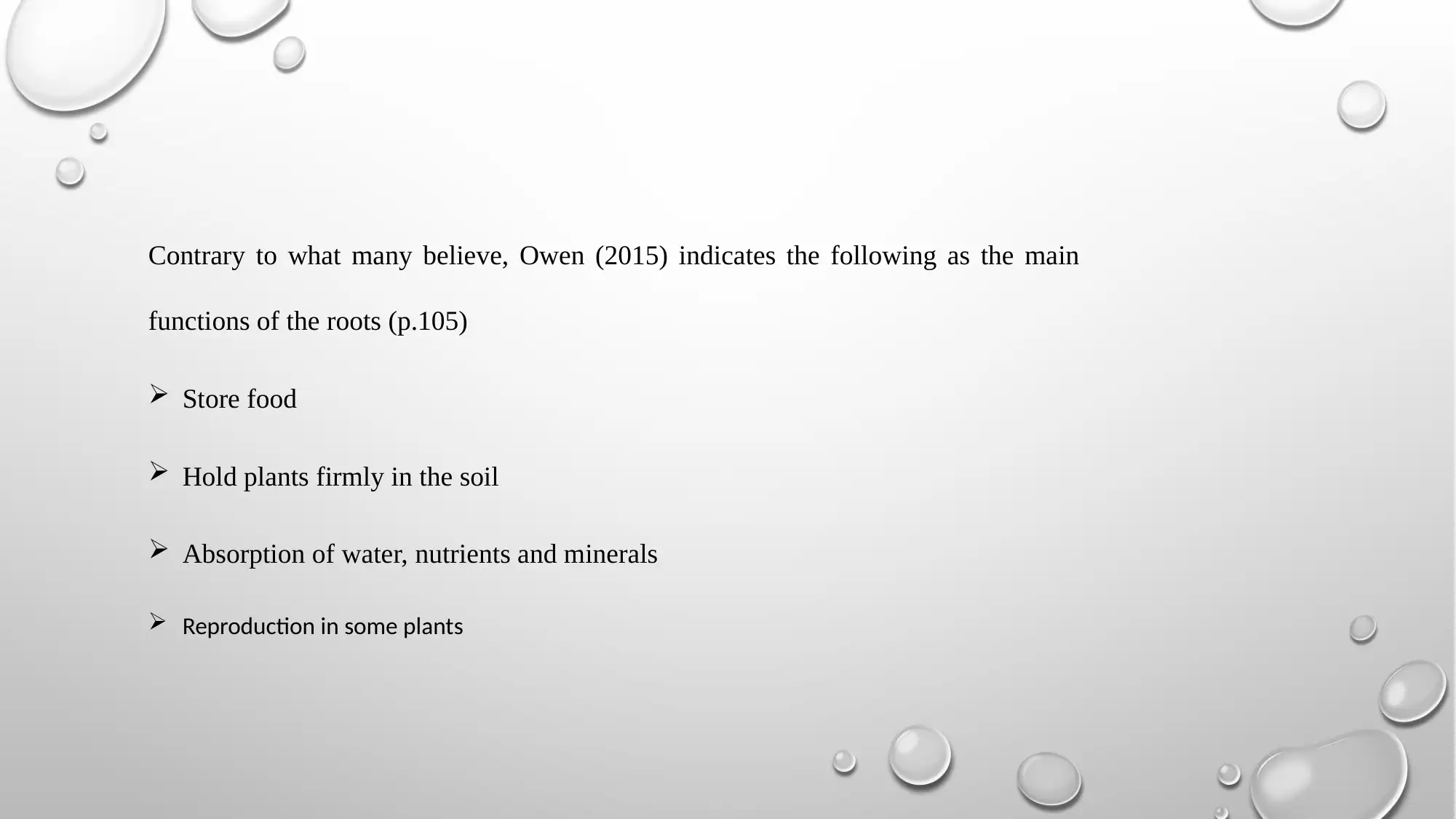
Contrary to what many believe, Owen (2015) indicates the following as the main
functions of the roots (p.105)
Store food
Hold plants firmly in the soil
Absorption of water, nutrients and minerals
Reproduction in some plants
Document Page
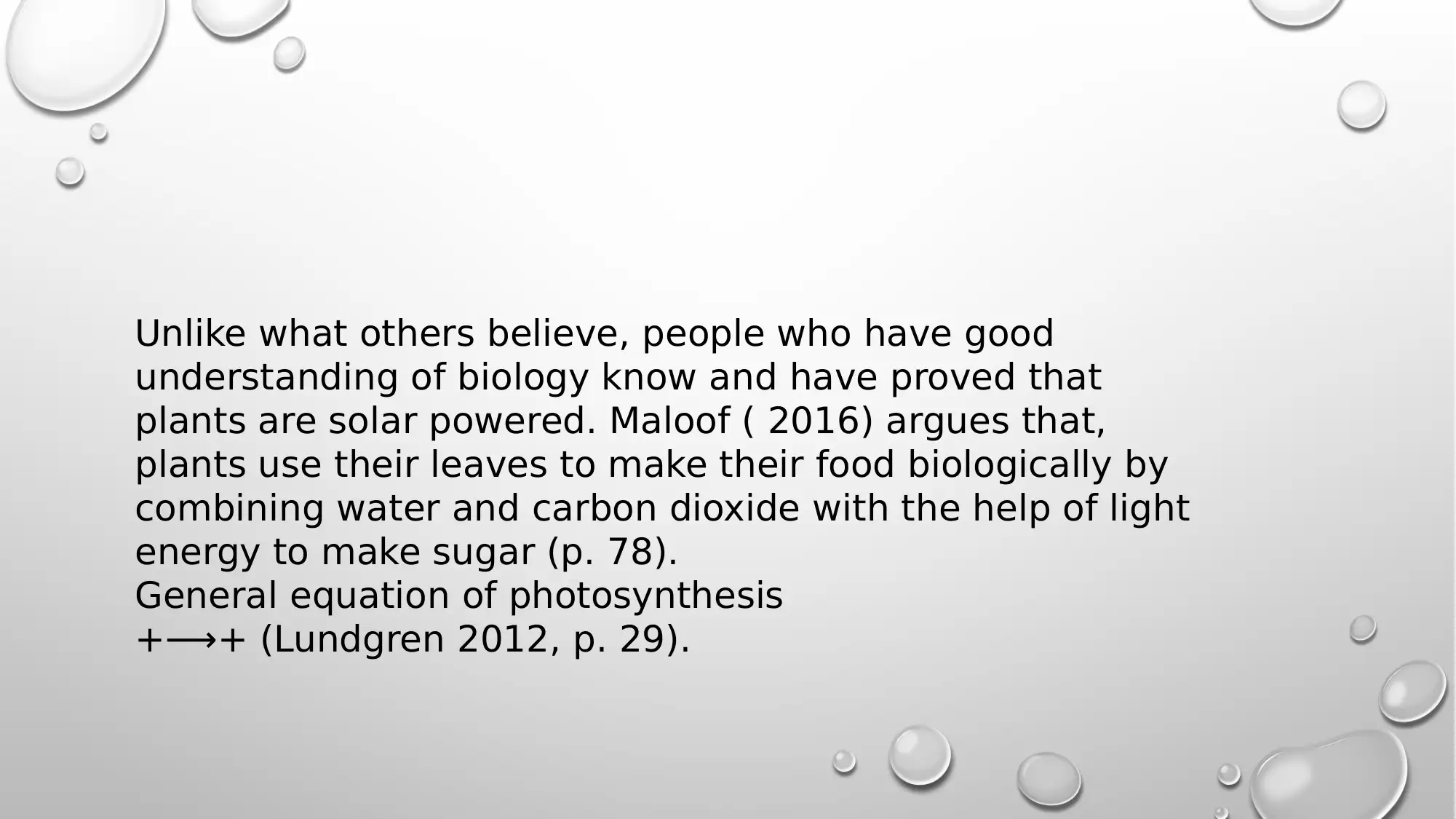
Unlike what others believe, people who have good
understanding of biology know and have proved that
plants are solar powered. Maloof ( 2016) argues that,
plants use their leaves to make their food biologically by
combining water and carbon dioxide with the help of light
energy to make sugar (p. 78).
General equation of photosynthesis
+⟶+ (Lundgren 2012, p. 29).
tabler-icon-diamond-filled.svg

Paraphrase This Document

Need a fresh take? Get an instant paraphrase of this document with our AI Paraphraser
Document Page
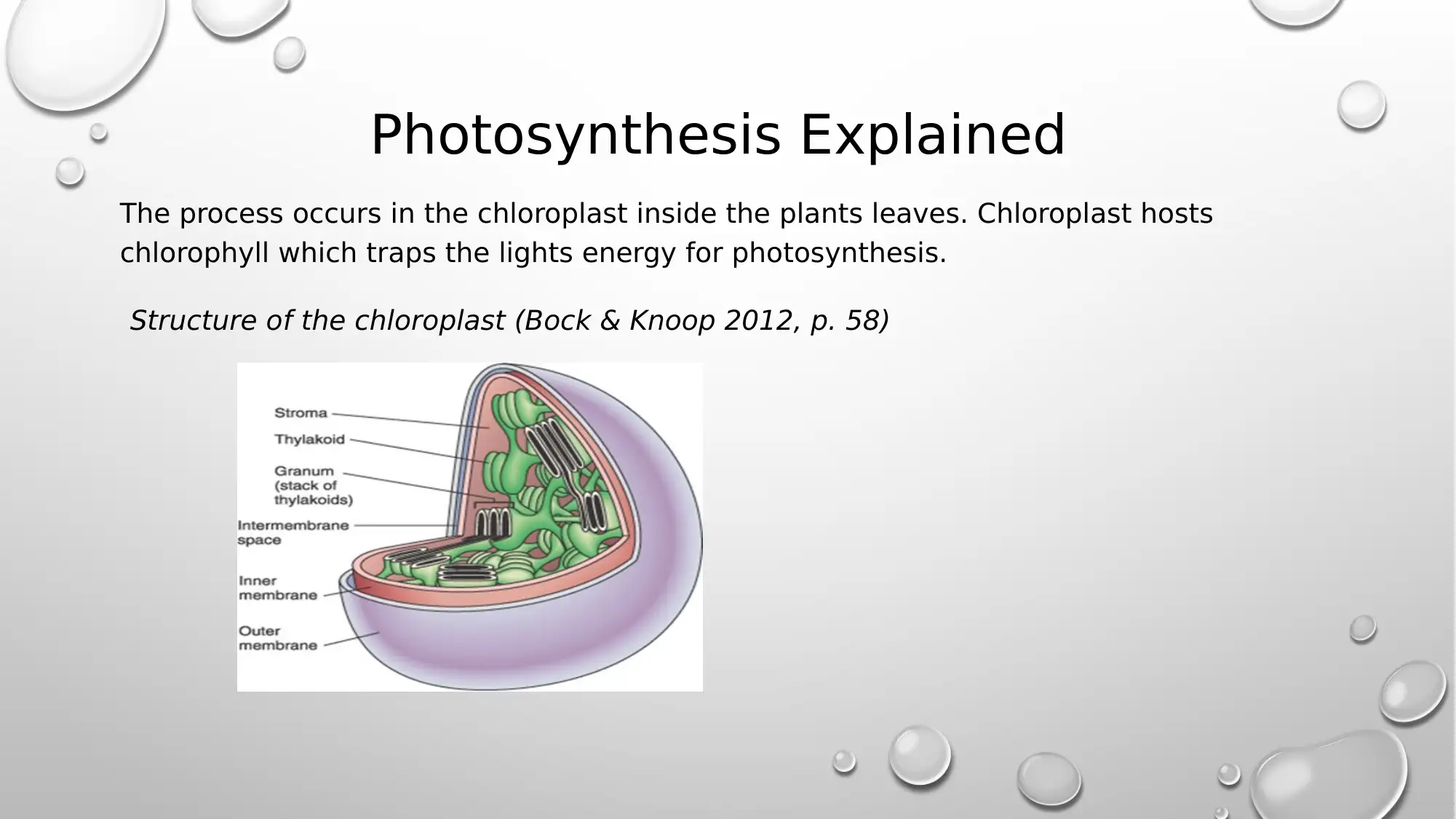
Photosynthesis Explained
The process occurs in the chloroplast inside the plants leaves. Chloroplast hosts
chlorophyll which traps the lights energy for photosynthesis.
Structure of the chloroplast (Bock & Knoop 2012, p. 58)
Document Page
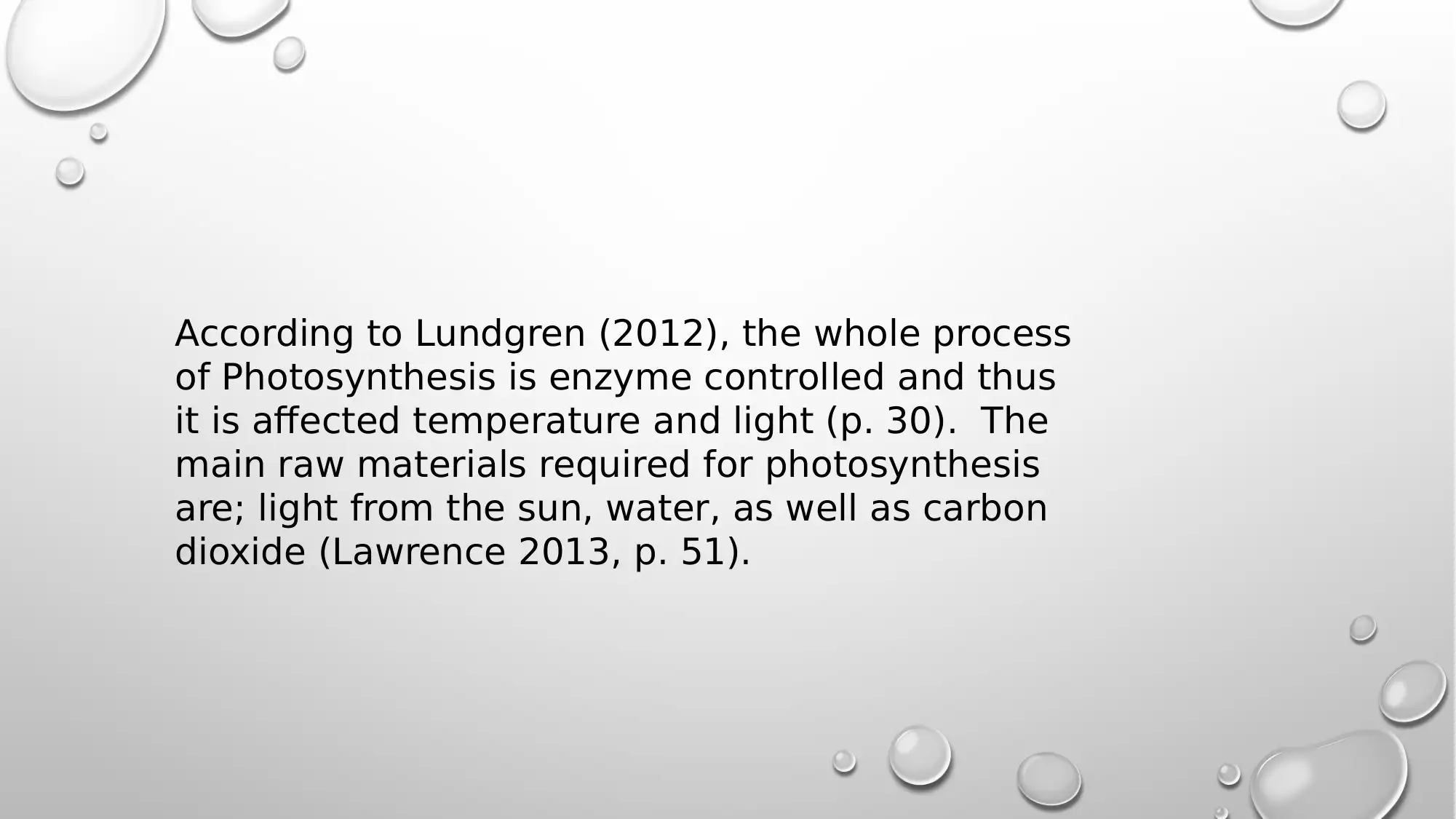
According to Lundgren (2012), the whole process
of Photosynthesis is enzyme controlled and thus
it is affected temperature and light (p. 30). The
main raw materials required for photosynthesis
are; light from the sun, water, as well as carbon
dioxide (Lawrence 2013, p. 51).
Document Page
Photosynthesis takes places in two stages as shown below:
Light Stage
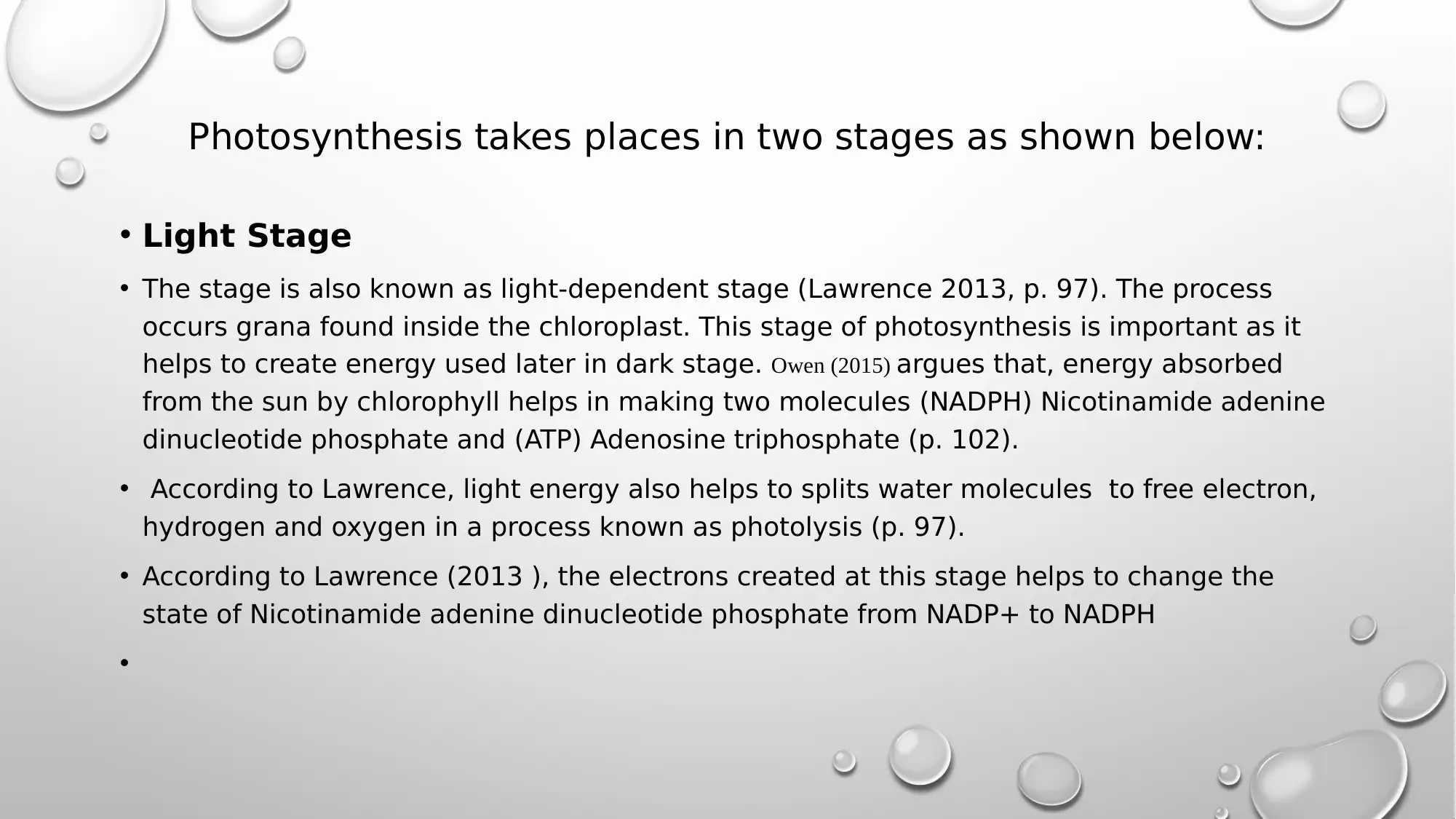
The stage is also known as light-dependent stage (Lawrence 2013, p. 97). The process
occurs grana found inside the chloroplast. This stage of photosynthesis is important as it
helps to create energy used later in dark stage. Owen (2015) argues that, energy absorbed
from the sun by chlorophyll helps in making two molecules (NADPH) Nicotinamide adenine
dinucleotide phosphate and (ATP) Adenosine triphosphate (p. 102).
According to Lawrence, light energy also helps to splits water molecules to free electron,
hydrogen and oxygen in a process known as photolysis (p. 97).
According to Lawrence (2013 ), the electrons created at this stage helps to change the
state of Nicotinamide adenine dinucleotide phosphate from NADP+ to NADPH
tabler-icon-diamond-filled.svg

Paraphrase This Document

Need a fresh take? Get an instant paraphrase of this document with our AI Paraphraser
Document Page
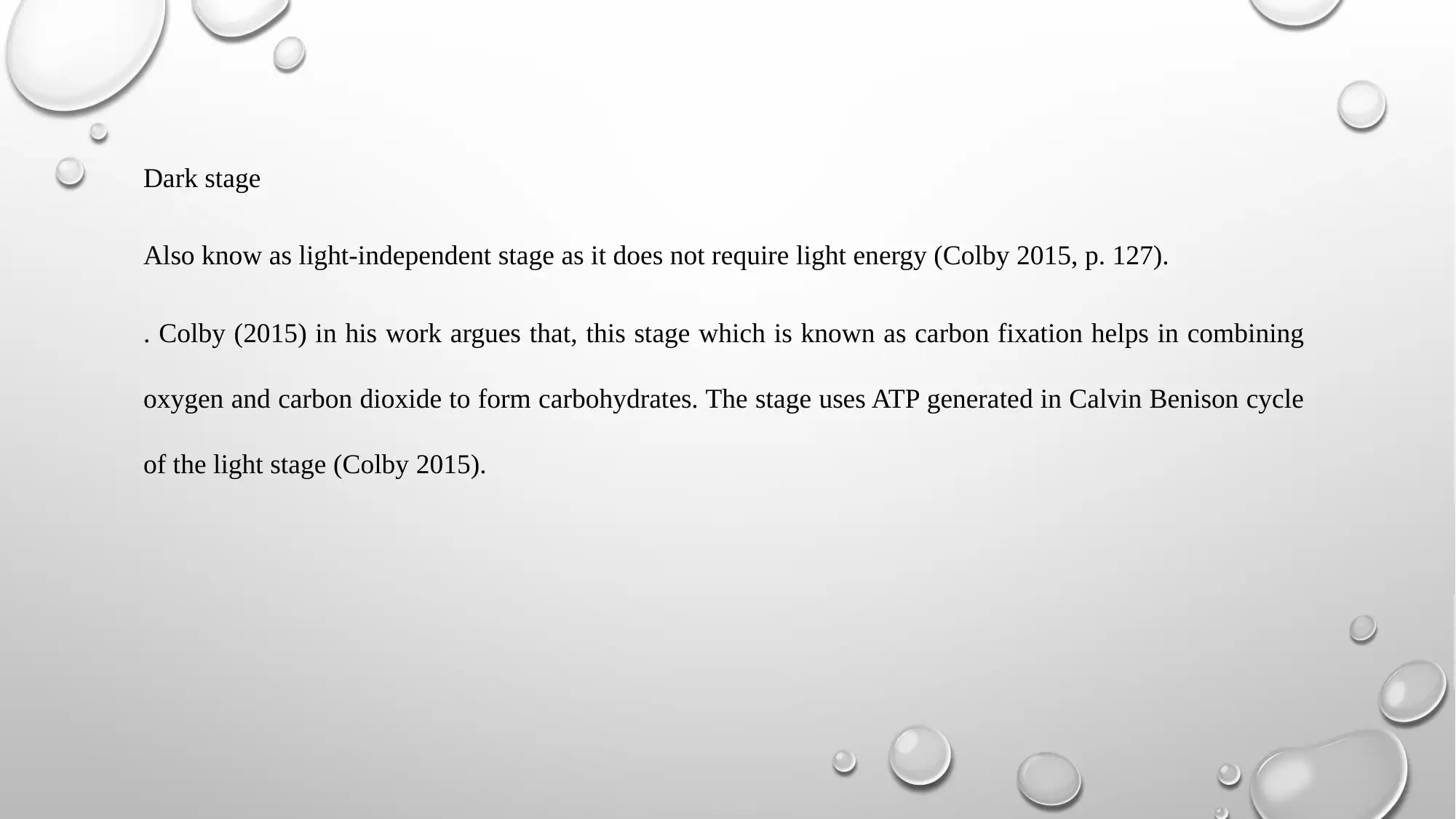
Dark stage
Also know as light-independent stage as it does not require light energy (Colby 2015, p. 127).
. Colby (2015) in his work argues that, this stage which is known as carbon fixation helps in combining
oxygen and carbon dioxide to form carbohydrates. The stage uses ATP generated in Calvin Benison cycle
of the light stage (Colby 2015).
Document Page
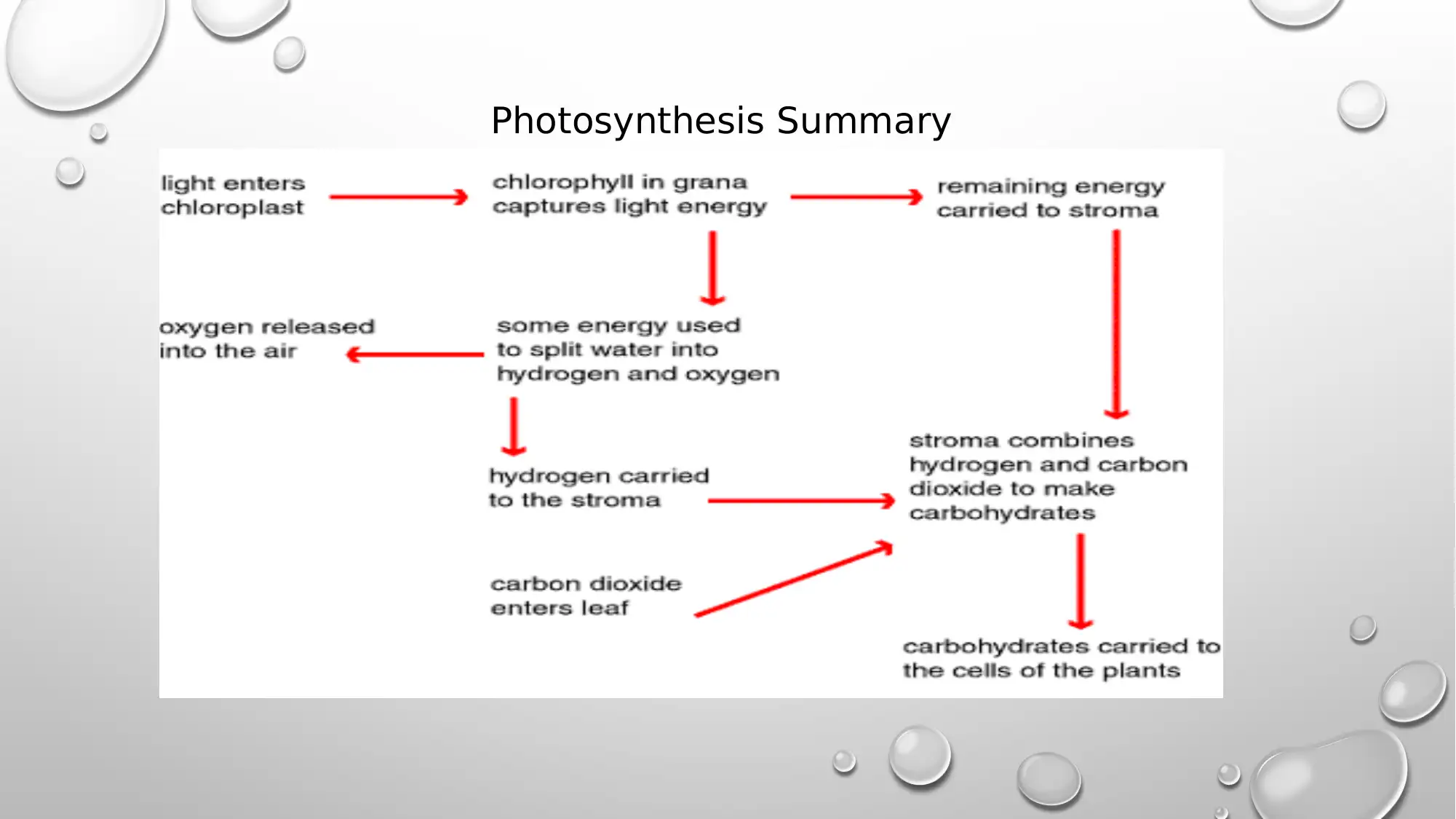
Photosynthesis Summary
chevron_up_icon
1 out of 16
circle_padding
hide_on_mobile
zoom_out_icon
[object Object]