Case Study Analysis: Management Strategies for Plant Productivity

Verified

Added on  2023/06/04

|3
|626
|402
Case Study
AI Summary
This case study examines the initial employee reactions to Alex Rogo's discoveries and the subsequent changes in their perception after applying new strategies based on Jonah's concepts. Jonah introduces the idea of bottleneck and non-bottleneck resources, emphasizing the need to balance product flow rather than capacity. Key resources like NCX-10 and the heat-treat department are identified as bottlenecks. The analysis explores the importance of increasing bottleneck resource capacity and implementing a system with red and green tags to manage work-in-progress (WIP). The furnace activity demonstrates how to decrease setup costs. Finally, the study discusses the impact of inventory pile-up and the relationship between bottleneck and non-bottleneck resources, providing a comprehensive overview of plant management strategies to enhance productivity and efficiency.

Document Page
Running Head: Case Study
Management
tabler-icon-diamond-filled.svg

Paraphrase This Document

Need a fresh take? Get an instant paraphrase of this document with our AI Paraphraser
Document Page
Case Study 1
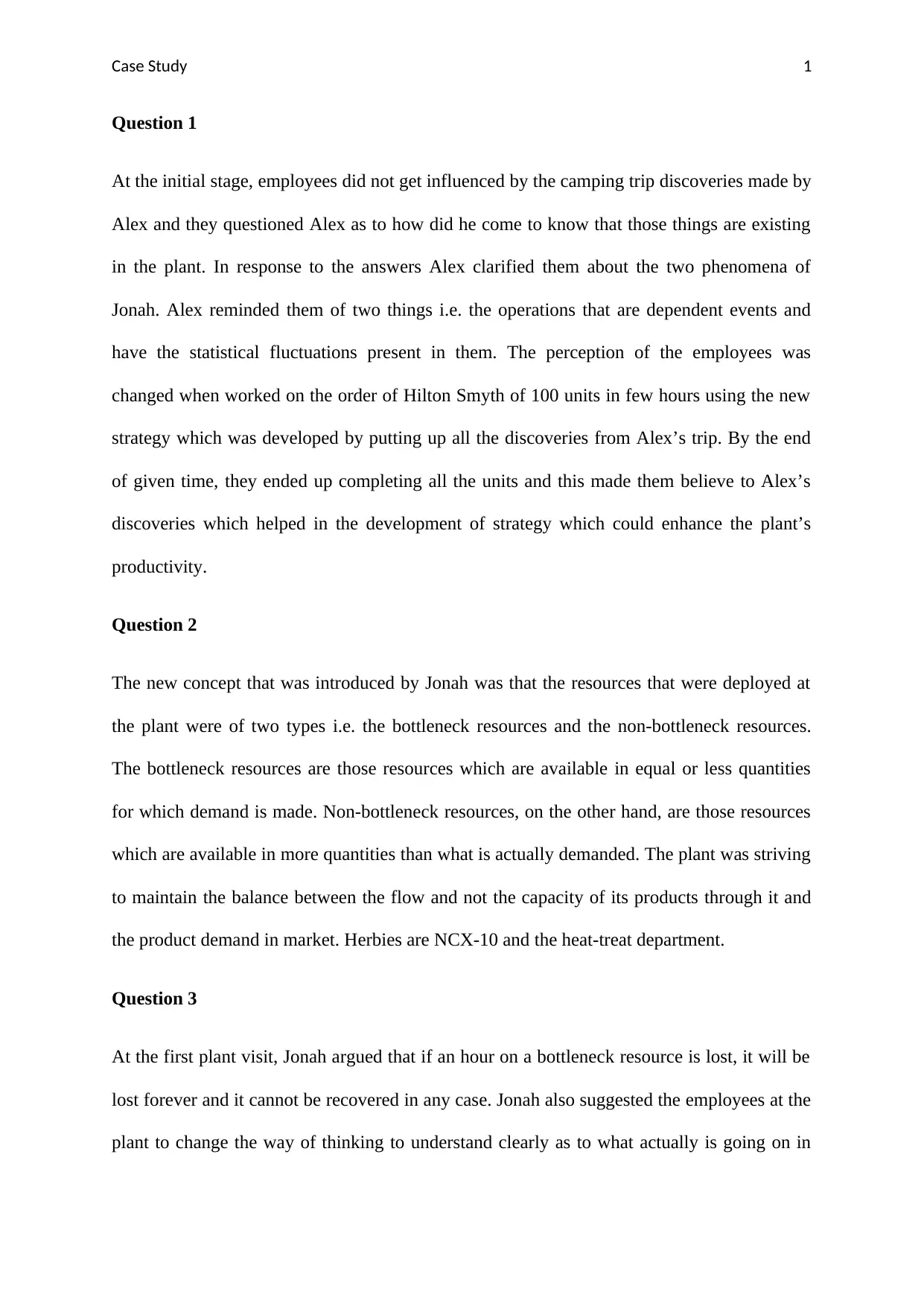
Question 1
At the initial stage, employees did not get influenced by the camping trip discoveries made by
Alex and they questioned Alex as to how did he come to know that those things are existing
in the plant. In response to the answers Alex clarified them about the two phenomena of
Jonah. Alex reminded them of two things i.e. the operations that are dependent events and
have the statistical fluctuations present in them. The perception of the employees was
changed when worked on the order of Hilton Smyth of 100 units in few hours using the new
strategy which was developed by putting up all the discoveries from Alex’s trip. By the end
of given time, they ended up completing all the units and this made them believe to Alex’s
discoveries which helped in the development of strategy which could enhance the plant’s
productivity.
Question 2
The new concept that was introduced by Jonah was that the resources that were deployed at
the plant were of two types i.e. the bottleneck resources and the non-bottleneck resources.
The bottleneck resources are those resources which are available in equal or less quantities
for which demand is made. Non-bottleneck resources, on the other hand, are those resources
which are available in more quantities than what is actually demanded. The plant was striving
to maintain the balance between the flow and not the capacity of its products through it and
the product demand in market. Herbies are NCX-10 and the heat-treat department.
Question 3
At the first plant visit, Jonah argued that if an hour on a bottleneck resource is lost, it will be
lost forever and it cannot be recovered in any case. Jonah also suggested the employees at the
plant to change the way of thinking to understand clearly as to what actually is going on in
Document Page
Case Study 2
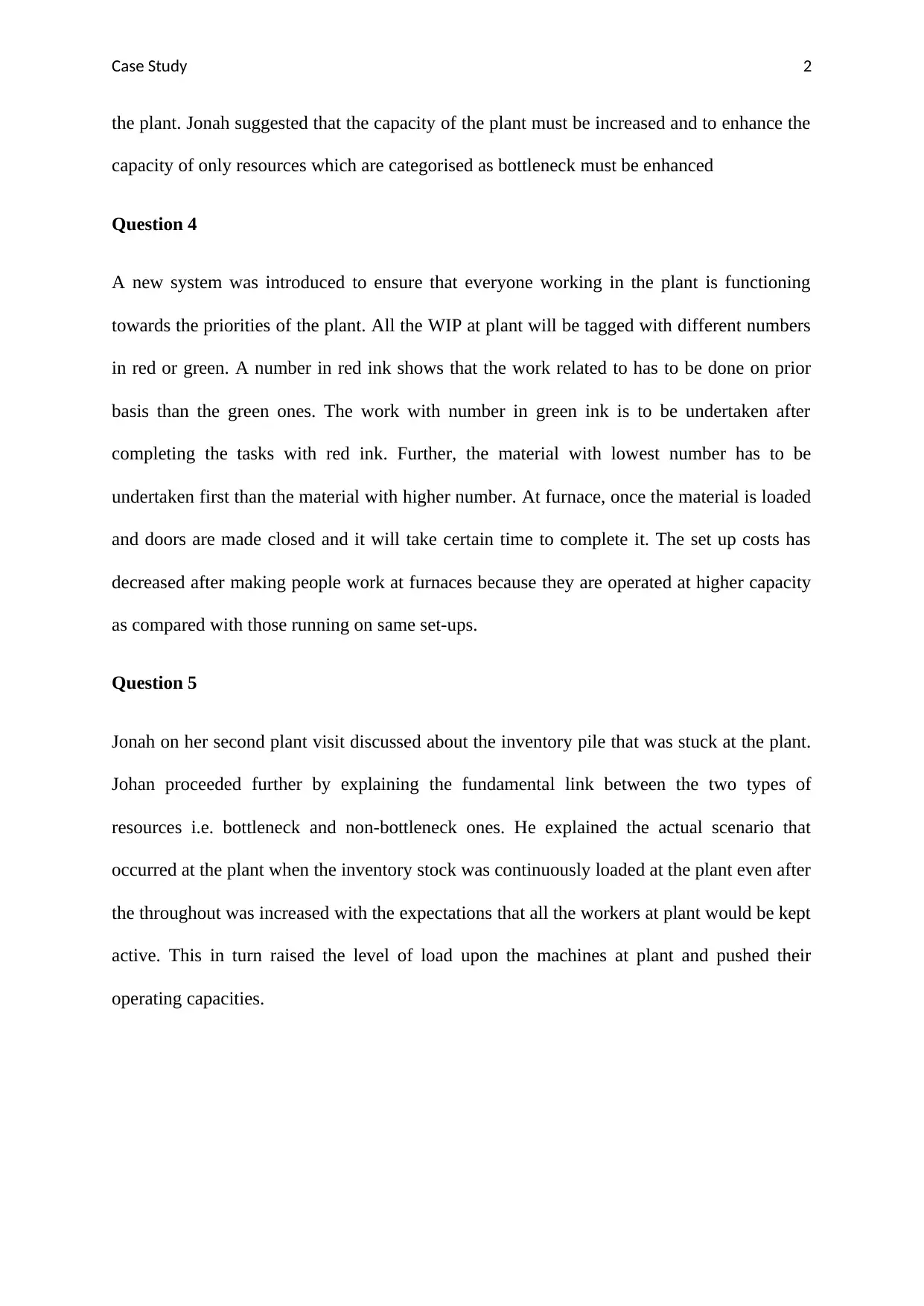
the plant. Jonah suggested that the capacity of the plant must be increased and to enhance the
capacity of only resources which are categorised as bottleneck must be enhanced
Question 4
A new system was introduced to ensure that everyone working in the plant is functioning
towards the priorities of the plant. All the WIP at plant will be tagged with different numbers
in red or green. A number in red ink shows that the work related to has to be done on prior
basis than the green ones. The work with number in green ink is to be undertaken after
completing the tasks with red ink. Further, the material with lowest number has to be
undertaken first than the material with higher number. At furnace, once the material is loaded
and doors are made closed and it will take certain time to complete it. The set up costs has
decreased after making people work at furnaces because they are operated at higher capacity
as compared with those running on same set-ups.
Question 5
Jonah on her second plant visit discussed about the inventory pile that was stuck at the plant.
Johan proceeded further by explaining the fundamental link between the two types of
resources i.e. bottleneck and non-bottleneck ones. He explained the actual scenario that
occurred at the plant when the inventory stock was continuously loaded at the plant even after
the throughout was increased with the expectations that all the workers at plant would be kept
active. This in turn raised the level of load upon the machines at plant and pushed their
operating capacities.
chevron_up_icon
1 out of 3
circle_padding
hide_on_mobile
zoom_out_icon
[object Object]