Plato's Concept of Democracy: Lessons for Today's Society
VerifiedAdded on 2022/10/04
|6
|1468
|20
Essay
AI Summary
This essay analyzes Plato's concept of democracy, focusing on his critique as presented in Book 8 of The Republic. It explores Plato's view of democracy as a deviation from an ideal society ruled by philosopher-kings, contrasting it with contemporary understandings of democracy. The essay details Plato's belief that the common people lack the expertise to govern and are driven by self-interest. It examines his arguments against democracy and the potential for chaos and instability that he associates with it. Furthermore, the essay presents a defense of democracy against Socrates' charges, emphasizing the importance of freedom and individual rights within a framework of law and order. The analysis also touches upon the lessons that can be drawn from Plato's Republic in relation to modern society, highlighting the differences between Plato's hierarchical views and the free, dynamic societies of today.
Surname 1
Plato’s Concept of Democracy
Name
Professor
Institution
Course
Date
Plato’s Concept of Democracy
Q5. What lessons can Plato's Republic teach us about our society today? Specifically, consider
Plato's critique of democracy in Book 8. Why does Plato think democracy is such a falling away
from the ideal society? How would you defend democracy against the charges Socrates levels
against it?
Introduction
In the Republic, Plato describes democracy as when the rich become incredibly rich and the poor
extremely poor. According to Socrates also, people who lack the basic knowledge occupy offices
and everyone is considered as an equal in capability. Plato says that philosopher-kings are the
only people who are eligible to govern the society and common people were seen as barbaric and
worthless of the ruling (Held). Plato’s opinion of democracy was formed by his aristocratic
experience. He perceived that only the influential had the right to govern the ordinary people
who seemed like they were ordained to be ruled. Plato describes the elite person as one who was
born with the ability to rule and does not want other people to occupy office and take power.
Plato’s Concept of Democracy
Name
Professor
Institution
Course
Date
Plato’s Concept of Democracy
Q5. What lessons can Plato's Republic teach us about our society today? Specifically, consider
Plato's critique of democracy in Book 8. Why does Plato think democracy is such a falling away
from the ideal society? How would you defend democracy against the charges Socrates levels
against it?
Introduction
In the Republic, Plato describes democracy as when the rich become incredibly rich and the poor
extremely poor. According to Socrates also, people who lack the basic knowledge occupy offices
and everyone is considered as an equal in capability. Plato says that philosopher-kings are the
only people who are eligible to govern the society and common people were seen as barbaric and
worthless of the ruling (Held). Plato’s opinion of democracy was formed by his aristocratic
experience. He perceived that only the influential had the right to govern the ordinary people
who seemed like they were ordained to be ruled. Plato describes the elite person as one who was
born with the ability to rule and does not want other people to occupy office and take power.
Paraphrase This Document
Need a fresh take? Get an instant paraphrase of this document with our AI Paraphraser

Surname 2
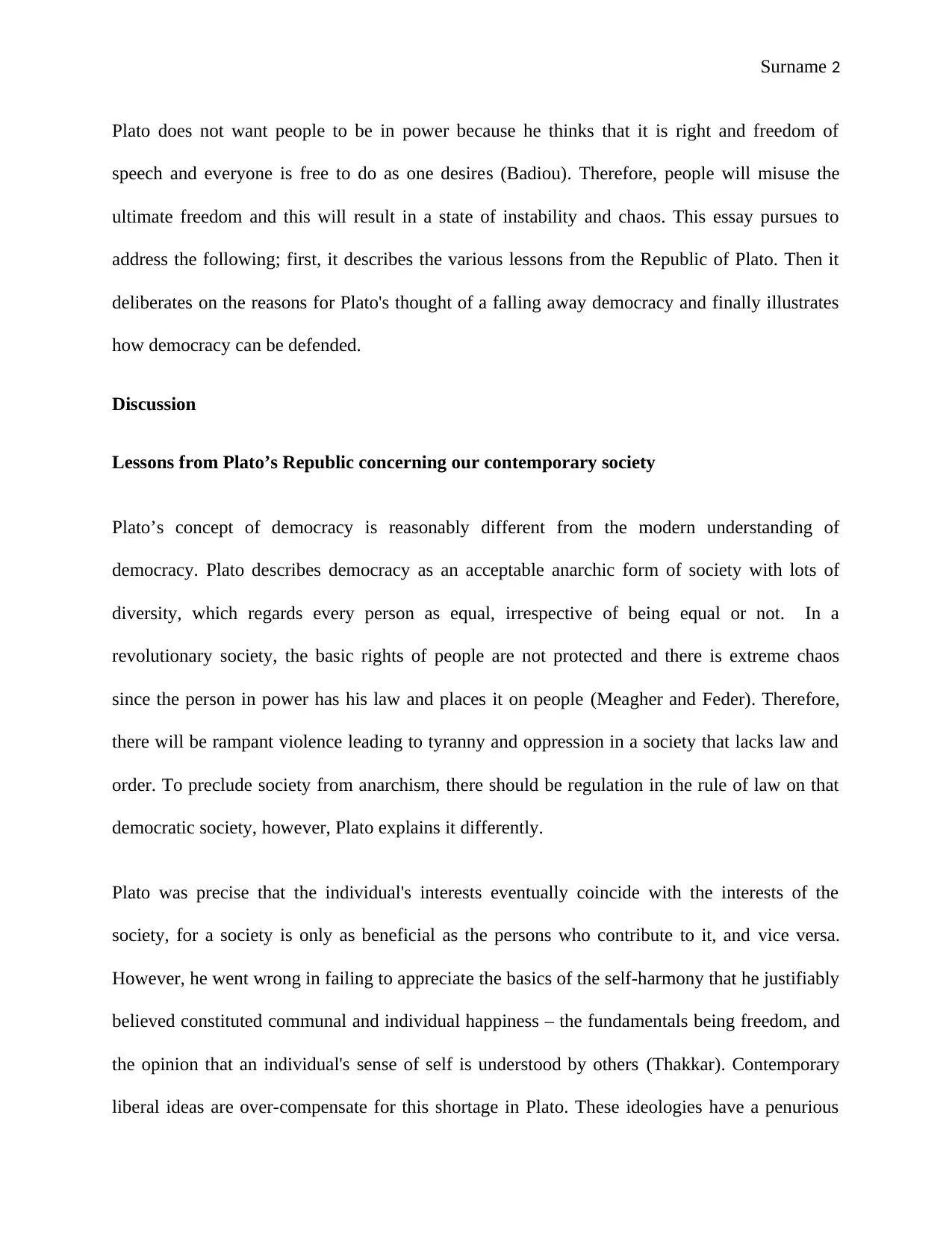
Plato does not want people to be in power because he thinks that it is right and freedom of
speech and everyone is free to do as one desires (Badiou). Therefore, people will misuse the
ultimate freedom and this will result in a state of instability and chaos. This essay pursues to
address the following; first, it describes the various lessons from the Republic of Plato. Then it
deliberates on the reasons for Plato's thought of a falling away democracy and finally illustrates
how democracy can be defended.
Discussion
Lessons from Plato’s Republic concerning our contemporary society
Plato’s concept of democracy is reasonably different from the modern understanding of
democracy. Plato describes democracy as an acceptable anarchic form of society with lots of
diversity, which regards every person as equal, irrespective of being equal or not. In a
revolutionary society, the basic rights of people are not protected and there is extreme chaos
since the person in power has his law and places it on people (Meagher and Feder). Therefore,
there will be rampant violence leading to tyranny and oppression in a society that lacks law and
order. To preclude society from anarchism, there should be regulation in the rule of law on that
democratic society, however, Plato explains it differently.
Plato was precise that the individual's interests eventually coincide with the interests of the
society, for a society is only as beneficial as the persons who contribute to it, and vice versa.
However, he went wrong in failing to appreciate the basics of the self-harmony that he justifiably
believed constituted communal and individual happiness – the fundamentals being freedom, and
the opinion that an individual's sense of self is understood by others (Thakkar). Contemporary
liberal ideas are over-compensate for this shortage in Plato. These ideologies have a penurious
Plato does not want people to be in power because he thinks that it is right and freedom of
speech and everyone is free to do as one desires (Badiou). Therefore, people will misuse the
ultimate freedom and this will result in a state of instability and chaos. This essay pursues to
address the following; first, it describes the various lessons from the Republic of Plato. Then it
deliberates on the reasons for Plato's thought of a falling away democracy and finally illustrates
how democracy can be defended.
Discussion
Lessons from Plato’s Republic concerning our contemporary society
Plato’s concept of democracy is reasonably different from the modern understanding of
democracy. Plato describes democracy as an acceptable anarchic form of society with lots of
diversity, which regards every person as equal, irrespective of being equal or not. In a
revolutionary society, the basic rights of people are not protected and there is extreme chaos
since the person in power has his law and places it on people (Meagher and Feder). Therefore,
there will be rampant violence leading to tyranny and oppression in a society that lacks law and
order. To preclude society from anarchism, there should be regulation in the rule of law on that
democratic society, however, Plato explains it differently.
Plato was precise that the individual's interests eventually coincide with the interests of the
society, for a society is only as beneficial as the persons who contribute to it, and vice versa.
However, he went wrong in failing to appreciate the basics of the self-harmony that he justifiably
believed constituted communal and individual happiness – the fundamentals being freedom, and
the opinion that an individual's sense of self is understood by others (Thakkar). Contemporary
liberal ideas are over-compensate for this shortage in Plato. These ideologies have a penurious

Surname 3
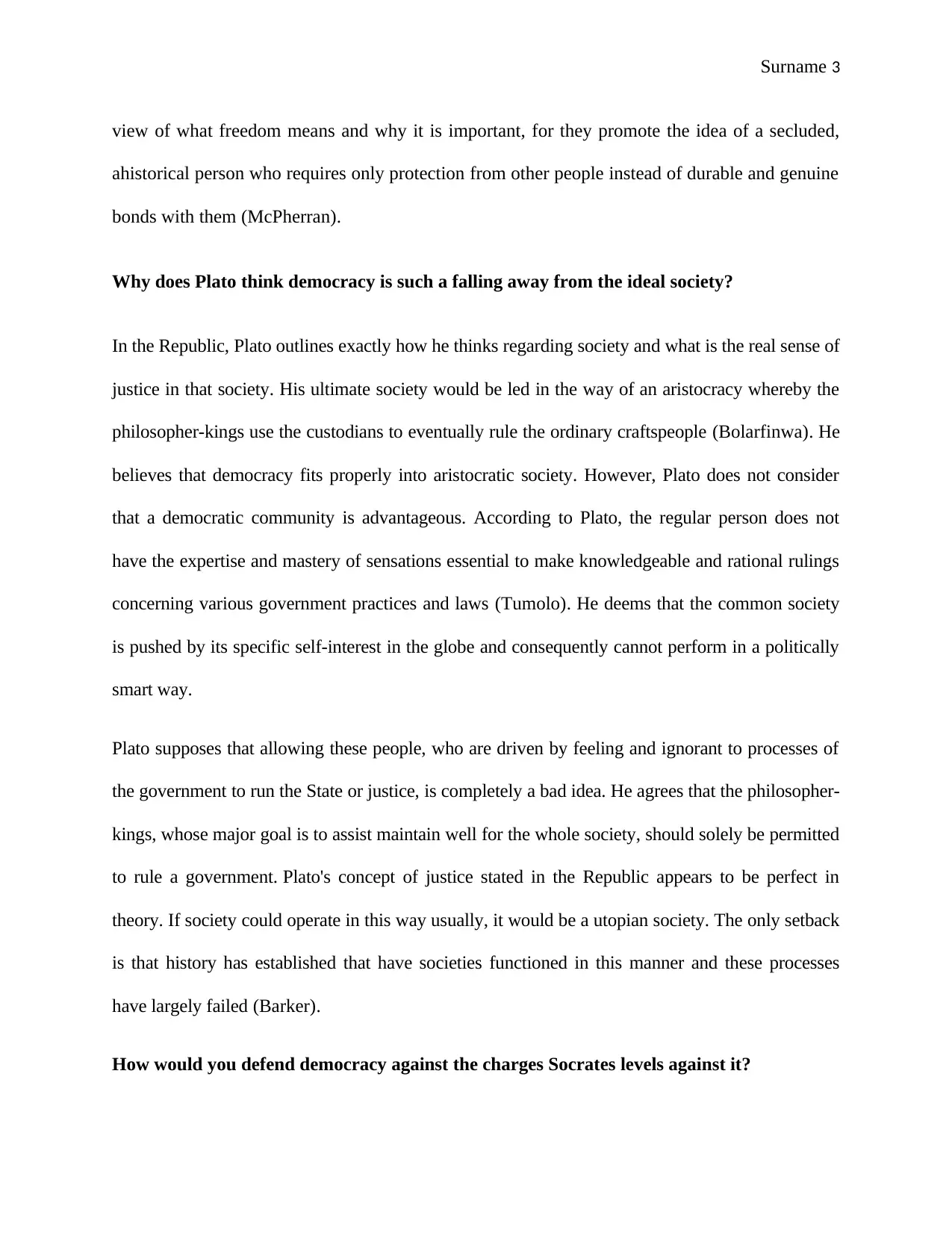
view of what freedom means and why it is important, for they promote the idea of a secluded,
ahistorical person who requires only protection from other people instead of durable and genuine
bonds with them (McPherran).
Why does Plato think democracy is such a falling away from the ideal society?
In the Republic, Plato outlines exactly how he thinks regarding society and what is the real sense of
justice in that society. His ultimate society would be led in the way of an aristocracy whereby the
philosopher-kings use the custodians to eventually rule the ordinary craftspeople (Bolarfinwa). He
believes that democracy fits properly into aristocratic society. However, Plato does not consider
that a democratic community is advantageous. According to Plato, the regular person does not
have the expertise and mastery of sensations essential to make knowledgeable and rational rulings
concerning various government practices and laws (Tumolo). He deems that the common society
is pushed by its specific self-interest in the globe and consequently cannot perform in a politically
smart way.
Plato supposes that allowing these people, who are driven by feeling and ignorant to processes of
the government to run the State or justice, is completely a bad idea. He agrees that the philosopher-
kings, whose major goal is to assist maintain well for the whole society, should solely be permitted
to rule a government. Plato's concept of justice stated in the Republic appears to be perfect in
theory. If society could operate in this way usually, it would be a utopian society. The only setback
is that history has established that have societies functioned in this manner and these processes
have largely failed (Barker).
How would you defend democracy against the charges Socrates levels against it?
view of what freedom means and why it is important, for they promote the idea of a secluded,
ahistorical person who requires only protection from other people instead of durable and genuine
bonds with them (McPherran).
Why does Plato think democracy is such a falling away from the ideal society?
In the Republic, Plato outlines exactly how he thinks regarding society and what is the real sense of
justice in that society. His ultimate society would be led in the way of an aristocracy whereby the
philosopher-kings use the custodians to eventually rule the ordinary craftspeople (Bolarfinwa). He
believes that democracy fits properly into aristocratic society. However, Plato does not consider
that a democratic community is advantageous. According to Plato, the regular person does not
have the expertise and mastery of sensations essential to make knowledgeable and rational rulings
concerning various government practices and laws (Tumolo). He deems that the common society
is pushed by its specific self-interest in the globe and consequently cannot perform in a politically
smart way.
Plato supposes that allowing these people, who are driven by feeling and ignorant to processes of
the government to run the State or justice, is completely a bad idea. He agrees that the philosopher-
kings, whose major goal is to assist maintain well for the whole society, should solely be permitted
to rule a government. Plato's concept of justice stated in the Republic appears to be perfect in
theory. If society could operate in this way usually, it would be a utopian society. The only setback
is that history has established that have societies functioned in this manner and these processes
have largely failed (Barker).
How would you defend democracy against the charges Socrates levels against it?
⊘ This is a preview!⊘
Do you want full access?
Subscribe today to unlock all pages.

Trusted by 1+ million students worldwide

Surname 4
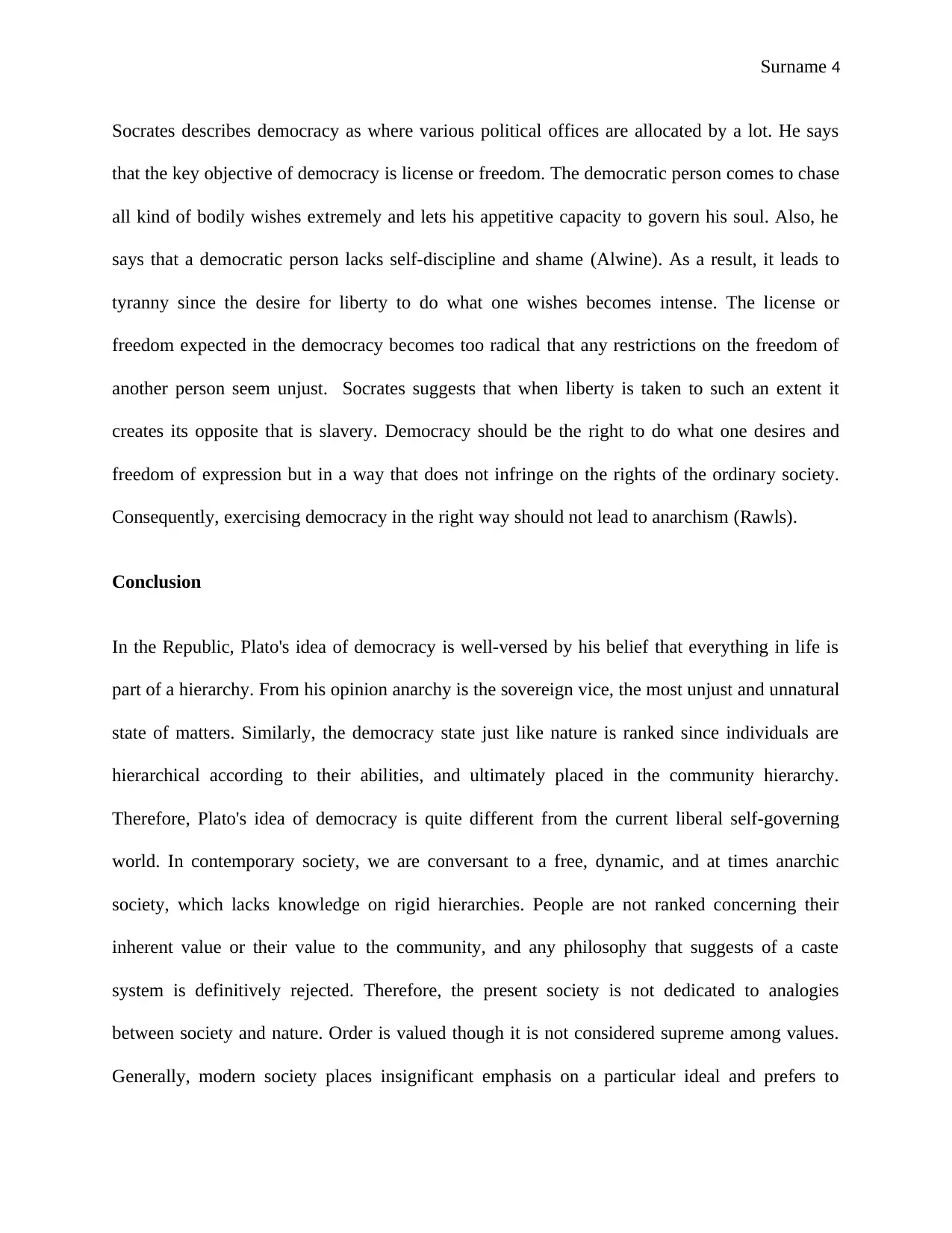
Socrates describes democracy as where various political offices are allocated by a lot. He says
that the key objective of democracy is license or freedom. The democratic person comes to chase
all kind of bodily wishes extremely and lets his appetitive capacity to govern his soul. Also, he
says that a democratic person lacks self-discipline and shame (Alwine). As a result, it leads to
tyranny since the desire for liberty to do what one wishes becomes intense. The license or
freedom expected in the democracy becomes too radical that any restrictions on the freedom of
another person seem unjust. Socrates suggests that when liberty is taken to such an extent it
creates its opposite that is slavery. Democracy should be the right to do what one desires and
freedom of expression but in a way that does not infringe on the rights of the ordinary society.
Consequently, exercising democracy in the right way should not lead to anarchism (Rawls).
Conclusion
In the Republic, Plato's idea of democracy is well-versed by his belief that everything in life is
part of a hierarchy. From his opinion anarchy is the sovereign vice, the most unjust and unnatural
state of matters. Similarly, the democracy state just like nature is ranked since individuals are
hierarchical according to their abilities, and ultimately placed in the community hierarchy.
Therefore, Plato's idea of democracy is quite different from the current liberal self-governing
world. In contemporary society, we are conversant to a free, dynamic, and at times anarchic
society, which lacks knowledge on rigid hierarchies. People are not ranked concerning their
inherent value or their value to the community, and any philosophy that suggests of a caste
system is definitively rejected. Therefore, the present society is not dedicated to analogies
between society and nature. Order is valued though it is not considered supreme among values.
Generally, modern society places insignificant emphasis on a particular ideal and prefers to
Socrates describes democracy as where various political offices are allocated by a lot. He says
that the key objective of democracy is license or freedom. The democratic person comes to chase
all kind of bodily wishes extremely and lets his appetitive capacity to govern his soul. Also, he
says that a democratic person lacks self-discipline and shame (Alwine). As a result, it leads to
tyranny since the desire for liberty to do what one wishes becomes intense. The license or
freedom expected in the democracy becomes too radical that any restrictions on the freedom of
another person seem unjust. Socrates suggests that when liberty is taken to such an extent it
creates its opposite that is slavery. Democracy should be the right to do what one desires and
freedom of expression but in a way that does not infringe on the rights of the ordinary society.
Consequently, exercising democracy in the right way should not lead to anarchism (Rawls).
Conclusion
In the Republic, Plato's idea of democracy is well-versed by his belief that everything in life is
part of a hierarchy. From his opinion anarchy is the sovereign vice, the most unjust and unnatural
state of matters. Similarly, the democracy state just like nature is ranked since individuals are
hierarchical according to their abilities, and ultimately placed in the community hierarchy.
Therefore, Plato's idea of democracy is quite different from the current liberal self-governing
world. In contemporary society, we are conversant to a free, dynamic, and at times anarchic
society, which lacks knowledge on rigid hierarchies. People are not ranked concerning their
inherent value or their value to the community, and any philosophy that suggests of a caste
system is definitively rejected. Therefore, the present society is not dedicated to analogies
between society and nature. Order is valued though it is not considered supreme among values.
Generally, modern society places insignificant emphasis on a particular ideal and prefers to
Paraphrase This Document
Need a fresh take? Get an instant paraphrase of this document with our AI Paraphraser

Surname 5
condemn forms of behavior which hampers with other people's quest for happiness. However,
Plato would think that the present ideal state in our society is decadent, unjust and anarchical.
condemn forms of behavior which hampers with other people's quest for happiness. However,
Plato would think that the present ideal state in our society is decadent, unjust and anarchical.

Surname 6
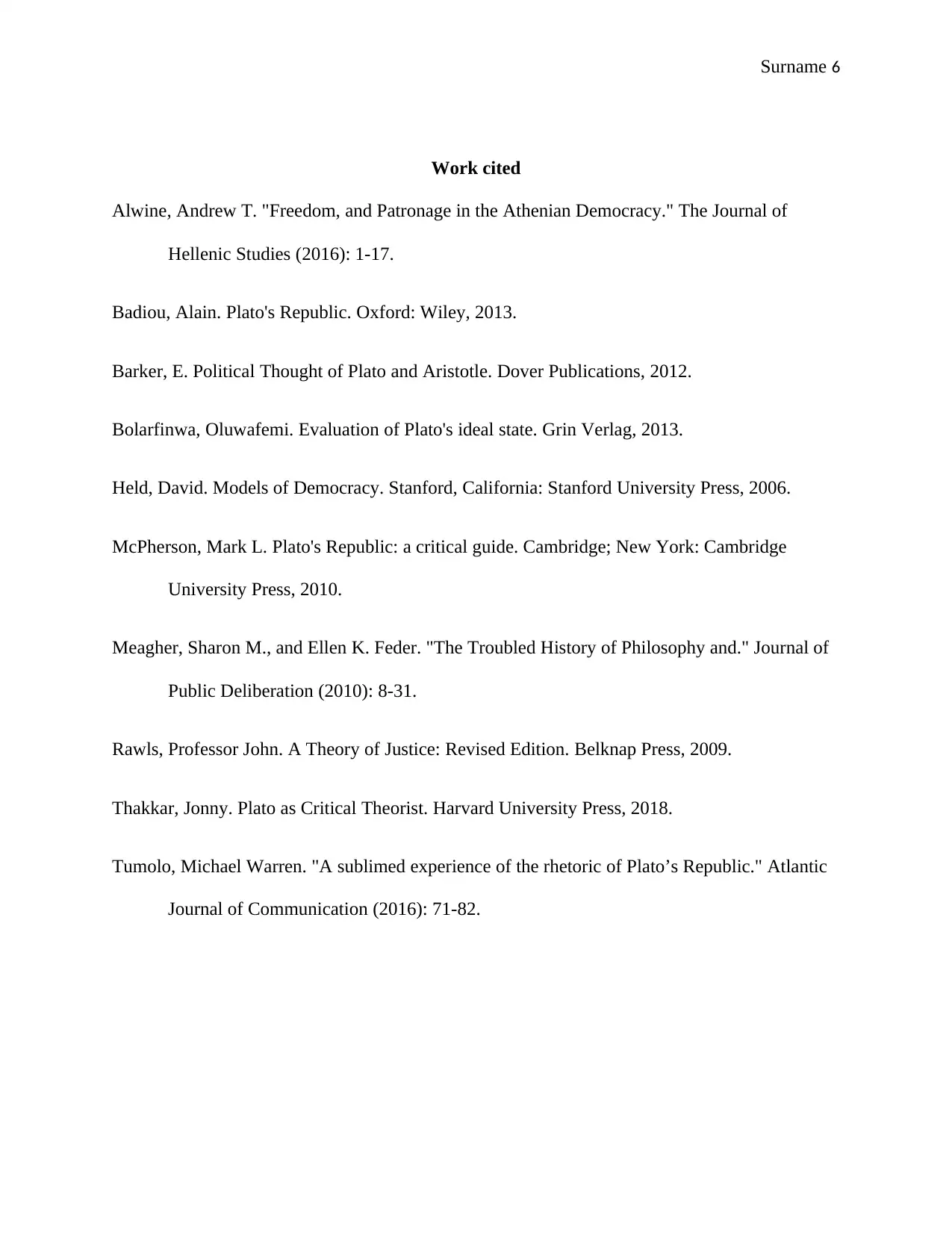
Work cited
Alwine, Andrew T. "Freedom, and Patronage in the Athenian Democracy." The Journal of
Hellenic Studies (2016): 1-17.
Badiou, Alain. Plato's Republic. Oxford: Wiley, 2013.
Barker, E. Political Thought of Plato and Aristotle. Dover Publications, 2012.
Bolarfinwa, Oluwafemi. Evaluation of Plato's ideal state. Grin Verlag, 2013.
Held, David. Models of Democracy. Stanford, California: Stanford University Press, 2006.
McPherson, Mark L. Plato's Republic: a critical guide. Cambridge; New York: Cambridge
University Press, 2010.
Meagher, Sharon M., and Ellen K. Feder. "The Troubled History of Philosophy and." Journal of
Public Deliberation (2010): 8-31.
Rawls, Professor John. A Theory of Justice: Revised Edition. Belknap Press, 2009.
Thakkar, Jonny. Plato as Critical Theorist. Harvard University Press, 2018.
Tumolo, Michael Warren. "A sublimed experience of the rhetoric of Plato’s Republic." Atlantic
Journal of Communication (2016): 71-82.
Work cited
Alwine, Andrew T. "Freedom, and Patronage in the Athenian Democracy." The Journal of
Hellenic Studies (2016): 1-17.
Badiou, Alain. Plato's Republic. Oxford: Wiley, 2013.
Barker, E. Political Thought of Plato and Aristotle. Dover Publications, 2012.
Bolarfinwa, Oluwafemi. Evaluation of Plato's ideal state. Grin Verlag, 2013.
Held, David. Models of Democracy. Stanford, California: Stanford University Press, 2006.
McPherson, Mark L. Plato's Republic: a critical guide. Cambridge; New York: Cambridge
University Press, 2010.
Meagher, Sharon M., and Ellen K. Feder. "The Troubled History of Philosophy and." Journal of
Public Deliberation (2010): 8-31.
Rawls, Professor John. A Theory of Justice: Revised Edition. Belknap Press, 2009.
Thakkar, Jonny. Plato as Critical Theorist. Harvard University Press, 2018.
Tumolo, Michael Warren. "A sublimed experience of the rhetoric of Plato’s Republic." Atlantic
Journal of Communication (2016): 71-82.
⊘ This is a preview!⊘
Do you want full access?
Subscribe today to unlock all pages.

Trusted by 1+ million students worldwide
1 out of 6
Related Documents
Your All-in-One AI-Powered Toolkit for Academic Success.
+13062052269
info@desklib.com
Available 24*7 on WhatsApp / Email
Unlock your academic potential
Copyright © 2020–2025 A2Z Services. All Rights Reserved. Developed and managed by ZUCOL.