CHCECE006-CHCECE013: Exploring Play & Development Knowledge Q&A
VerifiedAdded on 2023/06/16
|22
|5382
|105
Homework Assignment
AI Summary
This document presents a solved assignment addressing knowledge questions related to play and development within the context of early childhood education, specifically covering CHCECE006, CHCECE007, CHCECE010, CHCECE011, and CHCECE013. The assignment delves into the importance of nutrition for brain development, the role of educators in stimulating early brain development by discussing children's interests and observing their development, and the use of routines to foster independence. It also covers providing play and learning experiences across various developmental domains such as physical, emotional/psychological, language, creative, and cognitive development, including practical examples of activities and equipment. Furthermore, the assignment explores cultural activities that encourage the use of home languages and family contributions, and summarizes relevant child development theories, such as Arnold Gesell's theory of physical development.

CHCECE006 CHCECE007 CHCECE010 CHCECE011 CHCECE013 RTO No: 21595
| CRICOS Code: 02634E
Topic 1 Knowledge Questions Version 2Page 0 of 23
©copyright Academia International Approved
by: B.Wade
Play and Developmment
CHCECE006 CHCECE007
CHCECE010 CHCECE 011
CHCECE013
| CRICOS Code: 02634E
Topic 1 Knowledge Questions Version 2Page 0 of 23
©copyright Academia International Approved
by: B.Wade
Play and Developmment
CHCECE006 CHCECE007
CHCECE010 CHCECE 011
CHCECE013

Paraphrase This Document
Need a fresh take? Get an instant paraphrase of this document with our AI Paraphraser

CHCECE006 CHCECE007 CHCECE010 CHCECE011 CHCECE013 RTO No: 21595 | CRICOS
Code: 02634E
Coversheet
Name:
Student ID:
Email Address:
Class:
Unit name:
Unit Code:
name:
Student Declaration
I declare that –
a. The evidence I have submitted for assessment is my own work, and
b. The evidence I have submitted for assessment has not been shared with other
students, and I have taken all reasonable precautions to ensure that my work cannot
be accessed by other students that may seek to submit my work as their own, and
c. All of the sources of information used to prepare my work have been, or may be
accurately cited, and
d. I retain a copy of all my original for my own records, or for resubmission if required by
Academia Australia, and
e. I have read and understood Academia Australia’s policy regarding plagiarism, and I
accept the right of Academia Australia to investigate suspected plagiarism, and to act
in accordance with the policy and procedure I have read.
Student Signature: __________________________________________
Date of Submission: ___ / /20
Topic 1 Knowledge Questions Version 2Page 1 of 23
Code: 02634E
Coversheet
Name:
Student ID:
Email Address:
Class:
Unit name:
Unit Code:
name:
Student Declaration
I declare that –
a. The evidence I have submitted for assessment is my own work, and
b. The evidence I have submitted for assessment has not been shared with other
students, and I have taken all reasonable precautions to ensure that my work cannot
be accessed by other students that may seek to submit my work as their own, and
c. All of the sources of information used to prepare my work have been, or may be
accurately cited, and
d. I retain a copy of all my original for my own records, or for resubmission if required by
Academia Australia, and
e. I have read and understood Academia Australia’s policy regarding plagiarism, and I
accept the right of Academia Australia to investigate suspected plagiarism, and to act
in accordance with the policy and procedure I have read.
Student Signature: __________________________________________
Date of Submission: ___ / /20
Topic 1 Knowledge Questions Version 2Page 1 of 23

CHCECE006 CHCECE007 CHCECE010 CHCECE011 CHCECE013 RTO No: 21595 | CRICOS
Code: 02634E
ASSESSMENT INFORMATION
● You must achieve a satisfactory outcome for each of the required criteria of this
assessment to be deemed satisfactory for this assessment. You must achieve a
satisfactory result for the assessments for this unit of competency to achieve a
competent result for the unit. If one or more of the assessment results are not
satisfactory, you will be Not Yet Competent for this unit.
● You may follow the Assessment Appeals process in the Student Handbook
(www.academia21.com) if you are not satisfied with:
o the assessment result; or
o the way an assessment was carried out by your trainer; or
o the conditions or structure of the assessment
The student handbook has the steps for reassessment if you receive a Not Yet
Competent mark and do not want to appeal.
Reasonable adjustment for assessment
Where students have highlighted Language, Literacy and Numeracy issues reasonable
adjustment to the assessment can be made. Should you receive a ‘Not Yet Competent’ or
‘Resubmit’ result for the assessment you will be given the opportunity to re-submit your
assessment work with any amendments requested by your trainer.
The adjustment may include actions such as:
• Student demonstrating knowledge through verbal discussion to identify correct
answers
• Student demonstrating knowledge through applied skills
• Allowing additional time relating to disability
• Through consultation amending assessment timeframes
• Assistance in the form of the training location to allow easier access
• Accessing relevant equipment or aids to assist the student
• Adjustments to the assessment methods to cater for any special needs (without
effecting the integrity of the outcome)
If a student requests or is identified as requiring reasonable adjustment to the training
and assessment process a detailed training and assessment plan including timetables, notes
regarding the required adjustments, and any related communications regarding the
adjustments must be maintained in the students file.
The RTO Manager must review and authorise any request for ‘reasonable adjustment’ to
ensure that any adjustments and resulting outcomes are not affecting the integrity of the
training and assessment process.
Location of and completion timeframes for assessment
The location of the assessment will depend upon the nature of the assessment. Direct
observation of student’s skills will be assessed in the practical commercial kitchens at
Academia, the timeframes for these assessments will be related to the scheduled times of
the practical classes. Other assessments such as; role plays, in class activities,
presentations and written tests will be conducting in the classroom. The timeframes and due
dates for these assessments, as well as any reports, projects or research s, are documented
in the stage outlines. Stage outlines are handed out at the beginning of each term.
Topic 1 Knowledge Questions Version 2Page 2 of 23
Code: 02634E
ASSESSMENT INFORMATION
● You must achieve a satisfactory outcome for each of the required criteria of this
assessment to be deemed satisfactory for this assessment. You must achieve a
satisfactory result for the assessments for this unit of competency to achieve a
competent result for the unit. If one or more of the assessment results are not
satisfactory, you will be Not Yet Competent for this unit.
● You may follow the Assessment Appeals process in the Student Handbook
(www.academia21.com) if you are not satisfied with:
o the assessment result; or
o the way an assessment was carried out by your trainer; or
o the conditions or structure of the assessment
The student handbook has the steps for reassessment if you receive a Not Yet
Competent mark and do not want to appeal.
Reasonable adjustment for assessment
Where students have highlighted Language, Literacy and Numeracy issues reasonable
adjustment to the assessment can be made. Should you receive a ‘Not Yet Competent’ or
‘Resubmit’ result for the assessment you will be given the opportunity to re-submit your
assessment work with any amendments requested by your trainer.
The adjustment may include actions such as:
• Student demonstrating knowledge through verbal discussion to identify correct
answers
• Student demonstrating knowledge through applied skills
• Allowing additional time relating to disability
• Through consultation amending assessment timeframes
• Assistance in the form of the training location to allow easier access
• Accessing relevant equipment or aids to assist the student
• Adjustments to the assessment methods to cater for any special needs (without
effecting the integrity of the outcome)
If a student requests or is identified as requiring reasonable adjustment to the training
and assessment process a detailed training and assessment plan including timetables, notes
regarding the required adjustments, and any related communications regarding the
adjustments must be maintained in the students file.
The RTO Manager must review and authorise any request for ‘reasonable adjustment’ to
ensure that any adjustments and resulting outcomes are not affecting the integrity of the
training and assessment process.
Location of and completion timeframes for assessment
The location of the assessment will depend upon the nature of the assessment. Direct
observation of student’s skills will be assessed in the practical commercial kitchens at
Academia, the timeframes for these assessments will be related to the scheduled times of
the practical classes. Other assessments such as; role plays, in class activities,
presentations and written tests will be conducting in the classroom. The timeframes and due
dates for these assessments, as well as any reports, projects or research s, are documented
in the stage outlines. Stage outlines are handed out at the beginning of each term.
Topic 1 Knowledge Questions Version 2Page 2 of 23
⊘ This is a preview!⊘
Do you want full access?
Subscribe today to unlock all pages.

Trusted by 1+ million students worldwide

CHCECE006 CHCECE007 CHCECE010 CHCECE011 CHCECE013 RTO No: 21595 | CRICOS
Code: 02634E
KNOWLEDGE ASSESSMENT
A. Holistic Development
1. Nutrition is extremely important in relation to a child’s brain development.
a) Explain how adequate nutrition before a child’s birth is important.
b) Explain how adequate nutrition after a child’s birth is important.
a) Adequate maternal nutrition is essential for fetal growth. Maternal nutritional status
during pregnancy is more essential in determining fetal health since it provides
nutrients that assist brain development. Because it serves as the foundation for the
development of physical, socio-emotional, and cognitive skills throughout infancy and
adulthood. The fetus will struggle to grow if it does not receive adequate nutrients
from the mother.
b) Adequate nutrition is an important aspect in normal brain development. Improper
nutrition can have an impact on brain development by either directly impacting brain
functions or indirectly influencing children's experiences and behaviour. First, poor
food availability during gestation and infancy has an impact on the anatomical and
functional development of the brain. Many of the biological mechanisms that promote
this transition require nutrients. Proper nutrition is critical for brain growth.
2. As an Early Childhood educator, it is essential that you support the brain
development of all children in your care.
a) Explain in 4-5 sentences, the importance of discussing children’s interests
with them, to stimulate early brain development.
Guidance: Refer to the National Quality Standards and the relevant
approved learning framework to support your answer.
a) As a childhood educator, we are responsible for helping children develop their cognitive,
social, and emotional abilities by providing favourable, safe, stimulating, and responsive
human interactions. Engaging in a discussion, communicating with the children, and
discussing their best interests will boost early brain development by allowing them to
make choices and decisions for their own benefit while learning something from it.
Discussing it with them will make them feel safe and comfortable in the knowledge that
someone cares about them.
Topic 1 Knowledge Questions Version 2Page 3 of 23
Code: 02634E
KNOWLEDGE ASSESSMENT
A. Holistic Development
1. Nutrition is extremely important in relation to a child’s brain development.
a) Explain how adequate nutrition before a child’s birth is important.
b) Explain how adequate nutrition after a child’s birth is important.
a) Adequate maternal nutrition is essential for fetal growth. Maternal nutritional status
during pregnancy is more essential in determining fetal health since it provides
nutrients that assist brain development. Because it serves as the foundation for the
development of physical, socio-emotional, and cognitive skills throughout infancy and
adulthood. The fetus will struggle to grow if it does not receive adequate nutrients
from the mother.
b) Adequate nutrition is an important aspect in normal brain development. Improper
nutrition can have an impact on brain development by either directly impacting brain
functions or indirectly influencing children's experiences and behaviour. First, poor
food availability during gestation and infancy has an impact on the anatomical and
functional development of the brain. Many of the biological mechanisms that promote
this transition require nutrients. Proper nutrition is critical for brain growth.
2. As an Early Childhood educator, it is essential that you support the brain
development of all children in your care.
a) Explain in 4-5 sentences, the importance of discussing children’s interests
with them, to stimulate early brain development.
Guidance: Refer to the National Quality Standards and the relevant
approved learning framework to support your answer.
a) As a childhood educator, we are responsible for helping children develop their cognitive,
social, and emotional abilities by providing favourable, safe, stimulating, and responsive
human interactions. Engaging in a discussion, communicating with the children, and
discussing their best interests will boost early brain development by allowing them to
make choices and decisions for their own benefit while learning something from it.
Discussing it with them will make them feel safe and comfortable in the knowledge that
someone cares about them.
Topic 1 Knowledge Questions Version 2Page 3 of 23
Paraphrase This Document
Need a fresh take? Get an instant paraphrase of this document with our AI Paraphraser

CHCECE006 CHCECE007 CHCECE010 CHCECE011 CHCECE013 RTO No: 21595 | CRICOS
Code: 02634E
b) Explain in 4-5 sentences, the importance of using your observations of
children to support their development.
Guidance: Refer to the National Quality Standards and the relevant
approved learning framework
b) Observing the children may assist you grasp their strengths, capacities, and flaws.
Observation allows us to follow their growth every day and may give us the impression
that a child is suffering in one of the developmental areas. Later, we can think about this
information and see how it might help us enhance the classroom to better suit their
needs.
c) Explain in 4-5 sentences, the importance of using routines as opportunities
to foster children’s independence.
Guidance: Make sure you refer to the National Quality Framework in your
answer
c) Program learning opportunities, such as their daily routine, will allow a kid to learn and
improve their feeling of control, satisfaction, positive behaviour, and social skills. Children
learn what to expect at different times of the day as they begin to engage in these
routines. Routines can promote a child's independence by enabling them to make
decisions on their own, such as taking a bath, brushing their teeth, and putting on clothing
they choose when they wake up in the morning.
d) In 4-5 sentences, explain the importance of encouraging children to
explore the environment and biological resources, to positively influence
learning and development.
Guidance: Make sure you refer to the National Quality Framework in your
answer.
d) In the centre, catering to all children's interests and abilities and offering an environment
of opportunity, encouraging children to explore will improve physical activity, cognitive
development, social skills, gross/fine motor coordination, and gross/fine motor
coordination. Through physical activity, children will acquire confidence in themselves
and discover satisfaction. They will have more flexibility to explore their surroundings and
the people around them if they engage with the environment. This will also be an
opportunity for us to learn about their hobbies and inventiveness, as well as to begin
studying their behaviour.
Topic 1 Knowledge Questions Version 2Page 4 of 23
Code: 02634E
b) Explain in 4-5 sentences, the importance of using your observations of
children to support their development.
Guidance: Refer to the National Quality Standards and the relevant
approved learning framework
b) Observing the children may assist you grasp their strengths, capacities, and flaws.
Observation allows us to follow their growth every day and may give us the impression
that a child is suffering in one of the developmental areas. Later, we can think about this
information and see how it might help us enhance the classroom to better suit their
needs.
c) Explain in 4-5 sentences, the importance of using routines as opportunities
to foster children’s independence.
Guidance: Make sure you refer to the National Quality Framework in your
answer
c) Program learning opportunities, such as their daily routine, will allow a kid to learn and
improve their feeling of control, satisfaction, positive behaviour, and social skills. Children
learn what to expect at different times of the day as they begin to engage in these
routines. Routines can promote a child's independence by enabling them to make
decisions on their own, such as taking a bath, brushing their teeth, and putting on clothing
they choose when they wake up in the morning.
d) In 4-5 sentences, explain the importance of encouraging children to
explore the environment and biological resources, to positively influence
learning and development.
Guidance: Make sure you refer to the National Quality Framework in your
answer.
d) In the centre, catering to all children's interests and abilities and offering an environment
of opportunity, encouraging children to explore will improve physical activity, cognitive
development, social skills, gross/fine motor coordination, and gross/fine motor
coordination. Through physical activity, children will acquire confidence in themselves
and discover satisfaction. They will have more flexibility to explore their surroundings and
the people around them if they engage with the environment. This will also be an
opportunity for us to learn about their hobbies and inventiveness, as well as to begin
studying their behaviour.
Topic 1 Knowledge Questions Version 2Page 4 of 23
CHCECE006 CHCECE007 CHCECE010 CHCECE011 CHCECE013 RTO No: 21595 | CRICOS
Code: 02634E
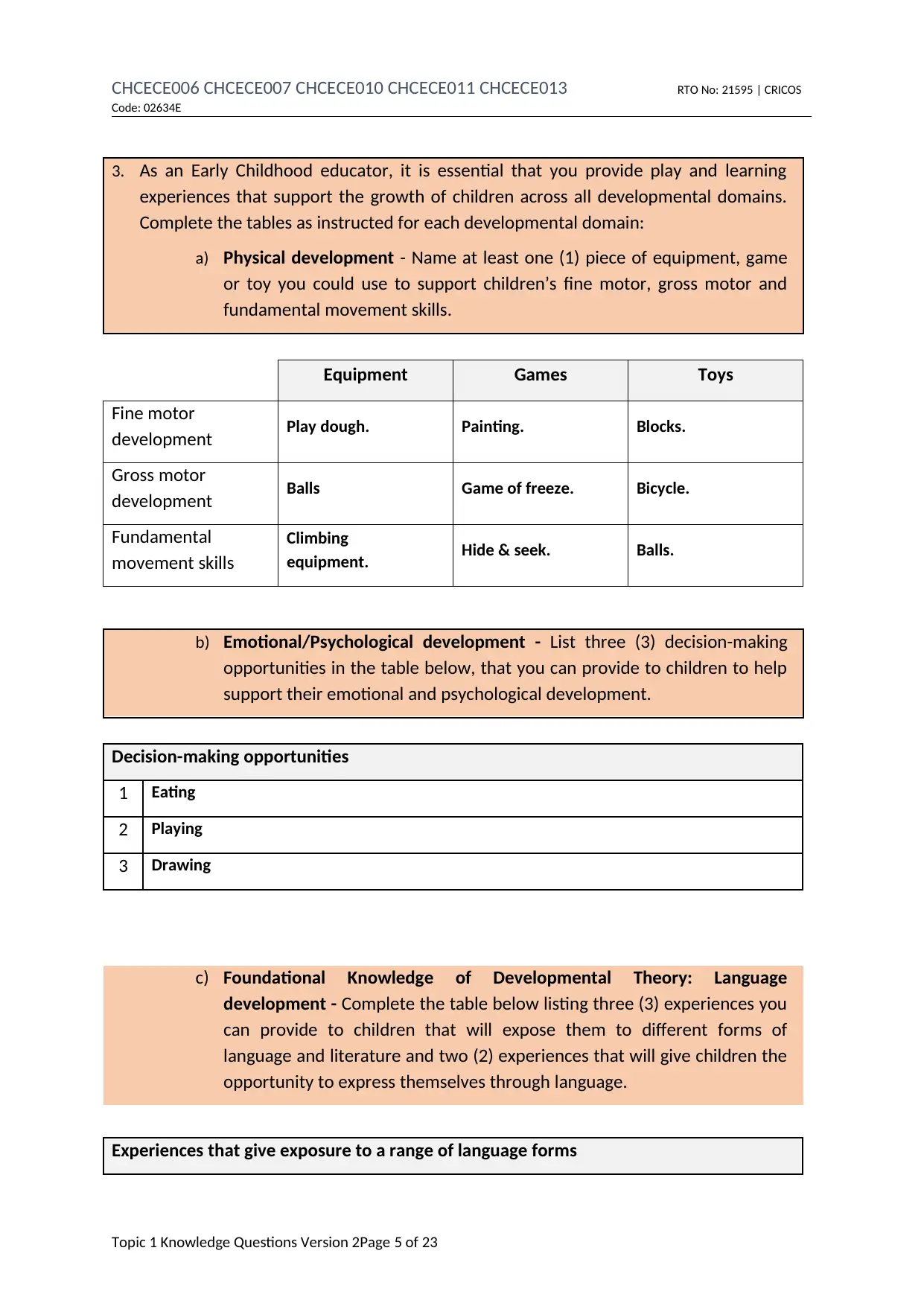
3. As an Early Childhood educator, it is essential that you provide play and learning
experiences that support the growth of children across all developmental domains.
Complete the tables as instructed for each developmental domain:
a) Physical development - Name at least one (1) piece of equipment, game
or toy you could use to support children’s fine motor, gross motor and
fundamental movement skills.
Equipment Games Toys
Fine motor
development Play dough. Painting. Blocks.
Gross motor
development Balls Game of freeze. Bicycle.
Fundamental
movement skills
Climbing
equipment. Hide & seek. Balls.
b) Emotional/Psychological development - List three (3) decision-making
opportunities in the table below, that you can provide to children to help
support their emotional and psychological development.
Decision-making opportunities
1 Eating
2 Playing
3 Drawing
c) Foundational Knowledge of Developmental Theory: Language
development - Complete the table below listing three (3) experiences you
can provide to children that will expose them to different forms of
language and literature and two (2) experiences that will give children the
opportunity to express themselves through language.
Experiences that give exposure to a range of language forms
Topic 1 Knowledge Questions Version 2Page 5 of 23
Code: 02634E
3. As an Early Childhood educator, it is essential that you provide play and learning
experiences that support the growth of children across all developmental domains.
Complete the tables as instructed for each developmental domain:
a) Physical development - Name at least one (1) piece of equipment, game
or toy you could use to support children’s fine motor, gross motor and
fundamental movement skills.
Equipment Games Toys
Fine motor
development Play dough. Painting. Blocks.
Gross motor
development Balls Game of freeze. Bicycle.
Fundamental
movement skills
Climbing
equipment. Hide & seek. Balls.
b) Emotional/Psychological development - List three (3) decision-making
opportunities in the table below, that you can provide to children to help
support their emotional and psychological development.
Decision-making opportunities
1 Eating
2 Playing
3 Drawing
c) Foundational Knowledge of Developmental Theory: Language
development - Complete the table below listing three (3) experiences you
can provide to children that will expose them to different forms of
language and literature and two (2) experiences that will give children the
opportunity to express themselves through language.
Experiences that give exposure to a range of language forms
Topic 1 Knowledge Questions Version 2Page 5 of 23
⊘ This is a preview!⊘
Do you want full access?
Subscribe today to unlock all pages.
Trusted by 1+ million students worldwide

CHCECE006 CHCECE007 CHCECE010 CHCECE011 CHCECE013 RTO No: 21595 | CRICOS
Code: 02634E
1 Stories
2 Songs
3 Poems
Expressive language experiences
1 Talking
2 Conversation
d) Creative development – Fill out the table below, by indicating at least one
(1) experience you could provide for children to use each of their senses
and to express themselves to support their creative development.
Experience
Visual Drawing
Hearing Playing Music
Taste Cooking / Making Foods
Touch Playing Dough
Smell Scented Playdough
Self-expression Mind Mapping / Art Writing
e) Cognitive development - Write at least one (1) problem-solving experience
you can provide to support the cognitive development of children in each
of the following age groups: 0-2 years, 3-5 years and 6-12 years.
Experience
Problem-solving
(0-2yrs) Matching Games
Problem-solving Colouring Activity
Topic 1 Knowledge Questions Version 2Page 6 of 23
Code: 02634E
1 Stories
2 Songs
3 Poems
Expressive language experiences
1 Talking
2 Conversation
d) Creative development – Fill out the table below, by indicating at least one
(1) experience you could provide for children to use each of their senses
and to express themselves to support their creative development.
Experience
Visual Drawing
Hearing Playing Music
Taste Cooking / Making Foods
Touch Playing Dough
Smell Scented Playdough
Self-expression Mind Mapping / Art Writing
e) Cognitive development - Write at least one (1) problem-solving experience
you can provide to support the cognitive development of children in each
of the following age groups: 0-2 years, 3-5 years and 6-12 years.
Experience
Problem-solving
(0-2yrs) Matching Games
Problem-solving Colouring Activity
Topic 1 Knowledge Questions Version 2Page 6 of 23
Paraphrase This Document
Need a fresh take? Get an instant paraphrase of this document with our AI Paraphraser

CHCECE006 CHCECE007 CHCECE010 CHCECE011 CHCECE013 RTO No: 21595 | CRICOS
Code: 02634E
(3-5yrs)
Problem-solving
(6-12yrs) Quizzes
4. Consider a cultural activity that encourages the use of home languages and family
contributions that can be done within the centre. Write a paragraph of 5-7
sentences, discussing the following points:
Ensure you cover the following points for your chosen activity:
▪ Briefly describe or name your chosen activity.
▪ How does your activity value and encourage the use and acquisition of home
languages?
▪ Which age group you have planned the activity for?
▪ What focus should the introduction and implementation of the activity have?
▪ What could you do to involve the children in group discussions?
▪ What could you do to encourage contribution from the children’s family?
▪ How does encouraging family’s diverse contribution to learning activities benefit
children?
Dramatic play theme. Allow the children to demonstrate or play out various daily activities
before heading to school in a way that all of the children can connect to. This is possible for
children aged 5 and up. Consider how their parents communicate with them in their daily lives.
Allow them to contribute if they have a similar routine with the other children and invite them
to share if they have anything to add to the other children's presentations.
5. Fill out the table below giving the name of a relevant theorist and a summary of the
relevant theory of child development.
Developmental
Theory Theorist Summary of Theory
Physical
Development
Arnold Gesell Physical development is a
process that begins in infancy
Topic 1 Knowledge Questions Version 2Page 7 of 23
Code: 02634E
(3-5yrs)
Problem-solving
(6-12yrs) Quizzes
4. Consider a cultural activity that encourages the use of home languages and family
contributions that can be done within the centre. Write a paragraph of 5-7
sentences, discussing the following points:
Ensure you cover the following points for your chosen activity:
▪ Briefly describe or name your chosen activity.
▪ How does your activity value and encourage the use and acquisition of home
languages?
▪ Which age group you have planned the activity for?
▪ What focus should the introduction and implementation of the activity have?
▪ What could you do to involve the children in group discussions?
▪ What could you do to encourage contribution from the children’s family?
▪ How does encouraging family’s diverse contribution to learning activities benefit
children?
Dramatic play theme. Allow the children to demonstrate or play out various daily activities
before heading to school in a way that all of the children can connect to. This is possible for
children aged 5 and up. Consider how their parents communicate with them in their daily lives.
Allow them to contribute if they have a similar routine with the other children and invite them
to share if they have anything to add to the other children's presentations.
5. Fill out the table below giving the name of a relevant theorist and a summary of the
relevant theory of child development.
Developmental
Theory Theorist Summary of Theory
Physical
Development
Arnold Gesell Physical development is a
process that begins in infancy
Topic 1 Knowledge Questions Version 2Page 7 of 23

CHCECE006 CHCECE007 CHCECE010 CHCECE011 CHCECE013 RTO No: 21595 | CRICOS
Code: 02634E
and continues until late
adolescence, focusing on gross
and fine motor abilities. Physical
development entails the growth
of the body, particularly the
muscles and physical
coordination. Physical
development is most often
practiced throughout
childhood.
Cognitive
Development Jean Piaget
The mental action or process of
gaining information via
experience and perception. He
argues that learning occurs in
four stages: sensorimotor (0-2),
pre-operational (2-6), concrete
(7-11), and formal operations
(11-12).
Emotional
/Psychological
Development
Erik Erikson
Babies and toddlers acquire
attachments to their primary
caregivers and begin to develop
trust and empathy.
Social Development Urie Bronfenbrenner
In this way, children begin to
learn excellent conduct,
particularly while interacting
with one another. This process
begins from birth and continues
throughout a person's life; it also
covers moral and spiritual
development in children.
Language
Development Lev Vygotsky
This is vital for children's growth
since it helps them to become
more knowledgeable and self-
assured.
6. In your own words, explain why creativity is important to child development.
It is a chance for them to express how deeply they grasp a given issue by expanding their
thoughts and ideas.
Topic 1 Knowledge Questions Version 2Page 8 of 23
Code: 02634E
and continues until late
adolescence, focusing on gross
and fine motor abilities. Physical
development entails the growth
of the body, particularly the
muscles and physical
coordination. Physical
development is most often
practiced throughout
childhood.
Cognitive
Development Jean Piaget
The mental action or process of
gaining information via
experience and perception. He
argues that learning occurs in
four stages: sensorimotor (0-2),
pre-operational (2-6), concrete
(7-11), and formal operations
(11-12).
Emotional
/Psychological
Development
Erik Erikson
Babies and toddlers acquire
attachments to their primary
caregivers and begin to develop
trust and empathy.
Social Development Urie Bronfenbrenner
In this way, children begin to
learn excellent conduct,
particularly while interacting
with one another. This process
begins from birth and continues
throughout a person's life; it also
covers moral and spiritual
development in children.
Language
Development Lev Vygotsky
This is vital for children's growth
since it helps them to become
more knowledgeable and self-
assured.
6. In your own words, explain why creativity is important to child development.
It is a chance for them to express how deeply they grasp a given issue by expanding their
thoughts and ideas.
Topic 1 Knowledge Questions Version 2Page 8 of 23
⊘ This is a preview!⊘
Do you want full access?
Subscribe today to unlock all pages.
Trusted by 1+ million students worldwide
CHCECE006 CHCECE007 CHCECE010 CHCECE011 CHCECE013 RTO No: 21595 | CRICOS
Code: 02634E
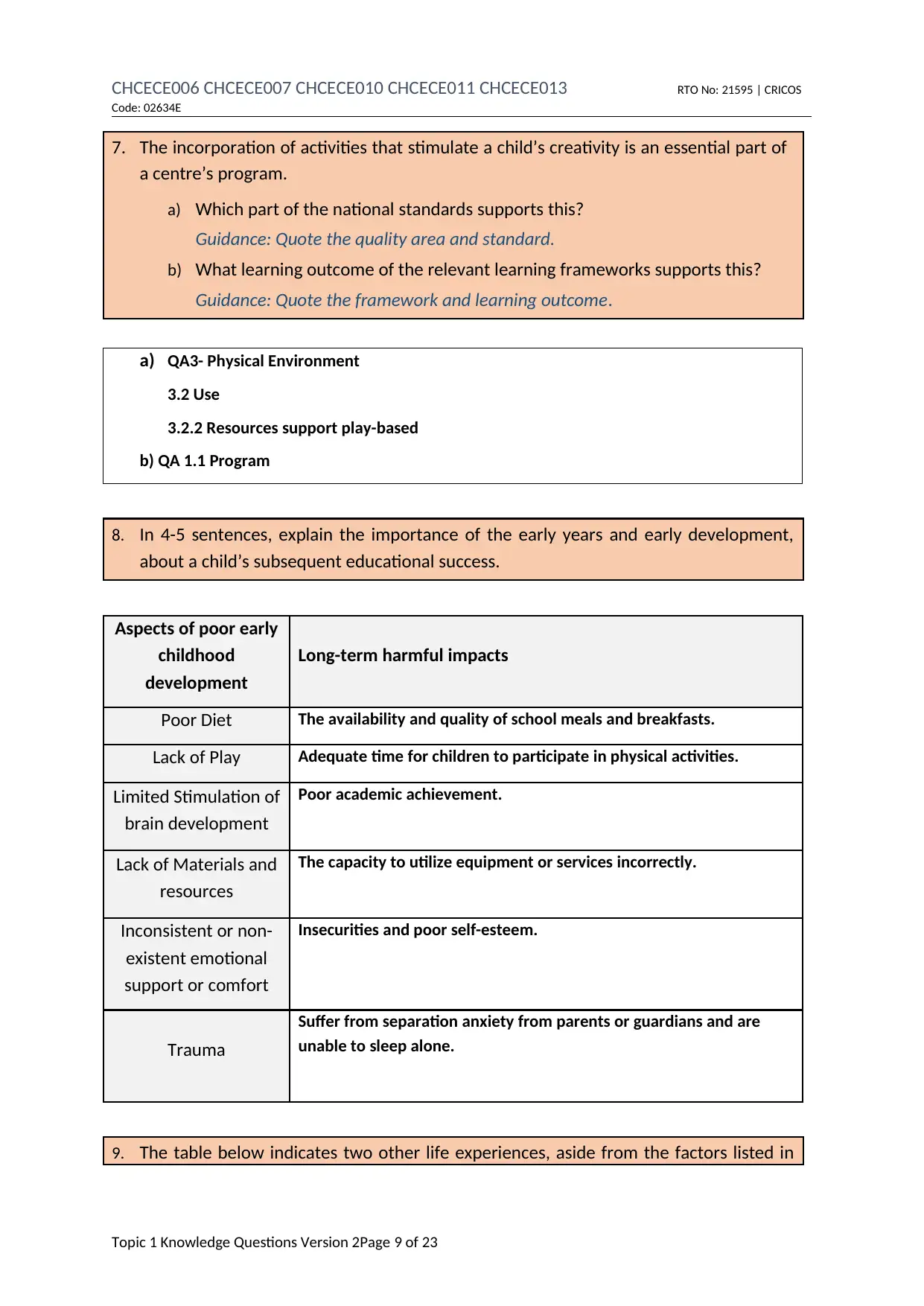
7. The incorporation of activities that stimulate a child’s creativity is an essential part of
a centre’s program.
a) Which part of the national standards supports this?
Guidance: Quote the quality area and standard.
b) What learning outcome of the relevant learning frameworks supports this?
Guidance: Quote the framework and learning outcome.
a) QA3- Physical Environment
3.2 Use
3.2.2 Resources support play-based
b) QA 1.1 Program
8. In 4-5 sentences, explain the importance of the early years and early development,
about a child’s subsequent educational success.
Aspects of poor early
childhood
development
Long-term harmful impacts
Poor Diet The availability and quality of school meals and breakfasts.
Lack of Play Adequate time for children to participate in physical activities.
Limited Stimulation of
brain development
Poor academic achievement.
Lack of Materials and
resources
The capacity to utilize equipment or services incorrectly.
Inconsistent or non-
existent emotional
support or comfort
Insecurities and poor self-esteem.
Trauma
Suffer from separation anxiety from parents or guardians and are
unable to sleep alone.
9. The table below indicates two other life experiences, aside from the factors listed in
Topic 1 Knowledge Questions Version 2Page 9 of 23
Code: 02634E
7. The incorporation of activities that stimulate a child’s creativity is an essential part of
a centre’s program.
a) Which part of the national standards supports this?
Guidance: Quote the quality area and standard.
b) What learning outcome of the relevant learning frameworks supports this?
Guidance: Quote the framework and learning outcome.
a) QA3- Physical Environment
3.2 Use
3.2.2 Resources support play-based
b) QA 1.1 Program
8. In 4-5 sentences, explain the importance of the early years and early development,
about a child’s subsequent educational success.
Aspects of poor early
childhood
development
Long-term harmful impacts
Poor Diet The availability and quality of school meals and breakfasts.
Lack of Play Adequate time for children to participate in physical activities.
Limited Stimulation of
brain development
Poor academic achievement.
Lack of Materials and
resources
The capacity to utilize equipment or services incorrectly.
Inconsistent or non-
existent emotional
support or comfort
Insecurities and poor self-esteem.
Trauma
Suffer from separation anxiety from parents or guardians and are
unable to sleep alone.
9. The table below indicates two other life experiences, aside from the factors listed in
Topic 1 Knowledge Questions Version 2Page 9 of 23
Paraphrase This Document
Need a fresh take? Get an instant paraphrase of this document with our AI Paraphraser

CHCECE006 CHCECE007 CHCECE010 CHCECE011 CHCECE013 RTO No: 21595 | CRICOS
Code: 02634E
the above table that may interrupt appropriate childhood activities.
Potential Long-term harmful impacts
Serious illness or
condition/hospitalisation
The difficulty in participating in any activity or restricted
activity, easily becoming weary, and scarcely developing
social/interaction development.
Loss of parent/family
through divorce/death or
displacement
The capacity to bully and become a loner.
B. Support Play and Learning
1. How would you use reflective practice in ‘providing experiences to support children’s
play and learning’?
Reflective practice is an approach used by educators to address the outcomes of the learning
process provided to children.
2. How does the United Nations Convention on the Rights of the Child relate to
‘Providing experiences to support children’s play and learning’?
Children have the right to play, relax, and participate in a variety of leisure activities. Children
should not be discouraged from playing since it is in their nature to do so.
Topic 1 Knowledge Questions Version 2Page 10 of 23
Code: 02634E
the above table that may interrupt appropriate childhood activities.
Potential Long-term harmful impacts
Serious illness or
condition/hospitalisation
The difficulty in participating in any activity or restricted
activity, easily becoming weary, and scarcely developing
social/interaction development.
Loss of parent/family
through divorce/death or
displacement
The capacity to bully and become a loner.
B. Support Play and Learning
1. How would you use reflective practice in ‘providing experiences to support children’s
play and learning’?
Reflective practice is an approach used by educators to address the outcomes of the learning
process provided to children.
2. How does the United Nations Convention on the Rights of the Child relate to
‘Providing experiences to support children’s play and learning’?
Children have the right to play, relax, and participate in a variety of leisure activities. Children
should not be discouraged from playing since it is in their nature to do so.
Topic 1 Knowledge Questions Version 2Page 10 of 23

CHCECE006 CHCECE007 CHCECE010 CHCECE011 CHCECE013 RTO No: 21595 | CRICOS
Code: 02634E
3. Fill out the table below. Identify common organisational standards, policies and
procedures that are relevant to a childcare centre. List two (2) of each.
Standards:
1. National Quality Standard and National
Law
2. Child Centre Guidelines
Policies: 1. Work Health and Safety
2. Child Protection Policy
Procedures: 1. Get up Grow
2. I move, We move
C. Use Information About Children
1. Fill out the table below in relation to the United Nations Convention on the Rights of
the Child and Code of Ethics and explain the purpose of each.
Guidance: Access the United Nations Convention Website and the Early Childhood
Australia Code of Ethics website.
Purpose
United Nations
Convention on the
Rights of the Child
To safeguard the children served by the Child
Centre, including educators, the government,
and parents. They are the ones who are in
charge of children's rights, needs, and
safety.
Early Childhood
Australia Code of
ethics
A collection of guidelines/principles followed or
assisted the educator in ensuring that their
actions are ethical, honest, and with
integrity.
2. Describe in your own words how you can use observations on child development and
analyse a child’s information to assist in planning?
Topic 1 Knowledge Questions Version 2Page 11 of 23
Code: 02634E
3. Fill out the table below. Identify common organisational standards, policies and
procedures that are relevant to a childcare centre. List two (2) of each.
Standards:
1. National Quality Standard and National
Law
2. Child Centre Guidelines
Policies: 1. Work Health and Safety
2. Child Protection Policy
Procedures: 1. Get up Grow
2. I move, We move
C. Use Information About Children
1. Fill out the table below in relation to the United Nations Convention on the Rights of
the Child and Code of Ethics and explain the purpose of each.
Guidance: Access the United Nations Convention Website and the Early Childhood
Australia Code of Ethics website.
Purpose
United Nations
Convention on the
Rights of the Child
To safeguard the children served by the Child
Centre, including educators, the government,
and parents. They are the ones who are in
charge of children's rights, needs, and
safety.
Early Childhood
Australia Code of
ethics
A collection of guidelines/principles followed or
assisted the educator in ensuring that their
actions are ethical, honest, and with
integrity.
2. Describe in your own words how you can use observations on child development and
analyse a child’s information to assist in planning?
Topic 1 Knowledge Questions Version 2Page 11 of 23
⊘ This is a preview!⊘
Do you want full access?
Subscribe today to unlock all pages.
Trusted by 1+ million students worldwide

1 out of 22


Related Documents


Your All-in-One AI-Powered Toolkit for Academic Success.
+13062052269
info@desklib.com
Available 24*7 on WhatsApp / Email
![[object Object]](/_next/static/media/star-bottom.7253800d.svg)
Unlock your academic potential
Copyright © 2020–2026 A2Z Services. All Rights Reserved. Developed and managed by ZUCOL.