Play and Environment: Designing Effective Learning Environments Report
VerifiedAdded on 2020/04/15
|13
|2586
|222
Report
AI Summary
This report provides a comprehensive overview of the significance of play and environment in early childhood education. It begins by discussing the concept of constructive play and its importance in child development, emphasizing the role of teachers in fostering this through appropriate instruction and assessment. The report then delves into the importance of the physical environment, highlighting how an organized and well-designed space can enhance children's learning and behavior. It explores the design of both indoor and outdoor learning environments, including the arrangement of classrooms, the selection of materials, and the establishment of learning centers. The report also addresses the importance of safety and provides detailed floor plans for both indoor and outdoor spaces, along with descriptions of different learning areas. Furthermore, it includes a cost analysis for setting up such environments, offering practical insights for educators and institutions aiming to create effective and engaging learning spaces for young children. This report is designed to help educators understand how to create stimulating learning environments that promote child development and academic success.
Play and environment
Overview of constructive play
According to Goodman (1994) analysis found out that outstanding method of teaching young
children will be balanced between the children exposed to play and their active content
understanding. Globally the professional teachers who are responsible for teaching younger
children are all trained to incorporate and develop comprehended theories that are subjected to
play, and use the same context to give instruction to the young children and also assess them on
the same. The teachers understands the essential roles children plays will impart in all
perspectives areas that includes emotional, social, mentally and physical fitness in general.
Therefore, it is always advisable that the teachers to the young children have strong background
with their academic studies of play, for them to be able to evaluate problems and provide
supporting services to children who faces some difficulties in playing, example being physical
disable children.
Importance for physical environment
An organized arranged environment has the ability to widely improve the development of
children play and learning. It simplifies the management of children in classrooms and helps in
executing the objectives and goals of the curriculum (Australian Curriculum, Assessment and
Reporting Authority [ACARA], 2017). The outline arrangement of the physical environment will
influence the general perspective on how the children will be feeling, acting and also behaving.
The children’s growth and their development based on the activities they participate in and
materials they will be exposed to will be influenced by the physical environment playing area
(DeViney, 2010). The indoor environment designed for playing activities will take a fundamental
role the children language interactions and their social interaction. Therefore, the physical
environment should be designed in such a manner that it will provide comfort ability, mental
development through existence of variety of manipulative materials, emotional, social and
physical fitness.
Learning environments
The outlook on how the physical environment or classroom is dependable on the teacher’s
viewpoint and the objective the teacher wants to accomplish on his or her learners (Bruce, 2011),
therefore, the arrangement of the room and how the instruction materials will be placed will be
different based on the teachers philosophy and objectives, however, it will be expected that the
fundamental features are placed in every classroom (Hand and Nourot, 1999).
Overview of constructive play
According to Goodman (1994) analysis found out that outstanding method of teaching young
children will be balanced between the children exposed to play and their active content
understanding. Globally the professional teachers who are responsible for teaching younger
children are all trained to incorporate and develop comprehended theories that are subjected to
play, and use the same context to give instruction to the young children and also assess them on
the same. The teachers understands the essential roles children plays will impart in all
perspectives areas that includes emotional, social, mentally and physical fitness in general.
Therefore, it is always advisable that the teachers to the young children have strong background
with their academic studies of play, for them to be able to evaluate problems and provide
supporting services to children who faces some difficulties in playing, example being physical
disable children.
Importance for physical environment
An organized arranged environment has the ability to widely improve the development of
children play and learning. It simplifies the management of children in classrooms and helps in
executing the objectives and goals of the curriculum (Australian Curriculum, Assessment and
Reporting Authority [ACARA], 2017). The outline arrangement of the physical environment will
influence the general perspective on how the children will be feeling, acting and also behaving.
The children’s growth and their development based on the activities they participate in and
materials they will be exposed to will be influenced by the physical environment playing area
(DeViney, 2010). The indoor environment designed for playing activities will take a fundamental
role the children language interactions and their social interaction. Therefore, the physical
environment should be designed in such a manner that it will provide comfort ability, mental
development through existence of variety of manipulative materials, emotional, social and
physical fitness.
Learning environments
The outlook on how the physical environment or classroom is dependable on the teacher’s
viewpoint and the objective the teacher wants to accomplish on his or her learners (Bruce, 2011),
therefore, the arrangement of the room and how the instruction materials will be placed will be
different based on the teachers philosophy and objectives, however, it will be expected that the
fundamental features are placed in every classroom (Hand and Nourot, 1999).

Paraphrase This Document
Need a fresh take? Get an instant paraphrase of this document with our AI Paraphraser
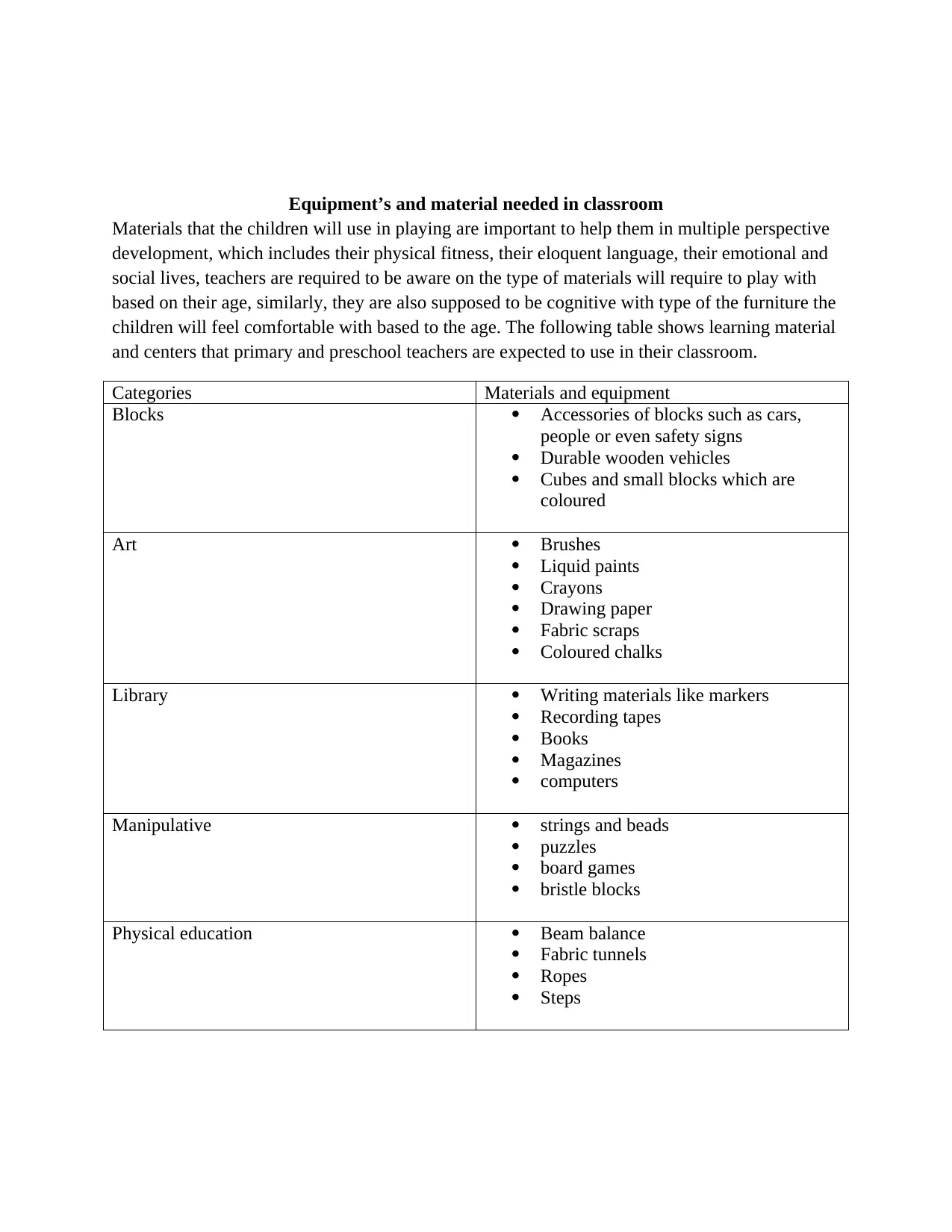
Equipment’s and material needed in classroom
Materials that the children will use in playing are important to help them in multiple perspective
development, which includes their physical fitness, their eloquent language, their emotional and
social lives, teachers are required to be aware on the type of materials will require to play with
based on their age, similarly, they are also supposed to be cognitive with type of the furniture the
children will feel comfortable with based to the age. The following table shows learning material
and centers that primary and preschool teachers are expected to use in their classroom.
Categories Materials and equipment
Blocks Accessories of blocks such as cars,
people or even safety signs
Durable wooden vehicles
Cubes and small blocks which are
coloured
Art Brushes
Liquid paints
Crayons
Drawing paper
Fabric scraps
Coloured chalks
Library Writing materials like markers
Recording tapes
Books
Magazines
computers
Manipulative strings and beads
puzzles
board games
bristle blocks
Physical education Beam balance
Fabric tunnels
Ropes
Steps
Materials that the children will use in playing are important to help them in multiple perspective
development, which includes their physical fitness, their eloquent language, their emotional and
social lives, teachers are required to be aware on the type of materials will require to play with
based on their age, similarly, they are also supposed to be cognitive with type of the furniture the
children will feel comfortable with based to the age. The following table shows learning material
and centers that primary and preschool teachers are expected to use in their classroom.
Categories Materials and equipment
Blocks Accessories of blocks such as cars,
people or even safety signs
Durable wooden vehicles
Cubes and small blocks which are
coloured
Art Brushes
Liquid paints
Crayons
Drawing paper
Fabric scraps
Coloured chalks
Library Writing materials like markers
Recording tapes
Books
Magazines
computers
Manipulative strings and beads
puzzles
board games
bristle blocks
Physical education Beam balance
Fabric tunnels
Ropes
Steps
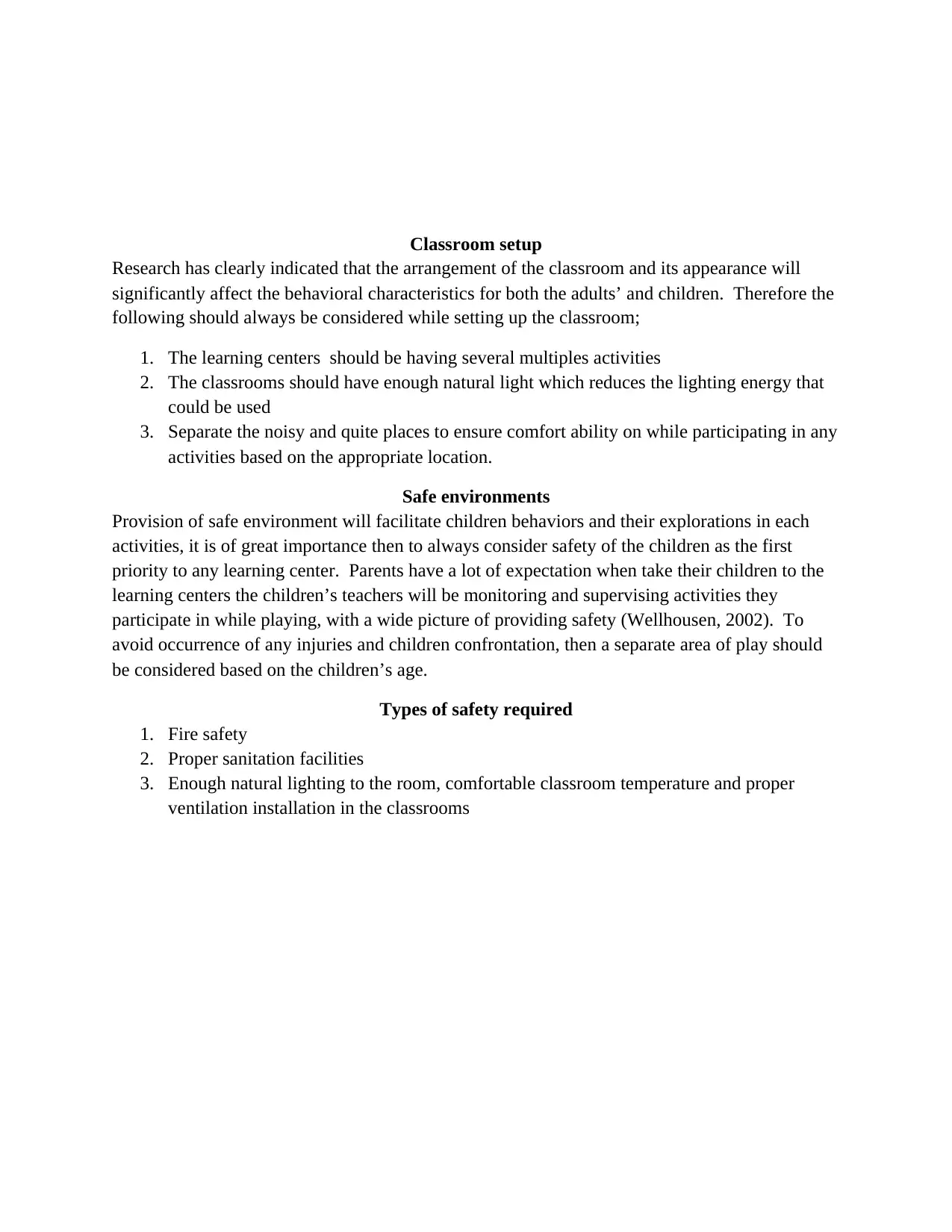
Classroom setup
Research has clearly indicated that the arrangement of the classroom and its appearance will
significantly affect the behavioral characteristics for both the adults’ and children. Therefore the
following should always be considered while setting up the classroom;
1. The learning centers should be having several multiples activities
2. The classrooms should have enough natural light which reduces the lighting energy that
could be used
3. Separate the noisy and quite places to ensure comfort ability on while participating in any
activities based on the appropriate location.
Safe environments
Provision of safe environment will facilitate children behaviors and their explorations in each
activities, it is of great importance then to always consider safety of the children as the first
priority to any learning center. Parents have a lot of expectation when take their children to the
learning centers the children’s teachers will be monitoring and supervising activities they
participate in while playing, with a wide picture of providing safety (Wellhousen, 2002). To
avoid occurrence of any injuries and children confrontation, then a separate area of play should
be considered based on the children’s age.
Types of safety required
1. Fire safety
2. Proper sanitation facilities
3. Enough natural lighting to the room, comfortable classroom temperature and proper
ventilation installation in the classrooms
Research has clearly indicated that the arrangement of the classroom and its appearance will
significantly affect the behavioral characteristics for both the adults’ and children. Therefore the
following should always be considered while setting up the classroom;
1. The learning centers should be having several multiples activities
2. The classrooms should have enough natural light which reduces the lighting energy that
could be used
3. Separate the noisy and quite places to ensure comfort ability on while participating in any
activities based on the appropriate location.
Safe environments
Provision of safe environment will facilitate children behaviors and their explorations in each
activities, it is of great importance then to always consider safety of the children as the first
priority to any learning center. Parents have a lot of expectation when take their children to the
learning centers the children’s teachers will be monitoring and supervising activities they
participate in while playing, with a wide picture of providing safety (Wellhousen, 2002). To
avoid occurrence of any injuries and children confrontation, then a separate area of play should
be considered based on the children’s age.
Types of safety required
1. Fire safety
2. Proper sanitation facilities
3. Enough natural lighting to the room, comfortable classroom temperature and proper
ventilation installation in the classrooms
⊘ This is a preview!⊘
Do you want full access?
Subscribe today to unlock all pages.

Trusted by 1+ million students worldwide
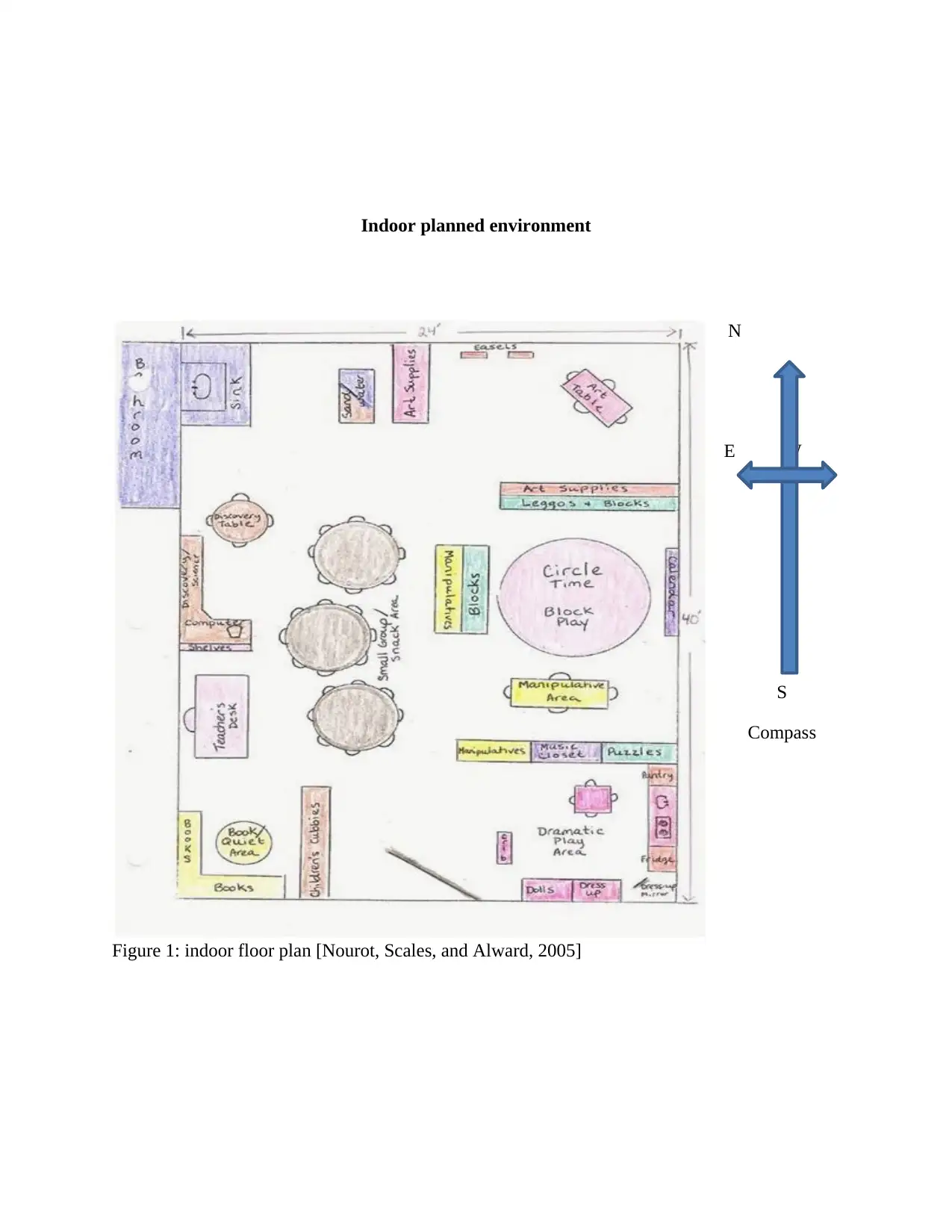
Indoor planned environment
N
E W
S
Compass
Figure 1: indoor floor plan [Nourot, Scales, and Alward, 2005]
N
E W
S
Compass
Figure 1: indoor floor plan [Nourot, Scales, and Alward, 2005]
Paraphrase This Document
Need a fresh take? Get an instant paraphrase of this document with our AI Paraphraser
Description of the indoor environment plan
The floor plan has been taken the way is shown to specify the location of all the facilities using
compass directions, the center surface will have three table with a maximum of eight chairs each,
this is an area where children will form small groups to take snacks if they are hungry, on the
East side, discovery table and discovery books on the shelves that portrays a wide science
concept application, on the Northern East the sinks have been installed to serve the children
while they are interacting with activities in discovery sections and also while they will be on the
art section that is located in North west, on West part of this floor plant arrangement of
manipulative and blocks object together with section of playing with the blocks have been
included, on the area found on South East at the Conner will have library section and next to the
library we will have the teacher’s desk, it is at this point that the teacher can monitor and
supervise all the activities taking place throughout the floor. The south west section will have
dramatic area.
Well-equipped and organized indoor environment will have direct influence on the quality of
children’s development and learning, the well-equipped indoor environment should be
comfortable, aesthetic, interesting and appropriate for children of age between five to eight ( .
Research as indicated that if all the criteria will be implemented then most of the children will
embrace it as their second home, where they are able eat, play, learn and sometime sleep. The
outlook of the indoor planned environment should be aesthetic and should also make the children
feel they are secured, safe and happy with the environment, and also ensure that children will
gain confident on playing and learning.
The indoor space will require detailed planning and should always be flexible with an aim of
accommodating changes on children needs and interest. The books that will be placed on this
classrooms need to be attractive to reflect fascinations of the children, all resources that the
children may be requiring to interact with be accessible to them. Example is shown on the floor
plan where the children can easily access manipulative blocks, move to circle time block play
and other places without restrictions.
The floor plan has been taken the way is shown to specify the location of all the facilities using
compass directions, the center surface will have three table with a maximum of eight chairs each,
this is an area where children will form small groups to take snacks if they are hungry, on the
East side, discovery table and discovery books on the shelves that portrays a wide science
concept application, on the Northern East the sinks have been installed to serve the children
while they are interacting with activities in discovery sections and also while they will be on the
art section that is located in North west, on West part of this floor plant arrangement of
manipulative and blocks object together with section of playing with the blocks have been
included, on the area found on South East at the Conner will have library section and next to the
library we will have the teacher’s desk, it is at this point that the teacher can monitor and
supervise all the activities taking place throughout the floor. The south west section will have
dramatic area.
Well-equipped and organized indoor environment will have direct influence on the quality of
children’s development and learning, the well-equipped indoor environment should be
comfortable, aesthetic, interesting and appropriate for children of age between five to eight ( .
Research as indicated that if all the criteria will be implemented then most of the children will
embrace it as their second home, where they are able eat, play, learn and sometime sleep. The
outlook of the indoor planned environment should be aesthetic and should also make the children
feel they are secured, safe and happy with the environment, and also ensure that children will
gain confident on playing and learning.
The indoor space will require detailed planning and should always be flexible with an aim of
accommodating changes on children needs and interest. The books that will be placed on this
classrooms need to be attractive to reflect fascinations of the children, all resources that the
children may be requiring to interact with be accessible to them. Example is shown on the floor
plan where the children can easily access manipulative blocks, move to circle time block play
and other places without restrictions.
Reading sections
The reading section should be separated entirely from the playing sections in order to prevent the
children from being destructed, and ensuring that peaceful concentration and understanding of
the children is completely achieved. The following should always be considered in designing the
reading sections;
Books area
The area of the storing books always is located at the corner at a distance from noise, the
children will only love the books if they will be provided an attractive comfortable learning
place. The children will need a quiet place where they can move to during the day.
Science area
The science area will be incorporated with wet areas since science is taken as a process of
investigation, the area can too be fixed with magnifying glasses, and pulley and even funnels, the
children while in this section should be instinctively introduced to nature.
The wet area should always be near a sink since at the end of the day the children will end up
dirtying themselves and they will require cleaning their hands.
Workshops area
The area will require a working bench where the children will be constructing using wood and
other recycling materials (Casey, 2010), the tools used here should real and not imaginary tools.
The working bench should be supervised to prevent children from getting injured.
The reading section should be separated entirely from the playing sections in order to prevent the
children from being destructed, and ensuring that peaceful concentration and understanding of
the children is completely achieved. The following should always be considered in designing the
reading sections;
Books area
The area of the storing books always is located at the corner at a distance from noise, the
children will only love the books if they will be provided an attractive comfortable learning
place. The children will need a quiet place where they can move to during the day.
Science area
The science area will be incorporated with wet areas since science is taken as a process of
investigation, the area can too be fixed with magnifying glasses, and pulley and even funnels, the
children while in this section should be instinctively introduced to nature.
The wet area should always be near a sink since at the end of the day the children will end up
dirtying themselves and they will require cleaning their hands.
Workshops area
The area will require a working bench where the children will be constructing using wood and
other recycling materials (Casey, 2010), the tools used here should real and not imaginary tools.
The working bench should be supervised to prevent children from getting injured.
⊘ This is a preview!⊘
Do you want full access?
Subscribe today to unlock all pages.
Trusted by 1+ million students worldwide
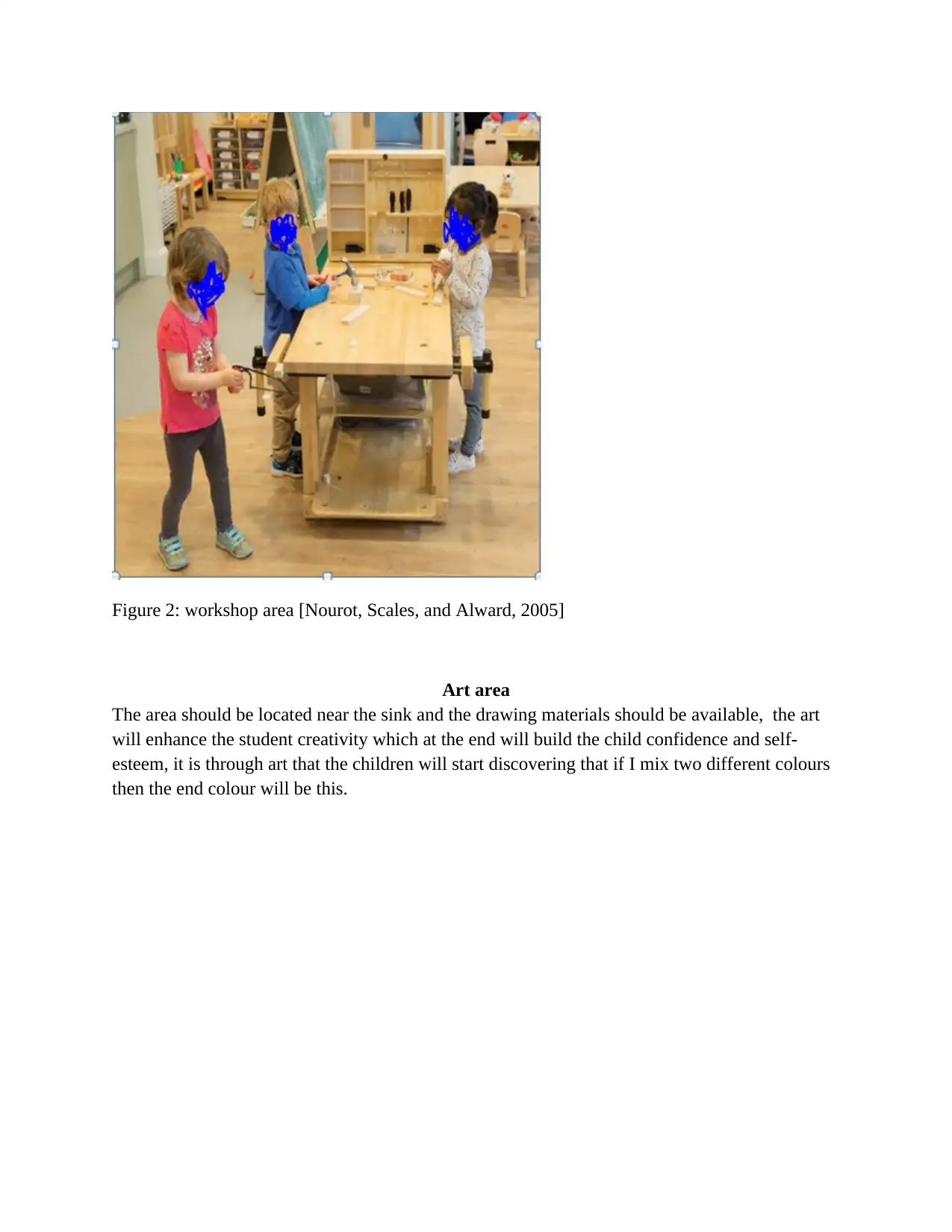
Figure 2: workshop area [Nourot, Scales, and Alward, 2005]
Art area
The area should be located near the sink and the drawing materials should be available, the art
will enhance the student creativity which at the end will build the child confidence and self-
esteem, it is through art that the children will start discovering that if I mix two different colours
then the end colour will be this.
Art area
The area should be located near the sink and the drawing materials should be available, the art
will enhance the student creativity which at the end will build the child confidence and self-
esteem, it is through art that the children will start discovering that if I mix two different colours
then the end colour will be this.
Paraphrase This Document
Need a fresh take? Get an instant paraphrase of this document with our AI Paraphraser
Outdoor environment
The outdoor environment comprises of area that outside on a classroom or building, it can also
be taken as open environment; the group of student who may be allowed to participate in playing
activities under outdoor environment includes early childhood at an age bracket of three to five
(Department of Education and Training, Victoria, 2016). The aim of the children of this age
bracket to be allowed to play outside is that they require minimal monitoring and supervision, it
is at this environment that children will shout, vigorously play and also participate in messy
projects and they can also interact with natural ecosystem like animals and plants (Greenman,
2007). The research has also helped in identifying several benefits of children playing outside
which includes;
1. Improvement in physical health
2. Increase in mental ability
3. Eloquent language
4. Improves creativity
5. Releases stress
The outdoor environment comprises of area that outside on a classroom or building, it can also
be taken as open environment; the group of student who may be allowed to participate in playing
activities under outdoor environment includes early childhood at an age bracket of three to five
(Department of Education and Training, Victoria, 2016). The aim of the children of this age
bracket to be allowed to play outside is that they require minimal monitoring and supervision, it
is at this environment that children will shout, vigorously play and also participate in messy
projects and they can also interact with natural ecosystem like animals and plants (Greenman,
2007). The research has also helped in identifying several benefits of children playing outside
which includes;
1. Improvement in physical health
2. Increase in mental ability
3. Eloquent language
4. Improves creativity
5. Releases stress
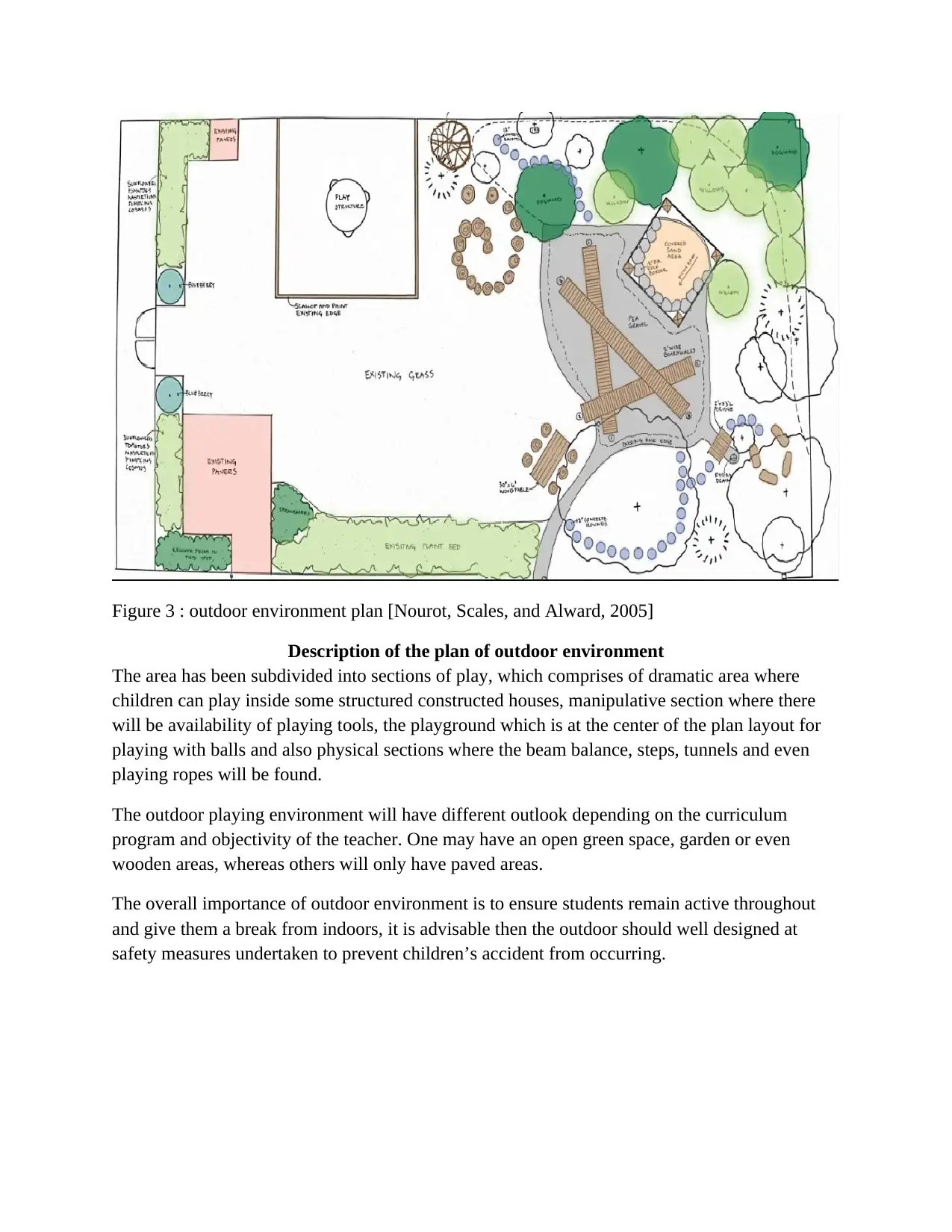
Figure 3 : outdoor environment plan [Nourot, Scales, and Alward, 2005]
Description of the plan of outdoor environment
The area has been subdivided into sections of play, which comprises of dramatic area where
children can play inside some structured constructed houses, manipulative section where there
will be availability of playing tools, the playground which is at the center of the plan layout for
playing with balls and also physical sections where the beam balance, steps, tunnels and even
playing ropes will be found.
The outdoor playing environment will have different outlook depending on the curriculum
program and objectivity of the teacher. One may have an open green space, garden or even
wooden areas, whereas others will only have paved areas.
The overall importance of outdoor environment is to ensure students remain active throughout
and give them a break from indoors, it is advisable then the outdoor should well designed at
safety measures undertaken to prevent children’s accident from occurring.
Description of the plan of outdoor environment
The area has been subdivided into sections of play, which comprises of dramatic area where
children can play inside some structured constructed houses, manipulative section where there
will be availability of playing tools, the playground which is at the center of the plan layout for
playing with balls and also physical sections where the beam balance, steps, tunnels and even
playing ropes will be found.
The outdoor playing environment will have different outlook depending on the curriculum
program and objectivity of the teacher. One may have an open green space, garden or even
wooden areas, whereas others will only have paved areas.
The overall importance of outdoor environment is to ensure students remain active throughout
and give them a break from indoors, it is advisable then the outdoor should well designed at
safety measures undertaken to prevent children’s accident from occurring.
⊘ This is a preview!⊘
Do you want full access?
Subscribe today to unlock all pages.
Trusted by 1+ million students worldwide
Design of outdoor environment
The design should include the following criteria’s;
1. The space should be adequate to ensure that all the children have a place they will play to
2. Provision of shelter place that are able to provide shade
3. The area should be close to bathrooms
4. The area should be easily accessed from the indoors
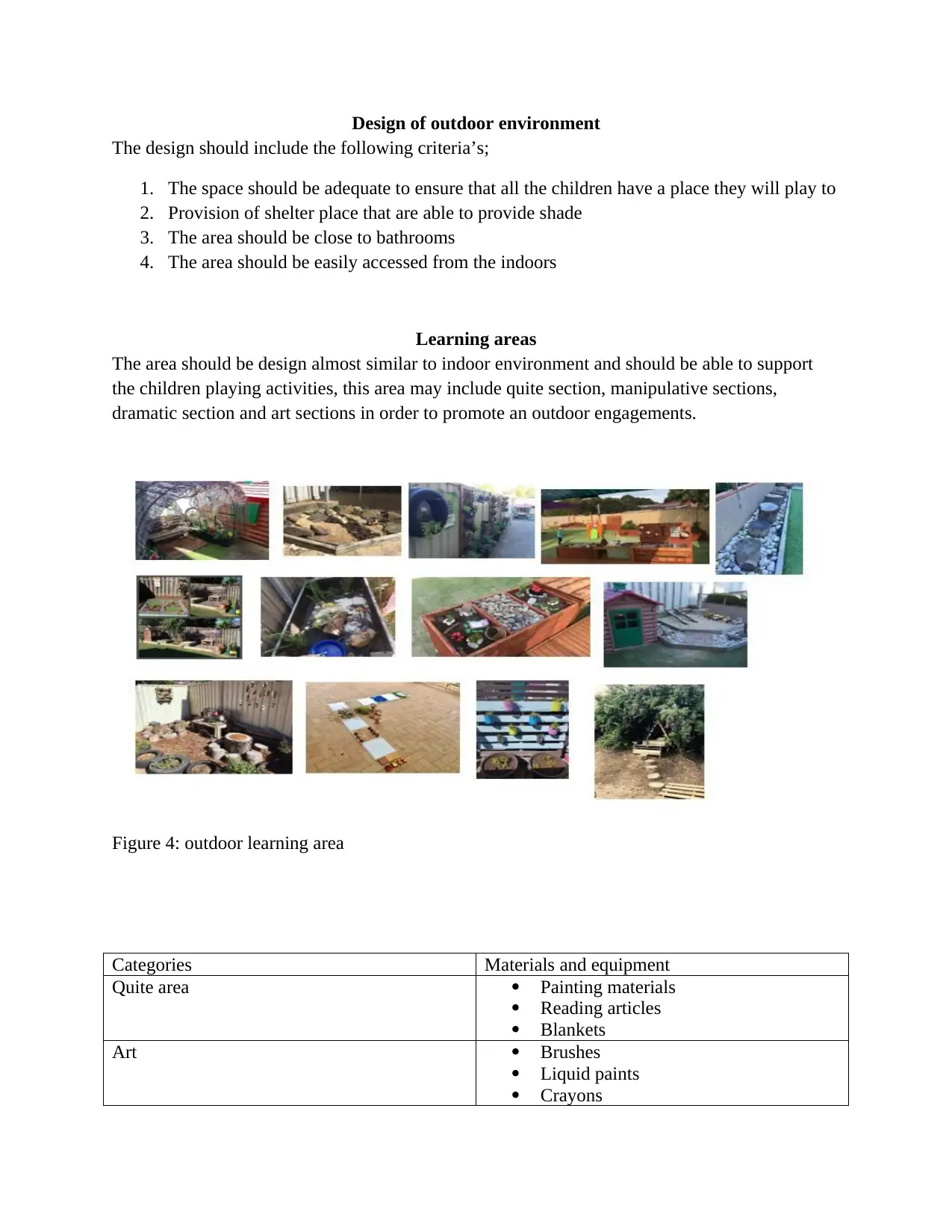
Learning areas
The area should be design almost similar to indoor environment and should be able to support
the children playing activities, this area may include quite section, manipulative sections,
dramatic section and art sections in order to promote an outdoor engagements.
Figure 4: outdoor learning area
Categories Materials and equipment
Quite area Painting materials
Reading articles
Blankets
Art Brushes
Liquid paints
Crayons
The design should include the following criteria’s;
1. The space should be adequate to ensure that all the children have a place they will play to
2. Provision of shelter place that are able to provide shade
3. The area should be close to bathrooms
4. The area should be easily accessed from the indoors
Learning areas
The area should be design almost similar to indoor environment and should be able to support
the children playing activities, this area may include quite section, manipulative sections,
dramatic section and art sections in order to promote an outdoor engagements.
Figure 4: outdoor learning area
Categories Materials and equipment
Quite area Painting materials
Reading articles
Blankets
Art Brushes
Liquid paints
Crayons
Paraphrase This Document
Need a fresh take? Get an instant paraphrase of this document with our AI Paraphraser
Drawing paper
Fabric scraps
Dramatic Playing house
Sands
Tools
Manipulative construction tools
writing materials
Physical education Beam balance
Fabric tunnels
Ropes
Steps
Playing ground
Playing balls
Planning activities
The planning activities outside should be a supplement to activities of indoor environments,
where what was learn theoretical indoors can now be physically be seen and interacted with, this
includes several lessons fields;
Subject Activities
Science Using the outdoor environment to explain the
scientific concepts like water cycles
Mathematics Using the outdoor environment to measure
diameter of trees or any other object
Creative writing Using outdoor environment to enhance
understanding of nature, example observing
different types of clouds
Language Improve student language eloquence by
explaining to them for example about the sun
that they observe in lined with evaporation
topic
Fabric scraps
Dramatic Playing house
Sands
Tools
Manipulative construction tools
writing materials
Physical education Beam balance
Fabric tunnels
Ropes
Steps
Playing ground
Playing balls
Planning activities
The planning activities outside should be a supplement to activities of indoor environments,
where what was learn theoretical indoors can now be physically be seen and interacted with, this
includes several lessons fields;
Subject Activities
Science Using the outdoor environment to explain the
scientific concepts like water cycles
Mathematics Using the outdoor environment to measure
diameter of trees or any other object
Creative writing Using outdoor environment to enhance
understanding of nature, example observing
different types of clouds
Language Improve student language eloquence by
explaining to them for example about the sun
that they observe in lined with evaporation
topic
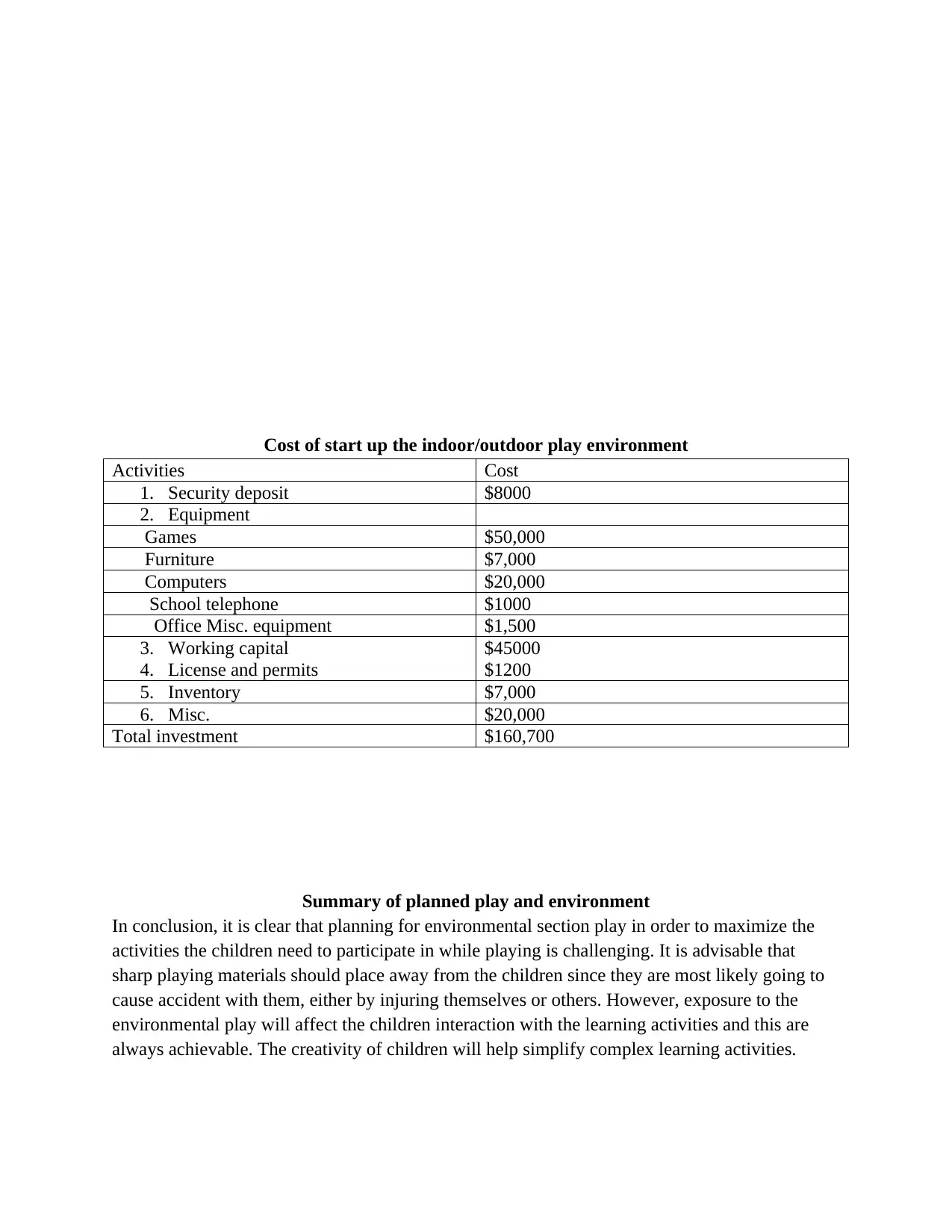
Cost of start up the indoor/outdoor play environment
Activities Cost
1. Security deposit $8000
2. Equipment
Games $50,000
Furniture $7,000
Computers $20,000
School telephone $1000
Office Misc. equipment $1,500
3. Working capital
4. License and permits
$45000
$1200
5. Inventory $7,000
6. Misc. $20,000
Total investment $160,700
Summary of planned play and environment
In conclusion, it is clear that planning for environmental section play in order to maximize the
activities the children need to participate in while playing is challenging. It is advisable that
sharp playing materials should place away from the children since they are most likely going to
cause accident with them, either by injuring themselves or others. However, exposure to the
environmental play will affect the children interaction with the learning activities and this are
always achievable. The creativity of children will help simplify complex learning activities.
Activities Cost
1. Security deposit $8000
2. Equipment
Games $50,000
Furniture $7,000
Computers $20,000
School telephone $1000
Office Misc. equipment $1,500
3. Working capital
4. License and permits
$45000
$1200
5. Inventory $7,000
6. Misc. $20,000
Total investment $160,700
Summary of planned play and environment
In conclusion, it is clear that planning for environmental section play in order to maximize the
activities the children need to participate in while playing is challenging. It is advisable that
sharp playing materials should place away from the children since they are most likely going to
cause accident with them, either by injuring themselves or others. However, exposure to the
environmental play will affect the children interaction with the learning activities and this are
always achievable. The creativity of children will help simplify complex learning activities.
⊘ This is a preview!⊘
Do you want full access?
Subscribe today to unlock all pages.
Trusted by 1+ million students worldwide

1 out of 13


Related Documents


Your All-in-One AI-Powered Toolkit for Academic Success.
+13062052269
info@desklib.com
Available 24*7 on WhatsApp / Email
![[object Object]](/_next/static/media/star-bottom.7253800d.svg)
Unlock your academic potential
Copyright © 2020–2026 A2Z Services. All Rights Reserved. Developed and managed by ZUCOL.