Why Playtime is Crucial for Young Children's Development and Learning

Verified

Added on  2023/01/23

|5
|1510
|49
Essay
AI Summary
This essay argues that playtime is as important as study time for young children, emphasizing the need for a balance between academic and co-curricular activities. It highlights how playtime enhances social relationships, creativity, problem-solving skills, and strategic thinking. The essay notes that the current education system often overlooks the benefits of playtime, leading to boredom and stress among children. Integrating creative activities into the learning process, such as practical presentations and role-playing sessions, can make education more engaging and effective. Playtime also reduces stress and promotes physical activity, addressing issues like obesity. The essay concludes by advocating for the recognition of playtime's crucial role in early childhood development, suggesting that simple games and activities can significantly improve communication, motor skills, and problem-solving abilities.

Document Page
ENGLISH ESSAY
tabler-icon-diamond-filled.svg

Paraphrase This Document

Need a fresh take? Get an instant paraphrase of this document with our AI Paraphraser
Document Page
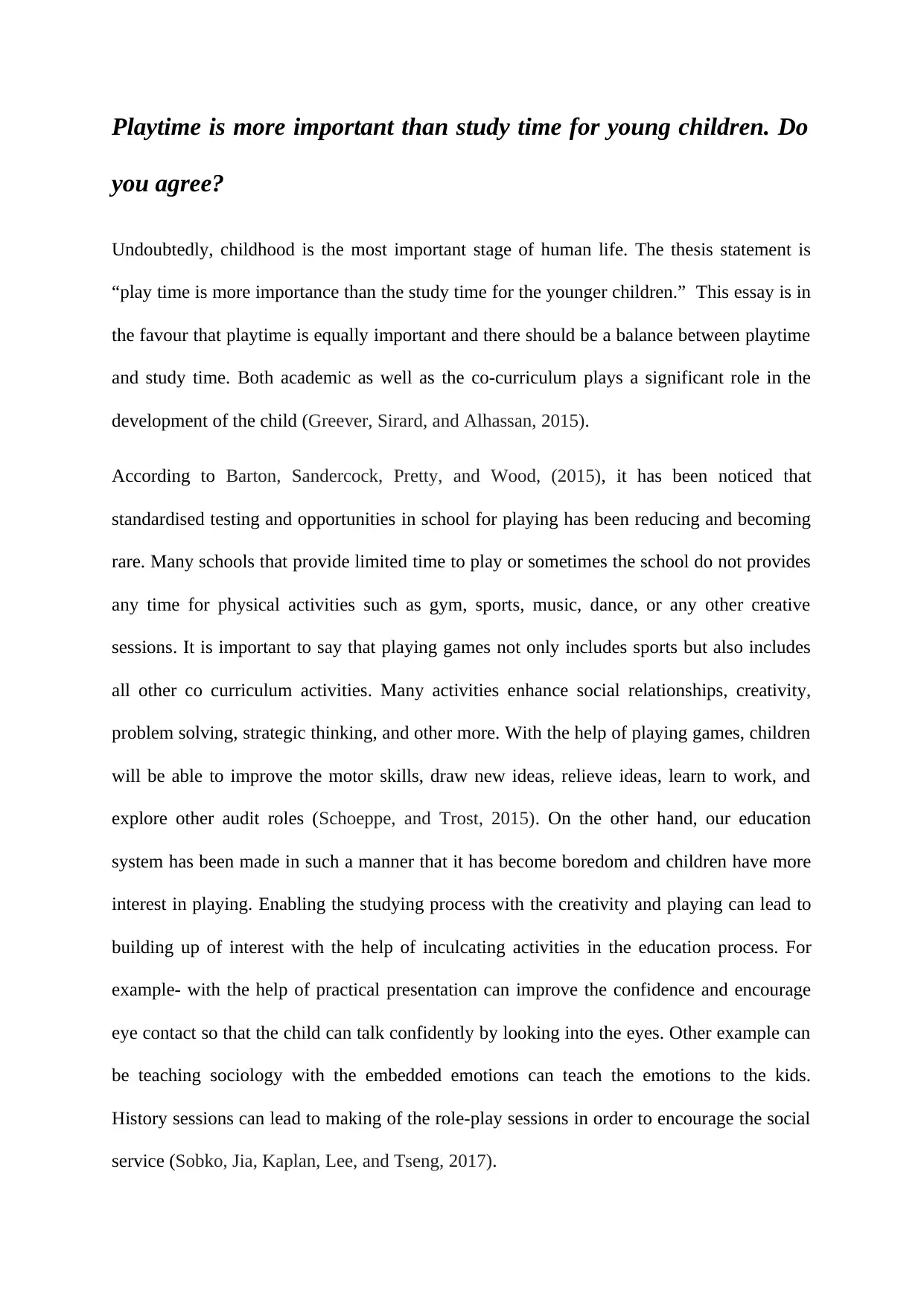
Playtime is more important than study time for young children. Do
you agree?
Undoubtedly, childhood is the most important stage of human life. The thesis statement is
“play time is more importance than the study time for the younger children.” This essay is in
the favour that playtime is equally important and there should be a balance between playtime
and study time. Both academic as well as the co-curriculum plays a significant role in the
development of the child (Greever, Sirard, and Alhassan, 2015).
According to Barton, Sandercock, Pretty, and Wood, (2015), it has been noticed that
standardised testing and opportunities in school for playing has been reducing and becoming
rare. Many schools that provide limited time to play or sometimes the school do not provides
any time for physical activities such as gym, sports, music, dance, or any other creative
sessions. It is important to say that playing games not only includes sports but also includes
all other co curriculum activities. Many activities enhance social relationships, creativity,
problem solving, strategic thinking, and other more. With the help of playing games, children
will be able to improve the motor skills, draw new ideas, relieve ideas, learn to work, and
explore other audit roles (Schoeppe, and Trost, 2015). On the other hand, our education
system has been made in such a manner that it has become boredom and children have more
interest in playing. Enabling the studying process with the creativity and playing can lead to
building up of interest with the help of inculcating activities in the education process. For
example- with the help of practical presentation can improve the confidence and encourage
eye contact so that the child can talk confidently by looking into the eyes. Other example can
be teaching sociology with the embedded emotions can teach the emotions to the kids.
History sessions can lead to making of the role-play sessions in order to encourage the social
service (Sobko, Jia, Kaplan, Lee, and Tseng, 2017).
Document Page
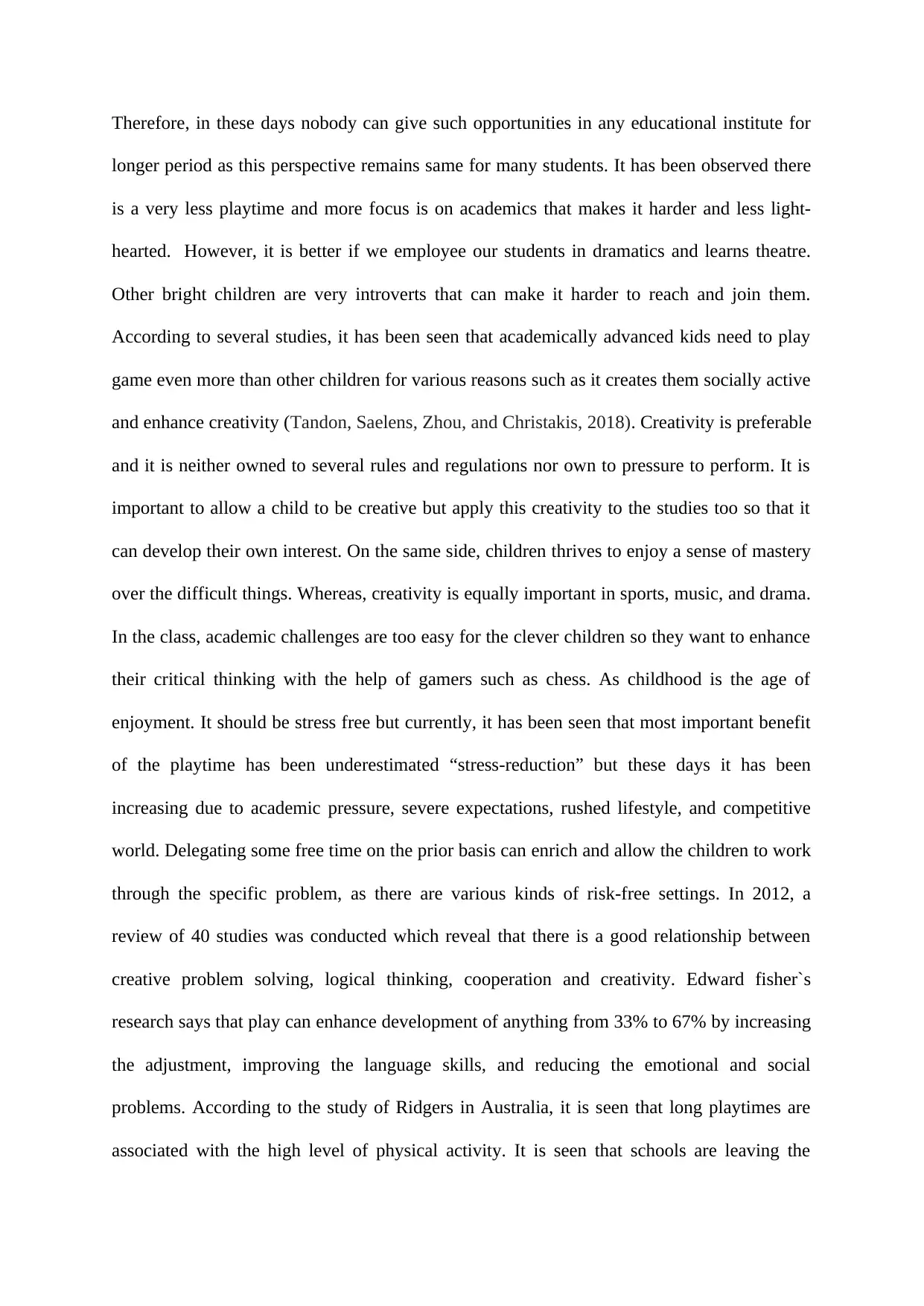
Therefore, in these days nobody can give such opportunities in any educational institute for
longer period as this perspective remains same for many students. It has been observed there
is a very less playtime and more focus is on academics that makes it harder and less light-
hearted. However, it is better if we employee our students in dramatics and learns theatre.
Other bright children are very introverts that can make it harder to reach and join them.
According to several studies, it has been seen that academically advanced kids need to play
game even more than other children for various reasons such as it creates them socially active
and enhance creativity (Tandon, Saelens, Zhou, and Christakis, 2018). Creativity is preferable
and it is neither owned to several rules and regulations nor own to pressure to perform. It is
important to allow a child to be creative but apply this creativity to the studies too so that it
can develop their own interest. On the same side, children thrives to enjoy a sense of mastery
over the difficult things. Whereas, creativity is equally important in sports, music, and drama.
In the class, academic challenges are too easy for the clever children so they want to enhance
their critical thinking with the help of gamers such as chess. As childhood is the age of
enjoyment. It should be stress free but currently, it has been seen that most important benefit
of the playtime has been underestimated “stress-reduction” but these days it has been
increasing due to academic pressure, severe expectations, rushed lifestyle, and competitive
world. Delegating some free time on the prior basis can enrich and allow the children to work
through the specific problem, as there are various kinds of risk-free settings. In 2012, a
review of 40 studies was conducted which reveal that there is a good relationship between
creative problem solving, logical thinking, cooperation and creativity. Edward fisher`s
research says that play can enhance development of anything from 33% to 67% by increasing
the adjustment, improving the language skills, and reducing the emotional and social
problems. According to the study of Ridgers in Australia, it is seen that long playtimes are
associated with the high level of physical activity. It is seen that schools are leaving the
Document Page
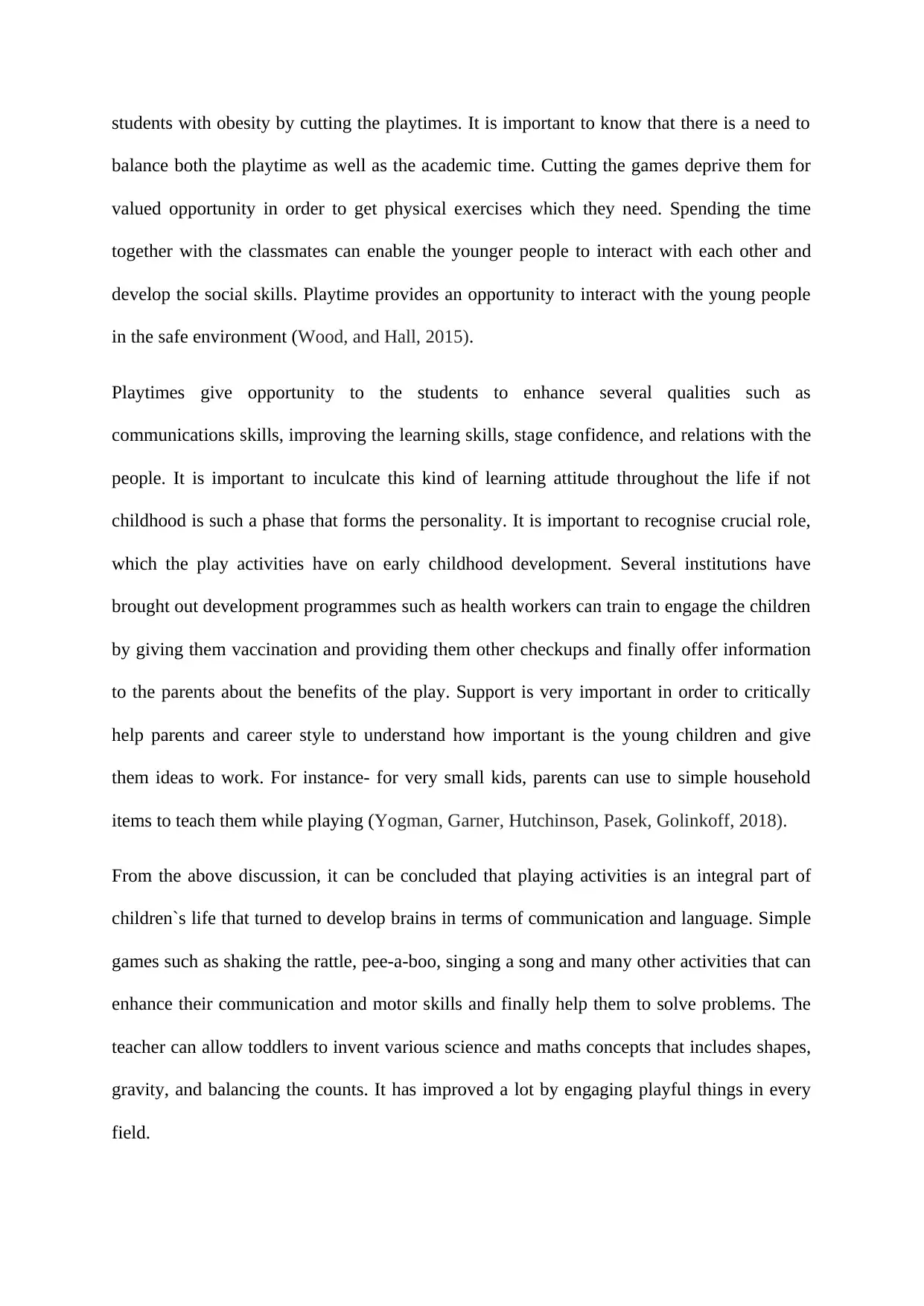
students with obesity by cutting the playtimes. It is important to know that there is a need to
balance both the playtime as well as the academic time. Cutting the games deprive them for
valued opportunity in order to get physical exercises which they need. Spending the time
together with the classmates can enable the younger people to interact with each other and
develop the social skills. Playtime provides an opportunity to interact with the young people
in the safe environment (Wood, and Hall, 2015).
Playtimes give opportunity to the students to enhance several qualities such as
communications skills, improving the learning skills, stage confidence, and relations with the
people. It is important to inculcate this kind of learning attitude throughout the life if not
childhood is such a phase that forms the personality. It is important to recognise crucial role,
which the play activities have on early childhood development. Several institutions have
brought out development programmes such as health workers can train to engage the children
by giving them vaccination and providing them other checkups and finally offer information
to the parents about the benefits of the play. Support is very important in order to critically
help parents and career style to understand how important is the young children and give
them ideas to work. For instance- for very small kids, parents can use to simple household
items to teach them while playing (Yogman, Garner, Hutchinson, Pasek, Golinkoff, 2018).
From the above discussion, it can be concluded that playing activities is an integral part of
children`s life that turned to develop brains in terms of communication and language. Simple
games such as shaking the rattle, pee-a-boo, singing a song and many other activities that can
enhance their communication and motor skills and finally help them to solve problems. The
teacher can allow toddlers to invent various science and maths concepts that includes shapes,
gravity, and balancing the counts. It has improved a lot by engaging playful things in every
field.
tabler-icon-diamond-filled.svg

Paraphrase This Document

Need a fresh take? Get an instant paraphrase of this document with our AI Paraphraser
Document Page
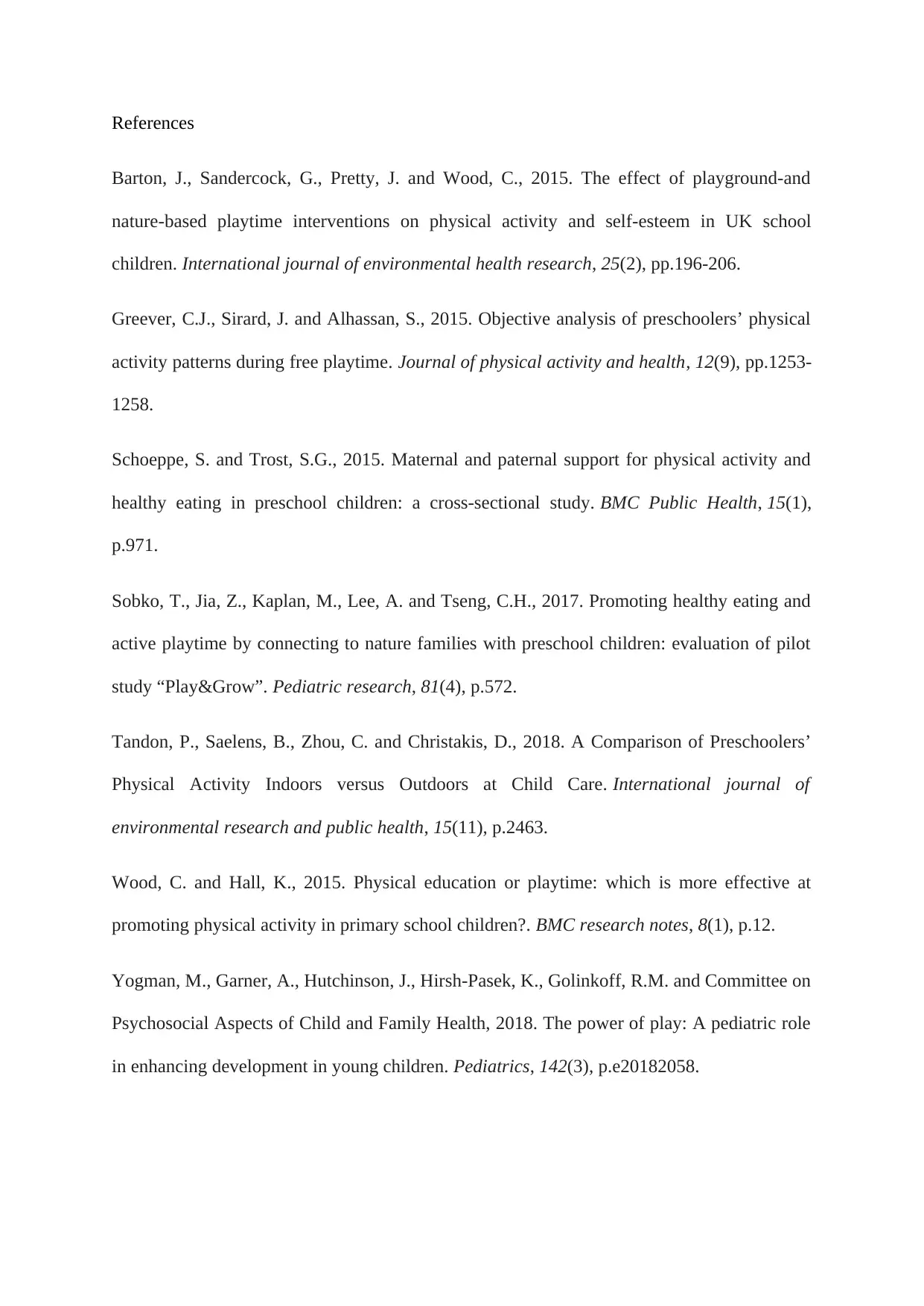
References
Barton, J., Sandercock, G., Pretty, J. and Wood, C., 2015. The effect of playground-and
nature-based playtime interventions on physical activity and self-esteem in UK school
children. International journal of environmental health research, 25(2), pp.196-206.
Greever, C.J., Sirard, J. and Alhassan, S., 2015. Objective analysis of preschoolers’ physical
activity patterns during free playtime. Journal of physical activity and health, 12(9), pp.1253-
1258.
Schoeppe, S. and Trost, S.G., 2015. Maternal and paternal support for physical activity and
healthy eating in preschool children: a cross-sectional study. BMC Public Health, 15(1),
p.971.
Sobko, T., Jia, Z., Kaplan, M., Lee, A. and Tseng, C.H., 2017. Promoting healthy eating and
active playtime by connecting to nature families with preschool children: evaluation of pilot
study “Play&Grow”. Pediatric research, 81(4), p.572.
Tandon, P., Saelens, B., Zhou, C. and Christakis, D., 2018. A Comparison of Preschoolers’
Physical Activity Indoors versus Outdoors at Child Care. International journal of
environmental research and public health, 15(11), p.2463.
Wood, C. and Hall, K., 2015. Physical education or playtime: which is more effective at
promoting physical activity in primary school children?. BMC research notes, 8(1), p.12.
Yogman, M., Garner, A., Hutchinson, J., Hirsh-Pasek, K., Golinkoff, R.M. and Committee on
Psychosocial Aspects of Child and Family Health, 2018. The power of play: A pediatric role
in enhancing development in young children. Pediatrics, 142(3), p.e20182058.
chevron_up_icon
1 out of 5
circle_padding
hide_on_mobile
zoom_out_icon
[object Object]