Political Science Essay: Pluralist Theory's Strengths and Weaknesses

Verified

Added on  2022/09/15

|3
|616
|44
Essay
AI Summary
This essay explores the strengths and weaknesses of pluralist theory, a framework for understanding political behavior in democracies. It highlights the theory's recognition of diverse interest groups and its emphasis on political power distribution, which allows for various organizations to participate in the political process and ensures that no single group dominates. The essay also discusses the role of government as a mediator and the importance of checks and balances. However, the essay critiques the theory for its potential for larger groups to exert undue influence, the difficulty in implementing it due to coordination challenges, and the impact of political bias. The essay concludes that while pluralist theory is beneficial in identifying the dynamics of interest groups, its practical application is complex and requires careful consideration of its limitations.
Document Page
1
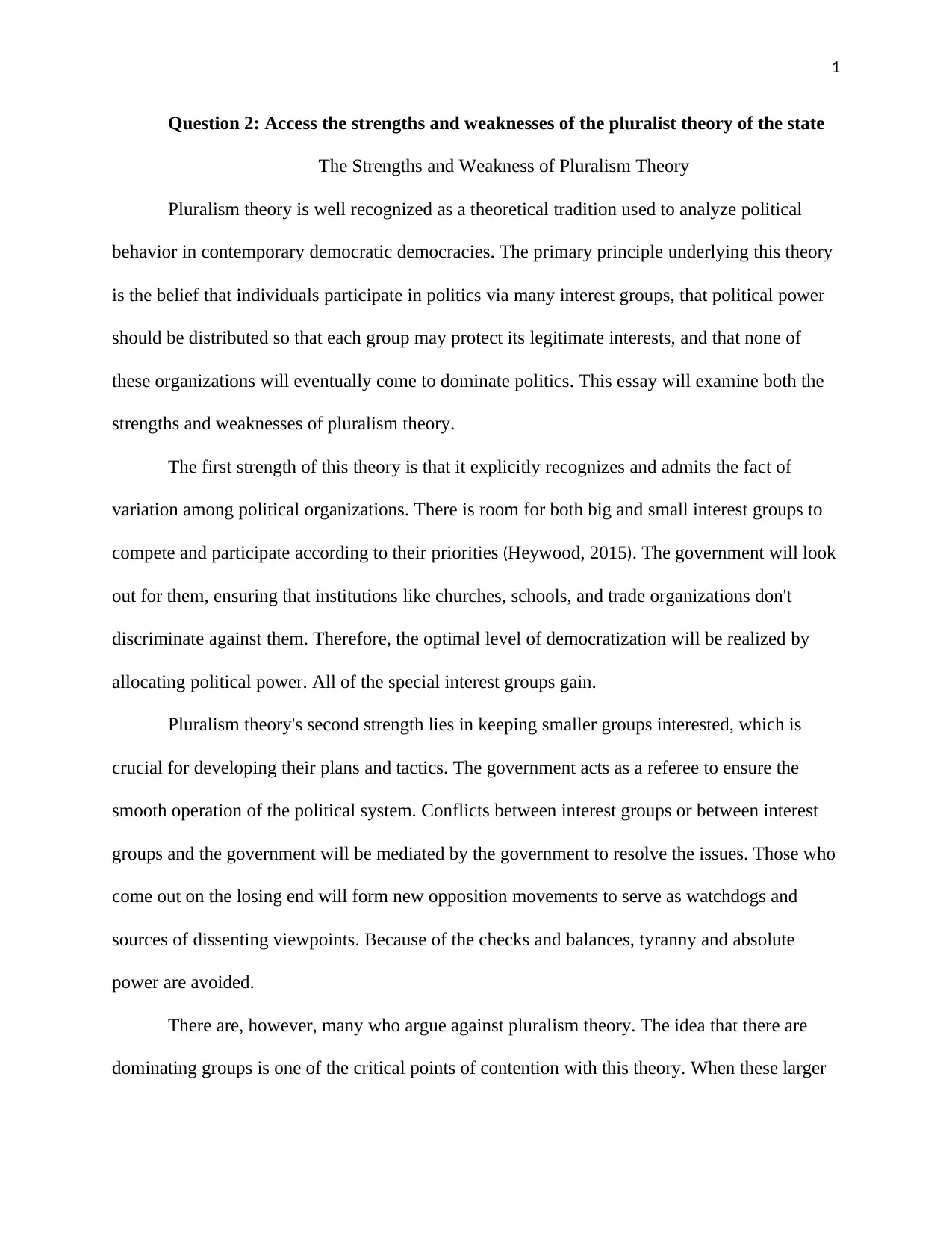
Question 2: Access the strengths and weaknesses of the pluralist theory of the state
The Strengths and Weakness of Pluralism Theory
Pluralism theory is well recognized as a theoretical tradition used to analyze political
behavior in contemporary democratic democracies. The primary principle underlying this theory
is the belief that individuals participate in politics via many interest groups, that political power
should be distributed so that each group may protect its legitimate interests, and that none of
these organizations will eventually come to dominate politics. This essay will examine both the
strengths and weaknesses of pluralism theory.
The first strength of this theory is that it explicitly recognizes and admits the fact of
variation among political organizations. There is room for both big and small interest groups to
compete and participate according to their priorities (Heywood, 2015). The government will look
out for them, ensuring that institutions like churches, schools, and trade organizations don't
discriminate against them. Therefore, the optimal level of democratization will be realized by
allocating political power. All of the special interest groups gain.
Pluralism theory's second strength lies in keeping smaller groups interested, which is
crucial for developing their plans and tactics. The government acts as a referee to ensure the
smooth operation of the political system. Conflicts between interest groups or between interest
groups and the government will be mediated by the government to resolve the issues. Those who
come out on the losing end will form new opposition movements to serve as watchdogs and
sources of dissenting viewpoints. Because of the checks and balances, tyranny and absolute
power are avoided.
There are, however, many who argue against pluralism theory. The idea that there are
dominating groups is one of the critical points of contention with this theory. When these larger
tabler-icon-diamond-filled.svg

Paraphrase This Document

Need a fresh take? Get an instant paraphrase of this document with our AI Paraphraser
Document Page
2
organizations exert their influence, it may cause phenomena such as when smaller interest groups
blindly perform in chorus with the larger group (Heywood, 2019). Because the majority group is
too powerful and might push the government, and because the minority group's contribution and
political clout are relatively small, the government does not fulfill its duty as an impartial referee.
The idea of pluralism has another flaw in that it is hard to put into practice. That's
because proper coordination is essential to decentralizing political authority. Therefore,
inefficiency and lack of efficacy may result if coordination cannot be achieved. For example,
national and state-level initiatives will likely not align when the federal government lacks
cooperation with the state governments and is driven by self-interest. The ineffectiveness of
initiatives is exacerbated by political prejudice. This is shown by the fact that persons in charge
of certain agencies have difficulty putting personal concerns aside when making decisions that
affect the country's greater good. Decisions on which programs should be prioritized and which
policies should be implemented take too long and are complicated by this system.
In conclusion, the ideal political system in democracies requires a system that emphasizes
the dynamics of interest groups, and pluralism theory is beneficial in identifying such acts. The
problem is that putting this method into action is challenging.
Document Page
3
References
Heywood, A. (2015). Global politics. London: Palgrave Macmillan.
HEYWOOD, A. (2019). P O L I T I C S (5th ed.). London: RED GLOBE PRESS.
chevron_up_icon
1 out of 3
circle_padding
hide_on_mobile
zoom_out_icon
[object Object]