Exploring Plutarch's Account of Alexander: Reliability and Context

Verified

Added on  2022/12/30

|4
|529
|25
Homework Assignment
AI Summary
This assignment analyzes Plutarch's perspective on Alexander the Great, exploring his portrayal of the historical figure and the reliability of his account. The paper examines Plutarch's biases, influenced by his Platonist philosophy and the historical context of the Hellenistic period, which shaped his interpretation of Alexander's actions and motivations. It addresses how Plutarch's focus on morality and ethics, as a biographer rather than a purely historical writer, impacts his assessment of Alexander, including his views on ambition and obsession. The analysis considers the available sources Plutarch used and the potential impact of his access to resources like the imperial library of Rome, ultimately evaluating the trustworthiness of Plutarch's biographical approach to history.

Document Page
Running head: PLUTARCH AND ALEXANDER
PLUTARCH AND ALEXANDER
Name of the student
Name of the university
Author Note
tabler-icon-diamond-filled.svg

Paraphrase This Document

Need a fresh take? Get an instant paraphrase of this document with our AI Paraphraser
Document Page
1PLUTARCH AND ALEXANDER
What does Plutarch think of Alexander? Does Plutarch's history seem reliable? Why or
Why not? How might Plutarch's context affect his interpretation of Alexander?
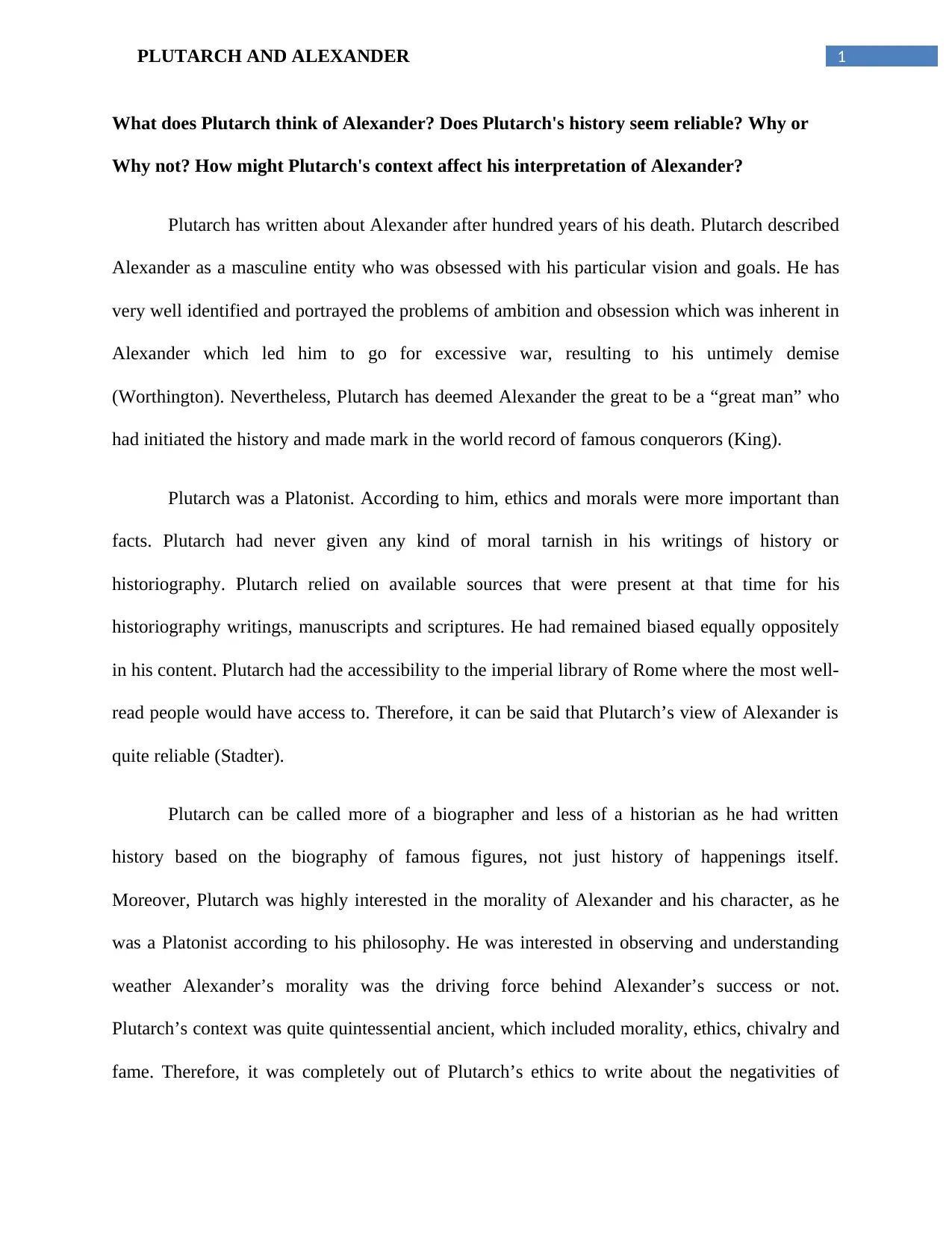
Plutarch has written about Alexander after hundred years of his death. Plutarch described
Alexander as a masculine entity who was obsessed with his particular vision and goals. He has
very well identified and portrayed the problems of ambition and obsession which was inherent in
Alexander which led him to go for excessive war, resulting to his untimely demise
(Worthington). Nevertheless, Plutarch has deemed Alexander the great to be a “great man” who
had initiated the history and made mark in the world record of famous conquerors (King).
Plutarch was a Platonist. According to him, ethics and morals were more important than
facts. Plutarch had never given any kind of moral tarnish in his writings of history or
historiography. Plutarch relied on available sources that were present at that time for his
historiography writings, manuscripts and scriptures. He had remained biased equally oppositely
in his content. Plutarch had the accessibility to the imperial library of Rome where the most well-
read people would have access to. Therefore, it can be said that Plutarch’s view of Alexander is
quite reliable (Stadter).
Plutarch can be called more of a biographer and less of a historian as he had written
history based on the biography of famous figures, not just history of happenings itself.
Moreover, Plutarch was highly interested in the morality of Alexander and his character, as he
was a Platonist according to his philosophy. He was interested in observing and understanding
weather Alexander’s morality was the driving force behind Alexander’s success or not.
Plutarch’s context was quite quintessential ancient, which included morality, ethics, chivalry and
fame. Therefore, it was completely out of Plutarch’s ethics to write about the negativities of
Document Page
2PLUTARCH AND ALEXANDER
Alexander. Plutarch, from the Hellenistic classical point of view, wrote about Alexander about
his invasion of the barbarians and building civilizations, which in the ancient times, were not
considered to be something “gruesome” or “unethical”. Therefore, it can be said that, the point of
view of Plutarch was highly Hellenistic in describing about Alexander (Green).
Document Page
3PLUTARCH AND ALEXANDER
References:
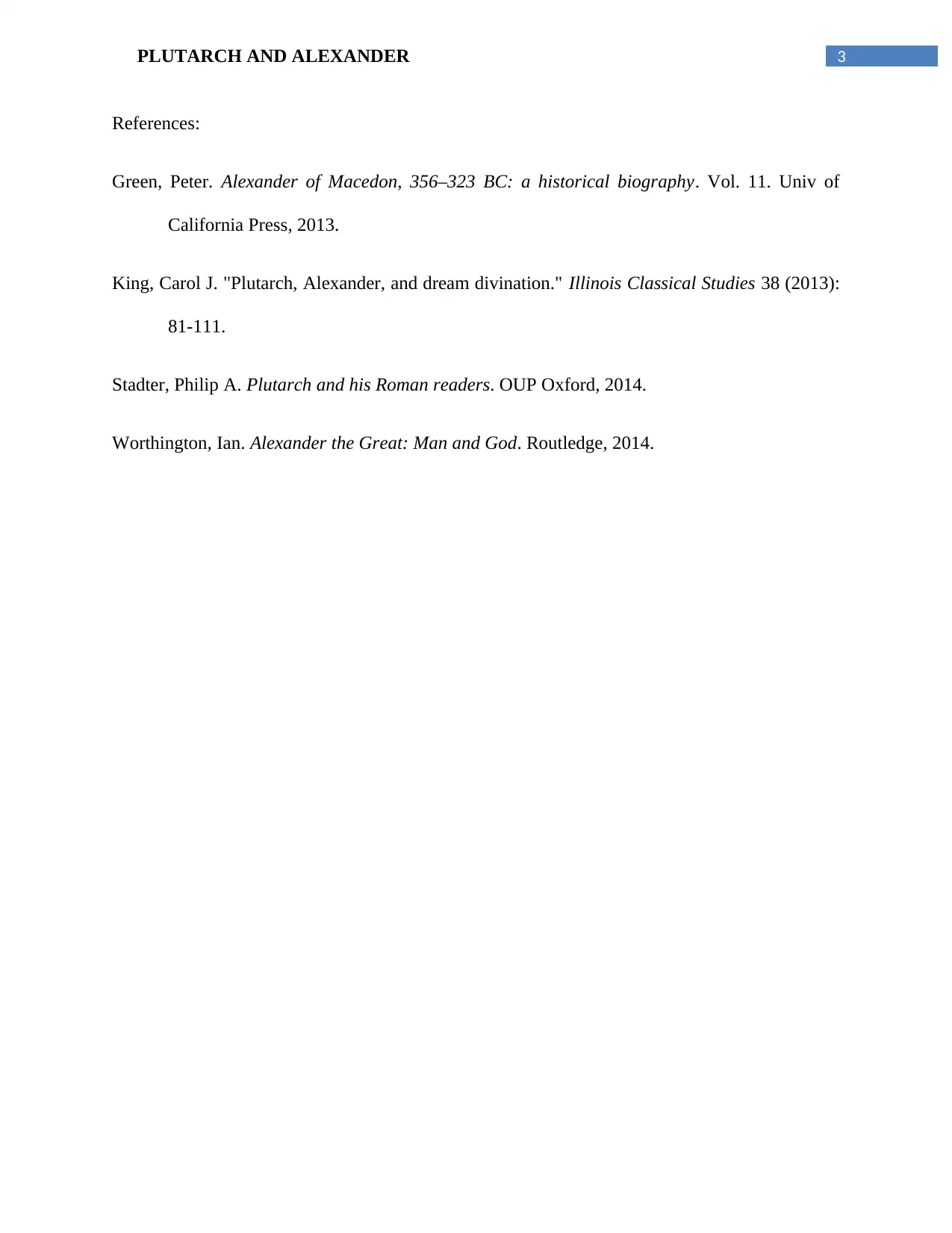
Green, Peter. Alexander of Macedon, 356–323 BC: a historical biography. Vol. 11. Univ of
California Press, 2013.
King, Carol J. "Plutarch, Alexander, and dream divination." Illinois Classical Studies 38 (2013):
81-111.
Stadter, Philip A. Plutarch and his Roman readers. OUP Oxford, 2014.
Worthington, Ian. Alexander the Great: Man and God. Routledge, 2014.
chevron_up_icon
1 out of 4
circle_padding
hide_on_mobile
zoom_out_icon
[object Object]