Case Study: Managing Pneumonia & Medications for Ruth Summer
VerifiedAdded on 2023/06/12
|25
|5624
|319
Case Study
AI Summary
This case study focuses on Ruth Summer, an elderly patient in an aged care facility, who is admitted to the hospital with community-acquired pneumonia. The assessment involves reviewing her medical history, current medications, and the hospital's management plan. Key areas explored include medication administration, pain management, and oxygen therapy. The study requires an understanding of drug actions, side effects, and patient safety protocols. Questions cover medication rights, pain assessment techniques (both pharmacological and non-pharmacological), and legal requirements for controlled substances. The case also addresses the importance of monitoring vital signs, documenting observations, and managing complications such as phlebitis at the IV site. Desklib provides access to similar solved assignments and past papers for students.
ASSESSMENT 1
Case Study
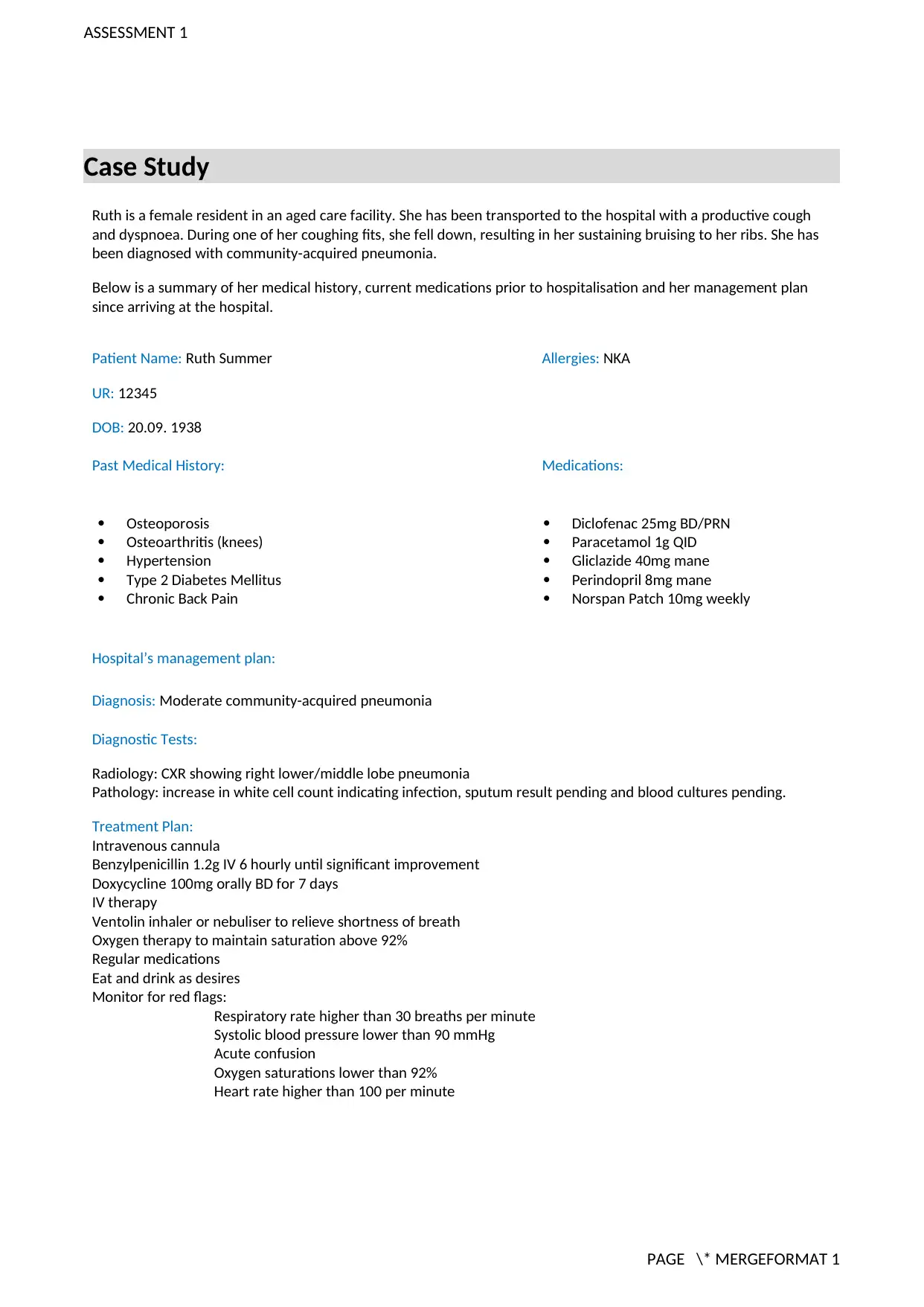
Ruth is a female resident in an aged care facility. She has been transported to the hospital with a productive cough
and dyspnoea. During one of her coughing fits, she fell down, resulting in her sustaining bruising to her ribs. She has
been diagnosed with community-acquired pneumonia.
Below is a summary of her medical history, current medications prior to hospitalisation and her management plan
since arriving at the hospital.
Patient Name: Ruth Summer Allergies: NKA
UR: 12345
DOB: 20.09. 1938
Past Medical History: Medications:
Osteoporosis
Osteoarthritis (knees)
Hypertension
Type 2 Diabetes Mellitus
Chronic Back Pain
Diclofenac 25mg BD/PRN
Paracetamol 1g QID
Gliclazide 40mg mane
Perindopril 8mg mane
Norspan Patch 10mg weekly
Hospital’s management plan:
Diagnosis: Moderate community-acquired pneumonia
Diagnostic Tests:
Radiology: CXR showing right lower/middle lobe pneumonia
Pathology: increase in white cell count indicating infection, sputum result pending and blood cultures pending.
Treatment Plan:
Intravenous cannula
Benzylpenicillin 1.2g IV 6 hourly until significant improvement
Doxycycline 100mg orally BD for 7 days
IV therapy
Ventolin inhaler or nebuliser to relieve shortness of breath
Oxygen therapy to maintain saturation above 92%
Regular medications
Eat and drink as desires
Monitor for red flags:
Respiratory rate higher than 30 breaths per minute
Systolic blood pressure lower than 90 mmHg
Acute confusion
Oxygen saturations lower than 92%
Heart rate higher than 100 per minute
PAGE \* MERGEFORMAT 1
Case Study
Ruth is a female resident in an aged care facility. She has been transported to the hospital with a productive cough
and dyspnoea. During one of her coughing fits, she fell down, resulting in her sustaining bruising to her ribs. She has
been diagnosed with community-acquired pneumonia.
Below is a summary of her medical history, current medications prior to hospitalisation and her management plan
since arriving at the hospital.
Patient Name: Ruth Summer Allergies: NKA
UR: 12345
DOB: 20.09. 1938
Past Medical History: Medications:
Osteoporosis
Osteoarthritis (knees)
Hypertension
Type 2 Diabetes Mellitus
Chronic Back Pain
Diclofenac 25mg BD/PRN
Paracetamol 1g QID
Gliclazide 40mg mane
Perindopril 8mg mane
Norspan Patch 10mg weekly
Hospital’s management plan:
Diagnosis: Moderate community-acquired pneumonia
Diagnostic Tests:
Radiology: CXR showing right lower/middle lobe pneumonia
Pathology: increase in white cell count indicating infection, sputum result pending and blood cultures pending.
Treatment Plan:
Intravenous cannula
Benzylpenicillin 1.2g IV 6 hourly until significant improvement
Doxycycline 100mg orally BD for 7 days
IV therapy
Ventolin inhaler or nebuliser to relieve shortness of breath
Oxygen therapy to maintain saturation above 92%
Regular medications
Eat and drink as desires
Monitor for red flags:
Respiratory rate higher than 30 breaths per minute
Systolic blood pressure lower than 90 mmHg
Acute confusion
Oxygen saturations lower than 92%
Heart rate higher than 100 per minute
PAGE \* MERGEFORMAT 1

Paraphrase This Document
Need a fresh take? Get an instant paraphrase of this document with our AI Paraphraser
ASSESSMENT 1
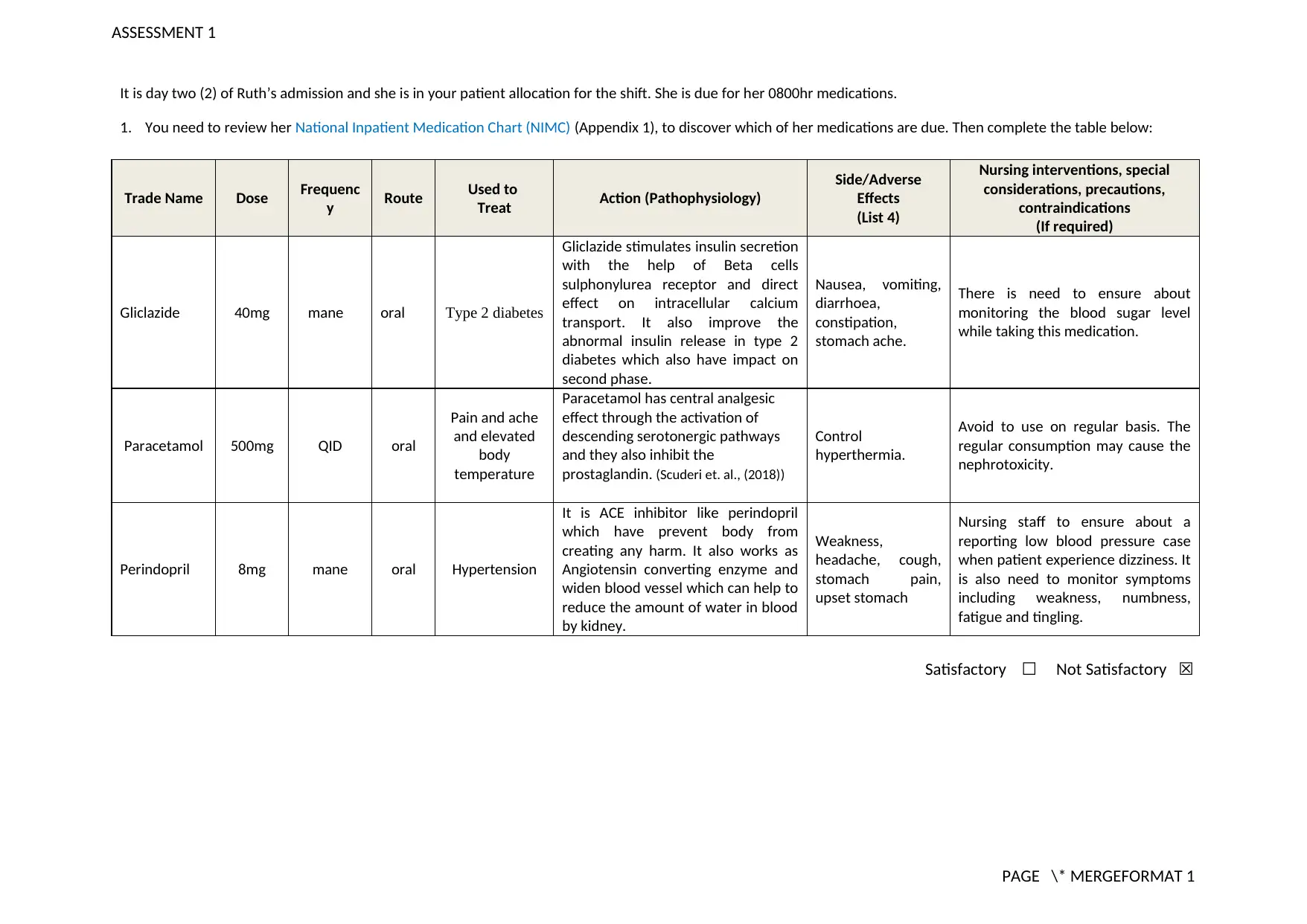
It is day two (2) of Ruth’s admission and she is in your patient allocation for the shift. She is due for her 0800hr medications.
1. You need to review her National Inpatient Medication Chart (NIMC) (Appendix 1), to discover which of her medications are due. Then complete the table below:
Trade Name Dose Frequenc
y Route Used to
Treat Action (Pathophysiology)
Side/Adverse
Effects
(List 4)
Nursing interventions, special
considerations, precautions,
contraindications
(If required)
Gliclazide 40mg mane oral Type 2 diabetes
Gliclazide stimulates insulin secretion
with the help of Beta cells
sulphonylurea receptor and direct
effect on intracellular calcium
transport. It also improve the
abnormal insulin release in type 2
diabetes which also have impact on
second phase.
Nausea, vomiting,
diarrhoea,
constipation,
stomach ache.
There is need to ensure about
monitoring the blood sugar level
while taking this medication.
Paracetamol 500mg QID oral
Pain and ache
and elevated
body
temperature
Paracetamol has central analgesic
effect through the activation of
descending serotonergic pathways
and they also inhibit the
prostaglandin. (Scuderi et. al., (2018))
Control
hyperthermia.
Avoid to use on regular basis. The
regular consumption may cause the
nephrotoxicity.
Perindopril 8mg mane oral Hypertension
It is ACE inhibitor like perindopril
which have prevent body from
creating any harm. It also works as
Angiotensin converting enzyme and
widen blood vessel which can help to
reduce the amount of water in blood
by kidney.
Weakness,
headache, cough,
stomach pain,
upset stomach
Nursing staff to ensure about a
reporting low blood pressure case
when patient experience dizziness. It
is also need to monitor symptoms
including weakness, numbness,
fatigue and tingling.
Satisfactory ☐ Not Satisfactory ☒
PAGE \* MERGEFORMAT 1
It is day two (2) of Ruth’s admission and she is in your patient allocation for the shift. She is due for her 0800hr medications.
1. You need to review her National Inpatient Medication Chart (NIMC) (Appendix 1), to discover which of her medications are due. Then complete the table below:
Trade Name Dose Frequenc
y Route Used to
Treat Action (Pathophysiology)
Side/Adverse
Effects
(List 4)
Nursing interventions, special
considerations, precautions,
contraindications
(If required)
Gliclazide 40mg mane oral Type 2 diabetes
Gliclazide stimulates insulin secretion
with the help of Beta cells
sulphonylurea receptor and direct
effect on intracellular calcium
transport. It also improve the
abnormal insulin release in type 2
diabetes which also have impact on
second phase.
Nausea, vomiting,
diarrhoea,
constipation,
stomach ache.
There is need to ensure about
monitoring the blood sugar level
while taking this medication.
Paracetamol 500mg QID oral
Pain and ache
and elevated
body
temperature
Paracetamol has central analgesic
effect through the activation of
descending serotonergic pathways
and they also inhibit the
prostaglandin. (Scuderi et. al., (2018))
Control
hyperthermia.
Avoid to use on regular basis. The
regular consumption may cause the
nephrotoxicity.
Perindopril 8mg mane oral Hypertension
It is ACE inhibitor like perindopril
which have prevent body from
creating any harm. It also works as
Angiotensin converting enzyme and
widen blood vessel which can help to
reduce the amount of water in blood
by kidney.
Weakness,
headache, cough,
stomach pain,
upset stomach
Nursing staff to ensure about a
reporting low blood pressure case
when patient experience dizziness. It
is also need to monitor symptoms
including weakness, numbness,
fatigue and tingling.
Satisfactory ☐ Not Satisfactory ☒
PAGE \* MERGEFORMAT 1
ASSESSMENT 1
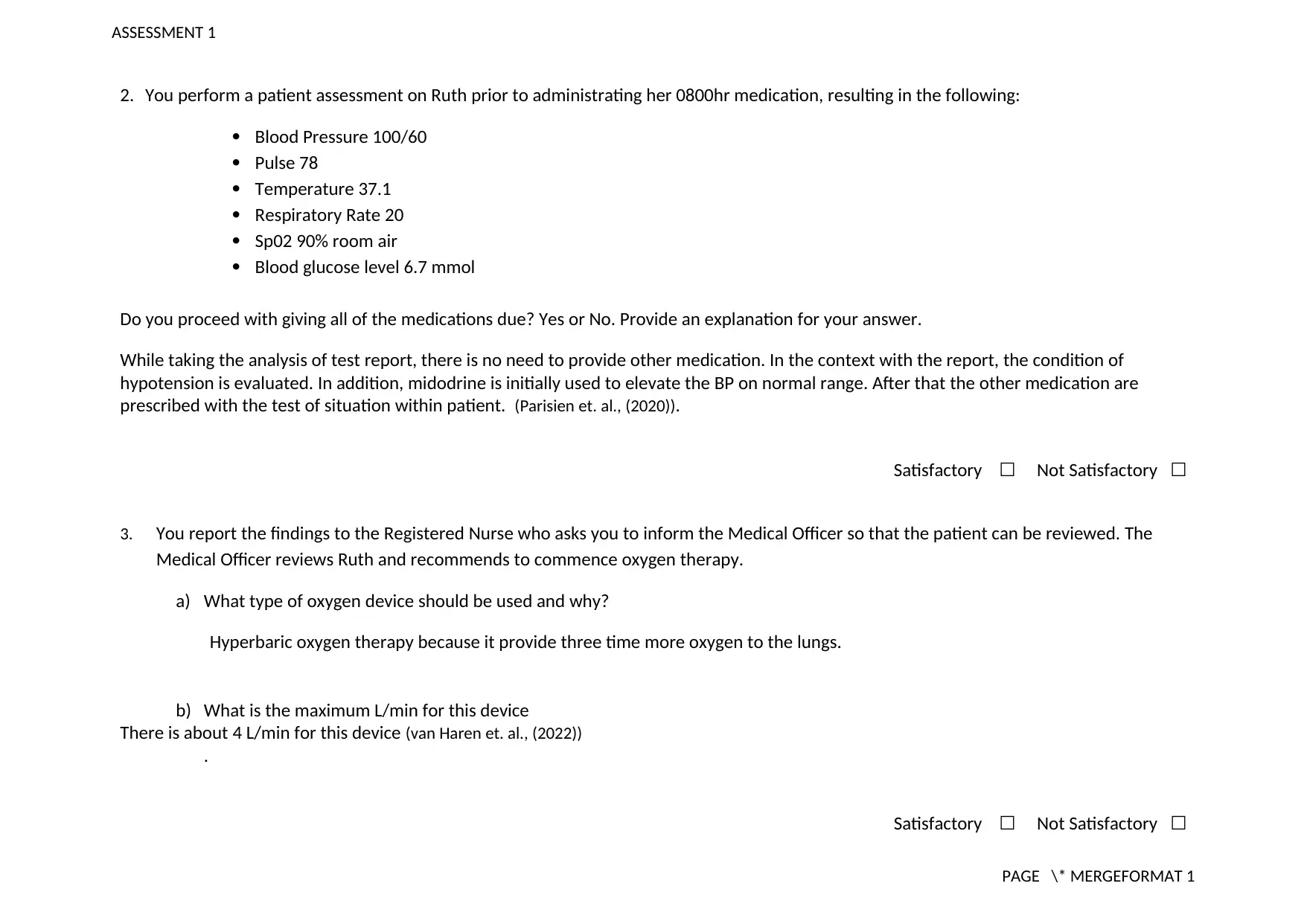
2. You perform a patient assessment on Ruth prior to administrating her 0800hr medication, resulting in the following:
Blood Pressure 100/60
Pulse 78
Temperature 37.1
Respiratory Rate 20
Sp02 90% room air
Blood glucose level 6.7 mmol
Do you proceed with giving all of the medications due? Yes or No. Provide an explanation for your answer.
While taking the analysis of test report, there is no need to provide other medication. In the context with the report, the condition of
hypotension is evaluated. In addition, midodrine is initially used to elevate the BP on normal range. After that the other medication are
prescribed with the test of situation within patient. (Parisien et. al., (2020)).
Satisfactory ☐ Not Satisfactory ☐
3. You report the findings to the Registered Nurse who asks you to inform the Medical Officer so that the patient can be reviewed. The
Medical Officer reviews Ruth and recommends to commence oxygen therapy.
a) What type of oxygen device should be used and why?
Hyperbaric oxygen therapy because it provide three time more oxygen to the lungs.
b) What is the maximum L/min for this device
There is about 4 L/min for this device (van Haren et. al., (2022))
.
Satisfactory ☐ Not Satisfactory ☐
PAGE \* MERGEFORMAT 1
2. You perform a patient assessment on Ruth prior to administrating her 0800hr medication, resulting in the following:
Blood Pressure 100/60
Pulse 78
Temperature 37.1
Respiratory Rate 20
Sp02 90% room air
Blood glucose level 6.7 mmol
Do you proceed with giving all of the medications due? Yes or No. Provide an explanation for your answer.
While taking the analysis of test report, there is no need to provide other medication. In the context with the report, the condition of
hypotension is evaluated. In addition, midodrine is initially used to elevate the BP on normal range. After that the other medication are
prescribed with the test of situation within patient. (Parisien et. al., (2020)).
Satisfactory ☐ Not Satisfactory ☐
3. You report the findings to the Registered Nurse who asks you to inform the Medical Officer so that the patient can be reviewed. The
Medical Officer reviews Ruth and recommends to commence oxygen therapy.
a) What type of oxygen device should be used and why?
Hyperbaric oxygen therapy because it provide three time more oxygen to the lungs.
b) What is the maximum L/min for this device
There is about 4 L/min for this device (van Haren et. al., (2022))
.
Satisfactory ☐ Not Satisfactory ☐
PAGE \* MERGEFORMAT 1
⊘ This is a preview!⊘
Do you want full access?
Subscribe today to unlock all pages.

Trusted by 1+ million students worldwide
ASSESSMENT 1
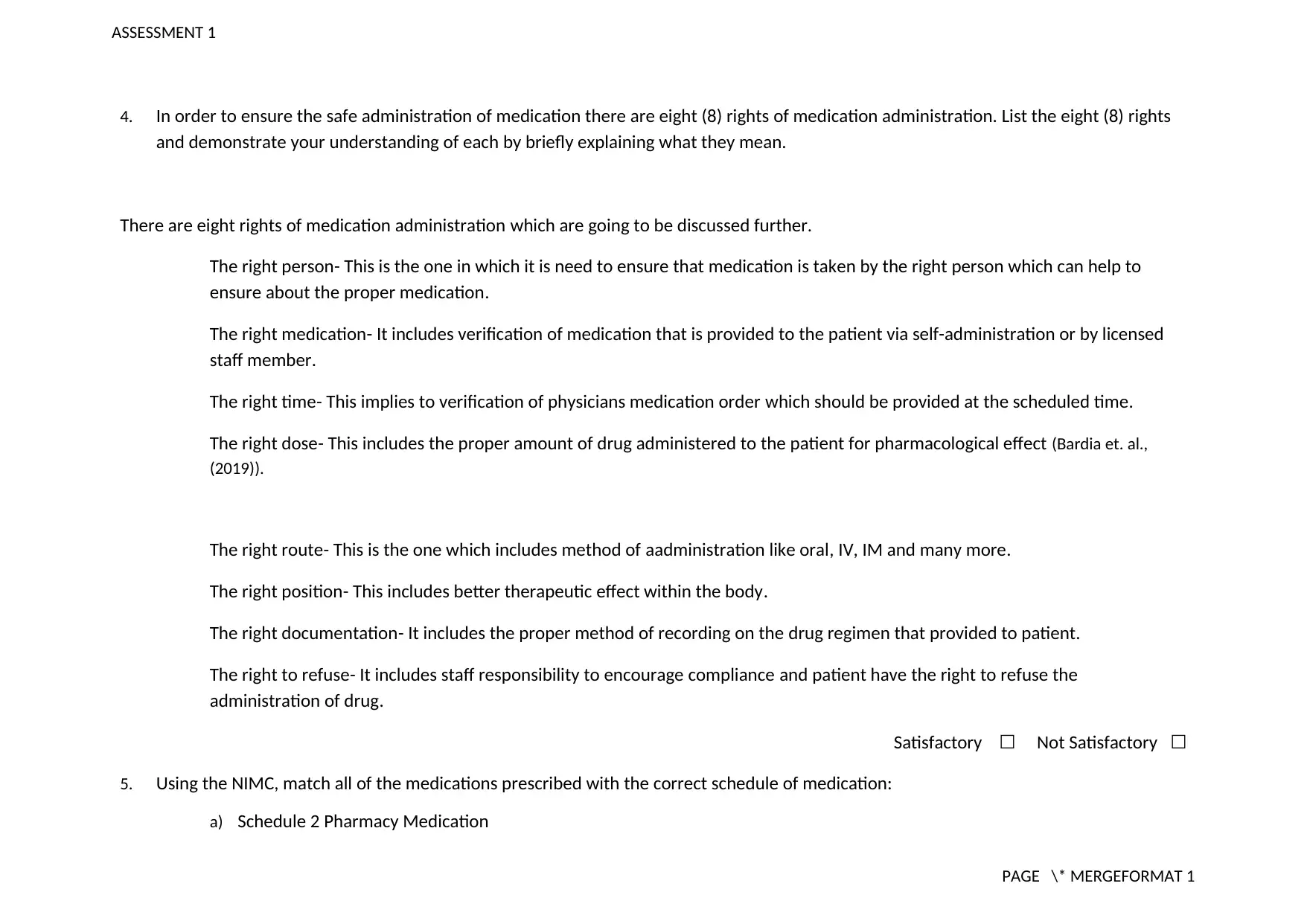
4. In order to ensure the safe administration of medication there are eight (8) rights of medication administration. List the eight (8) rights
and demonstrate your understanding of each by briefly explaining what they mean.
There are eight rights of medication administration which are going to be discussed further.
The right person- This is the one in which it is need to ensure that medication is taken by the right person which can help to
ensure about the proper medication.
The right medication- It includes verification of medication that is provided to the patient via self-administration or by licensed
staff member.
The right time- This implies to verification of physicians medication order which should be provided at the scheduled time.
The right dose- This includes the proper amount of drug administered to the patient for pharmacological effect (Bardia et. al.,
(2019)).
The right route- This is the one which includes method of aadministration like oral, IV, IM and many more.
The right position- This includes better therapeutic effect within the body.
The right documentation- It includes the proper method of recording on the drug regimen that provided to patient.
The right to refuse- It includes staff responsibility to encourage compliance and patient have the right to refuse the
administration of drug.
Satisfactory ☐ Not Satisfactory ☐
5. Using the NIMC, match all of the medications prescribed with the correct schedule of medication:
a) Schedule 2 Pharmacy Medication
PAGE \* MERGEFORMAT 1
4. In order to ensure the safe administration of medication there are eight (8) rights of medication administration. List the eight (8) rights
and demonstrate your understanding of each by briefly explaining what they mean.
There are eight rights of medication administration which are going to be discussed further.
The right person- This is the one in which it is need to ensure that medication is taken by the right person which can help to
ensure about the proper medication.
The right medication- It includes verification of medication that is provided to the patient via self-administration or by licensed
staff member.
The right time- This implies to verification of physicians medication order which should be provided at the scheduled time.
The right dose- This includes the proper amount of drug administered to the patient for pharmacological effect (Bardia et. al.,
(2019)).
The right route- This is the one which includes method of aadministration like oral, IV, IM and many more.
The right position- This includes better therapeutic effect within the body.
The right documentation- It includes the proper method of recording on the drug regimen that provided to patient.
The right to refuse- It includes staff responsibility to encourage compliance and patient have the right to refuse the
administration of drug.
Satisfactory ☐ Not Satisfactory ☐
5. Using the NIMC, match all of the medications prescribed with the correct schedule of medication:
a) Schedule 2 Pharmacy Medication
PAGE \* MERGEFORMAT 1
Paraphrase This Document
Need a fresh take? Get an instant paraphrase of this document with our AI Paraphraser
ASSESSMENT 1
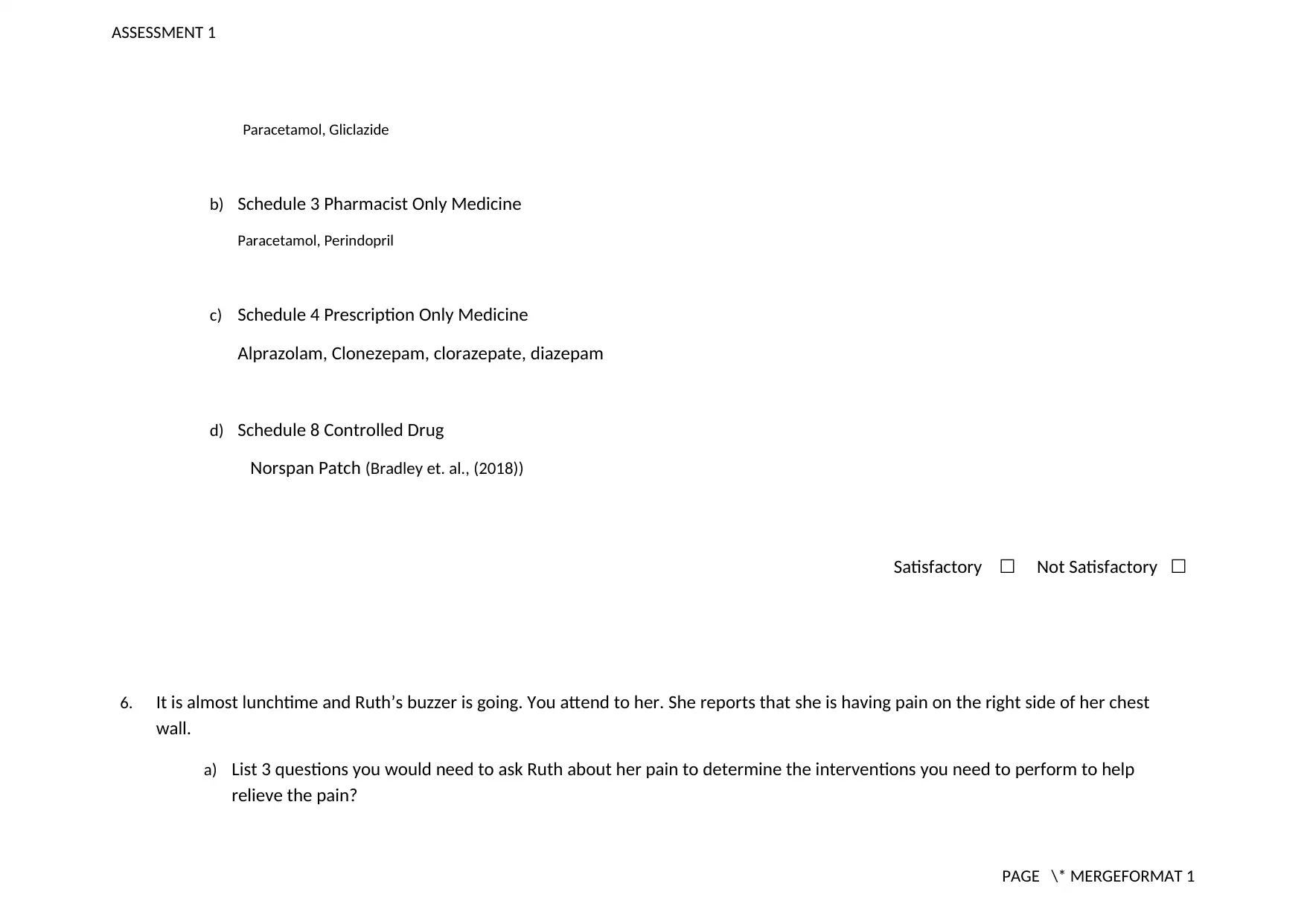
Paracetamol, Gliclazide
b) Schedule 3 Pharmacist Only Medicine
Paracetamol, Perindopril
c) Schedule 4 Prescription Only Medicine
Alprazolam, Clonezepam, clorazepate, diazepam
d) Schedule 8 Controlled Drug
Norspan Patch (Bradley et. al., (2018))
Satisfactory ☐ Not Satisfactory ☐
6. It is almost lunchtime and Ruth’s buzzer is going. You attend to her. She reports that she is having pain on the right side of her chest
wall.
a) List 3 questions you would need to ask Ruth about her pain to determine the interventions you need to perform to help
relieve the pain?
PAGE \* MERGEFORMAT 1
Paracetamol, Gliclazide
b) Schedule 3 Pharmacist Only Medicine
Paracetamol, Perindopril
c) Schedule 4 Prescription Only Medicine
Alprazolam, Clonezepam, clorazepate, diazepam
d) Schedule 8 Controlled Drug
Norspan Patch (Bradley et. al., (2018))
Satisfactory ☐ Not Satisfactory ☐
6. It is almost lunchtime and Ruth’s buzzer is going. You attend to her. She reports that she is having pain on the right side of her chest
wall.
a) List 3 questions you would need to ask Ruth about her pain to determine the interventions you need to perform to help
relieve the pain?
PAGE \* MERGEFORMAT 1
ASSESSMENT 1
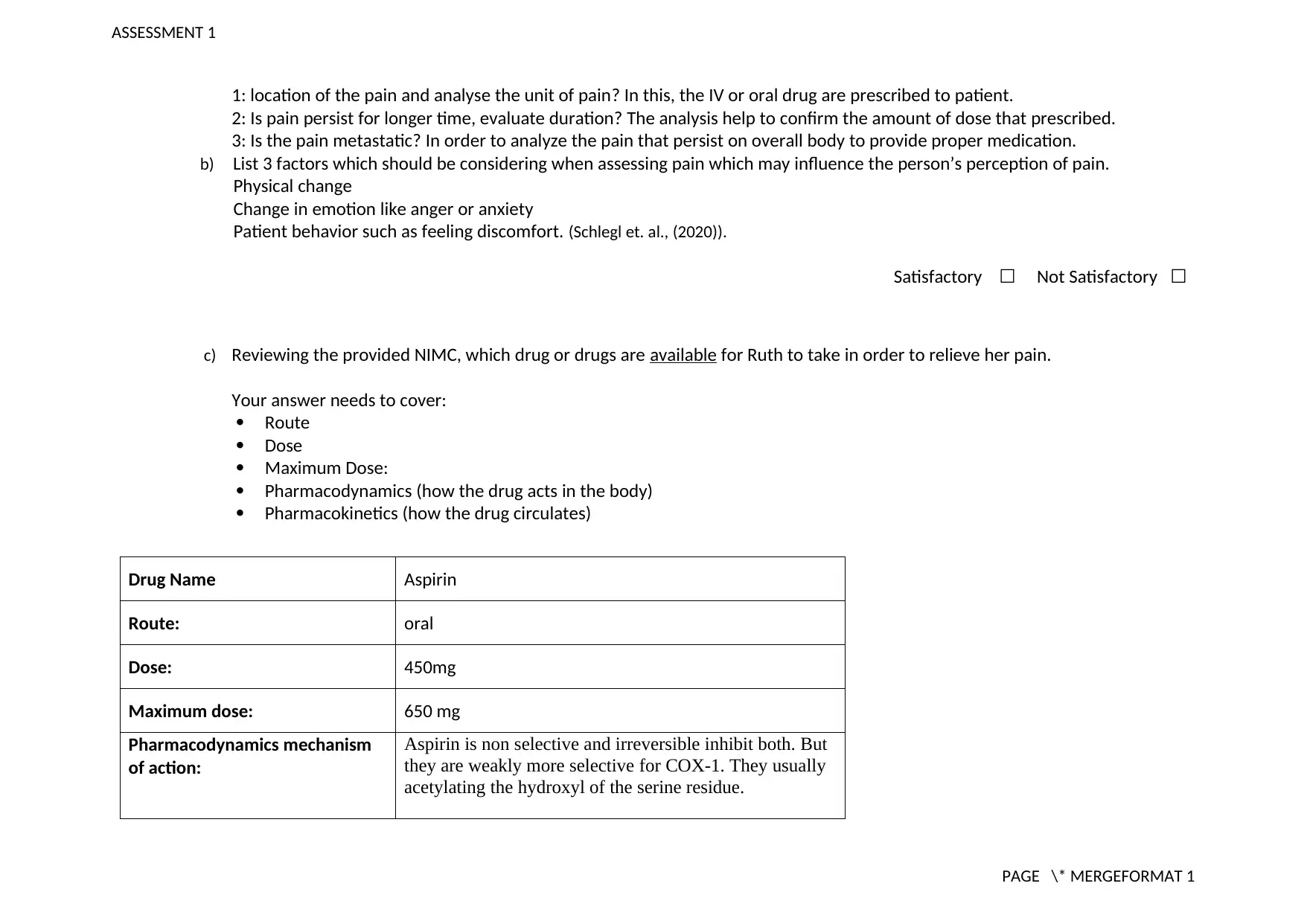
1: location of the pain and analyse the unit of pain? In this, the IV or oral drug are prescribed to patient.
2: Is pain persist for longer time, evaluate duration? The analysis help to confirm the amount of dose that prescribed.
3: Is the pain metastatic? In order to analyze the pain that persist on overall body to provide proper medication.
b) List 3 factors which should be considering when assessing pain which may influence the person’s perception of pain.
Physical change
Change in emotion like anger or anxiety
Patient behavior such as feeling discomfort. (Schlegl et. al., (2020)).
Satisfactory ☐ Not Satisfactory ☐
c) Reviewing the provided NIMC, which drug or drugs are available for Ruth to take in order to relieve her pain.
Your answer needs to cover:
Route
Dose
Maximum Dose:
Pharmacodynamics (how the drug acts in the body)
Pharmacokinetics (how the drug circulates)
Drug Name Aspirin
Route: oral
Dose: 450mg
Maximum dose: 650 mg
Pharmacodynamics mechanism
of action:
Aspirin is non selective and irreversible inhibit both. But
they are weakly more selective for COX-1. They usually
acetylating the hydroxyl of the serine residue.
PAGE \* MERGEFORMAT 1
1: location of the pain and analyse the unit of pain? In this, the IV or oral drug are prescribed to patient.
2: Is pain persist for longer time, evaluate duration? The analysis help to confirm the amount of dose that prescribed.
3: Is the pain metastatic? In order to analyze the pain that persist on overall body to provide proper medication.
b) List 3 factors which should be considering when assessing pain which may influence the person’s perception of pain.
Physical change
Change in emotion like anger or anxiety
Patient behavior such as feeling discomfort. (Schlegl et. al., (2020)).
Satisfactory ☐ Not Satisfactory ☐
c) Reviewing the provided NIMC, which drug or drugs are available for Ruth to take in order to relieve her pain.
Your answer needs to cover:
Route
Dose
Maximum Dose:
Pharmacodynamics (how the drug acts in the body)
Pharmacokinetics (how the drug circulates)
Drug Name Aspirin
Route: oral
Dose: 450mg
Maximum dose: 650 mg
Pharmacodynamics mechanism
of action:
Aspirin is non selective and irreversible inhibit both. But
they are weakly more selective for COX-1. They usually
acetylating the hydroxyl of the serine residue.
PAGE \* MERGEFORMAT 1
⊘ This is a preview!⊘
Do you want full access?
Subscribe today to unlock all pages.
Trusted by 1+ million students worldwide
ASSESSMENT 1
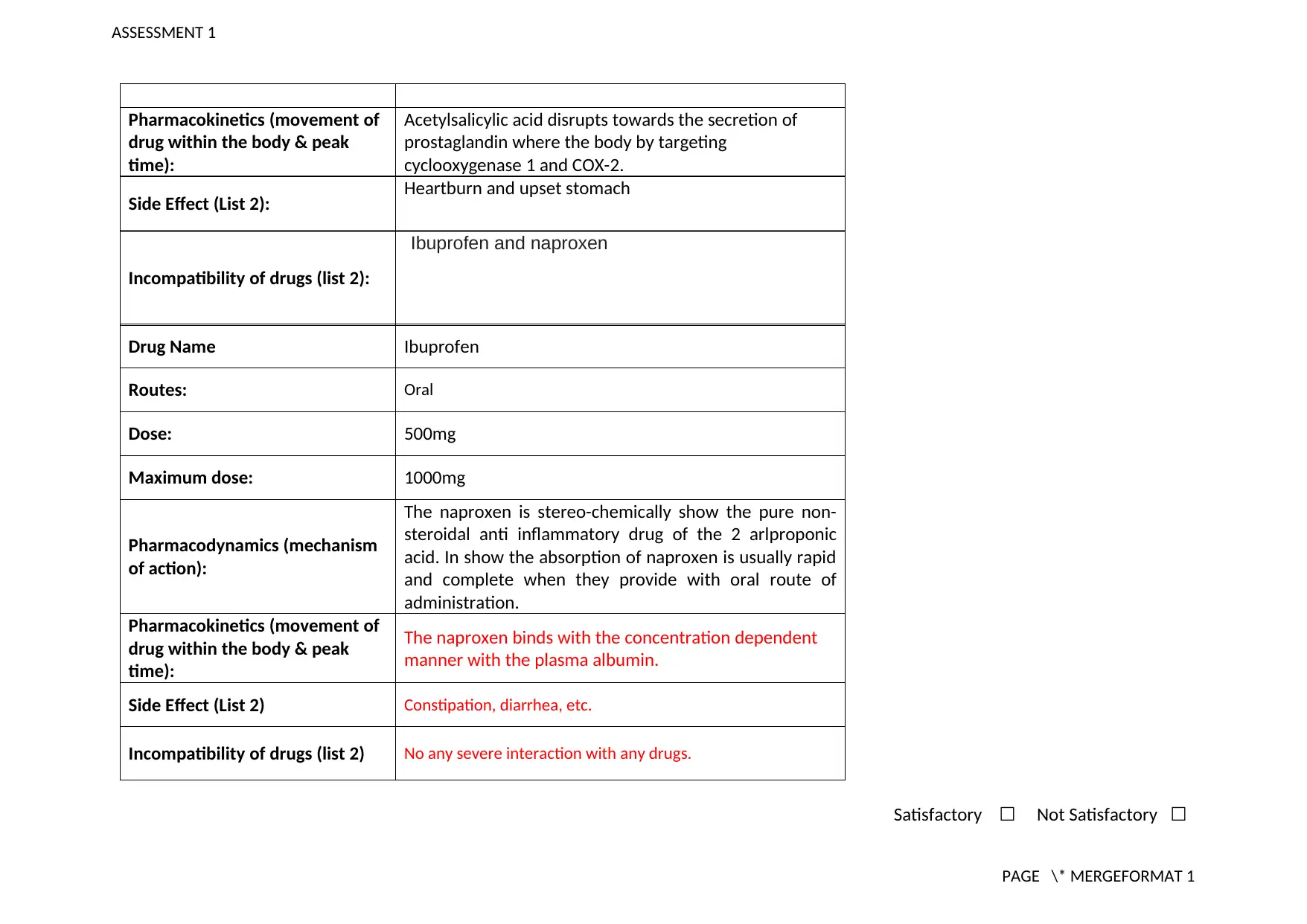
Pharmacokinetics (movement of
drug within the body & peak
time):
Acetylsalicylic acid disrupts towards the secretion of
prostaglandin where the body by targeting
cyclooxygenase 1 and COX-2.
Side Effect (List 2): Heartburn and upset stomach
Incompatibility of drugs (list 2):
Ibuprofen and naproxen
Drug Name Ibuprofen
Routes: Oral
Dose: 500mg
Maximum dose: 1000mg
Pharmacodynamics (mechanism
of action):
The naproxen is stereo-chemically show the pure non-
steroidal anti inflammatory drug of the 2 arlproponic
acid. In show the absorption of naproxen is usually rapid
and complete when they provide with oral route of
administration.
Pharmacokinetics (movement of
drug within the body & peak
time):
The naproxen binds with the concentration dependent
manner with the plasma albumin.
Side Effect (List 2) Constipation, diarrhea, etc.
Incompatibility of drugs (list 2) No any severe interaction with any drugs.
Satisfactory ☐ Not Satisfactory ☐
PAGE \* MERGEFORMAT 1
Pharmacokinetics (movement of
drug within the body & peak
time):
Acetylsalicylic acid disrupts towards the secretion of
prostaglandin where the body by targeting
cyclooxygenase 1 and COX-2.
Side Effect (List 2): Heartburn and upset stomach
Incompatibility of drugs (list 2):
Ibuprofen and naproxen
Drug Name Ibuprofen
Routes: Oral
Dose: 500mg
Maximum dose: 1000mg
Pharmacodynamics (mechanism
of action):
The naproxen is stereo-chemically show the pure non-
steroidal anti inflammatory drug of the 2 arlproponic
acid. In show the absorption of naproxen is usually rapid
and complete when they provide with oral route of
administration.
Pharmacokinetics (movement of
drug within the body & peak
time):
The naproxen binds with the concentration dependent
manner with the plasma albumin.
Side Effect (List 2) Constipation, diarrhea, etc.
Incompatibility of drugs (list 2) No any severe interaction with any drugs.
Satisfactory ☐ Not Satisfactory ☐
PAGE \* MERGEFORMAT 1
Paraphrase This Document
Need a fresh take? Get an instant paraphrase of this document with our AI Paraphraser
ASSESSMENT 1
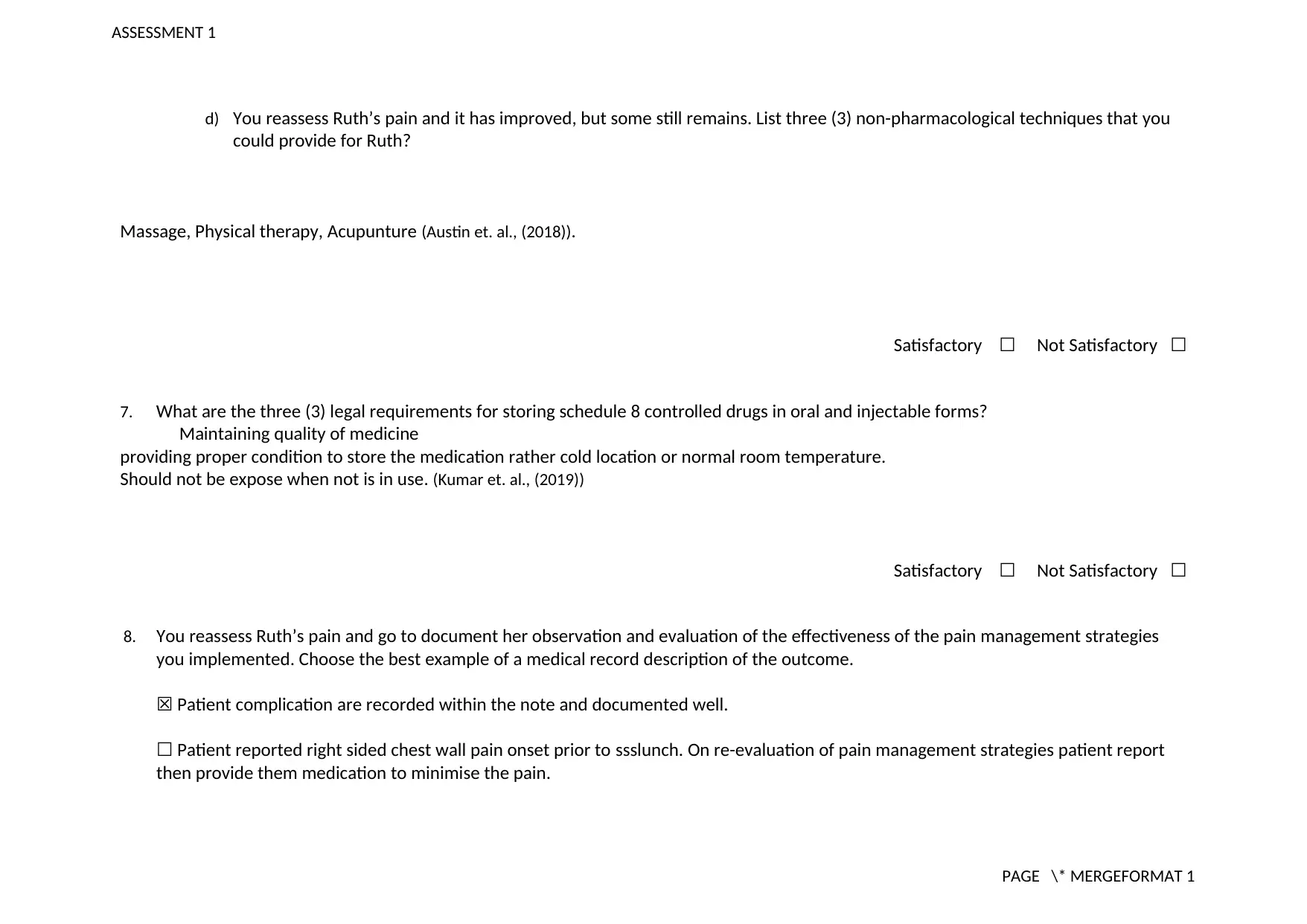
d) You reassess Ruth’s pain and it has improved, but some still remains. List three (3) non-pharmacological techniques that you
could provide for Ruth?
Massage, Physical therapy, Acupunture (Austin et. al., (2018)).
Satisfactory ☐ Not Satisfactory ☐
7. What are the three (3) legal requirements for storing schedule 8 controlled drugs in oral and injectable forms?
Maintaining quality of medicine
providing proper condition to store the medication rather cold location or normal room temperature.
Should not be expose when not is in use. (Kumar et. al., (2019))
Satisfactory ☐ Not Satisfactory ☐
8. You reassess Ruth’s pain and go to document her observation and evaluation of the effectiveness of the pain management strategies
you implemented. Choose the best example of a medical record description of the outcome.
☒ Patient complication are recorded within the note and documented well.
☐ Patient reported right sided chest wall pain onset prior to ssslunch. On re-evaluation of pain management strategies patient report
then provide them medication to minimise the pain.
PAGE \* MERGEFORMAT 1
d) You reassess Ruth’s pain and it has improved, but some still remains. List three (3) non-pharmacological techniques that you
could provide for Ruth?
Massage, Physical therapy, Acupunture (Austin et. al., (2018)).
Satisfactory ☐ Not Satisfactory ☐
7. What are the three (3) legal requirements for storing schedule 8 controlled drugs in oral and injectable forms?
Maintaining quality of medicine
providing proper condition to store the medication rather cold location or normal room temperature.
Should not be expose when not is in use. (Kumar et. al., (2019))
Satisfactory ☐ Not Satisfactory ☐
8. You reassess Ruth’s pain and go to document her observation and evaluation of the effectiveness of the pain management strategies
you implemented. Choose the best example of a medical record description of the outcome.
☒ Patient complication are recorded within the note and documented well.
☐ Patient reported right sided chest wall pain onset prior to ssslunch. On re-evaluation of pain management strategies patient report
then provide them medication to minimise the pain.
PAGE \* MERGEFORMAT 1
ASSESSMENT 1
Satisfactory ☐ Not Satisfactory ☐
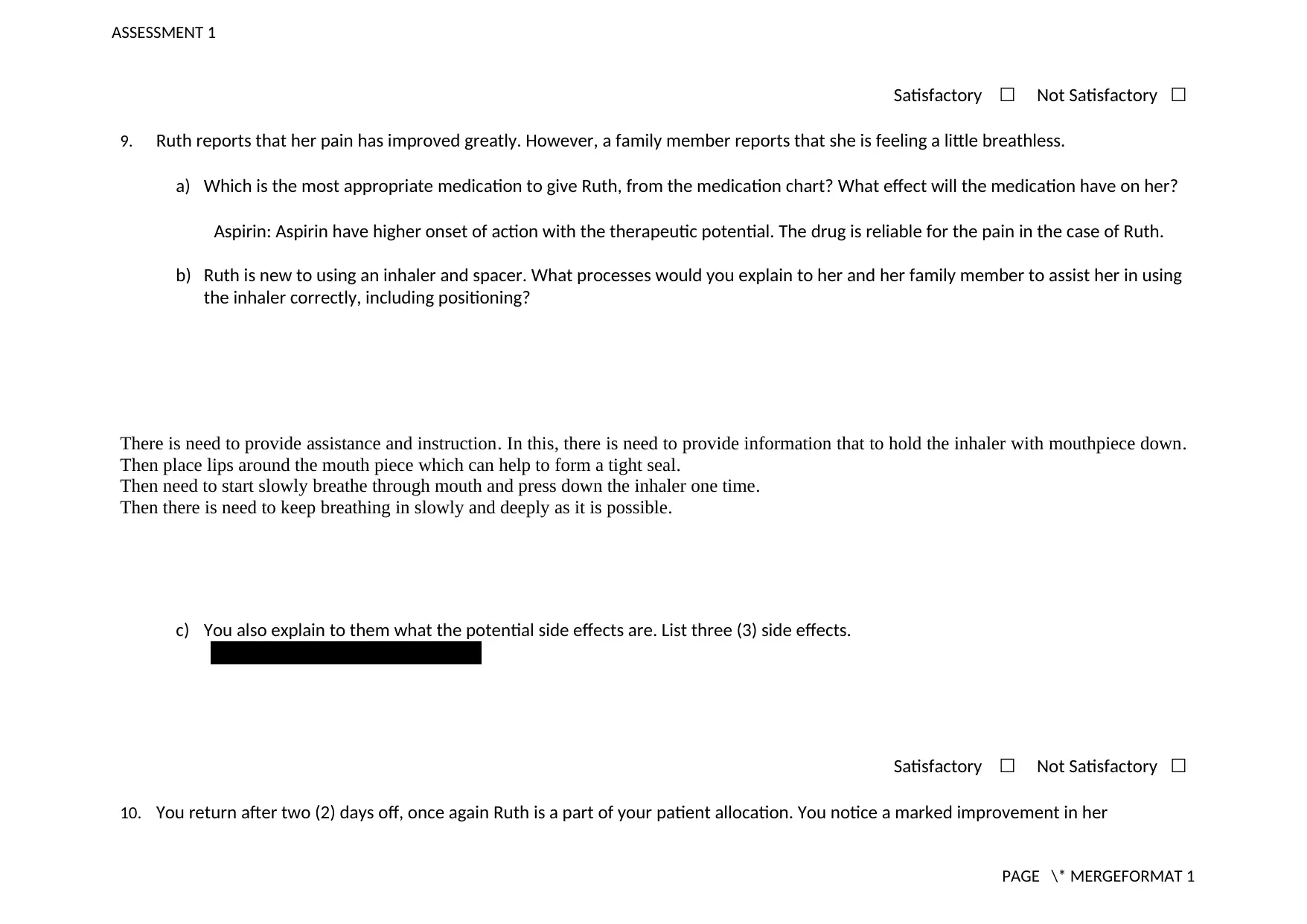
9. Ruth reports that her pain has improved greatly. However, a family member reports that she is feeling a little breathless.
a) Which is the most appropriate medication to give Ruth, from the medication chart? What effect will the medication have on her?
Aspirin: Aspirin have higher onset of action with the therapeutic potential. The drug is reliable for the pain in the case of Ruth.
b) Ruth is new to using an inhaler and spacer. What processes would you explain to her and her family member to assist her in using
the inhaler correctly, including positioning?
There is need to provide assistance and instruction. In this, there is need to provide information that to hold the inhaler with mouthpiece down.
Then place lips around the mouth piece which can help to form a tight seal.
Then need to start slowly breathe through mouth and press down the inhaler one time.
Then there is need to keep breathing in slowly and deeply as it is possible.
c) You also explain to them what the potential side effects are. List three (3) side effects.
Persistent cough, tightness in chest.
Satisfactory ☐ Not Satisfactory ☐
10. You return after two (2) days off, once again Ruth is a part of your patient allocation. You notice a marked improvement in her
PAGE \* MERGEFORMAT 1
Satisfactory ☐ Not Satisfactory ☐
9. Ruth reports that her pain has improved greatly. However, a family member reports that she is feeling a little breathless.
a) Which is the most appropriate medication to give Ruth, from the medication chart? What effect will the medication have on her?
Aspirin: Aspirin have higher onset of action with the therapeutic potential. The drug is reliable for the pain in the case of Ruth.
b) Ruth is new to using an inhaler and spacer. What processes would you explain to her and her family member to assist her in using
the inhaler correctly, including positioning?
There is need to provide assistance and instruction. In this, there is need to provide information that to hold the inhaler with mouthpiece down.
Then place lips around the mouth piece which can help to form a tight seal.
Then need to start slowly breathe through mouth and press down the inhaler one time.
Then there is need to keep breathing in slowly and deeply as it is possible.
c) You also explain to them what the potential side effects are. List three (3) side effects.
Persistent cough, tightness in chest.
Satisfactory ☐ Not Satisfactory ☐
10. You return after two (2) days off, once again Ruth is a part of your patient allocation. You notice a marked improvement in her
PAGE \* MERGEFORMAT 1
⊘ This is a preview!⊘
Do you want full access?
Subscribe today to unlock all pages.
Trusted by 1+ million students worldwide
ASSESSMENT 1
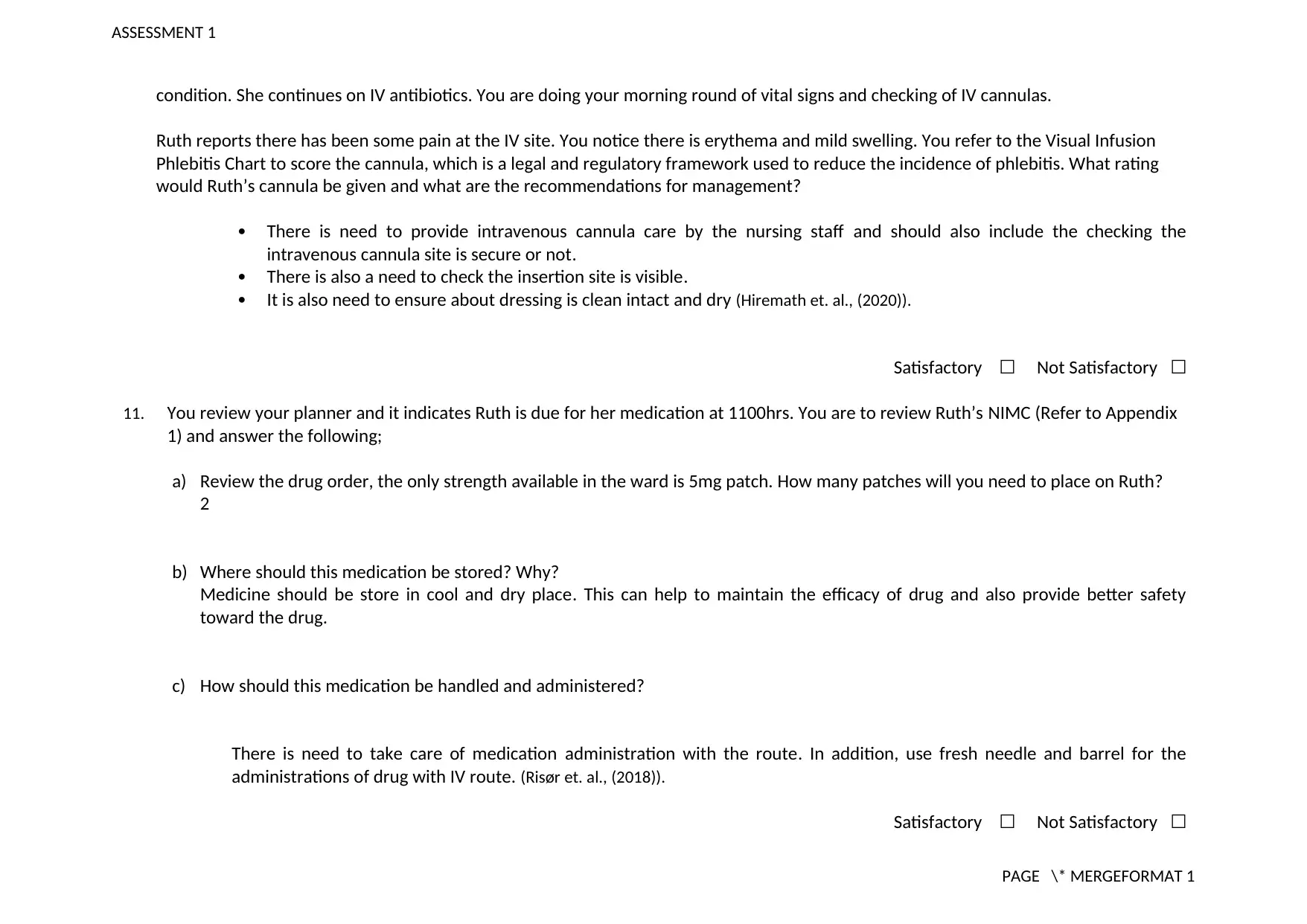
condition. She continues on IV antibiotics. You are doing your morning round of vital signs and checking of IV cannulas.
Ruth reports there has been some pain at the IV site. You notice there is erythema and mild swelling. You refer to the Visual Infusion
Phlebitis Chart to score the cannula, which is a legal and regulatory framework used to reduce the incidence of phlebitis. What rating
would Ruth’s cannula be given and what are the recommendations for management?
There is need to provide intravenous cannula care by the nursing staff and should also include the checking the
intravenous cannula site is secure or not.
There is also a need to check the insertion site is visible.
It is also need to ensure about dressing is clean intact and dry (Hiremath et. al., (2020)).
Satisfactory ☐ Not Satisfactory ☐
11. You review your planner and it indicates Ruth is due for her medication at 1100hrs. You are to review Ruth’s NIMC (Refer to Appendix
1) and answer the following;
a) Review the drug order, the only strength available in the ward is 5mg patch. How many patches will you need to place on Ruth?
2
b) Where should this medication be stored? Why?
Medicine should be store in cool and dry place. This can help to maintain the efficacy of drug and also provide better safety
toward the drug.
c) How should this medication be handled and administered?
There is need to take care of medication administration with the route. In addition, use fresh needle and barrel for the
administrations of drug with IV route. (Risør et. al., (2018)).
Satisfactory ☐ Not Satisfactory ☐
PAGE \* MERGEFORMAT 1
condition. She continues on IV antibiotics. You are doing your morning round of vital signs and checking of IV cannulas.
Ruth reports there has been some pain at the IV site. You notice there is erythema and mild swelling. You refer to the Visual Infusion
Phlebitis Chart to score the cannula, which is a legal and regulatory framework used to reduce the incidence of phlebitis. What rating
would Ruth’s cannula be given and what are the recommendations for management?
There is need to provide intravenous cannula care by the nursing staff and should also include the checking the
intravenous cannula site is secure or not.
There is also a need to check the insertion site is visible.
It is also need to ensure about dressing is clean intact and dry (Hiremath et. al., (2020)).
Satisfactory ☐ Not Satisfactory ☐
11. You review your planner and it indicates Ruth is due for her medication at 1100hrs. You are to review Ruth’s NIMC (Refer to Appendix
1) and answer the following;
a) Review the drug order, the only strength available in the ward is 5mg patch. How many patches will you need to place on Ruth?
2
b) Where should this medication be stored? Why?
Medicine should be store in cool and dry place. This can help to maintain the efficacy of drug and also provide better safety
toward the drug.
c) How should this medication be handled and administered?
There is need to take care of medication administration with the route. In addition, use fresh needle and barrel for the
administrations of drug with IV route. (Risør et. al., (2018)).
Satisfactory ☐ Not Satisfactory ☐
PAGE \* MERGEFORMAT 1
Paraphrase This Document
Need a fresh take? Get an instant paraphrase of this document with our AI Paraphraser
ASSESSMENT 1
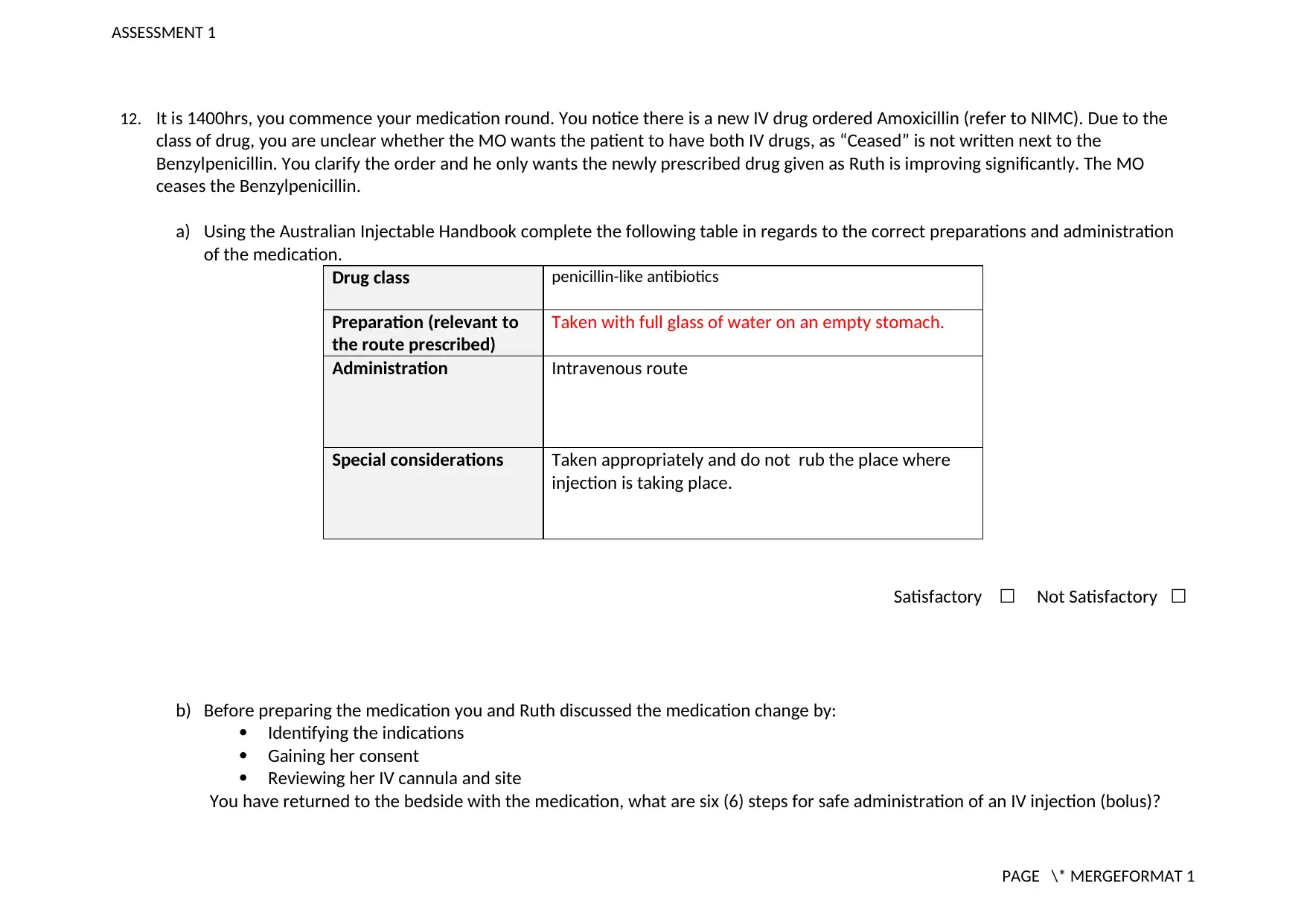
12. It is 1400hrs, you commence your medication round. You notice there is a new IV drug ordered Amoxicillin (refer to NIMC). Due to the
class of drug, you are unclear whether the MO wants the patient to have both IV drugs, as “Ceased” is not written next to the
Benzylpenicillin. You clarify the order and he only wants the newly prescribed drug given as Ruth is improving significantly. The MO
ceases the Benzylpenicillin.
a) Using the Australian Injectable Handbook complete the following table in regards to the correct preparations and administration
of the medication.
Drug class penicillin-like antibiotics
Preparation (relevant to
the route prescribed)
Taken with full glass of water on an empty stomach.
Administration Intravenous route
Special considerations Taken appropriately and do not rub the place where
injection is taking place.
Satisfactory ☐ Not Satisfactory ☐
b) Before preparing the medication you and Ruth discussed the medication change by:
Identifying the indications
Gaining her consent
Reviewing her IV cannula and site
You have returned to the bedside with the medication, what are six (6) steps for safe administration of an IV injection (bolus)?
PAGE \* MERGEFORMAT 1
12. It is 1400hrs, you commence your medication round. You notice there is a new IV drug ordered Amoxicillin (refer to NIMC). Due to the
class of drug, you are unclear whether the MO wants the patient to have both IV drugs, as “Ceased” is not written next to the
Benzylpenicillin. You clarify the order and he only wants the newly prescribed drug given as Ruth is improving significantly. The MO
ceases the Benzylpenicillin.
a) Using the Australian Injectable Handbook complete the following table in regards to the correct preparations and administration
of the medication.
Drug class penicillin-like antibiotics
Preparation (relevant to
the route prescribed)
Taken with full glass of water on an empty stomach.
Administration Intravenous route
Special considerations Taken appropriately and do not rub the place where
injection is taking place.
Satisfactory ☐ Not Satisfactory ☐
b) Before preparing the medication you and Ruth discussed the medication change by:
Identifying the indications
Gaining her consent
Reviewing her IV cannula and site
You have returned to the bedside with the medication, what are six (6) steps for safe administration of an IV injection (bolus)?
PAGE \* MERGEFORMAT 1
ASSESSMENT 1
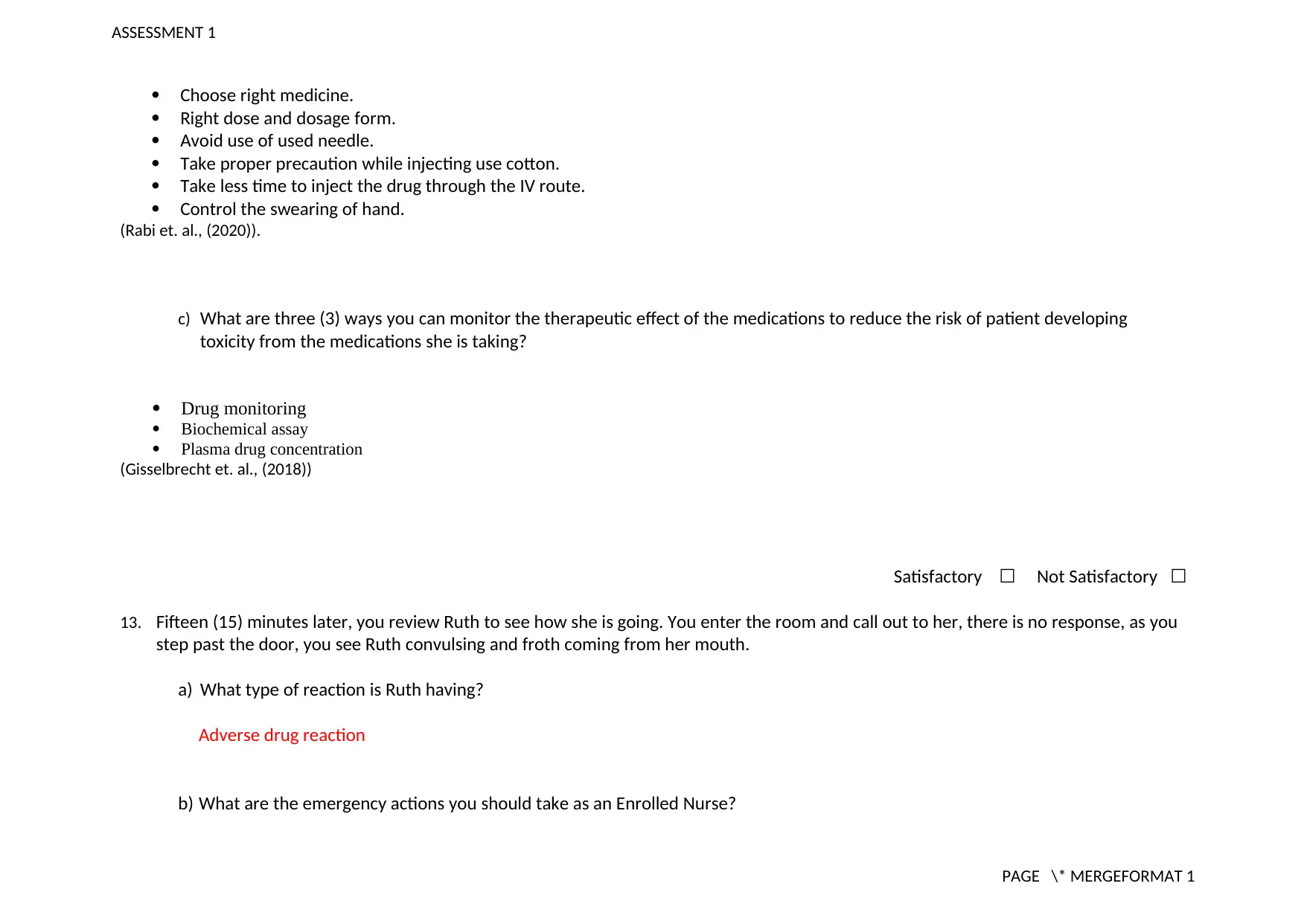
Choose right medicine.
Right dose and dosage form.
Avoid use of used needle.
Take proper precaution while injecting use cotton.
Take less time to inject the drug through the IV route.
Control the swearing of hand.
(Rabi et. al., (2020)).
c) What are three (3) ways you can monitor the therapeutic effect of the medications to reduce the risk of patient developing
toxicity from the medications she is taking?
Drug monitoring
Biochemical assay
Plasma drug concentration
(Gisselbrecht et. al., (2018))
Satisfactory ☐ Not Satisfactory ☐
13. Fifteen (15) minutes later, you review Ruth to see how she is going. You enter the room and call out to her, there is no response, as you
step past the door, you see Ruth convulsing and froth coming from her mouth.
a) What type of reaction is Ruth having?
Adverse drug reaction
b) What are the emergency actions you should take as an Enrolled Nurse?
PAGE \* MERGEFORMAT 1
Choose right medicine.
Right dose and dosage form.
Avoid use of used needle.
Take proper precaution while injecting use cotton.
Take less time to inject the drug through the IV route.
Control the swearing of hand.
(Rabi et. al., (2020)).
c) What are three (3) ways you can monitor the therapeutic effect of the medications to reduce the risk of patient developing
toxicity from the medications she is taking?
Drug monitoring
Biochemical assay
Plasma drug concentration
(Gisselbrecht et. al., (2018))
Satisfactory ☐ Not Satisfactory ☐
13. Fifteen (15) minutes later, you review Ruth to see how she is going. You enter the room and call out to her, there is no response, as you
step past the door, you see Ruth convulsing and froth coming from her mouth.
a) What type of reaction is Ruth having?
Adverse drug reaction
b) What are the emergency actions you should take as an Enrolled Nurse?
PAGE \* MERGEFORMAT 1
⊘ This is a preview!⊘
Do you want full access?
Subscribe today to unlock all pages.
Trusted by 1+ million students worldwide

1 out of 25


Your All-in-One AI-Powered Toolkit for Academic Success.
+13062052269
info@desklib.com
Available 24*7 on WhatsApp / Email
![[object Object]](/_next/static/media/star-bottom.7253800d.svg)
Unlock your academic potential
Copyright © 2020–2026 A2Z Services. All Rights Reserved. Developed and managed by ZUCOL.