Criminal Law 5: University Analysis of Youth Offending Case Study
VerifiedAdded on 2022/09/11
|6
|904
|14
Homework Assignment
AI Summary
This assignment delves into the critical issue of youth offending, analyzing its causes and the legal system's response. The document examines factors such as peer pressure, poverty, lack of parental guidance, and exposure to criminal behavior as significant contributors to juvenile crime. It uses the case of Police v. CW 2012 NSWSC 16 to illustrate these points, highlighting the challenges faced by homeless youth and the consequences of their actions. The analysis also explores preventative methods, including educational programs, guidance, supervision, and the importance of establishing rules and providing counseling. The assignment references relevant cases and resources to provide a comprehensive understanding of youth offending, its impact, and potential solutions within the criminal law framework.
University
Nature and Extent of Youth Offending
Police v. CW 2012 NSWSC 16
Student Credentials
4/6/2020
Nature and Extent of Youth Offending
Police v. CW 2012 NSWSC 16
Student Credentials
4/6/2020
Paraphrase This Document
Need a fresh take? Get an instant paraphrase of this document with our AI Paraphraser

Criminal Law 1
Mind Map
Mind Map

Criminal Law 2
⊘ This is a preview!⊘
Do you want full access?
Subscribe today to unlock all pages.

Trusted by 1+ million students worldwide

Criminal Law 3
Analysis of the Events of the Case Police v. CW 2012 NSWSC 16
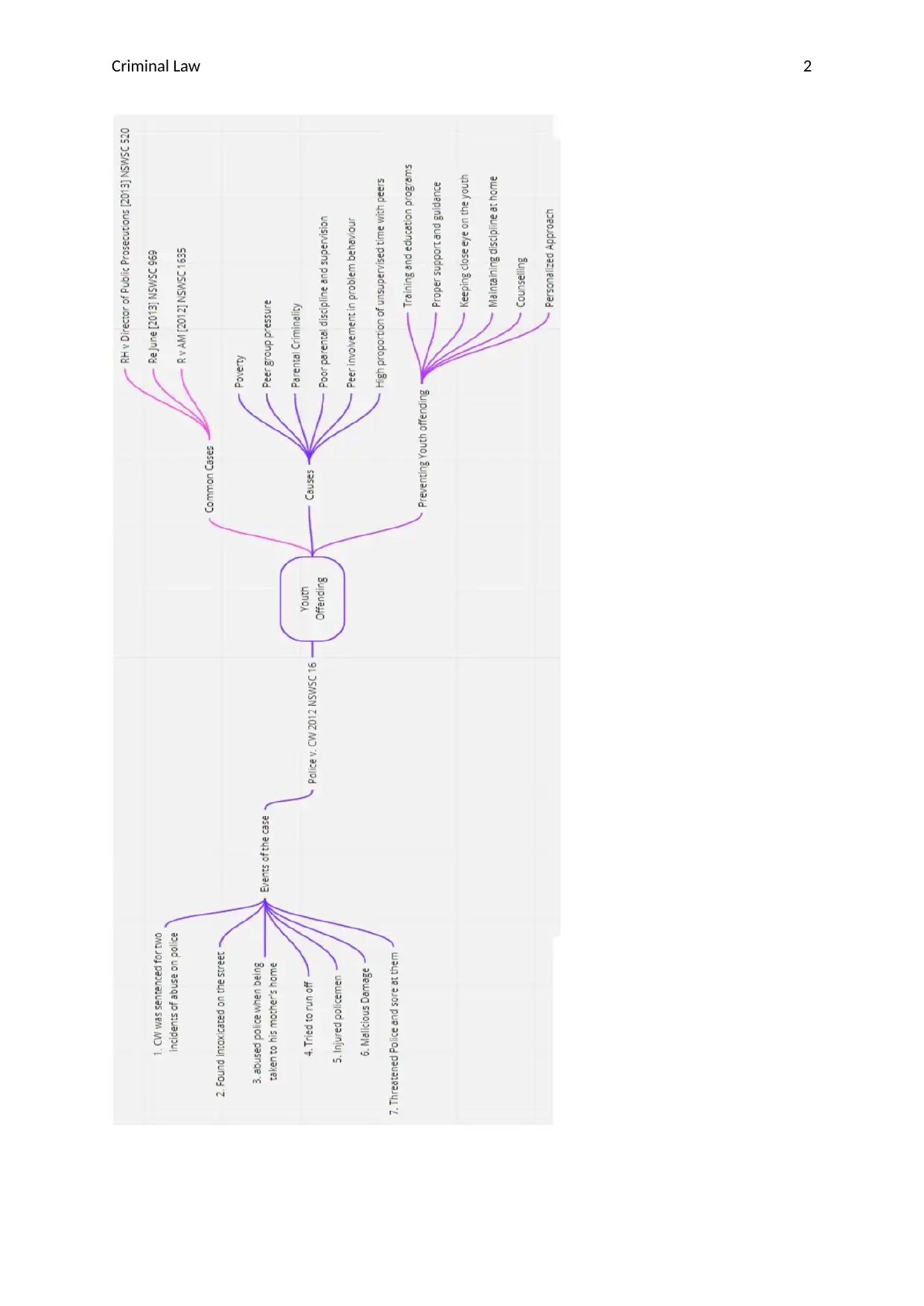
Youth Offending is something that has become a common occurrence in the country. In order
to cope with it, the legal system has taken certain steps as well so that there is less such kind
of occurrence in the country. The major causes of such kinds of incidences include the peer
pressure that youth faces on day to day basis, poverty, or even in scenarios such as the one
where the parents are involved in a criminal activity, or even when parents either don’t know
how to control the youth or there is no specific discipline in the family that the parents follow
or the youth in the family is supposed to follow. Few other causes include the non -
involvement of parents in the activities of the youth as well as allowing the youth to stay with
random people or unsupervised for long time period can also affect the thinking of the young
individuals or direct them towards criminal activities. This type of behaviour can be
prevented by adapting certain methods according to which, the constant Youth Offending can
be stopped. These methods include; providing students with apt kind of training or making
them a part of a particular program or regime that helps them grow into better people and
detach them from the criminal world; another aspect here is proving youth with proper
guidance as well as support, especially in cases where the youth or a young person tries to
talk about certain issues he/she has been facing; Keeping the youth under supervision,
maintaining a constant eye on them is another key to prevent any criminal activity in general,
as this way people can figure out more about what is happening in the lives of these
individuals; maintaining rules and following them is one another aspect that can help youth
crime or offending reduce a lot as most of these people actually do not belong to proper
families, there has been a struggle to teach these youngsters good morals and deeds; apart
from all these, counselling and a personalized approach can help them as well. The famous
cases that can be rendered to or read in order to understand a few reasons or situations that
lead the youth towards criminal behaviour are: Re June [2013] NSWSC 969, RH v Director
Analysis of the Events of the Case Police v. CW 2012 NSWSC 16
Youth Offending is something that has become a common occurrence in the country. In order
to cope with it, the legal system has taken certain steps as well so that there is less such kind
of occurrence in the country. The major causes of such kinds of incidences include the peer
pressure that youth faces on day to day basis, poverty, or even in scenarios such as the one
where the parents are involved in a criminal activity, or even when parents either don’t know
how to control the youth or there is no specific discipline in the family that the parents follow
or the youth in the family is supposed to follow. Few other causes include the non -
involvement of parents in the activities of the youth as well as allowing the youth to stay with
random people or unsupervised for long time period can also affect the thinking of the young
individuals or direct them towards criminal activities. This type of behaviour can be
prevented by adapting certain methods according to which, the constant Youth Offending can
be stopped. These methods include; providing students with apt kind of training or making
them a part of a particular program or regime that helps them grow into better people and
detach them from the criminal world; another aspect here is proving youth with proper
guidance as well as support, especially in cases where the youth or a young person tries to
talk about certain issues he/she has been facing; Keeping the youth under supervision,
maintaining a constant eye on them is another key to prevent any criminal activity in general,
as this way people can figure out more about what is happening in the lives of these
individuals; maintaining rules and following them is one another aspect that can help youth
crime or offending reduce a lot as most of these people actually do not belong to proper
families, there has been a struggle to teach these youngsters good morals and deeds; apart
from all these, counselling and a personalized approach can help them as well. The famous
cases that can be rendered to or read in order to understand a few reasons or situations that
lead the youth towards criminal behaviour are: Re June [2013] NSWSC 969, RH v Director
Paraphrase This Document
Need a fresh take? Get an instant paraphrase of this document with our AI Paraphraser

Criminal Law 4
of Public Prosecutions [2013] NSWSC 520, and also R v AM [2012] NSWSC 1635
(Children's Court, 2020).
In the mentioned case, Police v. CW 2012 NSWSC 16, CW is a youngster who has been on
the street as a homeless person, often taken advantage of and that has turned him into a
rebellious person. Such youth that does not has a proper family, makes it even more difficult
as there is no one to take care of and there is no sense of belongingness. As a result of this, he
has no knowledge of what is right and what is wrong for him, this is why, being intoxicated
and abusing the police did not seem like a big mistake to him. After being sentenced as well,
when he was being taken home, he refused the same and again abused the police by injuring
them to a certain level and out of the two injured cops’ one was a woman as well. This can be
concluded from this incidence that the CW in this case has no knowledge regarding what is
right and what is wrong. He also tried to escape or run away while being brought in by the
police to his mother’s house, this means that CW did not have any normal relationship with
his mother and she did not play an important role in his life. This is why, the youngster CW
could not be taught any good deed as there was no family to teach him the basics of surviving
like a truthful human being. Apart from this, he was also found with drugs on him as in
specifically Cannabis and Injuring policemen at work or duty both are serious crimes, apart
from these, there have been incidences of malicious damage as well and threats have been
given to these law enforcement authorities that CW committed. While being on trial he even
swore at the police. All these incidences specifically state CW never learnt the morals and
never got to know about the humanitarian side that he was supposed to have. He did what he
saw people doing on the street which is harming or injuring people and conducting criminal
activities (Sumner, 2020).
of Public Prosecutions [2013] NSWSC 520, and also R v AM [2012] NSWSC 1635
(Children's Court, 2020).
In the mentioned case, Police v. CW 2012 NSWSC 16, CW is a youngster who has been on
the street as a homeless person, often taken advantage of and that has turned him into a
rebellious person. Such youth that does not has a proper family, makes it even more difficult
as there is no one to take care of and there is no sense of belongingness. As a result of this, he
has no knowledge of what is right and what is wrong for him, this is why, being intoxicated
and abusing the police did not seem like a big mistake to him. After being sentenced as well,
when he was being taken home, he refused the same and again abused the police by injuring
them to a certain level and out of the two injured cops’ one was a woman as well. This can be
concluded from this incidence that the CW in this case has no knowledge regarding what is
right and what is wrong. He also tried to escape or run away while being brought in by the
police to his mother’s house, this means that CW did not have any normal relationship with
his mother and she did not play an important role in his life. This is why, the youngster CW
could not be taught any good deed as there was no family to teach him the basics of surviving
like a truthful human being. Apart from this, he was also found with drugs on him as in
specifically Cannabis and Injuring policemen at work or duty both are serious crimes, apart
from these, there have been incidences of malicious damage as well and threats have been
given to these law enforcement authorities that CW committed. While being on trial he even
swore at the police. All these incidences specifically state CW never learnt the morals and
never got to know about the humanitarian side that he was supposed to have. He did what he
saw people doing on the street which is harming or injuring people and conducting criminal
activities (Sumner, 2020).

Criminal Law 5
Bibliography
Children's Court, 2020. Children's Law News Volumes. [Online] Available at:
http://www.childrenscourt.justice.nsw.gov.au/Pages/publications/lawnews/
childrens_law_news_2013.aspx [Accessed 06 April 2020].
Sumner, C., 2020. PREVENTING JUVENILE CRIME. [Online] Available at:
https://aic.gov.au/sites/default/files/publications/proceedings/downloads/22-sumner.pdf
[Accessed 06 April 2020].
Bibliography
Children's Court, 2020. Children's Law News Volumes. [Online] Available at:
http://www.childrenscourt.justice.nsw.gov.au/Pages/publications/lawnews/
childrens_law_news_2013.aspx [Accessed 06 April 2020].
Sumner, C., 2020. PREVENTING JUVENILE CRIME. [Online] Available at:
https://aic.gov.au/sites/default/files/publications/proceedings/downloads/22-sumner.pdf
[Accessed 06 April 2020].
⊘ This is a preview!⊘
Do you want full access?
Subscribe today to unlock all pages.

Trusted by 1+ million students worldwide
1 out of 6
Related Documents
Your All-in-One AI-Powered Toolkit for Academic Success.
+13062052269
info@desklib.com
Available 24*7 on WhatsApp / Email
Unlock your academic potential
Copyright © 2020–2025 A2Z Services. All Rights Reserved. Developed and managed by ZUCOL.