Evaluating Police Selection: Tertiary Education and Psych Testing
VerifiedAdded on 2023/05/30
|12
|3421
|193
Report
AI Summary
This report analyzes the proposed changes to the Thompson Valley Police Service's recruitment process, specifically the removal of tertiary education requirements and psychological testing. It explores the historical context of higher education in Australian policing, referencing the Fitzgerald Inquiry and subsequent emphasis on education. The report reviews literature on the relationship between higher education and police performance, considering arguments for and against educational requirements, and the potential impact on job satisfaction and recruitment numbers. It also examines the role of psychological assessments in ensuring officer well-being and fitness for duty, discussing potential inconsistencies in assessment methods and the impact on the recruitment process. The study highlights the importance of psychological well-being for police officers facing traumatic experiences and organizational stressors, while also noting potential drawbacks of psychological assessment, such as slowing down recruitment. This assignment is available on Desklib, a platform offering a wealth of academic resources and study tools for students.
Running head: ANALYSIS OF POLICE SELECTION PROCESS 1
Analysis of Police Selection Process
[Author Name(s), First M. Last, Omit Titles and Degrees]
[Institutional Affiliation(s)]
Author Note
Analysis of Police Selection Process
[Author Name(s), First M. Last, Omit Titles and Degrees]
[Institutional Affiliation(s)]
Author Note

Paraphrase This Document
Need a fresh take? Get an instant paraphrase of this document with our AI Paraphraser
ANALYSIS OF POLICE SELECTION PROCESS 2
Abstract
The entire career of police officers can be challenging due to both the tasks involved and the
traumatic experiences that comes with those tasks. The community on the depends on the
policing system to handle the varying difficult and frequently dangerous circumstances that come
on a daily basis. Like any other government, the Australian government has given the police
system significant powers meaning that it is vital to police understand the effects of misuse of
these powers. Considering these facts, bringing the right individuals and training them as police
officers is a vital task. The government needs also to recruit a sufficient number of suitable
individuals who can address the ever-changing problems in the current dynamic society. This
paper would be an examination of whether a removing psychological testing and requirement for
higher education can increase the number of individuals that enter into the policing, and whether
such a change can have any impact in the efficacy of the police.
Keywords: Policing, Higher Education, Tertiary Education, Recruitment, Job
Performance
Abstract
The entire career of police officers can be challenging due to both the tasks involved and the
traumatic experiences that comes with those tasks. The community on the depends on the
policing system to handle the varying difficult and frequently dangerous circumstances that come
on a daily basis. Like any other government, the Australian government has given the police
system significant powers meaning that it is vital to police understand the effects of misuse of
these powers. Considering these facts, bringing the right individuals and training them as police
officers is a vital task. The government needs also to recruit a sufficient number of suitable
individuals who can address the ever-changing problems in the current dynamic society. This
paper would be an examination of whether a removing psychological testing and requirement for
higher education can increase the number of individuals that enter into the policing, and whether
such a change can have any impact in the efficacy of the police.
Keywords: Policing, Higher Education, Tertiary Education, Recruitment, Job
Performance
ANALYSIS OF POLICE SELECTION PROCESS 3
Introduction
The society has changed bringing changes in the law. Some of the crime the world is witnessing
did not exist some years back, and if they were, they were not sophisticated as it is today. As the
society changes, so does the policing system need to change so that it can be effective in its
duties. The government needs also to recruit a sufficient number of suitable individuals who can
address the ever-changing problems in the current dynamic society. Nevertheless, this can be a
challenging task considering the tight labor market, and the fact that the recruitment process
should not compromise the quality of service, recruits’ quality and the training quality. This
paper would be an examination of whether a removing psychological testing and requirement for
higher education can increase the number of individuals that enter into the policing, and whether
such a change can have an impact in the efficacy of the police.
Higher Education and Australian Policing
The debate about the significance of tertiary education on police officers has been there
for decades. As far as Australia is concerned, this debate went to the peak in the 1990s after the
emergence of two different models of education that were meant for police officers. One of the
models was based on the traditional liberal system of education (Paterson, 2011). The model was
characterized by subjects based on social science. The second model was based on
professionalism where the policing and the universities partnered to work together. In this one,
the policing mainly concentrated on the development and control police related discipline
(Paterson, 2011).
The implementation of tertiary education in policing came to Australia following
Fitzgerald Inquiry regarding the Queensland police corruption. The enquiry stated that there is a
need for the police to have more education for enabling them to handle their increasing complex
Introduction
The society has changed bringing changes in the law. Some of the crime the world is witnessing
did not exist some years back, and if they were, they were not sophisticated as it is today. As the
society changes, so does the policing system need to change so that it can be effective in its
duties. The government needs also to recruit a sufficient number of suitable individuals who can
address the ever-changing problems in the current dynamic society. Nevertheless, this can be a
challenging task considering the tight labor market, and the fact that the recruitment process
should not compromise the quality of service, recruits’ quality and the training quality. This
paper would be an examination of whether a removing psychological testing and requirement for
higher education can increase the number of individuals that enter into the policing, and whether
such a change can have an impact in the efficacy of the police.
Higher Education and Australian Policing
The debate about the significance of tertiary education on police officers has been there
for decades. As far as Australia is concerned, this debate went to the peak in the 1990s after the
emergence of two different models of education that were meant for police officers. One of the
models was based on the traditional liberal system of education (Paterson, 2011). The model was
characterized by subjects based on social science. The second model was based on
professionalism where the policing and the universities partnered to work together. In this one,
the policing mainly concentrated on the development and control police related discipline
(Paterson, 2011).
The implementation of tertiary education in policing came to Australia following
Fitzgerald Inquiry regarding the Queensland police corruption. The enquiry stated that there is a
need for the police to have more education for enabling them to handle their increasing complex
⊘ This is a preview!⊘
Do you want full access?
Subscribe today to unlock all pages.

Trusted by 1+ million students worldwide
ANALYSIS OF POLICE SELECTION PROCESS 4
roles(Fitzgerald, 1989). The report went further to specifically point on the need for higher
education in the police sector (Fitzgerald, 1989). Following the inquiry, a notable move was
taken whereby a partnership between the Queensland Police and the Griffith University was born
which was meant to deliver an enhanced course to newly recruited police officers (Prenzler,
Martin, & Sarre, 2010).
The policing in Australian has been a topic to various inquiries all the way from 1973 to
2006 (Rogers & Frevel, 2018, p. 250). Most of these inquiries all recommended a sweep of
change to the minimum education requirement in recruitment and an internalization of training to
dominate the preparation of the recruits (State Services Authority, 2011). In spite of the
recommendations, the work of (Rogers & Frevel, 2018, p. 250) reports that there is still low-
level education entry in the Australian policing recruitment.
Literature Review regarding Police Performance and Higher Education
The debate regarding the necessity of higher education on police officers has been there
for decades (Bruns & Magnan, 2014; Eterno, 2008; National Center for Education Statistics
[NCES], 2010; Rainford, 2016). Most of the studies conducted regarding police and higher
education have been based on the general career demands and skills. For instance, (Sereni-
Massinger & Wood, 2016) recommended that police officers require advanced skills in their
policing job especially this time where police tasks have been transitioned to be more
community-based. There are also some scholars like (Rainford, 2016) who have suggested that
college education on police officers equips them with skills that prepare them for their future job,
and they have more exposure to the knowledge than their counterparts high school level police
officers.
roles(Fitzgerald, 1989). The report went further to specifically point on the need for higher
education in the police sector (Fitzgerald, 1989). Following the inquiry, a notable move was
taken whereby a partnership between the Queensland Police and the Griffith University was born
which was meant to deliver an enhanced course to newly recruited police officers (Prenzler,
Martin, & Sarre, 2010).
The policing in Australian has been a topic to various inquiries all the way from 1973 to
2006 (Rogers & Frevel, 2018, p. 250). Most of these inquiries all recommended a sweep of
change to the minimum education requirement in recruitment and an internalization of training to
dominate the preparation of the recruits (State Services Authority, 2011). In spite of the
recommendations, the work of (Rogers & Frevel, 2018, p. 250) reports that there is still low-
level education entry in the Australian policing recruitment.
Literature Review regarding Police Performance and Higher Education
The debate regarding the necessity of higher education on police officers has been there
for decades (Bruns & Magnan, 2014; Eterno, 2008; National Center for Education Statistics
[NCES], 2010; Rainford, 2016). Most of the studies conducted regarding police and higher
education have been based on the general career demands and skills. For instance, (Sereni-
Massinger & Wood, 2016) recommended that police officers require advanced skills in their
policing job especially this time where police tasks have been transitioned to be more
community-based. There are also some scholars like (Rainford, 2016) who have suggested that
college education on police officers equips them with skills that prepare them for their future job,
and they have more exposure to the knowledge than their counterparts high school level police
officers.
Paraphrase This Document
Need a fresh take? Get an instant paraphrase of this document with our AI Paraphraser
ANALYSIS OF POLICE SELECTION PROCESS 5
While looking at professionalism, a report by the United States’ (National Center for
Education Statistics [NCES], 2010) theorized that professionalism has a significant value in the
individuals. NCES argued that higher education provides an entity with a reputation as it
determines the way it exercises its responsibilities. In this report, NCES states that people
performing their roles in an organization must carry themselves out as per the set standards in
that institution (NCES, 2010). This report argues that higher education plays a higher role in
one’s professionalism. There are studies that have tried to prove a positive hypothetical link
between police officers’ professionalism and higher education. For instance, one study conducted
in (Eterno, 2008) aimed to analyze this hypothesis by putting the officers in three separate
groups. The three groups were based on their recruitment education; those with cadet
background, those lacking cadet background but had higher education; and those who had high
school level qualifications. The results of this study found that there were very few cases of
complaints from the civilians in the group of the police who had higher education than the rest of
the groups. In most of the instances, the civilian had reported cases of offensive language,
gratuitous use of force, and abuse of power in the police who never had higher education.
Similarly, in Australia, a 2007-2008 study carried in (Trofymowych, 2008) to analyze the
police perceptions of the relationship between professionalism and tertiary education revealed
that there a significant benefit of higher education in police officers. In particular, the
respondents in the study had higher confidence that tertiary education was important in police
ranking. In England, the work of (Paterson, 2011) suggested that when police officers acquire
tertiary education, they are equipped with skills that enhance their performance. Finally, in the
performance, the work of (Hudgins, 2014) stated that officers with higher education respond
appropriately to the situation, and they have better communication skills when interacting with
While looking at professionalism, a report by the United States’ (National Center for
Education Statistics [NCES], 2010) theorized that professionalism has a significant value in the
individuals. NCES argued that higher education provides an entity with a reputation as it
determines the way it exercises its responsibilities. In this report, NCES states that people
performing their roles in an organization must carry themselves out as per the set standards in
that institution (NCES, 2010). This report argues that higher education plays a higher role in
one’s professionalism. There are studies that have tried to prove a positive hypothetical link
between police officers’ professionalism and higher education. For instance, one study conducted
in (Eterno, 2008) aimed to analyze this hypothesis by putting the officers in three separate
groups. The three groups were based on their recruitment education; those with cadet
background, those lacking cadet background but had higher education; and those who had high
school level qualifications. The results of this study found that there were very few cases of
complaints from the civilians in the group of the police who had higher education than the rest of
the groups. In most of the instances, the civilian had reported cases of offensive language,
gratuitous use of force, and abuse of power in the police who never had higher education.
Similarly, in Australia, a 2007-2008 study carried in (Trofymowych, 2008) to analyze the
police perceptions of the relationship between professionalism and tertiary education revealed
that there a significant benefit of higher education in police officers. In particular, the
respondents in the study had higher confidence that tertiary education was important in police
ranking. In England, the work of (Paterson, 2011) suggested that when police officers acquire
tertiary education, they are equipped with skills that enhance their performance. Finally, in the
performance, the work of (Hudgins, 2014) stated that officers with higher education respond
appropriately to the situation, and they have better communication skills when interacting with
ANALYSIS OF POLICE SELECTION PROCESS 6
the public than their counterparts. A contributing factor that can be linked to (Hudgins, 2014)
claim is that higher education provides an avenue for intellectual development, and officers who
have had a chance to take higher education could have had a chance to develop themselves
intellectually. In terms of responsiveness, it can also be argued that intellectual development can
earn the officers more faith and trust from the public as they are able to think professionally in
how to respond to different situations.
On the other hand, there are still critics of the higher education model who think that
raising the minimum requirements in educational level could have negative effects on the entire
policing system. One of the negative effect stated in (Paoline, Terrill, & Rossler, 2015) is that
more education would come with a demand for job satisfaction, and college-level officers might
be dissatisfied with the innumerable aspects of work carried out by police officers. Another point
brought forth in (Bruns, 2010) on the negative effects looks at the recruitment impact. Bruns
thinks that a demand for higher qualification will decrease the number of applications, and this
will potentially exclude many would-be officers who might be better for the job.
Psychological testing in Police recruitment
Psychological evaluations are part of the police recruitment procedure in Australia as a
selection process for those joining the police forces (Broadhurst & Davies, 2008, p. 69). The
tests involve the use of medical and scientific procedures in assessing the applicants’
psychological standards, personality, analyzing behavior, medical, and other competencies
(Australian Federal Police [AFP], 2016). The rationale for the AFP psychological assessment is
based on three inherent requirements in the one’s performance as police. These requirements
include the need to take responses to emergencies, one’s ability to execute urgent tasks such as
driving safely, and lastly, ability to carry and use firearms safely (AFP, 2016). Candidates who
the public than their counterparts. A contributing factor that can be linked to (Hudgins, 2014)
claim is that higher education provides an avenue for intellectual development, and officers who
have had a chance to take higher education could have had a chance to develop themselves
intellectually. In terms of responsiveness, it can also be argued that intellectual development can
earn the officers more faith and trust from the public as they are able to think professionally in
how to respond to different situations.
On the other hand, there are still critics of the higher education model who think that
raising the minimum requirements in educational level could have negative effects on the entire
policing system. One of the negative effect stated in (Paoline, Terrill, & Rossler, 2015) is that
more education would come with a demand for job satisfaction, and college-level officers might
be dissatisfied with the innumerable aspects of work carried out by police officers. Another point
brought forth in (Bruns, 2010) on the negative effects looks at the recruitment impact. Bruns
thinks that a demand for higher qualification will decrease the number of applications, and this
will potentially exclude many would-be officers who might be better for the job.
Psychological testing in Police recruitment
Psychological evaluations are part of the police recruitment procedure in Australia as a
selection process for those joining the police forces (Broadhurst & Davies, 2008, p. 69). The
tests involve the use of medical and scientific procedures in assessing the applicants’
psychological standards, personality, analyzing behavior, medical, and other competencies
(Australian Federal Police [AFP], 2016). The rationale for the AFP psychological assessment is
based on three inherent requirements in the one’s performance as police. These requirements
include the need to take responses to emergencies, one’s ability to execute urgent tasks such as
driving safely, and lastly, ability to carry and use firearms safely (AFP, 2016). Candidates who
⊘ This is a preview!⊘
Do you want full access?
Subscribe today to unlock all pages.
Trusted by 1+ million students worldwide
ANALYSIS OF POLICE SELECTION PROCESS 7
pass psychological assessments are those who have the pass the required minimum level of
psychological resilience in their response to stressing factors and their ability to show high levels
of psychological self-care (AFP, 2016).
Literature Review regarding Police Performance and Psychological Wellbeing
Psychological Wellbeing has been defined as the continuous process of going through
and realizing one’s true potential, purpose in life, and personal growth (Ryff, 2014).
Psychological Wellbeing can generally be defined it as an intentional and proactive aspect of life
which comprise one’s autonomy, mastery, self-acceptance, personality features such as integrity,
curiosity, forgiveness, and spirituality among others. According to (Dantzker, 2011), police
officers have a difficult career, and they frequently handle issues that are more negative in nature
which requires emotionally stable persons. On the other hand, (Miller, Watkins, & Webb, 2009)
states that law enforcement officers face significant influence from both the organization and the
communities. With this, a police officer must have the ability to cope excel in such a demanding
environment by learning to handle the ever-changing mandates, pressures, and focus. The work
of (McFarlane, Williamson, & Barton, 2009) summarizes the role of the police as one that
involves frequent experiences of traumatic incidences and various stressors moments.
There have been different studies on the importance of the psychological assessment of
police recruitment. However, most of these studies have mainly focused on the actual effects of
psychological well-being on police performance. An example of such studies was the work of
(Al-Ali, 2011). The study analyzed police performance and the five-factors of psychological
well-being which were police personality, their cognitive ability, job-related behaviors, and
emotional intelligence (El). The results of this study showed that psychological well-being had a
significant correlation with officers’ job performance, their training performance, the overall
pass psychological assessments are those who have the pass the required minimum level of
psychological resilience in their response to stressing factors and their ability to show high levels
of psychological self-care (AFP, 2016).
Literature Review regarding Police Performance and Psychological Wellbeing
Psychological Wellbeing has been defined as the continuous process of going through
and realizing one’s true potential, purpose in life, and personal growth (Ryff, 2014).
Psychological Wellbeing can generally be defined it as an intentional and proactive aspect of life
which comprise one’s autonomy, mastery, self-acceptance, personality features such as integrity,
curiosity, forgiveness, and spirituality among others. According to (Dantzker, 2011), police
officers have a difficult career, and they frequently handle issues that are more negative in nature
which requires emotionally stable persons. On the other hand, (Miller, Watkins, & Webb, 2009)
states that law enforcement officers face significant influence from both the organization and the
communities. With this, a police officer must have the ability to cope excel in such a demanding
environment by learning to handle the ever-changing mandates, pressures, and focus. The work
of (McFarlane, Williamson, & Barton, 2009) summarizes the role of the police as one that
involves frequent experiences of traumatic incidences and various stressors moments.
There have been different studies on the importance of the psychological assessment of
police recruitment. However, most of these studies have mainly focused on the actual effects of
psychological well-being on police performance. An example of such studies was the work of
(Al-Ali, 2011). The study analyzed police performance and the five-factors of psychological
well-being which were police personality, their cognitive ability, job-related behaviors, and
emotional intelligence (El). The results of this study showed that psychological well-being had a
significant correlation with officers’ job performance, their training performance, the overall
Paraphrase This Document
Need a fresh take? Get an instant paraphrase of this document with our AI Paraphraser
ANALYSIS OF POLICE SELECTION PROCESS 8
perceived work stress. In (Shane, 2010), the authors aimed to examine the effects of
organizational stressors on the performance of the police. The results of this study showed that
stressing organizational factors affect police performance. Though this study did not specifically
measure anything do with psychological assessment, it contributes to the evidence that
psychological wellbeing which in police which is the ultimate goal of psychological assessment
is important in the effective performance of the officers.
As there are different methods of psychological assessment, the study of (Mark, 2014)
took a different approach of finding out whether the lack of consistency among these methods of
psychological assessment can have effects on the recruitment process. Surprisingly, this study
showed that the results of the assessment differed with each method. Focusing on three different
procedures, the study concluded that there were significant negative implications from the use of
inconsistent procedures. One of the main negative effects this study noted was that an applicant
can be allowed in one procedure, and later disqualified by a different procedure. In addition to
these problems, there have been other issues reported with psychological assessment. One of
these is that the process greatly slows down the recruitment process as each applicant must be
screened (Dantzker, 2011). Another negative effect of psychological assessment comes when the
evaluator uses subjectivity techniques. In Brazil, for example, the court had to intervene to
prevent techniques that went as far as psychological profiling (Santos, 2016).
Conclusion and Recommendations
The aim of this paper was to analyze the impact of the two key changes that were
proposed to the recruitment process of the police. The changes were to stop lower the minimum
requirement of education which previously required a tertiary education level. The second
proposed change was to stop taking the phycological assessment in the recruitment procedure.
perceived work stress. In (Shane, 2010), the authors aimed to examine the effects of
organizational stressors on the performance of the police. The results of this study showed that
stressing organizational factors affect police performance. Though this study did not specifically
measure anything do with psychological assessment, it contributes to the evidence that
psychological wellbeing which in police which is the ultimate goal of psychological assessment
is important in the effective performance of the officers.
As there are different methods of psychological assessment, the study of (Mark, 2014)
took a different approach of finding out whether the lack of consistency among these methods of
psychological assessment can have effects on the recruitment process. Surprisingly, this study
showed that the results of the assessment differed with each method. Focusing on three different
procedures, the study concluded that there were significant negative implications from the use of
inconsistent procedures. One of the main negative effects this study noted was that an applicant
can be allowed in one procedure, and later disqualified by a different procedure. In addition to
these problems, there have been other issues reported with psychological assessment. One of
these is that the process greatly slows down the recruitment process as each applicant must be
screened (Dantzker, 2011). Another negative effect of psychological assessment comes when the
evaluator uses subjectivity techniques. In Brazil, for example, the court had to intervene to
prevent techniques that went as far as psychological profiling (Santos, 2016).
Conclusion and Recommendations
The aim of this paper was to analyze the impact of the two key changes that were
proposed to the recruitment process of the police. The changes were to stop lower the minimum
requirement of education which previously required a tertiary education level. The second
proposed change was to stop taking the phycological assessment in the recruitment procedure.
ANALYSIS OF POLICE SELECTION PROCESS 9
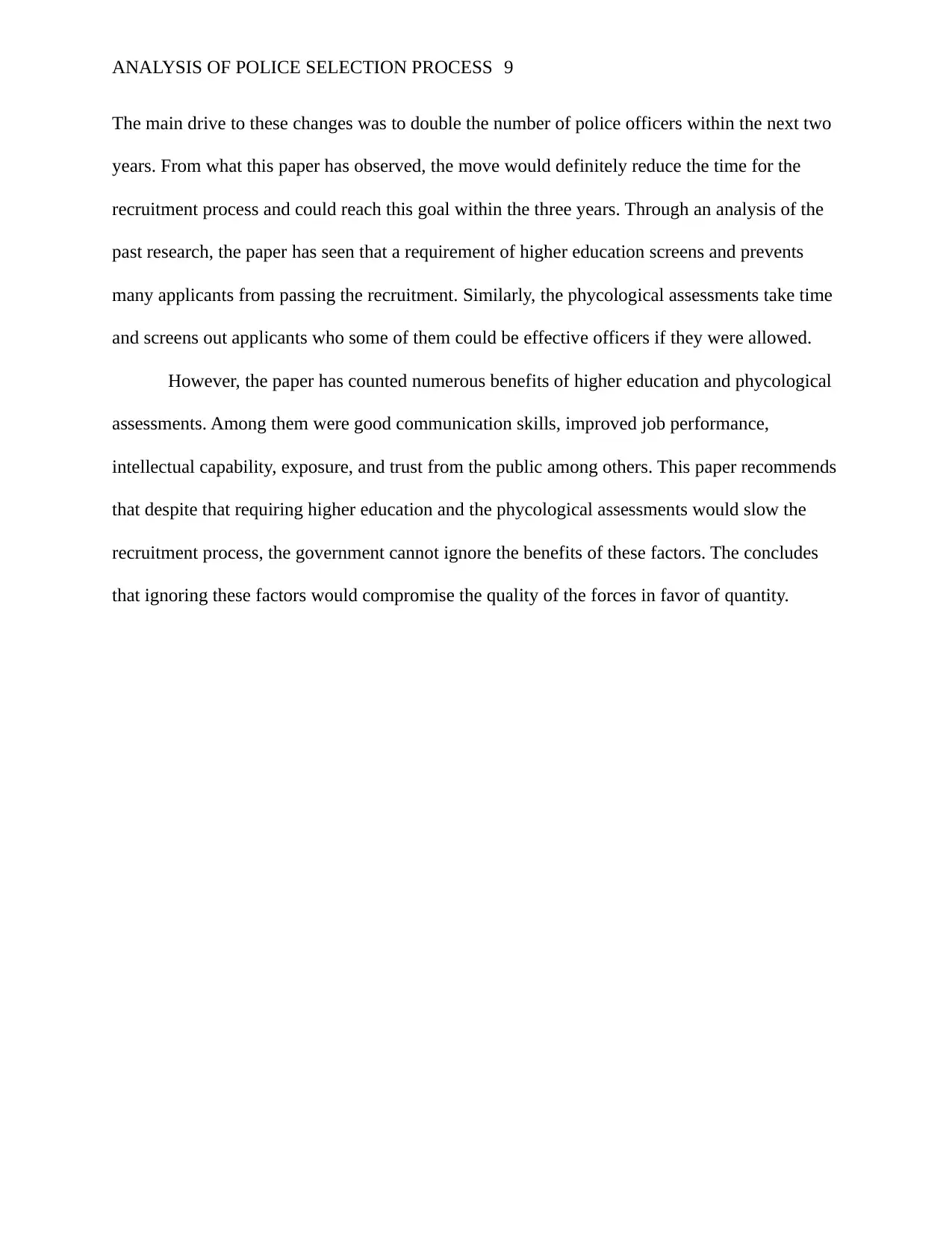
The main drive to these changes was to double the number of police officers within the next two
years. From what this paper has observed, the move would definitely reduce the time for the
recruitment process and could reach this goal within the three years. Through an analysis of the
past research, the paper has seen that a requirement of higher education screens and prevents
many applicants from passing the recruitment. Similarly, the phycological assessments take time
and screens out applicants who some of them could be effective officers if they were allowed.
However, the paper has counted numerous benefits of higher education and phycological
assessments. Among them were good communication skills, improved job performance,
intellectual capability, exposure, and trust from the public among others. This paper recommends
that despite that requiring higher education and the phycological assessments would slow the
recruitment process, the government cannot ignore the benefits of these factors. The concludes
that ignoring these factors would compromise the quality of the forces in favor of quantity.
The main drive to these changes was to double the number of police officers within the next two
years. From what this paper has observed, the move would definitely reduce the time for the
recruitment process and could reach this goal within the three years. Through an analysis of the
past research, the paper has seen that a requirement of higher education screens and prevents
many applicants from passing the recruitment. Similarly, the phycological assessments take time
and screens out applicants who some of them could be effective officers if they were allowed.
However, the paper has counted numerous benefits of higher education and phycological
assessments. Among them were good communication skills, improved job performance,
intellectual capability, exposure, and trust from the public among others. This paper recommends
that despite that requiring higher education and the phycological assessments would slow the
recruitment process, the government cannot ignore the benefits of these factors. The concludes
that ignoring these factors would compromise the quality of the forces in favor of quantity.
⊘ This is a preview!⊘
Do you want full access?
Subscribe today to unlock all pages.
Trusted by 1+ million students worldwide
ANALYSIS OF POLICE SELECTION PROCESS 10
References
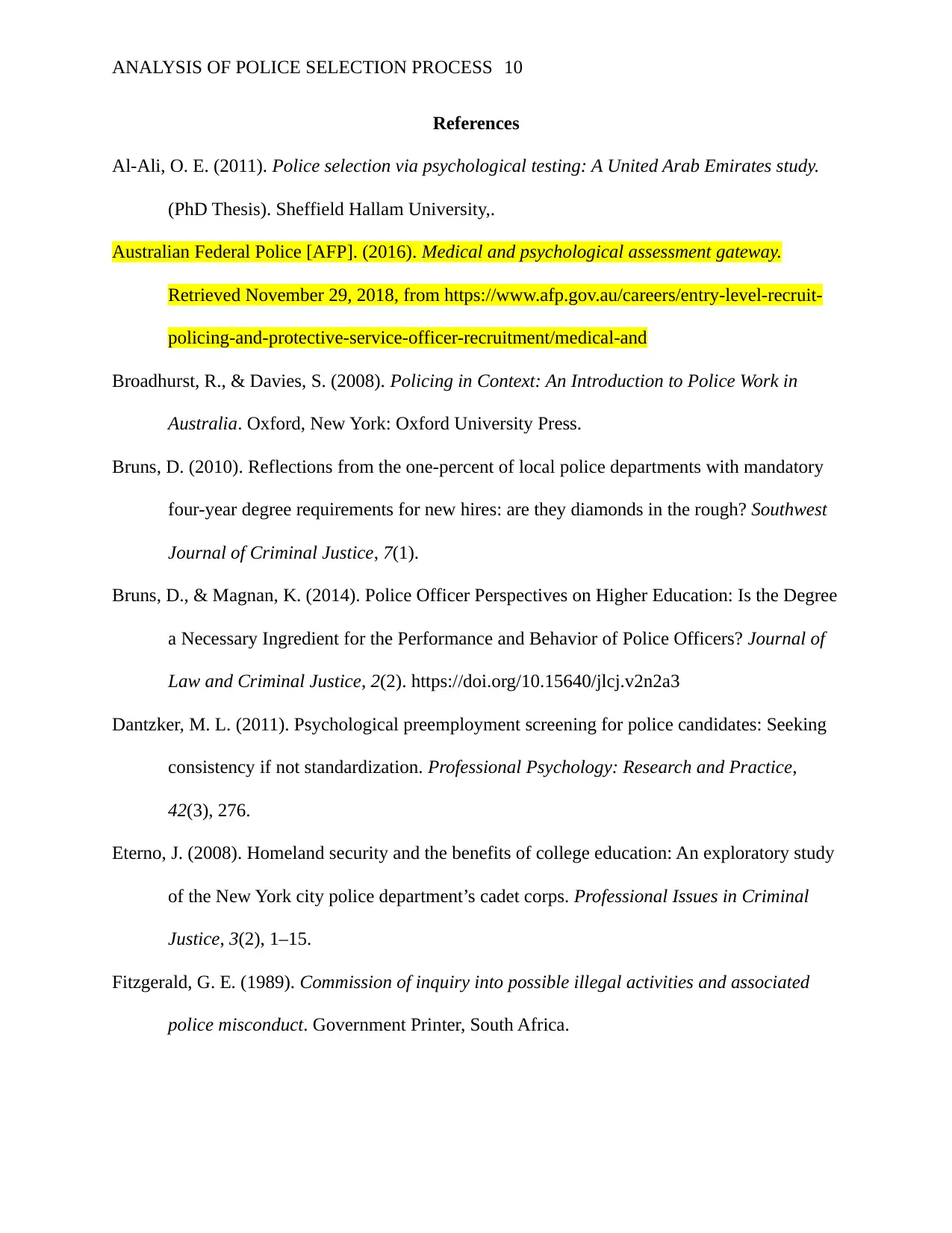
Al-Ali, O. E. (2011). Police selection via psychological testing: A United Arab Emirates study.
(PhD Thesis). Sheffield Hallam University,.
Australian Federal Police [AFP]. (2016). Medical and psychological assessment gateway.
Retrieved November 29, 2018, from https://www.afp.gov.au/careers/entry-level-recruit-
policing-and-protective-service-officer-recruitment/medical-and
Broadhurst, R., & Davies, S. (2008). Policing in Context: An Introduction to Police Work in
Australia. Oxford, New York: Oxford University Press.
Bruns, D. (2010). Reflections from the one-percent of local police departments with mandatory
four-year degree requirements for new hires: are they diamonds in the rough? Southwest
Journal of Criminal Justice, 7(1).
Bruns, D., & Magnan, K. (2014). Police Officer Perspectives on Higher Education: Is the Degree
a Necessary Ingredient for the Performance and Behavior of Police Officers? Journal of
Law and Criminal Justice, 2(2). https://doi.org/10.15640/jlcj.v2n2a3
Dantzker, M. L. (2011). Psychological preemployment screening for police candidates: Seeking
consistency if not standardization. Professional Psychology: Research and Practice,
42(3), 276.
Eterno, J. (2008). Homeland security and the benefits of college education: An exploratory study
of the New York city police department’s cadet corps. Professional Issues in Criminal
Justice, 3(2), 1–15.
Fitzgerald, G. E. (1989). Commission of inquiry into possible illegal activities and associated
police misconduct. Government Printer, South Africa.
References
Al-Ali, O. E. (2011). Police selection via psychological testing: A United Arab Emirates study.
(PhD Thesis). Sheffield Hallam University,.
Australian Federal Police [AFP]. (2016). Medical and psychological assessment gateway.
Retrieved November 29, 2018, from https://www.afp.gov.au/careers/entry-level-recruit-
policing-and-protective-service-officer-recruitment/medical-and
Broadhurst, R., & Davies, S. (2008). Policing in Context: An Introduction to Police Work in
Australia. Oxford, New York: Oxford University Press.
Bruns, D. (2010). Reflections from the one-percent of local police departments with mandatory
four-year degree requirements for new hires: are they diamonds in the rough? Southwest
Journal of Criminal Justice, 7(1).
Bruns, D., & Magnan, K. (2014). Police Officer Perspectives on Higher Education: Is the Degree
a Necessary Ingredient for the Performance and Behavior of Police Officers? Journal of
Law and Criminal Justice, 2(2). https://doi.org/10.15640/jlcj.v2n2a3
Dantzker, M. L. (2011). Psychological preemployment screening for police candidates: Seeking
consistency if not standardization. Professional Psychology: Research and Practice,
42(3), 276.
Eterno, J. (2008). Homeland security and the benefits of college education: An exploratory study
of the New York city police department’s cadet corps. Professional Issues in Criminal
Justice, 3(2), 1–15.
Fitzgerald, G. E. (1989). Commission of inquiry into possible illegal activities and associated
police misconduct. Government Printer, South Africa.
Paraphrase This Document
Need a fresh take? Get an instant paraphrase of this document with our AI Paraphraser
ANALYSIS OF POLICE SELECTION PROCESS 11
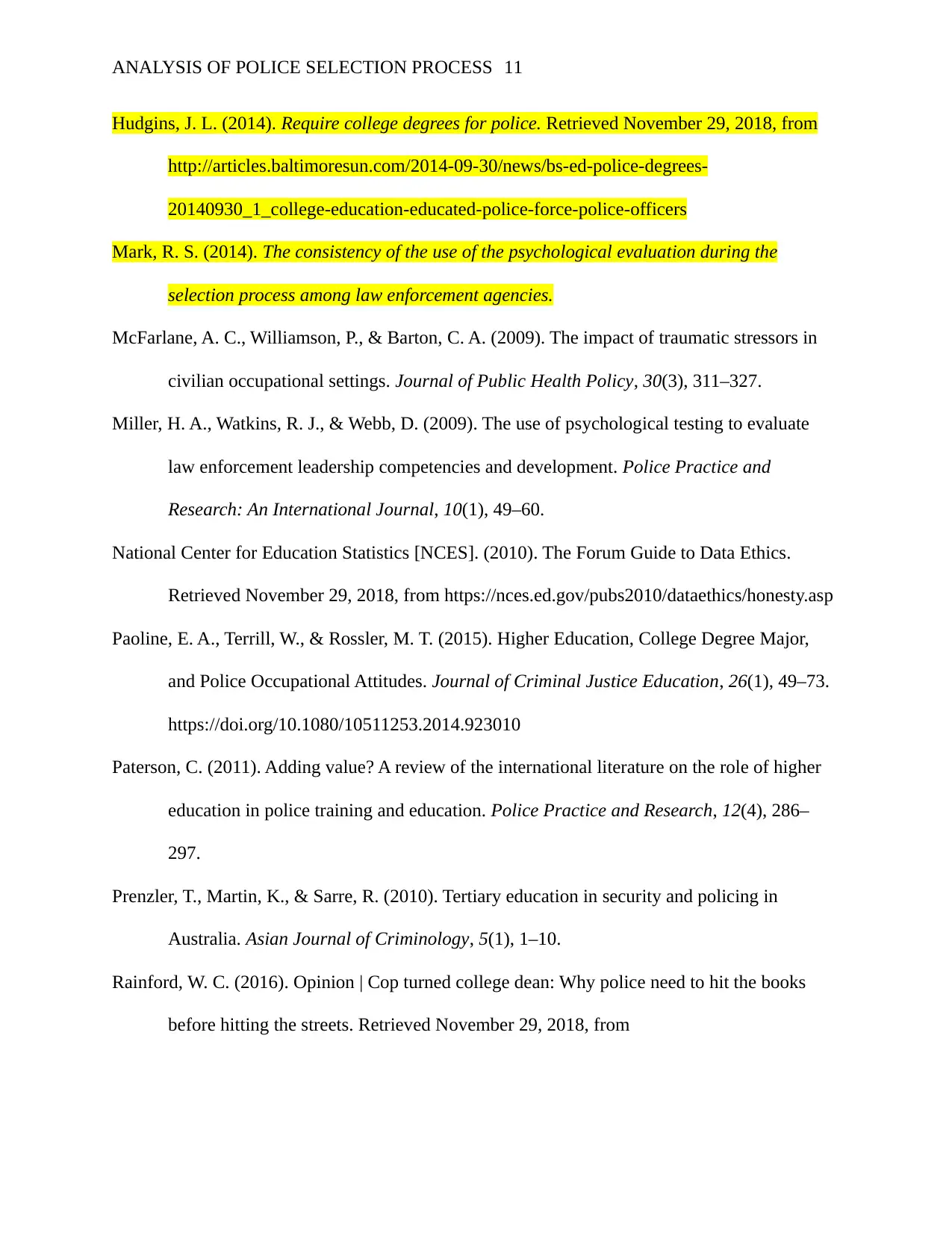
Hudgins, J. L. (2014). Require college degrees for police. Retrieved November 29, 2018, from
http://articles.baltimoresun.com/2014-09-30/news/bs-ed-police-degrees-
20140930_1_college-education-educated-police-force-police-officers
Mark, R. S. (2014). The consistency of the use of the psychological evaluation during the
selection process among law enforcement agencies.
McFarlane, A. C., Williamson, P., & Barton, C. A. (2009). The impact of traumatic stressors in
civilian occupational settings. Journal of Public Health Policy, 30(3), 311–327.
Miller, H. A., Watkins, R. J., & Webb, D. (2009). The use of psychological testing to evaluate
law enforcement leadership competencies and development. Police Practice and
Research: An International Journal, 10(1), 49–60.
National Center for Education Statistics [NCES]. (2010). The Forum Guide to Data Ethics.
Retrieved November 29, 2018, from https://nces.ed.gov/pubs2010/dataethics/honesty.asp
Paoline, E. A., Terrill, W., & Rossler, M. T. (2015). Higher Education, College Degree Major,
and Police Occupational Attitudes. Journal of Criminal Justice Education, 26(1), 49–73.
https://doi.org/10.1080/10511253.2014.923010
Paterson, C. (2011). Adding value? A review of the international literature on the role of higher
education in police training and education. Police Practice and Research, 12(4), 286–
297.
Prenzler, T., Martin, K., & Sarre, R. (2010). Tertiary education in security and policing in
Australia. Asian Journal of Criminology, 5(1), 1–10.
Rainford, W. C. (2016). Opinion | Cop turned college dean: Why police need to hit the books
before hitting the streets. Retrieved November 29, 2018, from
Hudgins, J. L. (2014). Require college degrees for police. Retrieved November 29, 2018, from
http://articles.baltimoresun.com/2014-09-30/news/bs-ed-police-degrees-
20140930_1_college-education-educated-police-force-police-officers
Mark, R. S. (2014). The consistency of the use of the psychological evaluation during the
selection process among law enforcement agencies.
McFarlane, A. C., Williamson, P., & Barton, C. A. (2009). The impact of traumatic stressors in
civilian occupational settings. Journal of Public Health Policy, 30(3), 311–327.
Miller, H. A., Watkins, R. J., & Webb, D. (2009). The use of psychological testing to evaluate
law enforcement leadership competencies and development. Police Practice and
Research: An International Journal, 10(1), 49–60.
National Center for Education Statistics [NCES]. (2010). The Forum Guide to Data Ethics.
Retrieved November 29, 2018, from https://nces.ed.gov/pubs2010/dataethics/honesty.asp
Paoline, E. A., Terrill, W., & Rossler, M. T. (2015). Higher Education, College Degree Major,
and Police Occupational Attitudes. Journal of Criminal Justice Education, 26(1), 49–73.
https://doi.org/10.1080/10511253.2014.923010
Paterson, C. (2011). Adding value? A review of the international literature on the role of higher
education in police training and education. Police Practice and Research, 12(4), 286–
297.
Prenzler, T., Martin, K., & Sarre, R. (2010). Tertiary education in security and policing in
Australia. Asian Journal of Criminology, 5(1), 1–10.
Rainford, W. C. (2016). Opinion | Cop turned college dean: Why police need to hit the books
before hitting the streets. Retrieved November 29, 2018, from
ANALYSIS OF POLICE SELECTION PROCESS 12
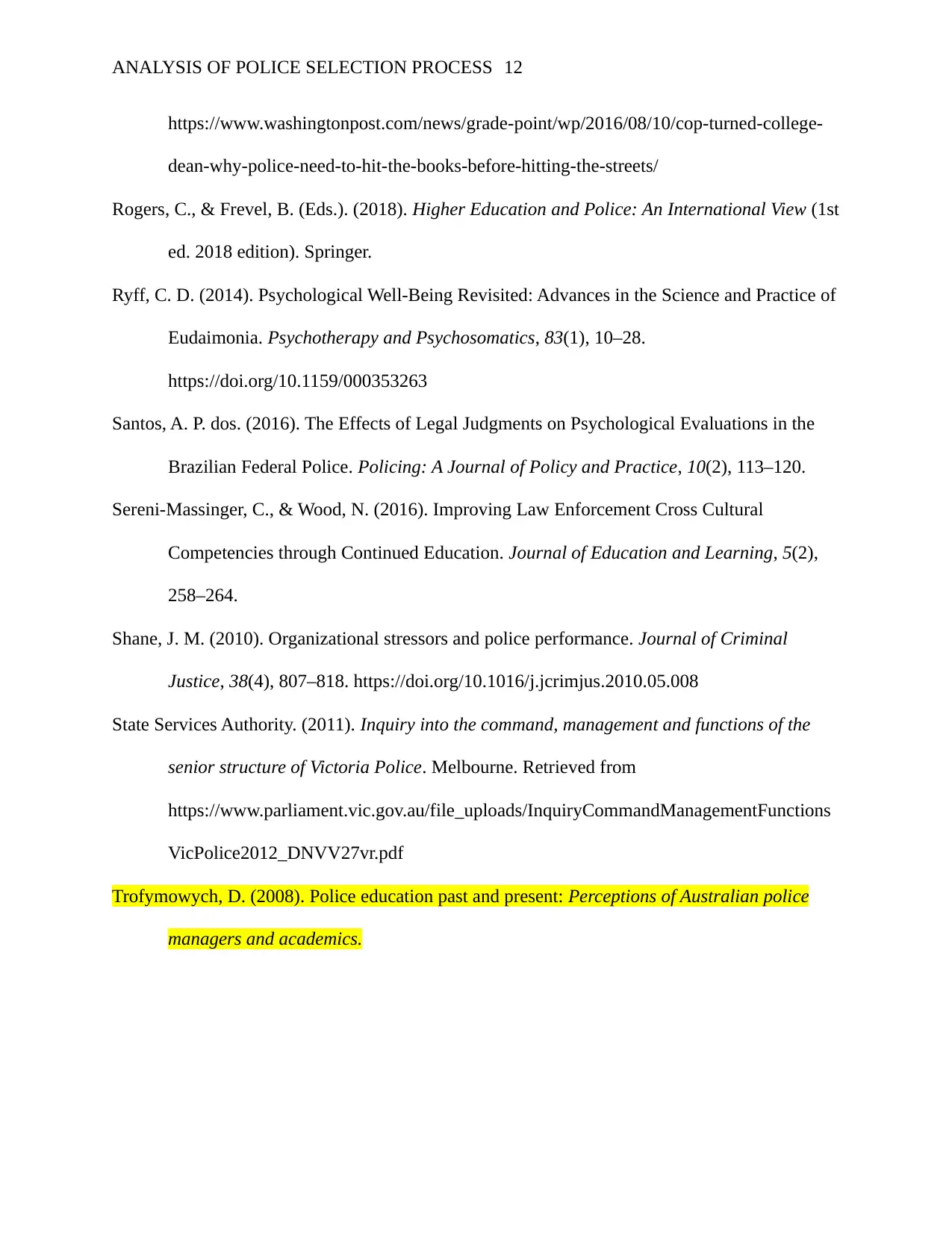
https://www.washingtonpost.com/news/grade-point/wp/2016/08/10/cop-turned-college-
dean-why-police-need-to-hit-the-books-before-hitting-the-streets/
Rogers, C., & Frevel, B. (Eds.). (2018). Higher Education and Police: An International View (1st
ed. 2018 edition). Springer.
Ryff, C. D. (2014). Psychological Well-Being Revisited: Advances in the Science and Practice of
Eudaimonia. Psychotherapy and Psychosomatics, 83(1), 10–28.
https://doi.org/10.1159/000353263
Santos, A. P. dos. (2016). The Effects of Legal Judgments on Psychological Evaluations in the
Brazilian Federal Police. Policing: A Journal of Policy and Practice, 10(2), 113–120.
Sereni-Massinger, C., & Wood, N. (2016). Improving Law Enforcement Cross Cultural
Competencies through Continued Education. Journal of Education and Learning, 5(2),
258–264.
Shane, J. M. (2010). Organizational stressors and police performance. Journal of Criminal
Justice, 38(4), 807–818. https://doi.org/10.1016/j.jcrimjus.2010.05.008
State Services Authority. (2011). Inquiry into the command, management and functions of the
senior structure of Victoria Police. Melbourne. Retrieved from
https://www.parliament.vic.gov.au/file_uploads/InquiryCommandManagementFunctions
VicPolice2012_DNVV27vr.pdf
Trofymowych, D. (2008). Police education past and present: Perceptions of Australian police
managers and academics.
https://www.washingtonpost.com/news/grade-point/wp/2016/08/10/cop-turned-college-
dean-why-police-need-to-hit-the-books-before-hitting-the-streets/
Rogers, C., & Frevel, B. (Eds.). (2018). Higher Education and Police: An International View (1st
ed. 2018 edition). Springer.
Ryff, C. D. (2014). Psychological Well-Being Revisited: Advances in the Science and Practice of
Eudaimonia. Psychotherapy and Psychosomatics, 83(1), 10–28.
https://doi.org/10.1159/000353263
Santos, A. P. dos. (2016). The Effects of Legal Judgments on Psychological Evaluations in the
Brazilian Federal Police. Policing: A Journal of Policy and Practice, 10(2), 113–120.
Sereni-Massinger, C., & Wood, N. (2016). Improving Law Enforcement Cross Cultural
Competencies through Continued Education. Journal of Education and Learning, 5(2),
258–264.
Shane, J. M. (2010). Organizational stressors and police performance. Journal of Criminal
Justice, 38(4), 807–818. https://doi.org/10.1016/j.jcrimjus.2010.05.008
State Services Authority. (2011). Inquiry into the command, management and functions of the
senior structure of Victoria Police. Melbourne. Retrieved from
https://www.parliament.vic.gov.au/file_uploads/InquiryCommandManagementFunctions
VicPolice2012_DNVV27vr.pdf
Trofymowych, D. (2008). Police education past and present: Perceptions of Australian police
managers and academics.
⊘ This is a preview!⊘
Do you want full access?
Subscribe today to unlock all pages.
Trusted by 1+ million students worldwide

1 out of 12


Related Documents


Your All-in-One AI-Powered Toolkit for Academic Success.
+13062052269
info@desklib.com
Available 24*7 on WhatsApp / Email
![[object Object]](/_next/static/media/star-bottom.7253800d.svg)
Unlock your academic potential
Copyright © 2020–2025 A2Z Services. All Rights Reserved. Developed and managed by ZUCOL.