Impact of Policies and Frameworks on Autism Care in UK Children
VerifiedAdded on 2023/01/06
|21
|4879
|25
Report
AI Summary
This research project investigates the impact of policies and frameworks implemented in the UK for the care of children with autism. The study begins by justifying the research topic within the context of health and social care services, outlining the research aim, objectives, and ethical considerations. It then reviews existing literature, exploring the prevalence of autism in the UK, the effectiveness of current policies, and the challenges faced in their implementation. The research methodology section details the research type, approach, philosophy, data collection methods (including both primary and secondary research), data sampling, and analysis techniques. The data analysis section presents the findings, organized thematically, including the perception of autism as a serious problem, the impact of noise sensitivity, the role of the Individuals with Disabilities Education Act, policy implications, barriers to implementation, and public opinion. The report concludes with recommendations for improving current frameworks, suggestions for future research, and a reflective writing section. The research employs both qualitative and quantitative data collection and analysis methods to comprehensively evaluate the current state of autism care in the UK, with a focus on the practical application of policies and the challenges faced by families and healthcare professionals.

RESEARCH PROJECT

Paraphrase This Document
Need a fresh take? Get an instant paraphrase of this document with our AI Paraphraser
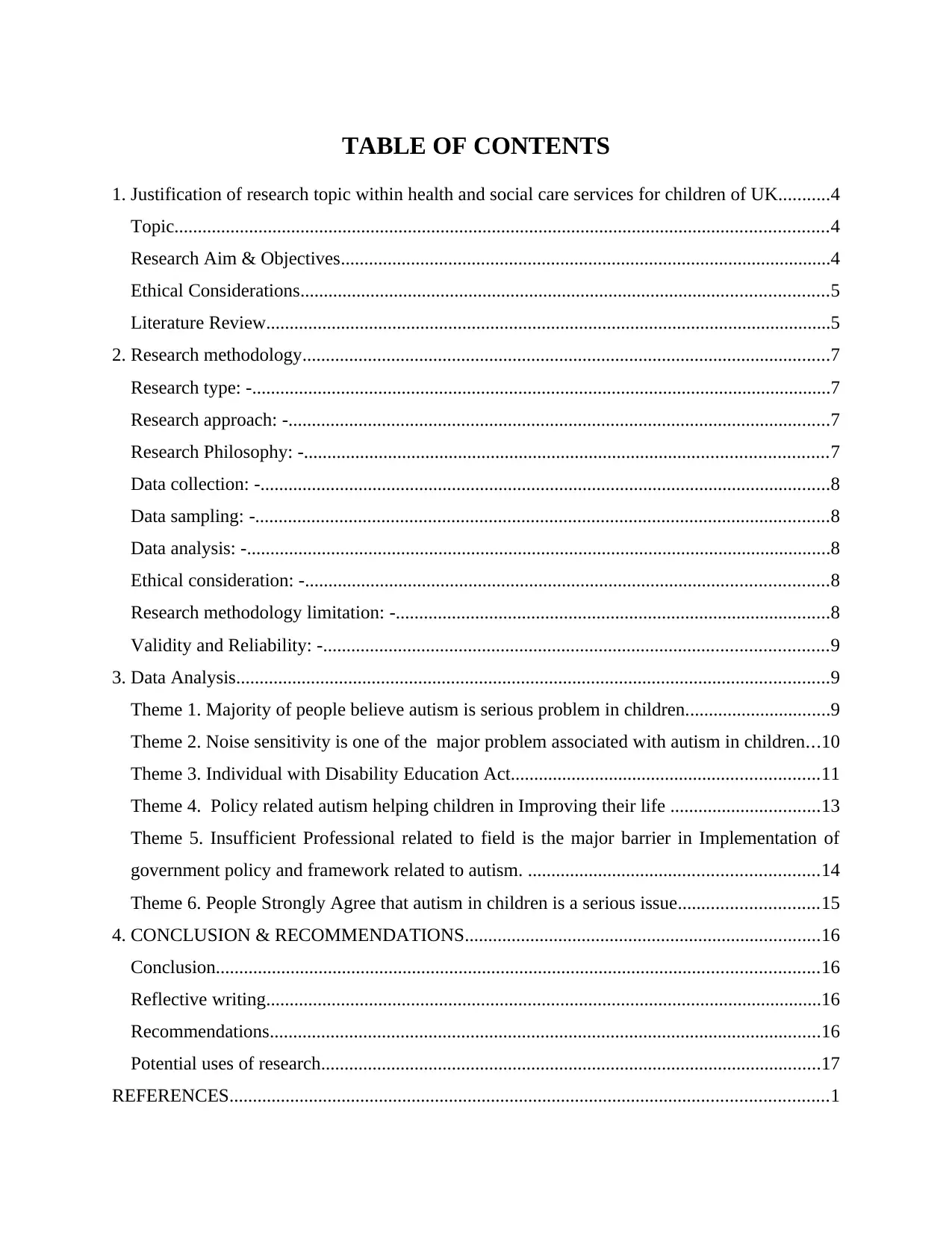
TABLE OF CONTENTS
1. Justification of research topic within health and social care services for children of UK...........4
Topic............................................................................................................................................4
Research Aim & Objectives.........................................................................................................4
Ethical Considerations.................................................................................................................5
Literature Review.........................................................................................................................5
2. Research methodology.................................................................................................................7
Research type: -............................................................................................................................7
Research approach: -....................................................................................................................7
Research Philosophy: -................................................................................................................7
Data collection: -..........................................................................................................................8
Data sampling: -...........................................................................................................................8
Data analysis: -.............................................................................................................................8
Ethical consideration: -................................................................................................................8
Research methodology limitation: -.............................................................................................8
Validity and Reliability: -............................................................................................................9
3. Data Analysis...............................................................................................................................9
Theme 1. Majority of people believe autism is serious problem in children...............................9
Theme 2. Noise sensitivity is one of the major problem associated with autism in children...10
Theme 3. Individual with Disability Education Act..................................................................11
Theme 4. Policy related autism helping children in Improving their life ................................13
Theme 5. Insufficient Professional related to field is the major barrier in Implementation of
government policy and framework related to autism. ..............................................................14
Theme 6. People Strongly Agree that autism in children is a serious issue..............................15
4. CONCLUSION & RECOMMENDATIONS............................................................................16
Conclusion.................................................................................................................................16
Reflective writing.......................................................................................................................16
Recommendations......................................................................................................................16
Potential uses of research...........................................................................................................17
REFERENCES................................................................................................................................1
1. Justification of research topic within health and social care services for children of UK...........4
Topic............................................................................................................................................4
Research Aim & Objectives.........................................................................................................4
Ethical Considerations.................................................................................................................5
Literature Review.........................................................................................................................5
2. Research methodology.................................................................................................................7
Research type: -............................................................................................................................7
Research approach: -....................................................................................................................7
Research Philosophy: -................................................................................................................7
Data collection: -..........................................................................................................................8
Data sampling: -...........................................................................................................................8
Data analysis: -.............................................................................................................................8
Ethical consideration: -................................................................................................................8
Research methodology limitation: -.............................................................................................8
Validity and Reliability: -............................................................................................................9
3. Data Analysis...............................................................................................................................9
Theme 1. Majority of people believe autism is serious problem in children...............................9
Theme 2. Noise sensitivity is one of the major problem associated with autism in children...10
Theme 3. Individual with Disability Education Act..................................................................11
Theme 4. Policy related autism helping children in Improving their life ................................13
Theme 5. Insufficient Professional related to field is the major barrier in Implementation of
government policy and framework related to autism. ..............................................................14
Theme 6. People Strongly Agree that autism in children is a serious issue..............................15
4. CONCLUSION & RECOMMENDATIONS............................................................................16
Conclusion.................................................................................................................................16
Reflective writing.......................................................................................................................16
Recommendations......................................................................................................................16
Potential uses of research...........................................................................................................17
REFERENCES................................................................................................................................1

APPENDIX......................................................................................................................................3
QUESTIONNAIRE.....................................................................................................................3
QUESTIONNAIRE.....................................................................................................................3
⊘ This is a preview!⊘
Do you want full access?
Subscribe today to unlock all pages.

Trusted by 1+ million students worldwide
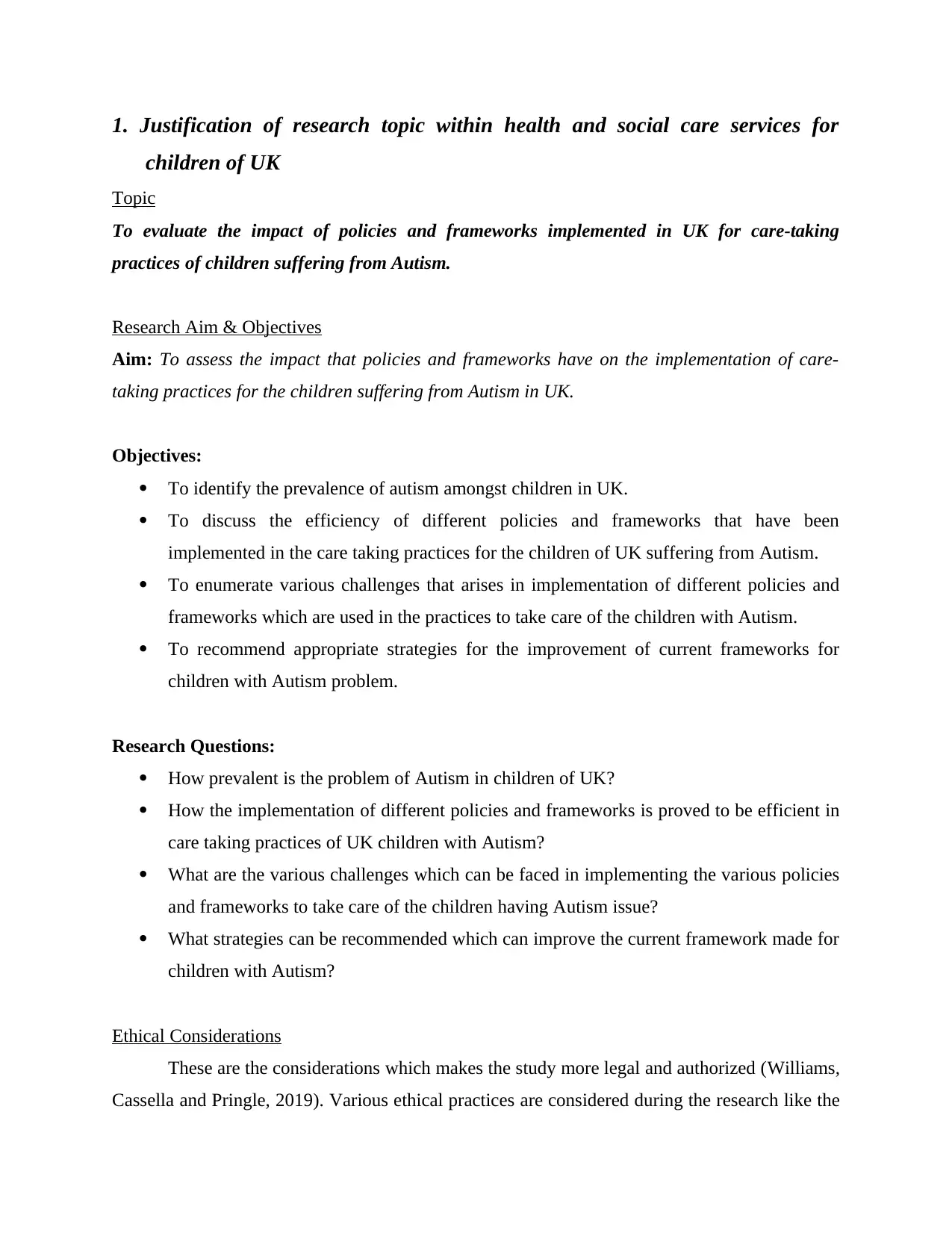
1. Justification of research topic within health and social care services for
children of UK
Topic
To evaluate the impact of policies and frameworks implemented in UK for care-taking
practices of children suffering from Autism.
Research Aim & Objectives
Aim: To assess the impact that policies and frameworks have on the implementation of care-
taking practices for the children suffering from Autism in UK.
Objectives:
To identify the prevalence of autism amongst children in UK.
To discuss the efficiency of different policies and frameworks that have been
implemented in the care taking practices for the children of UK suffering from Autism.
To enumerate various challenges that arises in implementation of different policies and
frameworks which are used in the practices to take care of the children with Autism.
To recommend appropriate strategies for the improvement of current frameworks for
children with Autism problem.
Research Questions:
How prevalent is the problem of Autism in children of UK?
How the implementation of different policies and frameworks is proved to be efficient in
care taking practices of UK children with Autism?
What are the various challenges which can be faced in implementing the various policies
and frameworks to take care of the children having Autism issue?
What strategies can be recommended which can improve the current framework made for
children with Autism?
Ethical Considerations
These are the considerations which makes the study more legal and authorized (Williams,
Cassella and Pringle, 2019). Various ethical practices are considered during the research like the
children of UK
Topic
To evaluate the impact of policies and frameworks implemented in UK for care-taking
practices of children suffering from Autism.
Research Aim & Objectives
Aim: To assess the impact that policies and frameworks have on the implementation of care-
taking practices for the children suffering from Autism in UK.
Objectives:
To identify the prevalence of autism amongst children in UK.
To discuss the efficiency of different policies and frameworks that have been
implemented in the care taking practices for the children of UK suffering from Autism.
To enumerate various challenges that arises in implementation of different policies and
frameworks which are used in the practices to take care of the children with Autism.
To recommend appropriate strategies for the improvement of current frameworks for
children with Autism problem.
Research Questions:
How prevalent is the problem of Autism in children of UK?
How the implementation of different policies and frameworks is proved to be efficient in
care taking practices of UK children with Autism?
What are the various challenges which can be faced in implementing the various policies
and frameworks to take care of the children having Autism issue?
What strategies can be recommended which can improve the current framework made for
children with Autism?
Ethical Considerations
These are the considerations which makes the study more legal and authorized (Williams,
Cassella and Pringle, 2019). Various ethical practices are considered during the research like the
Paraphrase This Document
Need a fresh take? Get an instant paraphrase of this document with our AI Paraphraser
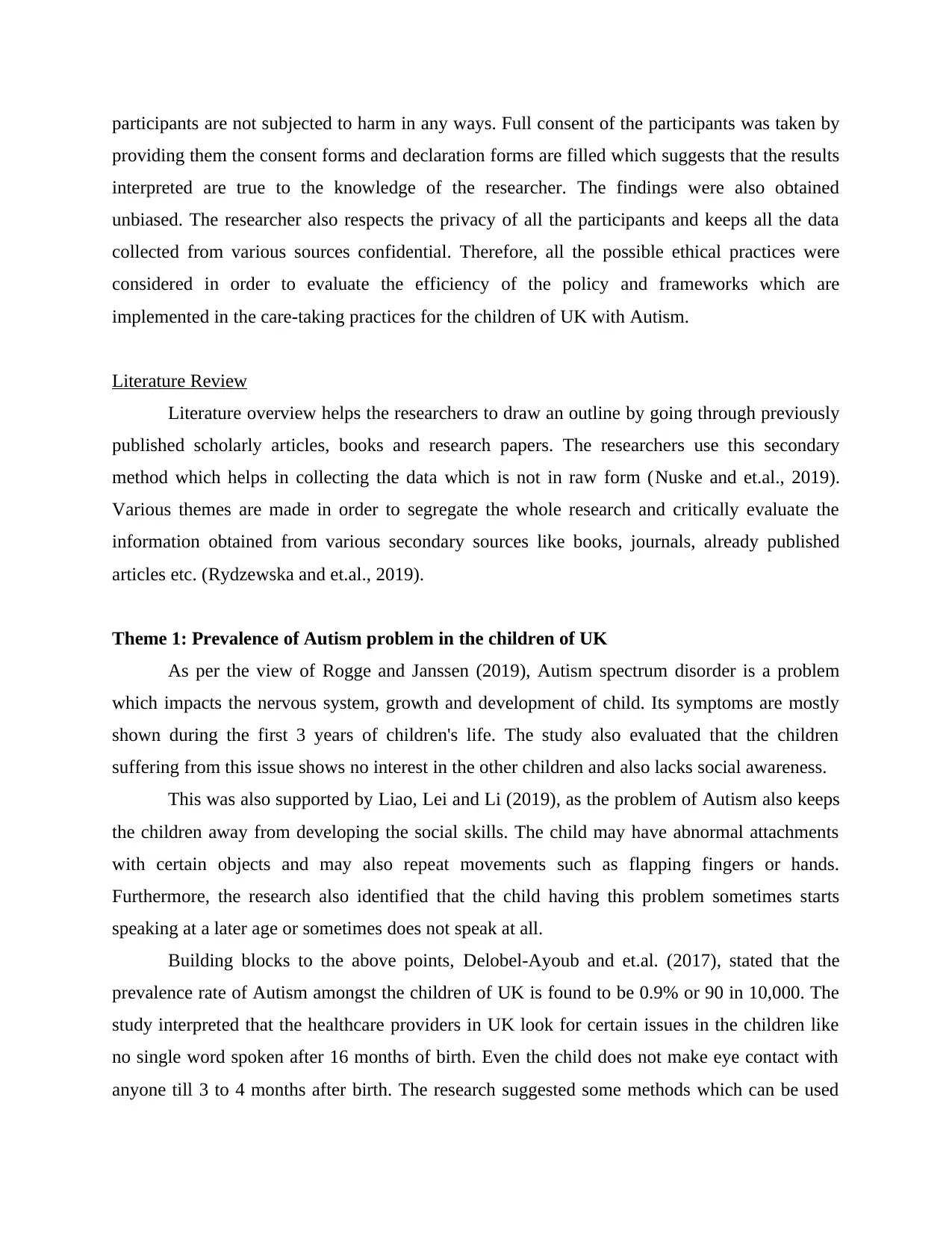
participants are not subjected to harm in any ways. Full consent of the participants was taken by
providing them the consent forms and declaration forms are filled which suggests that the results
interpreted are true to the knowledge of the researcher. The findings were also obtained
unbiased. The researcher also respects the privacy of all the participants and keeps all the data
collected from various sources confidential. Therefore, all the possible ethical practices were
considered in order to evaluate the efficiency of the policy and frameworks which are
implemented in the care-taking practices for the children of UK with Autism.
Literature Review
Literature overview helps the researchers to draw an outline by going through previously
published scholarly articles, books and research papers. The researchers use this secondary
method which helps in collecting the data which is not in raw form (Nuske and et.al., 2019).
Various themes are made in order to segregate the whole research and critically evaluate the
information obtained from various secondary sources like books, journals, already published
articles etc. (Rydzewska and et.al., 2019).
Theme 1: Prevalence of Autism problem in the children of UK
As per the view of Rogge and Janssen (2019), Autism spectrum disorder is a problem
which impacts the nervous system, growth and development of child. Its symptoms are mostly
shown during the first 3 years of children's life. The study also evaluated that the children
suffering from this issue shows no interest in the other children and also lacks social awareness.
This was also supported by Liao, Lei and Li (2019), as the problem of Autism also keeps
the children away from developing the social skills. The child may have abnormal attachments
with certain objects and may also repeat movements such as flapping fingers or hands.
Furthermore, the research also identified that the child having this problem sometimes starts
speaking at a later age or sometimes does not speak at all.
Building blocks to the above points, Delobel‐Ayoub and et.al. (2017), stated that the
prevalence rate of Autism amongst the children of UK is found to be 0.9% or 90 in 10,000. The
study interpreted that the healthcare providers in UK look for certain issues in the children like
no single word spoken after 16 months of birth. Even the child does not make eye contact with
anyone till 3 to 4 months after birth. The research suggested some methods which can be used
providing them the consent forms and declaration forms are filled which suggests that the results
interpreted are true to the knowledge of the researcher. The findings were also obtained
unbiased. The researcher also respects the privacy of all the participants and keeps all the data
collected from various sources confidential. Therefore, all the possible ethical practices were
considered in order to evaluate the efficiency of the policy and frameworks which are
implemented in the care-taking practices for the children of UK with Autism.
Literature Review
Literature overview helps the researchers to draw an outline by going through previously
published scholarly articles, books and research papers. The researchers use this secondary
method which helps in collecting the data which is not in raw form (Nuske and et.al., 2019).
Various themes are made in order to segregate the whole research and critically evaluate the
information obtained from various secondary sources like books, journals, already published
articles etc. (Rydzewska and et.al., 2019).
Theme 1: Prevalence of Autism problem in the children of UK
As per the view of Rogge and Janssen (2019), Autism spectrum disorder is a problem
which impacts the nervous system, growth and development of child. Its symptoms are mostly
shown during the first 3 years of children's life. The study also evaluated that the children
suffering from this issue shows no interest in the other children and also lacks social awareness.
This was also supported by Liao, Lei and Li (2019), as the problem of Autism also keeps
the children away from developing the social skills. The child may have abnormal attachments
with certain objects and may also repeat movements such as flapping fingers or hands.
Furthermore, the research also identified that the child having this problem sometimes starts
speaking at a later age or sometimes does not speak at all.
Building blocks to the above points, Delobel‐Ayoub and et.al. (2017), stated that the
prevalence rate of Autism amongst the children of UK is found to be 0.9% or 90 in 10,000. The
study interpreted that the healthcare providers in UK look for certain issues in the children like
no single word spoken after 16 months of birth. Even the child does not make eye contact with
anyone till 3 to 4 months after birth. The research suggested some methods which can be used
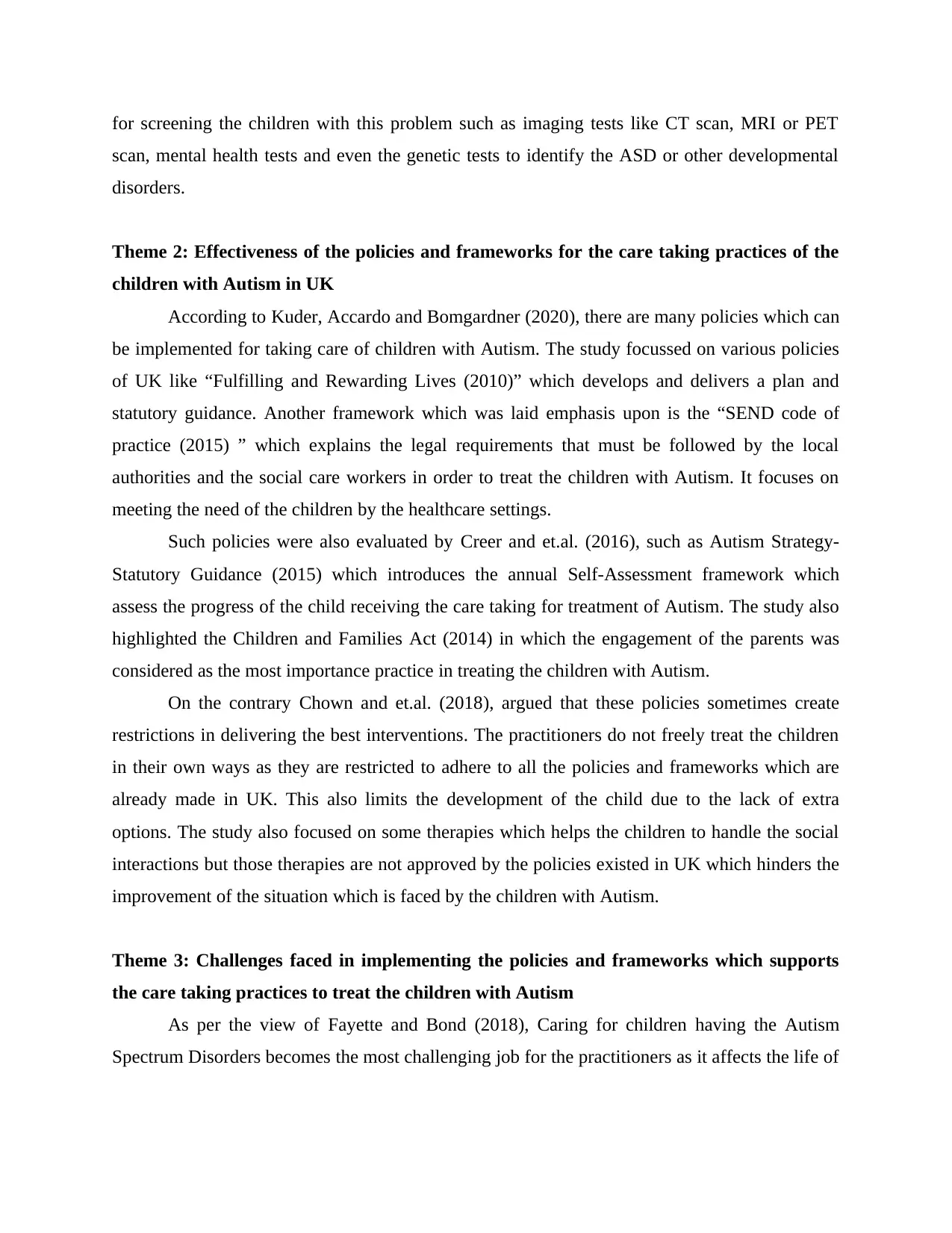
for screening the children with this problem such as imaging tests like CT scan, MRI or PET
scan, mental health tests and even the genetic tests to identify the ASD or other developmental
disorders.
Theme 2: Effectiveness of the policies and frameworks for the care taking practices of the
children with Autism in UK
According to Kuder, Accardo and Bomgardner (2020), there are many policies which can
be implemented for taking care of children with Autism. The study focussed on various policies
of UK like “Fulfilling and Rewarding Lives (2010)” which develops and delivers a plan and
statutory guidance. Another framework which was laid emphasis upon is the “SEND code of
practice (2015) ” which explains the legal requirements that must be followed by the local
authorities and the social care workers in order to treat the children with Autism. It focuses on
meeting the need of the children by the healthcare settings.
Such policies were also evaluated by Creer and et.al. (2016), such as Autism Strategy-
Statutory Guidance (2015) which introduces the annual Self-Assessment framework which
assess the progress of the child receiving the care taking for treatment of Autism. The study also
highlighted the Children and Families Act (2014) in which the engagement of the parents was
considered as the most importance practice in treating the children with Autism.
On the contrary Chown and et.al. (2018), argued that these policies sometimes create
restrictions in delivering the best interventions. The practitioners do not freely treat the children
in their own ways as they are restricted to adhere to all the policies and frameworks which are
already made in UK. This also limits the development of the child due to the lack of extra
options. The study also focused on some therapies which helps the children to handle the social
interactions but those therapies are not approved by the policies existed in UK which hinders the
improvement of the situation which is faced by the children with Autism.
Theme 3: Challenges faced in implementing the policies and frameworks which supports
the care taking practices to treat the children with Autism
As per the view of Fayette and Bond (2018), Caring for children having the Autism
Spectrum Disorders becomes the most challenging job for the practitioners as it affects the life of
scan, mental health tests and even the genetic tests to identify the ASD or other developmental
disorders.
Theme 2: Effectiveness of the policies and frameworks for the care taking practices of the
children with Autism in UK
According to Kuder, Accardo and Bomgardner (2020), there are many policies which can
be implemented for taking care of children with Autism. The study focussed on various policies
of UK like “Fulfilling and Rewarding Lives (2010)” which develops and delivers a plan and
statutory guidance. Another framework which was laid emphasis upon is the “SEND code of
practice (2015) ” which explains the legal requirements that must be followed by the local
authorities and the social care workers in order to treat the children with Autism. It focuses on
meeting the need of the children by the healthcare settings.
Such policies were also evaluated by Creer and et.al. (2016), such as Autism Strategy-
Statutory Guidance (2015) which introduces the annual Self-Assessment framework which
assess the progress of the child receiving the care taking for treatment of Autism. The study also
highlighted the Children and Families Act (2014) in which the engagement of the parents was
considered as the most importance practice in treating the children with Autism.
On the contrary Chown and et.al. (2018), argued that these policies sometimes create
restrictions in delivering the best interventions. The practitioners do not freely treat the children
in their own ways as they are restricted to adhere to all the policies and frameworks which are
already made in UK. This also limits the development of the child due to the lack of extra
options. The study also focused on some therapies which helps the children to handle the social
interactions but those therapies are not approved by the policies existed in UK which hinders the
improvement of the situation which is faced by the children with Autism.
Theme 3: Challenges faced in implementing the policies and frameworks which supports
the care taking practices to treat the children with Autism
As per the view of Fayette and Bond (2018), Caring for children having the Autism
Spectrum Disorders becomes the most challenging job for the practitioners as it affects the life of
⊘ This is a preview!⊘
Do you want full access?
Subscribe today to unlock all pages.
Trusted by 1+ million students worldwide
the complete family. The study evaluated that the children having such problem can exhibit
many other issues like severe tantrums or sleep problems.
Bond and et.al. (2016), supported the above mentioned points by considering the meeting
of high care demands of the children affected with autism is the most challenging job which
needs much time, effort and patience. It sometimes takes the healthcare specialists and the social
workers in distress, anxiety and other mental and physical problems. The research also explored
that the parents of such children also face many challenges like financial problems as the
treatment needs much investment, underemployment as they have to be with the child
completely and cannot leave them for a moment. They even feel strained by giving the care to
the children to bring improvement in the conditions caused by Autism.
2. Research methodology
Research type: -
Research type refer to the type in which the research is being done. It is of two types, one is
qualitative and other one is quantitative. Qualitative research refer to the non-numerical research
descriptive and uses words. Its aim is to get meeting, feeling and describe situation. Quantitative
research refer to all the research which are numerical and is an iterative process of research.
Researcher is taking qualitative research in this.
Research approach: -
Research approach are of two type inductive and deductive approach. Inductive approach does
not involve hypotheses formulation, it is done in the qualitative research type. Deductive
approach is a quantitative type of research. In this research the researcher is taking inductive
because research is done in qualitative type(Ørngreen and Levinsen, 2017).
Research Philosophy: -
it is a belief about the ways in which data about a topic is collected, analysed and used. It can be
done in two ways. One is interpretivism and positivism. In qualitative research type. The
interpretivism philosophy is used to do the research philosophy. The researcher will take this
because the researcher is doing qualitative type of research.
Data collection: -
Data collection refer to the collection of data in the report to evaluate all the research outcomes
with its data. It can be done in two ways primary and secondary. Primary research is a first-hand
many other issues like severe tantrums or sleep problems.
Bond and et.al. (2016), supported the above mentioned points by considering the meeting
of high care demands of the children affected with autism is the most challenging job which
needs much time, effort and patience. It sometimes takes the healthcare specialists and the social
workers in distress, anxiety and other mental and physical problems. The research also explored
that the parents of such children also face many challenges like financial problems as the
treatment needs much investment, underemployment as they have to be with the child
completely and cannot leave them for a moment. They even feel strained by giving the care to
the children to bring improvement in the conditions caused by Autism.
2. Research methodology
Research type: -
Research type refer to the type in which the research is being done. It is of two types, one is
qualitative and other one is quantitative. Qualitative research refer to the non-numerical research
descriptive and uses words. Its aim is to get meeting, feeling and describe situation. Quantitative
research refer to all the research which are numerical and is an iterative process of research.
Researcher is taking qualitative research in this.
Research approach: -
Research approach are of two type inductive and deductive approach. Inductive approach does
not involve hypotheses formulation, it is done in the qualitative research type. Deductive
approach is a quantitative type of research. In this research the researcher is taking inductive
because research is done in qualitative type(Ørngreen and Levinsen, 2017).
Research Philosophy: -
it is a belief about the ways in which data about a topic is collected, analysed and used. It can be
done in two ways. One is interpretivism and positivism. In qualitative research type. The
interpretivism philosophy is used to do the research philosophy. The researcher will take this
because the researcher is doing qualitative type of research.
Data collection: -
Data collection refer to the collection of data in the report to evaluate all the research outcomes
with its data. It can be done in two ways primary and secondary. Primary research is a first-hand
Paraphrase This Document
Need a fresh take? Get an instant paraphrase of this document with our AI Paraphraser
research and secondary research refer to the second hand research. The researcher will do both
type of research in its research on given topic.
Data sampling: -
Data sampling refer to the sampling of data from the market and collecting it to make the best
data to evaluate the result. It can be done in different ways as simple random data sampling,
purposive data sampling. The researcher will do simple random sampling as well as purposive
data sampling to complete the research. The research sampling is done on 30 respondents(Ooi
and et.al., 2016).
Data analysis: -
Data analysis refer to the analysis of all the data which is collected in data collection and
sampling will be analysed. Data analysis is of two type one is a thematic way of data analysis
and other one is SPSS. The researcher is doing thematic way of data analysis in the research as
the research is done in non-numerical way and is a qualitative research type. If the research is
done in qualitative type and deductive approach than the SPSS is done in research.
Ethical consideration: -
Ethical consideration refer to the ethical way of doing all the research in the report. It shows that
the researcher has done all the research in ethical way and is providing actual results. It declare
two things in it consideration, the declaration form and consent form. Declaration shows the
declaration by the researcher to declare that all the research is done by researcher only and
consent form filled by the respondent which shows that they were not forced in filling any of the
form, and they have filled all the details by themselves.
Research methodology limitation: -
RM limitation reflect that after having a limited resources and limited time. The researcher has
done all the research in the best way and is done in given time period with all the resources they
had. It tells about all the limitation a researcher is having to done the report and still did the best
in given resource and time (Zangirolami-Raimundo, Echeimberg and Leone, 2018).
Validity and Reliability: -
Validity refer to providing all the valid and relevant data in the research by the researcher, and
reliability refer to providing all the reliable resource and explaining that all the data and research
is done in reliable way.
type of research in its research on given topic.
Data sampling: -
Data sampling refer to the sampling of data from the market and collecting it to make the best
data to evaluate the result. It can be done in different ways as simple random data sampling,
purposive data sampling. The researcher will do simple random sampling as well as purposive
data sampling to complete the research. The research sampling is done on 30 respondents(Ooi
and et.al., 2016).
Data analysis: -
Data analysis refer to the analysis of all the data which is collected in data collection and
sampling will be analysed. Data analysis is of two type one is a thematic way of data analysis
and other one is SPSS. The researcher is doing thematic way of data analysis in the research as
the research is done in non-numerical way and is a qualitative research type. If the research is
done in qualitative type and deductive approach than the SPSS is done in research.
Ethical consideration: -
Ethical consideration refer to the ethical way of doing all the research in the report. It shows that
the researcher has done all the research in ethical way and is providing actual results. It declare
two things in it consideration, the declaration form and consent form. Declaration shows the
declaration by the researcher to declare that all the research is done by researcher only and
consent form filled by the respondent which shows that they were not forced in filling any of the
form, and they have filled all the details by themselves.
Research methodology limitation: -
RM limitation reflect that after having a limited resources and limited time. The researcher has
done all the research in the best way and is done in given time period with all the resources they
had. It tells about all the limitation a researcher is having to done the report and still did the best
in given resource and time (Zangirolami-Raimundo, Echeimberg and Leone, 2018).
Validity and Reliability: -
Validity refer to providing all the valid and relevant data in the research by the researcher, and
reliability refer to providing all the reliable resource and explaining that all the data and research
is done in reliable way.

3. Data Analysis
Data analysis refer to the process in which gathered information is represented in
thematic way to understand situation solution etc. to related topic (Zhang and Baranek, 2016).
Theme 1. Majority of people believe autism is serious problem in children.
Do you think autism in children become one of
the major problem in UK?
Participant
Yes 28
No 2
Total 30
Interpretation
It can be analysed from the above pictorial representation that out of 30, 28 participant
emphasizes that autism in child become a major problem and on the other hand only 2 people
choose that they do not agree with the statement and very limited number of children's suffer
from it because of not proper upbringing.
93%
7%
People believe in autism
Yes
No
Data analysis refer to the process in which gathered information is represented in
thematic way to understand situation solution etc. to related topic (Zhang and Baranek, 2016).
Theme 1. Majority of people believe autism is serious problem in children.
Do you think autism in children become one of
the major problem in UK?
Participant
Yes 28
No 2
Total 30
Interpretation
It can be analysed from the above pictorial representation that out of 30, 28 participant
emphasizes that autism in child become a major problem and on the other hand only 2 people
choose that they do not agree with the statement and very limited number of children's suffer
from it because of not proper upbringing.
93%
7%
People believe in autism
Yes
No
⊘ This is a preview!⊘
Do you want full access?
Subscribe today to unlock all pages.
Trusted by 1+ million students worldwide
It can be evaluated from above survey result autism become one of the serious and
highlighted among British customers. As per the view of Rotholz and et.al., (2017), There are
increasing number of disease patient among because of mental disabilities, didn't like of social
interaction etc. and hence dealing with need a proper procedure and guidelines. Umber of patient
increase in the world increase by disease and very less attention is pay by government to make
changes into it.
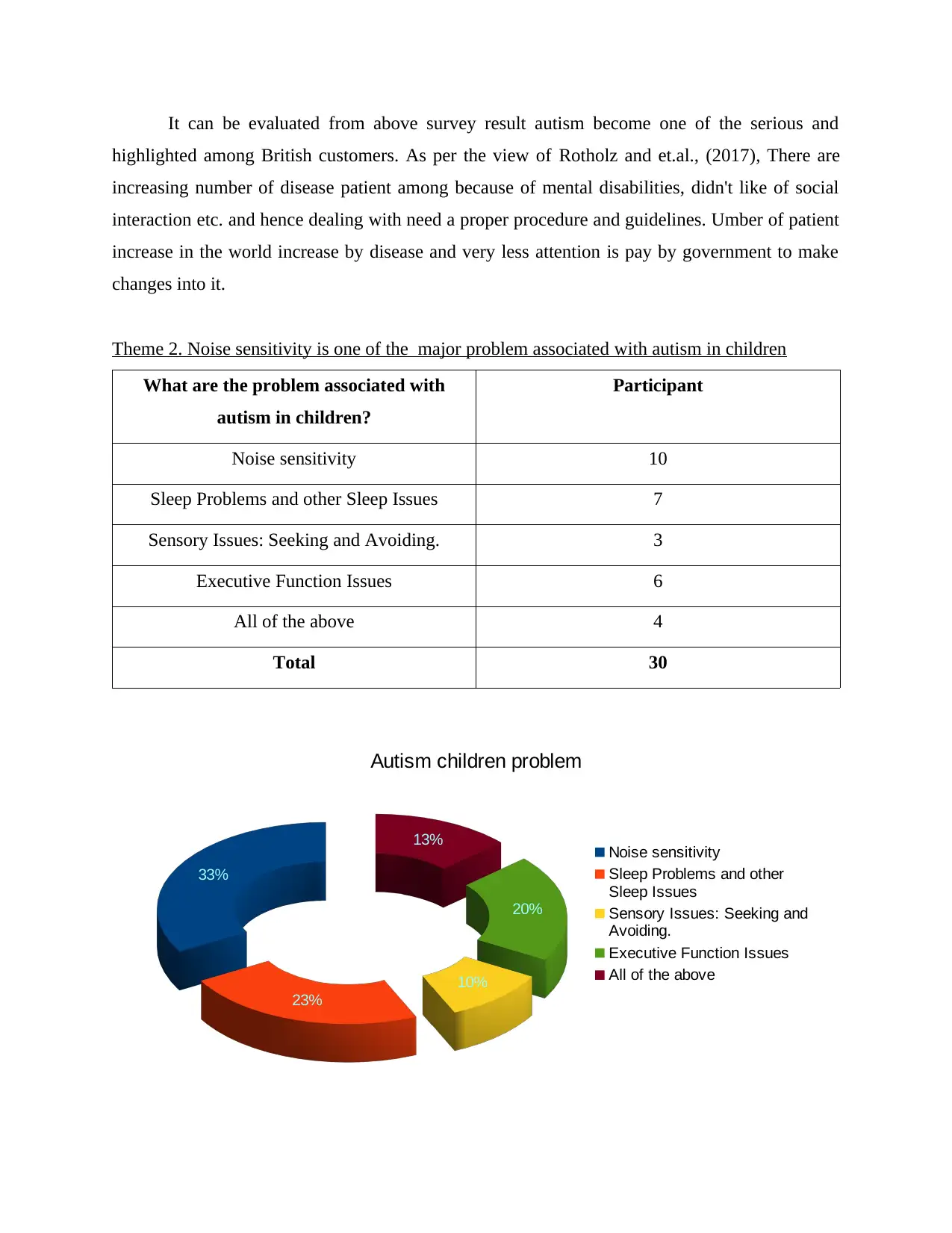
Theme 2. Noise sensitivity is one of the major problem associated with autism in children
What are the problem associated with
autism in children?
Participant
Noise sensitivity 10
Sleep Problems and other Sleep Issues 7
Sensory Issues: Seeking and Avoiding. 3
Executive Function Issues 6
All of the above 4
Total 30
33%
23%
10%
20%
13%
Autism children problem
Noise sensitivity
Sleep Problems and other
Sleep Issues
Sensory Issues: Seeking and
Avoiding.
Executive Function Issues
All of the above
highlighted among British customers. As per the view of Rotholz and et.al., (2017), There are
increasing number of disease patient among because of mental disabilities, didn't like of social
interaction etc. and hence dealing with need a proper procedure and guidelines. Umber of patient
increase in the world increase by disease and very less attention is pay by government to make
changes into it.
Theme 2. Noise sensitivity is one of the major problem associated with autism in children
What are the problem associated with
autism in children?
Participant
Noise sensitivity 10
Sleep Problems and other Sleep Issues 7
Sensory Issues: Seeking and Avoiding. 3
Executive Function Issues 6
All of the above 4
Total 30
33%
23%
10%
20%
13%
Autism children problem
Noise sensitivity
Sleep Problems and other
Sleep Issues
Sensory Issues: Seeking and
Avoiding.
Executive Function Issues
All of the above
Paraphrase This Document
Need a fresh take? Get an instant paraphrase of this document with our AI Paraphraser
Interpretation
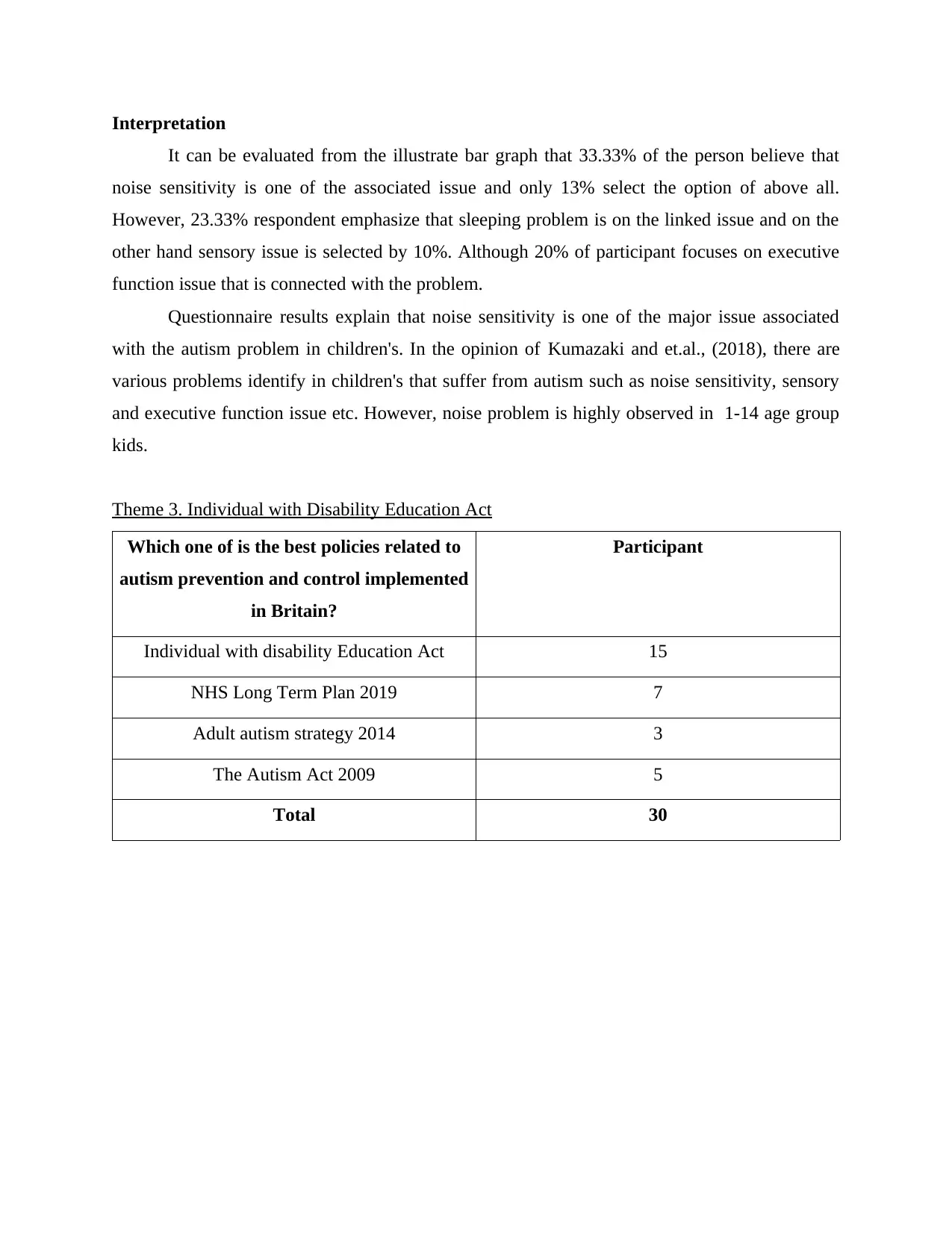
It can be evaluated from the illustrate bar graph that 33.33% of the person believe that
noise sensitivity is one of the associated issue and only 13% select the option of above all.
However, 23.33% respondent emphasize that sleeping problem is on the linked issue and on the
other hand sensory issue is selected by 10%. Although 20% of participant focuses on executive
function issue that is connected with the problem.
Questionnaire results explain that noise sensitivity is one of the major issue associated
with the autism problem in children's. In the opinion of Kumazaki and et.al., (2018), there are
various problems identify in children's that suffer from autism such as noise sensitivity, sensory
and executive function issue etc. However, noise problem is highly observed in 1-14 age group
kids.
Theme 3. Individual with Disability Education Act
Which one of is the best policies related to
autism prevention and control implemented
in Britain?
Participant
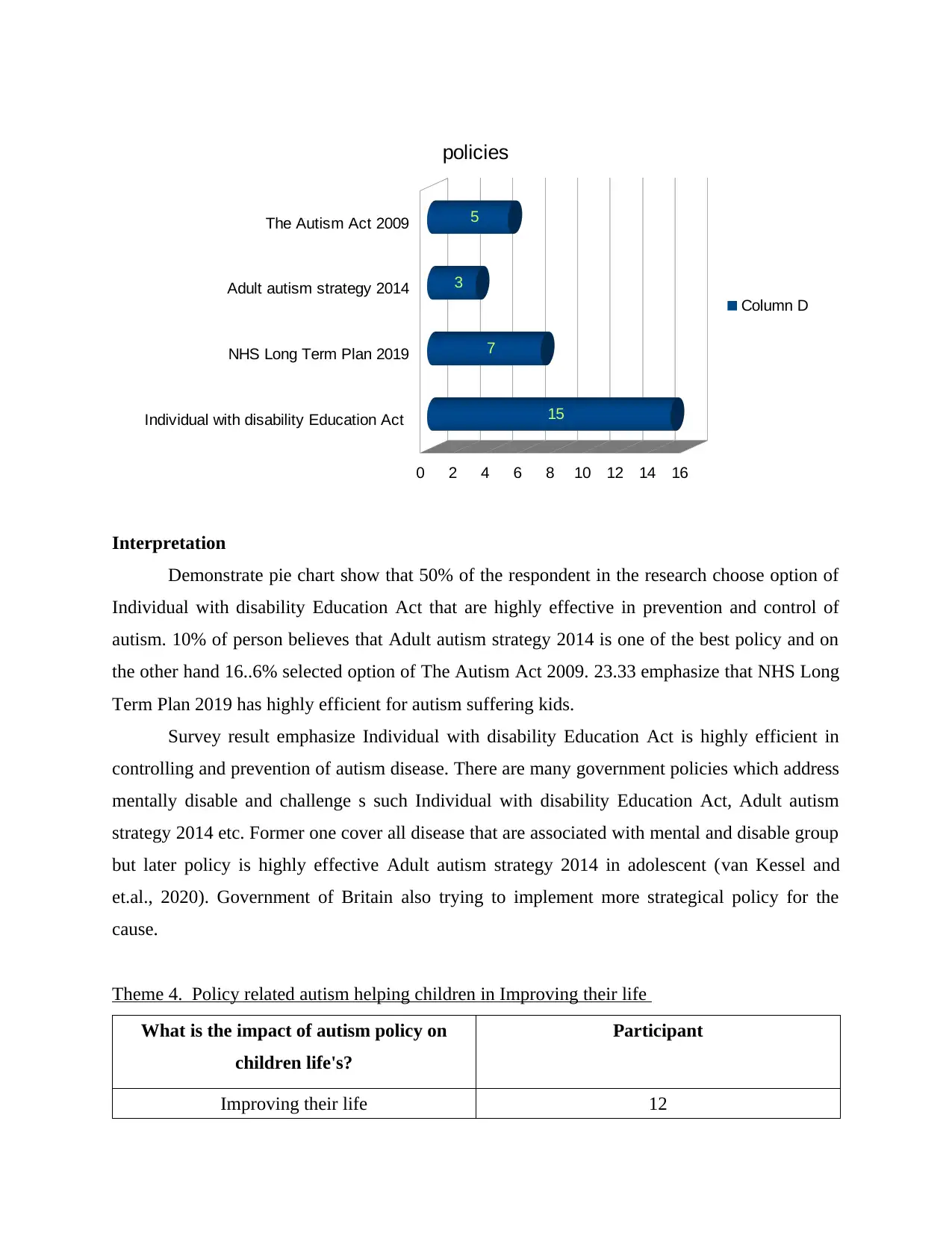
Individual with disability Education Act 15
NHS Long Term Plan 2019 7
Adult autism strategy 2014 3
The Autism Act 2009 5
Total 30
It can be evaluated from the illustrate bar graph that 33.33% of the person believe that
noise sensitivity is one of the associated issue and only 13% select the option of above all.
However, 23.33% respondent emphasize that sleeping problem is on the linked issue and on the
other hand sensory issue is selected by 10%. Although 20% of participant focuses on executive
function issue that is connected with the problem.
Questionnaire results explain that noise sensitivity is one of the major issue associated
with the autism problem in children's. In the opinion of Kumazaki and et.al., (2018), there are
various problems identify in children's that suffer from autism such as noise sensitivity, sensory
and executive function issue etc. However, noise problem is highly observed in 1-14 age group
kids.
Theme 3. Individual with Disability Education Act
Which one of is the best policies related to
autism prevention and control implemented
in Britain?
Participant
Individual with disability Education Act 15
NHS Long Term Plan 2019 7
Adult autism strategy 2014 3
The Autism Act 2009 5
Total 30
Interpretation
Demonstrate pie chart show that 50% of the respondent in the research choose option of
Individual with disability Education Act that are highly effective in prevention and control of
autism. 10% of person believes that Adult autism strategy 2014 is one of the best policy and on
the other hand 16..6% selected option of The Autism Act 2009. 23.33 emphasize that NHS Long
Term Plan 2019 has highly efficient for autism suffering kids.
Survey result emphasize Individual with disability Education Act is highly efficient in
controlling and prevention of autism disease. There are many government policies which address
mentally disable and challenge s such Individual with disability Education Act, Adult autism
strategy 2014 etc. Former one cover all disease that are associated with mental and disable group
but later policy is highly effective Adult autism strategy 2014 in adolescent (van Kessel and
et.al., 2020). Government of Britain also trying to implement more strategical policy for the
cause.
Theme 4. Policy related autism helping children in Improving their life
What is the impact of autism policy on
children life's?
Participant
Improving their life 12
Individual with disability Education Act
NHS Long Term Plan 2019
Adult autism strategy 2014
The Autism Act 2009
0 2 4 6 8 10 12 14 16
15
7
3
5
policies
Column D
Demonstrate pie chart show that 50% of the respondent in the research choose option of
Individual with disability Education Act that are highly effective in prevention and control of
autism. 10% of person believes that Adult autism strategy 2014 is one of the best policy and on
the other hand 16..6% selected option of The Autism Act 2009. 23.33 emphasize that NHS Long
Term Plan 2019 has highly efficient for autism suffering kids.
Survey result emphasize Individual with disability Education Act is highly efficient in
controlling and prevention of autism disease. There are many government policies which address
mentally disable and challenge s such Individual with disability Education Act, Adult autism
strategy 2014 etc. Former one cover all disease that are associated with mental and disable group
but later policy is highly effective Adult autism strategy 2014 in adolescent (van Kessel and
et.al., 2020). Government of Britain also trying to implement more strategical policy for the
cause.
Theme 4. Policy related autism helping children in Improving their life
What is the impact of autism policy on
children life's?
Participant
Improving their life 12
Individual with disability Education Act
NHS Long Term Plan 2019
Adult autism strategy 2014
The Autism Act 2009
0 2 4 6 8 10 12 14 16
15
7
3
5
policies
Column D
⊘ This is a preview!⊘
Do you want full access?
Subscribe today to unlock all pages.
Trusted by 1+ million students worldwide

1 out of 21


Related Documents


Your All-in-One AI-Powered Toolkit for Academic Success.
+13062052269
info@desklib.com
Available 24*7 on WhatsApp / Email
![[object Object]](/_next/static/media/star-bottom.7253800d.svg)
Unlock your academic potential
Copyright © 2020–2026 A2Z Services. All Rights Reserved. Developed and managed by ZUCOL.