Analyzing Development in Policing: Acts, Riots and Social Impact
VerifiedAdded on 2023/06/13
|8
|1981
|446
Essay
AI Summary
This essay examines the historical development of policing, starting with the Metropolitan Police Act of 1829 and the Peelian principles, which aimed to establish a cooperative relationship between the police and the public. It discusses the Brixton Riots of 1981 and the subsequent Scarman Report, which highlighted issues of racial bias and lack of community engagement. The essay also covers the Police and Criminal Evidence Act 1984 (PACE), intended to balance police powers with individual rights, and the Lawrence Inquiry following the murder of Stephen Lawrence, which exposed institutional racism within the police force. The Macpherson report's recommendations for improving police practices and fostering racial awareness are also discussed. Desklib offers a platform for students to access this and other solved assignments.

Running head: DEVELOPMENT IN POLICING
Development in Policing
Name of the Student
Name of the University
Author Note
Development in Policing
Name of the Student
Name of the University
Author Note

Paraphrase This Document
Need a fresh take? Get an instant paraphrase of this document with our AI Paraphraser
1DEVELOPMENT IN POLICING
Communal Policing:
It is evident that Sir Robert Peel initiated a new legislative body by implementing the
‘New Police’ under the provisions of the Metropolitan Police Act 1829 (Choi & Lee, 2016).
Therefore, it can be argued that the first police system was established by the Metropolitan
Police Act 1829. Authors were of the view that the other reformers of the police department were
aware of the fact that the fear of crime has increased considerably in the society (Eck, 2018).
However, Sir Robert Peel relied on various government records of 1810 which provided
appropriate evidences regarding the nature of the crimes which increased to a large extent.
Therefore, it occurred to him, that it will be appropriate to use such records for the benefit of the
police department. Modern scholars opined that, there is a necessary of an existing police force
in a society for the purpose of proper developing relationships between various conflicting
political and social classes (Gasper & Davies, 2018). In the perspective of the revisionist it can
be observed that in the presence of different capitalists within communities whose function were
to control the prevailing working classes and were mostly engaged in controlling political
disturbance, factory riots and other prevailing crime in the society opposed to public morality
(Heaton & Tong, 2015). The nine principles of policing, popularly known as the Peelian
principles were enacted for the purpose of providing active cooperation to the individuals of the
society (HOUGH, Hunter & MAY, 2017). Contemporary authors argued that, the police
officials are now aware of their responsibilities and how to use these responsibilities according to
the roles entrusted to them by the system (Choi & Lee, 2016). Modern autocrats were of the
opinion that the subject-matter of policing forms an important part of contract between the police
and the general public as a whole however; it is important on the part of the individuals to
cooperate actively (Heaton & Tong, 2015).
Communal Policing:
It is evident that Sir Robert Peel initiated a new legislative body by implementing the
‘New Police’ under the provisions of the Metropolitan Police Act 1829 (Choi & Lee, 2016).
Therefore, it can be argued that the first police system was established by the Metropolitan
Police Act 1829. Authors were of the view that the other reformers of the police department were
aware of the fact that the fear of crime has increased considerably in the society (Eck, 2018).
However, Sir Robert Peel relied on various government records of 1810 which provided
appropriate evidences regarding the nature of the crimes which increased to a large extent.
Therefore, it occurred to him, that it will be appropriate to use such records for the benefit of the
police department. Modern scholars opined that, there is a necessary of an existing police force
in a society for the purpose of proper developing relationships between various conflicting
political and social classes (Gasper & Davies, 2018). In the perspective of the revisionist it can
be observed that in the presence of different capitalists within communities whose function were
to control the prevailing working classes and were mostly engaged in controlling political
disturbance, factory riots and other prevailing crime in the society opposed to public morality
(Heaton & Tong, 2015). The nine principles of policing, popularly known as the Peelian
principles were enacted for the purpose of providing active cooperation to the individuals of the
society (HOUGH, Hunter & MAY, 2017). Contemporary authors argued that, the police
officials are now aware of their responsibilities and how to use these responsibilities according to
the roles entrusted to them by the system (Choi & Lee, 2016). Modern autocrats were of the
opinion that the subject-matter of policing forms an important part of contract between the police
and the general public as a whole however; it is important on the part of the individuals to
cooperate actively (Heaton & Tong, 2015).
2DEVELOPMENT IN POLICING
The Brixton Riots of 1981:
According to the evidences provided by the Scarman report, it can be observed that on
10th April 1981, the Brixton riots suddenly broke out which created major effect on the policing
system. According to the point of view of contemporary scholars, the exact reason behind these
violent activities was as a result of existing eco-economic factors in Brixton (Simon, 2017).
Modern autocrats argued that such socio-economic factors included high rates of unemployment,
low income rates and the increasing dominancy of the black communities who were subjected to
over-policing based on the SUS laws (Lumsden, 2017). Authors were of the view that these riots
were mostly associated with black communities and such activities included violent actions
against the police.
The Scarman Report:
For the purpose of providing appropriate recommendations for policy changes, Lord
Scarman was given the authority to produce a report based on the activities and outcomes of the
Brixton Riots in 1981. The report contained the consequences of civil unrest in Brixton.
However, the report stated provided various evidences regarding the activities of the police when
they were carrying out their operation during 10th of April during that year (Lumsden, 2017). In
the perspective of modern authors the black communities were overly targeted by the police. In
the opinion of ancient scholars, the operation of the police is carried out without efficient
communication with the general public and the existing political bodies (Roudometof, 2016). In
this regard, the Scarman report was heavily criticized by various authors and political leaders and
thereby various debates were conducted for this purpose. According to the perspective of modern
authors, the Scarman report was being focused upon, the principles of policing which were based
The Brixton Riots of 1981:
According to the evidences provided by the Scarman report, it can be observed that on
10th April 1981, the Brixton riots suddenly broke out which created major effect on the policing
system. According to the point of view of contemporary scholars, the exact reason behind these
violent activities was as a result of existing eco-economic factors in Brixton (Simon, 2017).
Modern autocrats argued that such socio-economic factors included high rates of unemployment,
low income rates and the increasing dominancy of the black communities who were subjected to
over-policing based on the SUS laws (Lumsden, 2017). Authors were of the view that these riots
were mostly associated with black communities and such activities included violent actions
against the police.
The Scarman Report:
For the purpose of providing appropriate recommendations for policy changes, Lord
Scarman was given the authority to produce a report based on the activities and outcomes of the
Brixton Riots in 1981. The report contained the consequences of civil unrest in Brixton.
However, the report stated provided various evidences regarding the activities of the police when
they were carrying out their operation during 10th of April during that year (Lumsden, 2017). In
the perspective of modern authors the black communities were overly targeted by the police. In
the opinion of ancient scholars, the operation of the police is carried out without efficient
communication with the general public and the existing political bodies (Roudometof, 2016). In
this regard, the Scarman report was heavily criticized by various authors and political leaders and
thereby various debates were conducted for this purpose. According to the perspective of modern
authors, the Scarman report was being focused upon, the principles of policing which were based
⊘ This is a preview!⊘
Do you want full access?
Subscribe today to unlock all pages.

Trusted by 1+ million students worldwide
3DEVELOPMENT IN POLICING
on the views of Sir Richard Mayne directed Scarman to change his objectives (Beattie, 2017).
Authors were of the view that, the principles of Sir Richard Mayne focused on the prevention of
crime, protection of personal life and property as well as the preservation of public tranquility
(Bohstedt, 2016).
It was argued that the recommendations contained in such report presented a better definition of
the subject matter of individual policing (Storrs, 2016). These principles were also associated
with the employment of officers who should be entrusted with a position by ignoring the
prevailing discrimination. Scholars argued that the government is at the authority to minimize the
risk factors arising out of this system (Roudometof, 2016). It was argued that Scarman made
active contribution towards the recommendation of both the system and organizational structure
of policing. The recommendations provided by him included various rules on racial
discrimination against the general public and between employers which were strict in nature.
According to the recommendations of Scarman, effecting policing can be achieved if there is
efficient communication between the police and the general public as well as different political
leaders (Ratcliffe, 2014). Authors were of the opinion that there will be an increase in police
accountability and improvement in the process of investigation. It was argued by contemporary
authors that the recommendations provided by Sir Scarman proved to be beneficial in gaining in-
depth knowledge regarding the subject matter of policing and the existing ethnic minor
communities however; much emphasis was laid on community development.
The Criminal Evidence Act and Police:
The Police and the Criminal Evidence Act 1984 is also regarded as the PACE, which was
enacted with an intention to improve the conditions of the existing legal measures over the
on the views of Sir Richard Mayne directed Scarman to change his objectives (Beattie, 2017).
Authors were of the view that, the principles of Sir Richard Mayne focused on the prevention of
crime, protection of personal life and property as well as the preservation of public tranquility
(Bohstedt, 2016).
It was argued that the recommendations contained in such report presented a better definition of
the subject matter of individual policing (Storrs, 2016). These principles were also associated
with the employment of officers who should be entrusted with a position by ignoring the
prevailing discrimination. Scholars argued that the government is at the authority to minimize the
risk factors arising out of this system (Roudometof, 2016). It was argued that Scarman made
active contribution towards the recommendation of both the system and organizational structure
of policing. The recommendations provided by him included various rules on racial
discrimination against the general public and between employers which were strict in nature.
According to the recommendations of Scarman, effecting policing can be achieved if there is
efficient communication between the police and the general public as well as different political
leaders (Ratcliffe, 2014). Authors were of the opinion that there will be an increase in police
accountability and improvement in the process of investigation. It was argued by contemporary
authors that the recommendations provided by Sir Scarman proved to be beneficial in gaining in-
depth knowledge regarding the subject matter of policing and the existing ethnic minor
communities however; much emphasis was laid on community development.
The Criminal Evidence Act and Police:
The Police and the Criminal Evidence Act 1984 is also regarded as the PACE, which was
enacted with an intention to improve the conditions of the existing legal measures over the
Paraphrase This Document
Need a fresh take? Get an instant paraphrase of this document with our AI Paraphraser
4DEVELOPMENT IN POLICING
existing functions of policing (Robinson, Pinchevsky & Guthrie, 2016). These measures
included proper investigation and regular interview sessions with the detainees. As a result of
this, the practices and procedures of policing system were taken into consideration and were
presented as a clearer picture. According to modern authors, the Act proved to be beneficial in
creating appropriate balance between the powers and functions of the police authorities and the
rights and freedom enjoyed by general public (Ratcliffe, 2014). In the process of maintaining
balance, the government provided adequate support to fill up the existing gaps. Authors stated
that from the beginning the Police and the Criminal Evidence Act 1984 is not involved in the
process of searching, detaining and interviewing the detainees (Gasper & Davies, 2018). It can
be observed that in spite of all these measures, it did not prevent the issue of unreasonable
policing on the black communities. It has been argued that it been possible on the part of the
police to recognize the impact of stereotypes while deciding that in what way these individuals
could be prevented.
Lawrence inquiry and Macpherson report:
In 22nd of April 1993, it was observed that Stephen Lawrence aged 18 was killed by
stabbing in a sudden attack. In spite of various investigative processes, the police failed to
recognize the actual criminal. However, the real investigation started on 24th of February, years
after his death. Authors argued that in the presence of racial discrimination and prevailing
corruption in the policing system, real investigation was not started. The Macpherson report
recommended that certain regulations needs to be improved in the policing system so that the
insecurities of the general public could be taken into account and public rights could be protected
(Wickes et al., 2017). Contemporary authors strongly supported the Macpherson report that
emphasized on the minor communities belonging to the ethnic groups and proposed that these
existing functions of policing (Robinson, Pinchevsky & Guthrie, 2016). These measures
included proper investigation and regular interview sessions with the detainees. As a result of
this, the practices and procedures of policing system were taken into consideration and were
presented as a clearer picture. According to modern authors, the Act proved to be beneficial in
creating appropriate balance between the powers and functions of the police authorities and the
rights and freedom enjoyed by general public (Ratcliffe, 2014). In the process of maintaining
balance, the government provided adequate support to fill up the existing gaps. Authors stated
that from the beginning the Police and the Criminal Evidence Act 1984 is not involved in the
process of searching, detaining and interviewing the detainees (Gasper & Davies, 2018). It can
be observed that in spite of all these measures, it did not prevent the issue of unreasonable
policing on the black communities. It has been argued that it been possible on the part of the
police to recognize the impact of stereotypes while deciding that in what way these individuals
could be prevented.
Lawrence inquiry and Macpherson report:
In 22nd of April 1993, it was observed that Stephen Lawrence aged 18 was killed by
stabbing in a sudden attack. In spite of various investigative processes, the police failed to
recognize the actual criminal. However, the real investigation started on 24th of February, years
after his death. Authors argued that in the presence of racial discrimination and prevailing
corruption in the policing system, real investigation was not started. The Macpherson report
recommended that certain regulations needs to be improved in the policing system so that the
insecurities of the general public could be taken into account and public rights could be protected
(Wickes et al., 2017). Contemporary authors strongly supported the Macpherson report that
emphasized on the minor communities belonging to the ethnic groups and proposed that these

5DEVELOPMENT IN POLICING
groups should be steadily employed in the police force for the post of officers in order to create
racial awareness among the society.
groups should be steadily employed in the police force for the post of officers in order to create
racial awareness among the society.
⊘ This is a preview!⊘
Do you want full access?
Subscribe today to unlock all pages.
Trusted by 1+ million students worldwide
6DEVELOPMENT IN POLICING
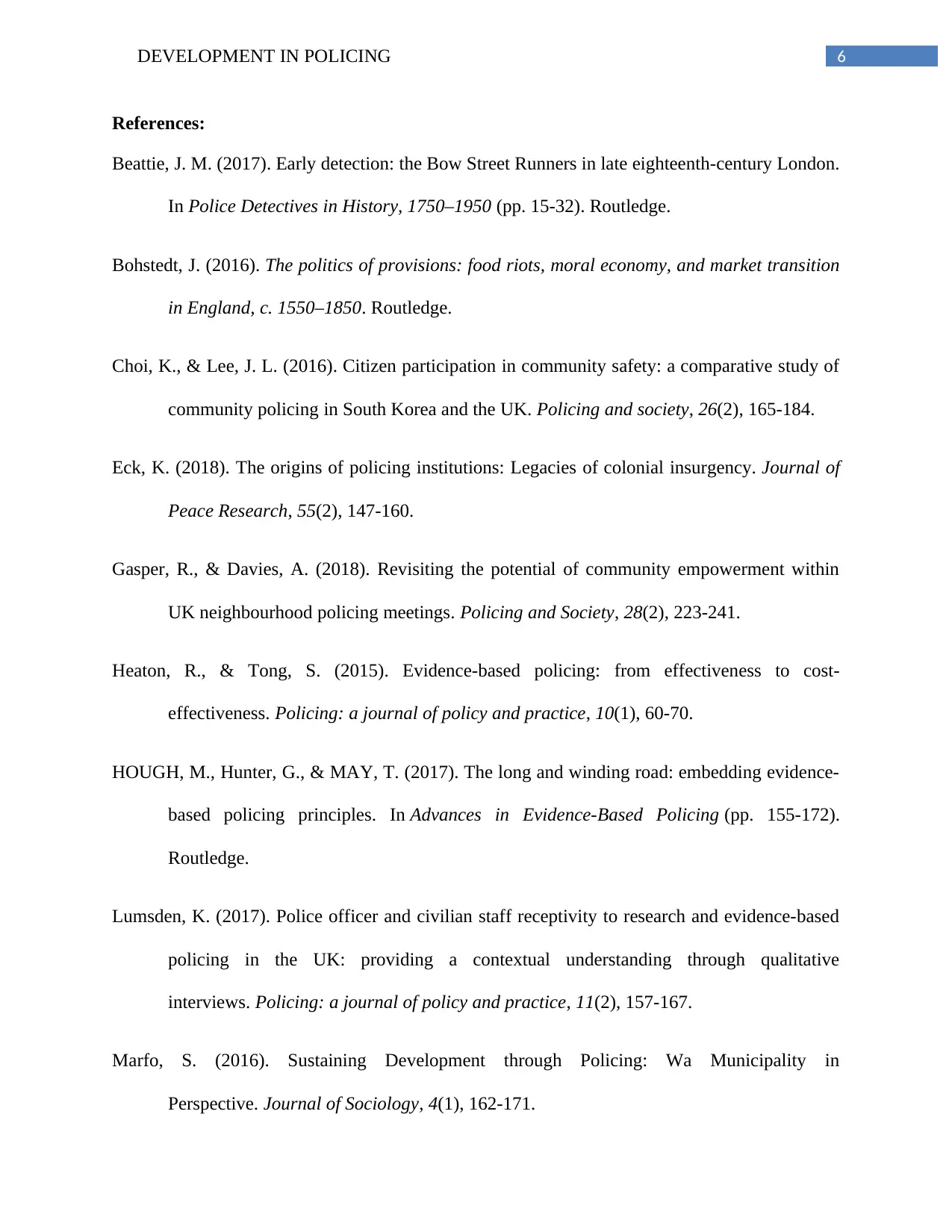
References:
Beattie, J. M. (2017). Early detection: the Bow Street Runners in late eighteenth-century London.
In Police Detectives in History, 1750–1950 (pp. 15-32). Routledge.
Bohstedt, J. (2016). The politics of provisions: food riots, moral economy, and market transition
in England, c. 1550–1850. Routledge.
Choi, K., & Lee, J. L. (2016). Citizen participation in community safety: a comparative study of
community policing in South Korea and the UK. Policing and society, 26(2), 165-184.
Eck, K. (2018). The origins of policing institutions: Legacies of colonial insurgency. Journal of
Peace Research, 55(2), 147-160.
Gasper, R., & Davies, A. (2018). Revisiting the potential of community empowerment within
UK neighbourhood policing meetings. Policing and Society, 28(2), 223-241.
Heaton, R., & Tong, S. (2015). Evidence-based policing: from effectiveness to cost-
effectiveness. Policing: a journal of policy and practice, 10(1), 60-70.
HOUGH, M., Hunter, G., & MAY, T. (2017). The long and winding road: embedding evidence-
based policing principles. In Advances in Evidence-Based Policing (pp. 155-172).
Routledge.
Lumsden, K. (2017). Police officer and civilian staff receptivity to research and evidence-based
policing in the UK: providing a contextual understanding through qualitative
interviews. Policing: a journal of policy and practice, 11(2), 157-167.
Marfo, S. (2016). Sustaining Development through Policing: Wa Municipality in
Perspective. Journal of Sociology, 4(1), 162-171.
References:
Beattie, J. M. (2017). Early detection: the Bow Street Runners in late eighteenth-century London.
In Police Detectives in History, 1750–1950 (pp. 15-32). Routledge.
Bohstedt, J. (2016). The politics of provisions: food riots, moral economy, and market transition
in England, c. 1550–1850. Routledge.
Choi, K., & Lee, J. L. (2016). Citizen participation in community safety: a comparative study of
community policing in South Korea and the UK. Policing and society, 26(2), 165-184.
Eck, K. (2018). The origins of policing institutions: Legacies of colonial insurgency. Journal of
Peace Research, 55(2), 147-160.
Gasper, R., & Davies, A. (2018). Revisiting the potential of community empowerment within
UK neighbourhood policing meetings. Policing and Society, 28(2), 223-241.
Heaton, R., & Tong, S. (2015). Evidence-based policing: from effectiveness to cost-
effectiveness. Policing: a journal of policy and practice, 10(1), 60-70.
HOUGH, M., Hunter, G., & MAY, T. (2017). The long and winding road: embedding evidence-
based policing principles. In Advances in Evidence-Based Policing (pp. 155-172).
Routledge.
Lumsden, K. (2017). Police officer and civilian staff receptivity to research and evidence-based
policing in the UK: providing a contextual understanding through qualitative
interviews. Policing: a journal of policy and practice, 11(2), 157-167.
Marfo, S. (2016). Sustaining Development through Policing: Wa Municipality in
Perspective. Journal of Sociology, 4(1), 162-171.
Paraphrase This Document
Need a fresh take? Get an instant paraphrase of this document with our AI Paraphraser
7DEVELOPMENT IN POLICING
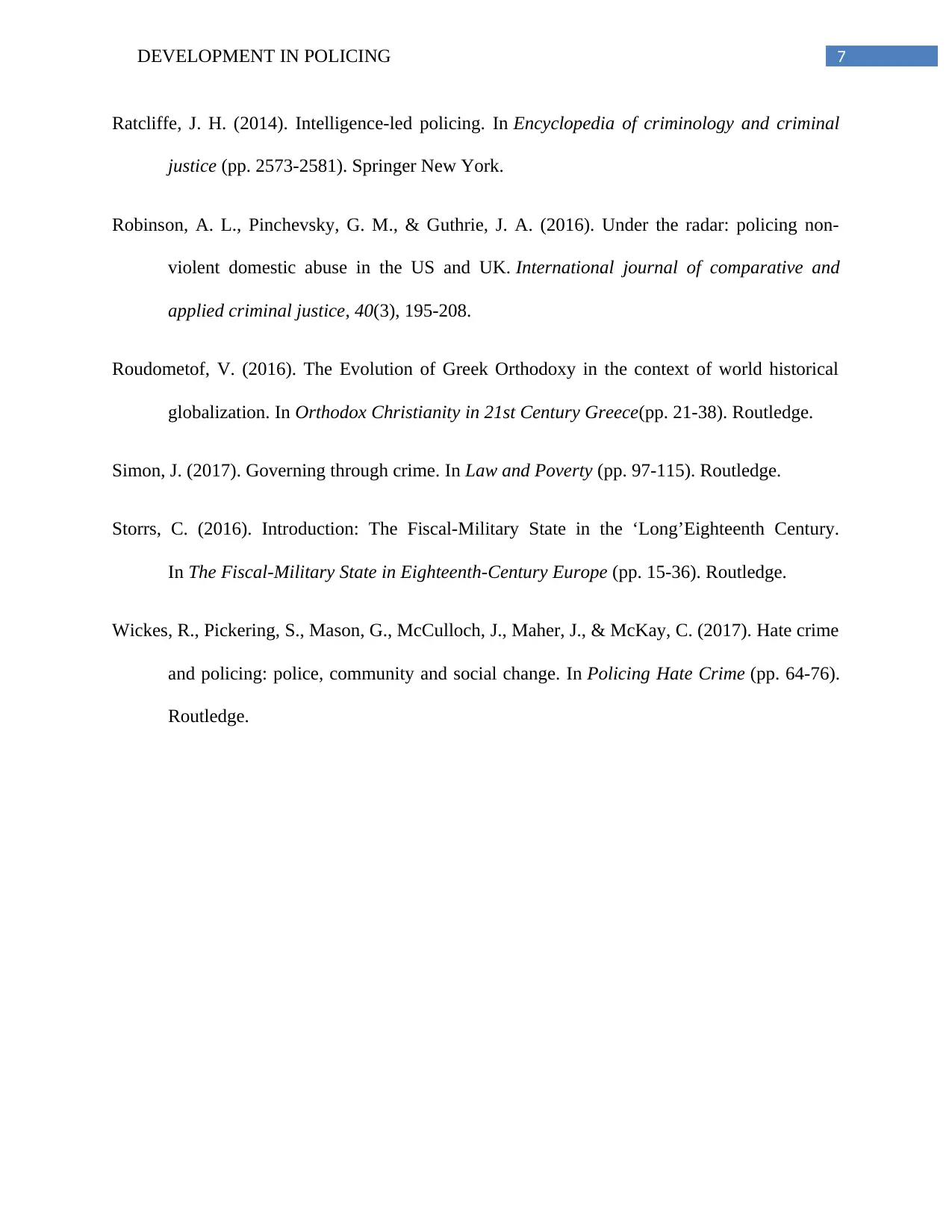
Ratcliffe, J. H. (2014). Intelligence-led policing. In Encyclopedia of criminology and criminal
justice (pp. 2573-2581). Springer New York.
Robinson, A. L., Pinchevsky, G. M., & Guthrie, J. A. (2016). Under the radar: policing non-
violent domestic abuse in the US and UK. International journal of comparative and
applied criminal justice, 40(3), 195-208.
Roudometof, V. (2016). The Evolution of Greek Orthodoxy in the context of world historical
globalization. In Orthodox Christianity in 21st Century Greece(pp. 21-38). Routledge.
Simon, J. (2017). Governing through crime. In Law and Poverty (pp. 97-115). Routledge.
Storrs, C. (2016). Introduction: The Fiscal-Military State in the ‘Long’Eighteenth Century.
In The Fiscal-Military State in Eighteenth-Century Europe (pp. 15-36). Routledge.
Wickes, R., Pickering, S., Mason, G., McCulloch, J., Maher, J., & McKay, C. (2017). Hate crime
and policing: police, community and social change. In Policing Hate Crime (pp. 64-76).
Routledge.
Ratcliffe, J. H. (2014). Intelligence-led policing. In Encyclopedia of criminology and criminal
justice (pp. 2573-2581). Springer New York.
Robinson, A. L., Pinchevsky, G. M., & Guthrie, J. A. (2016). Under the radar: policing non-
violent domestic abuse in the US and UK. International journal of comparative and
applied criminal justice, 40(3), 195-208.
Roudometof, V. (2016). The Evolution of Greek Orthodoxy in the context of world historical
globalization. In Orthodox Christianity in 21st Century Greece(pp. 21-38). Routledge.
Simon, J. (2017). Governing through crime. In Law and Poverty (pp. 97-115). Routledge.
Storrs, C. (2016). Introduction: The Fiscal-Military State in the ‘Long’Eighteenth Century.
In The Fiscal-Military State in Eighteenth-Century Europe (pp. 15-36). Routledge.
Wickes, R., Pickering, S., Mason, G., McCulloch, J., Maher, J., & McKay, C. (2017). Hate crime
and policing: police, community and social change. In Policing Hate Crime (pp. 64-76).
Routledge.

1 out of 8


Your All-in-One AI-Powered Toolkit for Academic Success.
+13062052269
info@desklib.com
Available 24*7 on WhatsApp / Email
![[object Object]](/_next/static/media/star-bottom.7253800d.svg)
Unlock your academic potential
Copyright © 2020–2026 A2Z Services. All Rights Reserved. Developed and managed by ZUCOL.