UK Public Health: Policy Evaluation and Covid-19 Secure Policy
VerifiedAdded on 2023/06/05
|13
|3934
|328
Essay
AI Summary
This essay provides an overview of policy and evaluation within the realm of public health, focusing on the United Kingdom's approach to public health issues, particularly in response to the Covid-19 pandemic. It discusses the importance of policy evaluation, the various stages of policy development and implementation, and the factors that influence policy effectiveness. The essay delves into the UK's Covid-19 secure policy, examining its objectives, implementation strategies, and impact on public health, along with challenges and barriers encountered. Furthermore, the essay touches on the roles of stakeholders, the influence of public opinion and economic conditions, and the importance of evidence-based decision-making in shaping public health policies. Desklib offers a range of resources, including similar solved assignments and past papers, for students studying public health.
Policy and Evaluation
in Public Health
in Public Health

Paraphrase This Document
Need a fresh take? Get an instant paraphrase of this document with our AI Paraphraser

Table of Contents
INTRODUCTION...........................................................................................................................1
BACKGROUND.............................................................................................................................1
BODY OF ESSAY..........................................................................................................................4
CONCLUSION................................................................................................................................7
REFERENCES................................................................................................................................9
INTRODUCTION...........................................................................................................................1
BACKGROUND.............................................................................................................................1
BODY OF ESSAY..........................................................................................................................4
CONCLUSION................................................................................................................................7
REFERENCES................................................................................................................................9
⊘ This is a preview!⊘
Do you want full access?
Subscribe today to unlock all pages.

Trusted by 1+ million students worldwide
INTRODUCTION
Evaluation of policy refers to the sequential gathering and determination of gathered data
to make decisions associated with characteristics, contexts, and results of one or more than one
realm of the process of policy. There are four types of evaluation of policy impact evaluation,
process evaluation, cost-efficient evaluation, and outcome evaluation. It is very important to
evaluate public policies as it helps the government to improve the structure and implementation
of public policies for the public welfare. Evaluation of public policies is also helpful to promote
public learning, accountability, health, and well-being of people (Williams et. al., 2020). It
facilitates effective decision-making to provide quality life to citizens. With this, it is well
analyzed that various situations arise that create public health issues. In this, Covid-19 is also
arising as an issue that predominantly acts as a public health issue among various countries. In
the UK, various policy is used to implement in which some of which are used to create
awareness, some are about rule and regulation and other is about precaution and rule that is
undertaken to reduce the spread of the virus from one to another. Above all, the Covid-19 secure
policy in the UK is taken in a report to review the policy and evaluate its effectiveness in
various phases (Altmann et. al., 2020).
Scope:
This essay will discuss all the public policies developed in the United Kingdom for public
welfare.
Objective:
This paper will evaluate the process of policies, the cycle of policies, the effectiveness of the
implementation of public policies, and recommendations.
BACKGROUND
A policy is a group of ideas and principles which guide one to attain a specific goal.
Governmental policies describe the aims and objectives of planned action, performed for the
public welfare. Public policies are usually developed by governmental bodies to achieve
objectives that resolve public issues. In the UK, public policies refer to the agreed ideas and
principles which guide how government can act or develop strategies associated with public
issues which can be political, economic, and social. This paper includes strategic planning,
visions, aims, and objectives of the activities which are performed for public well-being.
1
Evaluation of policy refers to the sequential gathering and determination of gathered data
to make decisions associated with characteristics, contexts, and results of one or more than one
realm of the process of policy. There are four types of evaluation of policy impact evaluation,
process evaluation, cost-efficient evaluation, and outcome evaluation. It is very important to
evaluate public policies as it helps the government to improve the structure and implementation
of public policies for the public welfare. Evaluation of public policies is also helpful to promote
public learning, accountability, health, and well-being of people (Williams et. al., 2020). It
facilitates effective decision-making to provide quality life to citizens. With this, it is well
analyzed that various situations arise that create public health issues. In this, Covid-19 is also
arising as an issue that predominantly acts as a public health issue among various countries. In
the UK, various policy is used to implement in which some of which are used to create
awareness, some are about rule and regulation and other is about precaution and rule that is
undertaken to reduce the spread of the virus from one to another. Above all, the Covid-19 secure
policy in the UK is taken in a report to review the policy and evaluate its effectiveness in
various phases (Altmann et. al., 2020).
Scope:
This essay will discuss all the public policies developed in the United Kingdom for public
welfare.
Objective:
This paper will evaluate the process of policies, the cycle of policies, the effectiveness of the
implementation of public policies, and recommendations.
BACKGROUND
A policy is a group of ideas and principles which guide one to attain a specific goal.
Governmental policies describe the aims and objectives of planned action, performed for the
public welfare. Public policies are usually developed by governmental bodies to achieve
objectives that resolve public issues. In the UK, public policies refer to the agreed ideas and
principles which guide how government can act or develop strategies associated with public
issues which can be political, economic, and social. This paper includes strategic planning,
visions, aims, and objectives of the activities which are performed for public well-being.
1
Paraphrase This Document
Need a fresh take? Get an instant paraphrase of this document with our AI Paraphraser
Government implements public policies to promote and protect public health. The development
and improvement of public policies rely on several factors including social, environmental, and
political factors. Citizens put their opinion in front of governmental bodies so they can develop
policies to resolve public issues. The government also modifies the policy by acknowledging the
viewpoints of citizens. With the chosen policy, Government implements a Covid-19 secure
policy to minimize the risk and reduce the issue which is associated with rising cases of Covid-
19. The transmission must be prevented while following the review of the policy that state it
announces and commenced with social distancing and try to not visit such place which is
crowded because the rate of transmission of Covid-19 is slightly higher than other in such places
and regions (Glaros and et. al., 2021).
The development of policies affects the delivery of health and social care to the public.
Sometimes, governmental bodies make changes in public policies to attain advantages from
enhanced subsidies. Policies may arise at various steps while the political cycle. Some public
policies are developed and implemented during the election. For example, in the UK, the
government has committed to a 25-year plan to regain the UK's biodiversity in the year 2015. At
all stages of the development of public policies, some external factors influence the process of
policy-making. Public policies are usually presented in white papers, natural environmental
white papers, and government manifestos. There are certain laws and legislation that enforce a
public policy. For example, the UK climate change act 2008 has been implemented to reduce
emissions by 80 percent (Ţicu, 2022). This act came into force to develop a safe environment for
citizens of the UK. The process of development of public policy involves several stages such as
identification of a public issue, collecting the relevant data, making decisions, implementing the
policy, evaluating the outcomes, and termination. Governmental bodies identify arsing public
issues to resolve them for the public welfare and well-being. The stakeholders and investors
require to understand and go through all the stages mentioned above. To formulate a public
policy all the required information is gathered so an effective policy can be developed. The
policy cycle is often divided into four steps such as setting the agenda, formulating the structures,
making decisions, implementing the policies, and evaluating the policies (Jain, and et. al., 2020).
Public health policy is vital as it develops research and theories regarding public health to
promote health and prevent illness (Anderson and Scacco, 2022). Public health policies conduct
activities to facilitate health resources for citizens. It is also seen within the Covid-19 secure
2
and improvement of public policies rely on several factors including social, environmental, and
political factors. Citizens put their opinion in front of governmental bodies so they can develop
policies to resolve public issues. The government also modifies the policy by acknowledging the
viewpoints of citizens. With the chosen policy, Government implements a Covid-19 secure
policy to minimize the risk and reduce the issue which is associated with rising cases of Covid-
19. The transmission must be prevented while following the review of the policy that state it
announces and commenced with social distancing and try to not visit such place which is
crowded because the rate of transmission of Covid-19 is slightly higher than other in such places
and regions (Glaros and et. al., 2021).
The development of policies affects the delivery of health and social care to the public.
Sometimes, governmental bodies make changes in public policies to attain advantages from
enhanced subsidies. Policies may arise at various steps while the political cycle. Some public
policies are developed and implemented during the election. For example, in the UK, the
government has committed to a 25-year plan to regain the UK's biodiversity in the year 2015. At
all stages of the development of public policies, some external factors influence the process of
policy-making. Public policies are usually presented in white papers, natural environmental
white papers, and government manifestos. There are certain laws and legislation that enforce a
public policy. For example, the UK climate change act 2008 has been implemented to reduce
emissions by 80 percent (Ţicu, 2022). This act came into force to develop a safe environment for
citizens of the UK. The process of development of public policy involves several stages such as
identification of a public issue, collecting the relevant data, making decisions, implementing the
policy, evaluating the outcomes, and termination. Governmental bodies identify arsing public
issues to resolve them for the public welfare and well-being. The stakeholders and investors
require to understand and go through all the stages mentioned above. To formulate a public
policy all the required information is gathered so an effective policy can be developed. The
policy cycle is often divided into four steps such as setting the agenda, formulating the structures,
making decisions, implementing the policies, and evaluating the policies (Jain, and et. al., 2020).
Public health policy is vital as it develops research and theories regarding public health to
promote health and prevent illness (Anderson and Scacco, 2022). Public health policies conduct
activities to facilitate health resources for citizens. It is also seen within the Covid-19 secure
2
policy that stated that people's health is precious and they can be safe from the virus that may
affect the issue of people's health due to the virus that impacts respiration, and so on. Covid-19
secure policy improves and protects people through intervening epidemics and prevalence of
diseases which provide safeguard to the people. Health policies are helpful to establish
governmental hospitals which can provide cost-effective treatment and medicines to people who
cannot afford the high-cost treatments and die due to lack of access to health resources. The
paper will discuss all the barriers that come on way to developing and implementing public
health policies (Ţicu, 2022). Several barriers lead to the formulation of ineffective policy such as
organizational barriers, deficiencies in policy design, resource constraints, and poor strategies.
Industrial interference, lack of clear roles, aims, and objectives, and poor enforcement lead to the
development of an unsuccessful policy that affects the health of people negatively. Inadequate
human and material resources, lack of continuity in governmental policies, and corruption result
in the implementation gap (Wolfson, and Leung, 2020).
Covid-19 secure policy UK is designed to provide guidance to prevent the transmission
of the virus. The policy is reviewed in a proper way that promotes the vision of safety and
protection from the Covid-19 virus. Policies were designed to maintain hygiene as it was a
communicable infection and thus maintaining hygiene became mandatory. The outbreak of
COVID has been observed in many job categories and workplaces. All the employees have been
instructed to wear masks. Infected people were exhaling droplets of infected fluid and people
could get infected when they came in contact with the infected person. Thus, people are strictly
instructed to maintain a distance of 1 meter. To maintain the distance, organizations have
allowed employees to work sitting at home (Mayor, 2020).
The Covid-19 secure policy UK shows their guidance that is related to the general
instruction which is population wears face masks while traveling through a mode of public
transport. Symptomatic people were not asked to take a PCR test and were recommended to stay
at home. Face masks and sanitizers are still compulsory in health care settings. During the
pandemic, catering industries were instructed to provide their staff, with appropriate training to
prevent the spreading. Maintaining hygiene in restaurants and cafes becomes mandatory. The
restaurant was allowed only 50% of the capacity of customers with the purpose to maintain the
distance. Government also distributed self-testing kits to citizens so they can public can check
themselves sitting at home. Free vitamin supplements were provided to boost immunity.
3
affect the issue of people's health due to the virus that impacts respiration, and so on. Covid-19
secure policy improves and protects people through intervening epidemics and prevalence of
diseases which provide safeguard to the people. Health policies are helpful to establish
governmental hospitals which can provide cost-effective treatment and medicines to people who
cannot afford the high-cost treatments and die due to lack of access to health resources. The
paper will discuss all the barriers that come on way to developing and implementing public
health policies (Ţicu, 2022). Several barriers lead to the formulation of ineffective policy such as
organizational barriers, deficiencies in policy design, resource constraints, and poor strategies.
Industrial interference, lack of clear roles, aims, and objectives, and poor enforcement lead to the
development of an unsuccessful policy that affects the health of people negatively. Inadequate
human and material resources, lack of continuity in governmental policies, and corruption result
in the implementation gap (Wolfson, and Leung, 2020).
Covid-19 secure policy UK is designed to provide guidance to prevent the transmission
of the virus. The policy is reviewed in a proper way that promotes the vision of safety and
protection from the Covid-19 virus. Policies were designed to maintain hygiene as it was a
communicable infection and thus maintaining hygiene became mandatory. The outbreak of
COVID has been observed in many job categories and workplaces. All the employees have been
instructed to wear masks. Infected people were exhaling droplets of infected fluid and people
could get infected when they came in contact with the infected person. Thus, people are strictly
instructed to maintain a distance of 1 meter. To maintain the distance, organizations have
allowed employees to work sitting at home (Mayor, 2020).
The Covid-19 secure policy UK shows their guidance that is related to the general
instruction which is population wears face masks while traveling through a mode of public
transport. Symptomatic people were not asked to take a PCR test and were recommended to stay
at home. Face masks and sanitizers are still compulsory in health care settings. During the
pandemic, catering industries were instructed to provide their staff, with appropriate training to
prevent the spreading. Maintaining hygiene in restaurants and cafes becomes mandatory. The
restaurant was allowed only 50% of the capacity of customers with the purpose to maintain the
distance. Government also distributed self-testing kits to citizens so they can public can check
themselves sitting at home. Free vitamin supplements were provided to boost immunity.
3
⊘ This is a preview!⊘
Do you want full access?
Subscribe today to unlock all pages.
Trusted by 1+ million students worldwide
Sanitizers, medicines, and other safety equipment were provided to the public. The government
has developed an infectious disease preparedness and response plan to provide safety to workers
at the workplace. The government has provided free check-ups and treatment to vulnerable
people to stop the prevalence. Workers are instructed to stick at home if feeling sick. Workers
are encouraged to use respirator etiquette while sneezing and coughing (Torjesen, 2021).
BODY OF ESSAY
In the UK, public health programs are conducted to identify the main public-related
health problems that arise during the covid-19 are drug abuse, obesity, depression, and anxiety.
The Covid-19 secure policy implement plan that is focused on testing Covid-19. It helps to
provide the proper aspect which is well focused on Covid-19 screening which allows knowing
about people who are facing the issue of Covid-19 and creating a quarantine process to reduce
transmission of the virus. Government collaborates with health agencies to address the health
requirements of vulnerable people which helps to resolve social, economic, and many other
arising health issues. The majority of death registered in the UK is due to malignant neoplasm of
the trachea, dementia and Alzheimer's disease, chronic respiratory diseases, cerebrovascular
disease, influenza and pneumonia, and ischaemic heart disease. Governance indulges the
development of policy that is completely evidence-based which helps to make decisions on
arising issues associated with public health through upholding principles of accountability,
participation, transparency, and fairness. Principle areas of governance of health indulge
accountability, performance monitoring, and prioritizing the setting. The government is
developing the healthcare setting as advancement in technology helps to deliver better health
services to people (Gebreslassie, and et. al., 2020).
Services users or patients, healthcare professionals, healthcare settings, non-governmental
organizations, pharmacists, and medicine suppliers are the main stakeholders of the healthcare
setting. Stakeholders are groups, organizations, or any individual who impacts and get affected
by the implementation of the policies. A healthcare setting involves the majority of external
stakeholders. Financial communities, patients, and suppliers are considered external stakeholders
in healthcare settings. These external stakeholders rely upon healthcare organizations for the
outcomes. Interface stakeholders are considered to work between the healthcare organization
and its environment. Sufficient inducements are provided by the healthcare organization so
interface stakeholders can make their suitable contributions. The healthcare organization may
4
has developed an infectious disease preparedness and response plan to provide safety to workers
at the workplace. The government has provided free check-ups and treatment to vulnerable
people to stop the prevalence. Workers are instructed to stick at home if feeling sick. Workers
are encouraged to use respirator etiquette while sneezing and coughing (Torjesen, 2021).
BODY OF ESSAY
In the UK, public health programs are conducted to identify the main public-related
health problems that arise during the covid-19 are drug abuse, obesity, depression, and anxiety.
The Covid-19 secure policy implement plan that is focused on testing Covid-19. It helps to
provide the proper aspect which is well focused on Covid-19 screening which allows knowing
about people who are facing the issue of Covid-19 and creating a quarantine process to reduce
transmission of the virus. Government collaborates with health agencies to address the health
requirements of vulnerable people which helps to resolve social, economic, and many other
arising health issues. The majority of death registered in the UK is due to malignant neoplasm of
the trachea, dementia and Alzheimer's disease, chronic respiratory diseases, cerebrovascular
disease, influenza and pneumonia, and ischaemic heart disease. Governance indulges the
development of policy that is completely evidence-based which helps to make decisions on
arising issues associated with public health through upholding principles of accountability,
participation, transparency, and fairness. Principle areas of governance of health indulge
accountability, performance monitoring, and prioritizing the setting. The government is
developing the healthcare setting as advancement in technology helps to deliver better health
services to people (Gebreslassie, and et. al., 2020).
Services users or patients, healthcare professionals, healthcare settings, non-governmental
organizations, pharmacists, and medicine suppliers are the main stakeholders of the healthcare
setting. Stakeholders are groups, organizations, or any individual who impacts and get affected
by the implementation of the policies. A healthcare setting involves the majority of external
stakeholders. Financial communities, patients, and suppliers are considered external stakeholders
in healthcare settings. These external stakeholders rely upon healthcare organizations for the
outcomes. Interface stakeholders are considered to work between the healthcare organization
and its environment. Sufficient inducements are provided by the healthcare organization so
interface stakeholders can make their suitable contributions. The healthcare organization may
4
Paraphrase This Document
Need a fresh take? Get an instant paraphrase of this document with our AI Paraphraser
provide institutional prestige, political contacts, specific services and advantages, and
professional autonomy. Internal stakeholders include non-professional, professional, and
management staff workers. The internal stakeholders are reliable to determine whether
inducements are sufficient to make the contribution that is required for the development of
policies (Keim‐Malpass, and et. al., 2019).
Covid-19 secure policy UK is referring to an advanced policy that supports people's
support and they have a major focus on universities where they can reduce the change of
transmission of the virus from one people to another. Policy is considered as multifaceted and
complex method which includes the interplay of several roles. Several factors influence the
development and implementation of the Covid-19 secure policy UK (Orr, 2018). These factors
include public opinion, economical condition of the nation, technological changes, interested
individuals and associated business associations. Government always prioritise public opinion.
Governmental bodies identify the public health issues when the public put their opinion in front
of the government. Usually it occurs during the election where politicians make commitments to
resolve public health issues in order to ensure their health and well-being. As public concern
about the volatile energy prices, global climate changes and environment is increasing, it is
influencing the development and implementation of public health policies (Anderson and
Scacco, 2022). Government has also become more conscious about the public health in order to
prevent prevalence of illness. Economic conditions of the nation also play a significant role in
the development of public health policies (Kim, and Hong, 2020). Development of a health
policy requires a huge amount of funding. Therefore, financial resources are required for
implementing the health policies effectively (Mahase, 2021).
Government has implemented Covid-19 polices and guidelines for the purpose of public
safety. Government set the rules if anyone tested positive, she/he must stay at home for 15 days.
In addition, there are some of the instruction which is usually provided by Covid-19 secure
policy UK are that sanitizer became mandatory at every individual workplace with the purpose
of safety of employees (Andersen and et. al., 2022). People are strictly instructed to avoid close
contacts and crowds. People were recommended to wear face mask if they cannot maintain the
distance. Poor ventilated settings lead to high chance of getting infection. Proper ventilation was
ensured when people were in close contact. Citizens were allowed to socialised outdoors in order
to ensure appropriate ventilation. During the pandemic, the pulse survey aimed to gather
5
professional autonomy. Internal stakeholders include non-professional, professional, and
management staff workers. The internal stakeholders are reliable to determine whether
inducements are sufficient to make the contribution that is required for the development of
policies (Keim‐Malpass, and et. al., 2019).
Covid-19 secure policy UK is referring to an advanced policy that supports people's
support and they have a major focus on universities where they can reduce the change of
transmission of the virus from one people to another. Policy is considered as multifaceted and
complex method which includes the interplay of several roles. Several factors influence the
development and implementation of the Covid-19 secure policy UK (Orr, 2018). These factors
include public opinion, economical condition of the nation, technological changes, interested
individuals and associated business associations. Government always prioritise public opinion.
Governmental bodies identify the public health issues when the public put their opinion in front
of the government. Usually it occurs during the election where politicians make commitments to
resolve public health issues in order to ensure their health and well-being. As public concern
about the volatile energy prices, global climate changes and environment is increasing, it is
influencing the development and implementation of public health policies (Anderson and
Scacco, 2022). Government has also become more conscious about the public health in order to
prevent prevalence of illness. Economic conditions of the nation also play a significant role in
the development of public health policies (Kim, and Hong, 2020). Development of a health
policy requires a huge amount of funding. Therefore, financial resources are required for
implementing the health policies effectively (Mahase, 2021).
Government has implemented Covid-19 polices and guidelines for the purpose of public
safety. Government set the rules if anyone tested positive, she/he must stay at home for 15 days.
In addition, there are some of the instruction which is usually provided by Covid-19 secure
policy UK are that sanitizer became mandatory at every individual workplace with the purpose
of safety of employees (Andersen and et. al., 2022). People are strictly instructed to avoid close
contacts and crowds. People were recommended to wear face mask if they cannot maintain the
distance. Poor ventilated settings lead to high chance of getting infection. Proper ventilation was
ensured when people were in close contact. Citizens were allowed to socialised outdoors in order
to ensure appropriate ventilation. During the pandemic, the pulse survey aimed to gather
5
information about the impact of a pandemic on vital health services across life. This survey leads
to improvement in understanding of disruption in health and care services. Government conduct
survey in order to address the basic health requirements of vulnerable people in order to maintain
them (Iacobucci, 2020).
CONCLUSION
From the above discussion, it has been summarised Covid-19 secure policy is a set of
principles which guide government as well as individuals to achieve a specific goal. Public
health policies have been developed for public welfare and well-being. There are number of
factors which affects the implementation and development of policies including social,
environmental and political factors. Government prioritise arising health issues in order to
develop a policy which can resolve these issues. Evaluation of policies are completely evidence
based process which determines the impact of implementation of policy on entire population.
Evaluation of policies is very significant as it helps to modify them as per the requirement of
public. Government and public authorities evaluate public health policies in order to identify the
weaknesses and make changes to develop an effective policy for the public good health and
welfare. It has been observed that COVID infection keep spreading across the world and it was
very difficult to predict. UK adopted the health, socio-economic and humanitarian policies in
order to evaluate strength and speed of recovery of vulnerable patients. Governmental policies
are formulated in order to stop the prevalence.
6
to improvement in understanding of disruption in health and care services. Government conduct
survey in order to address the basic health requirements of vulnerable people in order to maintain
them (Iacobucci, 2020).
CONCLUSION
From the above discussion, it has been summarised Covid-19 secure policy is a set of
principles which guide government as well as individuals to achieve a specific goal. Public
health policies have been developed for public welfare and well-being. There are number of
factors which affects the implementation and development of policies including social,
environmental and political factors. Government prioritise arising health issues in order to
develop a policy which can resolve these issues. Evaluation of policies are completely evidence
based process which determines the impact of implementation of policy on entire population.
Evaluation of policies is very significant as it helps to modify them as per the requirement of
public. Government and public authorities evaluate public health policies in order to identify the
weaknesses and make changes to develop an effective policy for the public good health and
welfare. It has been observed that COVID infection keep spreading across the world and it was
very difficult to predict. UK adopted the health, socio-economic and humanitarian policies in
order to evaluate strength and speed of recovery of vulnerable patients. Governmental policies
are formulated in order to stop the prevalence.
6
⊘ This is a preview!⊘
Do you want full access?
Subscribe today to unlock all pages.
Trusted by 1+ million students worldwide
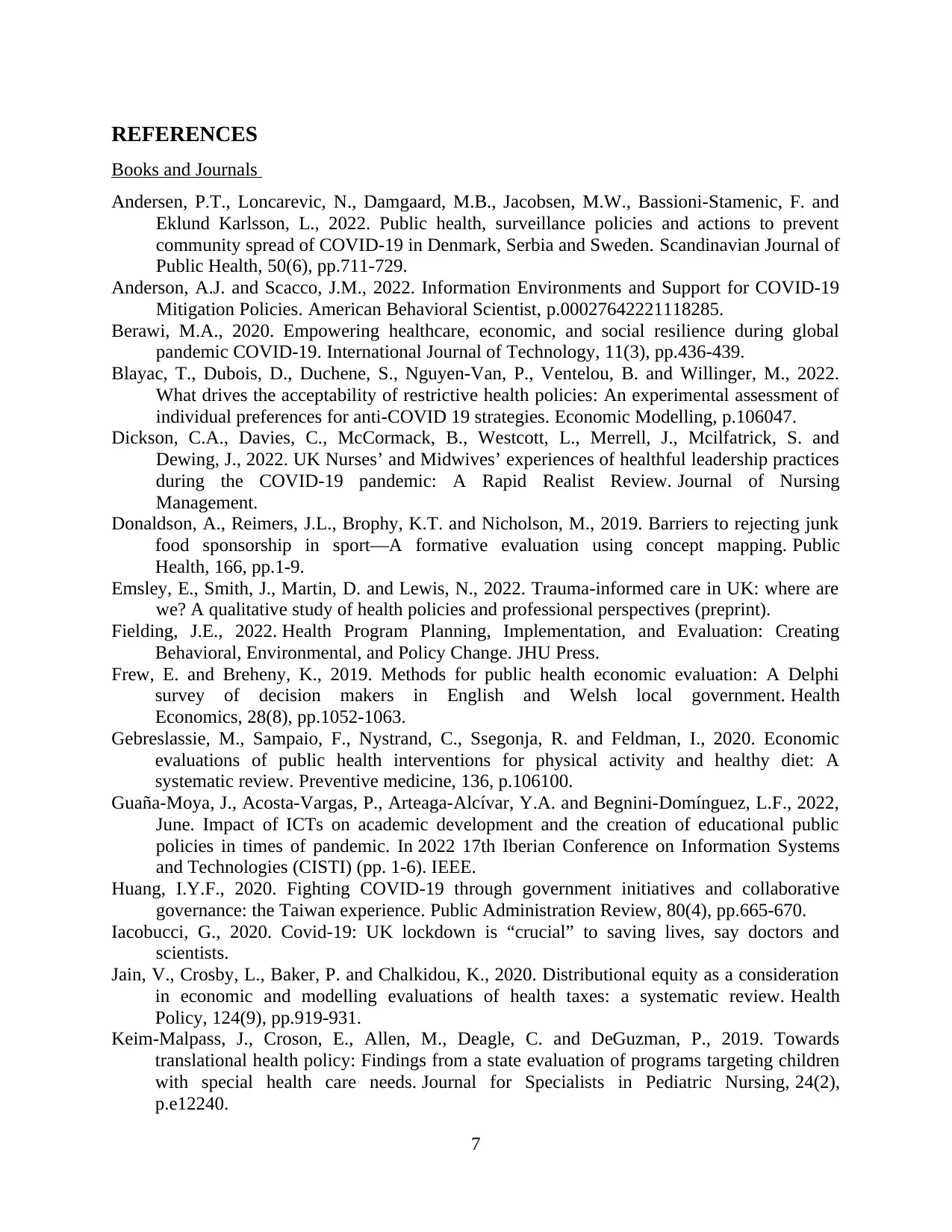
REFERENCES
Books and Journals
Andersen, P.T., Loncarevic, N., Damgaard, M.B., Jacobsen, M.W., Bassioni-Stamenic, F. and
Eklund Karlsson, L., 2022. Public health, surveillance policies and actions to prevent
community spread of COVID-19 in Denmark, Serbia and Sweden. Scandinavian Journal of
Public Health, 50(6), pp.711-729.
Anderson, A.J. and Scacco, J.M., 2022. Information Environments and Support for COVID-19
Mitigation Policies. American Behavioral Scientist, p.00027642221118285.
Berawi, M.A., 2020. Empowering healthcare, economic, and social resilience during global
pandemic COVID-19. International Journal of Technology, 11(3), pp.436-439.
Blayac, T., Dubois, D., Duchene, S., Nguyen-Van, P., Ventelou, B. and Willinger, M., 2022.
What drives the acceptability of restrictive health policies: An experimental assessment of
individual preferences for anti-COVID 19 strategies. Economic Modelling, p.106047.
Dickson, C.A., Davies, C., McCormack, B., Westcott, L., Merrell, J., Mcilfatrick, S. and
Dewing, J., 2022. UK Nurses’ and Midwives’ experiences of healthful leadership practices
during the COVID‐19 pandemic: A Rapid Realist Review. Journal of Nursing
Management.
Donaldson, A., Reimers, J.L., Brophy, K.T. and Nicholson, M., 2019. Barriers to rejecting junk
food sponsorship in sport—A formative evaluation using concept mapping. Public
Health, 166, pp.1-9.
Emsley, E., Smith, J., Martin, D. and Lewis, N., 2022. Trauma-informed care in UK: where are
we? A qualitative study of health policies and professional perspectives (preprint).
Fielding, J.E., 2022. Health Program Planning, Implementation, and Evaluation: Creating
Behavioral, Environmental, and Policy Change. JHU Press.
Frew, E. and Breheny, K., 2019. Methods for public health economic evaluation: A Delphi
survey of decision makers in English and Welsh local government. Health
Economics, 28(8), pp.1052-1063.
Gebreslassie, M., Sampaio, F., Nystrand, C., Ssegonja, R. and Feldman, I., 2020. Economic
evaluations of public health interventions for physical activity and healthy diet: A
systematic review. Preventive medicine, 136, p.106100.
Guaña-Moya, J., Acosta-Vargas, P., Arteaga-Alcívar, Y.A. and Begnini-Domínguez, L.F., 2022,
June. Impact of ICTs on academic development and the creation of educational public
policies in times of pandemic. In 2022 17th Iberian Conference on Information Systems
and Technologies (CISTI) (pp. 1-6). IEEE.
Huang, I.Y.F., 2020. Fighting COVID‐19 through government initiatives and collaborative
governance: the Taiwan experience. Public Administration Review, 80(4), pp.665-670.
Iacobucci, G., 2020. Covid-19: UK lockdown is “crucial” to saving lives, say doctors and
scientists.
Jain, V., Crosby, L., Baker, P. and Chalkidou, K., 2020. Distributional equity as a consideration
in economic and modelling evaluations of health taxes: a systematic review. Health
Policy, 124(9), pp.919-931.
Keim‐Malpass, J., Croson, E., Allen, M., Deagle, C. and DeGuzman, P., 2019. Towards
translational health policy: Findings from a state evaluation of programs targeting children
with special health care needs. Journal for Specialists in Pediatric Nursing, 24(2),
p.e12240.
7
Books and Journals
Andersen, P.T., Loncarevic, N., Damgaard, M.B., Jacobsen, M.W., Bassioni-Stamenic, F. and
Eklund Karlsson, L., 2022. Public health, surveillance policies and actions to prevent
community spread of COVID-19 in Denmark, Serbia and Sweden. Scandinavian Journal of
Public Health, 50(6), pp.711-729.
Anderson, A.J. and Scacco, J.M., 2022. Information Environments and Support for COVID-19
Mitigation Policies. American Behavioral Scientist, p.00027642221118285.
Berawi, M.A., 2020. Empowering healthcare, economic, and social resilience during global
pandemic COVID-19. International Journal of Technology, 11(3), pp.436-439.
Blayac, T., Dubois, D., Duchene, S., Nguyen-Van, P., Ventelou, B. and Willinger, M., 2022.
What drives the acceptability of restrictive health policies: An experimental assessment of
individual preferences for anti-COVID 19 strategies. Economic Modelling, p.106047.
Dickson, C.A., Davies, C., McCormack, B., Westcott, L., Merrell, J., Mcilfatrick, S. and
Dewing, J., 2022. UK Nurses’ and Midwives’ experiences of healthful leadership practices
during the COVID‐19 pandemic: A Rapid Realist Review. Journal of Nursing
Management.
Donaldson, A., Reimers, J.L., Brophy, K.T. and Nicholson, M., 2019. Barriers to rejecting junk
food sponsorship in sport—A formative evaluation using concept mapping. Public
Health, 166, pp.1-9.
Emsley, E., Smith, J., Martin, D. and Lewis, N., 2022. Trauma-informed care in UK: where are
we? A qualitative study of health policies and professional perspectives (preprint).
Fielding, J.E., 2022. Health Program Planning, Implementation, and Evaluation: Creating
Behavioral, Environmental, and Policy Change. JHU Press.
Frew, E. and Breheny, K., 2019. Methods for public health economic evaluation: A Delphi
survey of decision makers in English and Welsh local government. Health
Economics, 28(8), pp.1052-1063.
Gebreslassie, M., Sampaio, F., Nystrand, C., Ssegonja, R. and Feldman, I., 2020. Economic
evaluations of public health interventions for physical activity and healthy diet: A
systematic review. Preventive medicine, 136, p.106100.
Guaña-Moya, J., Acosta-Vargas, P., Arteaga-Alcívar, Y.A. and Begnini-Domínguez, L.F., 2022,
June. Impact of ICTs on academic development and the creation of educational public
policies in times of pandemic. In 2022 17th Iberian Conference on Information Systems
and Technologies (CISTI) (pp. 1-6). IEEE.
Huang, I.Y.F., 2020. Fighting COVID‐19 through government initiatives and collaborative
governance: the Taiwan experience. Public Administration Review, 80(4), pp.665-670.
Iacobucci, G., 2020. Covid-19: UK lockdown is “crucial” to saving lives, say doctors and
scientists.
Jain, V., Crosby, L., Baker, P. and Chalkidou, K., 2020. Distributional equity as a consideration
in economic and modelling evaluations of health taxes: a systematic review. Health
Policy, 124(9), pp.919-931.
Keim‐Malpass, J., Croson, E., Allen, M., Deagle, C. and DeGuzman, P., 2019. Towards
translational health policy: Findings from a state evaluation of programs targeting children
with special health care needs. Journal for Specialists in Pediatric Nursing, 24(2),
p.e12240.
7
Paraphrase This Document
Need a fresh take? Get an instant paraphrase of this document with our AI Paraphraser
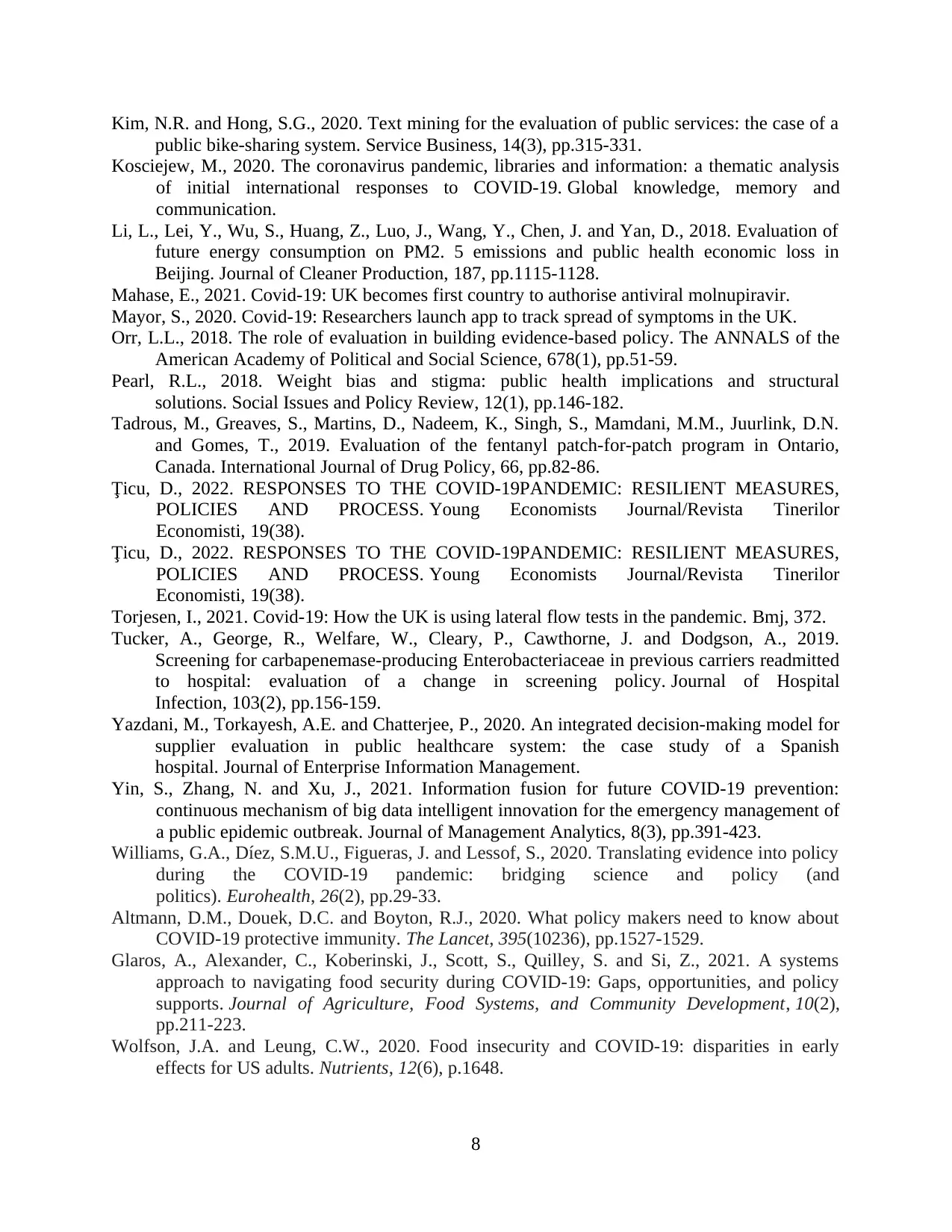
Kim, N.R. and Hong, S.G., 2020. Text mining for the evaluation of public services: the case of a
public bike-sharing system. Service Business, 14(3), pp.315-331.
Kosciejew, M., 2020. The coronavirus pandemic, libraries and information: a thematic analysis
of initial international responses to COVID-19. Global knowledge, memory and
communication.
Li, L., Lei, Y., Wu, S., Huang, Z., Luo, J., Wang, Y., Chen, J. and Yan, D., 2018. Evaluation of
future energy consumption on PM2. 5 emissions and public health economic loss in
Beijing. Journal of Cleaner Production, 187, pp.1115-1128.
Mahase, E., 2021. Covid-19: UK becomes first country to authorise antiviral molnupiravir.
Mayor, S., 2020. Covid-19: Researchers launch app to track spread of symptoms in the UK.
Orr, L.L., 2018. The role of evaluation in building evidence-based policy. The ANNALS of the
American Academy of Political and Social Science, 678(1), pp.51-59.
Pearl, R.L., 2018. Weight bias and stigma: public health implications and structural
solutions. Social Issues and Policy Review, 12(1), pp.146-182.
Tadrous, M., Greaves, S., Martins, D., Nadeem, K., Singh, S., Mamdani, M.M., Juurlink, D.N.
and Gomes, T., 2019. Evaluation of the fentanyl patch-for-patch program in Ontario,
Canada. International Journal of Drug Policy, 66, pp.82-86.
Ţicu, D., 2022. RESPONSES TO THE COVID-19PANDEMIC: RESILIENT MEASURES,
POLICIES AND PROCESS. Young Economists Journal/Revista Tinerilor
Economisti, 19(38).
Ţicu, D., 2022. RESPONSES TO THE COVID-19PANDEMIC: RESILIENT MEASURES,
POLICIES AND PROCESS. Young Economists Journal/Revista Tinerilor
Economisti, 19(38).
Torjesen, I., 2021. Covid-19: How the UK is using lateral flow tests in the pandemic. Bmj, 372.
Tucker, A., George, R., Welfare, W., Cleary, P., Cawthorne, J. and Dodgson, A., 2019.
Screening for carbapenemase-producing Enterobacteriaceae in previous carriers readmitted
to hospital: evaluation of a change in screening policy. Journal of Hospital
Infection, 103(2), pp.156-159.
Yazdani, M., Torkayesh, A.E. and Chatterjee, P., 2020. An integrated decision-making model for
supplier evaluation in public healthcare system: the case study of a Spanish
hospital. Journal of Enterprise Information Management.
Yin, S., Zhang, N. and Xu, J., 2021. Information fusion for future COVID-19 prevention:
continuous mechanism of big data intelligent innovation for the emergency management of
a public epidemic outbreak. Journal of Management Analytics, 8(3), pp.391-423.
Williams, G.A., Díez, S.M.U., Figueras, J. and Lessof, S., 2020. Translating evidence into policy
during the COVID-19 pandemic: bridging science and policy (and
politics). Eurohealth, 26(2), pp.29-33.
Altmann, D.M., Douek, D.C. and Boyton, R.J., 2020. What policy makers need to know about
COVID-19 protective immunity. The Lancet, 395(10236), pp.1527-1529.
Glaros, A., Alexander, C., Koberinski, J., Scott, S., Quilley, S. and Si, Z., 2021. A systems
approach to navigating food security during COVID-19: Gaps, opportunities, and policy
supports. Journal of Agriculture, Food Systems, and Community Development, 10(2),
pp.211-223.
Wolfson, J.A. and Leung, C.W., 2020. Food insecurity and COVID-19: disparities in early
effects for US adults. Nutrients, 12(6), p.1648.
8
public bike-sharing system. Service Business, 14(3), pp.315-331.
Kosciejew, M., 2020. The coronavirus pandemic, libraries and information: a thematic analysis
of initial international responses to COVID-19. Global knowledge, memory and
communication.
Li, L., Lei, Y., Wu, S., Huang, Z., Luo, J., Wang, Y., Chen, J. and Yan, D., 2018. Evaluation of
future energy consumption on PM2. 5 emissions and public health economic loss in
Beijing. Journal of Cleaner Production, 187, pp.1115-1128.
Mahase, E., 2021. Covid-19: UK becomes first country to authorise antiviral molnupiravir.
Mayor, S., 2020. Covid-19: Researchers launch app to track spread of symptoms in the UK.
Orr, L.L., 2018. The role of evaluation in building evidence-based policy. The ANNALS of the
American Academy of Political and Social Science, 678(1), pp.51-59.
Pearl, R.L., 2018. Weight bias and stigma: public health implications and structural
solutions. Social Issues and Policy Review, 12(1), pp.146-182.
Tadrous, M., Greaves, S., Martins, D., Nadeem, K., Singh, S., Mamdani, M.M., Juurlink, D.N.
and Gomes, T., 2019. Evaluation of the fentanyl patch-for-patch program in Ontario,
Canada. International Journal of Drug Policy, 66, pp.82-86.
Ţicu, D., 2022. RESPONSES TO THE COVID-19PANDEMIC: RESILIENT MEASURES,
POLICIES AND PROCESS. Young Economists Journal/Revista Tinerilor
Economisti, 19(38).
Ţicu, D., 2022. RESPONSES TO THE COVID-19PANDEMIC: RESILIENT MEASURES,
POLICIES AND PROCESS. Young Economists Journal/Revista Tinerilor
Economisti, 19(38).
Torjesen, I., 2021. Covid-19: How the UK is using lateral flow tests in the pandemic. Bmj, 372.
Tucker, A., George, R., Welfare, W., Cleary, P., Cawthorne, J. and Dodgson, A., 2019.
Screening for carbapenemase-producing Enterobacteriaceae in previous carriers readmitted
to hospital: evaluation of a change in screening policy. Journal of Hospital
Infection, 103(2), pp.156-159.
Yazdani, M., Torkayesh, A.E. and Chatterjee, P., 2020. An integrated decision-making model for
supplier evaluation in public healthcare system: the case study of a Spanish
hospital. Journal of Enterprise Information Management.
Yin, S., Zhang, N. and Xu, J., 2021. Information fusion for future COVID-19 prevention:
continuous mechanism of big data intelligent innovation for the emergency management of
a public epidemic outbreak. Journal of Management Analytics, 8(3), pp.391-423.
Williams, G.A., Díez, S.M.U., Figueras, J. and Lessof, S., 2020. Translating evidence into policy
during the COVID-19 pandemic: bridging science and policy (and
politics). Eurohealth, 26(2), pp.29-33.
Altmann, D.M., Douek, D.C. and Boyton, R.J., 2020. What policy makers need to know about
COVID-19 protective immunity. The Lancet, 395(10236), pp.1527-1529.
Glaros, A., Alexander, C., Koberinski, J., Scott, S., Quilley, S. and Si, Z., 2021. A systems
approach to navigating food security during COVID-19: Gaps, opportunities, and policy
supports. Journal of Agriculture, Food Systems, and Community Development, 10(2),
pp.211-223.
Wolfson, J.A. and Leung, C.W., 2020. Food insecurity and COVID-19: disparities in early
effects for US adults. Nutrients, 12(6), p.1648.
8
Ker, A.P., 2020. Risk management in Canada's agricultural sector in light of COVID‐
19. Canadian Journal of Agricultural Economics/Revue canadienne
d'agroeconomie, 68(2), pp.251-258.
9
19. Canadian Journal of Agricultural Economics/Revue canadienne
d'agroeconomie, 68(2), pp.251-258.
9
⊘ This is a preview!⊘
Do you want full access?
Subscribe today to unlock all pages.
Trusted by 1+ million students worldwide

1 out of 13


Related Documents


Your All-in-One AI-Powered Toolkit for Academic Success.
+13062052269
info@desklib.com
Available 24*7 on WhatsApp / Email
![[object Object]](/_next/static/media/star-bottom.7253800d.svg)
Unlock your academic potential
Copyright © 2020–2026 A2Z Services. All Rights Reserved. Developed and managed by ZUCOL.