Public Policy Analysis of 'Tej' Poem: Implications for Bangladesh

Verified

Added on  2021/07/08

|5
|1525
|288
Project
AI Summary
This assignment analyzes the poem 'Tej' by Debabrata Singha, focusing on its relevance to public policy in Bangladesh. The poem highlights social inequalities, particularly concerning class stratification, and the challenges within the education and healthcare systems, especially for rural communities and female students. The paper examines existing government policies and programs like Social Safety Net Programs, the Female Education Scholarship Program, and the National Health Policy, 2011, assessing their effectiveness in addressing the issues raised in the poem. It identifies shortcomings, such as a lack of coordination among implementing agencies leading to inefficiencies and corruption. The assignment suggests the need for an integrated 'Social Safety Net Policy' with a robust monitoring system to prevent mismanagement and ensure that the intended beneficiaries receive the services. It also discusses the alarming drop in female enrollment in upper secondary education and recommends policy revisions or a dedicated policy for female education. Furthermore, it emphasizes the importance of ethical and moral education to foster social coherence. The conclusion stresses the need for high-level political commitment to ensure the effectiveness of social programs in Bangladesh.
Document Page
Topic: Video Assignment (Poem)
Submitted to
Dr. Salahuddin M. Aminuzzaman
Professor
Department of Public Administration
University of Dhaka
SUBMITTED BY
Mohammad Imtiaj Hossain
Roll: MM-042-063
Registration NO.: 2015-818-258
MSS 2nd Semester
Department of Public Administration
University of Dhaka
Course: PA:523 – Public Policy Analysis
Date of Submission: 14th April,2021
tabler-icon-diamond-filled.svg

Paraphrase This Document

Need a fresh take? Get an instant paraphrase of this document with our AI Paraphraser
Document Page
POLICY RELEVANCE AND IMPLICATIONS OF THE POEM TEJ BY DEBABRATA
SINGHA
The poem ‘Tej’ is written by Debabrata Singha in his book ‘Tej’. The poem drew the painting of
the life of an extremely brilliant girl who lives in a village in abject poverty. It artfully captured
the life of the lower-working-class people of the society. This paper aims at identifying whether
there are any public policies which significantly address the problems those are indicated in poem.
It also entails a critical discussion of the learnings from the video for Bangladesh in terms of the
existing polices, vacancies and achievement.
Theme of the poem
The poem hits the very fundamental of the governance and made us into thinking about some of
the greatest plots it shows to its audience, such as;
It reflects on the existing ‘social inequality’ in the form class stratification in our
society which prescribe roles on groups of people on the basis of their caste,
gender, money and class etc.
It sheds light on the poor education system in the rural areas, more specifically on
schooling of female students. It concentrates on the
It hints to the poor healthcare system in rural locality indirectly to some extent.
Thus, the core message that has been echoing from the poem is ensure distributive justice in the
society.
Policy Relevance
The problems that the author indicated to is prevalent in Bangladeshi society to some extent.
Different governments initiated a number of programs in order to address those problems over the
years. Relevant policies and programs are;
Social Safety Net Programs: The major social safety net program (SSNPs) in Bangladesh
can be divided under four broad categories: (i) employment generation program; (ii)
program to cope with natural disasters and other shocks; (iii) incentives provided to
parents for their children’s education; and (iv) incentives provided to families to improve
Document Page
their health status. These all types of programs are designed to provide services to those
who need them best. Thus, they are relevant to the core of the poem’s theme directly i.e.
distributive justice.
Female Education Scholarship Program (FESP): To address the problem of low
enrolment of girls at the secondary level, the government undertook the Female
Education Scholarship Program (FESP) which provided stipends to secondary school
girls (Khuda, 2011). This is one of the issues that the author shed light onto. This could
be considered as one of the responses to one of messages of the author as to make the
journey of getting educated easy for the girls of rural areas.
Female Secondary School Assistance Project (FSSAP): The positive findings from the
FESP encouraged the government and several development partners to develop projects
to provide direct financial assistance for the girl students at the secondary level. The
Female Secondary School Assistance Project (FSSAP), jointly funded by the government
and the World Bank in 1994. Under the FSSAP, around 1.6 million girls received
stipends. Also, Prime Minister’s Education Assistance Trust Act, 2012 has been playing
an important role in order to increase enrollment of deprived ones in the secondary level
education.
National Health Policy, 2011: National Health policy, 2011 lays out provision for
establishing community clinic at Union level. As termed by the document, it is
considered the 1st ladder of healthcare system of the country which is established in order
to provide free healthcare services to those who lack opportunities to get access to
healthcare services as easy as urban people get. There is 13,907 community clinic has
been established till date.
Lessons for Bangladesh
The previous paragraph reveals that there is certain degree of efforts has been shown by the
governments over the years in order to ensure distributive justice. But the efforts are questioned in
terms effectiveness which often led to injustice to many. Such as;
The social safety net programs which have been undertaken by different
governments are administered from different ministries/departments of the government and
NGOs, with little or no coordination among them. This leads to duplication, overlap, wastage of
Document Page
resources, mismanagement and corruption which jeopardize the targets of the efforts for which
they are been undertaken. As identified by many scholars, the projects lack proper co-ordination
mechanism among the agencies which also lead to inefficiency in order to service delivery to the
beneficiaries. Thus, this has been a policy issue for long which has been overlooked. Therefore,
there is an urgent need to develop an integrated and encompassing ‘Social Safety Net Policy’ which
addresses the problems associated with the projects of such kinds and outline a Plan of Action for
effective implementation, monitoring and evaluation. The policy must incorporate a co-ordination
mechanism ensuring adequate coordination among the implementing agencies. A proper
monitoring system is to be established in order to prevent the embezzlement and corruption in the
projects as it is one of the mostly heard phrases about the SSNPs are that, the real needy ones’
don’t often get the services as they are supposed to get (Khuda, 2011). Thus, the policy must
establish mechanism to avoid corruption and provide check and balance system.
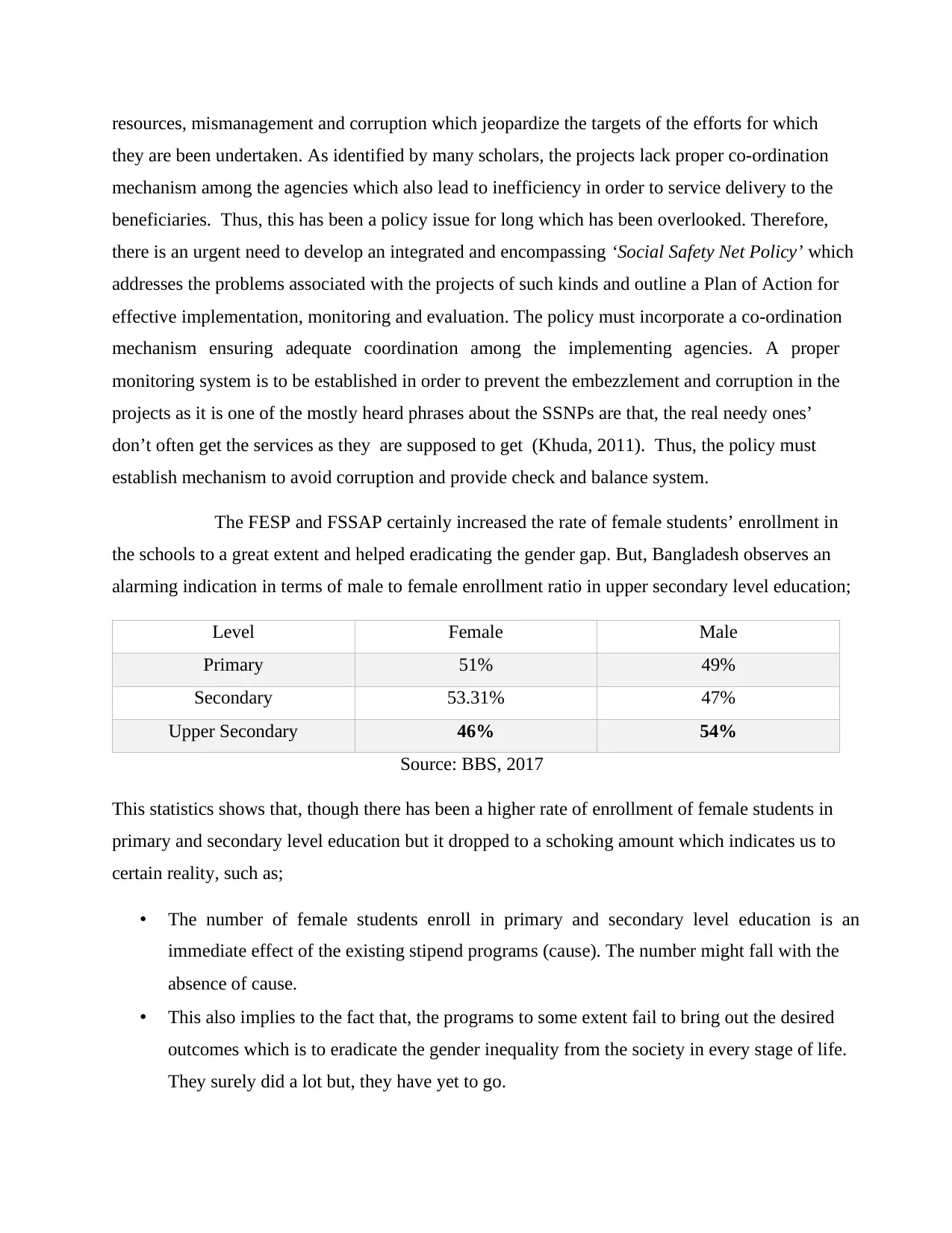
The FESP and FSSAP certainly increased the rate of female students’ enrollment in
the schools to a great extent and helped eradicating the gender gap. But, Bangladesh observes an
alarming indication in terms of male to female enrollment ratio in upper secondary level education;
Level Female Male
Primary 51% 49%
Secondary 53.31% 47%
Upper Secondary 46% 54%
Source: BBS, 2017
This statistics shows that, though there has been a higher rate of enrollment of female students in
primary and secondary level education but it dropped to a schoking amount which indicates us to
certain reality, such as;
The number of female students enroll in primary and secondary level education is an
immediate effect of the existing stipend programs (cause). The number might fall with the
absence of cause.
This also implies to the fact that, the programs to some extent fail to bring out the desired
outcomes which is to eradicate the gender inequality from the society in every stage of life.
They surely did a lot but, they have yet to go.
tabler-icon-diamond-filled.svg

Paraphrase This Document

Need a fresh take? Get an instant paraphrase of this document with our AI Paraphraser
Document Page
The absence of mechanism to bring out female students from the secondary level to upper
secondary level could also be the reason for the case. Because, there are a number of factors
associated with upper secondary education such as, movement from place to place, living
by one’s own etc. which are considered tougher for girls.
The Education policy, 2011 does not recognize such kind of problems which are meant to be
addressed. There should be a comprehensive plan for mainstreaming the female education in our
country sustainably. Therefore, a revision in the education policy or, a dedicated policy for female
education must be in place to coherently guide the course of action of government regarding the
issue and bring the best results out of the programs taken. The concern for moral and ethical
education should not be overlooked. By the time going, we are getting financially empowered,
economically sound but morally, culturally and ethically drained. The Education policy, thus,
should concentrate one empowering ethical education in order bring social coherence, the sense of
respect for each other regardless of one’s religion, caste, class income etc.
Conclusion
Bangladesh needs to establish an over encompassing Social Safety Net Policy to run its programs
and projects with high efficiency which in turn need to sustain high-level political commitment.
Otherwise, they might feel to grasp the targeted outcome which they are established for.
References
BBS, 2017. Education Scenario in Bangladesh: Gender perspective, Dhaka: Bangladesh Bureau of
Statistics.
Khuda, B. e., 2011. Social Safety Net Programmes in Bangladesh: A Review. Bangladesh Development
Studies, XXXIV(02), pp. 87-108.
chevron_up_icon
1 out of 5
circle_padding
hide_on_mobile
zoom_out_icon
[object Object]