Sovereignty, Liberal Institutionalism, Realism and IPE Analysis
VerifiedAdded on 2022/11/03
|6
|1203
|384
Homework Assignment
AI Summary
This homework assignment provides a detailed Q&A on several core concepts in political science. It begins by defining sovereignty and its significance, emphasizing the state's supreme authority and its role in international relations. The assignment then explores liberal institutionalism, highlighting its role in promoting international cooperation through institutions like the IMF and WTO. Realism is discussed next, contrasting it with romanticism and idealism and focusing on the power struggles in international politics. The assignment also covers nation effectiveness, the causes of war, and international political economy (IPE), emphasizing how economic and political factors intertwine. The definitions of states and human rights are also included, providing a comprehensive overview of essential political science concepts. The assignment is well-researched, citing relevant academic sources to support its arguments.
Running Head: Q&A 0
Questions and Answers
Student Name:
Student University:
Questions and Answers
Student Name:
Student University:
Paraphrase This Document
Need a fresh take? Get an instant paraphrase of this document with our AI Paraphraser

Q&A 1
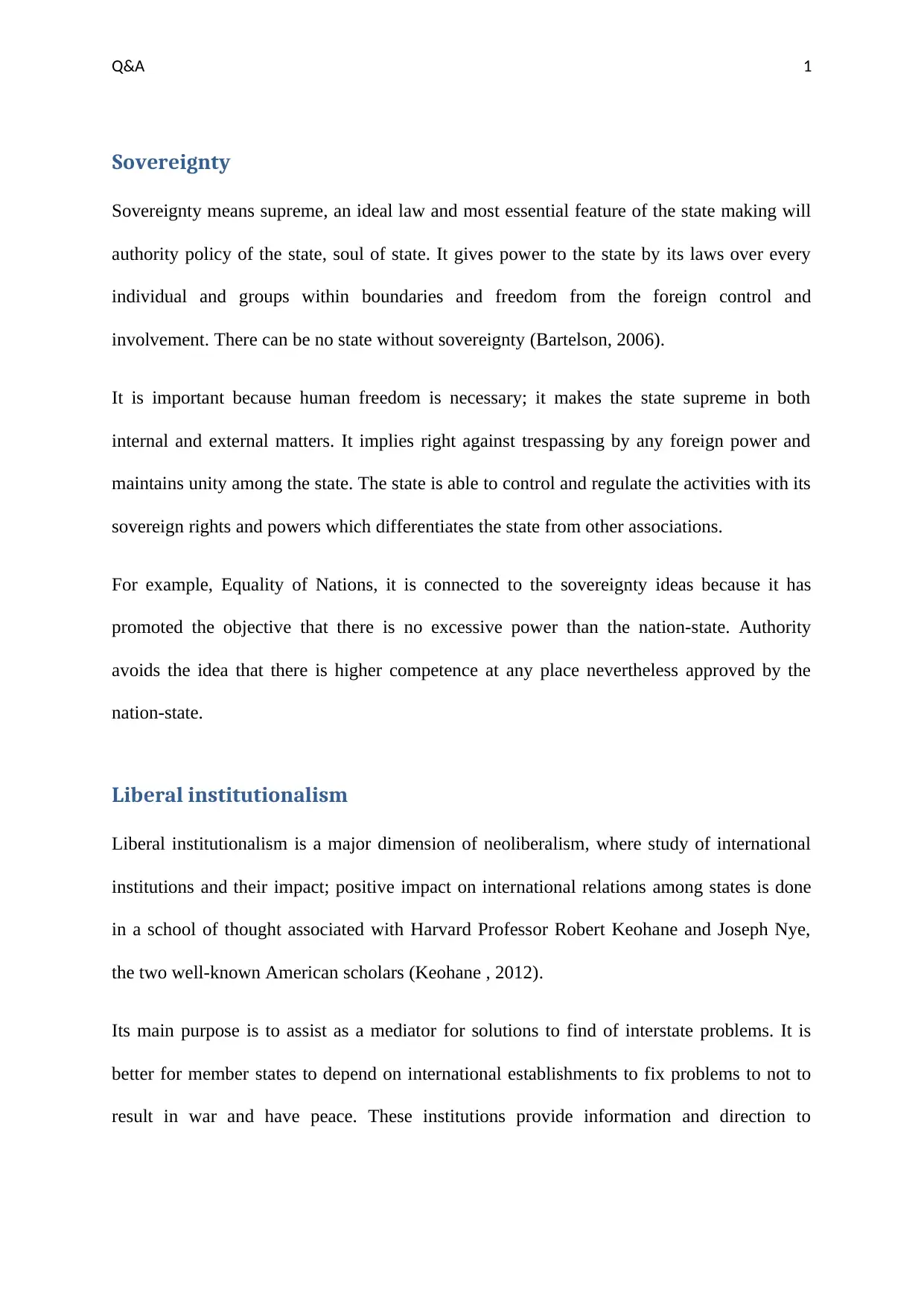
Sovereignty
Sovereignty means supreme, an ideal law and most essential feature of the state making will
authority policy of the state, soul of state. It gives power to the state by its laws over every
individual and groups within boundaries and freedom from the foreign control and
involvement. There can be no state without sovereignty (Bartelson, 2006).
It is important because human freedom is necessary; it makes the state supreme in both
internal and external matters. It implies right against trespassing by any foreign power and
maintains unity among the state. The state is able to control and regulate the activities with its
sovereign rights and powers which differentiates the state from other associations.
For example, Equality of Nations, it is connected to the sovereignty ideas because it has
promoted the objective that there is no excessive power than the nation-state. Authority
avoids the idea that there is higher competence at any place nevertheless approved by the
nation-state.
Liberal institutionalism
Liberal institutionalism is a major dimension of neoliberalism, where study of international
institutions and their impact; positive impact on international relations among states is done
in a school of thought associated with Harvard Professor Robert Keohane and Joseph Nye,
the two well-known American scholars (Keohane , 2012).
Its main purpose is to assist as a mediator for solutions to find of interstate problems. It is
better for member states to depend on international establishments to fix problems to not to
result in war and have peace. These institutions provide information and direction to
Sovereignty
Sovereignty means supreme, an ideal law and most essential feature of the state making will
authority policy of the state, soul of state. It gives power to the state by its laws over every
individual and groups within boundaries and freedom from the foreign control and
involvement. There can be no state without sovereignty (Bartelson, 2006).
It is important because human freedom is necessary; it makes the state supreme in both
internal and external matters. It implies right against trespassing by any foreign power and
maintains unity among the state. The state is able to control and regulate the activities with its
sovereign rights and powers which differentiates the state from other associations.
For example, Equality of Nations, it is connected to the sovereignty ideas because it has
promoted the objective that there is no excessive power than the nation-state. Authority
avoids the idea that there is higher competence at any place nevertheless approved by the
nation-state.
Liberal institutionalism
Liberal institutionalism is a major dimension of neoliberalism, where study of international
institutions and their impact; positive impact on international relations among states is done
in a school of thought associated with Harvard Professor Robert Keohane and Joseph Nye,
the two well-known American scholars (Keohane , 2012).
Its main purpose is to assist as a mediator for solutions to find of interstate problems. It is
better for member states to depend on international establishments to fix problems to not to
result in war and have peace. These institutions provide information and direction to

Q&A 2
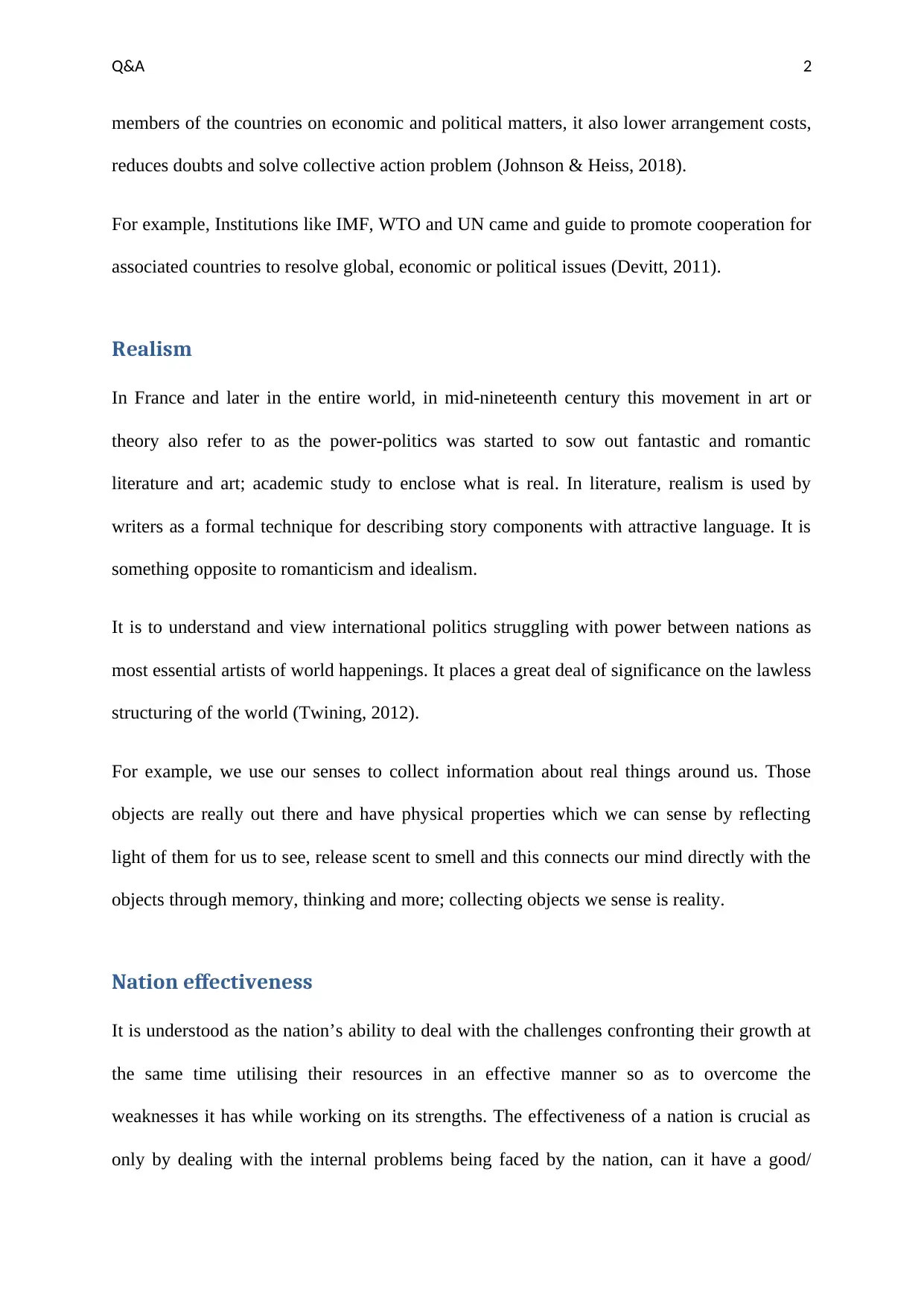
members of the countries on economic and political matters, it also lower arrangement costs,
reduces doubts and solve collective action problem (Johnson & Heiss, 2018).
For example, Institutions like IMF, WTO and UN came and guide to promote cooperation for
associated countries to resolve global, economic or political issues (Devitt, 2011).
Realism
In France and later in the entire world, in mid-nineteenth century this movement in art or
theory also refer to as the power-politics was started to sow out fantastic and romantic
literature and art; academic study to enclose what is real. In literature, realism is used by
writers as a formal technique for describing story components with attractive language. It is
something opposite to romanticism and idealism.
It is to understand and view international politics struggling with power between nations as
most essential artists of world happenings. It places a great deal of significance on the lawless
structuring of the world (Twining, 2012).
For example, we use our senses to collect information about real things around us. Those
objects are really out there and have physical properties which we can sense by reflecting
light of them for us to see, release scent to smell and this connects our mind directly with the
objects through memory, thinking and more; collecting objects we sense is reality.
Nation effectiveness
It is understood as the nation’s ability to deal with the challenges confronting their growth at
the same time utilising their resources in an effective manner so as to overcome the
weaknesses it has while working on its strengths. The effectiveness of a nation is crucial as
only by dealing with the internal problems being faced by the nation, can it have a good/
members of the countries on economic and political matters, it also lower arrangement costs,
reduces doubts and solve collective action problem (Johnson & Heiss, 2018).
For example, Institutions like IMF, WTO and UN came and guide to promote cooperation for
associated countries to resolve global, economic or political issues (Devitt, 2011).
Realism
In France and later in the entire world, in mid-nineteenth century this movement in art or
theory also refer to as the power-politics was started to sow out fantastic and romantic
literature and art; academic study to enclose what is real. In literature, realism is used by
writers as a formal technique for describing story components with attractive language. It is
something opposite to romanticism and idealism.
It is to understand and view international politics struggling with power between nations as
most essential artists of world happenings. It places a great deal of significance on the lawless
structuring of the world (Twining, 2012).
For example, we use our senses to collect information about real things around us. Those
objects are really out there and have physical properties which we can sense by reflecting
light of them for us to see, release scent to smell and this connects our mind directly with the
objects through memory, thinking and more; collecting objects we sense is reality.
Nation effectiveness
It is understood as the nation’s ability to deal with the challenges confronting their growth at
the same time utilising their resources in an effective manner so as to overcome the
weaknesses it has while working on its strengths. The effectiveness of a nation is crucial as
only by dealing with the internal problems being faced by the nation, can it have a good/
⊘ This is a preview!⊘
Do you want full access?
Subscribe today to unlock all pages.

Trusted by 1+ million students worldwide

Q&A 3
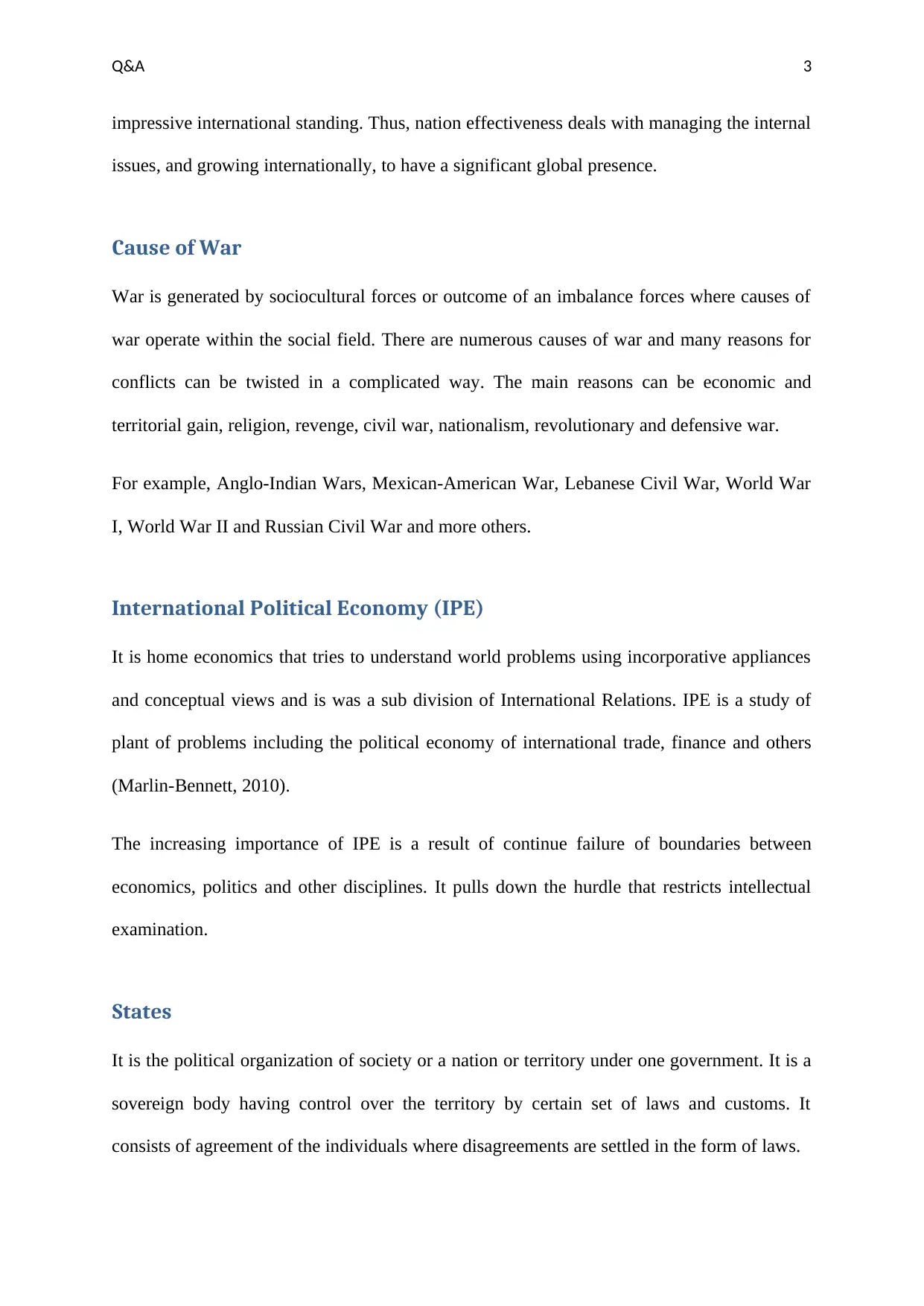
impressive international standing. Thus, nation effectiveness deals with managing the internal
issues, and growing internationally, to have a significant global presence.
Cause of War
War is generated by sociocultural forces or outcome of an imbalance forces where causes of
war operate within the social field. There are numerous causes of war and many reasons for
conflicts can be twisted in a complicated way. The main reasons can be economic and
territorial gain, religion, revenge, civil war, nationalism, revolutionary and defensive war.
For example, Anglo-Indian Wars, Mexican-American War, Lebanese Civil War, World War
I, World War II and Russian Civil War and more others.
International Political Economy (IPE)
It is home economics that tries to understand world problems using incorporative appliances
and conceptual views and is was a sub division of International Relations. IPE is a study of
plant of problems including the political economy of international trade, finance and others
(Marlin-Bennett, 2010).
The increasing importance of IPE is a result of continue failure of boundaries between
economics, politics and other disciplines. It pulls down the hurdle that restricts intellectual
examination.
States
It is the political organization of society or a nation or territory under one government. It is a
sovereign body having control over the territory by certain set of laws and customs. It
consists of agreement of the individuals where disagreements are settled in the form of laws.
impressive international standing. Thus, nation effectiveness deals with managing the internal
issues, and growing internationally, to have a significant global presence.
Cause of War
War is generated by sociocultural forces or outcome of an imbalance forces where causes of
war operate within the social field. There are numerous causes of war and many reasons for
conflicts can be twisted in a complicated way. The main reasons can be economic and
territorial gain, religion, revenge, civil war, nationalism, revolutionary and defensive war.
For example, Anglo-Indian Wars, Mexican-American War, Lebanese Civil War, World War
I, World War II and Russian Civil War and more others.
International Political Economy (IPE)
It is home economics that tries to understand world problems using incorporative appliances
and conceptual views and is was a sub division of International Relations. IPE is a study of
plant of problems including the political economy of international trade, finance and others
(Marlin-Bennett, 2010).
The increasing importance of IPE is a result of continue failure of boundaries between
economics, politics and other disciplines. It pulls down the hurdle that restricts intellectual
examination.
States
It is the political organization of society or a nation or territory under one government. It is a
sovereign body having control over the territory by certain set of laws and customs. It
consists of agreement of the individuals where disagreements are settled in the form of laws.
Paraphrase This Document
Need a fresh take? Get an instant paraphrase of this document with our AI Paraphraser

Q&A 4
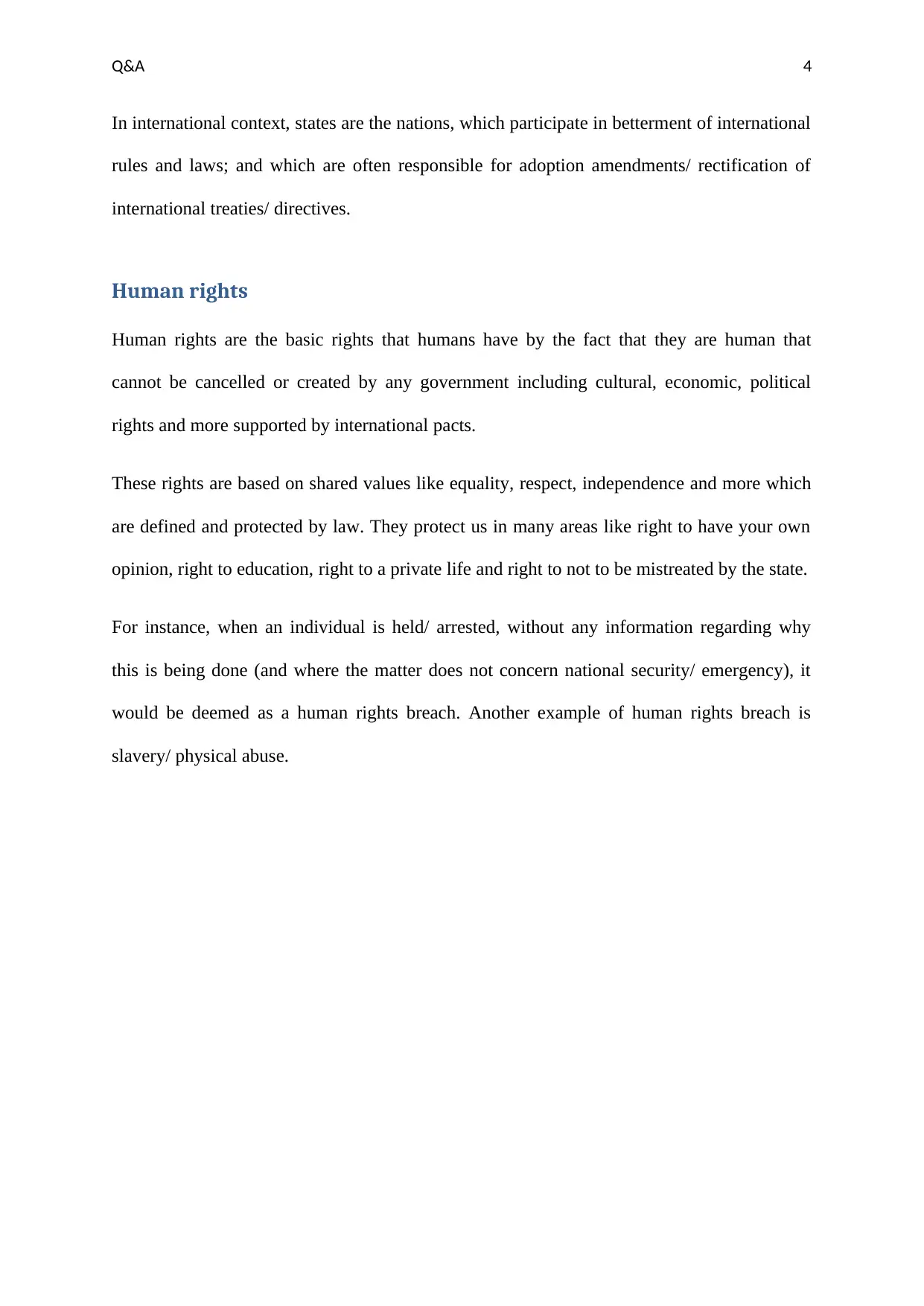
In international context, states are the nations, which participate in betterment of international
rules and laws; and which are often responsible for adoption amendments/ rectification of
international treaties/ directives.
Human rights
Human rights are the basic rights that humans have by the fact that they are human that
cannot be cancelled or created by any government including cultural, economic, political
rights and more supported by international pacts.
These rights are based on shared values like equality, respect, independence and more which
are defined and protected by law. They protect us in many areas like right to have your own
opinion, right to education, right to a private life and right to not to be mistreated by the state.
For instance, when an individual is held/ arrested, without any information regarding why
this is being done (and where the matter does not concern national security/ emergency), it
would be deemed as a human rights breach. Another example of human rights breach is
slavery/ physical abuse.
In international context, states are the nations, which participate in betterment of international
rules and laws; and which are often responsible for adoption amendments/ rectification of
international treaties/ directives.
Human rights
Human rights are the basic rights that humans have by the fact that they are human that
cannot be cancelled or created by any government including cultural, economic, political
rights and more supported by international pacts.
These rights are based on shared values like equality, respect, independence and more which
are defined and protected by law. They protect us in many areas like right to have your own
opinion, right to education, right to a private life and right to not to be mistreated by the state.
For instance, when an individual is held/ arrested, without any information regarding why
this is being done (and where the matter does not concern national security/ emergency), it
would be deemed as a human rights breach. Another example of human rights breach is
slavery/ physical abuse.

Q&A 5
Bibliography
Bartelson, J., 2006. The Concept of Sovereignty. The European Journal of International Law,
17(2), pp. 463-474.
Devitt, R., 2011. Liberal Institutionalism: An Alternative IR Theory or Just Maintaining the
Status Quo?. [Online]
Available at: https://www.e-ir.info/2011/09/01/liberal-institutionalism-an-alternative-ir-
theory-or-just-maintaining-the-status-quo/
Johnson, T. & Heiss, A., 2018. Liberal institutionalism. London: Routledge.
Keohane , R. O., 2012. Twenty Years of Institutional. International Relations, 26(2), pp. 125-
138.
Marlin-Bennett, R., 2010. International Political Economy: Overview and Conceptualization.
USA: Oxford University Press.
Twining, W., 2012. The Significance of Realism. In Karl Llewellyn and the Realist
Movement. London: Cambridge University Press.
Bibliography
Bartelson, J., 2006. The Concept of Sovereignty. The European Journal of International Law,
17(2), pp. 463-474.
Devitt, R., 2011. Liberal Institutionalism: An Alternative IR Theory or Just Maintaining the
Status Quo?. [Online]
Available at: https://www.e-ir.info/2011/09/01/liberal-institutionalism-an-alternative-ir-
theory-or-just-maintaining-the-status-quo/
Johnson, T. & Heiss, A., 2018. Liberal institutionalism. London: Routledge.
Keohane , R. O., 2012. Twenty Years of Institutional. International Relations, 26(2), pp. 125-
138.
Marlin-Bennett, R., 2010. International Political Economy: Overview and Conceptualization.
USA: Oxford University Press.
Twining, W., 2012. The Significance of Realism. In Karl Llewellyn and the Realist
Movement. London: Cambridge University Press.
⊘ This is a preview!⊘
Do you want full access?
Subscribe today to unlock all pages.

Trusted by 1+ million students worldwide
1 out of 6
Related Documents
Your All-in-One AI-Powered Toolkit for Academic Success.
+13062052269
info@desklib.com
Available 24*7 on WhatsApp / Email
Unlock your academic potential
Copyright © 2020–2025 A2Z Services. All Rights Reserved. Developed and managed by ZUCOL.