Evaluating Political Economic Factors Impacting FDI in Bangladesh
VerifiedAdded on 2023/06/15
|9
|2399
|466
Essay
AI Summary
This essay provides a comprehensive analysis of the socio-economic and political factors influencing Foreign Direct Investment (FDI) in Bangladesh. It examines government stability, socio-economic conditions, laws and regulations, internal and external conflicts, corruption, religious tensions, and bureaucratic quality, highlighting their impact on attracting foreign investors. The report identifies external conflicts, corruption, and religious tension as significant risk factors. It also suggests that while violent street agitations have decreased, poverty, corruption, and bureaucratic inefficiencies continue to hinder FDI. The essay concludes that backward FDI, particularly in sectors with abundant raw materials like pharmaceuticals, could be a viable strategy for foreign companies seeking to invest in Bangladesh, despite the existing challenges. The risk rating table summarizes the effects of each factor on foreign direct investment.
1fo
FOREIGN DIRECT INVESTMENT IN BANGLADESH
ASSIGNMENT/ASSESSMENT ITEM COVER SHEET
StudentName:
FIRST NAME FAMILY / LASTNAME
StudentNumber: Email:
CourseCode CourseTitle
G S B S
(Example) (Example)
A B C D 1 2 3 4
Intro to University
CampusofStudy: (egCallaghan,Ourimbah,PortMacquarie)
AssessmentItemTitle:Individual Reflection Essay DueDate/Time:
TutorialGroup(Ifapplicable): WordCount(Ifapplicable):
Lecturer/TutorName ExtensionGranted:
Yes No GrantedUntil:
Pleaseattachacopy ofyourextensionapproval
NB:STUDENTSMAY EXPECT THAT THISASSIGNMENT WILL BE RETURNED WITHIN 3 WEEKSOF THE
DUEDATEOFSUBMISSION
FOREIGN DIRECT INVESTMENT IN BANGLADESH
ASSIGNMENT/ASSESSMENT ITEM COVER SHEET
StudentName:
FIRST NAME FAMILY / LASTNAME
StudentNumber: Email:
CourseCode CourseTitle
G S B S
(Example) (Example)
A B C D 1 2 3 4
Intro to University
CampusofStudy: (egCallaghan,Ourimbah,PortMacquarie)
AssessmentItemTitle:Individual Reflection Essay DueDate/Time:
TutorialGroup(Ifapplicable): WordCount(Ifapplicable):
Lecturer/TutorName ExtensionGranted:
Yes No GrantedUntil:
Pleaseattachacopy ofyourextensionapproval
NB:STUDENTSMAY EXPECT THAT THISASSIGNMENT WILL BE RETURNED WITHIN 3 WEEKSOF THE
DUEDATEOFSUBMISSION

Paraphrase This Document
Need a fresh take? Get an instant paraphrase of this document with our AI Paraphraser
2fo
Pleasetickboxif applicable
Students withintheFaculty of Business andLaw, Faculty ofScience, Facultyof EngineeringandBuilt EnvironmentandtheSchoolofNursingandMidwifery:
Iverifythat IhavecompletedtheonlineAcademicIntegrityModuleandadhered to its principles
Students withintheSchoolof Education:
"Iunderstandthataminimum standardof correct referencingandacademic literacy isrequiredto pass allwrittenassignments intheSchoolof Education;andI havere
FOREIGN DIRECT INVESTMENT IN BANGLADESH
Ideclarethat thisassessment itemismyownworkunless otherwiseacknowledgedand isin accordancewiththeUniversity’sStudent
Academic Integrity Policy (http://www.newcastle.edu.au/about-uon/governance-and-leadership/policy-library/
document?RecordNumber=D09/1899P)
I certifythat this assessment item hasnot beensubmittedpreviouslyforacademic credit inthisoranyothercourse.
IcertifythatIhavenotgiven acopy orhave shown a copy of thisassessment item to anotherstudentenrolledinthecourse.
Iacknowledgethat theassessorofthisassignment may, forthepurposeof assessingthis assignment:
Reproducethisassessment itemandprovide a copyto anothermemberoftheFaculty; and/or
Communicate acopy of thisassessmentitemto aplagiarismcheckingservice(whichmaythenretain acopy
oftheitemonitsdatabaseforthepurposeoffutureplagiarismchecking).
Submit theassessment item to otherformsof plagiarismchecking.
DATE
STAM
PHER
E
I certifythat any electronicversionof thisassessmentitem that I havesubmittedorwill submitis identical tothispaperversion.
TurnitinID:
(ifapplicab
Signature: Date:
Pleasetickboxif applicable
Students withintheFaculty of Business andLaw, Faculty ofScience, Facultyof EngineeringandBuilt EnvironmentandtheSchoolofNursingandMidwifery:
Iverifythat IhavecompletedtheonlineAcademicIntegrityModuleandadhered to its principles
Students withintheSchoolof Education:
"Iunderstandthataminimum standardof correct referencingandacademic literacy isrequiredto pass allwrittenassignments intheSchoolof Education;andI havere
FOREIGN DIRECT INVESTMENT IN BANGLADESH
Ideclarethat thisassessment itemismyownworkunless otherwiseacknowledgedand isin accordancewiththeUniversity’sStudent
Academic Integrity Policy (http://www.newcastle.edu.au/about-uon/governance-and-leadership/policy-library/
document?RecordNumber=D09/1899P)
I certifythat this assessment item hasnot beensubmittedpreviouslyforacademic credit inthisoranyothercourse.
IcertifythatIhavenotgiven acopy orhave shown a copy of thisassessment item to anotherstudentenrolledinthecourse.
Iacknowledgethat theassessorofthisassignment may, forthepurposeof assessingthis assignment:
Reproducethisassessment itemandprovide a copyto anothermemberoftheFaculty; and/or
Communicate acopy of thisassessmentitemto aplagiarismcheckingservice(whichmaythenretain acopy
oftheitemonitsdatabaseforthepurposeoffutureplagiarismchecking).
Submit theassessment item to otherformsof plagiarismchecking.
DATE
STAM
PHER
E
I certifythat any electronicversionof thisassessmentitem that I havesubmittedorwill submitis identical tothispaperversion.
TurnitinID:
(ifapplicab
Signature: Date:
FOREIGN DIRECT INVESTMENT IN BANGLADESH 0
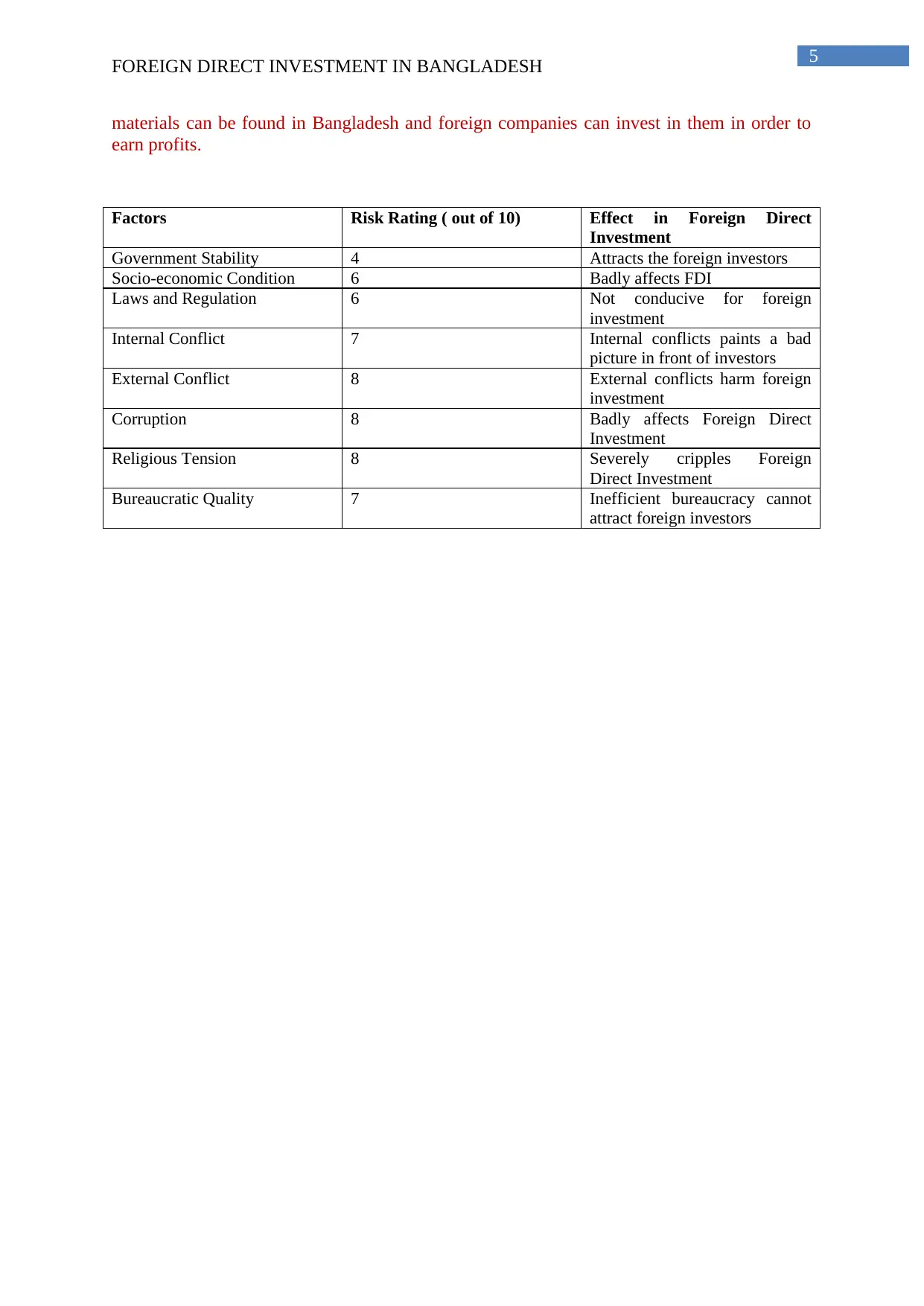
Executive Summary
The primary purpose of this report is to talk about the socio-economic conditions of
Bangladesh and how it affects the foreign direct investment of the country. The report
discusses in length about government stability, socio-economic condition, laws, internal
conflict, external conflict, corruption, religious tension and that of bureaucratic quality of
Bangladesh. The report highlights that external conflicts, corruption and religious tension
prove to be the greatest risk factors in relation to Bangladesh.
Executive Summary
The primary purpose of this report is to talk about the socio-economic conditions of
Bangladesh and how it affects the foreign direct investment of the country. The report
discusses in length about government stability, socio-economic condition, laws, internal
conflict, external conflict, corruption, religious tension and that of bureaucratic quality of
Bangladesh. The report highlights that external conflicts, corruption and religious tension
prove to be the greatest risk factors in relation to Bangladesh.
⊘ This is a preview!⊘
Do you want full access?
Subscribe today to unlock all pages.

Trusted by 1+ million students worldwide
fo1
FOREIGN DIRECT INVESTMENT IN BANGLADESH
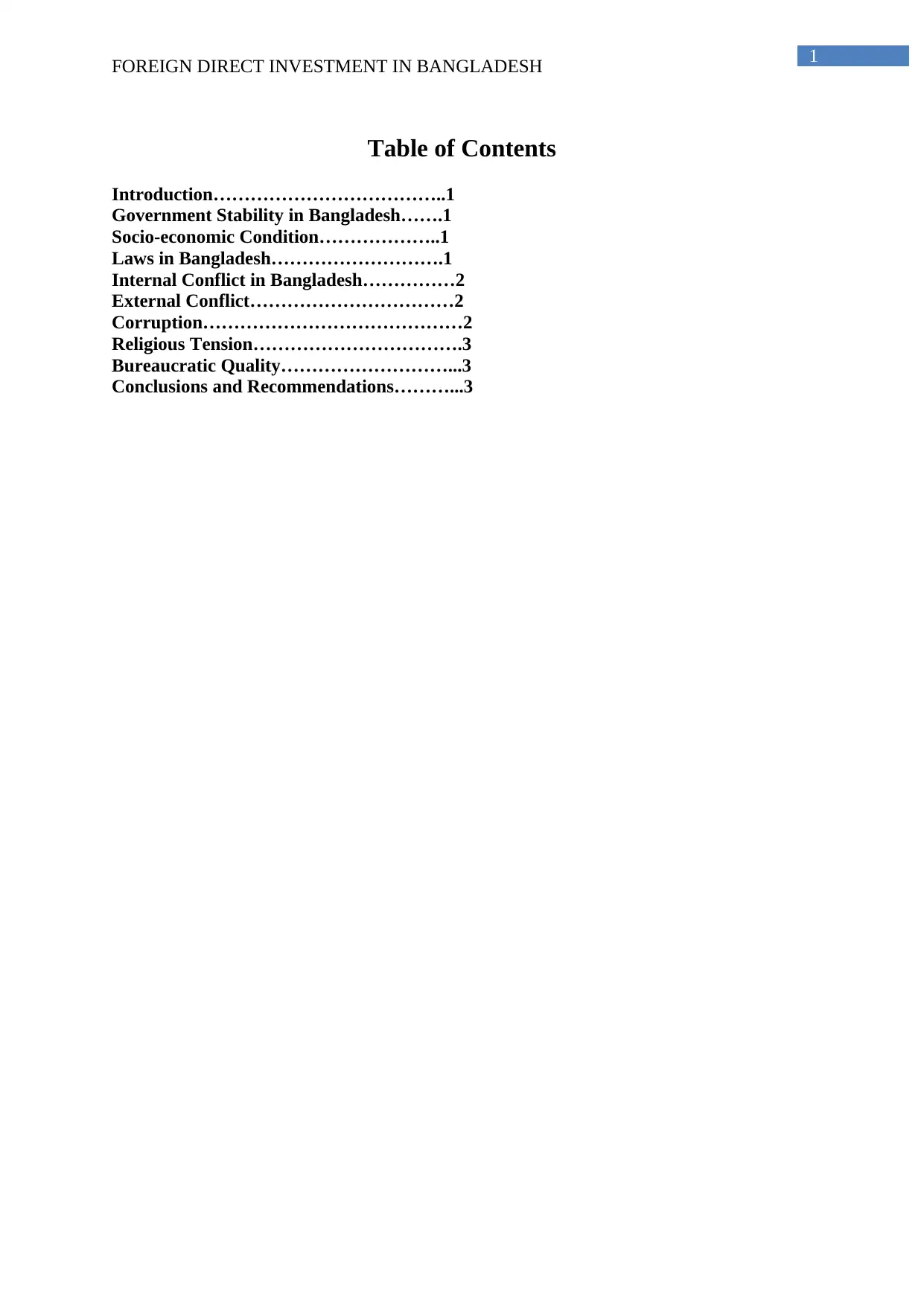
Table of Contents
Introduction………………………………..1
Government Stability in Bangladesh…….1
Socio-economic Condition………………..1
Laws in Bangladesh……………………….1
Internal Conflict in Bangladesh……………2
External Conflict……………………………2
Corruption……………………………………2
Religious Tension…………………………….3
Bureaucratic Quality………………………...3
Conclusions and Recommendations………...3
FOREIGN DIRECT INVESTMENT IN BANGLADESH
Table of Contents
Introduction………………………………..1
Government Stability in Bangladesh…….1
Socio-economic Condition………………..1
Laws in Bangladesh……………………….1
Internal Conflict in Bangladesh……………2
External Conflict……………………………2
Corruption……………………………………2
Religious Tension…………………………….3
Bureaucratic Quality………………………...3
Conclusions and Recommendations………...3
Paraphrase This Document
Need a fresh take? Get an instant paraphrase of this document with our AI Paraphraser
fo2
FOREIGN DIRECT INVESTMENT IN BANGLADESH
Introduction
Foreign Direct Investment refers to investment that is made by company for the
business interest in another country. It can be done either by establishing business operations
or by acquiring the assets in relation to that of the business. Primary feature of Foreign Direct
Investment is that the investments are made that can help in establishing effective control or
by having influence over the process of decision making of a business. Globalization has led
to an increase in the volume of trade and FDI in between different countries
(Bandyopadhyay, Sandler & Younas, 2013). Economic factors play a huge role in the process
of decision making as the economic actors want return of their investment. The political
factors are also crucial as the country that has a high political unrest faces uncertainty and
becomes less prone for that of investment (Castro & Nunes, 2013). Government stability,
socio-economic condition, laws and regulations, religious tension, external conflict,
bureaucratic quality, corruption and internal tensions are the different political economic
factors that can have an influence on the aspect of foreign direct investment. This report
analyses how the political economic factors of Bangladesh have an effect on that of the
foreign direct investment.
Government stability in Bangladesh
The tenth parliamentary election was responsible for changing the scenario in relation
to foreign investment. The Bangladesh Awami League was responsible for winning ten
parliamentary election in which 153 members were elected in an uncontested manner. The
country witnessed agitation on the streets in between the year 2013 and that of 2015
(Rahman, 2015). Macroeconomic stability is a major cause of strength of the Bangladesh
economy. The economy of Bangladesh has shown many promising aspects. Bangladesh has
been able to increase the growth by that of 1 % in each decade from 2013 to 2015 (Sarker et
al., 2017). The per capita income has increased that helps in drawing foreign direct
investment to a great extent.
Socio-economic Condition
The rate of unemployment within Bangladesh remained unchanged from that of 4.10
percent in the year 2016 from that of 4.10 in the year 2015. The unemployment rate within
Bangladesh averaged that of 3.83 percent from the year 1991 till the year 2016. The
Household Income and Expenditure Survey conducted in the year 2016-17 pointed out that
around 1 of every 4 Bangladeshis are living in a state of abject poverty and it has been found
that 12.9 percent of people have to suffer on account of poverty (Bandyopadhyay, Sandler &
Younas, 2013). Poverty and unemployment prove to be major causes of hindrance that can
adversely affect foreign direct investment in Bangladesh. The government of Bangladesh
tends to limit resources in relation to building of new infrastructure and in order to maintain
existing infrastructure. Inefficient infrastructure undermines economic development of the
country. CIA World Fact book has highlighted that a meagre 10 % of the roads in Bangladesh
are paved that hinders in drawing foreign direct investment (Uddin, Ali & Masih, 2017). The
underdeveloped telecommunication services within Bangladesh do not bode well for that of
foreign direct investment.
Laws in Bangladesh
The tax service within Bangladesh suffers on account of low level of that of revenue
mobilisation, regressive nature of that of taxation, low tax base and that of high degree of that
of tax evasion. It has been found that the tax receipts can roughly generate four-fifth of that of
total revenue (Islam, 2015). The consumer price inflation within Bangladesh got eased to
5.83 percent on year-to-year basis in 2017 (December) from that of 5.91 percent of that of the
previous month. The inflation rate within Bangladesh averaged to 6.58 percent from the year
FOREIGN DIRECT INVESTMENT IN BANGLADESH
Introduction
Foreign Direct Investment refers to investment that is made by company for the
business interest in another country. It can be done either by establishing business operations
or by acquiring the assets in relation to that of the business. Primary feature of Foreign Direct
Investment is that the investments are made that can help in establishing effective control or
by having influence over the process of decision making of a business. Globalization has led
to an increase in the volume of trade and FDI in between different countries
(Bandyopadhyay, Sandler & Younas, 2013). Economic factors play a huge role in the process
of decision making as the economic actors want return of their investment. The political
factors are also crucial as the country that has a high political unrest faces uncertainty and
becomes less prone for that of investment (Castro & Nunes, 2013). Government stability,
socio-economic condition, laws and regulations, religious tension, external conflict,
bureaucratic quality, corruption and internal tensions are the different political economic
factors that can have an influence on the aspect of foreign direct investment. This report
analyses how the political economic factors of Bangladesh have an effect on that of the
foreign direct investment.
Government stability in Bangladesh
The tenth parliamentary election was responsible for changing the scenario in relation
to foreign investment. The Bangladesh Awami League was responsible for winning ten
parliamentary election in which 153 members were elected in an uncontested manner. The
country witnessed agitation on the streets in between the year 2013 and that of 2015
(Rahman, 2015). Macroeconomic stability is a major cause of strength of the Bangladesh
economy. The economy of Bangladesh has shown many promising aspects. Bangladesh has
been able to increase the growth by that of 1 % in each decade from 2013 to 2015 (Sarker et
al., 2017). The per capita income has increased that helps in drawing foreign direct
investment to a great extent.
Socio-economic Condition
The rate of unemployment within Bangladesh remained unchanged from that of 4.10
percent in the year 2016 from that of 4.10 in the year 2015. The unemployment rate within
Bangladesh averaged that of 3.83 percent from the year 1991 till the year 2016. The
Household Income and Expenditure Survey conducted in the year 2016-17 pointed out that
around 1 of every 4 Bangladeshis are living in a state of abject poverty and it has been found
that 12.9 percent of people have to suffer on account of poverty (Bandyopadhyay, Sandler &
Younas, 2013). Poverty and unemployment prove to be major causes of hindrance that can
adversely affect foreign direct investment in Bangladesh. The government of Bangladesh
tends to limit resources in relation to building of new infrastructure and in order to maintain
existing infrastructure. Inefficient infrastructure undermines economic development of the
country. CIA World Fact book has highlighted that a meagre 10 % of the roads in Bangladesh
are paved that hinders in drawing foreign direct investment (Uddin, Ali & Masih, 2017). The
underdeveloped telecommunication services within Bangladesh do not bode well for that of
foreign direct investment.
Laws in Bangladesh
The tax service within Bangladesh suffers on account of low level of that of revenue
mobilisation, regressive nature of that of taxation, low tax base and that of high degree of that
of tax evasion. It has been found that the tax receipts can roughly generate four-fifth of that of
total revenue (Islam, 2015). The consumer price inflation within Bangladesh got eased to
5.83 percent on year-to-year basis in 2017 (December) from that of 5.91 percent of that of the
previous month. The inflation rate within Bangladesh averaged to 6.58 percent from the year
fo3
FOREIGN DIRECT INVESTMENT IN BANGLADESH
1994 till the year 2017. Bangladesh is known for the restrictive trade regimes and it earns a
lot of revenue from that of excise taxes. Infrastructure development surcharge is levied on all
imports and the lengthy custom procedures prove to be deterrent in terms of attracting foreign
direct investment.
Internal Conflict in Bangladesh
Internal conflicts and unrest has taken a toll on the economy of Bangladesh. Public
life as well as the business activity is hampered to a great extent owing to the political strife
of the different parties within Bangladesh. This country was witness to political violence
when the leader of the main opposition, Khaleda Zia was confined to that of her office
(Rahman, 2015).The unrest continued even after the release of Khaleda Zia and frequent
strikes were rampant after this incident (Hayakawa, Kimura & Lee, 2013). These kind of
political conflict hamper the economic activity of the country to a great extent and prevents
the normal operation of a business. The frequent shutdowns taking place in Bangladesh takes
a toll on the economic activity and the industrial sectors face a lot of losses owing to the
inability of shipping goods. It bears a negative impact on that of foreign direct investment.
External Conflict
Government of Bangladesh brought into existence the Import Policy Order 2015-2018
and the new policy eased import in relation to raw materials so that they can be of use for that
of the export-oriented industries (Castro & Nunes, 2013). Bangladesh has been able to settle
the border disputes in a peaceful manner with India and improving the ties can help in the
aspect of foreign direct investment (Islam, 2015).
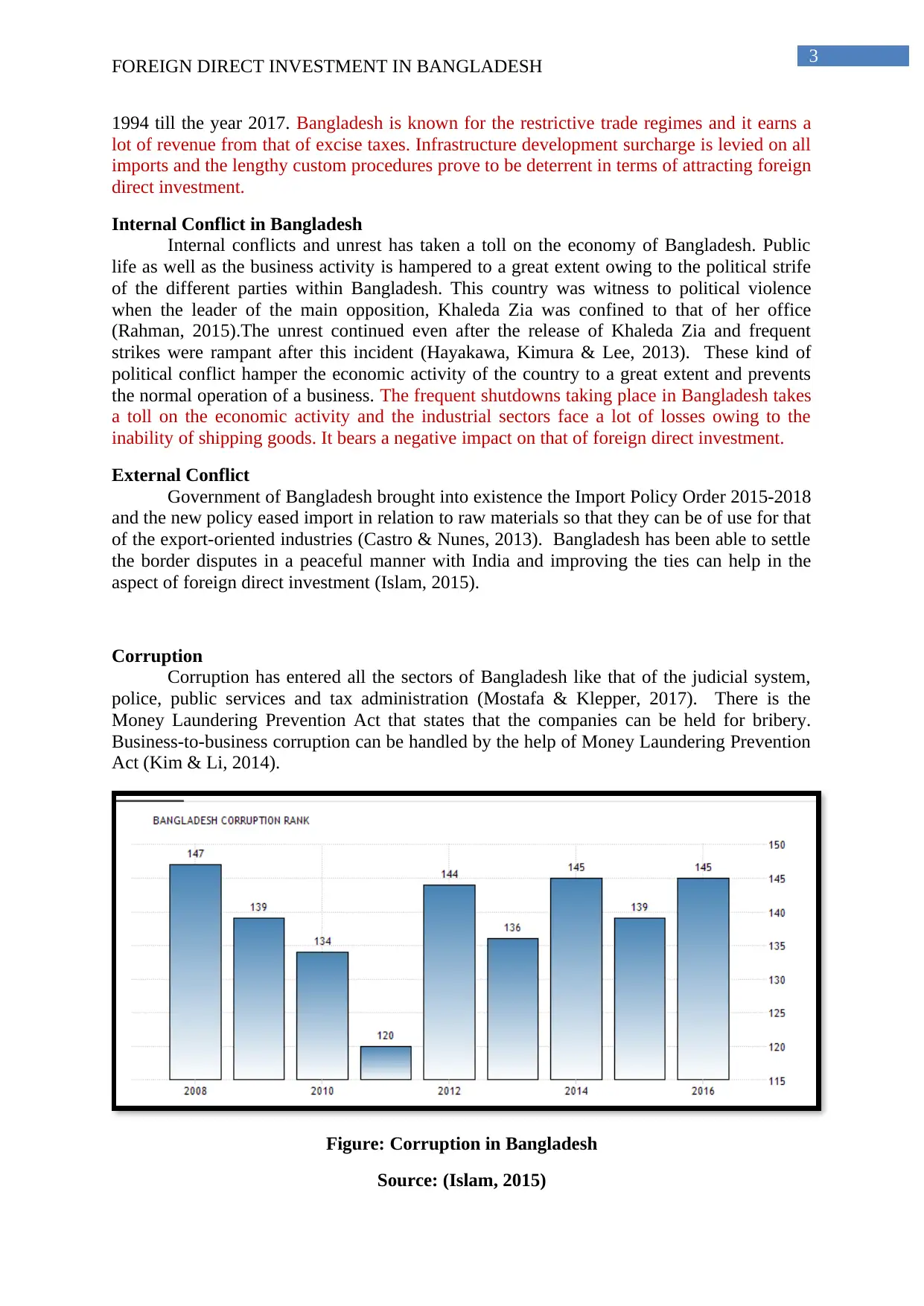
Corruption
Corruption has entered all the sectors of Bangladesh like that of the judicial system,
police, public services and tax administration (Mostafa & Klepper, 2017). There is the
Money Laundering Prevention Act that states that the companies can be held for bribery.
Business-to-business corruption can be handled by the help of Money Laundering Prevention
Act (Kim & Li, 2014).
Figure: Corruption in Bangladesh
Source: (Islam, 2015)
FOREIGN DIRECT INVESTMENT IN BANGLADESH
1994 till the year 2017. Bangladesh is known for the restrictive trade regimes and it earns a
lot of revenue from that of excise taxes. Infrastructure development surcharge is levied on all
imports and the lengthy custom procedures prove to be deterrent in terms of attracting foreign
direct investment.
Internal Conflict in Bangladesh
Internal conflicts and unrest has taken a toll on the economy of Bangladesh. Public
life as well as the business activity is hampered to a great extent owing to the political strife
of the different parties within Bangladesh. This country was witness to political violence
when the leader of the main opposition, Khaleda Zia was confined to that of her office
(Rahman, 2015).The unrest continued even after the release of Khaleda Zia and frequent
strikes were rampant after this incident (Hayakawa, Kimura & Lee, 2013). These kind of
political conflict hamper the economic activity of the country to a great extent and prevents
the normal operation of a business. The frequent shutdowns taking place in Bangladesh takes
a toll on the economic activity and the industrial sectors face a lot of losses owing to the
inability of shipping goods. It bears a negative impact on that of foreign direct investment.
External Conflict
Government of Bangladesh brought into existence the Import Policy Order 2015-2018
and the new policy eased import in relation to raw materials so that they can be of use for that
of the export-oriented industries (Castro & Nunes, 2013). Bangladesh has been able to settle
the border disputes in a peaceful manner with India and improving the ties can help in the
aspect of foreign direct investment (Islam, 2015).
Corruption
Corruption has entered all the sectors of Bangladesh like that of the judicial system,
police, public services and tax administration (Mostafa & Klepper, 2017). There is the
Money Laundering Prevention Act that states that the companies can be held for bribery.
Business-to-business corruption can be handled by the help of Money Laundering Prevention
Act (Kim & Li, 2014).
Figure: Corruption in Bangladesh
Source: (Islam, 2015)
⊘ This is a preview!⊘
Do you want full access?
Subscribe today to unlock all pages.
Trusted by 1+ million students worldwide
fo4
FOREIGN DIRECT INVESTMENT IN BANGLADESH
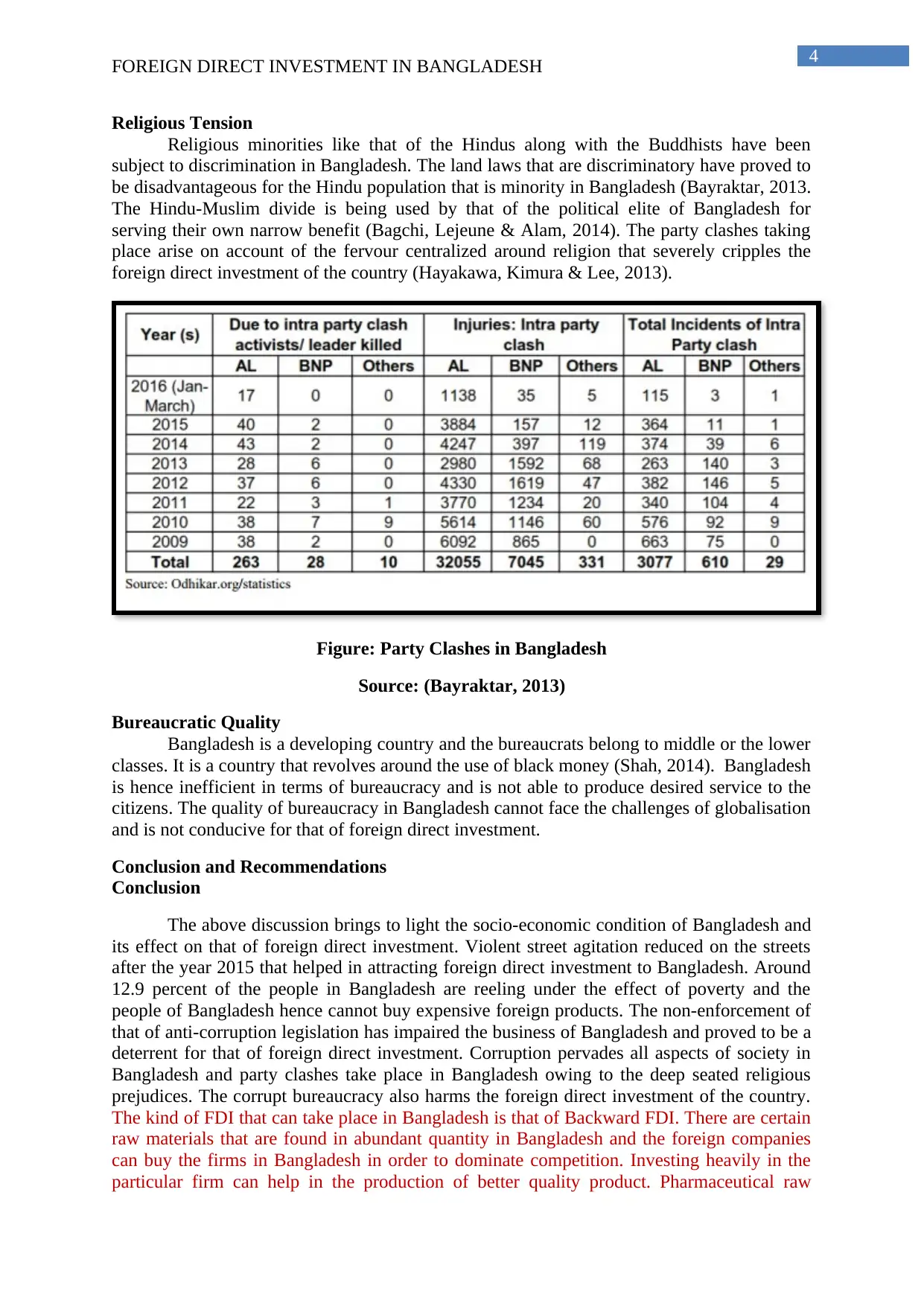
Religious Tension
Religious minorities like that of the Hindus along with the Buddhists have been
subject to discrimination in Bangladesh. The land laws that are discriminatory have proved to
be disadvantageous for the Hindu population that is minority in Bangladesh (Bayraktar, 2013.
The Hindu-Muslim divide is being used by that of the political elite of Bangladesh for
serving their own narrow benefit (Bagchi, Lejeune & Alam, 2014). The party clashes taking
place arise on account of the fervour centralized around religion that severely cripples the
foreign direct investment of the country (Hayakawa, Kimura & Lee, 2013).
Figure: Party Clashes in Bangladesh
Source: (Bayraktar, 2013)
Bureaucratic Quality
Bangladesh is a developing country and the bureaucrats belong to middle or the lower
classes. It is a country that revolves around the use of black money (Shah, 2014). Bangladesh
is hence inefficient in terms of bureaucracy and is not able to produce desired service to the
citizens. The quality of bureaucracy in Bangladesh cannot face the challenges of globalisation
and is not conducive for that of foreign direct investment.
Conclusion and Recommendations
Conclusion
The above discussion brings to light the socio-economic condition of Bangladesh and
its effect on that of foreign direct investment. Violent street agitation reduced on the streets
after the year 2015 that helped in attracting foreign direct investment to Bangladesh. Around
12.9 percent of the people in Bangladesh are reeling under the effect of poverty and the
people of Bangladesh hence cannot buy expensive foreign products. The non-enforcement of
that of anti-corruption legislation has impaired the business of Bangladesh and proved to be a
deterrent for that of foreign direct investment. Corruption pervades all aspects of society in
Bangladesh and party clashes take place in Bangladesh owing to the deep seated religious
prejudices. The corrupt bureaucracy also harms the foreign direct investment of the country.
The kind of FDI that can take place in Bangladesh is that of Backward FDI. There are certain
raw materials that are found in abundant quantity in Bangladesh and the foreign companies
can buy the firms in Bangladesh in order to dominate competition. Investing heavily in the
particular firm can help in the production of better quality product. Pharmaceutical raw
FOREIGN DIRECT INVESTMENT IN BANGLADESH
Religious Tension
Religious minorities like that of the Hindus along with the Buddhists have been
subject to discrimination in Bangladesh. The land laws that are discriminatory have proved to
be disadvantageous for the Hindu population that is minority in Bangladesh (Bayraktar, 2013.
The Hindu-Muslim divide is being used by that of the political elite of Bangladesh for
serving their own narrow benefit (Bagchi, Lejeune & Alam, 2014). The party clashes taking
place arise on account of the fervour centralized around religion that severely cripples the
foreign direct investment of the country (Hayakawa, Kimura & Lee, 2013).
Figure: Party Clashes in Bangladesh
Source: (Bayraktar, 2013)
Bureaucratic Quality
Bangladesh is a developing country and the bureaucrats belong to middle or the lower
classes. It is a country that revolves around the use of black money (Shah, 2014). Bangladesh
is hence inefficient in terms of bureaucracy and is not able to produce desired service to the
citizens. The quality of bureaucracy in Bangladesh cannot face the challenges of globalisation
and is not conducive for that of foreign direct investment.
Conclusion and Recommendations
Conclusion
The above discussion brings to light the socio-economic condition of Bangladesh and
its effect on that of foreign direct investment. Violent street agitation reduced on the streets
after the year 2015 that helped in attracting foreign direct investment to Bangladesh. Around
12.9 percent of the people in Bangladesh are reeling under the effect of poverty and the
people of Bangladesh hence cannot buy expensive foreign products. The non-enforcement of
that of anti-corruption legislation has impaired the business of Bangladesh and proved to be a
deterrent for that of foreign direct investment. Corruption pervades all aspects of society in
Bangladesh and party clashes take place in Bangladesh owing to the deep seated religious
prejudices. The corrupt bureaucracy also harms the foreign direct investment of the country.
The kind of FDI that can take place in Bangladesh is that of Backward FDI. There are certain
raw materials that are found in abundant quantity in Bangladesh and the foreign companies
can buy the firms in Bangladesh in order to dominate competition. Investing heavily in the
particular firm can help in the production of better quality product. Pharmaceutical raw
Paraphrase This Document
Need a fresh take? Get an instant paraphrase of this document with our AI Paraphraser
fo5
FOREIGN DIRECT INVESTMENT IN BANGLADESH
materials can be found in Bangladesh and foreign companies can invest in them in order to
earn profits.
Factors Risk Rating ( out of 10) Effect in Foreign Direct
Investment
Government Stability 4 Attracts the foreign investors
Socio-economic Condition 6 Badly affects FDI
Laws and Regulation 6 Not conducive for foreign
investment
Internal Conflict 7 Internal conflicts paints a bad
picture in front of investors
External Conflict 8 External conflicts harm foreign
investment
Corruption 8 Badly affects Foreign Direct
Investment
Religious Tension 8 Severely cripples Foreign
Direct Investment
Bureaucratic Quality 7 Inefficient bureaucracy cannot
attract foreign investors
FOREIGN DIRECT INVESTMENT IN BANGLADESH
materials can be found in Bangladesh and foreign companies can invest in them in order to
earn profits.
Factors Risk Rating ( out of 10) Effect in Foreign Direct
Investment
Government Stability 4 Attracts the foreign investors
Socio-economic Condition 6 Badly affects FDI
Laws and Regulation 6 Not conducive for foreign
investment
Internal Conflict 7 Internal conflicts paints a bad
picture in front of investors
External Conflict 8 External conflicts harm foreign
investment
Corruption 8 Badly affects Foreign Direct
Investment
Religious Tension 8 Severely cripples Foreign
Direct Investment
Bureaucratic Quality 7 Inefficient bureaucracy cannot
attract foreign investors
fo6
FOREIGN DIRECT INVESTMENT IN BANGLADESH
References:
Bagchi, P., Lejeune, M. A., & Alam, A. (2014). How supply competency affects FDI
decisions: some insights. International Journal of Production Economics, 147, 239-
251.
Bandyopadhyay, S., Sandler, T., & Younas, J. (2013). Foreign direct investment, aid, and
terrorism. Oxford Economic Papers, 66(1), 25-50.
Bayraktar, N. (2013). Foreign direct investment and investment climate. Procedia Economics
and Finance, 5, 83-92.
Castro, C., & Nunes, P. (2013). Does corruption inhibit foreign Direct investment?. Política:
Revista de Ciencia Política, 51, 61-83.
Hayakawa, K., Kimura, F., & Lee, H. H. (2013). How does country risk matter for foreign
direct investment?. The Developing Economies, 51(1), 60-78.
Islam, K. A. (2015). Foreign Direct Investment (FDI) in Bangladesh: Prospects and
Challenges and Its Impact on Economy. Asian Business Review, 4(1), 24-36.
Kim, P. H., & Li, M. (2014). Injecting demand through spillovers: Foreign direct investment,
domestic socio-political conditions, and host-country entrepreneurial activity. Journal
of Business Venturing, 29(2), 210-231.
Mostafa, R., & Klepper, S. (2017). Industrial development through tacit knowledge seeding:
evidence from the Bangladesh garment industry. Management Science.
Rahman, A. (2015). Impact of foreign direct investment on economic growth: Empirical
evidence from Bangladesh. International Journal of Economics and Finance, 7(2),
178.
Sarker, M. N. I., Bingxin, Y., Sultana, A., & Prodhan, A. Z. M. S. (2017). Problems and
challenges of public administration in Bangladesh: pathway to sustainable
development. International Journal of Public Administration and Policy
Research, 2(1), 008-015.
Shah, M. H. (2014). The significance of infrastructure for FDI inflow in developing
countries. Journal of Life Economics, 2(1), 1-16.
Uddin, M. A., Ali, M. H., & Masih, M. (2017). Political stability and growth: An application
of dynamic GMM and quantile regression. Economic Modelling, 64, 610-625.
FOREIGN DIRECT INVESTMENT IN BANGLADESH
References:
Bagchi, P., Lejeune, M. A., & Alam, A. (2014). How supply competency affects FDI
decisions: some insights. International Journal of Production Economics, 147, 239-
251.
Bandyopadhyay, S., Sandler, T., & Younas, J. (2013). Foreign direct investment, aid, and
terrorism. Oxford Economic Papers, 66(1), 25-50.
Bayraktar, N. (2013). Foreign direct investment and investment climate. Procedia Economics
and Finance, 5, 83-92.
Castro, C., & Nunes, P. (2013). Does corruption inhibit foreign Direct investment?. Política:
Revista de Ciencia Política, 51, 61-83.
Hayakawa, K., Kimura, F., & Lee, H. H. (2013). How does country risk matter for foreign
direct investment?. The Developing Economies, 51(1), 60-78.
Islam, K. A. (2015). Foreign Direct Investment (FDI) in Bangladesh: Prospects and
Challenges and Its Impact on Economy. Asian Business Review, 4(1), 24-36.
Kim, P. H., & Li, M. (2014). Injecting demand through spillovers: Foreign direct investment,
domestic socio-political conditions, and host-country entrepreneurial activity. Journal
of Business Venturing, 29(2), 210-231.
Mostafa, R., & Klepper, S. (2017). Industrial development through tacit knowledge seeding:
evidence from the Bangladesh garment industry. Management Science.
Rahman, A. (2015). Impact of foreign direct investment on economic growth: Empirical
evidence from Bangladesh. International Journal of Economics and Finance, 7(2),
178.
Sarker, M. N. I., Bingxin, Y., Sultana, A., & Prodhan, A. Z. M. S. (2017). Problems and
challenges of public administration in Bangladesh: pathway to sustainable
development. International Journal of Public Administration and Policy
Research, 2(1), 008-015.
Shah, M. H. (2014). The significance of infrastructure for FDI inflow in developing
countries. Journal of Life Economics, 2(1), 1-16.
Uddin, M. A., Ali, M. H., & Masih, M. (2017). Political stability and growth: An application
of dynamic GMM and quantile regression. Economic Modelling, 64, 610-625.
⊘ This is a preview!⊘
Do you want full access?
Subscribe today to unlock all pages.
Trusted by 1+ million students worldwide

1 out of 9


Related Documents


Your All-in-One AI-Powered Toolkit for Academic Success.
+13062052269
info@desklib.com
Available 24*7 on WhatsApp / Email
![[object Object]](/_next/static/media/star-bottom.7253800d.svg)
Unlock your academic potential
Copyright © 2020–2026 A2Z Services. All Rights Reserved. Developed and managed by ZUCOL.